Exposing the Big Game

Forget Hunters' Feeble Rationalizations and Trust Your Gut Feelings: Making Sport of Killing Is Not Healthy Human Behavior

Exposing the Big Game

Nine climate tipping points now ‘active,’ warn scientists

UNIVERSITY OF EXETER NEWS RELEASE 27-NOV-2019

 
Authors Timothy M. Lenton, Johan Rockström, Owen Gaffney, Stefan Rahmstorf, Katherine Richardson, Will Steffen & Hans Joachim Schellnhuber
 
 
Full press release

More than half of the climate tipping points identified a decade ago are now “active”, a group of leading scientists have warned.

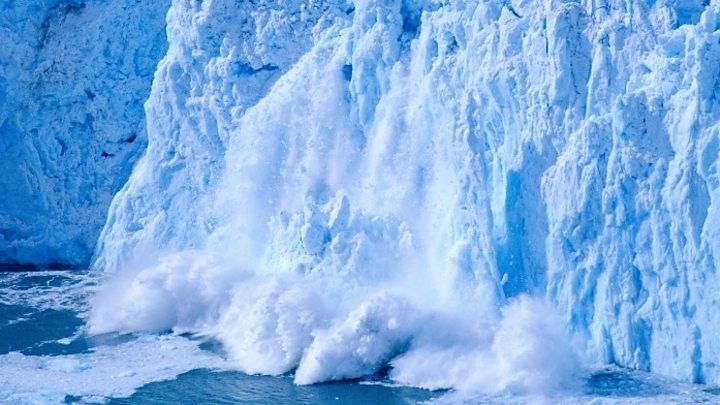
This threatens the loss of the Amazon rainforest and the great ice sheets of Antarctica and Greenland, which are currently undergoing measurable and unprecedented changes much earlier than expected.

This “cascade” of changes sparked by global warming could threaten the existence of human civilisations.

Evidence is mounting that these events are more likely and more interconnected than was previously thought, leading to a possible domino effect.

In an article in the journal Nature <<https://www.nature.com/magazine-assets/d41586-019-03595-0/d41586-019-03595-0.pdf>>, the scientists call for urgent action to reduce greenhouse gas emissions to prevent key tipping points, warning of a worst-case scenario of a “hothouse”, less habitable planet.

“A decade ago we identified a suite of potential tipping points in the Earth system, now we see evidence that over half of them have been activated,” said lead author Professor Tim Lenton, director of the Global Systems Institute at the University of Exeter.

“The growing threat of rapid, irreversible changes means it is no longer responsible to wait and see. The situation is urgent and we need an emergency response.”

Co-author Johan Rockström, director of the Potsdam Institute for Climate Impact Research, said: “It is not only human pressures on Earth that continue rising to unprecedented levels.

“It is also that as science advances, we must admit that we have underestimated the risks of unleashing irreversible changes, where the planet self-amplifies global warming.

“This is what we now start seeing, already at 1°C global warming.

“Scientifically, this provides strong evidence for declaring a state of planetary emergency, to unleash world action that accelerates the path towards a world that can continue evolving on a stable planet.”

In the commentary, the authors propose a formal way to calculate a planetary emergency as risk multiplied by urgency.

Tipping point risks are now much higher than earlier estimates, while urgency relates to how fast it takes to act to reduce risk.

Exiting the fossil fuel economy is unlikely before 2050, but with temperature already at 1.1°C above pre-industrial temperature, it is likely Earth will cross the 1.5°C guardrail by 2040. The authors conclude this alone defines an emergency.

Nine active tipping points:

  1. Arctic sea ice
  2. Greenland ice sheet
  3. Boreal forests
  4. Permafrost
  5. Atlantic Meridional Overturning Circulation
  6. Amazon rainforest
  7. Warm-water corals
  8. West Antarctic Ice Sheet
  9. Parts of East Antarctica

The collapse of major ice sheets on Greenland, West Antarctica and part of East Antarctica would commit the world to around 10 metres of irreversible sea-level rise.

Reducing emissions could slow this process, allowing more time for low-lying populations to move.

The rainforests, permafrost and boreal forests are examples of biosphere tipping points that if crossed result in the release of additional greenhouse gases amplifying warming.

Despite most countries having signed the Paris Agreement, pledging to keep global warming well below 2°C, current national emissions pledges – even if they are met – would lead to 3°C of warming.

Although future tipping points and the interplay between them is difficult to predict, the scientists argue: “If damaging tipping cascades can occur and a global tipping cannot be ruled out, then this is an existential threat to civilization.

“No amount of economic cost-benefit analysis is going to help us. We need to change our approach to the climate problem.”

Professor Lenton added: “We might already have crossed the threshold for a cascade of inter-related tipping points.

“However, the rate at which they progress, and therefore the risk they pose, can be reduced by cutting our emissions.”

Though global temperatures have fluctuated over millions of years, the authors say humans are now “forcing the system”, with atmospheric carbon dioxide concentration and global temperature increasing at rates that are an order of magnitude higher than at the end of the last ice age.
Lake methane emissions should prompt rethink on climate change

Global methane cycle should be reconsidered in light of new research

Date:
December 4, 2019
Source:
Swansea University
Summary:
Study sheds new light on the impact of natural methane production on global climate change assessments.

A new study from Swansea University has given new insights into how the greenhouse gas methane is being produced in the surface waters of lakes, which should signal a rethink on the global methane cycle.

After carbon dioxide, methane is the second most important carbon-based greenhouse gas and its continuous increase in the atmosphere is a global climate threat.

Conventional research, including the assessments by the Intergovernmental Panel on Climate Change (IPCC), has suggested that methane is produced naturally in oxygen-depleted environments such as swamps and wetlands. However the result of this new study, which is published in Nature Communications has now challenged these previous assessments.

The research team from the University’s College of Science analysed Lake Stechlin in north-eastern Germany and found that a significant amount of methane was being produced there in the well-oxygenated surface layer.

It was also discovered that as the methane gas is produced at the surface in direct contact with air, the levels of emissions that travel directly into the atmosphere are also significant.

The researchers also predicted that emissions from these surface waters are likely to increase with the lake size, and could account for over half of surface methane emission for lakes larger than one square kilometer.

Professor Kam Tang, of Swansea University’s Department of Biosciences said: “Our research shows that well oxygenated lake waters are an important, but long overlooked, source of methane emissions to the atmosphere. These novel findings open new avenues for methane research and support a more accurate global assessment of this powerful greenhouse gas.”

Lead author of the study, Marco Günthel said: “Methane emission in lakes is based on a complex network of biochemical and physical processes, some of which are still poorly understood. I hope our study will stimulate more research on this topic as it is needed to fully understand the global methane cycle and to improve climate change predictions.”


Story Source:

Materials provided by Swansea UniversityNote: Content may be edited for style and length.


Journal Reference:

  1. Marco Günthel, Daphne Donis, Georgiy Kirillin, Danny Ionescu, Mina Bizic, Daniel F. McGinnis, Hans-Peter Grossart, Kam W. Tang. Contribution of oxic methane production to surface methane emission in lakes and its global importanceNature Communications, 2019; 10 (1) DOI: 10.1038/s41467-019-13320-0

Cite This Page:

Swansea University. “Lake methane emissions should prompt rethink on climate change: Global methane cycle should be reconsidered in light of new research.” ScienceDaily. ScienceDaily, 4 December 2019. <www.sciencedaily.com/releases/2019/12/191204124545.htm>

Climate change: Oceans running out of oxygen as temperatures rise

  • 8 hours ago
Related Topics

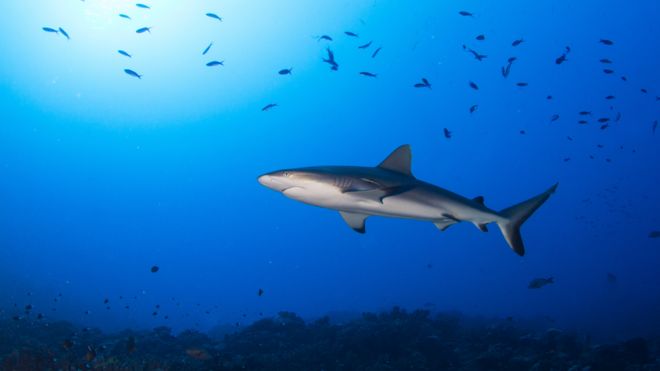
sharkImage copyrightIUCN

Climate change and nutrient pollution are driving the oxygen from our oceans, and threatening many species of fish.

That’s the conclusion of the biggest study of its kind, undertaken by conservation group IUCN.

While nutrient run-off has been known for decades, researchers say that climate change is making the lack of oxygen worse.

Around 700 ocean sites are now suffering from low oxygen, compared with 45 in the 1960s.

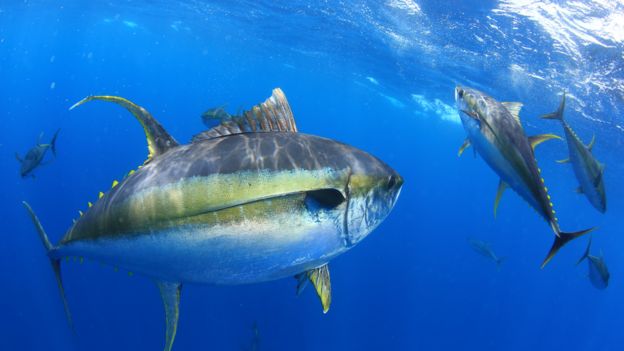
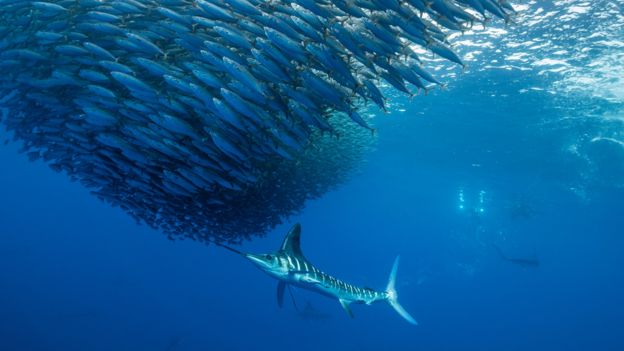
Researchers say the depletion is threatening species including tuna, marlin and sharks.

The threat to oceans from nutrient run-off of chemicals such as nitrogen and phosphorus from farms and industry has long been known to impact the levels of oxygen in the sea waters and still remains the primary factor, especially closer to coasts.

However, in recent years the threat from climate change has increased.

As more carbon dioxide is released enhancing the greenhouse effect, much of the heat is absorbed by the oceans. In turn, this warmer water can hold less oxygen. The scientists estimate that between 1960 and 2010, the amount of the gas dissolved in the oceans de

Media captionClimate change: How 1.5C could change the world

That may not seem like much as it is a global average, but in some tropical locations the loss can range up to 40%.

Even small changes can impact marine life in a significant way. So waters with less oxygen favour species such as jellyfish, but not so good for bigger, fast-swimming species like tuna.

OxygenImage copyrightIUCN

“We have known about de-oxygenation but we haven’t known the linkages to climate change and this is really worrying,” said Minna Epps from IUCN.

“Not only has the decline of oxygen quadrupled in the past 50 years but even in the best case emissions scenario, oxygen is still going to decline in the oceans.”

For species like tuna, marlin and some sharks that are particularly sensitive to lack of oxygen – this is bad news.

Bigger fish like these have greater energy needs. According to the authors, these animals are starting to move to the shallow surface layers of the seas where there is more of the gas dissolved. However, this make the species much more vulnerable to over-fishing.

If countries continue with a business-as-usual approach to emissions, the world’s oceans are expected to lose 3-4% of their oxygen by the year 2100.

This is likely to be worse in the tropical regions of the world. Much of the loss is expected in the top 1,000m of the water column, which is richest in biodiversity.

TunaImage copyrightIUCN
Image captionTuna are suffering from lack of oxygen, says IUCN

Low levels of oxygen are also bad for basic processes like the cycling of elements crucial for life on Earth, including nitrogen and phosphorous.

“If we run out of oxygen it will mean habitat loss and biodiversity loss and a slippery slope down to slime and more jellyfish,” said Minna Epps.

“It will also change the energy and the biochemical cycling in the oceans and we don’t know what these biological and chemical shifts in the oceans can actually do.”

Changing the outcomes for the oceans is down to the world’s political leaders which is why the report has been launched here at COP25.

“Ocean oxygen depletion is menacing marine ecosystems already under stress from ocean warming and acidification,” said Dan Laffoley, also from IUCN and the report’s co-editor.

“To stop the worrying expansion of oxygen-poor areas, we need to decisively curb greenhouse gas emissions as well as nutrient pollution from agriculture and other sources.”

New Zealand begins genetic program to produce low methane-emitting sheep

‘Global first’ project will help tackle climate change by lowering agricultural greenhouse gases

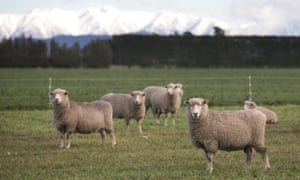
Sheep outside the city of Christchurch.
 The New Zealand livestock industry has begun a ‘global first’ program to breed low methane-emitting sheep. Photograph: Carly Earl/The Guardian

The New Zealand livestock industry has begun a “global first” genetic program that would help to tackle climate change by breeding low methane-emitting sheep.

There are about six sheep for each person in New Zealand, and the livestock industry accounts for about one-third of the country’s total greenhouse gas emissions.

The livestock industry’s peak body, Beef and Lamb New Zealand, already uses a measure called “breeding value” to help breeders select rams with characteristics they want to bolster within their flocks. Within two years breeders will be able to select rams whose traits include lower methane emissions.

“Farmers are more interested than I anticipated,” said a stud breeder, Russell Proffit. His family has been producing rams for more than 40 years.

“I’ve undertaken the [methane] measurements because I believe an animal that is healthy and doing well should produce less methane and I wanted to test that.

“I don’t know if that’s the case yet, but either way breeding for less methane complements what we are working to achieve on our stud. That is, more robust rams that require [fewer] inputs and make less demand on the environment.”

Breeders who want to produce low-methane rams will need to measure a portion of their flock in an accumulation chamber, where their gas emissions are measured. Sheep spend 50 minutes in the chamber, and must be measured twice with an interval of more than 14 days.

The resulting data is used alongside other genetic information to calculate a “methane breeding value”.

The pastoral greenhouse gas research consortium, which is jointly funded by the agricultural sector and the government, said the concept was to take advantage of variations in levels of methane emissions and research that found the differences were passed on to the next generation.

“This is a global first for any species of livestock,” the consortium’s general manager, Mark Aspin, said.

“Launching the methane breeding value gives New Zealand’s sheep sector a practical tool to help lower our agricultural greenhouse gases. This is significant. Up until now, the only option available to farmers wanting to lower their greenhouse gas emissions has been to constantly improve their overall farming efficiency.

“This takes us a step further – towards actually lowering sheep methane emissions, in keeping with the sector’s commitment to work towards reducing its greenhouse emissions.”

Progress via breeding could be about 1% a year, but it would be cumulative and have no negative impact on farm productivity.

Aspin said amounts of feed were the biggest factor that contributed to methane emissions, and the consortium was working on three technologies that aimed to reduce amounts of methane generated by feed.

“So by breeding sheep that produce less methane per mouthful eaten – as other methane-reducing technologies come on stream – the influence of these sheep on the national flock’s methane production becomes compounding.”

Beef and Livestock New Zealand’s chief executive, Sam McIvor, said recent research of 1,000 farmers found that information about reducing greenhouse emissions was among farmers’ top five priorities.

Scientists Warn: Nine Climate Tipping Points Now ‘Active’ – Could Threaten the Existence of Human Civilization

Global Warming Threatens Human Civilization

More than half of the climate tipping points identified a decade ago are now “active,” a group of leading scientists have warned.

This threatens the loss of the Amazon rainforest and the great ice sheets of Antarctica and Greenland, which are currently undergoing measurable and unprecedented changes much earlier than expected.

“We must admit that we have underestimated the risks of unleashing irreversible changes, where the planet self-amplifies global warming.” — Johan Rockström, Potsdam Institute for Climate Impact Research

This “cascade” of changes sparked by global warming could threaten the existence of human civilizations.

Evidence is mounting that these events are more likely and more interconnected than was previously thought, leading to a possible domino effect.

In an article published in the journal Nature on November 27, 2019, the scientists call for urgent action to reduce greenhouse gas emissions to prevent key tipping points, warning of a worst-case scenario of a “hothouse,” less habitable planet.

“A decade ago we identified a suite of potential tipping points in the Earth system, now we see evidence that over half of them have been activated,” said lead author Professor Tim Lenton, director of the Global Systems Institute at the University of Exeter.

“The growing threat of rapid, irreversible changes means it is no longer responsible to wait and see. The situation is urgent and we need an emergency response.”

Co-author Johan Rockström, director of the Potsdam Institute for Climate Impact Research, said: “It is not only human pressures on Earth that continue rising to unprecedented levels.

“It is also that as science advances, we must admit that we have underestimated the risks of unleashing irreversible changes, where the planet self-amplifies global warming.

“This is what we now start seeing, already at 1°C global warming.

“Scientifically, this provides strong evidence for declaring a state of planetary emergency, to unleash world action that accelerates the path towards a world that can continue evolving on a stable planet.”

In the commentary, the authors propose a formal way to calculate a planetary emergency as risk multiplied by urgency.

Tipping point risks are now much higher than earlier estimates, while urgency relates to how fast it takes to act to reduce risk.

Exiting the fossil fuel economy is unlikely before 2050, but with temperature already at 1.1°C above pre-industrial temperature, it is likely Earth will cross the 1.5°C guardrail by 2040. The authors conclude this alone defines an emergency.

Nine active tipping points:

  1. Arctic sea ice
  2. Greenland ice sheet
  3. Boreal forests
  4. Permafrost
  5. Atlantic Meridional Overturning Circulation
  6. Amazon rainforest
  7. Warm-water corals
  8. West Antarctic Ice Sheet
  9. Parts of East Antarctica

The collapse of major ice sheets on Greenland, West Antarctica and part of East Antarctica would commit the world to around 10 meters of irreversible sea-level rise.

Reducing emissions could slow this process, allowing more time for low-lying populations to move.

The rainforests, permafrost, and boreal forests are examples of biosphere tipping points that if crossed result in the release of additional greenhouse gases amplifying warming.

“Scientifically, this provides strong evidence for declaring a state of planetary emergency.” — Johan Rockström

Despite most countries having signed the Paris Agreement, pledging to keep global warming well below 2°C, current national emissions pledges — even if they are met — would lead to 3°C of warming.

Although future tipping points and the interplay between them is difficult to predict, the scientists argue: “If damaging tipping cascades can occur and a global tipping cannot be ruled out, then this is an existential threat to civilization.

“No amount of economic cost-benefit analysis is going to help us. We need to change our approach to the climate problem.”

Professor Lenton added: “We might already have crossed the threshold for a cascade of inter-related tipping points.

“However, the rate at which they progress, and therefore the risk they pose, can be reduced by cutting our emissions.”

Though global temperatures have fluctuated over millions of years, the authors say humans are now “forcing the system,” with atmospheric carbon dioxide concentration and global temperature increasing at rates that are an order of magnitude higher than at the end of the last ice age.
###

Reference: “Climate tipping points — too risky to bet against: The growing threat of abrupt and irreversible climate changes must compel political and economic action on emissions.” by Timothy M. Lenton, Johan Rockström, Owen Gaffney, Stefan Rahmstorf, Katherine Richardson, Will Steffen and Hans Joachim Schellnhuber, 27 November 2019, Nature.
DOI: 10.1038/d41586-019-03595-0

The latest UN Climate Change Conference will take place in Madrid from December 2-13.

Groups inspired by Greta Thunberg plan Black Friday climate strikes

Greta Thunberg to Congress: Listen to the scientists

Play Video

Greta Thunberg to Congress: Listen to the scientists 00:51

(CNN)People in cities across the US are expected to take part in strikes on Black Friday to call attention to the global climate crisis.

Climate strikes are also scheduled to take place around the world on Friday.
The protests are part of Fridays for Future, a youth-driven movement that started after teenage Swedish climate activist Greta Thunberg skipped school and staged sit-ins on Fridays outside the Swedish Parliament. Supporters hope to build off of the momentum of the Fridays for Future global climate strikes that took place in September.
“In September, 7.5 million people around the world took to the streets. Tomorrow we’re doing it again. Everyone’s needed. Everyone’s welcome,” Thunberg posted on social media.
Climate change will most directly impact young people, organizers have said. But that doesn’t mean it shouldn’t be an issue on everyone’s minds. They want allies.
close dialog
Strikers have demanded “climate justice” to cast the climate crisis as not just an environmental issue, but also an ethical obligation.
They hope the strikes will show world leaders that it’s not just young people who want climate change to be addressed.
Organizers have encouraged would-be shoppers on Black Friday to boycott the holiday and focus on the degeneration of the planet by joining the climate strikes.
“Consumerism is destroying our planet,” Extinction Rebellion, an environmental group, said on social media. “We do not have infinite resources, yet the system continues to persuade us all that we need to constantly buy more of everything. We are continuously sold cheap products at the expense of our environment, but enough is enough.”
One group said it plans to silently push empty shopping carts through a New York city store, forming a lengthy chain of non-shoppers who will weave through the store aisles, inviting customers to take a break from shopping.
Another climate strike is planned for December 6.
December’s demonstrations will coincide with the COP25 environmental summit that will take place in Madrid from December 2 to December 13.

Jeremy Clarkson Says 16-Year-Old Activist Has ‘Killed The Car Show’

Greta Thunberg is “an idiot,” adds Jezza.

Ex-Top Gear lead host Jeremy Clarkson likes for his opinion to be heard. He often speaks about various automotive-related topics, including the best and worst cars on the planet, cyclists, autonomous machines, and many more. His latest observation is now making the news, accusing 16-year-old climate change activist Greta Thunberg of basically killing car shows on TV.

Thunberg is a Swedish environmental mover and shaker whose opinions have gained international recognition to the point where Clarkson publicly called her “an idiot” in his recent interview with The Sun. The 59-year-old TV host and journalist also expressed his belief that Thunberg is the reason why young people generally hate cars, which is a big reason why motoring shows are not that popular anymore.

“Everyone I know under 25 isn’t the slightest bit interested in cars — Greta Thunberg has killed the car show,” he told The Sun. “They’re taught at school, before they say ‘Mummy and Daddy’, that cars are evil, and it’s in their heads.”

Richard Hammond seems to finally agree with Clarkson about something. “I hate to say it, but I think Jeremy is right. Young people don’t care about cars. How many kids now are growing up with posters of cars on their bedroom wall?”

Interestingly, Clarkson, together with colleagues May and Hammond, take global climate changes as the main topic in the upcoming The Grand Tour Presents: Seamen special, which was teased earlier this month. While Clarkson admits that “for the first time ever, we’ve had global warming rammed down our throats — and we’ve not been idiotic,” he insists that “going round saying we’re all going to die” is not going to help us.

The Grand Tour Presents: Seamen is slated for a December 13 launch on Amazon Prime.

Source: The Sun

We’ll see an ice-free Arctic this century, latest research says

New paper from University of California narrows window for Arctic melting

A polar bear stands on an ice floe in Baffin Bay above the Arctic Circle, as seen from the Canadian Coast Guard icebreaker Louis S. St-Laurent in July 2008. New research has narrowed the window on when we can expect a functionally ice-free September in the Arctic. (Jonathan Hayward/The Canadian Press)
1533
comments

We can expect to see an ice-free Arctic Ocean within 50 years, according to researchers at the University of California’s Center for Climate Science, who say they’ve improved and narrowed past projections of when the Arctic might be free of sea ice.

Projections have varied from as early as 2026 to as distant as 2132. Now, according to research published in the journal Nature Climate Change, the Arctic could be “functionally ice-free” by September 2044 — and no later than 2067 — assuming no changes to global carbon emissions.

September is when the Arctic sea ice pack is at its thinnest. That’s when the effect of summer’s heat shows up in the ice pack.

Functionally ice free is like basically broke — it doesn’t mean there won’t be a shard of ice anywhere, but there would be fewer than one million square kilometres of it. That’s compared with the current minimum six million square kilometres of Arctic sea ice that exists today, even at its lowest point after summer’s heat.

The important thing about one million square kilometres of Arctic sea ice is that it mostly represents thick, multi-year ice close to coastal areas of Greenland and in the Arctic archipelago. The Arctic Ocean itself would be essentially ice free. Declining sea ice hurts the ability of the Arctic to perform its important albedo function.

The sea ice albedo effect refers to the reflective capacity of sea ice to deflect sunlight. Where there is no sea ice, darker open water absorbs up to approximately 90 per cent of incoming solar energy (heat). Sea ice absorbs just 20 per cent of that energy, with the rest reflected away, according to research published by the University of California.

It’s the Earth’s freezer malfunctioning. This quickens global warming.

“Essentially, when we’re losing that ice, the ocean is taking up much more heat than it would be say if we had an ice-covered Arctic,” said Chad Thackeray, the article’s lead author and research scientist on climate change at the University of California Los Angeles.

“So that change has big implications for the climate system; not just changes in the Arctic.”

Declining Arctic sea ice will quicken global warming. (UCLA Center for Climate Science)

Accurate modelling of when we could see an ice-free Arctic is an important piece of data in global climate models, Thackeray said.

“This is one … quantity or metric where a model disagreement is particularly large. A lot of our work is about trying to reduce this uncertainty … so that we’re better prepared for the changes that are to come.”

Consistent modelling of Arctic sea ice changes will improve global projections that rely on that data.

“If models have more consistent simulations of sea ice, then it’s likely that they’ll have a better consistency in projecting future changes in temperature — especially in the Arctic region,” he said.

New method

Thackeray and co-author Alex Hall used a new method to build their model. They took 30 years of satellite data on seasonal ice melt as a benchmark. Next, they compared 23 existing models to the data, rejecting those that failed to match the benchmark. The idea is that if a model can’t accurately ‘predict’ what did happen, it shouldn’t be relied on to predict what will happen.

Chad Thackeray is an assistant researcher at UCLA, in the Department of Atmospheric and Oceanic Sciences. (Submitted by Chad Thackeray)

Once the weak models were rejected, they were left with six models that, taken together, give what they believe is the most accurate timeframe a functionally ice-free Arctic, and how soon the best science tells us we should expect it.

There are some caveats to the research. Data was limited to sea ice between 70 and 90 degrees North latitude. That leaves out much of the Canadian archipelago — that mass of land and islands that defines Canada’s North on a map.

Sea ice in that area is affected by nearby land masses. Regional sea ice forecasts would be a different, and more complicated, data set to work with.

“There are some areas … just north of the archipelago and off northwestern Greenland, where the ice is very thick, multiyear ice that doesn’t really melt every summer,” Thackeray, who is from the Toronto area, said.

“That ice will stick around a bit longer. There will still be flows that find their way through the Canadian archipelago. That’ll be pretty thick even in this mid-century timeframe.”

Reflective sea ice helps regulate climate. It’s absence encourages warming. (UCLA Center for Climate Science)

But the trend is toward ice-free, assuming nothing is done to curb carbon emissions.

Thackeray said they did not consider how reductions in greenhouse gas emissions could effect the timeframe. Different models or “pathways” could significantly delay, halt, or even ultimately reverse Arctic sea ice thaw.

“This process can be delayed by several decades or even completely halted if we were to limit ourselves to say 1.5 degrees of warming,” Thackeray said. “It’s just a matter of what pathway we choose … and how quickly we choose.”

Helpful, if not groundbreaking

Walt Meier, senior research scientist with the National Snow and Ice Data Center at the University of Colorado, said that Thackeray’s paper does not necessarily point to something new. Other attempts to cull the data of extreme outliers have given similar results. But he said the method itself is new and it’s reassuring to see different approaches yielding similar results.

“In one sense, many people are reluctant to give a date or range of dates because of uncertainties,” Meier stated in an email. “This paper does provide the range and a reasonable justification.”

Meier’s research focuses on satellite data, not modelling, so he doesn’t expect the paper to directly inform his work.

“But I am on a couple projects that focus on sea ice projections, including from models, and I think this paper makes a valuable contribution to our knowledge.”

This Nov. 12, 2019, photo shows a view from the research vessel Sikuliaq near Jones Island in the Beaufort Sea. (John Guillote via Associated Press)

Scientists Have Detected a Rapid Spike of a Widely Overlooked Greenhouse Gas

CARLY CASSELLA
19 NOV 2019

Carbon dioxide and methane aren’t the only greenhouse gases the world needs to worry about. The rapid rise of nitrous oxide (N2O), colloquially known as ‘laughing gas’, is no joke either.

This little-known greenhouse gas may not be as prevalent nor as long-lasting as carbon dioxide, but it is hundreds of times more potent and can stick around in the atmosphere for more than a century.

Today, it’s released mainly through human agricultural practices, such as using cheap nitrogen fertiliser. And, as you’ve no doubt guessed, it’s also a main contributor to ozone depletion and global warming.

To make matters worse, we’ve seriously underestimated its use. Since the turn of the century, new measurements reveal atmospheric N2O has risen much faster than experts at the United Nations once predicted.

“We see that the N2O emissions have increased considerably during the past two decades, but especially from 2009 onwards,” says climate scientist Rona Thompson from the Norwegian Institute for Air Research (NILU).

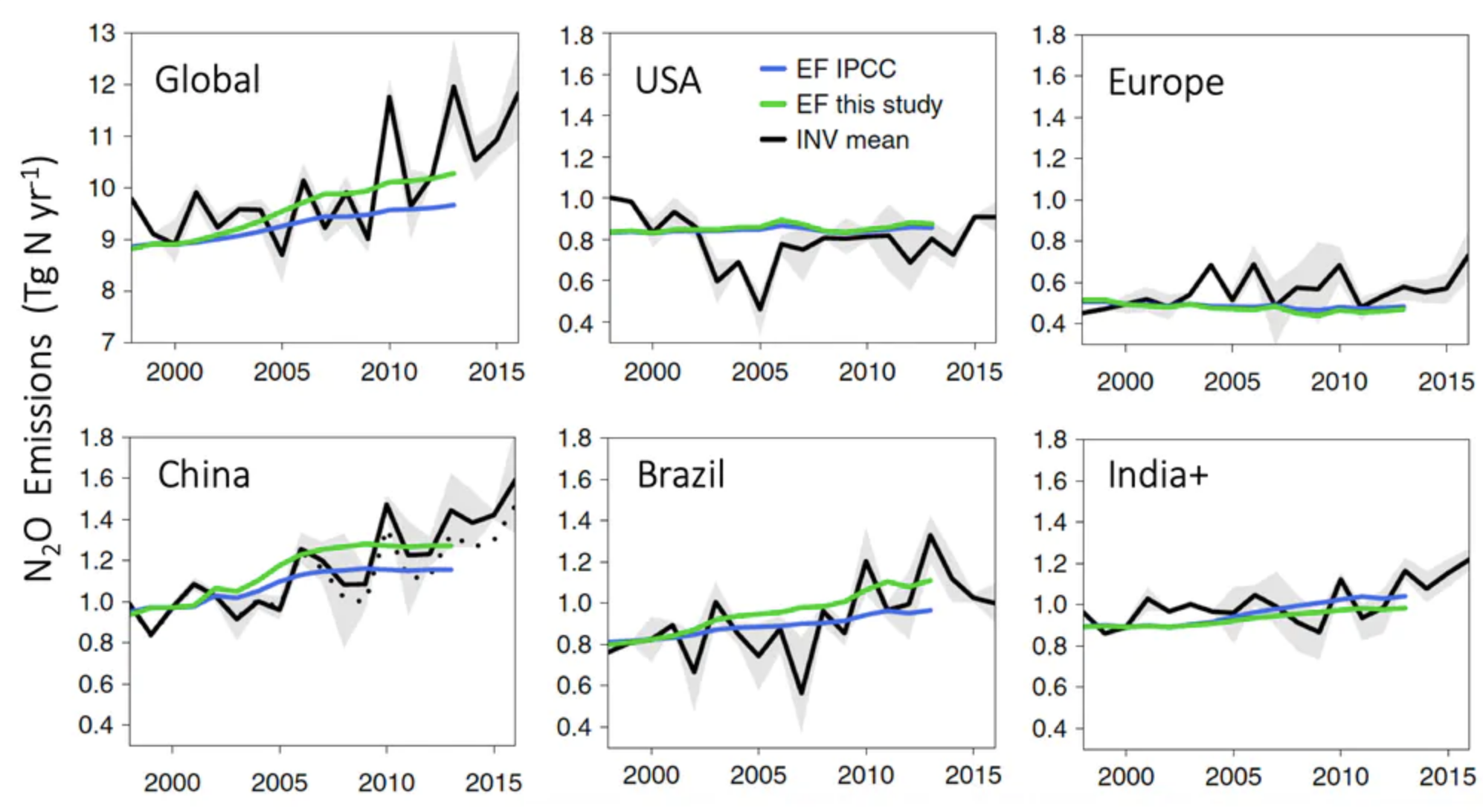
“Our estimates show that the emission of N2O has increased faster over the last decade than estimated by the Intergovernmental Panel on Climate Change (IPCC) emission factor approach.”

Instead of basing their calculations on human emissions, which are usually gathered from indirect sources, the researchers used a ‘top-down’ approach, based on dozens of atmospheric measurements from around the world. These data were then used to predict N2O dynamics on land and in the ocean between 1998 and 2016.

Between 2000 and 2005, and 2010 and 2015, N2O emissions were found to increase by roughly 10 percent. This is more than twice the rate estimated from fertiliser use, which was reported to the United Nations.

And this isn’t due to natural changes, the authors say, but rather our growing reliance on nitrogen fertilisers for agricultural crops. Producing nitric acid and burning fossil fuels and biomass certainly doesn’t help.

“This increase is significantly larger than prior estimates,” the authors write, adding that “a change of this magnitude cannot be explained by any known mechanism through the [N2O] sink, as it would require an increase in atmospheric lifetime of ~20 years, and such a change is unrealistic over this timescale.”

Screen Shot 2019 11 18 at 4.37.25 pm(Thompson et al., Nature Climate Change, 2019)


The vast majority of the excess nitrogen is coming from the land, and while emissions in the United States and Europe have remained fairly stable, N2O has shot up in China and to a lesser extent in India, Nepal, Bangladesh, Pakistan and Brazil.

The authors found these regions are responsible for roughly half the increase in global emissions over the past two decades, with Africa contributing a further 20 percent. For both China and Brazil, the IPCC projections were way off.

After a certain point, they explain, it appears as though plants can no longer fix nitrogen as effectively and this causes emissions to increase exponentially.

The idea is hardly new, but agricultural researcher Richard Eckard, who was not involved in the study, told ABC News Australia it’s never been studied at this global level before.

“When you exceed the [plant] system’s capacity to use that nitrogen fertiliser, the efficiency goes out the window, and the nitrogen can leak out of the cycle,” he told the ABC.

“That plays out in some industries where the recommended amount of fertiliser is exceeded, and you get exponential loss of nitrogen.”

In a Nature review of the study, environmental agronomist David Makowski agrees. He writes that the steady rise of nitrogen fertilisers in developing countries is most likely to blame for the recent spike in global emissions.

“This result reinforces the hypothesis of a nonlinear relationship between N2O emission and Nitrogen inputs and thus of a non-constant emission factor, as previously suggested by several experimental field studies and meta-analyses,” he writes.

“This implies that the IPCC’s default Tier 1 approach of a constant emission factor may both overestimate emissions when excess nitrogen is low and underestimate them when it is high.”

IPCC reports have been critiqued in the past for underestimating carbon emissions from thawing permafrost, tipping points and positive feedback loops. Now, it’s starting to look as though the same has occurred with N2O emissions.

Earlier this year, a study found that thawing permafrost in the Arctic may be releasing 12 times as much nitrous oxide as we previously thought. Even more recently, it’s been suggested that global warming and ocean acidification may simply make emissions of this potent gas worse.

“We will have to adjust our emission inventories in light of these results,” says Wilfried Winiwarter, a researcher at the IIASA Air Quality and Greenhouse Gases Program.

But more than that, the authors say we must reduce our emissions. In the USA and Europe, strong regulations have stopped nitrogen from building up in soils and in waterways, and more sustainable farming techniques in other parts of the world may help as well.

The authors suggest reducing the amount of soil tillage and waterlogging that occurs on farmed land – none of which come at the cost of agricultural output if done correctly.

“It’s not that they shouldn’t be using nitrogen fertiliser,” Eckard told the ABC, “but if we all used the right amount we’d have significantly less nitrous oxide going into the atmosphere.”

The study was published in Nature Climate Change.

https://www.sciencealert.com/there-s-another-rapidly-growing-greenhouse-gas-and-you-ve-probably-never-heard-of-it

Secrets of the largest ape that ever lived

Jaw of the aoeImage copyrightPROF WEI WANG
Image captionLittle is known about the ape as only a few fossils are known, including this jawbone

A fossilised tooth left behind by the largest ape that ever lived is shedding new light on the evolution of apes.

Gigantopithecus blacki was thought to stand nearly three metres tall and tip the scales at 600kg.

In an astonishing advance, scientists have obtained molecular evidence from a two-million-year-old fossil molar tooth found in a Chinese cave.

The mystery ape is a distant relative of orangutans, sharing a common ancestor around 12 million years ago.

“It would have been a distant cousin (of orangutans), in the sense that its closest living relatives are orangutans, compared to other living great apes such as gorillas or chimpanzees or us,” said Dr Frido Welker, from the University of Copenhagen.

Artist reconstruction of the apeImage copyrightIKUMI KAYAMA
Image captionArtist reconstruction of the ape

Human evolution hopes

The research, reported in Nature, is based on comparing the ancient protein sequence of the tooth of the extinct ape, believed to be a female, with apes alive today.

Obtaining skeletal protein from a two-million-year-old fossil is rare if not unprecedented, raising hopes of being able to look even further back in time at other ancient ancestors, including humans, who lived in warmer regions.

There is a much poorer chance of being able to find ancient DNA or proteins in tropical climates, where samples tend to degrade quicker.

“This study suggests that ancient proteins might be a suitable molecule surviving across most of recent human evolution even for areas like Africa or Asia and we could thereby in the future study our own evolution as a species over a very long time span,” Dr Welker told BBC News.

Extinction clues

Gigantopithecus blacki was first identified in 1935 based on a single tooth sample. The ape is thought to have lived in Southeast Asia from two million years ago to 300,000 years ago.

Many teeth and four partial jawbones have been identified but the animal’s relationship to other great ape species has been hard to decipher.

The ape reached massive proportions, exceeding that of living gorillas, based on analysis of the few bones that have been found.

It is thought to have gone extinct when the environment changed from forest to savannah.