

In response to an application submitted by Idaho for Wildlife to host a Predator Hunt Derby on public land, the BLM is accepting public comments on an Environmental Assessment (EA) through October 16th.
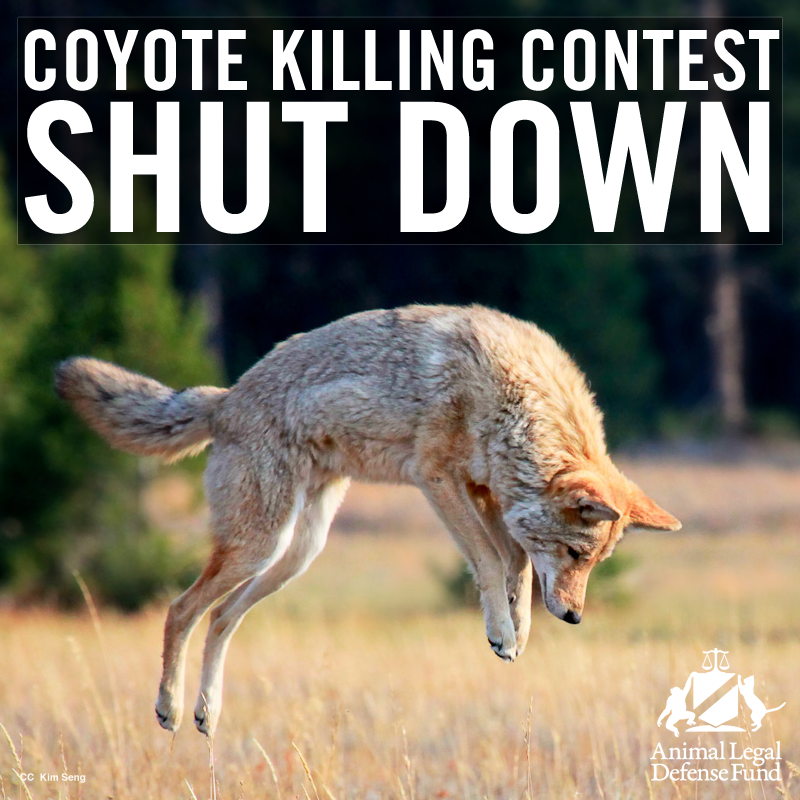
Idaho for Wildlife is seeking to repeat their highly controversial killing contest targeting wolves, coyotes, bobcats, foxes and other predators — offering prizes to those who kill the most and largest animals — in a multi-year “predator derby” scheduled for the next five winters (with the next one scheduled for January 2-4, 2015).
The EA comment period comes following a scoping period that resulted in approximately 56,500 public comments of which a mere 10 were in support of the permit being issued. Thank you for making your voices heard during the scoping process! Your input is needed again!
Express your support for Alternative B- the “No Action Alternative” – which would deny Idaho for Wildlife’s request for a special recreation permit that would allow contestants to kill predators on over 3 million acres of public lands in Idaho for the next five years. This event would be damaging to the affected ecosystem, harmful to ecologically vital species, incompatible with scientific principles of wildlife management, and offensive to the concept of fair chase.
Please don’t miss this opportunity to voice your opposition (you do not have to be an Idaho resident to comment as this is federal BLM land- YOUR land!).
You can read the EA here.
Please act now! Comments are due no later than October 16th and can be emailed to:
Liz Townley
Outdoor Recreation Planner
BLM Idaho Field Office
1206 S. Challis Street
Salmon, Idaho 83467
blm_id_predatorhuntderby@blm.gov
Please cc Project Coyote as we are tracking letters sent (info@projectcoyote.org) & remember to include your full contact info. in your signature block to ensure your comments are included in the official record.
Please include in your subject line Re: Predator Hunt Derby EA- Support for Alt. B
Talking Points:
Express your support for Alternative B – the “No Action Alternative” (please use your own words).
1. Killing contests have nothing in common with fair chase, ethical hunting. Technology, baiting, and “calling” place wildlife at an even greater and unfair disadvantage. Hunting in winter, when species can be easily tracked in snow and when most animals are working hard to survive contravenes the notion of fair chase. Killing predators, or any wild animal, as part of a ‘contest’ or ‘derby’ is ethically indefensible and ecologically reckless.
2. Bloodsport contests are conducted for profit, entertainment, prizes and, simply, for the “fun” of killing. No evidence exists showing that predator killing contests control problem animals or serve any beneficial management function. Coyote populations that are not exploited (that is hunted, trapped, or controlled by other means), form stable “extended family” social structures that naturally limit overall coyote populations through defense of territory and the suppression of breeding by subordinate female members of the family group.
3. The importance of wolves, coyotes and other predators in maintaining order, stability, and productivity in ecosystems has been well documented in peer- reviewed scientific literature. Coyotes provide myriad ecosystem services that benefit humans including their control of rodents and rabbits, which compete with domestic livestock for available forage. As apex predators wolves increase biodiversity and ecological integrity.
4. With fewer than 700 wolves in Idaho and poaching a common problem, allowing a killing contest of a species just off the endangered species list is reckless, indefensible and counter to sound science.
5. Economically, a live wolf is worth far more than a dead one. Wolf watching has brought in millions of dollars into Idaho and tourism is a major economic revenue source. Furthermore, issuing the permit is likely to affect tourism in Idaho as those who value wildlife decide not to visit due to the state’s draconian predator management policies.
6. Wildlife killing contests perpetuate a culture of violence and send the message to children that life has little value and that an entire species of animals is disposable.
7. Wildlife killing contests put non-target animals, companion animals, and people at risk. Domestic dogs are sometimes mistaken for coyotes and wolves.






 Exposing the Big Game