Lawsuit filed to stop cormorant slaughter by federal agencies

http://audubonportland.org/news/april20-2015

April 20, 2015: Five conservation and animal welfare organizations initiated a lawsuit today against the U.S. Army Corps of Engineers, U.S. Fish and Wildlife Service and USDA Wildlife Services to stop the slaughter of thousands of Double-crested Cormorants in the Columbia River basin. According to the lawsuit, the agencies are scapegoating the native birds for salmon declines while ignoring the real threat to salmon: mismanagement of the federal hydropower system. Unless stopped, the agencies will kill more than 15 percent of the entire population of Double-crested Cormorants west of the Rocky Mountains.

The federal agencies are set to kill more than 10,000 Double-crested Cormorants using shotguns as the birds forage for food over water. Snipers with night vision goggles and high-powered rifles will also shoot birds from elevated platforms as the birds care for their eggs and young on their nesting grounds at East Sand Island in the Columbia River. The agencies also plan to destroy more than 26,000 Double-crested Cormorant nests through oiling of eggs, egg failure, and starvation of nestlings whose parents have been shot.

“This is not about birds versus fish,” said Bob Sallinger, Audubon Society of Portland conservation director. “The Corps and other federal agencies have proposed rolling back dam operations that benefit salmon while at the same time targeting thousands of cormorants. Blaming salmon and steelhead declines on wild birds that have coexisted with salmon since time immemorial is nothing more than a diversion.”

The lawsuit identifies several ways in which the Corps and Fish and Wildlife Service violated federal laws in their decision to move forward with the cormorant slaughter, including by refusing to analyze alternative dam operations to benefit salmon as required by the National Environmental Policy Act and the Migratory Bird Treaty Act. In addition, the agencies failed to utilize available non-lethal methods of cormorant control, such as habitat modification on East Sand Island.

“The Corps has lost four lawsuits in federal court over the past decade due to its failure to address the impacts of dams on salmon,” said Stephen Wells, ALDF executive director. “Rather than addressing this ongoing violation of federal law, the Corps is now trying to blame wild birds who co-existed with healthy salmon runs for millennia before the Corps of Engineers came on the scene.”

It is particularly troubling that the Corps and the Service both admit that this slaughter will drive cormorant populations below sustainable levels. The agencies define a “sustainable” cormorant population as one that is “able to maintain a long-term trend with numbers above a level that would not result in a major decline or cause a species to be threatened or endangered.”

“It is unprecedented that federal agencies would deliberately drive a native species below levels defined as sustainable,” said Michael Harris, Friends of Animals’ legal director. “We expect the federal government to protect native wildlife, not intentionally cause major declines.”

“The agencies need to stop scapegoating these native birds,” said Collette Adkins, a senior attorney at the Center for Biological Diversity. “The Corps’ refusal to modify dam operations is the real threat to salmon, and the deaths of thousands of cormorants will be another casualty of the agency’s mismanagement of the Columbia River ecosystem.”

“The saddest part about this action is that it will do little or nothing to protect salmon,” said Sharnelle Fee, director of the Wildlife Center of the North Coast. “The science supporting this lethal control action is remarkably weak and this action is virtually meaningless from a salmon recovery perspective.”

Cormorants eat a very small portion of migrating salmon and also eat their predators, so the killing will have little benefit for salmon. But the killing will have a significant impact on the cormorant population. According to scientific experts, cormorant populations are under tremendous pressure throughout the Western United States from natural hazards such as drought and climate change. They are also under pressure from deliberate hazing, harassment and lethal control by humans. Western cormorant populations are currently less than 10 percent of their historic levels.

The plaintiffs on this lawsuit are: Audubon Society of Portland, Center for Biological Diversity, Wildlife Center of the North Coast, Animal Legal Defense Fund, and Friends of Animals. Plaintiffs are represented by Dan Rohlf and Earthrise Law Center. The plaintiffs will seek an injunction to stop the killing while the case proceeds through the court system.

Complaint for Declaratory and Injunctive Relief – filed by plaintiffs on April 20, 2015.

Learn more about the Audubon Society of Portland’s work to protect cormorants on East Sand Island.

How You Can Help

Please make a donation to support the Audubon Society of Portland’s efforts to protect East Sand Island cormorants from horrific lethal control.

Double-crested Cormorant - Jim Cruce
Double-crested Cormorant – Jim Cruce

Groups sue Corps over Cormorant-Kill

April 23, 2015

The Army Corps of Engineers proposes to kill thousands of the double-crested cormorants nesting on Sand Island near the mouth of the Columbia River because the birds eat too many young salmon and steelhead.
The Wildlife Center of the North Coast joins lawsuit against cormorant killing

COLUMBIA RIVER — A permit the U.S. Army Corps of Engineers needed to proceed with its plan to kill thousands of double-crested cormorants nesting on the Lower Columbia River’s East Sand Island is now in place — and so is the first lawsuit.

The U.S. Fish and Wildlife Service issued a depredation permit April 13. The permit, valid through Jan. 31, 2016, will allow contractors to kill 3,489 double-crested cormorants and 5,879 nests, 105 Brandt’s cormorants and 10 pelagic cormorants in 2015.

On April 20, the Audubon Society of Portland, along with four other nonprofit or volunteer-led organizations, filed a complaint for declaratory and injunctive relief against the Corps, the U.S. Fish and Wildlife Service and the U.S. Department of Agriculture Wildlife Services, which is authorized by the Fish and Wildlife Service to kill the allowed number of birds and eggs.

The Wildlife Center of the North Coast, a private volunteer-based nonprofit, recently joined the lawsuit.

Audubon argues cormorants are being blamed for damage to salmon runs that is actually caused by dams, and that the Corps’ management plan would cause the Western population of double-crested cormorants to dip below “sustainable levels” as defined by the U.S. Fish and Wildlife Service itself.

With the lawsuit filed, the Audubon Society of Portland will seek an injunction to put a halt this year to the Corps’ plans to cut the nesting population on the island almost in half by 2018.

“I don’t know exactly where this is going to take us,” said Amy Echols, assistant chief with the Corps’ public affairs office in Portland, about the complaint.

Bob Sallinger, the society’s conservation director, is also concerned about the timing of the culling. Peak nesting season is approaching on the island — Oregon State University researchers on the island say the first eggs are usually laid between mid-April and early May — and the Corps estimates that an additional 3,489 nestlings and eggs might die if their parents are shot and they are orphaned. A Corps spokesperson said contractors are on the island now, erecting fencing that will separate out nesting areas, but that it will be several more weeks before they begin killing the birds.

More: http://www.dailyastorian.com/Local_News/20150423/wildlife-groups-sue-corps-over-cormorants

image

Tell the U.S. Fish and Wildlife Service to deny a permit to kill 11,000 cormorants

Tell the U.S. Fish and Wildlife Service to deny a permit to kill 11,000 cormorants. ·  Trouble viewing this email? Try our web version.
Audubon logo | ACTION ALERT
OPPOSE CORMORANT SLAUGHTER
arrow pointing at letter
Double-crested Cormorant with eggs
A Double-crested Cormorant protects its eggs on East Sand Island.
Urge the U.S. Fish and Wildlife Service to deny the permit that will allow the Army Corps of Engineers to kill 11,000 cormorants.
Take Action ›

Dear Jim,

The Army Corps of Engineers is moving ahead with a misguided plan to kill 11,000 Double-crested Cormorants—15 percent of the entire Double-crested Cormorant population west of the Rocky Mountains—and destroy 26,000 nests.

In order to carry out this slaughter, the Corps needs a permit from the U.S. Fish and Wildlife Service (USFWS). We have a very short window of time to ask the USFWS to deny the permit and save these birds.

Urge the U.S. Fish and Wildlife Service to deny the permit that will allow the Army Corps of Engineers to kill 11,000 Double-crested Cormorants and destroy 26,000 nests.

The cormorants live and nest on East Sand Island, a globally-significant Important Bird Area (IBA) in Oregon’s lower Columbia River estuary. In the Final Environmental Impact Statement, the Fish and Wildlife Service itself acknowledges that the proposed plan would reduce the population of cormorants below the number they previously said was sustainable. While cormorants do prey on salmon, the fish are endangered because of dams, pollution, habitat loss, and an array of other factors—not because of the cormorants.

According to the Audubon Society of Portland, which is closely tracking this issue, “It is time for the US Army Corps to do a ground-up review of its entire approach to managing birds in the Columbia Estuary.” Audubon opposes the Corps’ plan to slaughter thousands of cormorants and we have urged the Corps and its partners instead to review and rebuild their strategy for management of avian predation on fish on a regional scale. Such a strategy needs to be based on sound science, fully employ and evaluate non-lethal measures of reducing avian predation, and consider a full range of alternatives beyond manipulation and control of native wildlife.

Send a letter today urging the U.S. Fish and Wildlife Service to deny the permit that will allow thousands of cormorants to be killed at East Sand Island!

Thousands of Cormorants to be Killed: There Will be Blood

The U.S. Army Corps of Engineers plans to kill 11,000 and destroy 26,000 nests

Post published by Marc Bekoff Ph.D. on Mar 28, 2015 in Animal Emotions

In August 2014 I wrote an essay called “Birds and Us: Should Cormorants Be Killed toimage Save Salmon?” in response to Felicity Barringer’s essay in the New York Times called “Taking Up Arms Where Birds Feast on Buffet of Salmon (link is external).” Ms.Barringer’s essay dealt with the situation in Oregon’s Columbia River where salmon living in the river were killed off due to hydroelectric dams and are now increasing in number, and double-crested cormorants, who like to eat salmon, have become aware of this and are a threat to the fish. Many people, including conservation biologists, say, “shoot the birds.” Others, such as the National Audubon Society’s Stan Senner, argue that killing some of the birds who make up 25 percent of the birds’ western population “is an extreme measure, totally inappropriate.” Mr. Senner “said it was possible to shoo them away, noting ‘They came from somewhere else. They can go back to somewhere else.’” He also notes, “We’re not persuaded they have fully explored ways of improving habitats elsewhere or other means of dispersing” these birds.

I thoroughly agreed with Mr. Stenner that the cormorants shouldn’t be shot. The guiding principle of compassionate conservation (see also (link is external)) is “first do no harm”, which means the life of each and every individual animal is valued. So, trading off individuals of one species for the good of individuals of another species or of the same species isn’t acceptable. I also agree with retired marine biologist Bob Hees, who is quoted as saying, “I’ve seen people try to mess with Mother Nature before, and it never works. It goes toward creating more problems.” The cormorant-salmon situation is a good catalyst for open discussions about creating a viable and practical conservation ethic based on compassion.

There will be blood: Experimental killing sprees are wrong and likely won’t work

Despite experts agreeing that killing the cormorants is wrong and won’t work, it turns out that the U.S. Army Corps of Engineers is planning to kill nearly 11,000 cormorants and destroy more than 26,000 of their nests to try to reduce cormorant numbers by more than half. You can read the details in an essay by Alicia Graef called “Plans Move Forward to Kill Thousands of Cormorants (link is external).”

Ms. Graef also notes, “Criticism [to the killing spree] was also brought by researchers from Oregon State University who were hired by the Army Corps to study the bird population on the island. They say the Army Corps ignored their findings and isn’t using the best available science in its plan to protect young salmon. Unfortunately, despite widespread opposition from the public and scientific community, the Army Corps announced it has finalized its decision that will slightly reduce the number of cormorants targeted, but will still kill nearly 11,000 of them and destroy more than 26,000 of their nests in an effort to reduce their numbers by more than half.”

Killing one species to save another is a rather common occurrence and I also wrote about this heinous practice in an essay called “Killing Barred Owls to Save Spotted Owls? Problems From Hell.” In this piece I wrote about an essay in the magazine Conservation by science writer Warren Cornwall called “There Will Be Blood (link is external),” and noted that it is a must read for anyone interested in keeping up with current discussions and debates about the supposed need to kill animals of one species to save those of another species. The question at hand in Mr. Cornwall’s excellent essay is, “Should barred owls be killed to save endangered spotted owls?” Spotted owls are shy birds who favor ancient forests that are disappearing due to logging in the northwestern United States, and they are threatened by larger and more aggressive barred owls who have migrated west from their original homes on the east coast of the United States.

Killing one species to save another isn’t a “sad good,” it’s wrong

At the beginning of his piece Mr. Cornwall writes, “The pressure to reach for a gun to help save one animal from another is stronger than ever. And it has triggered a conservation problem from hell.” He’s right. I argued against killing the barred owls and against the position of ethicist, Bill Lynn. Dr. Lynn was hired by the Fish and Wildlife Service and was initially skeptical about the above killing experiments, however, he changed his mind. He concluded that it was all right to kill the barred owls as an experiment if it was done as humanely as possible, and called it a “sad good.” For me, a “sad good” is a very slippery slope that sets a lamentable precedent for opening the door for the more widespread “experimental killing” of barred owls and other species. Dr. Lynn balked on supporting a region-wide war on barred owls, and, experts protested any killing because they were convinced it simply wouldn’t work.

The killing of the cormorants is really a murderous experiment and is wrong and likely won’t work. Even if it did “work,” whatever that means, according to Ms. Graef, “the Audubon Society of Portland announced its Board of Directors has voted to sue both the Army Corps and the FWS if permits are granted. Bob Sallinger, the organization’s conservation director, said in a statement (link is external): We are deeply disappointed that despite more than 145,000 comments opposing this decision, the federal government has chosen to move forward with the wanton slaughter of thousands of protected birds. Rather than addressing the primary cause of salmon decline, the manner in which the Corps operates the Columbia River Hydropower System, the Corps has instead decided to scapegoat wild birds and pursue a slaughter of historic proportions. Sadly this will do little or nothing to protect wild salmon but it will put Double-crested Cormorant populations in real jeopardy. The organization is hoping to get the Army Corps to focus instead on non-lethal measures that will protect both birds and salmon. For more info on how to help protect these cormorants from being needlessly killed, visit the Audubon Society of Portland (link is external).”

Please do all you can to stop this unnecessary slaughter.

Marc Bekoff’s latest books are Jasper’s story: Saving moon bears (with Jill Robinson), Ignoring nature no more: The case for compassionate conservationWhy dogs hump and bees get depressed, and Rewilding our hearts: Building pathways of compassion and coexistenceThe Jane effect: Celebrating Jane Goodall (edited with Dale Peterson) has recently been published. (marcbekoff.com; @MarcBekoff)

Columbia River cormorant plan calls for shooting 11,000 birds, destroying 26,000 nests

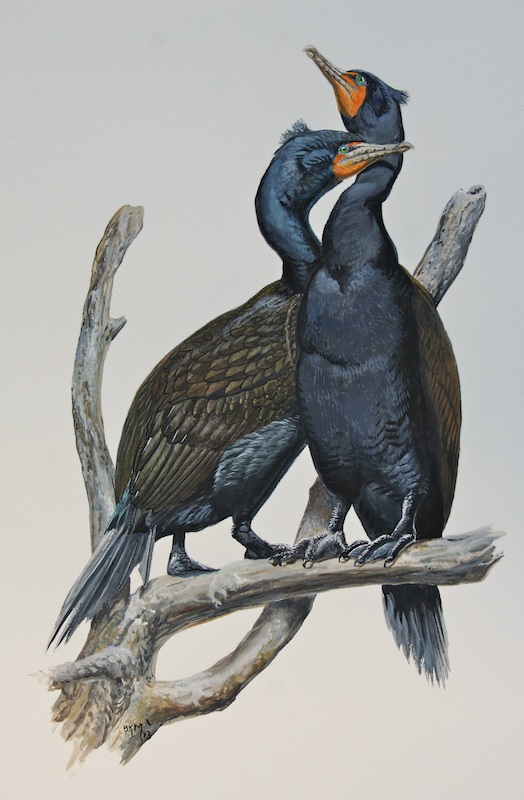
Painting Courtesy  Barry Kent MacKay

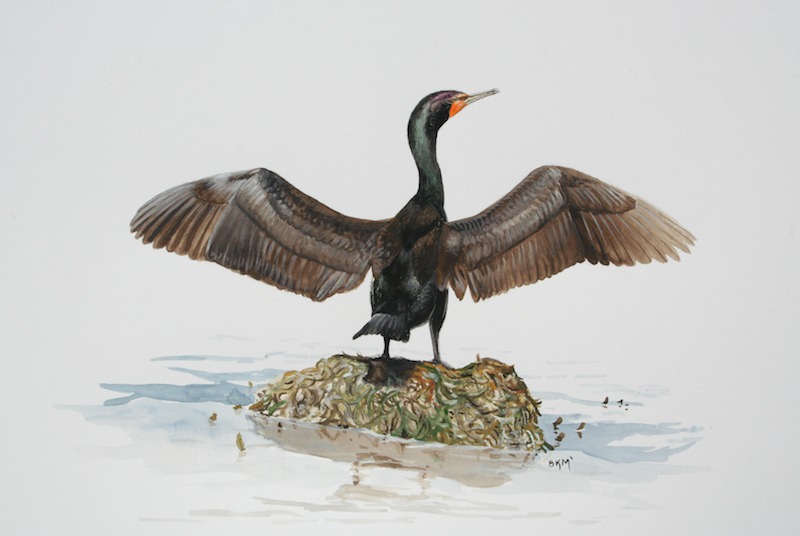
Painting Courtesy Barry Kent MacKay

http://www.oregonlive.com/environment/index.ssf/2015/02/east_sand_island_cormorant_kil.html

By Kelly House | The Oregonian/OregonLive The Oregonian

The U.S. Army Corps of Engineers has scaled back its plan to kill thousands of federally protected migratory birds to keep them from eating endangered juvenile salmon and steelhead at the mouth of the Columbia River.

On Friday, the corps released a final environmental impact statement detailing plans to use lethal measures to shrink the East Sand Island colony of double-crested cormorants, a long-necked black sea bird.

The revised version of a preliminary plan released last summer calls for shooting nearly 11,000 birds by the end of 2018 and pouring oil over 26,000 nests to prevent eggs from hatching. The corps’ goal is to reduce the colony by 57 percent, to about 5,600 breeding pairs.

It represents a rollback from the original plan, which called for shooting 16,000 birds to achieve the same population reduction.

The corps estimates that since 1989, the cormorant colony on East Sand Island has exploded from 100 nesting pairs to 13,000. During that time, the birds have eaten about 11 million smolts yearly, or nearly 7 percent of juvenile steelhead that pass by East Sand Island on their way to the ocean.

Plans to kill the birds were drawn up in response to a NOAA Fisheries biological opinion that recommended the corps trim the cormorant colony in order to protect endangered fish.

The changes to the plan come in response to more than 152,000 public comments on the original plan, nearly all of which expressed opposition to the killing.

Environmentalists on Friday said they aren’t satisfied, arguing the new plan still resorts to “wanton slaughter” without considering other ways to protect endangered fish.

Bob Sallinger, conservation director with the Audubon Society of Portland, argued the corps is blaming cormorants “when the primary causes for salmon declines are the dams, habitat loss and hatchery fish.” Before resorting to killing, he said, the corps should consider modifying dams to improve fish passage, improving habitat along the Columbia River, and forcing the birds off the island by reducing their habitat.

“We’re talking about killing 15 percent of the population west of the Rocky Mountains,” Sallinger said. “That level of lethal control is absolutely horrific.”

But Blaine Parker with the Columbia River Inter-Tribal Fish Commission said he was disappointed that the corps didn’t stick to the original plan. He questioned whether the revised option would make a great enough dent in the number of juvenile fish eaten by cormorants each year.

“There’s been a lot of work done to get fish passage projects at the dams,” he said. “To have all that work done, and then have those fish run into yet another obstacle once they reach saltwater, is a tremendous loss.”

The corps is still at least a couple of months away from going through with the culling. First, it must publish its plan in the federal registry and wait 30 days before issuing a record of decision. Then, it must obtain permits from U.S. Fish and Wildlife Service and hire workers to do the job.

The workers would shoot cormorants on land and in flight. The plan also calls for flooding a portion of the island to reduce nesting land for surviving birds, combined with hazing to discourage them from staying on the island.

If all goes according to plan, corps spokeswoman Diana Fredlund said, culling could begin soon after the cormorants return to East Sand Island this spring from their winter habitat in the southern United States.

Fredlund couldn’t offer further details about what a culling would entail, but said, “it’s done humanely and under all the proper veterinary approvals.”

Sallinger said if the plan receives final approval group is “prepared to use all tools at our disposal” to fight it, including a lawsuit.


Response to massive cormorant kill

Painting Courtesy Barry Kent MacKay

Painting Courtesy Barry Kent MacKay


Comment period still open, until the 19th…send to e-mail address shown:

Sondra Ruckwardt U.S. Army Corps of Engineer, District, Portland Attn: CENWP-PM-E/Double-crested Cormorant draft EIS P.O. Box 2946 Portland, Oregon 97208-2946 USA. cormor…@usace.army.mil Response to Double-crested Cormorant Management P

Response to Double-crested Cormorant Management Plan to

 Reduce Predation of Juvenile Salmonids in the Columbia River Estuary


by Barry K. MacKay Aug 16

I am writing on behalf of Born Free USA in response to the “Double-crested Cormorant Management Plan to Reduce Predation of Juvenile Salmonids in the Columbia River Estuary”, hereafter referred to as “the Plan”.   We oppose the “Preferred Alternative”.

As the title suggests, the Plan is designed to enhance smolt survival by killing a large number of cormorants.   The Plan discusses a multiplicity of anthropogenic factors influencing smolt survival, but then has simply scapegoated cormorants – one species in a complex ecosystem.  The Plan assumes that if more smolt leave the Estuary, more adults will return to spawn thereby enhancing the salmon populations.  Our position is that this approach – based on the assumption that each predator removed results in an increase in the species equal to the number of individuals not consumed – reflects a long outdated approach to ecology and wildlife management in which no positive role is assigned to the predator.  But in fact, in a naturally-evolved predator-prey relationship, it is the number of prey that determine the number of predators.

Recent media coverage, reporting on the current presence of cormorants and other predators, suggests that the numbers of Sockeye and Chinook  Salmon taken in 2013 broke all previous records.  Yet, there appears to be no empirical evidence provided in the plan that demonstrates having the largest take of two Salmonid species is related to having a large cormorant population which the Plan alleges is having a deleterious effect?

While the Plan examines the various Salmonid populations in the Columbia River, showing  some populations increasing and some in decline, it fails to identify what Salmonid populations cormorants feed on and whether the consumption enhances, reduces or has no significant effect on the overall carrying capacity of the River for the different Salmonid populations.

I argue that such a simplistic approach to a complex system will have ecological consequences not considered in the Plan and with no guarantee that the Plan’s assumed outcome will indeed become a reality.

There are multiple human activities that affect Salmon, including fish farming, an increase in numbers of sea lice within the oceanic environment, acidification, dams and the results of various forms of land use.  The singular and accumulative effects of these impacts are not well understood.  Nor is there any real consideration of the need to modify such activities to mitigate negative impacts on Salmonids and other species.  Instead, simplistically, blame is attributed to the cormorants.  Given the enormity of the anthropogenic  changes to the river ecosystem, the simplistic notion that more salmon leaving the estuary means more salmon returning and the singular blame of one (or a few) predatory species reduces the credibility of the Plan and calls into question the management approach.

Wildlife managers tend, too often, to operate under the inherent assumption that when apex predators are reduced or removed from a region, prey species of concern will not be consumed and will survive and be part of and contribute to their respective populations.  This assumption is not based on empirical evidence or peer reviewed science but is presented as a “logical assumption”.

Dating back over a century, study after study has demonstrated that Double-crested Cormorants are rarely responsible for declines in fish species, exclusive of highly contrived situations, such as a diurnal hatchery release, or when the fish are confined by some construction.  In most cases the species of fish that are of concern typically are “game” or “commercial” species, or “forage” fish they consume (see, for example: http://www.aou.org/committees/docs/ConservationAddn) since they are of the greatest interest to commercial fishers and anglers.  Indeed, the Columbia River Estuary appears to be an example of an ecosystem that sustains a large cormorant population where at least two Salmonid species, the Sockeye and Chinook  Salmon populations are currently on the increase.

Yet cormorants are, for a variety of reasons, irresistibly attractive as scapegoats, and “traditional” reasons for blaming them are often complex, as discussed by Linda Wires in her book, The Double-crested Cormorant: Plight of a Feathered Pariah (Yale University Press, 2014) and by Richard King, in his book, The Devil’s Cormorant A Natural History (University of New Hampshire Press, 2013).

Wildlife managers single out the Double-crested Cormorant as the “villain” with no consideration of its role as an apex predator.  No weight is given to the possibility that Cormorants can enhance or maintain fish species by removing ill or genetically compromised fish, predators and competitors, or even contribute to ecological health by transferring nutriment from aquatic to terrestrial environments as is true of “sea” birds generally.  It seems likely that the species has had a role in making newly emerged islands more fertile, thus enhancing biodiversity.

The nineteenth century lethal approach to wildlife management, however politically expedient, did not then and does not now effectively resolve the concern for the decline in some species, in this case a decline in specific Salmonid at the smolt stage.  Such management approaches divert resources from efforts which, while perhaps more complex to explain, are more likely to actually work.

The decline in some Columbia River Salmonids has coincided with the decline in a variety of fish and other species of wildlife native to the region, including a variety of other seabird species.  The species involved are diverse.   But they do share a common food source, the herring (Clupea) and other small oceanic fish species such as Sand Lances (Ammodytes).

According to Iain McKechnie, a coastal archaeologist with the University of British Columbia, the archaeological record indicates that for the past 7,000 years herring population levels have been robust and steady, but now are in decline.  Herring are consumed by seabird populations including wintering loons, Western Grebes and other species that may nest in salt or fresh water, leading to the theory that, depending on the species, their decline is at least to a variable degree the result of documented and unprecedented declines in herring populations, and those of other small fish species that occurred in the region in much greater numbers than now

But the system is far more complicated than that.  For example, one of the Alcids that is increasingly rare, the Marbled Murrelet, is famous for being Old Growth forest dependent.   Thus a decline in Old Growth forests is generally cited as a causative factor in the decline in Marbled Murrelet.  This is not to suggest that the decline in Old Growth forest habitat is the only factor contributing to the decline in murrrelets, since it also apparently has a high dependence on viable herring stocks.

What is overlooked, I fear, is the effect not only of the loss of Old Growth forest on Salmonids but also the loss of all forests in the vast, Columbia River drainage, including the Snake River.  This river is 1,240 in lenth, fed by networks of other lakes, ponds, artesian wells, rivers and streams, which in turn are fed by variable amounts of precipitation and snow and glacial melt, themselves influenced by suites of other factors ranging from local to global in scope.

I mention these variables to emphasize the changing and dynamic nature of the environment and to demonstrate that no single factor can be attributed to the decline in Salmonids but that it involves s suite of interacting factors.

For example, when I visited the upper reaches of the Columbia River basin last year, I noted that the trees in the region have been influenced by heavy infestations of Mountain Pine Beetle which are considered “natural processes”.  Parks Canada writes, “Mountain pine beetle (Dendroctonus ponderosae Hopk., hereafter referred to as MPB) and fire are major natural disturbance agents for lodgepole pine ecosystems in western North America”.  This natural disturbance potentially impacts the ecosystems, including the Columbia River and may contribute to a suite of factors that impact the Salmonid populations.

Numerous other influences contribute to Salmonid survival during the sea-going stage, including a large variety of anthropogenic factors, many of relatively recent origin.  Among these one of outstanding concern is fish farming.  Areas of concern about salmon farming include the risk of escaped domestic fish interbreeding with wild Salmonids, the transference of disease associated with such contrived and intensive concentrations of fish, and the presence of artificially enhanced population sizes of sea lice (see http://www.farmedanddangerous.org/scientific-case/sea-lice-research/).

There is a relatively new potential threats as we can see from the fates of other species.  In nearby Puget Sound, north of the Columbia delta, the production of oyster larvae went from a peak of 7 billion in the 2006 – 07 season to less than a third as many by 2009, with similar catastrophic declines in shellfish up and down the coast.   These coincide with indications of stunted growth in Alaskan king and tanner crabs.  Evidence suggests the cause is likely increased acidification of the water.   A senior scientist of the National Oceanic and Atmospheric Administration’s Pacific Marine Environmental Laboratory and the University of Washington, Richard A. Feely, has predicted that in about 36 years some fifty to 70 percent of the water will be corrosive (see http://www.pmel.noaa.gov/pubs/PDF/feel2899/feel2899.pdf).

Such acidification will destroy the ability of small marine organisms with calcium-based shells or other calcium-dependent physiological components to survive, which, in turn, can deplete the foundation of food chains that end up with Salmonids, as well as whales, seals, cormorants and other species that may or may not be scapegoated.

The degree to which smolt survival is key to ultimate population goals is similarly unclear from the Plan.  It is of particular concern as it is not only smolt survival that contributes to the fishery, but also other events in the marine environment.   Positive fisheries management, which has resulted in the declines in fishery catch, seems to have led to increased populations of Salmonid populations overall.

The Plan’s calculations on smolt survival in the lower Columbia lacks empirically derived estimates. The estimates in the Plan are based on unpublished, non-peer-reviewed and non-accessible data.  Why would the authors of the Plan not access the arguably more reliable data set, provided by Passive Integrated Transponder tags (PIT tags)?

The following questions must be asked:  If the purpose of the Plan is to enhance smolt survival, which smolt species are targeted for enhancement?  Where are the scientific papers that demonstrate a carrying capacity of the river and estuary that can support a greater number of smolts and adults should they return as the Plan assumes?  Given that there are other Salmonid predators such as terns, sea lions etc, why focus on cormorants?   Indeed, are all opportunistic piscivorous species common in the region to be targeted.

There is a vast range in the amount of consumption of Salmonid smolts by cormorants in the Columbia River from year to year (see http://www.birdresearchnw.org/final%20esi%20dcco%20benefits%20analysis.pdf ) and yet fish biomass per cormorant, times the number of cormorants, is presumably more consistent.  Thus opportunistic consumption would be tied to availability.  The fewer smolt consumed, the more of other fish species which may be displacing competitors or predators of smolts.

As in any opportunistic predator-prey interaction, it is important for wildlife managers to know what species are consumed when smolt consumption is lower to make up the equivalent aquatic biomass consumed.

It appears, at the very least, to be possible that within a given population size of cormorants, consumption by the birds of predatory or competitive species within the overall Salmonid smolt habitat adjoining the Sand Island colony may be at least neutral, and possibly positive, in affecting Salmonid smolt survival.  Certainly the range of species documented as being consumed by cormorants is vast, with numbers of individuals of given species determined by accessibility, thus availability.

The positive role of predators was very poorly, if at all, understood in the 19th century.   We should do better in the 21st.

And yet I read that cormorant predation of smolt is comparable to the number of smolt lost to a dam.  This contention totally ignores the difference between impacts of man-made devices such as dams on species verses natural ecological processes.  Cormorant consumption of smolt is far more, and differently, selective, with said selectivity possibly benefiting smolt survival overall.  Losses from dams are far more random than losses to predation by any species.

As well, the authors of the Plan admit that reduction of nesting cormorants may be counterbalanced by arrival of more Double-crested Cormorants, with no particularly significant decrease in the amount of consumption of whatever the cormorant is preying upon.

Cormorants prey on individual smolts, on individuals of species that would prey upon smolts, on individuals of species that would compete with smolts for resources, and on individuals of species whose presence or absence would have a neutral effect on smolt survival.   That’s inevitable.

I would further argue that what cormorants prey upon and in what number would also be a function of the number and availability of smolts relative to other species and that there remains an unanswered question as to what has been or is the limiting factor in cormorant numbers.  Removing cormorants from the nesting site would not reduce consumption of whatever is being consumed.  If it is food availability that limits cormorant numbers, there should be some indication of it (and none is given) as demonstrated by such indicators as reduced cormorant recruitment, a decline in mean weight of adult birds, etc.

Thus reducing nest site carrying capacity, as proposed, literally by making nesting a fatal option for a percentage of the cormorant population, will not necessarily, or even likely, reduce cormorant predation of any species (smolt, smolt competitors, smolt predators, or neutral species) any time soon, or ever, given the likelihood of compensatory mortality and subsequent immigration from other locations, which will counterbalance the losses from management action.

Such a Draconian action as the massive destruction of so many individuals of a native species is completely unsupportable given that cormorants have never been demonstrated to be responsible for, nor even implicated in, the loss of a single fish species or significant population of a single fish species anywhere.

Many government regimes talk about “sustainable” consumption of renewable resources, and then proceed to do no such thing.  The current take of Columbia River Salmonid species by commercial or recreational fishers cannot be called “sustainable” so long as it is deemed necessary to augment the population with the addition of hatchery-raised smolts .  The “average” number of Chinook Salmon sub-yearlings released into the environment may annually be around 75,000,000 (half way between the low of 50,000,000 and the high of 100,000,000 given).

What is more to the point, though, is the admission that even  though some Salmonid species numbers are on the rise, there has been a steady decline in Salmonids overall “since the late 19th century”, due to various anthropogenic factors that are, as we indicate above, increasing, both in number and in kind.  Thus what Salmonids are experiencing is not different, in kind, than the losses of herring and other species in the Pacific region, as indicated above.   The loss of major Salmonid stocks from the Okanagan River system, for example, had nothing whatsoever to do with cormorants (or Caspian Terns, sealions or other Pinnipeds, Orcas, mergansers or other natural predators).

Historically there were some ten to sixteen million Salmonids breeding in the Columbia River system.  With fewer than two million anadromous Salmonids (not all Salmonids are anadromous) returning to spawn currently, there are millions not accounted for.

When Salmonids fail to recover after the killing of thousands of cormorants what other natural predator will be targeted as a causative factor impacting the Columbia River Salmonds?  We can only speculate, and the Plan does not even do that.   It is not as if fish declines only occur where there are cormorants.  Freshwater  Atlantic Salmon, once found in Lake Ontario, were completely exterminated when cormorants were absent from the environment.  There is certainly no dearth of candidate causations for Salmonid decline, and fish stock decline of species that are not eaten by cormorants are certainly widespread and widely documented.

In Toronto, near where I am based, we have the largest Double-crested Cormorant colony in eastern North America, and it is managed, but without any lethal culling. While the Plan states non-lethal procedures to reduce cormorant smolt predation have been tried and failed, the Plan does not acknowledge that the killing of cormorants in other jurisdictions has also been tried and failed.  The Plan is lacking in any scientific studies showing that cormorants negatively impact the fish biomass.

Because I do not think a case for reducing cormorants has been made in the first instance, I am reluctant to advocate for dispersal procedures, since I would prefer to focus on preventing known anthropogenic detriments to fish stock declines.   That said, hazing techniques to prevent establishment of nesting (or, in other terms, to lower the capacity of the environment in question to accommodate nests) does work and has the added advantage of being relatively humane and possibly of not removing non-target species (such as Brandt’s Cormorants).   Hazing also has the benefit of being socially more acceptable, because it is more humane, than culling.  Uet there is no indication in the Plan that a well-thought out hazing regime has been adequately tried.

I have long witnessed a scenario, now at play in the Plan, whereby a wildlife management agency assures itself that simply by removing “X” number of cormorants from a breeding colony (with “X” always being a significant percentage of the number present) a reduction to “Y” will occur, with “Y” always being a number that meets whatever the objective is, usually either to protect a given fish stock or age class within a given fish stock, and/or vegetation at risk, and/or other species dependent on that vegetation within the colony.   It never works because the population is fluid and other birds will simply replace those removed, making culling a permanent management strategy.

Lastly, I would like to address the Plan’s concern over the perceived threat of the Double-crested Cormorant to the local, endangered subspecies of the Horned Lark.  After a life devoted professionally and otherwise to an appreciation of wild birds and dedicated to their survival, with species always valued over individual, I’m naturally concerned about the survival of an endangered local race of the Horned Lark.   I believe that endangered species legislation in both our countries is correct and valid to the degree that it addresses survival at the taxon level, thus giving the subspecies consideration equal to that of the species.  The last thing I would want would be to champion a common species at the expense of an endangered species or subspecies.

But I think it is disingenuous in the extreme to suggest that the activities of Double-crested Cormorants, in any way have a negative impact on the strigata race of the Horned Lark.  There is nothing about the habitat requirements of the lark, which all literature sources I have referenced suggest are similar to the several subspecies I am familiar with, including those that nest in my home province of Ontario.   In fact, I respectfully suggest that it discredits the document overall to imply that the Horned Lark is at risk from the presence of the Sand Island cormorant colony, or would be compromised by hazing and other non-lethal, non-culling procedures.

I strongly urge rejection of the “Preferred Alternative” as the case that reducing the number of cormorants on Sand Island will result in enhanced Salmonid smolt survival has not been made.  Do not scapegoat the cormorants for the excesses of our own species.

Sincerely,

Barry Kent MacKay

Senior Programme Associate

Born Free USA

Audubon Action Alert: Stop Cormorant Slaughter

Audubon logo | ACTION ALERT
STOP CORMORANT SLAUGHTER
arrow pointing at letter
Double-crested Cormorant with eggs

A Double-crested Cormorant protects its eggs on East Sand Island.

Tell the Army Corps of Engineers that you oppose the plan to kill 16,000 cormorants.

Take Action

Dear Jim,

The Army Corps of Engineers is planning to kill 16,000 Double-crested Cormorants—more than 25 percent of the entire western North American cormorant population—in a misdirected effort to reduce avian predation on endangered salmon. The cormorants live and nest on East Seal Island, a globally-significant Important Bird Area (IBA) in Oregon’s lower Columbia River estuary. While cormorants do prey on salmon, the fish are endangered because of dams, pollution, habitat loss, and an array of other factors—not because of the cormorants.

Write to the Army Corps of Engineers today to oppose their plan to kill 16,000 Double-crested Cormorants.

According to the Audubon Society of Portland, which is closely tracking this issue, “It is time for the US Army Corps to do a ground-up review of its entire approach to managing birds in the Columbia Estuary.” Audubon opposes the Corps’ Alternative C, which emphasizes lethal control, and favors Alternative A, no action, until such time as the Corps and its partners can review and rebuild their strategy for management of avian predation on fish on a regional scale. Such a strategy needs to be based on sound science, fully employ and evaluate non-lethal measures of reducing avian predation, and consider a full range of alternatives beyond manipulation and control of native wildlife.

Send your public comments to the Army Corps today to oppose their plan to kill thousands of cormorants at East Sand Island!

Cormorant culling causes concerns

Painting Courtesy  Barry Kent MacKay

Painting Courtesy Barry Kent MacKay

Thursday, July 31, 2014 1:36 pm

A plan to kill 16,000 double-crested cormorants on East Sand Island has some residents on the North Coast scratching their heads.

Although still in the proposal phase, the plan drew many to an open house in Astoria last week to ask questions of the federal agencies involved.

“I can’t believe in this day and age we can’t come up with an alternative solution to killing things,” said Tommy Huntington of Cannon Beach.

The Alternative C plan is the preferred option of the U.S. Army Corps of Engineers to stem the ravenous consumption of juvenile salmon and steelhead each year. A final decision won’t be reached until after a public comment period and a review process are completed by the end of this year.

“I don’t want them to shoot the birds anymore than anyone else,” said Nancy Holmes of Seaside, explaining that she believes many people feel the same way.

The Army Corps released its plan to reduce the East Sand Island colony to 5,600 breeding pairs June 12. A public comment period has been extended to Aug. 19 after organizations advocated for more time. The federal agency, which manages hydropower dams and dredges the Columbia River, is required by the Endangered Species Act to come up with a management plan to control the burgeoning seabird population.

There were about 100 breeding pairs on the island in 1989, according to officials, but it has grown to 14,900 breeding pairs today. Dredge spoils were dumped there in the 1980s creating a perfectly flat and sandy location for the birds to nest.

The colony is estimated to have consumed about 11 million young salmon and steelhead annually over the past 15 years. Endangered and threatened wild stocks as well as hatchery fish are scooped up mostly in May by the seabirds as they head for the Pacific Ocean.

Since 1997 the Army Corps has done research on juvenile predation by the black birds. In 2008, they began to try out nonlethal methods to move nesting away from the mouth by hazing with lights, reducing nesting habitat and scaring them off. The available habitat is about 11 acres on the western portion of the island. In 2011, researchers began focusing on reducing that by putting in barrier fences and forcing birds from the nondesignated areas. They eventually restricted it to 4.4 acres, reducing 75 percent of prime nesting area. The federal agency even marked cormorants with satellite transmitters and banded hundreds of adults to provide information about where they moved during the restrictive period.

The Army Corps presented four options for reducing the colony to a size that would lessen the impact on endangered and threatened fish. A federal Biological Opinion of endangered Columbia River stocks requires the Army Corps to manage predation as one of three federal agencies that oversee hyrdoelectric dams on the river.

Alternative C was considered to be the best solution by the agency. The three other options did not include killing the cormorants, but forms of hazing and removal of nesting habitat.

“We feel it’s the one that gives us the most certainty of achieving the requirements that have been put upon us by the Biological Opinion,” said Joyce Casey, chief of the agency’s environmental resources branch in Portland. “It’s the most cost effective and it’s the one that has the best likelihood of not moving the problem somewhere else.”

The proposed plan includes land- and boat-based hazing and taking a limited amount of eggs, all with an “adaptive management” approach over four years. About 20 percent would be killed each year with 5,230 being taken the first year. The agency will have to file an annual depredation permit with the U.S. Fish and Wildlife Service for the “take levels.” The killing would take place on and off the island within the 15.5 mile foraging range around the island.

“It’s not a great plan,” said Holmes, adding that she’s at least glad that an adaptive management strategy is being used.

Huntington said he acknowledges the strong feelings that fishermen have about fish runs being consumed, but that the management plan shouldn’t have to be one or the other.

“You have to kill one to save the other one?” Huntington said. “It doesn’t make any sense.”

The federal agency also has to take into consideration the Caspian terns, brown pelicans and other birds on the island. The total number of nesting birds is about 60,000.

Casey said the preferred option also provides a balance because the agency wouldn’t have to eliminate all cormorant habitat on the island. With Alternative C, she said inundation of part of the nesting site will create habitat for shorebirds searching for food in the shallow water.

The Army Corps is also in the process of reducing habitat for Caspian terns on the island by about a third. The terns accounted for about 5.5 million juveniles consumed annually between 2000 and 2009.

URGENT CALL TO ACTION: Oppose the Planned Killing of 16,000 Cormorants Along the Columbia River

http://www.seashepherd.org/news-and-media/2014/07/07/call-to-action-oppose-the-planned-killing-of-16000-cormorants-along-the-columbia-river-1602

Cormorants are being targeted simply because they eat salmonCormorants are being targeted simply
because they eat salmon
Photo: Sea Shepherd
The U.S. Army Corps of Engineers has announced plans to shoot thousands of double-crested cormorants in the Columbia River Estuary beginning next year.

Much like California sea lions at the Columbia River, cormorants are being targeted simply because they eat salmon. Federal officials are claiming that these seabirds, protected under the Migratory Bird Treaty Act, eat too many juvenile salmon, as well as steelhead, as the fish migrate through the river estuary to the Pacific Ocean. The proposed cull program would claim the lives of 16,000 cormorants over the course of four years, with killing taking place during the birds’ nesting seasons. Oil will also be spread over cormorant eggs to suffocate the eggs and ensure that they do not hatch. While the Army Corps emphasizes the increase in the East Sand Island double-crested cormorant population in recent years, populations of these birds in general have been declining and the sustainability of this large-scale cull is questionable at best.

Sea Shepherd’s Dam Guardians were on the frontlines along the Columbia River and at the Bonneville Dam in 2012 and 2013, documenting the hazing, trapping and cruel branding of sea lions by the Oregon and Washington Departments of Fish & Wildlife for the “crime” of eating salmon. If any of the branded sea lions are determined to be eating “too many” salmon, they are killed – and the federal government has allowed these states to kill up to 92 federally protected sea lions each year until June 2016. It is important to note that “too many salmon” might constitute just one salmonid. The sea lion cull continues, despite the fact that they consume only 1-4% of the salmon, while fisheries are typically allowed to take 10-12%.

USDA bird hazer sets off explosives at the Bonneville Dam, May 2013USDA bird hazer sets off explosives at the
Bonneville Dam, May 2013
Photo: Sea Shepherd
The Army Corps reports that non-lethal methods – including “hazing with lights, reducing nesting habitat, and using human presence to flush double-crested cormorants off potential nesting sites” – have been tested. Sea Shepherd has documented bird hazers from the USDA harassing cormorants along the river, frightening the birds with explosives.

Just as the taxpayer-funded culling of sea lions at the Bonneville Dam will not solve the problem of a declining salmon population, nor will the shooting and killing of cormorants – set to cost up to $1.5 million each year of the four-year cull. The scapegoating of these innocent animals redirects the public’s focus from the real problems at the Columbia – overfishing, a polluted river filled with toxins, and the dam itself.

CALL TO ACTION: Though Sea Shepherd does not currently have Dam Guardians on the ground, we remain dedicated to protecting the animals who call the Columbia River home and exposing the true threats to this endangered salmon population. Please join us in speaking out against the planned killing of 16,000 cormorants for the “crime” of eating salmon. Here are ways you can help:

1) Attend one or both of the upcoming public meetings scheduled by the Army Corps of Engineers to discuss the proposed cull to show that you stand with the cormorants and the sea lions, as well as the salmon:

July 10 from 2:30pm to 5:30pm PT
Matt Dishman Community Center
77 N.E. Knott St.
Portland, Oregon

July 24 from 3pm to 6pm

Best Western Lincoln Inn
555 Hamburg Ave.
Astoria, Oregon

2) Submit public comments against the cull:

Email: Cormorant-EIS@usace.army.mil

Mail:

Sondra Ruckwardt
U.S. Army Corps of Engineers, Portland District
Attn: CENWP-PM-E / Double-creasted cormorant draft EIS
P.O. Box 2946
Portland, OR 97208-2946

The deadline for public comments is August 4, 2014.

First sea lions. Now cormorants. Where and when will it end?

Dam Guardians
Visit our
Dam Guardians
site for more information.