HUMBOLDT AND MENDOCINO COUNTIES URGED TO VOID CONTRACT WITH SECRETIVE, INHUMANE WILDLIFE SERVICES

http://www.theecoreport.com/green-blogs/area/usa/california/humboldt-and-mendocino-counties-urged-to-void-contract-with-secretive-inhumane-wildlife-services/

Indiscriminate Killing, Environmental Destruction, and Legal Violations Spark Controversy

A joint Press Release from the organizations listed below 

Screen-shot-2014-01-08-at-2.36.48-AMSAN FRANCISCO – A broad coalition of national animal and conservation groups sent formal letters to the Humboldt County and Mendocino County boards of supervisors today urging them to terminate their contracts with the U.S. Department of Agriculture’s Wildlife Services, which indiscriminately kills tens of thousands of native wild animals in California every year, including coyotes, bears, foxes and mountain lions. The letters ask the counties to undertake appropriate environmental review and ensure proper protections prior to hiring Wildlife Services to kill any additional wildlife, as required under California state law. Last year, in response to a similar letter from the Animal Legal Defense Fund, Sonoma County’s Board of Supervisors opted not to renew the county’s contract with Wildlife Services; it is now conducting a review of its wildlife policies. Marin County cancelled its contract with Wildlife Services 14 years ago and implemented a nonlethal predator-control program. As a result, the county has seen a 62 percent decrease in livestock predation at one-third of the former cost.

Since 2000 Wildlife Services has spent a billion taxpayer dollars to kill a million coyotes across the nation. The excessive killing continues unchecked despite extensive peer-reviewed science showing that reckless destruction of native predators leads to broad ecological devastation. The indiscriminate methods used by Wildlife Services have killed more than 50,000 “non-target” animals in the past decade, including endangered condors and bald eagles. The agency deploys steel-jaw leghold and body-crushing traps and wire snares, which maim and trap animals, who then may take several days to die. These devices have also injured hikers and killed pets — not only in wilderness and rural areas, but often in populated suburban landscapes. In 1998 California voters banned several of these methods, including leghold traps.Last year Wildlife Services drew national public scrutiny when employee Jamie P. Olson posted pictures on social media of his hunting dogs mauling coyotes caught in leghold traps. Another agency trapper, Russell Files, was charged with animal cruelty for intentionally maiming his neighbor’s dog with multiple leghold traps.

“California taxpayers may be shocked to know their dollars are funding a rogue agency that recklessly kills predators, endangered animals, and pets,” said Stephen Wells, executive director of the Animal Legal Defense Fund. “We urge Mendocino and Humboldt to follow the example of counties that use more humane and more effective methods of predator control.”

“Despite growing public outcry, calls for reform by members of Congress and an ongoing investigation by the Agriculture Department’s inspector general, Wildlife Services poisoned, strangled and shot more than 2 million native animals last year, an increase of almost 30 percent over the year before,” said Tim Ream, a staff attorney with the Center for Biological Diversity’s endangered species program. “Taxpayers in Mendocino and Humboldt should follow the lead of Sonoma and Marin and stop the slaughter.”

“Marin County’s Livestock and Wildlife Protection Program demonstrates that killing wildlife is not necessary to reduce conflicts,” said Camilla Fox, Project Coyote founder and executive director, who helped develop Marin’s nonlethal program. “It has become a national model based on coexistence, community involvement and a recognition that coyotes and other predators are vital to healthy ecosystems.”

“Californians shouldn’t adopt the shoot-first, ask questions later approach taken elsewhere,” said Elly Pepper, a wildlife advocate with the Natural Resources Defense Council. “These letters call on the counties to make sure nonlethal efforts are used first to address wildlife conflicts.”

“Wildlife Services has long fostered a culture of cruelty among employees, overlooking glaring misconduct and ignoring readily available alternatives to its outdated wildlife management tools,” noted D.J. Schubert, a wildlife biologist at the Animal Welfare Institute.

Copies of the demand letters are available upon request.

ALDF was founded in 1979 with the unique mission of protecting the lives and advancing the interests of animals through the legal system. For more information, please visit aldf.org.
The Center for Biological Diversity is a national, nonprofit conservation organization with more than 775,000 members and online activists dedicated to the protection of endangered species and wild places.

Project Coyote is a North America coalition of wildlife educators, scientists, predator friendly ranchers, and community leaders promoting coexistence between people and wildlife, and compassionate conservation through education, science, and advocacy. For more information, please visit ProjectCoyote.org.

The Natural Resources Defense Council (NRDC) is an international nonprofit environmental organization with more than 1.4 million members and online activists. Since 1970, our lawyers, scientists, and other environmental specialists have worked to protect the world’s natural resources, public health, and the environment. Visit us at http://www.nrdc.org and follow us on Twitter @NRDC.

Since 1951, the Animal Welfare Institute has been dedicated to reducing animal suffering caused by people. We seek better treatment of animals everywhere – in the laboratory, on the farm, in commerce, at home, and in the wild. For more information, please visit AWIonline.org

Mountain Lion Foundation is a national nonprofit organization protecting mountain lions and their habit. Visit mountainlion.org

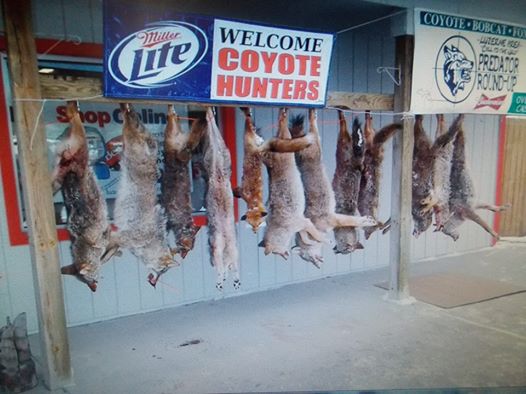
 

Welcome to Hell, Coyote Hunters

1795706_473627576096881_1329203140_n

Hundreds of killing contests have taken place all over the USA…Here is a description of a killing contest that just happened in Michigan — This pic and the description are on a public forum.

What is a “tagged coyote”? A tagged coyote is one that was previously trapped, marked in some way and then released, and killed for a prize.

“Just a few weeks ago the “Call of the Wild” Predator Round Up was held near our cabin in Luzerne Michigan. The hunt began at 7:00 p.m. Friday night and ran till 12 noon Sunday. Seventy three (73) hunters signed up comprising 33 different teams. Several teams used coyote dogs and others worked various “sets” while calling. The hunters with the dogs had the advantage, but the first “yote” turned in was by a father and son team who called the 29.7 pound female within range of a flat shooting 223” …..
“Ma Deeters (local bar/restaurant) was the starting point of the hunt, and the Best Hardware store was where the successful hunters displayed their success. There were around $1700.00 dollars in prizes with anyone bringing in a tagged coyote receiving a $1000.00 dollar bonus. Knight and Hale (game calls) donated many of the prizes handed out. First coyote, biggest, (41 pounds) ugliest, and longest awards were all given out at the culmination of the hunt. Two of the dog teams garnered most of the awards.
On Sunday afternoon there were eleven (11) coyote and one fox hanging on the game pole at the hardware store. There was an additional prize to any team that brought in the “trifecta” of predator hunting (a coyote, fox, and bobcat.) No one collected that award this year, but one team came close.”

Interview With Project Coyote: Compassionate Coexistence with Predators

Compassionate Coexistence with Predators

March 3, 2014

Hosted by Eli Weiss

Camilla H. Fox
Dr. Robert Crabtree

Episode Description

Coexisting with America’s Song Dog, with Camilla Fox and Robert Crabtree America’s Song Dog, the Trickster, of mythological status to Native Americans; Clever and intelligent, they are critical players in ecosystem health, yet they are the most persecuted. Today I welcome guest experts from Project Coyote: Camilla Fox, Founder and Executive Director and Dr. Robert Crabtree, Scientific Advisory Board member. We learn from Fox and Crabtree why our model of predator management in the form of “coyote killing contests’ and extreme exploitation is not, and will not work- particularly for our Wile E Coyote. We continue hot on the heels unveiling the barbaric practices of our USDA’s secretive killing agency ‘Wildlife Services’, using our tax dollars, on public and private land, to indiscriminately and overkill our wildlife, especially the carnivores – coyotes, wolves, bobcats, and other animals under the mantel of managing human-carnivore conflict toward agricultural and livestock interests.

Listen here: http://www.voiceamerica.com/episode/76154/compassionate-coexistence-with-predators

First the Good News: Wildlife Services’ Plane Crashes

…The bad news? The aerial coyote-killers on board survived.

[True to form, the anthropocentric media makes no mention that while “conducting aerial operations” the Wildlife “Services” agents were shooting coyotes from their plane.]

http://www.sheridancountyjournalstar.net/news/item/2259-crew-members-okay-after-plane-crash

Two crew members with the USDA-Wildlife Services escaped with only bumps and bruises Wednesday, February 12, when their plane, a government owned “Super Cub” crashed south of Gordon.

The pair were returning from western Box Butte County where they had been conducting aerial operations. Approximately nine miles out the plane’s engine started acting up and losing power. They coaxed the plane along until at five miles out the engine quit.

The pilot, Gregg Alan, from Ray, Colorado, was able to land the plane on the highway at which time it was hit with a gust of wind which caused the plane to skid off the road, hitting a power pole and two fence posts before coming to a stop.

Area rancher Paul Simmons saw the accident and gave the two a ride to town. Crew member Randy Benben, of Gordon, was treated at Gordon Memorial for back and hip pain. The plane sustained major damage and the accident is still being investigated by the Aviation Training and Operation Center (ATOC) of Cedar City Utah and the FAA.

Jim Robertson-wolf-copyright

Pennsilvania Considering a Bounty on Coyotes

[Talk about backsliding…]

Hunters could cash in on coyotes

By Brad Pedersen

Published: Saturday, Dec. 14, 2013, 1:01 a.m.

Pending legislation could make controlling the coyote population lucrative for hunters across Pennsylvania.

The State House approved a bill on Wednesday in a 111-78 vote, which would allow the Pennsylvania Game Commission to place a $25 bounty on coyotes. The bill proposes to use $700,000 for coyote control, meaning the state could pay bounties for up to 28,000 coyotes per year.

The bill needs to be approved by the State Senate before it becomes a law. The senate reconvenes on Jan. 7.

If it gets approval from the Senate, the Pennsylvania Game Commission plans to conduct a study on the state’s coyote population and complaints, to determine if a bounty is necessary, according to game commission press secretary Travis Lau.

“Right now, the Game Commission’s stance is we need to wait and see what happens in the Senate,” Lau said.

The game commission does not keep estimates on the coyote population in Pennsylvania, but loosely bases the number of animals on game surveys and harvest reports, Lau said.

According to a report from the Game Commission, the number of coyotes harvested across Pennsylvania quadrupled from 10,160 in 2000 to 40,109 in 2012.

Cliff Chestnut, a local hunter and hunter safety course instructor from North Buffalo, said although coyotes have taken residence in Armstrong County, the region is not overrun with them.

Although he has never gone hunting for coyotes specifically, Chestnut said he has encountered the animals in the wild.

“Most hunters, especially archers, see them out around October,” Chestnut said. “In certain areas, there are a lot of coyotes, but I don’t think Armstrong County has a problem with them.

“Even with a bounty, I don’t think you’ll ever eradicate the coyotes here. They have a foothold.”

The Game Commission’s last bounty program was in the 1950s, in an attempt to control the state’s red fox population, Lau said.

“Historically, bounties were used in Pennsylvania for wolves, cougars, the red fox and predators,” Lau said. “The bounties are meant to thin the population of predators, hunters blamed for killing too many game animals or that generated a safety concern or general fear for the public.”

Hunters can harvest coyotes all year, as long as they have a general hunting license, Lau said.

The Game Commission limits coyote hunting during the rifle deer hunting season, Lau said. Although it permits hunters to hunt coyote, they must also have a deer-hunting license, he said.

“We do it as a way to keep people from deer hunting without a license,” Lau said.

Today (Saturday) marks the final day of rifle deer hunting season, he added.

The Game Commission regulates coyote trapping by setting a statewide trapping season from Oct. 27 to Feb. 23, Lau said. Trappers using a cable restraint trap can begin coyote trapping on Dec. 26, he added.

“The harvest is high, so people are going out there to find and hunt coyotes,” Lau said. “Coyotes can be elusive and a true challenge to find and hunt because they do a lot of their moving at night, when they’re harder to see.”

Chestnut said a $700,000 per year allotment for coyote bounties may be too steep. Instead, he said the game commission could explore other ways to spend the money.

In addition, coyote pelts sell for $75 to $100 each, depending upon the fur market, which is more than the bounty program could offer, Chestnut said.

“Wherever you see deer populations, you’ll probably find coyotes,” Chestnut said. “It’s a beautiful animal, but I think around here, we have them under control, and they’re not a problem.”

Brad Pedersen is a staff writer for Trib Total Media. He can be reached at 724-543-1303 , ext. 1337.

Read more: http://triblive.com/news/armstrong/5250458-74/coyotes-coyote-game#ixzz2nZsvdA8i
Follow us: @triblive on Twitter | triblive on Facebook

Coyote Photo Copyright Jim Robertson

Coyote Photo Copyright Jim Robertson

Red Wolves (and Coyotes) Under the Gun!

There are only about 100 left – and if drastic measures aren’t taken soon, the critically endangered red wolf could once again be pushed to extinction in the wild by coyote hunters in North Carolina.

Last week, Defenders of Wildlife and other conservation groups officially filed suit in federal court to halt uncontrolled hunting of coyotes in the red wolves’ North Carolina habitat. In the past year, hunters have killed at least 10 red wolves – that’s 10 percent of the remaining wild population of these remarkable creatures.

North Carolina’s red wolves are the last remaining wild population on earth. These animals were extinct in the wild as recently as 1980 due to intensive predator control and loss of habitat. A concerted reintroduction program has raised the wild population of these animals to roughly 100, all confined to a small area in the eastern part of the state.

Red wolves are almost indistinguishable from coyotes in daylight,Red-wolf-and-pups-240x300 and at night they are virtually impossible to tell apart. In spite of this, the state has authorized almost unlimited hunting for coyotes in red wolf habitat. Unless the hunting is stopped, red wolves are in serious danger of once again disappearing from the wild.

[Just thinking out loud here, but how about, while we’re at it, halting the uncontrolled hunting of coyotes throughout the country; Isn’t it time we all learn to live with them?]

Conservation Groups Sue Over NC Coyote Hunting

RALEIGH, N.C. — Conservation groups are suing North Carolina wildlife regulators, saying a rule that allows coyote hunting endangers the world’s only wild population of about 100 red wolves because hunters easily confuse the two animals.

An attorney with the Southern Environmental Law Center filed the lawsuit Thursday in federal court on behalf of three other groups.

The state Wildlife Resources Commission in July approved a permanent regulation allowing coyote hunting in the five-county area of eastern North Carolina that’s known as the Red Wolf Recovery Area. A state judge earlier blocked a temporary rule allowing the hunting in Dare, Tyrrell, Hyde, Washington and Beaufort counties.

The Southern Environmental Law Center says 20 red wolves have died from gunshots since 2008.

A wildlife commission spokesman declined comment until the agency receives the lawsuit.

Coyote photo Copyright Jim Robertson

Coyote photo Copyright Jim Robertson

Public opinion differs on coyote hunting, trapping

Jim Robertson-wolf-copyright

State proposing 120-day hunting season, 100-day trapping period

By Nick Roth | Sep 06, 2013

Control is proposing a 120-day hunting and 100-day trapping season on coyotes.

The Department of Natural Resources and Environmental Control has presented its proposed regulations for hunting and trapping coyotes, and both supporters and opposition are making sure their voices are heard.

More than 50 people took the opportunity to express their opinions on coyotes and other proposed changes to the regulations at a public hearing Sept. 4 at the DNREC Building in Dover. Hunters are eager to legally kill what they consider an unwanted nuisance, while animal rights activists claim the non-native creature will not have a significant effect on Delaware’s ecosystem.

“Allowing the hunting and trapping of coyotes and the other animals is not only inhumane, it is irresponsible,” said Patricia Haddock, president of Delaware Votes for Animals. “This proposal could result in the unnecessary suffering and terrible deaths of adult animals and leave many young pups orphaned and unable to survive themselves.”

DNREC’s Division of Fish and Wildlife is proposing a hunting season of Nov. 1 through Feb. 28 and trapping season from Dec. 1 through March 10. Many hunters in attendance called the proposed regulations too conservative and lobbied officials to allow year-round hunting and trapping.

“I wholeheartedly recommend the elimination of coyotes,” said Dover resident Teddy Morwitz. “I am a dog person – I hunt with dogs – and I have had dogs killed and dragged off. Anything that can be done to reduce the population is wonderful.”

It is believed between 50 and 100 coyotes are present in Delaware, an estimation based partially on roadkill data that has found one to two coyotes are killed by automobiles annually. Comparatively, the Department of Transportation removes about 1,000 roadkill deer per year, said DNREC deer and furbearer biologist Joe Rogerson.

Rogerson said the presence of coyotes could have both positive and negative impacts on Delaware’s wildlife. The population of rodents, raccoons and red fox would likely decline, which could increase the population of the ground-nesting birds those animals prey upon, such as wild turkey.

“Predator/prey dynamics are very complex issues because we’re managing a very adaptive animal that has a very diverse diet, and landscape composition may be a factor,” he said.

Rogerson said he believes the deer population is productive enough to absorb the anticipated modest level of predation by coyotes.

Coyotes have also been known to feast on fruits, vegetables and livestock, which has many farmers also in support of the proposed regulations.

“Farming is important to my life and so is wildlife,” said farmer Ray Ellis. “These are fierce predators, and we do not need to let them establish. We need to do everything we can to eradicate them.”

DNREC is not trying to eliminate the animal from Delaware. Division of Fish and Wildlife Director David Saveikis said the regulations are meant to strike a balance among the various interests expressed.

“If these regulations are adopted or a modification thereof, there is always room to change them,” he said. “We intend, through the mandatory reporting, to track the coyote harvest, and if we find the regulations are not sufficient, we will change them.”

Many hunters strongly expressed their desire for more liberal hunting and trapping seasons, similar to those that exist in Maryland, Pennsylvania and Virginia. Some hunters also supported the idea of nighttime hunting of the animal.

Saveikis said nuisance coyotes could be addressed through a proposed secretary’s order that would authorize all private landowners to shoot coyotes that are considered a nuisance or depredating livestock or domestic animals. The order can be issued outside the regulations and is considered more responsive, Saveikis said. He said the department is waiting to see the final regulations before making a decision on the secretary’s order.

“I think it was important to realize that the combination of the secretary’s order and the proposed hunting and trapping seasons provide the tools for landowners to protect their property and effectively manage the coyote population,” he said.

Cathy Rash, vice president for Delaware Action for Animals, was strongly opposed to the hunting and trapping seasons because research suggests coyotes compensate for the loss of population by breeding at earlier ages and having larger litters.

“While we understand a few individual coyotes may be a nuisance to farmers, most are a valuable asset as having a natural predator helps keep smaller animals populations in check,” she said. “In the instance of nuisance coyotes, they should be dealt with on an individual basis instead of opening a trapping and hunting season on all coyotes.”

After listening to many animal welfare activists speak, Milton resident Ted Palmer described the cruel manner in which coyotes take down their prey.

“I hate the cruelty of animals [but] there is absolutely no comparison to what a coyote does to an animal,” Palmer said. “I’m tired of hearing about coyote puppies and how cute they are. They are cute, but they are a coyote and they need to be addressed as a coyote.”

Public comment will remain open until 4:30 p.m., Thursday, Sept. 19. Those wishing to submit comments may do so by emailing lisa.vest@state.de.us or sending comments to Lisa A. Vest, Public Hearing Officer, Office of the Secretary, 89 Kings Hwy., Dover DE 19901.