On Ho Plaza, Lucy Contreras ’21 defiantly faced the Thursday afternoon passersby with the words “Fur Kills” painted across her abdomen and an apparently blood-drenched Canada Goose jacket wrapped around her body.
The blood was fake, as was the jacket — an imitation with a “Canada Douche” sticker where one would normally find the coat’s iconic sleeve patch.
Contreras, who is a Sun opinion columnist, and her fellow demonstrators aimed to raise awareness about the animal cruelty involved in making the products of the ubiquitous winter-time brand. The coats use goose feathers, most commonly obtained by plucking live geese without any painkillers, and leaving open wounds before they are killed, according to Contreras, president of Cornell Vegan Society and Sun opinion columnist.
The detachable fur trim around the hood of the coat is made of coyote fur, Contreras said. This fur is obtained by capturing wild coyotes in steel traps, where they are often left to agonize for days — suffering from gangrene, dehydration, or attacked by other predators before the trapper returns, according to PETA. If still alive at this point, they are bludgeoned, stomped, or strangled to death, said Contreras.
The demonstrators hoped that those who currently own Canada Goose products never buy from them again and donate the detachable coyote-fur trim of their coats. Several organizations, including PETA and the Wildlife Rescue League, accept donations of furs and redistribute them to rehabilitating animals in shelters or homeless people.
And for those who don’t own Canada Goose products, the demonstrators want them to consider animal cruelty when they buy products such as coats, pillows and comforters.
Chloe Cabrera grad, a participant in the demonstration, called for people to make more responsible consumer choices.
“Each Canada Goose jacket requires seven birds and two coyotes. That’s nine animals dying for virtually no reason, for an overpriced coat that works just as well as any vegan coat,” Cabrera said.
Ultimately, Contreras said, geese and coyotes suffer and die on behalf of the market demand for Canada Goose.
The demonstration was “eye-opening,” Paul Agbaje ’22 said after speaking with a protester.
“No matter how you feel about it, people seem to just mindlessly buy these Canada Goose jackets, without ever considering the ethical implications,” he said.
Other onlookers were less keen, making hostile comments about the demonstration as they walked by.
Contreras is understanding of negative responses like these. “I feel like this shame and this frustration is the beginning of a process of acceptance and of actually taking action against Canada Goose,” she said.
“We’re not blaming them,” Contreras said. “We just want them to know, in the future, to buy jackets that don’t have down or fur.”
Contreras declared the demonstration a success, describing it as one step towards a better public understanding of the relationship between everyday expenditures and animal exploitation.
She encourages friends and peers of Canada Goose wearers to engage them in dialogue. On campus, conversations about ethical consumption are on the rise — Cornell Vegan Society has risen from just a handful of members twoyears ago to about twenty five today, according to Contreras.
She wants them to know that, “with that social status, you are hurting a lot of beings in the process. And it’s not worth it.”
These five bears travelled together in a pack in the Okanagan city of Penticton, B.C., before being put down by conservation officers on Thursday. (Submitted by Tobe Sprado/Conservation Officer Service)
comments
Five bears were destroyed by conservation officers in Penticton, B.C., Thursday after the group ventured too close to an elementary school.
Tobe Sprado, an inspector for the Okanagan region with the B.C. Conservation Officer Service, says the service has received 44 complaints about these particular bears since August.
“We were hoping that we’re going to be able to coexist with these bears,” Sprado said. “But things had escalated over that period of time.”
Sprado said the bears were attracted to garbage and fruit, and were starting to cause property damage.
On Wednesday afternoon, things escalated after one of the bears charged a person out walking.
“That [was] an aggressive behaviour that definitely put these bears more on our radar,” Sprado said.
“Then when they entered into the vicinity of the elementary school, we ended up making the decision to put down all five bears.”
The children and teachers were kept inside until the bears were shot dead.
Bears can cause problems in towns and cities as they look for food to eat before winter hibernation. (Submitted by Rachel Rowbottom)
Unusual grouping
Sprado said the bears would travel together in a pack, unusual for black bears. The group comprised three adult male bears and two females who were sub-adults.
“It wasn’t your typical sow with the cubs at all … [it’s] a bit of an anomaly from what we’re used to dealing with,” he said. “They could be a bunch of siblings.”
Sprado said his team was emotionally drained and frustrated by the turn of events.
It comes a little over a week after six bears were shot in the space of three days in the area of Lake Okanagan Resort northwest of Kelowna. In that case, the bears were eating garbage that hadn’t properly been secured and had lost their fear of humans.
An undisclosed company near Kelowna was fined $230 and ordered to improve the way it stores its garbage.
Sprado implored people to safely secure bear attractants like garbage, fruit, as well as pet food, bird feeders, barbecues and compost.
Wild burros on a dry lake bed in the Silurian Valley in October 2014. Since May 2019, a total of 42 wild burro carcasses with gunshot wounds have been found along Interstate 15 near the California-Nevada state line.
More than 40 wild burros have been found shot and killed along the Interstate 15 near the Nevada state line, Federal officials said on Friday, and they’ve offered a reward of up to $18,000 for information leading to the arrest and conviction of those responsible.
It is one of the largest killings of its kind on public land managed by the U.S. Bureau of Land Management in Southern California, officials said.
A total of 42 wild burro carcasses with gunshot wounds have been found in various states of decomposition near the freeway corridor through the Clark Mountain Herd Area managed by the Needles field office of the BLM.
“We will pursue every lead until we’ve arrested and prosecuted those responsible for these cruel, savage deaths,” said William Perry Pendley, the BLM’s Deputy Director for policy and programs, “and we welcome the public’s help to bring the perpetrator or perpetrators to justice.”
Details about the ongoing investigation were scarce. However, BLM officials said the burros, including several juveniles, were shot in the neck with a rifle.
Some were brought down while drinking water in the Halloran Springs area.
Animal protection organizations said they were outraged by the slaughter and have contributed thousands of dollars to the reward.
“It’s a travesty that these animals would be gunned down,” said Grace Kuhn, spokeswoman for the nonprofit American Wild Horse Campaign. “There’ve been isolated incidents before over the years, but nothing on this scale in memory.”
Neda DeMayo, president of the nonprofit Return to Freedom, said, “I’ve been told that at least one of the burros was still alive when it was discovered by a passerby. But it succumbed to its injuries by the time BLM investigators arrived on the scene.”
“It’s all so unbelievable,” she added. “Crazy. Hostile. Cruel.”
Burros are not native to the West’s deserts, but they became some its most valued resources: sure-footed in rugged terrain, capable of carrying heavy loads long distances, and withstanding extremes in temperatures of cold and heat.
In the 1920s and 30s, they were turned loose and replaced by Model-A Fords and other vehicles. Since then, they have multiplied without restraint with few predators to check their numbers.
With populations that doubled every four to five years, they’ve managed to survive by feeding on the sage and wild growth of the Mojave Desert.
By the 1950s, wanton slaughter of wild burros in California’s desert and mountains had reached such proportions that the Society for the Prevention of Cruelty to Animals pressed for legislation to protect the creatures from trigger-happy hunters.
One killing ground was Homewood Canyon, near Trona, about 240 miles northeast of Los Angeles, where the SPCA officials in 1953 reported a shocking scene: Over an area of 50 acres, they found 50 burro carcasses. Only a few had bullet holes in the head, indicating that most had been left wounded where they fell.
Today, the animals are protected from capture, branding, harassment or death under the Wild Free-Roaming Horses and Burros Act of 1971, which considers them an integral part of the natural system of public lands managed by the BLM.
Violations of the act are subject to a fine of up to $2,000, or imprisonment for up to one year, or both, for each count charged.
Anyone with information about this incident is asked to call the WeTip hotline at (800) 782-7463 or visit http://wetip.com.
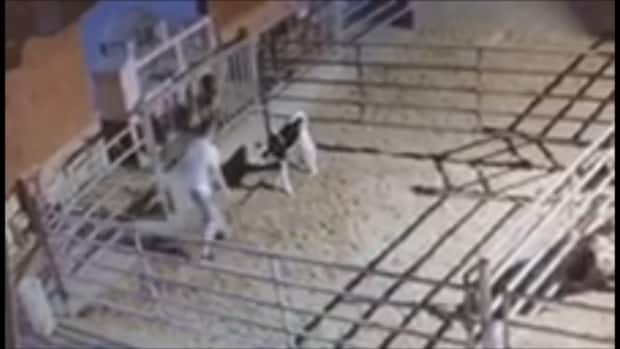
A man and woman, in this surveillance footage, stand at the far left of the enclosure near the calf at the Langley, B.C., farm. (Eagle Acres Dairy/Facebook)
Brian Anderson walked into his dairy farm last week expecting to see Scorcher, a five-day-old calf he left sleeping in its enclosure the night before.
The calf was gone. In its place were puddles of blood and a broken arrow.
The arrow was apparently used in an attack against the calf that was caught on surveillance footage at Eagles Acres Dairy, a small, family-run farm in Langley, B.C.
RCMP are now investigating.
The footage, which Anderson reviewed shortly after the discovery, shows a man and a woman entering the barn at about 4:45 a.m. PT on Aug. 1.
For eight minutes, Anderson said, the man shot the calf with up to six arrows using a crossbow. When the animal remained alive and standing, the man stabbed it repeatedly with an arrow.
Watch the man approach the enclosure and roll under the gate:
CBC News BC
Surveillance footage shows couple entering dairy farm before calf is killed
00:0000:38
RCMP say they’re investigating footage from a Metro Vancouver dairy farm that shows a couple attacking and killing a calf. The attack is not shown here in this edited version. 0:38
The man dragged the body out of the farm and placed it in the trunk of a black luxury SUV before driving off with the woman.
“Looking at the video was a gut-wrenching experience,” Anderson said.
“It was disturbing to us even being farmers who understand what death is.”
The calf was five days old when it was attacked. (Submitted by Brian Anderson)
Motive not known
The case garnered attention after Anderson posted stills from the surveillance footage on the farm’s Facebook page.
RCMP Cpl. Holly Largy said investigators reviewed the surveillance video and hope the public can help identify the two trespassers.
The motive for the attack is unclear, she said.
“Potentially they took it for a veal for a restaurant or there could be more sinister type of things that I couldn’t begin to conceive. But I honestly don’t know why they did it.”
Anderson said the male and female trespassers appeared to be Asian and in their mid-to-late 20s or early 30s.
A camera captured the couple driving away, but the licence plate is not visible.
The footage shows the man and woman placing the carcass in the trunk of a luxury SUV and driving off.(Eagle Acres Dairy/Facebook)
The farm, which opened in 1999, offers tours to schools and drop-in visits in a wide, open space.
Anderson installed the cameras to monitor cows giving birth, he said, but the farm remains largely unsecured at night.
“To surround ourselves with a gate and a fence is just not practical,” he said.
Chuckwagon driver Chad Harden was disqualified from the Calgary Stampede after causing an accident on July 11, 2019, that led to a horse being put down. Chuckwagon horses make up more than two-thirds of the animal deaths at the Stampede. (CBC Sports)
94
comments
The 2019 Calgary Stampede is now tied for second place as the deadliest year for chuckwagon horses in more than three decades — with the total tally of animal deaths surpassing 100.
The latest deaths bring the total number of animals that have died during the rodeo and chuckwagon races at the Stampede since 1986 — when the most detailed records are available — to 102.
The Calgary Stampede declined requests to provide the organization’s own details on deaths through the years.
The most complete records available publicly are from the Vancouver Humane Society, which has added up the tally since 1986 using data from the Calgary Humane Society and media reports.
That gives it the unfortunate honour of tying with 2010 as having the second highest toll on chuckwagon horses. Chuckwagon horses make up more than two-thirds of the animal deaths at the Stampede.
The top of the list is 1986, when 12 horses died.
Two humans have also died in the competition since 1986: outrider Eugene Jackson in 1996 and wagon driver Bill McEwen in 1999. Both died of head injuries.
Here’s an overall roundup of animal deaths at the Stampede since 1986:
The Vancouver Humane Society says the total tally includes:
72 chuckwagon horses.
Nine calves.
Five steers.
Four bucking horses.
One wild ride horse.
One show horse.
One bull.
Outside of the Stampede itself, nine horses died in 2005 while being herded over a bridge on their way to the grounds.
The latest deaths prompted renewed calls from animal rights advocates and others for the Stampede to end chuckwagon races and the rodeo.
This graph tallies animal deaths, by year, at the Stampede. Use the drop-down menu to see the data by animal type:
The Calgary Stampede has launched a review in response to Sunday’s deaths. Last week, a chuckwagon driver who caused an accident that led to a horse being put down was fined $10,000 and banned from competing at future Stampedes.
The Stampede says it has made many changes over the years to increase the safety of animals and humans.
The Stampede’s roots can be traced to 1886, when the Calgary and District Agricultural Society held its first fair.
The 2019 Calgary Stampede ran July 5-July 14.
A tarp covers the scene of the accident that led to three horses being euthanized after a chuckwagon race at the Calgary Stampede on June 14, 2019. (Anis Heydari/CBC)
A dog was set on fire and killed in Connecticut last Friday — and police are searching for the person who committed the heinous act, according to reports.
The pooch, believed to be a miniature schnauzer, was discovered when firefighters responded to a 10 a.m. blaze in a parking lot of the Sandy Point Beach and Bird Sanctuary in West Haven, according to NBC Connecticut.
Investigators believe an accelerant was also used to burn the animal, the report said.
“I don’t even think there’s a chance that even Hell would accept them,” West Haven Chief of Police Joseph Perno told the paper, referring to whoever is responsible for the attack.
Perno, who owns five Labrador retrievers, is asking for the public’s help in solving the crime.
“We’re asking anybody who could possibly have seen anything, or anyone in the neighborhood who might have a video camera to come forward and help,” he said.
West Haven Fire Department Chief Jim O’Brien was equally as appalled.
“Anybody that does something like that to an animal, it’s sick,” he told the paper. “I can’t imagine who would want to do that to a defenseless animal.”
Italian police are investigating after one of the country’s most famous tamers was killed by four tigers he was training.
Ettore Weber died Thursday evening during a rehearsal at Marina Orfei Circus in Triggiano, Bari, Italian newspaper Repubblica reported.
Police said they think one tiger bit Weber, prompting the other three to attack. The animals mauled the tamer for some 20 minutes, according to Notizie.it.
Some 118 people tried to rescue Weber, but he died from his injuries. He was in his early sixties.
Weber’s show was part of the circus’s “Animal Park” event, which featured live animals from five continents. It was due to run from June 15 to July 14. The circus did not immediately respond to Newsweek‘s request for comment.
File photo: A tiger jumps through a flaming hoop at a circus. An exotic animal tamer has been killed by four tigers he was training.GETTY
Weber’s death provoked fierce criticism on social media of circuses that feature wild animals. One Twitter user wrote: “Animals have to stay where nature puts them, stop. You can’t torture them for your own profit and delight.”
Sofia Marinelli@TopaM79
·
Procura di Bari apre inchiesta per ricostruire l’incidente a Ettore Weber, domatore del circo Orfei, ucciso da una tigre durante le prove a Triggiano. Che vuoi ricostrui’? Un animale selvatico, per quanto addestrato, resta selvatico. Se lo tratti da giocattolo ci scappa il morto.
Gianluca #IoBalloConLaura@Gianluc54410558
Gli animali devono stare dove la natura li mette, stop. Non puoi torturarli per il tuo profitto e diletto.
User Lello Pinto called those who run circuses with wild animals “beasts.” “A decent parent doesn’t take their children to see animals behind bars,” Pinto added.
User Katerina Medici said she was not “at all” sorry about the tragedy. “This is not their natural habitat,” she wrote. “Let these animals go free.”
“Karma is a b****,” tweeted another user. “Another reason not to use animals in circuses.”
Bari, tigre sbrana addestratore al Circo Orfei e lo uccide: tragedia durante le prove
Tragedia al Circo Orfei allestito nelle campagne di Triggiano, vicino al centro commerciale Bariblu. Secondo quanto appreso una tigre, durante le prove dello spettacolo, ha azzannato il suo addestr…
fanpage.it
See Taltos ‘s other Tweets
User Paola Massari said she was “dismayed, of course,” but added: “This could also be an opportunity to stop exploiting, segregating and mistreating exotic animals.”
But some Twitter users hit back at critics. One said those “rejoicing” over Weber’s death wouldn’t do the same if he was their own friend or relative. The user added: “If you are so opposed to the mistreatment of animals in the circus, why don’t you actually take action?”
G I O@mccharmlypaul
·
Siete di una piccolezza infinita, voi che esultate per la morte di un uomo sbranato da quattro tigri. Immagino che avreste fatto la stessa cosa se al suo posto ci fosse stato vostro padre, vostro figlio, un vostro parente o un vostro amico. #circo#ettoreweber
G I O@mccharmlypaul
Se siete così contrari al maltrattamento degli animali nel circo, perché non vi attivate concretamente? Al posto di scrivere “godo”, “se lo è meritato”, “finalmente”.
Italy’s parliament voted to phase out animal circus acts in November 2017, with a requirement that new legislation be outlined within a year. Campaign group Animal Defenders International hailed the move as “a major breakthrough” for animal rights.
In the U.S., some states have banned the use of exotic wild animals in circuses. When New Jersey governor Phil Murphy signed such a bill into law last December he said he was proud his state would no longer allow animals to be “exploited and cruelly treated.” He added: “These animals belong in their natural habitats or in wildlife sanctuaries, not in performances where their safety and the safety of others is at risk
On May 5, 2019, Thomas “Landon” Grant, a 19-year-old former college student
and
19-year-old Jacob Thomas Frye went to the pond at Central Alabama Community
College in Alexander City, in Tallapoosa County, looking for an animal to
abuse
following a party.
Alexander City police Det. Robert Oliver said they and others grabbed a
white
Muscovy duck and “beat the duck with a bat,” then took the duck to a nearby
apartment, put the beaten duck in a bag, beat the duck more, then disposed
of
the wounded, still living bird in the woods.
A baseball coach, overhearing a commotion, found the beaten duck in the
woods,
and took her to a veterinarian to be euthanized. The coach notified the
authorities.
Thomas “Landon” Grant was arrested on May 31 and booked into the Tallapoosa
County Jail on a Class C felony charge of aggravated cruelty for the
“infliction
of torture to the animal.” We understand that Jacob Thomas Frye has also
been
charged.
*What Can I Do?*
Politely urge the Tallapoosa County District Attorney to prosecute Thomas
“Landon” Grant and Jacob Thomas Frye to the fullest extent of the law for
their
Class C aggravated felony cruelty to this duck. Please do NOT plead that
this
crime matters because it could lead to violence against humans. The duck’s
experience is not a mere gateway to what could happen to humans. What the
duck
endured at the hands of these brutal men is as bad as it gets. Justice for
this
duck is what we are asking for. See United Poultry Concerns’ letter to the
<http://upc-online.org/ducks/190702_letter_to_da_re_sadistic_duck_abuse.html>
Tallapoosa County District Attorney
<http://upc-online.org/ducks/190702_letter_to_da_re_sadistic_duck_abuse.html>
.
*Contact:*
Jeremy Duerr, District Attorney
Tallapoosa County, Alabama
395 Lee Street
Alexander City, AL 35010
Phone: 2562342735 or 256-215-3055
Email: duerrman@gmail.com
an animal looking at the camera: Named Hope by her rescuers, an orangutan in Indonesia who was shot and blinded by villagers now lives in an enclosure.
Named Hope by her rescuers, an orangutan in Indonesia who was shot and blinded by villagers now lives in an enclosure.
BUNGA TANJUNG, Indonesia — The men came at Hope and her baby with spears and guns. But she would not leave. There was no place for her to go.
When the air-gun pellets pierced Hope’s eyes, blinding her, she felt her way up the tree trunks, auburn-furred fingers searching out tropical fruit for sustenance.
By the end, Hope’s torso was slashed with deep lacerations. Multiple bones were broken. Seventy-four pellets were lodged in her body. Her months-old baby had been ripped away.
Hope, who was named at a rehabilitation center, is a Sumatran orangutan — a critically endangered animal that scientists warn could be the first major great ape species to go extinct. As jungle and swamp are cleared for palm oil plantations, orangutans, whose name means “people of the forest” in Malay, are losing the very habitat that gives them their identity.
All around the Indonesian island of Sumatra, charred landscapes of blackened tree stumps and singed earth attest to the devastation wrought by humans.
“Twenty thousand hectares are cleared and a couple trees are left and the orangutan looks around and says, ‘What happened to my forest?’” said Ian Singleton, the director of the Sumatran Orangutan Conservation Program.
Two nations, Indonesia and Malaysia, provide the world with more than 80 percent of the palm oil used in everything from biofuel and cooking oil to lipstick and chocolate. Last September, amid concerns over diminishing habitat for endangered species and dangerous carbon emissions from mass burnings to clear land, Indonesia stopped issuing new licenses for palm oil plantations.
“They say there is a moratorium, but I can see with my own eyes that land is being lost every day,” said Krisna, a coordinator for the Human Orangutan Conflict Response Unit, a group based on Sumatra that has rescued more than 170 injured orangutans since 2012. (Like many Indonesians, Krisna goes by a single name.)
Orangutans live on just two islands in the world. Apart from humans, they are the only great ape species that resides outside of Africa.
From 1999 to 2015, the orangutan population on the island of Borneo declined by more than 100,000, researchers reported in Current Biology, a scientific journal. There are about 100,000 orangutans remaining on Borneo, according to the World Wildlife Fund. On Sumatra — where more than half of the forest cover has been lost since 1985, according to a coalition of environmental groups called Eyes on the Earth — there are now fewer than 14,000 Sumatran orangutans.
That might not sound like a figure heralding certain extinction. But because orangutan mothers let so much time pass between births — eight to nine years are dedicated to raising each child — scientists fear that the population is in a death spiral.
The unluckiest orangutans die in the fires set to clear the land. The more fortunate are marooned on small islands of trees among oil palms. Desperate for food, they stray into areas inhabited by humans, raiding crops and provoking villagers to act.
“They eat a couple fruit, and they get shot,” said Mr. Singleton. “And nothing’s done about it. There’s no law enforcement.”
When Hope showed up earlier this year on the outskirts of Bunga Tanjung village in Aceh Province on Sumatra, some of the earth was still smoldering. Neat rows of oil palm seedlings stretched toward the horizon. Confined to a narrow strip of secondary forest, Hope gobbled fruit from village orchards to survive.
The majority of Bunga Tanjung’s residents are not from Aceh, but are poor, economic migrants from other parts of Indonesia, lured by the demand for palm oil.
The palms, a species native to West Africa, provide essential income for often struggling farmers, even if the plants spread pernicious roots that make it difficult to till the land again.
“Without palm oil, we cannot survive,” said Sanita, the mayor of a Bunga Tanjung borough.
Over a period of weeks, villagers repeatedly shot at Hope, trying to scare her away. But with few places to go but the sliver of jungle, Hope stayed put.
A 100-pound orange ape is considered an oversized pest, but Hope’s baby held promise for some in the village. Although selling endangered species is illegal, orangutan babies are often captured for the pet trade, or for zoos in need of a star attraction.
Compared to humans or chimpanzees, orangutans are the introverts of the ape world, leading largely solitary lives. But in captivity, they have been taught sign language, and their eye contact is disarming. Their exuberant smooching noises sound suspiciously like flirting.
A big-eyed baby with tufts of coppery hair can earn villagers $70, according to local conservationists who have tracked the endangered species trade. By the time the apes are sold to unscrupulous zoos or private owners, they can go for 100 times that.
Adulthood, though, devalues the captive orangutans. They aren’t as cute. They are too strong. And few people have the time and energy to devote to such intelligent creatures, leaving many forgotten behind bars, their limbs and minds atrophied.
“We wouldn’t put a human in a cage so small they couldn’t turn around,” said Harista, a keeper at a rescue center, who once taught an orangutan to swing on his arms again after 17 years of confinement. “Why do we do this to orangutans?”
In March, a teenager from Bunga Tanjung headed for a cluster of trees. His aim: To pry Hope’s baby from her arms. Even though pellets had robbed the mother of her eyesight, Hope struggled to protect her child, leaving scratches on the boy’s arms.
But the teenager did ultimately succeed in taking the baby away, keeping it in a basket outside his home.
By the time local forestry officials were alerted to Hope’s presence and mounted a rescue effort, the baby was barely responsive, said Mr. Krisna, the coordinator for the orangutan rescue organization.
Mr. Sanita, the mayor, presented a different version of events. Hope was only in the village for a couple of days, he said, contradicting the evidence of weeks of orangutan nests built in nearby trees. No one in his village had shot her, he said, discounting the 74 pellets.
“We wouldn’t do anything to hurt orangutans, even though the orangutans bother us,” he said.
Mr. Sanita said he had no idea a baby was involved, although he later amended his story. If anyone had kidnapped a baby orangutan, he said, it would have been children.
“Adults know that taking an orangutan is illegal, so I’m sure no one in the village would do that,” he said. “Maybe it was just children playing around.”
With Hope sedated in the back of a vehicle, the baby restored to her embrace, Mr. Krisna rushed to Mr. Singleton’s rehabilitation center near the city of Medan, 10 hours away.
The baby died along the way.
A Swiss surgeon flew out to operate on Hope. (Surgeons tend to be more adept than veterinarians at ape surgery.)
Hope is now recovering in an enclosure. She has learned through touch to accept a papaya or bottle of milk from a keeper.
Nearby, orphaned orangutans whimper and squeak. When Hope hears the babies, she curls into a fetal position and cries out.
Orangutans share nearly 97 percent of their DNA sequence with humans. The remaining 3 percent do not preclude Hope from mourning her baby. Her body is still producing milk.
“Hope’s body was broken, she lost her vision and her baby, and now she’s a wild animal in a cage,” said Yenny Saraswati, a veterinarian at the center. “I can’t think of a more stressful situation.”
Back in Bunga Tanjung, Hope’s shadow lingers. The teenager, whose name is being withheld because he is a minor, has been questioned by the police, but because he’s underage it’s not clear whether he will be charged. No adults have come forward to claim responsibility for Hope’s many injuries.
The teenager has given up his dream of becoming a mechanic and rarely comes home now, according to his father, Aliong Sitepu. “He’s always in a bad mood,” Mr. Aliong said. “I don’t know how to talk to him.”
Sitting outside his wooden shack, the jungle heat oppressing every pore, Mr. Aliong wondered whether it was time to leave this place, where the fruit of an African palm had failed to make his fortune. An orange beast, he said, had cursed the family.
“Is this a fair world,” he said, “in which my son’s life is worth less than an orangutan’s?”
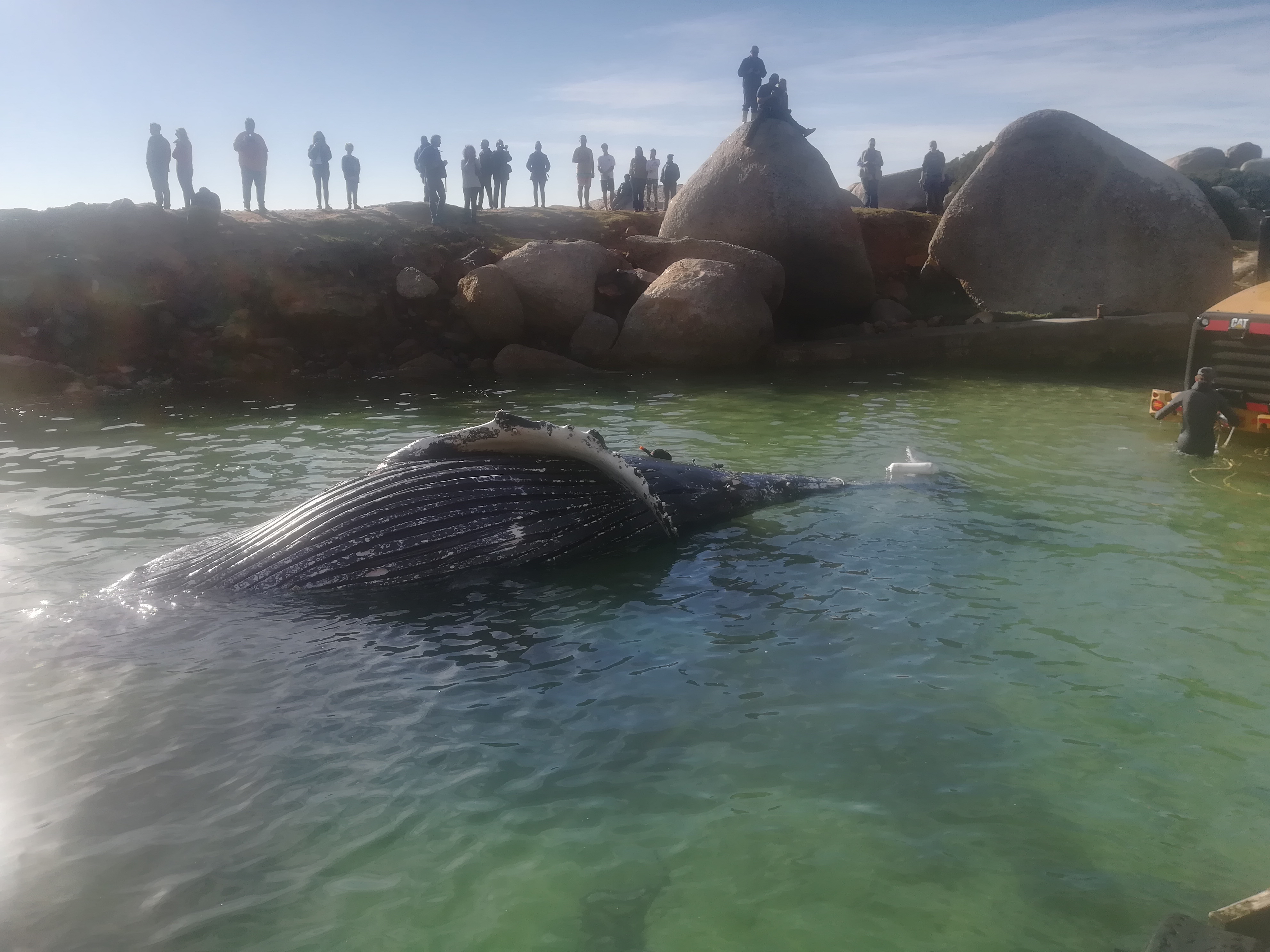
A carcass of a young humpback whale, about eight metres long, that was killed during octopus fishing is retrieved on June 27, 2019 in Cape Town, South Africa. According to the City of Cape Town officials, the humpback whale was entangled in an octopus fishery line and had drowned. This is reportedly the third entanglement and second fatality of whales as a result of the octopus fishery in the last two weeks. (Photo by Gallo Images/Brenton Geach) Less
The City of Cape Town has called on Environment, Forestries and Fisheries Minister Barbara Creecy to issue a moratorium on octopus trapping in False Bay, following the death of two whales in two weeks as a result of the controversial industry.
ARTICLE UPDATE 4.50PM, 28 JUNE, 2018: The Minister on Friday acounnced in a statement it had decided to temporarily suspend exploratory fishing for octopus with immediate effect. The decision was taken following consultation with operators in the False Bay Area.
Late in the afternoon of Wednesday, 26 June, the carcass of a juvenile humpback whale was spotted off of Sunny Cove in False Bay. The animal was left floating overnight until city officials from the Environmental Management Department’s Coastal Management Branch, with assistance from Cape Town Octopus – the company at the centre of the controversy – were able to retrieve it early on Friday morning.
It was the second whale to have died in just two weeks, both allegedly having drowned after becoming entangled in fishing line attached to octopus traps.
The death of a Bryde’s whale on 11 June sparked outrage on social media platforms such as Facebook and Twitter, with citizens calling for the industry to be shut down after media reports revealed that the octopus trapping permit is classified as experimental rather than commercial. The official number of whales that have died as a direct result of becoming entangled in octopus traps is not known – some reports indicate that nine whales have died over the last few years, while others say the humpback whale is only the third to drown.
But Garry Nel, General Manager of Cape Town Octopus, told Daily Maverick on Thursday that the latest whale death was not as a direct result of his current gear.
“It was a line that was lost seven years ago in another detanglement operation from a separate vessel all together that was one of the very first research boats in that area using gear with no modifications. We assisted the NSRI in that detanglement, and they cut the line and we never found that gear again.”
Nel has operated in False Bay catching octopus for over 15 years, although the Department of Environmental Affairs told Daily Maverick that multiple stakeholders were offered the same permit option.
Nel said the line used seven years ago floated, while the lines his team currently use are weighted, sinking lines. Nel told Daily Maverick that one of the new sinking lines caught onto the old piece of line, but the whale was entangled in the older line.
In a press release issued by the City of Cape Town Marian Nieuwoudt, Mayoral Committee Member for Spatial Planning and Environment said that “the whales swim into the long ropes, and that they get a fright when this happens. They then roll over and get entangled, and eventually drown because the fishing gear is too heavy for them to reach the surface.”
A juvenile humpback whale is hauled to shore after becoming entangled in octopus traps on 26 June in False Bay, Cape Town. Photo: Tessa Knight
As a result of the latest whale death, the City has called for Minister Barbara Creecy to issue a moratorium on the experimental licence, requesting that all gear be removed from False Bay until the “fishing gear and equipment are redesigned, tested, and proven not to pose a threat to our marine life”.
Creecy, as the new Minister of Environment, Forestries and Fisheries (DEFF), takes over control of what was previously the Department of Agriculture, Forestries and Fisheries (DAFF). It was DAFF that issued the experimental octopus fishing permit in 2003 and it is DAFF, now DEFF, that Nel provides with data on all things octopus related.
At a Fisheries stakeholder forum on 19 June Creecy addressed the contentious issue of trapping octopus in False Bay.
“What I would like to do is get some independent opinion on this so that I can understand whether we are doing everything that we can to prevent a situation where we’re endangering mammals,” Creecy said.
But environmental activists are demanding the Department provide answers as to why the process has taken so long. Swati Thiyagarajan, head of Conservation and Campaign of the Cape Town-based Seachange Project, told Daily Maverick that one of the biggest issues with the Department is a lack of transparency.
“It’s a Marine Protected Area, why did the start this project in the first place? What, and who, are they supposed to be protecting?”
Video Player
00:00
00:09
Thiyagarajan was among a small group of bystanders and activists who watched Thursday’s humpback being transported from the slipway onto the back of the City’s Solid Waste Department’s trucks (see video clip above). As the juvenile whale was moved into shallow waters those present noted the presence of another whale just outside of the slipway investigating the situation.
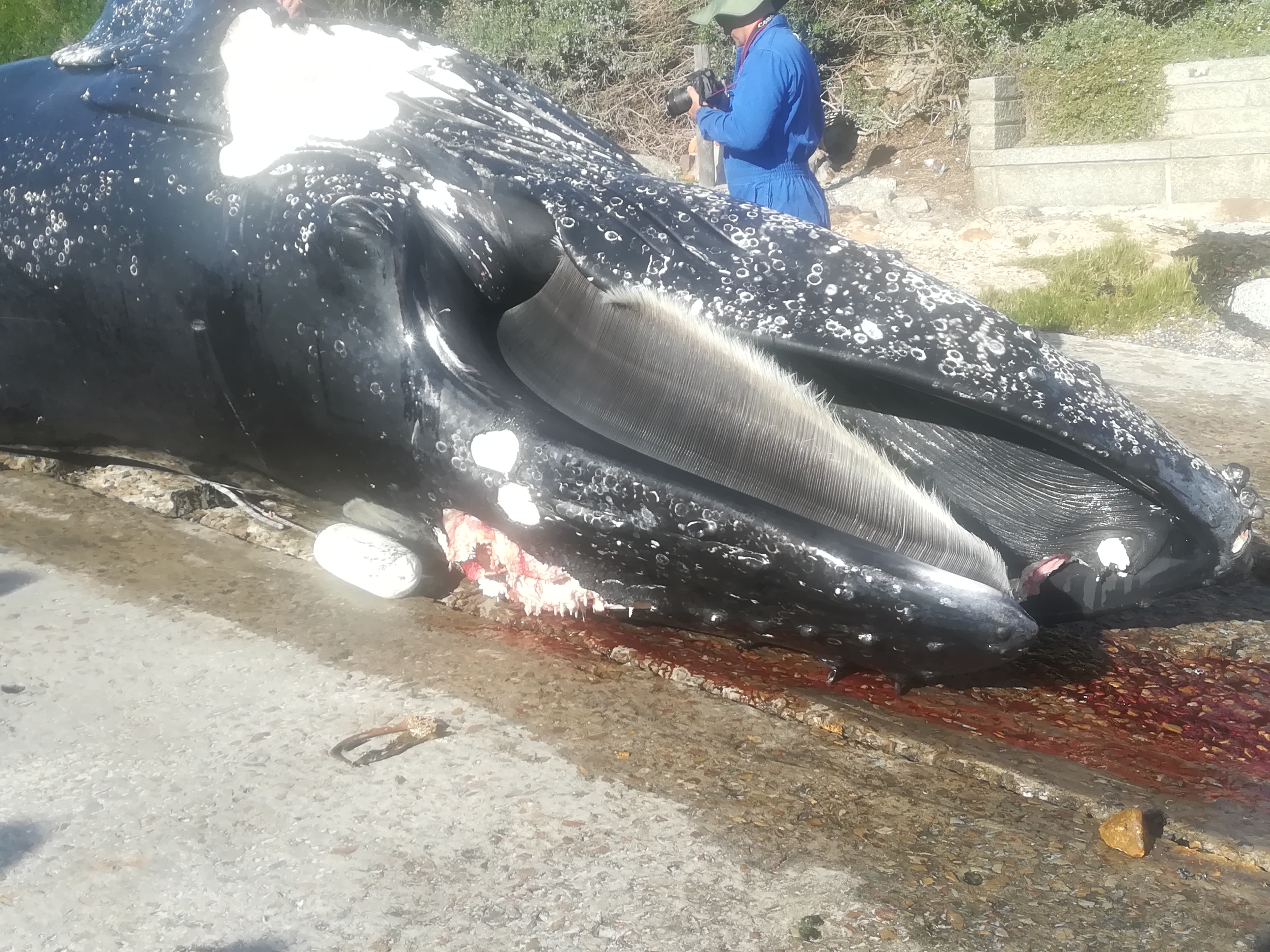
Darryl Colembrander, City of Cape Town Head of Coastal Management and Programmes, told Daily Maverick that the missing pieces of flesh on the whale were in fact shark bites rather than wounds caused by the entanglement itself.
A juvenile humpback whale is hauled to shore, 26 June, False Bay, Cape Town. Photo: Tessa Knight
In a response to Daily Maverick’s request for information, Albie Modise, Chief Director of Communications for the Department of Environmental Affairs said:
“The only consistent (and therefore practically usable data) that has been received from this fishery to date has been that collected by Mr Nel’s fishing operations.
“As fisheries data relies on analyses of trends over time, the data from the first few years are not very informative, but these become more informative as one accumulates more data over time.”
The Department did not respond to a deadline requesting more information on why data was not made public. DM





 Exposing the Big Game