Exposing the Big Game

Forget Hunters' Feeble Rationalizations and Trust Your Gut Feelings: Making Sport of Killing Is Not Healthy Human Behavior

Exposing the Big Game

Animal welfare: if you want cheap knitwear, it’s the sheep that may suffer

Shutterstock

Secretly filmed footage of a group of sheep shearers working on a farm makes for shocking viewing. Animals are kicked, stamped on and punched in the face. The abuse, uncovered by an animal rights group, is difficult to watch.

Broadcast by Channel 4 News, the footage was filmed by PETA Asiaduring summer wool shearing, when teams of contractors are typically paid “per sheep sheared”.

It goes without saying that animal cruelty and mishandling is unethical, and sheep farmers are understandably keen to stress that the footage is not representative of British sheep farming practises. But beyond the indefensible actions of some individuals lies a wider issue. In low margin industries, such as wool, there are limited incentives to invest in people with a high level of skill – or respect for animals.

Consumer demand for cheap clothing is part of the problem. Apart from what is used for carpets, mattresses and one or two other artisan sectors of the industry, the generally low price of wool makes it hard for farmers to prioritise processes like shearing. To do so is neither profitable nor productive.

The market for wool is particularly stringent. What was once a thriving component of the sheep farming industry is now a mere byproduct of the more profitable lamb market. Yes, wool commodity prices have increased over the last decade and there have been some niche successes in, for example, rare breed wool such as Herdwick fleece from the UK’s Lake District.

But for many farmers, wool production provides only a small fraction of their overall income. In terms of the invested effort in cleaning, processing and packing shorn fleeces, it is almost certainly loss making.

The sheep shearing scandal revealed by PETA comes at a time when there has been a sharpening focus on animal welfare issues. There have been policy pledges made by the UK’s environment secretary, Michael Gove, to bring animals into the political spotlight, for example by prohibiting sales of puppies and kittens in pet shops.

But these pledges may do little to reassure a public that takes a serious interest in animal health and that has seen myriad recent “scandals” in relation to contamination (horse meat), disease (foot and mouth, BSE, bird flu) and the ethics of animal treatment.

Animal ethics

Research shows that a large majority of people who work with animals do so because they find human-animal contact rewarding in some way. For some, it’s the prospect of improving the well-being of animals as a veterinary surgeon, or as a volunteer in a rescue shelter. For others, like farmers, the reward comes from interacting with animals as part of a particular way of life.

Even those employed in slaughterhouses and meat processing plants have been observed to display a generally unemotional “blankness” rather than outright violence when it comes to handling animals. It seems instead that acts of violence and cruelty are restricted to a minority, and research has shed light on the psychological links between animal violence and other forms of social dysfunction, such as domestic abuse. For most, animal work is either positively rewarding or routinely unemotional.

What is significant is that a minority of unregulated and probably unobserved individuals are allowed to engage in acts of cruelty that most would find repugnant and deeply upsetting. In the sheep farming industry, where farmers are working to tight profit margins in tough conditions, there is so little slack in the system that – at times like shearing – speed can be valued over other concerns.

It is this low margin, high speed culture which makes it more likely that self-employed contractors like shearing gangs will seek to cut corners or lose patience with their charges and react with violence.

There are no simple solutions to such problems. But continuing to expose and discuss animal cruelty is an important step in ensuring it remains on the agricultural and political agenda – and that it permeates the consciousness of consumers, too.

Consumer demand for wool is a driver of the price the farmer receives and, as the seasons change and magazine editors publicise jumpers and cardigans for the autumn and winter, now is a good time to raise awareness of the issue.
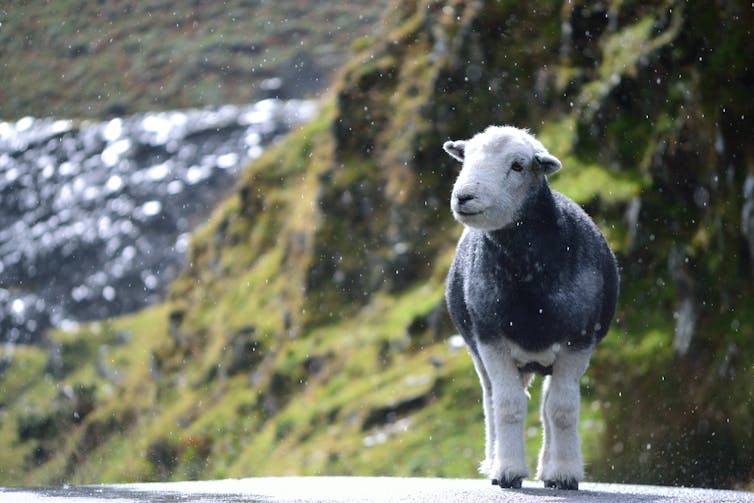
A happy Herdwick. Shutterstock

Greater regulation and surveillance is needed in the shearing industry to ensure rogue practitioners are prevented from finding work. Beyond that, however, sheep farmers also need to be able to secure greater returns for wool in order to maximise the care they take in its production. It needs to be worth their while to hire people who are paid fairly for the time they take to do the job well.

It can be done. In the UK, Herdwick sheep were once maligned for their particularly wiry wool. Their products have now been successfully rebranded as the breed’s longstanding connection to the beautiful Lake District has added a premium to their fleeces, now prized for their quality and durability in the production of mattresses, carpets and tweeds. Other farmers may well be able to follow their lead, providing greater opportunities for generating new value in this most ancient of commodities.
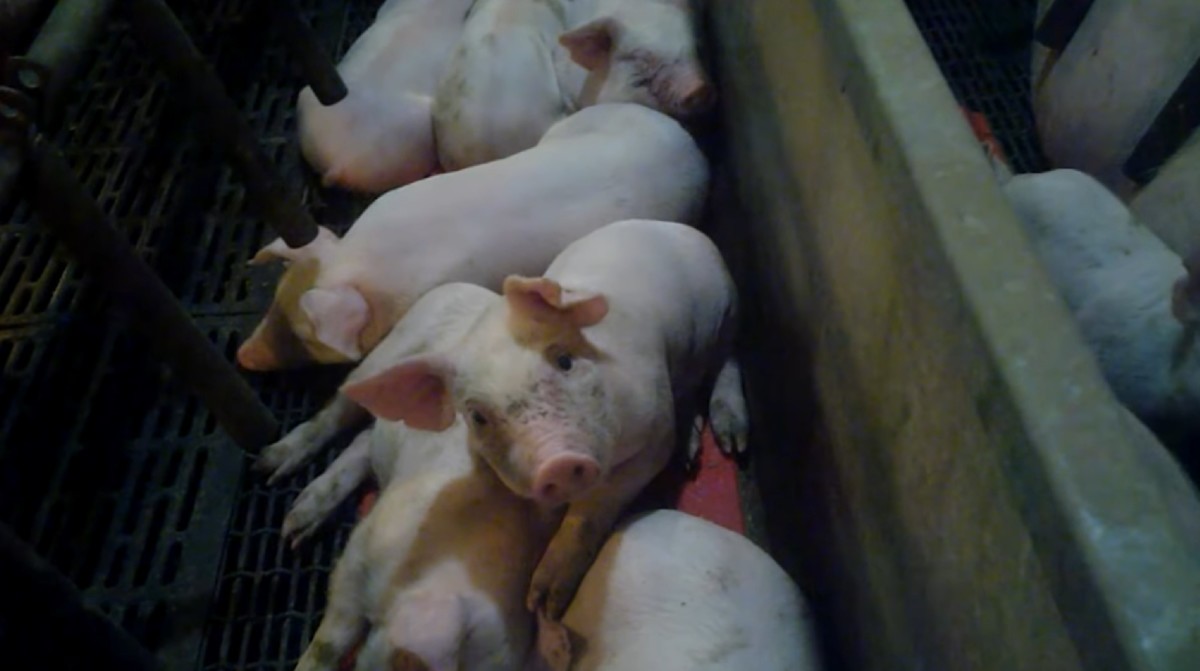
Investigation Exposes Animal Abuse at US Supplier to World’s Largest Meat Company

In September of last year, two executives of JBS, the world’s largest meat producer, based in Brazil, were arrested and charged with insider trading. In May 2017, the billionaire siblings—Wesley Batista, JBS’s CEO, and his younger brother Joesley, the firm’s former chairman—admitted to bribing more than 1,800 politicians and government officials, including meat inspectors, in an effort to avoid food safety checks.

Now, new undercover video shot by a Mercy for Animals (MFA) investigator at Tosh Farms, a JBS pork supplier based in Franklin, Kentucky, exposes what the animal rights group calls the “malicious and systemic abuse of mother pigs and piglets.”

“I’ll never forget the way they looked up at me,” said Tyler, the MFA investigator, about the pigs he documented at Tosh Farms. “They all shared the same look of helplessness and fear.”

“One mother pig stumbled down a corridor with her uterus hanging outside her body. She wouldn’t live much longer,” he said on an MFA website launched specifically to document the JBS investigation, jbstorture.com.

Tyler witnessed workers at Tosh Farms kicking and striking animals in their faces, ripping out the testicles of piglets without any pain relief, and even smashing the heads of piglets against the ground in order to kill them.

Those piglets who did not immediately die were left to suffer, denied proper veterinary care. “A worker grabbed a piglet, just hours old, by the feet and swung him high and then slammed his head down against the hard concrete,” said Tyler. “Any life left quickly vanished.”

“From the day pigs are born until the day they are violently killed for JBS pork, their lives are filled with misery and deprivation,” said Matt Rice, president of MFA, in a press statement. “If JBS executives abused even one dog or cat the way their suppliers abuse millions of pigs, they would be jailed for cruelty to animals. As the largest meat company in the world, JBS has the power and responsibility to end this torture.”

Clare Ellis, publisher of Stone Pier Press, which recently released “Sprig the Rescue Pig,” the first of its Farm Animal Rescue Books for children, was appalled: “Stories like this are even more heartbreaking and upsetting when you consider how very smart, curious, affectionate and sensitive pigs are.” She added that, “Close to 99 percent of animals raised for food come from factory farms, which, in addition to being terribly cruel, do an enormous amount of environmental damage.”

Following the July 17 release of the video, which was taken between December 2017 and March 2018, JBS said it suspended shipments from that supplier site. “The images presented in the video fall completely outside the company’s standards,” JBS said in a statement, but did not name the supplier involved.

But for MFA, suspending shipments from that single supplier isn’t nearly enough. “JBS’s decision to suspend Tosh Farms as a supplier is too little, too late,” Kenny Torrella, director of communications with MFA, told Truthout. “It amounts to nothing more than meaningless PR spin.”

The group, headquartered in Los Angeles, is now calling on JBS to end factory farm cruelty across its global pork supply chains, including the elimination of painful mutilations. In addition, MFA is calling on JBS to prohibit its suppliers from housing sows in tiny gestation crates for nearly their entire lives. These metal cages, the standard of which measures just 6.6 feet x 2 feet—so small that they can’t even turn around or lie down comfortably—are where pregnant sows live in factory farms around the globe for nearly their entire lives. In the United States as of 2016, there were 5.36 million breeding sows, most of them kept in gestation crates.

Confined to tiny gestation crates, mother pigs are not only denied basic natural behaviors like playing, exploring and engaging with their peers and children, but they also must endure immense and prolonged mental and emotional suffering. “These curious animals lose their minds from frustration and stress,” writes Lucas Alvarenga, vice president of MFA in Brazil. “They often also suffer painful pressure sores from rubbing against the bars of their crates and crippling joint problems as their muscles waste away from lack of use.”

While gestation crates are still the norm across the world, things are beginning to change for the better. Canada, the European Union, New Zealand and Australia, as well as 10 US states, have banned cruel gestation crates. Further, more than 60 major food companies—including McDonald’s, Walmart, Burger King and Nestlé—have said they would ban gestation crates from their suppliers.

In addition, California voters will have the opportunity in November to ban the sale of pork from pigs confined in gestation crates. If the measure passes, that will impact Tosh Farms and JBS, as the pigs reared at Tosh are then transported to a JBS slaughterhouse in Louisville, Kentucky, which supplies pork products to stores across California.

The systemic abuse and torture of pigs is an industry-wide problem. Last year, MFA investigators at the Aurora cooperative pig factory farm in the state of Santa Catarina in Brazil, the third-largest meat producer in Brazil and a major pork exporter to the United States, recorded video of pigs and piglets enduring a wide range of cruelty, including, notes Alvarenga, “workers slicing off the tails, cutting holes in the ears and grinding the teeth of piglets without any pain relief.”

Animal rights advocates are quick to point out that pigs—as well as other animals raised for human consumption—are intelligent, have rich emotional lives and possess unique, individual personalities. For some, these are reasons to not eat them. Ellen Page, one of many celebrity vegans who have used their fame to speak out on behalf of animals raised for food, said, “The inhumane factory farming process regards animals and the natural world merely as commodities to be exploited for profit.”

“The animals who are raised to be food for humans are so much more than just burgers and bacon,” said Marc Bekoff, professor emeritus of ecology and evolutionary biology at the University of Colorado, Boulder, and co-author of The Animals’ Agenda: Freedom, Compassion, and Coexistence in the Human Age.

“Pigs, cows, chickens, turkeys and other non-human animals whose flesh is destined to wind up in our mouths were once sentient beings with rich emotional lives,” said Bekoff, who is also the co-founder, with Jane Goodall, of Ethologists for the Ethical Treatment of Animals. “But because consumers rarely interact with them while they are still alive, they don’t see that these animals feel such a wide range of emotions, ranging from joy to sadness to grief, just like we all do.”

Non-human animals aren’t the only victims of the factory farm system. Slaughterhouse workers must witness the nightmarish conditions that the animals must endure. Some workers must do the actual killing, day in and day out.

“The psychological toll this takes on a person cannot be underestimated,” writes Ashitha Nagesh. “Slaughterhouse work has been linked to a variety of disorders, including PTSD and the lesser-known PITS (perpetration-induced traumatic stress). It has also been connected to an increase in crime rates, including higher incidents of domestic abuse.”

“To help move society to a more ethical food system, we as consumers must think less about ‘what’ is on our plate and more about ‘who’ is on our plate,” said Bekoff.

TAKE ACTION: Sign the petition urging JBS to ban gestation crates and painful mutilations.

This article was produced by Earth | Food | Life, a project of the Independent Media Institute.

New Study Sheds Light on Suffering of Canadian Dairy Cows

Wales to ban wild animals in circuses

Welsh government pledges new laws in a move being hailed by campaigners

https://www.dailypost.co.uk/news/wales-ban-wild-animals-circuses-14917707

The use of wild animals in circuses across Wales will be banned, Carwyn Jones will announce today.
In a move that brings UK-wide legislation one step closer the first minister will say that a bill will be introduced within the next 12 months.

His announcement has been hailed by animal welfare campaigners, who said it was a “stand to stop circus suffering in Wales”.

Only two circuses featuring wild animals currently operate within the UK.

A statement released this morning from the Welsh Government states: “The way animals are treated is an important reflection of society and over the next 12 months, a bill will be introduced to ban the use of wild animals in travelling circuses on welfare grounds.”

Animal Defenders International (ADI) that has campaigning to end the suffering of animals in UK circuses for 20 years, said the decision should be welcomed.

Jan Creamer, president of ADI, said: “We congratulate the Welsh Government for taking a stand to stop circus suffering in Wales and bringing a UK-wide ban one step closer.

“ADI has documented suffering and abuse in UK circuses for many years. Knowing that only a ban can protect them, we are delighted an end to the use of wild animals in circuses in Wales is finally within sight.”

The group argues that due to the constant travel and the temporary nature of their accommodation circuses on the road cannot cannot provide animals with adequate facilities to keep them physically or psychologically healthy.

The Welsh Government first committed to ban wild animals in circuses back in 2013, stating it would seek an extension to draft legislation published for England by the UK Government.

The bill however was left to gather dust with the UK Government only finally committing in February this year, to act by January 2020.

Around the world, 45 countries have already introduced prohibitions on animals in circuses including Scotland and Ireland.

With a Welsh Government-commissioned report published in 2016, finding that “life for wild animals in travelling circuses…does not appear to constitute either a ‘good life’ or a ‘life worth living’ and in support of a ban, it was expected legislation would soon follow.

Consulting the public on the broader issue of mobile animal exhibits last year, the Welsh Government also asked if a ban on wild animals in circuses should be considered.

The response from the public was overwhelming, with the Welsh Government stating that there was “strong support for a ban”.

Most recently, during a debate in the Senedd in March, Assembly Members unanimously called for urgent action to bring in the ban, Cabinet Secretary for Energy, Planning and Rural Affairs Lesley Griffiths responding that she was “exploring opportunities to bring forward legislation”.

Changing attitudes and awareness of animal suffering have seen the number of circuses with wild animals in Britain plummet.

Only two remain, Circus Mondao and Peter Jolly’s Circus which are licensed in England and tour Wales.

A third circus with big cats also performed in Wales when owner Thomas Chipperfield was unable to obtain a licence in England, it has remained off the road since.

Animal Defenders International
Millbank Tower, Millbank
LONDON, SW1P 4QP, UK
Tel: +44 (0)20 7630 3340

Mob slaughters 300 crocodiles in Indonesia following death of local man

The mass killing was in retaliation after a villager was recently killed by crocodile.
by Associated Press /  / Updated 
Image: Local residents look at the carcasses of hundreds of crocodiles

A mob slaughtered nearly 300 crocodiles at a breeding ground in retaliation for the death of a local man, officials said Monday.Olha Mulalinda / Antara Foto via Reuters

JAKARTA, Indonesia — A mob slaughtered nearly 300 crocodiles at a breeding ground in Indonesia’s West Papua province in retaliation for the death of a local man, officials said Monday.

A total of 292 crocodiles were killed by hundreds of villagers on Saturday following the funeral of a 48-year-old man who was killed by crocodiles after entering the area around the breeding pond, said Basar Manullang, the head of the local Natural Resources and Conservation Agency.

The man was believed to have entered the sanctuary in the Klamalu neighborhood of Sorong district to cut grass for his cattle.

“Since killing the crocodiles is illegal, we are coordinating with the police for the investigation,” Manullang said.

The agency said in a statement that the villagers were armed with machetes, hammers, shovels and other sharp weapons. They killed two large crocodiles of up to 13 feet and many babies measuring 20-60 inches.

Recommended

Witnesses said about 40 policemen came to the scene but were too outnumbered to stop the mob.

Police said about five witnesses have been questioned but no suspects have been named.

Police are encouraging mediation between the victim’s family and Mitra Lestari Abadi, the company that operates the sanctuary.

Dog found dead in crate during Delta Air Lines layover for cross-country flight

An 8-year-old Pomeranian was found dead during a layover near Detroit, Mich., on Wednesday after the dog was on a Delta Air Lines flight en route to New Jersey, his owners and the airline said.

Alejandro was found dead in his crate in the cargo facility at Detroit Metropolitan Airport, southwest of Detroit in Romulus. Michael Dellegrazie, the owner, said the dog was alive when the flight from Phoenix, Ariz., landed at the airport around 6:30 a.m. Wednesday for a scheduled layover.

About two hours later, Alejandro was found dead by an agent, who said the dog was unresponsive. He reportedly had vomit in his crate. The dog’s blanket also had blood stains.

alejandro delta flight

The dog named Alejandro died Wednesday during a layover at Detroit Metropolitan Airport after a Delta flight from Phoenix, Ariz.  (EVAN OSHAN/ OSHAN & ASSOCIATES)

“We lost a family member. That’s exactly what happened, and somebody has to be responsible for it. He was in their care and they didn’t take care of him,” Dellegrazie told WDIV-TV.

UNITED CEO ON DOG’S DEATH IN OVERHEAD BIN: ‘WE GOT IT WRONG’

Dellegrazie, who owns the dog with his girlfriend, said he’s grasping to understand how his Pomeranian had died while heading to Newark, N.J.

“Things need to change, and I’m here to tell you that the people will make them change,” Evan Oshan, Dellegrazie’s attorney, told the news site.

A Delta Air Lines spokesman told Fox News the dog was seen in good health after the flight and brought to the staging area. The kennel facility determined the dog had died about two hours later and airline officials immediately notified the owner. The spokesman added that Delta offered to conduct a necropsy, but was told by the owner to hold off.

In a statement, Delta said it is conducting an investigation.

“Pets are an important member of the family and we are focused on the well-being of all animals we transport. Delta is conducting a thorough review of the situation to ensure this does not happen again and have been working directly with Alejandro’s family to support them however we can,” the statement provided to Fox News read.

“As part of that review, Delta offered to have Alejandro evaluated by a veterinarian while in our possession to find out more about why this may have occurred. We are disappointed that we were not allowed to have a necropsy performed immediately following this unfortunate situation. The family now has Alejandro and we continue to offer our support,” it added.

UNITED MAKES SHORT-TERM EXCEPTION TO TRANSPORTATION OF MILITARY PETS

It’s still unclear what caused the dog’s death. Oshan said the family is “devastated” over the incident.

Oshan is the same lawyer who represented the owners of the French bulldog that died on a United Airlines flight. The 9-month-old puppy, Kokito, died after he stopped breathing on a flight from Houston to New York in March. A flight attendant told the owner to put him in the overhead bin rather than under the seat.

The French bulldog that died in March was not part of the cargo program.

The Associated Press contributed to this report.

Sixty senior rabbis call for end to ‘evil crime’ of live animal shipments

https://www.timesofisrael.com/sixty-senior-rabbis-call-for-end-to-evil-crime-of-live-animal-shipments/

Chief rabbi of Beersheba says every rabbi should join protest; anyone
buying such meat is complicit in activity that is against human and Torah
morality

One of Israel’s most senior rabbis has ruled that anyone buying meat from
animals shipped from overseas to Israel for slaughter in cruel conditions
is a partner to a crime.

In a letter released Thursday by animal rights activists, Rabbi Yehuda
Deri, chief rabbi of the southern city of Beersheba and a member of the
Chief Rabbinate’s Council, called on every rabbi in Israel to protest the
long-distance shipments of sheep and cattle for fattening and slaughter in
Israel.

He said he planned to raise the issue at an upcoming meeting of the council.

“It is clear… that whoever buys this meat is a partner to and helps those
committing an evil crime, ” he wrote. “Every rabbi in Israel must take part
in this protest until the issue is resolved.”

The letter was released along with a petition against the shipments signed
by 60 leading rabbis from across the religious spectrum.

“It is clear… that whoever buys this meat is a partner to and helps those
committing an evil crime, ” he wrote. “Every rabbi in Israel must take part
in this protest until the issue is resolved.”

The letter was released along with a petition against the shipments signed
by 60 leading rabbis from across the religious spectrum.

It came in the wake of an exposé by Animals Australia
<https://secure.animalsaustralia.org/take_action/live-export-shipboard-cruelty/>,
broadcast on Australian TV’s “60 Minutes
<https://www.youtube.com/watch?v=m1V96Y533Ds>,” into the appalling
conditions in which sheep were shipped to the Middle East on five journeys.

The petition says it is “neither the way of the Torah nor of human morality
to allow such cruelty to animals.”

The signatories include members of the Chief Rabbinate’s Council — Rabbi
Deri, Rabbi Ratzon Arusi and Rabbi Shimon Elitov; as well as Israel Prize
laureates Rabbi Prof. Daniel Sperber, Rabbi Avraham Steinberg and Rabbi Eli
Sadan; and the late Rabbi Elyashiv Knohl, who died two weeks ago.

Among other names are Shmuel Rabinowitz, rabbi of the Western Wall; Avigdor
Nebenzahl, a former chief rabbi of Jerusalem, who serves on the faculty of
the Yeshivat HaKotel and is rabbi of the Ramban Synagogue in the Old City;
kashrut expert and veterinarian Dr. Israel Meir Levinger; Itamar
Wahrhaftig, a Bar-Ilan University expert on Jewish law; Ronen Neubert, a
co-founder of the Beit Hillel organization; and Shlomo Sheffer, Bar-Ilan
University’s rabbi.

“We were shocked to discover the harsh facts about the great suffering of
calves and sheep, God’s creatures, sent by ships from Australia and Europe
to be slaughtered in Israel,” says the petition, which reflects the biggest
rabbinical mobilization to date to stop the shipments, which, from
Australia, can take three weeks or more.

“The causing of such extreme suffering to animals solely to satisfy our
desire for fresh meat is not the way of Torah, and it is not human morality
to permit such harsh cruelty to animals… in addition to which, the meat
produced from them costs more than fresh meat that is imported to Israel
chilled.”

The petition concludes by saying that the shipments must be stopped.

Disturbing footage from the documentary, shot by a whistleblower on the
ship and subsequently broadcast on Israel’s Hadashot news, showed
overcrowding on board, with animals packed so tightly that many could not
reach food and water.

Unable to sit or lie down, most stood covered in their own excrement,
gasping for air in scorching temperatures — a sign that they were about to
die from heatstroke.

“They literally cook from the inside while alive during the journey,”
veterinarian Yuval Samuel told Hadashot TV news.

On one of the journeys documented, 2,400 sheep perished and were thrown
overboard.

The rabbinical protest is being led by two Bar Ilan University professors —
British-born Sperber, president of the Higher Institute of Torah Studies
and a vegetarian, and Yael Shemesh of the Bible department and the center
for women’s research, a vegan — in conjunction with the animal rights
organizations Anonymous for Animal Rights and Let Animals Live.

Rabbi Prof. Daniel Sperber at the June 9, 2015 ordination celebration of
the first cohort for Har’el Beit Midrash. (Sigal Krimolovski

Sperber said, “I have no doubt that anyone who sees these pictures will
find that this situation is completely forbidden by [Jewish law]. This is
indescribable animal suffering…it is so horrific and certainly absolutely
forbidden.”

Rabbi Deri said in his letter that “there is no doubt that this phenomenon
completely contradicts the spirit of our Holy Torah and stands in complete
contradiction to certain mitzvot of what is and is not allowed and the many
[Jewish ritual] laws that followed in the Talmud.”

Deri went on to quote examples from Jewish law prohibiting cruelty to
animals and ruling that while Jews are allowed to eat meat, they must do
everything they can to minimize suffering.

Following the broadcast in Australia, the Australian Agriculture Ministry
said it would open an inquiry into the standards of livestock shipping from
Australia to the Middle East.

Public Security Minister Gilad Erdan called for a complete halt, or at
least a significant reduction, to what he termed the “cruel” shipments.
Rabbi Yehuda Deri, April 4, 2011. (Kobi Gideon/Flash90)

He told Hadashot that there was insufficient supervision of the conditions
<https://www.timesofisrael.com/public-security-minister-calls-for-halt-to-cruel-long-haul-animal-shipments/>on
the long-haul voyages, and that all effort should be made to reduce or
preferably stop the shipments to Israel and the “serious abuse” of animals
involved.

The prime minister’s wife, Sara Netanyahu, took to Facebook to register her
“shock” after seeing the broadcast.

Last year, 499,265 live cattle and sheep were shipped to Israel for the
meat industry from Australia and various European countries — a slight
reduction from 2016, when 571,972 heads arrived at Israeli ports, but
nearly double the number for 2015 — 292,274, according to Israel’s
Agriculture Ministry.

Ships resembling multi-story parking lots carry from 1,000 to 20,000
cattle, or 100,000 sheep, or a combination.

Once in Israel, the animals are loaded onto trucks for journeys that can
take hours to slaughterhouses or to pre-slaughter fattening facilities.
They are treated with antibiotics against the infections that overcrowding
causes.

While the Australian exposé did not directly relate to shipments to Israel,
footage from a quarantine station at Kibbutz Eilot in the south of the
country released at the same time by Anonymous for Animal Rights showed the
same sort of abuse after ships’ arrivals to the country, with animals being
whipped through a narrow passage.
A worker filmed beating a cow at a quarantine station at Kibbutz Eilot in
Israel’s south after the unloading of cattle for slaughter at the Eilat
port.(Anonymous/Hadashot News screenshot)

Lawmakers from the Knesset’s cross-party Lobby for Animal Rights said in a
statement following the broadcast that despite “explicit promises” from the
agriculture ministry that live shipments would be reduced and imports of
chilled meat increased, “the investigation today shows that nothing has
changed.”

At present, the government exempts totally or partially from tax the import
of live animals for slaughter while imposing ceilings on tax exemptions for
the import of chilled meat.

It has said in the past that it will gradually increase the amount of tax
exempt chilled meat allowed into the country and phase out live shipments.

For the Love of Chickens in Honor of International Respect for Chickens Day

By Karen Davis, PhD, President of United Poultry Concerns*

I Know Just How Incredible Chickens Are: I’ve Spent More Than Thirty Years
Getting to Know Them

“The poultry industry represents chickens as mentally vacuous, eviscerated
organisms. Hens bred for egg production are said to be suited to a cage,
with no
need for personal space or normal foraging and social activity. They are
characterized as aggressors who, notwithstanding their proclaimed passivity
and
affinity for cages, cannot live together without first having a portion of
their
sensitive beaks burned off-otherwise, it is said, they will tear each other
up.
Similarly, the instinct to tend and fuss over her eggs and be a mother has
been
rooted out of these hens (so it is claimed), and the idea of one’s having a
social relationship with such hens is dismissed as silly sentimentalism. .
. .”

Read Karen’s article: I Know Just How Incredible Chickens Are: I’ve Spent
More
<https://www.alternet.org/animal-rights/love-chickens-honor-international-respect-chickens-day>
Than Thirty Years Getting to Know Them
<https://www.alternet.org/animal-rights/love-chickens-honor-international-respect-chickens-day>
.

Please do an ACTION for:
International Respect for Chickens Day May 4/Month of May
<http://www.upc-online.org/respect/>


United Poultry Concerns is a nonprofit organization that promotes
the compassionate and respectful treatment of domestic fowl.
Don’t just switch from beef to chicken. Go Vegan.
http://www.UPC-online.org/ http://www.twitter.com/upcnews
http://www.facebook.com/UnitedPoultryConcerns

View this article online
<http://upc-online.org/respect/180427_for_the_love_of_chickens.html>

ACT NOW: STOP BLOODY BOAR FIGHTS IN VIETNAM!

Shocking footage has emerged of a pack of dogs ripping a terrified boar limb from limb, as part of a LEGAL organised dog fight. Urgent animal protection laws are needed to end this savage cruelty. Sign the petition now!

*Image: Screengrab of the original video which can be found here.


Devastating footage on social media shows crowds cheering as an exhausted boar runs for his life. His screams of pain and fear can be heard as he is set upon by a pack of baying dogs… trained to kill.


The footage has sparked outrage in Vietnam, but these organised ‘death battles’ – between dogs and boars fleeing for their lives are nothing new in Vietnam. One crowd member even commented, “We will continue doing it because it isn’t illegal.


And boar aren’t the only victims of this vicious blood sport…


Dogs used as killing-machines are treated as nothing more than sporting equipment. Often chained, mutilated, and treated cruelly to make them more aggressive.


Two years ago, the Vietnamese government passed its first Animal Health Law. Yet, there are currently no laws to protect animals from harm, or punish animal abusers.


When barbaric cruelty like these sick organised dog fights can go unpunished, and leave authorities powerless to act, urgent changes are needed…

Please, join us in calling on the Vietnam Government to update the law to include animal protection regulations, and strong punishments for those who commit acts of violence against animals.

Act now, call for urgent animal welfare laws in Vietnam. Please, sign the petition now…

https://help.animalsasia.org/page/22492/petition/1?en_chan=fb&locale=en-GB&ea.tracking.id=facebook&en_ref=145314288


Kangaroo Dies After Visitors At Chinese Zoo Hurl Rocks To Force Her To Jump

April 20, 2018

One kangaroo was killed and another injured at a zoo in southeast China
after visitors to their enclosure
<http://www.abc.net.au/news/2018-04-20/kangaroo-dies-in-chinese-zoo-after-vi
sitors-throw-rocks/9682220> pelted the animals with rocks and other objects
in an apparent attempt to get the kangaroos to hop around. The abuse has
sparked fury online and prompted renewed scrutiny into the
<http://www.scmp.com/news/china/society/article/2100775/chinas-terrible-zoos
-and-why-theyre-still-thriving> mistreatment of animals at Chinese zoos,
several of which have gained notoriety in recent years for cramped and cruel
conditions.

Zookeepers at the Fuzhou Zoo in Fujian Province
<http://www.hxnews.com/news/fj/fz/201804/19/1500695.shtml> told the Haixia
Metropolis News this week that at least one visitor threw “multiple”
sharp-edged rocks at a 12-year-old female kangaroo in March to compel her to
jump, leaving her badly injured and in “deep pain.” She died a few days
later of profuse internal bleeding, her caretakers said.

A 5-year-old male kangaroo in the same enclosure was reportedly also injured
last month after a visitor threw part of a brick at him. The younger
kangaroo was not seriously hurt.

“Some adult [visitors] see the kangaroos sleeping and then pick up stones to
throw at them,” a Fuzhou Zoo attendant told the Haixia Metropolis News.
“Even after we cleared all the stones from the display area, they went
elsewhere to find them. It’s abhorrent.”

Pics of the bricks that visitors hurled at kangaroos at the zoo in Fujian,
killing one and injuring another. Zoo staff say visitors often throw objects
at animals despite it being ‘prohibited’.

– Bill Birtles (@billbirtles)
<https://twitter.com/billbirtles/status/987263932636151808> 5:37 AM – Apr
20, 2018

12-year-old kangaroo at zoo in eastern China died after being stoned by
visitors hoping to make it hop <https://t.co/HyrP46HQij>
http://ow.ly/sfAs30jArZe

– Sixth Tone (@SixthTone)
<https://twitter.com/SixthTone/status/987243239941050370> 4:15 AM – Apr 20,
2018

Netizens in China and elsewhere have
<https://www.nytimes.com/2018/04/20/world/asia/china-kangaroo-zoo-death.html
> expressed their horror at the behavior of the stone-hurling visitors.

The Metropolis News <http://szb.mnw.cn/2018/0420/1368203.shtml> said on
Friday that their social media pages were flooded with readers’ angry
comments, with many calling for visitors who mistreat animals to be
“blacklisted” from zoos.

The Fuzhou Zoo said it had
<http://www.chinadaily.com.cn/a/201804/20/WS5ad93d28a3105cdcf6519721.html>
applied for funding to install high-definition surveillance cameras to
better identify perpetrators. They added that now only three kangaroos would
be on display to reduce the risks to the animals.

Several Chinese zoos have made headlines in recent years for mistreatment of
animals. Last year, visitors were horrified when a
<https://news.nationalgeographic.com/2017/06/wildlife-watch-china-donkey-tig
ers-zoo/> live donkey was fed to tigers at a so-called safari park near
Shanghai. In 2016, hundreds of thousands of people called for the
<https://www.huffingtonpost.com/entry/worlds-saddest-zoo-grandview-aquarium_
us_578c8b3be4b03fc3ee514af2> closure of Guangzhou’s Grandview Aquarium,
dubbed the “saddest zoo in the world,” after photos of the facility’s barren
enclosures went viral.

Such incidents have increased concerns in China about the country’s lack of
comprehensive
<http://www.scmp.com/lifestyle/article/2050730/chinas-growing-animal-rights
movement-calling-change> animal welfare laws.

Without such legislation, “we can only try to persuade people using common
sense and referring to animal welfare laws in Western countries,” Tong
Yanfang, an animal welfare advocate,
<http://www.scmp.com/news/china/society/article/2100775/chinas-terrible-zoos
-and-why-theyre-still-thriving> told the South China Morning Post last year.

“For children and many adults who lack judgment, a wrong perception has been
built [in China] that animals are there for the entertainment of humans,”
Tong said. “When they see animals perform in a zoo, they won’t consider how
the animals acquired those skills.”

. This article originally appeared on
<https://www.huffingtonpost.com/entry/kangaroo-china-dies-throw-rocks_us_5ad
a572ce4b00a1849cf477d?ncid=edlinkushpmg00000313> HuffPost.