[What kind of twisted species would hurl live turkeys from airplanes? It underscores their disrespect for the animals whose death they celebrate every fall.]
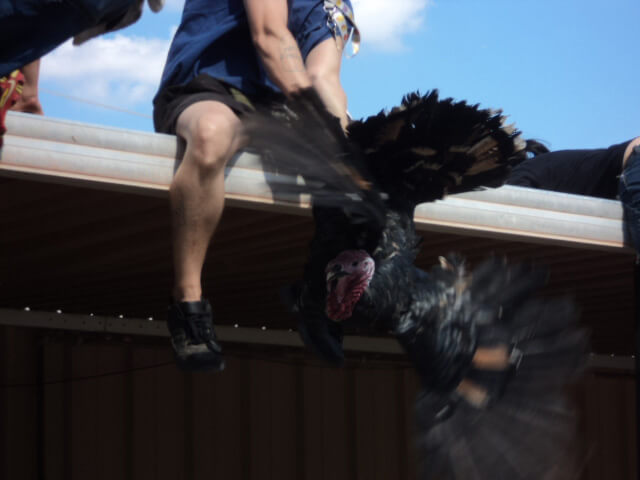
Every October, the city of Yellville, Arkansas, holds its annual Turkey Trot, an event that includes the notorious “turkey drop.” This year was no exception, as live domestically bred wild turkeys—who normally would fly only short distances and low to the ground—were hurled from an airplane, the courthouse roof, buildings, and the festival stage into the clutches of a frenzied crowd. Thankfully, four birds were rescued by local PETA supporters and provided with veterinary treatment, and they’re currently safe in foster care. More information about this year’s sadistic event can be viewed here.
Once again, please urge Yellville officials to end this cruelty, which is a blight on the entire state—then forward this alert to everyone you know.
The Honorable Clinton L. Evans
Marion County Sheriff
491 Hwy. 62 W.
Yellville, AR 72687
Please click here to send an e-mail.
870-449-4236
The Honorable Kenford O. Carter
Deputy Prosecuting Attorney
105 S. Berry St.
Yellville, AR 72687
870-449-4018
“Last week New York’s Solomon R. Guggenheim Museum announcedit would
be pulling three works from its next big exhibition, “Art and China
after 1989: Theater of the World.” It did so after angry criticism
from animal rights protesters that the works were — according to an
online petition that has attracted over 700,000 signatories —
“distinct instances of unmistakable cruelty against animals in the
name of art.””
…
“These works have outraged animal rights advocates: the campaign group
PETA fumed that “people who find entertainment in watching animals try
to fight each other are sick individuals whose twisted whims the
Guggenheim should refuse to cater to.
“Only a little more tolerantly, the American Society for the
Prevention of Cruelty to Animals (ASPCA) declared that “the ASPCA
fully supports artistic expression, but strongly oppose any use of
animals in art or entertainment if it results in pain or distress to
the animals, which is clearly the case in this video,” referring to
“Dogs That Cannot Touch Each Other” (2003).”
Two men were charged with harassment of wildlife after posting photos of beer being forced down the throat of an alligator. (South Carolina Department of Natural Resources via CNN Newsource)
0527_gatorbeer1.JPG0527_gatorbeer4.JPG0527_gatorbeer5.JPG
VIEW PHOTO GALLERY
6 photos
AA
JASPER COUNTY, S.C. (WPEC) – Two men in South Carolina are facing criminal charges for forcing beer down the throat of a young alligator, according to the South Carolina Department of Natural Resources.
Investigators said the men posted a photo of the alligator chugging the beer to social media. A short time later, the SCDNR started getting calls, messages and screenshots related to the incident.
Authorities said the two men, after forcing the juvenile gator to drink the beer, released the reptile back into a pond and watched it swim away.
Wildlife investigators went out to a dirt road near Hardeeville in Jasper County and caught up with the two men. Both admitted to harassing the alligator after seeing it cross the road.
Joseph Andrew Floyd Jr., 20, and Zachary Lloyd Brown, 21, are facing a misdemeanor charge of harassing wildlife.
“Wildlife conservation is a big part of what SCDNR officers do each day,” SCDNR 1st Sgt. Earl Pope said. “This case is a good example of why we strive to educate people about wildlife in hopes that they will respect it.”
The men face a maximum fine of $300.
Policymakers in Texas continue to scratch their heads over the state’s feral hog problem, and the solutions are getting weirder.
Hot air balloon FLICKER/IRULAN_AMY
Researchers and policymakers for years have searched fruitlessly for effective ways to significantly drop feral hog population levels in Texas, with proposals ranging from eating our way out of the problem to widespread poisoning.
Roughly 2 million wild hogs are estimated to live in Texas, and they cause more than $50 million in damage each year. The invasive animals’ high breeding rate and lack of predators have fueled their proliferation in South, Central and East Texas, leading to big business for hunters and trappers.
In 2011, Agriculture Commissioner Sid Miller, then a state rep, passed what became known as the “pork chopper” bill, legalizing the hunting of feral hogs from a helicopter. On its face, the bill sounded more like a joke than an actual solution.
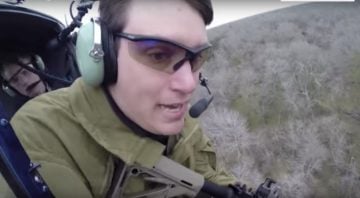
Hunter prepares to shoot feral hogs with a rifle from a helicopter. YOUTUBE/NICK LEGHORN
Turns out, it’s really hard to shoot anything from a helicopter. In addition to being ineffective, the method is also very dangerous (and not just for the hogs.) The only results produced by the bill were some crazy YouTube videos and an industry in which people pay upwards of $3,000 per hunt to pick off pigs from a chopper.
Enter state Representative Mark Keough, a Republican and pastor from The Woodlands. He told the Observer that he “loved” Miller’s pork chopper bill and found himself asking: “What are more ways we can take more feral hogs?”
After chatting with hunters and conducting his own informal research, Keough believes he’s found an alternative solution: hot air balloons.
His House Bill 3535 would authorize Texans to hunt feral hogs and coyotes from a hot air balloon with a permit.
If the idea seems crazy, that’s because it is. No one hunts from a hot air balloon. Go ahead, Google it. “I haven’t found people anywhere doing this,” Keough admits.
But he thinks it would be pretty damn sweet to try. (It’s currently illegal, or he would’ve tried already, he said.)
The fast-moving helicopter approach, Keough says, has a lot of “safety issues,” leads to many misses and often scares off the hogs. “They’re smart,” he said.
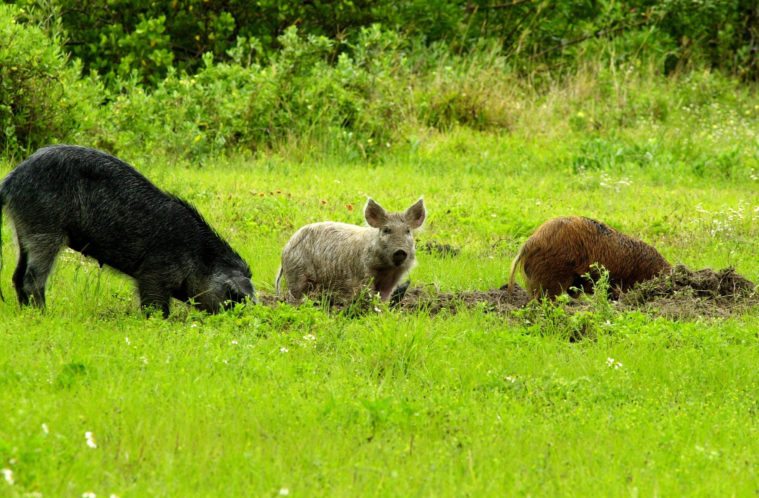
Feral hogs damage land in rural areas, but have increasingly caused problems in suburban and urban areas. U.S. FISH AND WILDLIFE SERVICE
Hot air balloons, on the other hand, are more stable, slower and offer a better rifle-shooting platform, Keough said.
Last July, 16 people were killed in the deadliest hot air balloon crash in U.S. history near Lockhart when the pilot lost control and crashed into power lines. The incident led to calls for stricter regulation of the balloon industry.
Still, Keough says, “It’s far safer than if you were hunting out of a helicopter.”
But more effective? Probably not.
Even Keough admits there’s a good chance hunters could spend all day in a balloon and not shoot anything. And its clumsy, slow-moving nature will keep hunters from effectively chasing the animals.
The animals, which can grow to weigh 100-400 pounds, have a gestation period that’s shorter than four months and litter sizes of up to 12. They are considered a non-game animal, meaning there are no seasons or bag limits, but a state hunting license is required.
Billy Higginbotham, a professor and wildlife and fisheries specialist with the Texas A&M AgriLife Extension Service, said the balloon strategy faces the same problem as helicopters in the eastern third of the state: trees.
“Aerial gunning by any vehicle [in East Texas] is not widely used because of the extensive tree cover,” Higginbotham said.
State Representative Mark Keough, R-The Woodlands. FACEBOOK
Keough said the “pork choppper” bill “was more about creating an industry” and that no single strategy will significantly reduce hog populations.
“I think there is a possibility [with hot air balloons] for an industry, but the motivating factor is this is another way to get rid of the problem,” he said
Keough also sponsored legislation that would require more research on the effects of widespread lethal pesticides, including warfarin, before they can be used on hogs. The measure passed the House Monday.
A Texas Parks and Wildlife Department spokesperson declined to comment on pending legislation, citing agency policy. HB 3535 would require the agency to license individuals who want to hunt from the balloons.
Keough, who said he’s “interested in anything that will help us get rid of these things,” believes his bill represents the spirit of Texas.
“We’ve got a problem here, and we are willing to fix it ourself,” he said. “We have that Western, swashbuckling, cowboying type of way to deal with things. It’s part of the culture, it’s different than any other state.”
Correction: An earlier version of this story reported no license is required to hunt feral hogs in Texas. A state-issued license is required, although there are no seasons or bag limits.
We are finding dogs living in inches of their own urine and feces, with coats matted so heavily that they can barely walk, puppies choking on toxic fumes and many animals suffering from a variety of skin and eye conditions.
Sadly, it isn’t just dogs and puppies who are suffering.
So far, our Animal Rescue Team has found more than 350 neglected animals — including cats, donkeys, a horse, bunnies, chickens, ducks, geese, goats, sheep and an alpaca.
Jim, the cruelty we’re witnessing is heart-wrenching. We will stay here until every animal is on their way to a better life.
This rescue is only possible with the help of compassionate supporters like you.
Thank you so much,
Sára Varsa
Senior Director, Animal Cruelty, Rescue and Response
FILE – In this Thursday, Dec. 10, 2015, file photo, live lobsters are packed and weighed for overseas shipment at the Maine Lobster Outlet in York, Maine. The expanding market for lobsters in China is continuing to grow, with the country setting a new record for the value of its imports of the crustaceans from the United States.
ROCKPORT, Maine (AP) — The expanding market for lobsters in China is continuing to grow, with the country setting a new record for the value of its imports of the crustaceans from the United States.
American lobster was almost unheard of in most of China until 2010, when the value of imports grew 250 percent to about $7.4 million. Last year, China imported more than $108 million in lobsters from America, surpassing the previous high of about $90.2 million in 2014.
“We’ve opened new markets in Asia, which is booming,” said Dave Cousens, president of the Maine Lobstermen’s Association. “Everything is clicking now.”
Chinese importers took in more than 14 million pounds of U.S. lobsters last year, which was also a record. The previous high was about 13.1 million pounds the previous year.
Interest in American lobster has grown in other countries in Asia as well, such as South Korea, which grew from less than $5 million in 2010 to nearly $28 million last year. Vietnam’s imports grew from $142,940 to more than $31 million in that time.
One of the factors spurring the growth of lobsters in China appears to be the growth of the country’s middle class, said Stephanie Nadeau, owner of The Lobster Company, in Arundel, Maine, which is a key player in the export business. American lobsters tend to be less expensive in China than other live seafood, such as spiny lobsters and geoduck clams, she said.
“It’s kind of an affordable luxury,” Nadeau said. “One of my customers said our lobsters are one of the cheapest things in the live tanks.”
The uptick came in a record year for lobster catch in Maine, where most of America’s lobster catch comes ashore. Fishermen caught more than 130 million pounds of lobster in Maine last year, an all-time record and more than double the 2007 total. Atlantic Canada also has a large lobster fishery and sends the same species of lobster to China.
“The Asian market is a key component,” said Patrick Keliher, the commissioner of the Maine Department of Marine Resources.
Lobster sales to China do not appear to be slowing down in the new year. America exported more than 1.7 million pounds and $14 million in lobsters to the country in the first month of the year.
You might care about how the chicken you eat is raised and killed. What about the lobster? (iStockphoto)
An Australian seafood company was recently convicted of animal cruelty — for killing a lobster.
The legally actionable problem was not actually taking the life of the lobster. It’s that the lobster was killed in a way deemed to be unnecessarily — and illegally — brutal.
According to the Guardian’s description of what happened, workers at Nicholas Seafoods were seen by investigators “butchering and dismembering lobsters with a band saw, without adequately stunning or killing them.” The lobsters’ tails were cut from their bodies while the animals were still alive, in violation of local animal cruelty laws, and led to a conviction that may be the first of its kind in the world.
Depending on your perspective, this might both churn the stomach and raise confusing questions. Are you behaving monstrously if you boil a live lobster — a fairly common cooking method? Could you be found guilty of animal cruelty if so?
The answer to the second question is pretty straightforward: As things stand now, you are highly unlikely to be convicted of animal cruelty for behaving badly, even very badly, toward a lobster.
The Nicholas Seafoods killing took place in the Australian state of New South Wales — one of a few Australian jurisdictions to specifically include crustaceans sold for food, like lobsters, in its animal cruelty laws. The conviction was the first in that state, a local spokeswoman for the Royal Society of the Prevention of Cruelty to Animals said. The company was fined $1,500.
It’s not unheard of for some sea critters to have legal protections. Octopuses are “honorary vertebrates” under European Union law governing the treatment of animals used in scientific research. And some advocates say they would like to see more fish gain more protection — like the 806 people who recently signed an online petition asking to include lobsters in Britain’s animal cruelty laws.
Lobster at the Clam Shack in Kennebunkport, Maine. Federal American animal cruelty laws do not cover the crustaceans. (Robert F. Bukaty/Associated Press)
But welfare laws for lobsters and their ilk are unusual. In the United States, neither fish nor crustaceans are covered under the federal Animal Welfare Act, and they are mostly exempt from state animal cruelty laws as well. (Occasionally, a cruelty charge has been brought under state law when a pet fish is killed in a brutal way.)
“A majority of state laws protect all animals, but there are typically exemptions for hunting and fishing activities,” said Ann Chynoweth, vice president of the Humane Society of the United States’s animal cruelty campaign. “Laws regarding slaughter do not cover fish — or chickens.” (They do cover cows and pigs.)
“Their lives matter to them,” he said. “I’ve become firmly convinced they deserve equal moral consideration to all other vertebrates.”
Balcombe said the situation with crustaceans, as opposed to vertebrate fish, is “less clear.” But research has shown that crustaceans do “remember and learn from apparently painful events,” and that should bring them into our moral universe, he said.
“Sentience is the bedrock of ethics,” he said.
Regardless of the established science or the moral reasoning, the reason dogs and cows have more legal protection than lobsters seems primarily based on our cultural associations and practices. Dogs have the most protections because people adore them and think of them as members of the family. Fish and lobsters have been given practically none, because in general people do not — though every once in a while an especially old or pretty lobster captures our rapt attention and mercy.
“This exemplifies the paradoxes and inconsistencies we see in the treatment of animals,” said Hal Herzog, a psychology professor at Western Carolina University and author of “Some We Love, Some We Hate, Some We Eat.”
But according to Andrew Lurie, the Humane Society International’s senior attorney for international law and trade, even those species we love don’t get a whole lot of protection — here in the United States or elsewhere. Animal cruelty convictions in general “are rather rare worldwide,” he said.
On the other hand, consumers are beginning to demand that the animals who produce our food are kept and killed more humanely. It’s this consumer demand that, for example, is driving companies to vow to switch to eggs from cage-free hens. In November, Massachusetts voters approved a ballot measure banning the sale of eggs or meat from animals kept in tight confinement.
So is the Australian lobster case an oddball anomaly or a step toward a future in which more animals we eat get more protections, and when it might not be so strange for lobsters to be included in our moral and legal universe? Lurie said he is not sure. But the chief executive of the RSPCA in New South Wales said it sets a significant precedent.
“We hope this conviction will expand the circle of empathy and welfare to crustaceans and more animals that often do not evoke the same level of compassion as others,” Steve Coleman said. “With the scientific community proving lobsters feel pain, and the New South Wales legislation backing that up, we’re excited to see such progress in the space of animal welfare, and we hope that this case can be a guiding light for others.”
Still want to dine on lobster but minimize its suffering — not to mention your chances of being busted if you happen to be in Australia? The RSPCA Australia’s website recommends a few preferable methods for ending a lobster’s life. And no, boiling it alive is not one of them.
Stunning the lobster in an electrified bath is better, the organization says, as is chilling the lobster in a saltwater ice slurry, then “rapidly cutting through the center-line of the head, thorax (chest) and abdomen with a large, sharp knife” before the lobster regains its version of consciousness.
Or — just a friendly suggestion here — you could avoid all these questions and let the lobsters live.
On February 21, 2017 Crow, Cindy and I were on patrol in the afternoon heading up Jardine Road when we came upon two bull bison grazing beside the road. We stopped for a few moments to admire them. We also had severe reservations on their safety.
We continued to drive up Jardine Road to one of the lookout points and were checking on recent remains of bison kills. We heard five gunshots and our hearts sank.
It took about ten minutes to drive down Jardine Road and discover what we had feared. There were no hunting vehicles present, but we saw three teenagers and one younger boy situated about 50 yards up an incline from the road. They were busy gutting one of the bulls.
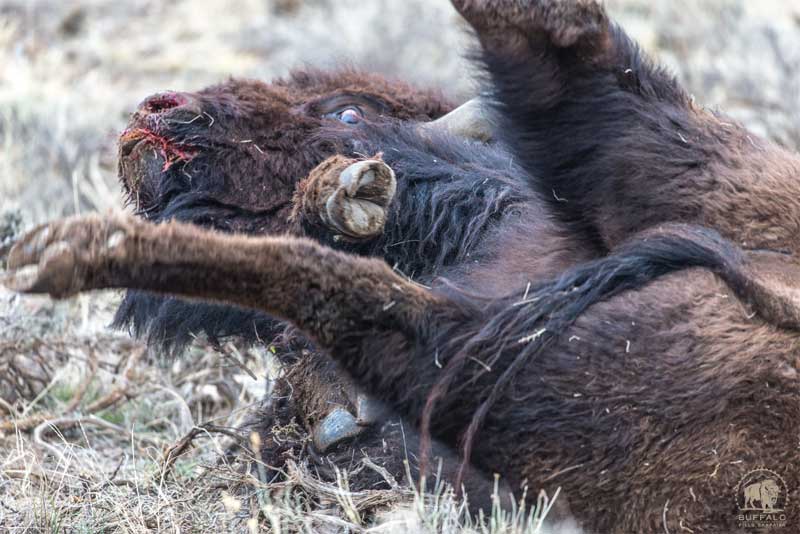
We then spotted the other bull only 15 yards from the road. Cindy thought it was still breathing and Crow confirmed. Crow and Cindy immediately walked up to the teenagers to tell them this bull was still alive.
The teenagers came down to the suffering bull with knives in their hands and immediately proceeded to stab him in the neck. The bull immediately jumped to his knees and everyone scattered. The bull fell down, but was actively moving its legs and head.
The teenagers once again proceeded to stab him in the neck several more times.
He fought for his life as they stabbed him, raising his legs and hindquarters toward the sky in a desperate attempt to get away from his attackers.
The teenagers were giving up.
Then the adult hunters arrived. One of the hunters walked up to the struggling bull and shot it.
The three of us are incredibly distraught at having to witness such a horrendous scene. I am certain that we will never forget the experience.
These two magnificent bulls had spent their lives living within Yellowstone. They lived their lives grazing and strolling along the rivers and roads of the park. They had become immune to vehicles and people. They lacked a fear mechanism that would allow them to avoid or defend themselves from such a brutal attack. When these two magnificent bison migrated across the park boundary, they were just strolling along a road and grazing like they always did. Hunters then pulled-up in a truck and shot them from a few yards away. This murder continued with the brutal stabbing and final slaughter of one of them. There is no skill to this type of “hunting,” which is really nothing more than a slaughter.
Witnessing this brutality makes me wonder how many other bison have succumbed to a similar death.
HARRIS COUNTY, TEXAS – A Harris County teenager was arrested Tuesday after allegedly killing a bald eagle in a north Harris County neighborhood.
Orlando David Delgado, 17, is charged with a hunting misdemeanor. Killing a bald eagle is normally a federal crime, but the U.S. Attorney’s Office declined to prosecute Delgado because of his age.
Delgado bonded out of jail on Wednesday.
A resident called the Harris County Sheriff’s Office after finding the dead eagle behind his home, which runs along White Oak Bayou.
The man told deputies he had seen three males near the tree where the eagle nested and one of them had a rifle.
While waiting for deputies, the man said the three males came back, pulled a feather from the eagle’s body and drove away in a white pickup truck.
Thanks to a tip from a mail carrier, Deputy A. Ebrahim found the truck a block away in front of Delgado’s home.
Investigators say Delgado admitted he shot the eagle with a high-powered Gammo pellet rifle. The first shot did not kill the federally protected bird, so he shot it several more times.
Neighbors are upset and heartbroken after hearing the news.
“It really hurts my stomach, it’s like a family member,” said Monette Villegas.
Villegas and her family watched the bird for years, along with another eagle they believed was his mate.
The family named the birds, Steve and Mary.
One of them is now memorialized with a stuffed animal eagle the family brought to the tree on Wednesday.
BROCKPORT, N.Y. — They crouched and hid, using the gray, rainy skies and fallow fields as camouflage. They scurried across well-traveled roads, up barren trees and perhaps even toward the border with Canada. They used their wits, their two extra legs and — yes — their bushy tails to fend off their pursuers.
And yet, it was not the squirrels but the hunters who triumphed here on Saturday during the annual Squirrel Slam, a decade-old fund-raising event that has drawn the ire of animal lovers and environmentalists.
The slam and its former host and beneficiary — a volunteer fire department in the nearby town of Holley in western New York — are the subject of a lawsuit filed in state court by Lauren Sheive, a squirrel aficionado who claims there has not been a proper review of its environmental effect.
In particular, Ms. Sheive and her lawyers allege that the slam — which is held on the last Saturday of February during squirrel-hunting season — is particularly damaging to the arboreal rodents because the key to winning the one-day contest is to bag the heaviest squirrels; that is, those that might be pregnant.
“Since it is baby time, the moms will be fatter and larger,” according to an affidavit submitted by Ms. Sheive, who lives in Williamson, N.Y., east of Rochester. “So if, as could happen, there is an overkilling of females who are potentially leaving young to die in their nests, what does that do to the balance of nature?”
Photo
Dennis Bauer recorded the weight of squirrels at the hunt on Saturday. Mr. Bauer has helped organize the event for the last 11 years.CreditMike Bradley for The New York Times
State environmental officials dispute that assertion, saying the hunt falls outside of the period in which squirrels breed and care for their young. Supporters of the slam have long been bewildered by the accusation that they are somehow upsetting the area’s ecology, saying the event is merely a fun way to raise money and promote community bonding.
“Everyone thinks I’m sending 300 people into the woods and slaughtering all the squirrels,” said Dennis Bauer, a hunter who helps organize the event, noting that the slam is not localized, but countywide. If it were harming squirrels, he said, “I wouldn’t do it.”
The dispute also touches on age-old friction between rural and urban mores, with some here grumbling that the conflict was being stoked by downstaters who would not know a Remington from a Rembrandt.
“I think it’s the coolest — Americana in action,” said Jeff Allen, a former logger in Alaska and a local resident who was up early to check out the slam. “And I think this is just a great little thing for upstate New York.”
At the same time, the hunt has also tapped into a broader push by national animal rights groups to stop hunting contests, including those that target animals such as coyotes, pigeons and prairie dogs.
In Albany, state lawmakers have introduced a bill to ban any contest where the goal “is to take the greatest number of wildlife,” though the winners of the squirrel slam receive a small cash prize based on weight, not the number of animals killed. (Slam hunters are limited to five squirrels; the state limit for most species is six a day.)
Still, the New York State director of the Humane Society of the United States, Brian Shapiro, has expressed concern that the slam could cause “the wider community to believe that wildlife is unimportant and killing for a monetary prize is meritorious.”
When the lawsuit was filed in 2015, it was initially dismissed. Then in December, Ms. Sheive won on appeal, and the case was sent back to Orleans County Supreme Court for further review. Arguments there are due on Monday.
One of the slam’s principal opponents has been Richard Brummel, a Long Island resident and grass-roots environmental advocate who has waged a dogged campaign against the event in recent years, citing the State Environmental Quality Review Act to challenge the hunt. He said that his love of squirrels was born from a suburban upbringing and that the animals were “agile,” “industrious” and “very acrobatic.”
“And they are actually somewhat approachable,” he said.
Squirrels are plentiful in New York, according to the State Department of Environmental Conservation, which categorizes three types of squirrels — gray, fox and black — as having “abundant population” and allows them to be hunted in most parts of the state from Sept. 1 to Feb. 28.
Some squirrels, however, are considered nuisances and thus are hunted by humans year round. And many of the squirrels in this neck of the woods fall into that enemy-of-the-people category, said Amethyst McCracken, an avowed pet lover who works at an animal-care office in Holley.
“We have squirrels here the size of cats,” said Ms. McCracken, a licensed veterinary technician. “They do damage. They cause accidents. They chew through power cords, go through drains.”
Photo
Amy Prate of Hilton, N.Y., left, and Brian Sams of Palmyra, N.Y., took a selfie at the hunt in Brockport, N.Y., on Saturday.CreditMike Bradley for The New York Times
Like others here, Ms. McCracken said part of the slam’s problem might be branding. “When you hear ‘slam,’ you think about someone taking it and slamming them on the ground,” she said. But whatever the hunt is called, its organizers insist that the animals did not go to waste. Their tails are used to make fishing lures, while much of their meat — a flavor that has been compared to rabbit or, yes, chicken — finds its way into squirrel stew and other foods.
Joey Inthavong, an immigrant from Thailand who lives in Rochester, collects hundreds of squirrels from the slam every year. He insisted the quality of the local squirrels was excellent.
“They live outside, eat apples, like deer, eat good food,” Mr. Inthavong said. “Not like in the city — they eat garbage.”
Lawyers for Ms. Sheive, who declined to comment, said it was not clear how many squirrels were killed during the slam. They are seeking to stop the event until the effect of the “large number of squirrels killed in a small geographic area in a short span of time” is determined, said Ross M. Kramer, a partner at Winston & Strawn, a Park Avenue law firm in Manhattan.
Regardless of the looming legal action, the slam proceeded on Saturday, though without the Holley Fire Department after previous protests. Kevin Dann, the fire chief, said his company was “100 percent uninvolved.”
“People in New York City don’t like that we hunt up here,” he said.
Instead, the event was transferred to an Elks Lodge in Brockport, a college town on the Erie Canal, about 20 miles west of Rochester. Most of the participants were experienced hunters — rifles and high-powered pellet guns being the weapons of choice — and had war stories about their nimble prey.
Photo
Brett Jacobson of Greece, N.Y., participated in the squirrel hunt. “They’re like little ninjas,” he said.CreditMike Bradley for The New York Times
“They’re like little ninjas,” said Brett Jacobson, an avid hunter from Greece, N.Y. He noted that squirrels often scare off deer during that hunting season. “They’re obnoxious,” he said.
All told, New York has more than 500,000 licensed hunters — including 30,000 squirrel hunters. The participants in Saturday’s slam worked in a range of professions, including public-school teachers, salesmen and small-business people. Many chatted amiably in the hall of the Elks Lodge, drinking draft beer and buying raffle tickets.
Mr. Bauer, the hunter who helps organize the event, is a mechanic. He says the event draws all kinds of people — “fathers and daughters, 60-year-old brothers, husbands and wives.” And sure enough, a steady stream of hunters arrived in the late afternoon, bearing boxes and plastic bags full of squirrels.
The squirrels were handed off to a team of women called “squirrel girls,” who weighed them on digital scales as Mr. Bauer recorded weights. The winning team — teenagers from Kendall, N.Y. — brought in the heaviest individual squirrel (nearly two pounds), and five squirrels that weighed more than seven pounds total.
Mr. Bauer said it had been a tough day to hunt, driving rain and wind, but a good day for the slam: All of the money raised — from $10 tickets, raffles and the like — would go to the local Elks, who said they would use it for causes like helping veterans and fighting cerebral palsy.
Many of the hunters said they understood that squirrel hunts may not be for everyone, particularly those in cities, where the animals are more likely to be in a park than your barn.
“It’s a country thing,” said Rich Ezell, 62, who hunted with his son-in-law, adding that the event was for a good cause. “I wouldn’t shoot them just to shoot them.”









 Exposing the Big Game