Killing Barred Owls to Save Spotted Owls? Problems From Hell

by Marc Bekoff, Ph.D. in Animal Emotions

A new essay in the magazine Conservation by science writer Warren Cornwall called “There Will Be Blood” is a must read for anyone interested in keeping up with current discussions and debates about the supposed need to kill animals of one species to save those of another species. The question at hand in this fine essay is, “Should barred owls be killed to save endangered spotted owls?” (See also “Birds and Us: Should Cormorants Be Killed to Save Salmon?“). Spotted owls are shy birds who favor ancient forests that are disappearing due to logging in the northwestern United States, and they are threatened by larger and more aggressive barred owls who have migrated west from their original homes on the east coast of the United States.

A conservation problem from hell

At the beginning of his piece Mr. Cornwall writes, “The pressure to reach for a gun to help save one animal from another is stronger than ever. And it has triggered a conservation problem from hell.” He’s right. Mr. Cornwall also notes that the history of conservation is “tinged with blood.” For example, noted conservationists John Audubon and Aldo Leopold were quite comfortable killing members of one species to save members of another species, and so too are many conservationists nowadays. Mr. Cornwall provides some summary statistics for animals who were killed for conservation. These include 1.1 million lake trout and 60 California sea lions. There also are plans in the works to kill 16,000 double-crested cormorants to protect salmon and to poison 4000 ravens to help the greater sage grouse.

The United States government also sanctions mass and wanton killing. Mr. Cornwall’s summaries of body counts of animals killed by Wildlife Services, aka Murder Inc., is truly sickening. Individuals working for Wildlife Services kill millions of animals every year, including two million European starlings and more than one million brown-headed cowbirds. It’s really heartening that their murderous ways are under investigation by members of congress and various organizations including Project Coyote and Predator Defense (see also).

Unacceptable alternatives and a planned killing experiment: Is there a suitable exit strategy?

Concerning the owls, there are varied opinions. Bob Sallinger, conservation director of the Audubon Society of Portland, Oregon, notes, “On the one hand, killing

more: http://www.psychologytoday.com/blog/animal-emotions/201411/killing-barred-owls-save-spotted-owls-problems-hell

24/7/365 Coyote Extermination Contest? Are Some People Really That Tweeked?

Announcing the first FOREVER 24/7/365 Coyote Extermination Contest

by Brent Reece 

I was more than a little disturbed to read the other day this disturbing little footnote in history. 

xVHAyLEawJsheWD-556x313-noPad

by Associated Press

kgw.com

Posted on July 25, 2014 at 3:23 PM

Updated Friday, Jul 25 at 3:23 PM

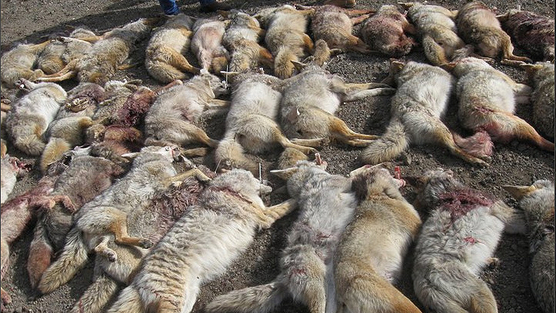
PORTLAND, Ore. – An animal-rights group and the organizer of an annual coyote-killing contest in southeast Oregon have settled competing lawsuits with an agreement that there will be no more hunting contests.

Coyotes are classified as predatory animals under Oregon law, and there are no limits on killing them.

Faced with that reality, the Animal Legal Defense Fund sued on the grounds that the contest violated anti-gambling laws.

Organizer Duane Freilino said Friday he agreed to the contest-ending settlement because he ran out of money to pay attorneys.

Stephen Wells, executive director of the animal-right group, says the agreement means hundreds of coyotes can live peacefully in the wilderness.

Freilino said he started the contest almost a decade ago to increase winter tourism in the sparsely populated region and to help ranchers by reducing coyote numbers before calving season.


Well folks I was inspired to snub the “anti’s” on this one. Especially in light of the fact that HSUS is here in Maine trying to steal my Bear Hunt using lies, deception, and half-truths to get the uninformed to back them. On November 4th we are facing the loss of our bear hunting tradition in Maine under the guise of more SPORTSMAN-like euphemistic terms like fair chase/stalking/still hunting.  The anti-group is trying to repeal our right to hunt over bait, use dogs , and to legsnare/trap. (Old school toothy bear traps are illegal and have not been used in decades.) They have made no bones that if they can steal the bear hunt from us they are after an end to all hunting…and the consumptive use of all animals. So first bear hunting goes , and eventually farming.


In direct response to the events in Oregon, and to HSUS interfering in hunting here. I am hosting the first of it’s kind……FOREVER 24/7/365 COYOTE EXTERMINATION CONTEST.


The rules are simple……….KILL AS MANY COYOTES AS YOU CAN …..WHEN AND WHERE YOU CAN…24/7/365!! This contest has no end date, and costs nothing to enter so it cannot violate any gambling laws.


One, the deer and small critters need a break here in Maine. Two, they are an invasive species not natural to this or any area now that they have been hybridized with dogs and wolves. THIS IS A GENETIC FACT HERE IN MAINE!!


The cute little 35 lb. coyote of the great plains and Texas has been replaced with 65+ pound coy/dog/wolves. That will kill humans and attack pets/kids and eats “anything” including it’s own kind. (Taylor Mitchell in Cape Breton was the first documented death here in the Northeast, but not the only or the last.)


How to Enter:


  1. Kill the coyote!!!
  2. Take it’s picture with you holding it or standing/kneeling /sitting near it. (You have to be in the picture.)
  3. Email the picture along with a brief story about the hunt with the usual who/what /where/when…. To northwoodswanderings@yahoo.com (Subject: Coyote Exterminator) OR….Snail Mail: Mail your printed pic and a note to Brent Reece: 25 Garfield Street #2A, Madison Me 04950
  4. I will post all pictures on my blog and on NWW’s Facebook page. I will select one picture each month for cudos and possible prizes. Once per year..like in June I will select a YEARLY WINNER from the previous MONTHLY WINNERS.


It costs nothing to enter and I will except pictures from all 48 states and Canada!!! But they must comply with the #2 rule!!


PLEASE LIKE Northwoods Wanderings on FACEBOOK…..Visit the blog: www.skinnymoose.com/wanderings or comment on TWITTER @aroostookbasser


AS in all contests I am looking for sponsors/prizes and support …….you can help me here or you can look up the great folks listed below and help us beat back HSUS and save our hunting traditions!


Here’s a link to the good folks at SAVE Maine’s Bear Hunt, who are leading the fight to save Maine’s bear hunt.


http://savemainesbearhunt.com/about/

Read more: http://www.skinnymoose.com/wanderings/2014/07/30/announcing-the-first-forever-247365-coyote-extermination-contest/#ixzz39ijro2i7

Mute Swans: Logic vs. Myth; Compassion vs. Dogma

Sanity and compassion prevail in New York… for now.

Canadian Blog

by Barry Kent MacKay,
Senior Program Associate

Born Free USA’s Canadian Representative

06/23/14

Wow. I am so accustomed to myth-based wildlife management policy swaying legislators (who are too lazy to do their homework), both Canadian and American, thatDSC_0098 it’s hard to believe what has happened, at least to date, in New York state (just across the lake from where I live, in Ontario). Senator Tony Avella recently announced the unanimous passage of his state legislation (S. 6589) by the state senate. This sets up a two year moratorium on plans by the ironically named Department of Environmental Conservation (DEC) to kill all mute swans in New York state: every last individual. While this has, inevitably, been called a victory for “animal rights and environmental protection groups,” it is much, much more than that. It is a victory for reason, logic, science, and yes—compassion.

Mute swans are those white swans with the curved necks, orange beaks, with black knobs at the forehead, who often “fluff” their wings into a graceful, sail-like configuration as part of their wonderful breeding display. They are seen in estate ponds, zoos, parks, and, increasingly, along urban waterfronts. Mute swans are native to Eurasia and distinct from North America’s two native swan species, the tundra swan and the trumpeter swans. Both native swans have tapered black (not orange) beaks, no knobs, and are less likely to carry their necks curved, and lack that characteristic “sail” display of the mute swan. Additionally, they are highly migratory, while mute swans are generally less so, if at all.

Seeing them—the epitome of grace and beauty—it may be difficult to understand why anyone would kill one, let alone every single one in an entire state. I think there are two answers: one official, and one not.

Officially, they are demonized for eating submerged vegetation needed by native waterfowl; for chasing native waterfowl from nesting areas, thereby usurping wetlands; and for pulling up emergent vegetation. The concern is simplified by calling the mute swan an alien, non-native, foreign bird who is displacing our native waterfowl—waterfowl that, I might add, are “game” birds shot by hunters, bringing in revenue that pays salaries of wildlife managers who want to kill off the mutes. Mutes are not very sporting prey… You can walk right up to most of them, and they tend to take food from the hands of kids, making it harder to shoot them.

But, it’s not nearly that simple. North America’s trumpeter swan was nearly exterminated by excessive hunting, particularly for the “fur” trade. (Back then, it included an equal trade in the feathered skins of birds.) We know that it nested in the western mountains and northern forests, and that many wintered on the mid to south U.S. Atlantic coast. There is no proof of them nesting much, if at all, east of the Great Plains and Mississippi drainage, but facts don’t matter to groups like DEC, and there is a massive bi-national effort to “restore” them as a breeding species in the east. No one admits it in so many words, but I suspect the hope is that, being highly migratory, they will eventually become another waterfowl species to entice the dwindling numbers of waterfowl hunters to load up their shotguns, and buy those licences so important in providing money to pay wages of wildlife managers.

But, people intuitively love mute swans, so they must be demonized. Being “alien” helps, though there is a huge hypocrisy involved. The same agencies that decry the bird’s foreign origins fail to mention that, by itself, that is hardly a problem when it comes to so many other species (including the brown trout, ring-necked pheasant, coho salmon, and other “game” animals that they, themselves, cheerfully add to the environment). So, being “alien” is only selectively a concern. In fact, most of the plants and a huge percentage of the animals we see in the wetlands are not native. More to the point, either the exact same species, or ones quite like them, co-exist with mute swans in Eurasian wetlands, begging the question (seldom asked and never answered): What makes the same, or very similar, species so vulnerable over here? And, why more vulnerable to mute swans than to trumpeter swans, whose “re”introduction is not challenged?

One of the most abundant plants in wetlands is the common reed, Phragmites, which is choking out wetlands. It is not native, but it is far too established to eliminate, and if mutes pull them out, isn’t that good? In fact, we have “Europeanized” so much of North America that it is far more suitable for mute swans than for trumpeters. Many Eurasian bird species, including other swans, have reached North America on their own, some establishing themselves as breeding species—and, in the fullness of time, the mute swan might, too. And, don’t forget that they are also common here in Ontario, across the lake, and we are not killing them… So, to keep New York mute swans free would require endlessly killing each one seen. Really, isn’t that a tad absurd?

But, most tellingly, there is nothing “bad” that a mute swan does that a trumpeter swan does not also do. (Plus, the latter is a lot noisier!) So, good for Senator Avella and his colleagues for seeing through the nonsense and making the logical, compassionate choice.

Sadly, the people in another neighboring region, the state of Michigan, show signs of being bamboozled by similar rhetoric from their own, but with a twist that would be humorous, were it not tragic for the swans… The mute swans chase Canada geese. Yes… From their nesting sites… But, do they not see the irony of also complaining about “too many” Canada geese? Also, how to explain the success that Canada geese have had in “invading” Europe, where, like mute swans in North America, the geese have escaped captivity and become established as an “alien” species? It would all be so funny, were it not so darn sad.

Petition to stop the slaughter of ravens in Idaho

A couple of weeks ago, I came across a small news article explaining that the Idaho Department of Fish and Game had received a permit from the United State Dept. of Agriculture (I think it was Ag) to kill 4000 ravens. This is proposed under the guise of protecting the sage-grouse, which, I believe, is being added to the endangered species list. The sage-grouse does need protection but here’s the problem. There are 19 factors that have caused their populations to decline, most the result of human activity. Predation by other creatures is #12 and ravens are the only ones that have been singled out, although there are many. Killing ravens will do little if anything at all to mitigate the problems the sage-grouse face.

I was so upset that I took it on myself to create a petition and I hope some of you will consider signing it.

There is a bias among many people against ravens and crows–their voices are not lyrical and some people see them as bullies or as symbols of evil. But recent studies show that they are among the most intelligent creatures on earth and actually may be the most intelligent. They have complex societies, young stay with their parents for years and they even have a ritual that humans would call a funeral when one of their own dies. Killing 4000 of these remarkable birds will reverberate through their community for generations.

You’ll find my petition here: http://www.thepetitionsite.com/114/2…-4000-ravens/#

And just so you know, I have NO financial or professional interest in this. It is a simple act of love. I have long adored ravens and crows. And Edgar Allen Poe, too.

Big huge thanks to all who take the time to sign.

Photo Copyright Jim Robertson

Photo Copyright Jim Robertson

Copenhagen Zoo Kills Four Healthy Staff Members To Make Space For New Employees

http://www.theglobaledition.com/copenhagen-zoo-kills-four-healthy-staff-members-to-make-space-for-new-employees/

COPENHAGEN (The Global Edition) – The Copenhagen Zoo has killed several of its staff members early this morning in order to create four new job openings, the Zoo public relations sector reported.

Officials of the Zoo say that the four members of the staff were humanely executed after being put to sleep with a lethal injection, and then skinned and chopped up while visitors crowded around and the meat was fed to the lion population.

“Based on the recommendation of the European Association of Work and Organizational Psychology (EAWOP), we have decided to make space for new work positions, because the Zoo needs new workers, and we found that killing old staff members was the cheapest and the most efficient way to do it,” said Zoo spokesman Tobias Stenbaek Bro “Four of the oldest staff members, among them one female, were put to sleep with a lethal injection and then fed to the giraffes. However, the giraffes didn’t show interest in their meat, so they were fed to the lions,” explained the Zoo spokesman.

“Being that the oldest staff members could no longer keep track with the new Zoo technologies, and could not manage themselves in the fast and ever-changing job environment, we feel that the criticism coming from some of their family members is completely unfounded,” the Zoo spokesman was quoted as saying.

“Zoos do not own the staff, but they are in charge of their employment, and in that regard have the full right to do with them whatever is considered necessary when they are on the Zoo territory”, said Tobias Stenbeak Bro. “It was the only humane way to dispose of them, you know. We couldn’t just leave them without jobs in this economy, as some heartless observers suggested”.

The Zoo spokesman concluded that “considering that the Zoo animals were fed with the meat of the former employees, the food chain was virtually completed, which is totally in respect of the law of nature”.

APRIL FOOLS!!

8775_524935520889725_1949817662_n

New Yorkers in Uproar Over Planned Mass-Killing of Swans

By Brandon Keim

http://www.wired.com/wiredscience/2014/02/mute-swan-controversy/all/

A mute swan in Prospect Park, Brooklyn. Image: Brandon Keim/Wired

In the menagerie of human mythology, mute swans occupy a special place. Across millennia they’ve symbolized transformation and devotion, light and beauty. Now a plan to eradicate the birds from New York has made them symbols of something else: a bitter and very modern environmental controversy.

The debate swirls around a host of prickly questions. Are mute swans rapacious destroyers of wetlands, or unfairly demonized because they’re not native to this area? Are some species in a given place more valuable than others, and why? Which deserves more protection, the animals that inhabit our landscapes, or the ones that might thrive in their absence? The answers depend on whom you ask.

“Mute swans always attract controversy, and tend to polarize people. And, as with most things, the truth probably lies somewhere in the middle,” said waterfowl researcher Chris Elphick of the University of Connecticut. “The real issue is that there are no simple answers.”

Mute swans are not native to North America. New York’s population descended from escapees imported for ornamental gardens in the late 1800s. Weighing up to 40 pounds apiece, they can eat 10 pounds of aquatic vegetation daily. In their absence, that food might be eaten by native wildlife. Mute swans are also aggressive during nesting season, and have been blamed for attacking ducks and pushing out other waterfowl.

Late in January, New York’s Department of Environmental Conservation issued a draft of a plan to reduce New York’s wild mute swan population to zero by 2025. Nests and eggs would be destroyed; a few adults might be sterilized or permitted to live on in captivity, but the rest would be killed.

“They are large, destructive feeding birds, and as much as they are beautiful, they can wreak havoc on the underwater habitat that a lot of other fish and wildlife depend on,” said Bryan Swift, a DEC waterfowl specialist and lead author of the plan. “We have an obligation to sustain native species. The question then is, ‘At what level?’ But in the case of introduced species, I don’t think we have that same obligation.”

That’s one way of looking at it. “We have so little opportunity to experience wildlife in New York City,” said David Karopkin, director of animal advocacy group GooseWatch NYC, “and now they’re targeting the most beautiful animals that we do have. The fact of the matter is, they’re part of our community.”

Were mute swans not so beautiful, the plan might not have caused much outcry. But unlike other animals tagged as invasive and pestilential — like Burmese pythons, feral hogs, and snakehead fish — mute swans are widely beloved. For people who live near wetlands around Long Island and the Hudson Valley, where most of New York’s mute swans live, they’re also a part of everyday life.

‘The real issue is that there are no simple answers.’

To their defenders, the fact that mute swans are non-native carries little weight. As one Queens resident told the New York Times, “If they were born here, they should be considered native by now.” And some think the swans’ heritage is being held arbitrarily against them.

“If Mute Swans were native to North America, they would not be viewed negatively by state wildlife agencies,” said ornithologist Don Heintzelman, an author of bird-watching field guides who is working with Friends of Animals, a New York-based animal advocacy group, to oppose the plan. Complaints that that mute swans harm other wildlife “are greatly overblown,” he said.

Over the last few years, some scientists have argued that non-native species are unfairly persecuted, their negative effects too frequently assumed rather than conclusively demonstrated. In fact, the evidence for ecological harm by mute swans is somewhat mixed.

In a review of mute swan impacts on wetlands published this month, French ecologists said the swans sometimes attacked other birds — but sometimes they did not. Likewise, their feeding habits sometimes damaged aquatic plant communities, but not always.

“The consequences of mute swan presence may strongly differ from an ecological context to another, so that no simple rule of thumb can be provided,” wrote the researchers. They did, however, say that the risk of mute swans reproducing prolifically and out-competing other species could justify their eradication from North America “as a safety measure.”

Swan defenders say the need for a safety measure is far from clear. In Maryland’s Chesapeake Bay, where a controversial mute swan eradication program was enacted in 2003 to help restore aquatic vegetation, the U.S. Fish and Wildlife Service previously said that swans had likely done little harm to seagrass beds.

“That’s a good example of how the science on this is incomplete,” said Brian Shapiro, New York state director of the Humane Society of the United States. Whatever effects New York’s 2,200 swans may have, he said, is a drop in the bucket compared to human-generated pollution and habitat destruction.

But scientists argue that the effects would be much more severe if mute swan populations grow as anticipated, and more difficult to control. “The dilemma wildlife managers face is that if they wait until there is no doubt that native species are being adversely affected, it will be much, much harder to do anything about it,” said Elphick. And although human impacts on habitat and native wildlife are undoubtedly greater, mute swans could consume a disproportionate amount of resources.

“Introduced species are a major cause of extinction and biodiversity loss, and the concern is that if they’re not controlled then we will see the world’s biota become much more homogenous,” Elphick said. “Mute swans are just one example of many.”

Mute swans’ lives are not the only ones that matter, said Michael Schummer, a waterfowl ecologist at the State University of New York at Oswego. People care so deeply about mute swans because they’re aware of them — but if they paid more attention to birds they impact, they might care about those as well.

Migratory tundra swans, said Schummer, which fly every year between the Arctic and southeastern United States, rely on those same wetlands. If they land after a 1,000-mile flight and can’t find a meal, it’s a disaster. “But maybe people don’t recognize that, or even realize that there’s a native swan that migrates,” Schummer said.

Swift noted that two dozen other duck species share the mute swans’ habitat, yet people are frequently unaware of them. And unlike migratory birds, mute swans stay in the same locale year-round, feeding through the growing season. “It’s like pulling up corn every time it sprouts,” Swift said. “It has a much more lasting and damaging effect.”

“I value the long-term stability of the ecosystem for the individuals that live within it,” said Schummer, who supports the DEC plan. “When that is threatened by one species, and the well-being of the collective is at risk, then something needs to be done.”

Given these competing and deeply-entrenched views, a compromise seems unlikely. Yet there may yet be a middle ground, says behavioral ecologist Marc Bekoff, a pioneer of an emerging discipline called “compassionate conservation,” which tries to balance species- and population-level considerations with the well-being of individual animals.

“The take of compassionate conservation is that individuals count. Our motto is, ‘Do no harm.’ In this case, it would be worth pursuing every single possible non-lethal alternative,” said Bekoff. Rather than killing mute swans outright, as is happening in Maryland, wildlife managers could try to prevent eggs from hatching by shaking them or spraying them with oil. Swans might also be sterilized.

These are just possibilities, said Bekoff. What matters is that people try to find alternatives to killing. In the end, non-lethal measures may prove to be the only control palatable to a public that’s come to adore swans, whatever their impacts.

Of course, non-lethal methods tend to be more expensive than killing. Volunteer assistance from the public may be required. Shapiro said the Humane Society would be open to helping. “We want there to be a focus on non-lethal management,” he said, noting that Humane Society volunteers have helped to non-lethally control Canada geese by scaring them with dogs or shaking their eggs. “We’d like to have a dialogue on this.”

Swift said he’s open to such a discussion, and would welcome the help. “There’s definitely room to work on this issue,” he said. Following public outcry, he’s also considered treating New York’s mute swan populations differently. Those around Lake Ontario, which are growing by about 13 percent every year, might be eliminated, while Long Island’s swans could be managed to balance their impacts with public sentiment.

“I can’t speak for the whole agency,” Swift said, “but I’m certainly going to entertain that idea and discuss it with other people involved in management.”

New York’s DEC is accepting public comment on the plan until February 21st. If things go their way, those non-native swans might just become fully naturalized ecological citizens.

Last chance to stop bowhunting in Cayuga Heights

PUBLIC HEARING –  Weds, Jan. 29th, at 7 PM

Marcham Hall, 836 Hanshaw Rd, Ithaca, NY

Across from Community Corners, same building as the police station

Dear friends,

In December, we wrote to you about a new proposed law that will allow bowhunters and their deadly weapons into Cayuga Heights. Since then, the Cayuga Heights board of trustees has held two public hearings and made small adjustments to the law, which you can see in its latest form here: http://www.cayuga-heights.ny.us/doc/PLL-A-2014.pdf . Before they pass this new draft of the law, they are required to hold another public hearing, happening this Wednesday, Jan. 29 at 7 PM at the Village Hall (address above). Please attend. Even better, speak out. Better still, encourage others to join you.

This new law will allow deadly crossbows and compound bows to be discharged in residential neighborhoods — outside of hunting season, at all times throughout the year, including Summer, and even at night. In other words, there will be no time of year that it is safe for the people and animals in and around Cayuga Heights.

 Every hunting season, stories come out about dogs, cats and other “non-target” animals being wounded and killed by hunters. In a recent TV news story from Wisconsin, a woman tearfully described how she found her poor dog under a hunter’s tree stand, dead from a mortal wound from an arrow. The dog was left there for 3 days, to painfully die in a pool of her own blood. Please watch and share this news story, as it demonstrates the kind of tragedy that can easily unfold when hunters are introduced into a densely settled community like ours: http://tinyurl.com/kw3ryo9

Bow hunting is notoriously cruel. Numerous studies show that more than half the deer who are shot with arrows are never retrieved, running off to painfully bleed to death or live with a debilitating open wound. Their prolonged agony and deaths are no less horrific than the one the Wisconsin woman’s dog experienced. Desensitization to the killing of deer leads to other forms of desensitization and violence. Let’s teach our community’s children to respect wildlife and other animals, not condone their killing.

And what about the children? At the Jan. 13 meeting of the Village government, Cayuga Heights trustee Stephen Hamilton identified the most likely area where bowhunting will occur, based on available open space: A piece of land between Cornell and Cayuga Heights. A citizen in the audience commented that there is a daycare center in that area. This appeared to be of little concern to Mayor Kate Supron (former co-president of the Cayuga Heights PTA) or her fellow trustees. However, during the discussion, trustees Liz Karns and Diana Riesman expressed their preference for having deadly weapons discharged by professional contractors overseen by the Village government. It is yet to be seen whether they will vote in favor or against the law.

Mayor Kate Supron is obsessed with killing. How else can you explain this latest move when nearly 100% of the does in Cayuga Heights are now sterilized? Numerous residents are commenting on how they have noticed fewer fawns this year, and less deer browsing. After paying $150,000 of taxpayers’  money to sterilize an estimated 95% of the does in 2012, the Village spent nearly $3,000 per deer to sterilize the remaining 12 at the end of 2013. So how does the mayor justify killing these same deer? The answer is, she has no justification other than her opinion that there are still “too many deer.” She contends there should be only a fraction of the deer that the village currently has, yet she refuses to allow the sterilization program play out long enough to achieve the desired result. She also refuses to address questions from her constituents about how she plans to prevent fertile does in surrounding areas from moving in to take the place of sterile does who have been killed by the bowhunters she now wants to allow in. Sadly, as we have seen over and over again, logic, reason, science and ethics have no role in the Mayor’s agenda.

This new law poses a threat to ALL of us, not just those who live in the village. Most of us drive on Cayuga Heights roads, many of us take walks, jog or ride bikes there. Hundreds of people live in proximity to the village border. The safety of their families and companion animals are threatened by the discharge of deadly weapons that could just as easily maim or kill a human as a deer. These neighboring residents are just as likely to have bowhunters trespassing on their land, and injured/dying deer show up in their yards, as Cayuga Heights residents.

The opposition is growing. Earlier this month, an open letter protesting the law, signed by 44 residents, was sent out to people who live in and around Cayuga Heights. Please join these engaged citizens and be a voice for safety, non-violence, and common sense!

Thank you for staying involved throughout this long struggle. We know it hasn’t always been easy, but there is no denying that our work together thus far has prevented the mass-slaughter of the Cayuga Heights deer, and all the violence and ugliness that an annual wildlife killing program would bring.

Your friends,

Jenny, James and Eric, on behalf of CayugaDeer.org

WHAT YOU CAN DO:

Attend Wednesday’s hearing and speak out! Please also encourage others to join you, especially those who are most affected by this new law, and may not realize the potential risks to their safety.

If you can’t attend, please take a moment now to send a quick email to the trustees expressing your opposition to this new law. It can just be one sentence, the important thing is that they hear from people who are against the new law before they vote on it on Wednesday night. Their addresses are: mayor@cayuga-heights.ny.usrrobinson@cayuga-heights.ny.uspsalton@cayuga-heights.ny.usccrooker@cayuga-heights.ny.usekarns@cayuga-heights.ny.usdriesman@cayuga-heights.ny.usshamilton@cayuga-heights.ny.usjsteinmetz@cayuga-heights.ny.us

CITIZENS FOR SAFE, ETHICAL AND RATIONAL APPROACHES TO REDUCING DEER-HUMAN CONFLICT

[Here’s an example of the unethical and irrational]:

E0AF0B4E-024A-431C-AE14-90CB22CA791B

Cormorant hunt in South Carolina Must Be Stopped

[This cormorant cull is just the kind of thing that the infamous Time Magazine piece on the resurgence of hunting was meant to prepare us for. As with so many articles from the mainstream media, this one saves the real story for the end (where they know many readers won’t see it).

Here, then, are the last lines first:  …The cormorant population went into serious decline with the use of the now-banned DDT. The increase of birds on the lakes means the population is re-establishing itself.

“We should be celebrating that, it seems to me,” he said. The removal “is a sad thing.”

http://www.postandcourier.com/article/20140125/PC16/140129561/cormorant-hunt-in-marion-moultrie-lakes-rouses-controversy

Cormorant hunt in Marion-Moultrie lakes rouses controversy
by Bo Petersen

Saturday, January 25, 2014

Cormorants aren’t a favorite bird for very many people. They are snaky necked, ravenous fish eaters that can kill a tree with their acidic feces if they roost there thickly enough.

Cormorant facts

The double-crested cormorant

One of 38 species worldwide, one of 6 in the U.S.

Found in waterways from Alaska to Florida.

Long-lived waterbird, nests in colonies that can be as large as a few thousand.

An estimated 2 million in North America. Population increased rapidly 1970s-1990, slowed in the 1990s.

States permitted to conduct cormorant depredation removals include Alabama, Arkansas, Florida, Georgia, Kentucky, Louisiana, Minnesota, Mississippi, North Carolina, Oklahoma, South Carolina, Tennessee, and Texas.

Sources: U.S. Fish and Wildlife Service, U.S. Department of Agriculture.

And this time of year they descend on the Marion-Moultrie lakes by the “thousands and thousands and thousands,” according to one fishing guide, ready to feast on the shad and herring runs that provide food for the lakes’ trophy game fish.

That’s why anglers and state legislators have been pushing for a cormorant removal hunt scheduled to start Feb. 2 on the lakes. Avian conservationists oppose it. As a migratory bird, the cormorant, craw and all, is a protected species, meaning federal regulations restrict harassment or taking of the birds.

“These are native birds. They have always been here. Someone now perceives that to be a problem,” said Norman Brunswig, Audubon South Carolina state director. The S.C. Department of Natural Resources has no credible scientific evidence that the onslaught of winter migrating birds does any substantive damage to the fishery, he said. “To kill a bird without a really, really good reason to do it is kind of barbaric.”

‘Look at the flocks’

DNR is holding the removal “event” after years of angling groups seeking it, and after a proviso was tacked onto the 2013-2014 budget directing the agency “through the use of existing funds” to manage public participation in “cormorant control activities.”

Truman Lyon, the South Carolina Guides Association representative for Berkeley County, makes no bones about it.

“We definitely need to have this hunt,” he said. “Look at the roosts. Look at the banks. Look at the flocks and flocks of (cormorants) on the lakes. There are many, many more than there ever were. There’s nothing to kill them,” he said.

Studies have shown that the birds eat a tremendous amount of fish. But that’s alongside other birds and, of course, the fish themselves.

How much the feasting might be depleting the game fish isn’t clear. The lakes – relatively shallow, stagnant and heavily fished – have long been a problematic fishery to manage. Previous declines in game fish species have been blamed on factors such as overfishing, aquatic cover removal and drought, as well as competition for food. The recent cold snap killed bait fish.

Striped bass, or stripers, were the trophy fish that turned the lakes into what has been touted as a $300 million-per-year tourism destination. In the early 2000s the striper numbers went into a precipitous decline, but aggressive stocking and tighter catch restrictions, among other measures, brought them back.

“There’s loads of stripers,” Lyon said, but crappie and bream numbers are not where they should be, he said, and catfish have depleted to the point where DNR is now imposing a limit of 20 fish per day per person in the boat.

Cormorants increasing

How many cormorants there actually are around the lakes isn’t clear, although observers generally agree there are a lot, and they are increasing.

The removal hunt was given a depredation permit “to protect public resources” by the U.S. Fish and Wildlife Service, the federal agency in charge of managing protected species. The permit doesn’t require population numbers to be reported, just the harvest, said Tom McKenzie, Southeast region media relations chief.

Santee Cooper, the quasi-state utility that manages the lakes, officially is staying hands-off.

DNR manages the fish and game for Lake Marion and Lake Moultrie, said Santee Cooper spokeswoman Nicole Aiello; it is the agency’s role to make decisions such as this one.

DNR staff have concerns about the “event.” Staff will fly over the lakes before and afterward to do counts of cormorants, along with other protected bird species such as bald eagles, anhingas and wood storks. That data will be reviewed to decide – among other things – whether to hold the hunt again.

800 hunters qualified

“We’re not concerned about the future of the migrating cormorant population, because it has grown so much,” said Derrell Shipes, DNR Wildlife Statewide Projects, Research and Survey chief. The birds are now so numerous they routinely are caught in the lakes’ fish passage, he said.

More than 800 people have qualified to hunt the birds, making the “public removal” so labor-intensive that the agency doesn’t have the staff to enforce bag limits. The hunters each have taken part in a training session that includes warnings not to mistakenly shoot other similar-looking, protected species such as anhingas and wood ducks or face arrest.

The scheduled two-month “event” can be stopped at any time by DNR, Shipes said.

“All of us should pay attention to what we’re doing,” he said. “When we have the harvest information, we’ll step back, look at the problems and issues and go from there.”

Brunswig isn’t buying it. DNR wouldn’t hold this hunt if it wasn’t being pressured to, he said. The cormorant population went into serious decline with the use of the now-banned DDT. The increase of birds on the lakes means the population is re-establishing itself.

“We should be celebrating that, it seems to me,” he said. The removal “is a sad thing.”

1459861_559462450790007_563882710_n

National Park Service Starts Mass Slaughter of Deer in Rock Creek Park

Washington, D.C. (January 8, 2014) – As Christmas trees and charming illuminated

Photo Copyright Jim Robertson

Photo Copyright Jim Robertson

deer decorations sparkled on lawns in the nation’s capital last night the real deer who live in Washington, DC, were being gunned down by the National Park Service in the bitter cold. Last night’s begin of the mass killing of deer was the first of several unannounced deer kills that the NPS plans to conduct in Rock Creek National Park through March 31.

In record-breaking bitter cold temperatures that reached into the single digits with 40 mph wind gusts the National Park Service, in a sneaky attack, last night set up unannounced road blocks around Rock Creek Park and turned its guns on some of the 300 deer who live there.

Although gunshots could not be heard, Park Police acknowledged to passers-by that the killing was taking place. The NPS has announced in the past that silencers would be used by USDA Wildlife Service’s agents on guns so that residents who live near the Park would not be disturbed. It is also possible that archery was used, an unusually cruel method of killing animals.

Unlike last year’s killing, in which the NPS announced in advance on what days the killing would occur, the NPS has now changed tactics. In an attempt to outwit deer supporters, the NPS has announced that it will conduct surprise kills on unannounced nights through March 31.

Last night’s killing was exceptionally unconscionable because it took place during a record-breaking cold spell during which wild animals need to preserve their heat and energy by hunkering down. Hunting the deer during such extreme weather stressed not only the deer but all the other animals who live in the Park.

“The National Park Service’s decision to enter in an endless cycle of killing deer is appalling in terms of its brutality, and it goes against the public’s will, common sense, compassion and science,” says Anja Heister, In Defense of Animals’ Director for the Wild and Free-Habitats Campaign. “The agency kills deer despite its failure to provide proof that it is actually the park’s deer and not exotic plants that interfere with forest regeneration.”

“Urban deer are here to stay, and we need to take responsibility in treating them humanely” adds Heister. “Instead of being so incredibly backward, the NPS should enter the 21st century and use existing nonlethal methods, including fertility control.”

Legal action by a coalition of local Washington D.C. residents and In Defense of Animals against the NPS killing continues, as will negative publicity and protests by local residents for as long as it takes to put a halt to this senseless killing, and for the agency to realize that it had better start to listen to the public, who strongly opposes the killing of deer in our nation’s capital as unacceptable.

###

Contact: Anja Heister, anja@idausa.org, 406-544-5727

In Defense of Animals is an international animal protection organization located in San Rafael, Calif. dedicated to protecting animals’ rights, welfare, and habitat through education, outreach, and our hands-on rescue facilities in India, Africa, and rural Mississippi.

IN DEFENSE OF ANIMALS – 3010 KERNER BLVD. – SAN RAFAEL, CA 94901 – 415-448-0048

Stop the exterminat​ion of Idaho wolf packs!

A hit man sent by the Idaho Department of Fish and Game may be the last thing the Monumental and Golden Creek wolf packs will see before they die.

Yes, you read that correctly.

The U.S Forest Service (USFS) has ignored their own wilderness management policy and allowed the Idaho Department of Fish and Game (IDFG) to send a trapper out to exterminate two wolf packs deep within the vast Frank Church-River of No Return Wilderness.

This is a massive betrayal of the public trust. Tell the USFS, the agency in charge of protecting this Wilderness Area, to immediately stop the wolf eradication program in the Frank Church-River of No Return Wilderness area.

The future of wolves in Idaho is grim if we don’t act against their brutal anti-wolf agenda. In 2012, IDFG funded the aerial killing of 14 wolves, paying a bounty of $1600 per dead wolf. And now the Forest Service is letting it happen – against their own policies.

Enough is enough. Tell the USFS that their reckless decision to allow entire wolf packs to be exterminated in a protected wilderness area is unconscionable.

There isn’t any time to lose – as you read this, the state’s hit man is out laying his traps which by Idaho law can be left unchecked for up to 72 hours – leaving anything caught to bleed to death or succumb to exposure while waiting to be shot by the returning trapper.

This is going on as we speak – time is of the essence.

Please, take action immediately! Tell the USFS that it’s their duty to protect the wild in Wilderness Areas – and they must stop this reckless wolf extermination!

Thank you for all that you do.

https://secure.defenders.org/site/Advocacy?cmd=display&page=UserAction&id=2679

528624c939a88_preview-620