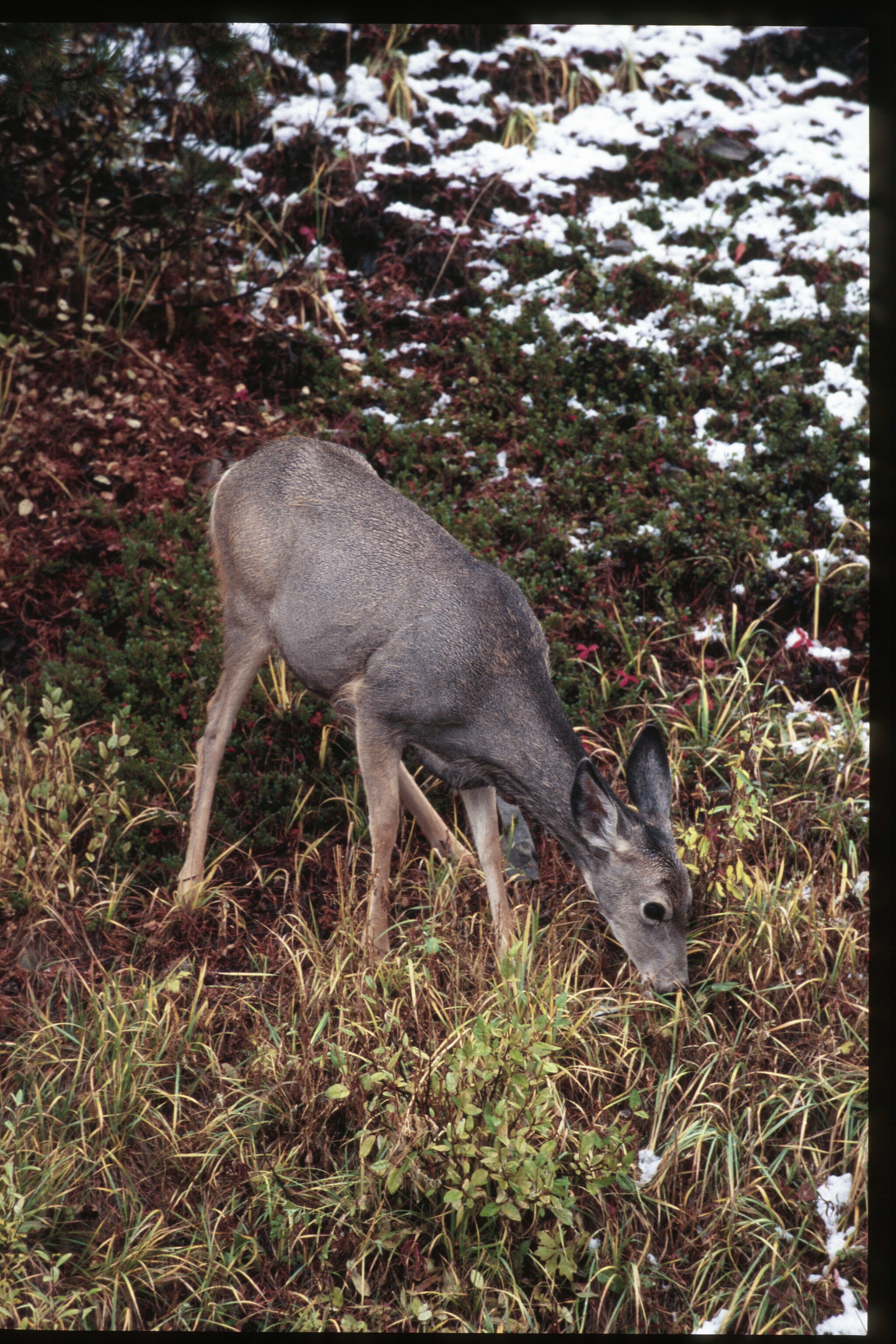
Action Alert: Urge Long Island to Halt Deer Massacre

Urge Long Island to Halt Deer Massacre!

cute deer

According to news sources, the Long Island Farm Bureau intends to contract with the U.S. Department of Agriculture’s Wildlife Services to kill deer in local municipalities by using sharpshooters or by using netting to catch them so that they can be slaughtered, apparently in hopes of controlling the deer population. Animals who are shot often do not die outright. Wounded deer commonly “disappear,” only to succumb unseen to their injuries or to die from extreme stress or in attacks by other animals. And netting is a terrifying ordeal for these easily frightened prey animals, who thrash frantically when ensnared, often harming themselves in the process, and then endure rough handling before finally being killed.
Deer are beneficial to ecosystems because they distribute key nutrients. Even if population control is insisted upon, there is no need for lethal measures when effective, humane methods exist. Please politely urge the Long Island Farm Bureau to halt this cruel initiative—and then forward this alert widely!

Take Action Here: https://secure.peta.org/site/Advocacy?cmd=display&page=UserAction&id=5221

NYT Approves of Killing 3,000 Deer on Long Island

THE NEW YORK TIMES EDITORS APPROVE OF KILLING 3,000 DEER ON LONG ISLAND

by Anne Muller

When The New York Times editorial staff gives its imprimatur to an idea, policy, politician, or event, it carries a lot of weight. I’m an avid online reader of the NYT, sometimes waking at 3:45 a.m. to read the NYT in my inbox. As an anti-hunting advocate, the subject of wildlife management has been a specialty of mine for many years, so I was disappointed to read that the killing of deer was given short shrift by the Times’ editors.

There’s something wrong when the killing of 3,000 living, breathing beings is given a thumbs-up by an esteemed newspaper. I prefer to believe that the support shown for this “cull” is not a lack of ethics, but rather a lack of information about how deer populations increase. It’s important to know the truth in order to apprehend the real culprit.

To allow hunters to remove a considerable percentage of the deer population while ensuring a continuing “crop” for the next hunting season, land manipulation and hunting regulations are designed to increase their birthrate and food supply. The current goal of wildlife management agencies is to sustain hunting from season to season. (There is an exception to this form of management but it would be too lengthy to discuss here.)

Wildlife Services, which operates almost as a separate fiefdom within the USDA, benefits greatly from killing “excess” wildlife that occurs due to sloppy miscalculations by state game departments, and their indifference to wild animal suffering. It’s a win-win situation for both a state wildlife management agency and the federal Wildlife Services, but it is a huge loss for the general public, the deer, and those who love them.

Both state game agencies and Wildlife Services operate as if they were private enterprises functioning within a larger government entity, enjoying all the benefits of public money and the credibility that municipal governments attribute to them. Yet, the very survival of Wildlife Services depends on outside contracts from private or government entities; and the survival of state game departments depends on hunting license sales and excise taxes on handguns, other firearms, and ammunition used legally against wild animals and illegally against people.

While hunting has been given a pass by President Obama and other gun control proponents, there are certain fiscal inequities that need to be exposed, and opposed as vigorously as other wrong laws plaguing our society.

I wonder if those who believe that gun control is needed but hunting is okay understand that every firearm purchased and every bit of ammunition used in the killing and injury of students, theater goers, elected officials, and thousands of individuals shot in urban areas, increases the revenue of the Conservation Fund whose purpose is to fund game agencies so that they can continue to benefit from the excise taxes on weapons and ammunition. Put another way, the goal of wildlife management agencies is to increase the use of firearms and ammunition in order to collect the excise tax.

Isn’t it time to revisit the Pittman-Robertson Act, which created an insulated and circular business that cares little about how firearms are used just so long as they are used?

Wouldn’t it only be fair that funds derived from the sale of guns and ammunition be allocated to compensate victims, or their care-takers, to mitigate the impact of losses from death, injury, or property damage resulting from the use of such weapons and ammunition?

Does it really seem right that all conservation funds are used to promote hunting and more use of firearms and ammunition?

Wildlife management needs to shift from a weapons-based and hunting-based foundation to a non-consumptive, wildlife watching one. That alone will reduce the artificially increased number of deer, thus obviating the pretense of a “necessary cull” due to natural causes rather than the choreography of wildlife management agencies.

How much longer must we and wildlife suffer with our current form of wildlife management? How much longer should families of victims of gun violence be left without compensation to cover the financial burden of their loss? How much longer should the public be kept in the dark about the funding scheme of firearms use? How much longer should our wild animals suffer as a result of mismanagement and a lack of ethics regarding their welfare?

Killing the Long Island deer is wrong both morally and strategically. The real culprit is wildlife management’s connection to the firearms industry. Slaughter of these precious beings will not solve anything, but it will allow the nightmare to continue. Hunting should not be a sacred cow for gun control proponents. It’s time to take it on and change the game.

Anne Muller, VP

Committee to Abolish Sport Hunting

New Paltz, NY and Las Cruces, NM

Photo Copyright Jim Robertson

Photo Copyright Jim Robertson

Resurgence of hunting is “welcome, overdue”

[Some people actually agreed with the Time article, if you can believe that!]

http://democratherald.com/news/opinion/editorial/editorial-resurgence-of-hunting-is-welcome-overdue/article_f19d2988-642f-11e3-bcee-0019bb2963f4.html

A recent cover story in Time magazine made the case that hunting is on the verge of making a comeback.

If true, that would be welcome.

Interest in both hunting and fishing in the United States (and even in Oregon, despite the state’s rich outdoors tradition) has been declining for years.

Now, as the article in Time argued, we’re starting to see one of the results: Our forests and wildlands are packed with unsustainable numbers of wild animals — and the critters, starving for habitat, are starting to move in on more urban areas.

States and cities have adopted what appear to be extraordinary measures to deal with the overflow. Consider these examples cited by Time:

— The City Council in Durham, N.C., recently authorized bow hunting for deer inside the city limits to help deal with an outbreak of Lyme disease and an increase in the number of deer-vs.-vehicle collisions.

— Officials in San Jose, Calif. — yes, in the heart of Silicon Valley — now allow the hunting of wild pigs within the city.

— Rock Island, Ill. recently approved bow hunting in town, as long as it occurs on the city’s green spaces — golf courses, parks, cemeteries — or on public land.

The long-running shift in attitudes toward hunting (it dates, in some ways, to the release of the movie “Bambi“) has had exactly the result you would expect: The number of animals in our forests in some cases has reached historic highs. Consider, for example, white-tailed deer — in 1930, hunted nearly to the point of extinction. Today, estimates suggest, 32 million deer are in the United States — and a couple of million of them recently have been in your back yard, eating everything they can.

We have dramatically underestimated the important role hunters play in maintaining a balanced ecosystem. In retrospect, the results should have been obvious.

But the price we are paying for that failure, in some ways, isn’t as obvious: Damage from the nation’s 5.5 million feral pigs, for example, is estimated at $1.5 billion every year. The U.S. Department of Agriculture is considering a plan to encourage wild pig hunting.

It is true that the actions of some thoughtless vandals have hurt the image of hunting. Consider the incident last month in Oregon State University’s McDonald-Dunn Research Forest, in which poachers dumped a bull elk, wasting more than 250 pounds of meat. The elk’s antlers had been cut from its skull with a saw.

The people responsible for despicable actions like these are not hunters. They are criminals — but their actions tarnish the reputation of the sport, and likely have played some role in the decline of hunting.

Now, however, the table might be set for true hunters to reclaim their position as critical players in maintaining the balance that allows both animals and humans to thrive. (mm)

Mike McInally is the editor of the Democrat-Herald. He can be reached at 541-812-6097

1459861_559462450790007_563882710_n

Letter Annihilates “America’s Pest Problem”

The following letter from a friend and fellow blogger/photographer, Ingrid Taylar, completely annihilates Time Magazine’s recent anti-wildlife article, “America’s Pest Problem…

Coyote Photo©Jim Robertson

Coyote Photo©Jim Robertson

Dear Editor:

David von Drehle’s piece, “America’s Pest Problem,” barely touches on the crux of the issue which is our own exponentially growing population combined with our gluttonous appetite for land and resources, all of which present wild animals with fewer options. He describes our ecological role in heroic terms, without delving into the much more complicated morass of human intrusion. We encroach on wild spaces, sterilize formerly complex habitats with subdivisions and lawns, raze and trample forests to provide grazing lands for cattle, pollute water sources with our industrial production of food and materials, poison critical plants like milkweed out of existence for Monarch butterflies and bees, build roadways through critical migration corridors, produce trash to the degree that there is no feasible way to dispose of it all, plasticize the oceans, and so forth. But what conclusion does von Drehle derive? That we kill too rarely. It takes a lot of gall to argue for lethal methods against wildlife as a solution when we are, in fact, the most damaging and lethal ecological presence ourselves, literally altering our ecosystems and forcing other species to survive and seek out food sources within the realm of hazards and limitations we impose.

To present the issue as simplistically as David von Drehle does is lazy journalism. The piece ignores important environmental considerations while also leaving out the known problems with lethal control. He doesn’t grapple, for instance, with the paradox that despite unregulated and often brutal killing and trapping of animals like coyotes, their populations explode nonetheless. He ignores the biological principles which suggest that killing meso predators leaves gaping niches which are then filled by even more animals. He engages fear mongering over the presence of apex predators, not seeming to fully grasp that animals like wolves help balance our ecosystems more effectively than any human management plan. He doesn’t mention, for instance, the concept of trophic cascades, where healthy wolf populations lead to numerous benefits for plants and animals which now thrive because of this restored balance. At the same time, he leaves out information about state wildlife programs which actually work to keep deer abundant for hunting purposes, or which promote habituation by allowing hunting over bait. He makes little issue of the fact that populations of feral pigs in many cases were encouraged for sport hunting. These are but a few examples that point to a much murkier underbelly and even a deliberate complicity by humans in these problems.

There are success stories about urban and suburban coexistence with wildlife that don’t involve mass slaughter. Marin County in California is one such place, replacing lethal predator control with creative ideas about managing our lives, our needs, our farms and our lands in the context of a more compassionate, progressive and sound ethic toward wildlife. Von Drehle argues for an archaic, 19th century model of wildlife “management” which drastically underestimates what we can achieve through more thoughtful and advanced paradigms of understanding and conflict resolution. Von Drehle says it’s time for a new perspective on hunting and wildlife control in the 21st century. On this, I agree. What he misses, however, is that better models do exist and are being improved based on our increased scientific awareness of wild animals and their inherent value. Instead, he looks backward for answers, to an era and an ethic when killing and exploitation were the applied solutions for almost all issues involving wildlife. As a species and as individuals, we are much better than this. But you’d never know it from this article.

Wildlife activists outraged at TIME’s cover story this month Special

The cover of this month’s issue of TIME depicts a young female deer below the headline “America’s Pest Problem.” The wildlife activist community is in an uproar over the article many see as factually inaccurate and something more fit for an op-ed

The article does appear to be advancing an agenda, as the last line in the lead paragraph on the TIME website reads “Why wildlife in the U.S. needs stronger management.”  The article’s full title is “America’s Pest Problem: It’s time to cull the herd.”  Whether intentional or not, David Von Drehle’s article has sparked controversy.

Almost immediately, activists took to the internet expressing their outrage. The article’s dateline is Dec 9, 2013, but is available online now. A Facebook event page is already set up to encourage people to write physical letters to TIME. The event page has this in its description

Time Magazine is coming out with an article to the general public, supporting the slaughter of wildlife on a grand scale. This article is extremely dangerous and inaccurate. This article supports outright slaughter of our wildlife in all parts of the country stating that we are all being overrun with animals and that “experts” say it is necessary. Time Magazine has a responsibility to the public to be accurate and unbiased, and not promote an anti-environment extremist point of view.

Protecting Endangered Species, the Facebook page hosting the letter writing event had this to say in a statement

It is disturbing that Time Magazine has used it’s reputation as a legitimate news source to promote a very extreme and controversial opinion as fact. The consequences of promoting this type of intolerance of our wildlife are severe and promotes violence and cruelty towards our animals. Wildlife belongs to all of us as a nation, not to the special interests of oil, the livestock industry, and recreational hunters. The opinion expressed by Time is that of these special interest businesses and is in direct opposition to wildlife experts and the overwhelming number of voters in the states of concern. This is an opinion which could be freely expressed in an op-ed section, but to present it as fact, as a cover story, is highly unprofessional and exerts the power of Time magazine in an inappropriate manner.

The use of hunting today beyond the purpose of sustenance is a very important contributor to the destruction of our environment. The use of hunters to control populations or “manage” them IS THE PROBLEM. At the turn of the century the wolves and other predators were nearly exterminated out of fear and lack of knowledge of biology, contributing to over and under populations of other animals. We know more about biology than we did in 1900 and this needs to stop. No form of hunting is superior to Nature, and the motivations of special interests are based on human desires of consumption, they are not based on the best interest of the animals or the environment. Misinformation needs to be corrected before we destroy what we do have left. We have nonviolent and nonlethal means to correct problems and we need to use them.

One of the activists participating in the event, Mar Wargo, expressed her opinion as well

Americans seem to be learning and expressing a new ethic today. It seems to me it is not a well educated ethic and lacks moral grounds. In the 40 years of the Endangered Species Act, Wild Free Roaming Horse and Burro Act we have come full circle and now have this tremendous backlash towards the wild animals and wild lands. I believe much of this is corporate interests and this now encompasses hunters who had not been the enemy at one time. They had been the conservationists once. No longer. Killing is too popular and this is all weighed down in ignorance and greed. We have good laws that allowed us to participate in the process and stop actions against wild lands and wildlife. This is Not user friendly any longer, we have lost much of our own traction as a result. We need to regain sanity and science in this country. We need to respect this Earth which is now damaged beyond repair if we intend to survive. Killing the Earth is not the way to survival.

Photo Copyright Jim Robertson

Photo Copyright Jim Robertson


When the sun sets, the dark reality of badger culling emerges

Monday, September 02, 2013
Western Morning News

We’re a week in to the badger-cull that is said to be taking place in West Somerset. As yet no official facts or figures relating to the operation have been released but WMN reporters have been out gauging the mood in the area…

The public, visible, normal face of West Somerset could be found on the shoreline at Minehead this weekend when thousands of people gathered in sunshine to witness the finish of the popular annual RNLI raft-race. It’s a happy vision that belies the new, hidden, furtive and sinister side of the area which occurs after sundown several miles from the coast up in the hills.

​Above: Protesters walking in the cull zone to disperse badgers. Right: Monksilver in the Brendons, where people are roaming the lanes at night

Protesters walking in the cull zone to disperse badgers. Right: Monksilver in the Brendons, where people are roaming the lanes at night
For that is a zone of threat and, at night-times, even fear. A place where police helicopters hover at midnight; where roadblocks are set up without notice; where once- unpopulated nocturnal lanes are suddenly busy; where strangely clean Land Rovers lurk in gateways; where the gateways themselves are now chained and locked; where torchlight flickers in woods at two in the morning; and where – just occasionally – the sound of gunfire reverberates through the coombes.

Welcome to Badger-Cull-UK – land of anonymity and rumour. A place where locals won’t go on record and where unknown people move about the byways at night because they’re either trying to stop the cull, or because they are guarding those who’ve signed up to kill badgers.

Or, perhaps, they’re just making their way home from the pub… like one hapless West Somerset local the other night who inadvertently terrorised a dozen or more people out on anti-cull patrol.

“I was riding my bicycle over the hill from Monksilver and I passed this cottage where two dogs often come out and have a go at me if their owner has forgotten to lock them up,” he told the Western Morning News. “I was swearing and shouting at the dogs as they chased me in the dark lane – and when I went around the corner there were more than a dozen people huddled in the hedgerow, and some of them were screaming in fear.

“They must have thought I was some crazy farmer out to attack them, but I was just fed up with those dogs. And it was a steep hill so, by the time I’d shot by the badger-cull people, it was too late to explain.”

An hour after the late-night incident, a police roadblock was set up in the village of Monksilver – although it is not known if the two events were related.

Indeed, in West Somerset most things related to the cull are unknown. Media enquiries are unwelcome by both sides and monitoring a vast district riddled with valleys and myriad lanes on the ground at night is not an easy option.

Which is presumably why a police helicopter was hovering over the Brendon escarpment between the villages of Monksilver, Roadwater, Luxborough and Withycombe for nearly an hour just after midnight yesterday morning.

In most places where people fear to speak out, rumours tend to abound. And so it is in West Somerset. All manner of tales relating to anti-cull activity are doing the rounds. Is it, for example, really true that one farmer who owns a holiday complex had diesel oil tipped into his swimming pool by animal-rights activists?

Landowners who’ve signed up for the cull are, understandably, reluctant to draw the spotlight of attention on themselves – this newspaper is aware of a dozen such stories, but we cannot vouch for their authenticity because the victims would rather not speak with the Press.

We do know that animal rights activists have created websites giving details of every farmer or landowner in the West Somerset area who has signed up for the cull – one such site provides intricate detail with maps and even videos of properties concerned.

Darkness is descending on the other side of the fence too – a freelance photographer used by the WMN who’d been following the cull story was told this weekend that he was no longer welcome to go out on patrol with activists in the area.

If we descend to the last possible rung of reportage and relate to the “general feeling” of a normally peaceful area that suddenly finds itself the focus of so much nocturnal attention, it would be true to say that many have noticed an upturn in badger numbers over the last few years. Some will have been glad to see them – but, in what is mainly an agricultural community, the most commonly held opinion sparked by bovine TB has, for a long while, been along the lines that “something must be done”.

The trouble a week into the cull is – what is being done is about as clear as mud. There are beginning to be murmurings even among some in the agricultural community that the experiment, operation – call it what you will – lacks scientific credibility.

One farmer in his late 60s – who remains adamant that large numbers of badgers should be exterminated – pointed into a West Somerset valley and told the WMN: “There are two large setts down there – the landowner on the right has signed up for the cull, the one on the left hasn’t.

“No-one knows what state those badgers are in – what happens if they cull a healthy colony, leaving one that is infested with TB? I’ll tell you what – all they’ll have done is helped spread the damned disease!”

And what’s making such people more uncomfortable – or even angry – are unverified reports doing the rounds that the corpses of culled badgers are not being tested for TB.

“If those reports are true,” said the veteran farmer. “Then this whole thing is half-cocked and a waste of time.”

In the meantime, some locals in West Somerset who have nothing to do with the cull either way are beginning to wish the area had never been selected.

A woodman who has worked on an estate near Williton for the past 25 years was stopped by police last week.

“There were three officers in the vehicle and they gave me a right old grilling,” said the man. “One even took my name and wrote down everything I said in a notebook.

“Maybe I can’t blame them – I’ve been in the lanes around here in the past few nights and they’ve been full of all sorts of suspicious-looking people – including security guards in big Land Rovers.

“I’m fed up with it,” he added. “What’s more – I’m afraid it’s all going to kick off and get much worse.”

Many locals would agree with the sentiment – and yearn for the days when the most newsworthy thing that happened in West Somerset was the annual raft-race.

Read more: http://www.thisiscornwall.co.uk/sun-sets-dark-reality-badger-culling-emerges/story-19738531-detail/story.html#ixzz2e0B6APEK
Follow us: @thisiscornwall on Twitter | thisiscornwall on Facebook

STOP THE BADGER CULL – BOYCOTT ALL ENGLISH FARM PRODUCE

From people on the scene:

BADGERS WERE MURDERED LAST NIGHT SCREAMING IN AGONY.DOGS OFF LEADS AND UNMUZZLED WERE USED TO FINISH THE WOUNDED BADGERS OFF..SUCH HORROR !!! POOR BADGERS 😦
THE PEOPLE RESPONSIBLE ARE THE UK GOVERNMENT AND THE UK FARMERS. PLEASE SIG…

 STOP THE BADGER CULL - BOYCOTT ALL ENGLISH FARM PRODUCE

This petition will be delivered to:

DEFRA and NFU

STOP THE BADGER CULL – BOYCOTT ALL ENGLISH FARM PRODUCE

Because Badgers have been wrongly blamed for Bovine Tb in Cattle. Farmers want a cull and government have given the go ahead for Badgers to be killed in June 2013,and this will not cure the problem Scientists say. A total of 130,000 are to be slaughtered in the near future. Vaccinate instead.

To: DEFRA and NFU
Stop the Badger Cull, allow badgers to be vaccinated and press forward for a cattle vaccine.
We the under signed agree to Boycott All English Farm Produce , including meat dairy fruit veg and eggs, basically any thing produced by English farmers, in protest against the Badger Cull.

Sincerely, [Your name]