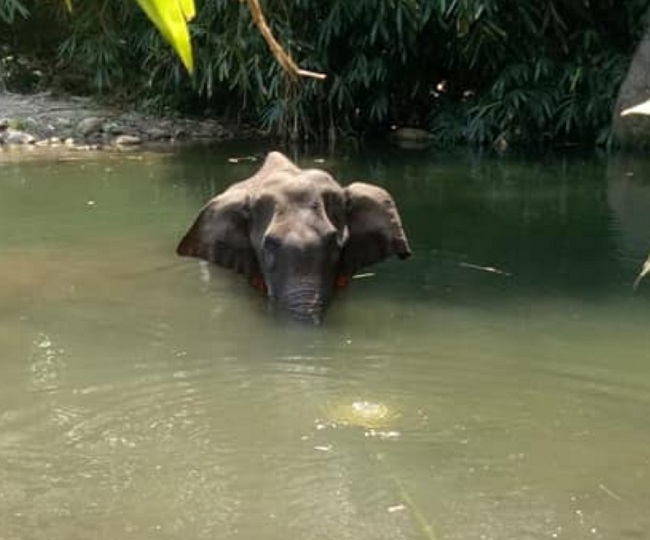
Elephants or Wild Boars: By Shreya | Updated: Monday, June 8, 2020, 13:20 [IST] New Delhi, June 08: The death of a starving, pregnant elephant in Palakkad allegedly consuming a pineapple stuffed with explosives caused outrage on social media. The jumbo went through unthinkable trauma, stood impassively in a river and died a slow death. Video grab Various theories have shrouded the ghastly death of the elephant. While people are blaming the farmer responsible for the incident, it is important to note that the elephant was an unintended target. Primary investigations into the death of pregnant elephant in Kerala has found that it may have accidentally consumed a cracker-stuffed fruit, the environment ministry noted. NGT takes cognisance of elephant death in Kerala, seeks action-taken report from panel India public places reopen even as Covid-19 infections surge by 9000 for 5 days | Oneindia News The government noted that many a times locals resort to an illegal act of planting explosive-filled fruits to repel wild boars from entering plantation farms. In a series of tweets, the ministry has said that one person has been arrested in the matter. “Primary investigations revealed, the elephant may have accidentally consumed in such fruit.” Ministry is in constant touch with Kerala Govt and has sent them detailed advisory for immediate arrest of culprits & stringent action against any erring official that led to elephant’s death,” the ministry said. “As of now, one person has been arrested & efforts are on to nab more individuals who may have participated in this illegal & utterly inhuman act. The @WCCBHQ has also been directed to act on this matter with utmost sense of urgency. #WildlifeProtection,” the ministry posted on its official Twitter handle. So now, it has come to the light that the elephant had strayed into a trap that was intended for wild boars. Wild boars are a chronic problem to farmers because they tend to destroy crops in their search for food. To avert them, farmers have come up with cruel methods like the explosive-laced traps that claimed the elephant’s life. It’s a common practice in most of the Indian states to ward-off the animals. But that does not make this practice less evil and it has to stop at any cost. The intended target is an elephant or a wild boar, it is an inhumane method of dealing with wildlife.
Between 2014 and 2019, 510 elephants died all over India as a result of electrocution, train accidents, poaching and poisoning.
New Delhi | Jagran News Desk: A pregnant Elephant was fed with pineapples and firecrackers in Kerala’s Palakkad district’s Silent Valley, which exploded right in her mouth leading to fatal injuries and immediate death right after. A senior forest officer in Attappadi Reserve Forest told media about the incident on Tuesday.
“Her jaw was broken and she was unable to eat after she chewed the pineapple and it exploded in her mouth. It is certain that she was offered the pineapple filled with crackers to eliminate her,” Principal Chief Conservator of Forests (Wildlife) and Chief Wildlife Warden of Attappadi Reserve Forest, Surendra Kumar, was quoted as saying by the news agency PTI.
The incident was reported from the left wing fringe areas of the Silent Valley in Attappadi in Palakkad district. However, Surendrakumar told media that the Elephant died at Velliyar river in Malappuram district on May 27. Later on, the post mortem revealed that the female jumbo was pregnant.
8 things your disaster emergency kit must have to better deal a crisis
“I have directed the forest officials to nab the culprit. We will punish him for ‘hunting’ the elephant,” Surendrakumar said.
The incident came to light when Mohan Krishnan, a forest officer wrote a heartbreaking note on his Facebook wall, explaining the events which led to Elephant’s death in Northern Kerala.
Krishnan was the part of initial response team to help the injured creature He said on later that she didn’t trample homes as she ran through the village in excruciating agony.
Coronavirus News: Uttarakhand reports 60 new COVID-19 cases, state tally..
‘This is why I said, she is full of goodness,’ Krishnan said.
Officials brought two other elephants to the river in an attempt to entice her from the water but, according to Krishnan, she had come to the river to die.
“I think she had a sixth sense. She didn’t let us do anything,” Krishnan wrote on his Facebook wall.
Elaborating upon the moment when Elephant died, Krishnan wrote that to give her the farewell which she deserved, he and his colleagues took her inside the Reserve Forest in a lorry.
“She lay there on firewood, in the land she played and grew up. The doctor who did her post-mortem told me that she was not alone. I could sense his sadness though the expression on his face was not visible due to his mask. We cremated her in a pyre there. We bowed before her and paid our last respects,” the forest officer added.
According to an Indian Express report, between 2014 and 2019, 510 elephants died all over India as a result of electrocution, train accidents, poaching and poisoning.
In early April this year, a video was being circulated amongst animal rights activists in Karnataka: A mahout stating that since the lockdown, his 55-year-old captive elephant has not had anything to eat.
The elephant belonged to a temple in Mudhol district, and for the past 40 years, had been living off offerings of jaggery, sugarcane, fruits and grains provided by the people visiting the temple. Since the lockdown, the mahout had not been able to step out and the temple was running out of fodder. The video ends with the mahout appealing for help.
Ever since the lockdown, there have been several such stories that have been doing the rounds on social media, seeking donations to provide food for starving captive elephants.
Joseph Barretto, owner of Jungle Book Resort in Goa, has five elephants in captivity, which are typically used for rides and “showers” for tourists. He released a video seeking donations for “his starving elephants”.
The elephant owners of Amer Fort in Jaipur, Rajasthan, known for using at least a hundred elephants for tourist rides, also complained about the lack of income that disabled them from getting fodder for their elephants. Similarly, elephants held captive by individual owners in Kerala and religious institutions in Karnataka have been seeking help.
“It takes one pandemic to throw things out of gear,” said Suparna Ganguly of Wildlife Rescue and Rehabilitation Centre, an animal rights non-profit based in Bangalore, Karnataka. “It just goes on to show how precarious their situation is when they are in private custody.”
‘Owning’ an elephant
There are 2,675 captive elephants in India, according to the information received by Tamil Nadu-based animal welfare activist Antony Clement Rubin via a Right to Information response from the Ministry of Environment, Forest and Climate Change in November 2019 and available to Mongabay-India.
Of these, 1,821 are in private custody and the rest are under the care of the forest department of various states. Among the elephants in private custody, some are owned by individuals and others by institutions like temples and circuses.
The Indian Elephant is protected under Schedule one of the Wildlife Protection Act, 1972, which affords maximal protection. It is listed as “Endangered” in the Red List of Threatened Species of the International Union for Conservation of Nature.
Under Section 1(5) of the Wildlife Protection Act, a captive animal is “captured, or kept or bred in captivity”. Section 40 of the Act gives special status regarding possession, inheritance, or acquisition of the animal. “This exception was originally created for the elephants that were already in captivity at the time, to regularise their possession. But it is being used to capture more elephants and issue new ownership certificates,” said Alok Hisarwala, a Goa-based lawyer who manages the Elephant Rights Campaign for Federation of Indian Animal Protection Organisations.
Explaining it further, he said, “It’s like this. If I step into the forest and see a wild elephant and if I get caught trying to capture it, I have committed an offence. But if the next morning, I happen to walk to the Chief Wildlife Warden’s office, telling him that I have an elephant in my backyard and that he/she is listening to all my commands, I will get the ownership certificate. They won’t ask me how I acquired the elephant.”
There are 2,675 captive elephants in India. Credit: Radhika Agarwal/Mongabay
Currently, there are 1,251 captive elephants with ownership certificates and 723 elephants whose ownership certificates are still under process. “These captive elephants are brought as baby calves from the Northeast to Rajasthan and trained for tourist rides,” said Abhishek Singh, an animal welfare activist based in Jaipur. “A [memorandum of understanding] was passed between the Forest Department and some of the non-profits in the area, about four to five years back that no more new elephants will be brought to the state,” he said. “But the rules continue to be flouted.”
Moreover, elephants are used for commercial purposes. Under the Performing Animals Registration Rules, 2001 – part of Prevention of Cruelty to Animals Act 1960 – using captive elephants for commercial purposes such as tourism is strictly prohibited unless specific permission is obtained by the Animal Welfare Board of India. There are several state-specific laws, as well.
Elephants under stress
In 2017, members of the Animal Welfare Board of India attempted to conduct health checks on the elephants in Jaipur. Out of the 102 elephants tested, at least ten showed symptoms of tuberculosis, a zoonotic disease. The report also revealed that elephants were suffering from blindness, had their tusks removed, and were under extreme psychological stress. However, no action was taken at the time.
“We tried to organise a health camp earlier this year, but that was also cancelled at the last minute,” said Singh. In fact, earlier in March, PETA wrote a letter to the chief minister of Rajasthan, urging him to stop the elephant rides because of the potential risk to tourists of contracting tuberculosis.
“The elephants are constantly abused, they are made to stay in concrete stalls, they have foot diseases, ankush [a sharp instrument used by mahouts] is used to control them, and they are constantly under stress,” said Singh.
In August 2019, a study assessing physiological stress in captive Asian elephants was published by scientists at CSIR- Centre for Cellular and Molecular Biology, Hyderabad. The study checked the amount of stress hormones called glucocorticoids in 870 dung samples from 37 captive elephants. The samples were collected from elephants that were engaged in different activities – from Mysore zoo, Mysore Dussehra temporary elephant camp, Mudumalai Tiger reserve elephant camp, and Bandhavgarh Tiger reserve elephant camp.
The elephants from the Mysore Dussehra camp, which were made to perform at religious ceremonies had a higher amount of stress hormones than others. The study explained that heightened levels of stress can cause infertility, hyperglycemia, suppression of immune response, imperfect wound healing, and neuronal cell death.
“Elephants are social animals, they need other elephants around them, and when they are kept isolated environments such as temples, it automatically elevates their stress hormones,” said Sreedhar Vijayakrishnan, a researcher on elephant behavior at National Institute of Advanced Studies, Bangalore.
“In females, this disrupts their reproductive cycle,” he said. Male elephants go into musth at around 20-21 years of age. Their testosterone level goes up and their raging behavior increases. “This means they travel a larger distance than normal, in search of a mate. When you keep them in captivity in one place, it automatically increases their stress level,” he said.
“Some of the manifestations of stress include stereotypic behaviour – rocking, swaying, head-bobbing, and other repetitive movements,” said Dr Shantanu Kalambi, wildlife veterinarian and consultant at Wildlife Rescue and Rehabilitation Centre, based in Bangalore. “This sometimes causes them to walk in an awkward manner, leading to arthritis and spondylosis.”
Further explaining the physiological problems captive elephants go through, feet are the “biggest issue” for them, he said. “Thanks to constantly standing or walking on unsuitable hard surfaces, they have bad feet, abscess in the foot and hips, broken nails, and develop arthritis over time,” he added.
Other issues they face include blindness and cataract, “since they are out in the sun all the time.” If they had their own will, they would find shade, he said.
Elephants in captivity are often not allowed to have mud baths. “Mud acts like sunscreen for them, and keeps away ectoparasites,” said Kalambi. As a result, they develop skin problems.
“Increasing cases of conflict in captivity, manifested in the form of property damages and human casualties, is another issue in captive conditions,” said Vijayakrishnan. Several times a year, local papers report headlines such as “Elephant runs amok during temple festival in Kerala” or “Elephant crushes mahout to death”. “This is an area that is often overlooked, and is also a result of stress and inadequate rest for the elephant,” he said.
Research shows that isolation, confinement and increased workload causes stress in elephants, which manifests itself in various physiological problems. Credit: Shantanu Kalambi via Mongabay
Response to pandemic
Conservationists and activists say that an average middle-aged healthy elephant needs 100-150 kg of food per day, consisting of grass, foliage, hay, banana stock, ragi, rice, gingelly oil, vegetables, pulses and fruits, along with 5,000 gallons of water. Captive elephants are heavily dependent on human intervention for their well-being, especially their mahouts, who play an active role in their positive reinforcement. The ones that are medically unfit require regular veterinary assistance. On average, the bare minimum cost for providing nutrition, medical needs and logistic support for one captive elephant amounts to approximately Rs one lakh per month.
In response to the current Covid-19 crisis, Singh explained that each elephant handler in Jaipur was given Rs 600 per day for the food and upkeep of the elephant, by the Rajasthan forest department. “This is too less an amount,” said Singh. “One needs at least Rs 2,000-Rs 3,000 per day for an elephant.”
In Kerala, the state government released Rs five crore for animal welfare, which includes the 479 privately-owned captive elephants in the state. In Karnataka, the high court passed an order on April 9, asking the state’s forest department to ensure the upkeep of the state’s privately-owned elephants.
In Tamil Nadu, activist Antony Rubin sent a letter to the forest department, requesting them to allocate appropriate funds, food and veterinary attention to the state’s captive elephants, as well as to the mahouts. The confidential letter is available with Mongabay-India.
Need of the hour
While a long term policy change is the need of the hour, experts offer a variety of views for handling the gentle giants in captivity. The CSIR-Centre for Cellular and Molecular Biology study on captive elephant stress recommends “minimising participation in religious activities, processions” and creating opportunities “for elephants to interact with other elephants in the facility.”
“We need an urgent policy change to completely ban the ownership of elephants in private hands,” said Ganguly. “Whether it is owned by an individual or an institution, this needs to be stopped by law.”
She further added, “There are many captive elephants that are currently in good condition, and many in a bad condition. There needs to be formed a neutral committee, that consists of experts in the field, that can make a detailed report on the kind of housing and facility these elephants need.
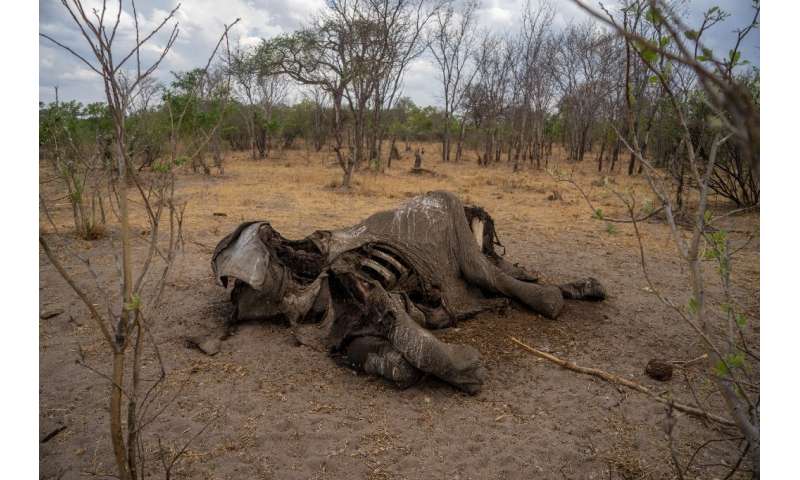
Taken on November 12, 2019 it shows the carcass of an elephant that succumbed to drought in the Hwange National Park, in Zimbabwe.
Zimbabwean villager Dumisani Khumalo appeared to be in pain as he walked gingerly towards a chair under the shade of a tree near his one-room brick shack.
The 45-year-old was attacked by a buffalo days earlier, and he was lucky to be on his feet.
Wild animals in Zimbabwe were responsible for the deaths of at least 36 people in 2019, up from 20 in the previous year.
“I thank God that I survived the attack,” said Khumalo with a laugh, making light of the fact that the buffalo almost ripped off his genitals.
Authorities recorded 311 animal attacks on people last year, up from 195 in 2018.
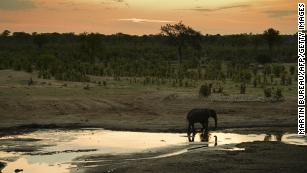
The attacks have been blamed on a devastating drought in Zimbabwe which has seen hungry animals breaking out of game reserves, raiding human settlements in search of food and water.
“The cases include attacks on humans, their livestock and crops,” said national parks spokesman Tinashe Farawo.
He said elephants caused most fatalities, while hippos, buffalos, lions, hyenas and crocodile also contributed to the toll.
Hwange National Park, which is half the size of Belgium, is Zimbabwe’s largest game park and is situated next to the famed Victoria Falls. The park is not fenced off.
Animals breach the buffer and “cross over to look for water and food as there is little or none left in the forest area,” Farawo said
Starving animals
Khumalo vividly remembers the attack.
More than 200 elephants starved to death over three months last year
He was walking in a forest near his Ndlovu-Kachechete village to register for food aid, when he heard dogs barking.
Suddenly a buffalo emerged from the bush and charged, hitting him in the chest and tossing him to the ground.
It went for his groin and used its horn to rip off part of the skin around his penis.
Khumalo grabbed the buffalo’s leg, kicked it in the eye and it scampered off.
Villagers in Zimbabwe’s wildlife-rich but parched northwestern region are frequently fighting off desperately hungry game.
More than 200 elephants starved to death over three months last year.
Despite suspecting that Khumalo was hunting illegally when he was attacked, Phindile Ncube, CEO of Hwange Rural District Council admitted that wild animals are killing people and that the drought has worsened things.
“Wild animals cross into human-inhabited areas in search of water as … sources of drinking water dry up in the forest,” said Ncube.
He described an incident that took place a few weeks earlier, during which elephants killed two cows at a domestic water well.
Armed scouts have been put on standby to respond to distress calls from villagers.
But it was while responding to one such call that the scouts inadvertently shot dead a 61-year-old woman in Mbizha village, close to Khumalo’s.
“As they tried to chase them off one (elephant) charged at them and a scout shot at it. He missed, and the stray bullet hit and killed Irene Musaka, who was sitting by a fire outside her hut almost a mile away.”
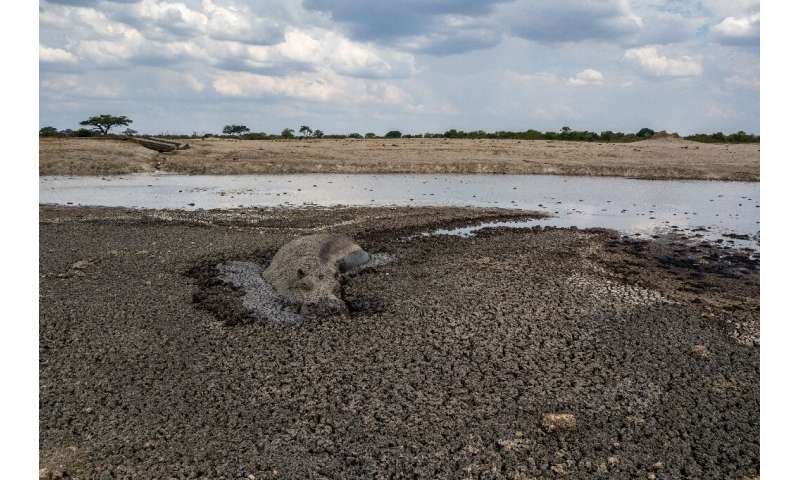
In this file photo taken on November 12, 2019 a hippo is stuck in the mud at a drying watering hole in the Hwange National Park, in Zimbabwe.
Chilli cake repellant
Locals are encouraged to play their part to scare off animals. One way is to beat drums.
But the impact is limited.
“Animals, such as elephants get used to the noise and know it… won’t hurt them, so it does not deter them in the long term,” said George Mapuvire, director of Bio-Hub Trust, a charity that trains people to respond to animal attacks.
Bio-Hub Trust advocates for a “soft approach” that encourages peaceful co-existence between humans and wildlife.
Mapuvire suggested burning home-made hot chilli cakes to repel wildlife.
“You mix chilli powder with cow or elephant dung and shape it into bricks, once the bricks dry, you can burn them when elephants are approaching. They can’t stand the smell!”
Villagers have created an elephant alarm system by tying strings of empty tin cans to trees and poles.
When the cans click, they know an elephant is approaching and they light chilli cakes to keep it away.
Another way of keeping elephants at bay is the chilli gun, a plastic contraption loaded with ping-pong balls injected with chilli oil.
“When it hits an elephant, it disintegrates, splashing the animal with the chilli oil,” Mapuvire explained.
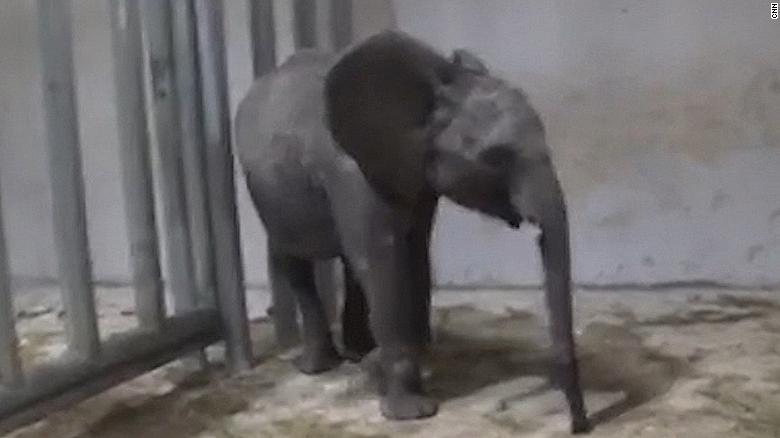
Hwange National Park, Zimbabwe (CNN)The cellphone footage reveals rows of steel cells stretching along a concrete floor. Behind each set of bars, a juvenile African elephant, their tusks just barely showing. One elephant presses its head into the corner of its prison-like confinement.
Zimbabwean officials legally captured these highly intelligent and social animals in Hwange National Park. Now, they will be broken and put on display for tourists in China.
By the end of this month, as more and more experts weigh in on the deep trauma suffered by captured elephants, a treaty governing international animal trade will halt the export of live elephants from Zimbabwe and other countries in Southern Africa.
Activists say they fear that the opaque trade could now move underground.
A screenshot taken from cellphone footage shows a caged young elephant in China.
Stuck in a holding pen
A vast park on Zimbabwe’s westernmost frontier, Hwange is one of the continent’s best spots for seeing giant elephant herds.
But few of the tourists entering the main gate are aware that just a few miles away to the southeast is a large boma compound, notorious among animal rights groups as the center of Zimbabwe’s efforts to sell elephants.
Armed with satellite coordinates provided by a source, we drove to the edge of the compound to try and see the elephants allegedly still inside.
“I have no idea about that,” a manager says, when asked about the elephant boma, a kind of holding pen before translocation.
We were quickly asked to leave, but Chrispen Chikadaya, a senior inspector with the Zimbabwe National Society for the Prevention of Cruelty to Animals (ZNSPCA), is one of the few people who has gotten inside.
Chikadaya began hearing the rumors late last year that park authorities were rounding up breeding herds and capturing juveniles for export.
Witnesses told him that wranglers were grabbing elephants old enough to survive without their mother’s milk, but small enough to squeeze into a freight box to China.
“They experience severe stress; they don’t have the freedom they have to move around like they do in the wild. If you put them in cages, you have now taken away the wild in them,” says Chikadaya.
Footage courtesy of Humane Society International released earlier this year.
Video released by Humane Society International shows the young mammals pacing back and forth, behavior often exhibited by stressed elephants. Predictably, the images sparked outrage.
“This is fiction. People act like we don’t love these animals, that we are abusing them. It is not true, because we are looking after our animals very well,” says Tinashe Farawo, a spokesman for Zimbabwe National Parks and Wildlife Management Authority (Zimparks).
He says that Zimbabwe has legally translocated animals to zoos, circuses and sanctuaries for decades without much fuss.
“We have moved animals to the US, the UK, Australia and New Zealand. This is not a new phenomenon in this country,” he says. “We think people should be scientific and ask what the facts are, not the emotions.”
Intelligent and sociable animals
Well-known elephant biologist Joyce Poole scoffs at the emotion-versus-science argument.
After studying elephants in the field for decades, she believes that they are uniquely intelligent and ill-suited for confinement.
“Some critics say we are ascribing human characteristics towards elephant, but we are not. These are elephant characteristics. They are capable of empathy, of self-awareness, understanding death and compassion. This is the kind of scientific evidence that Zimbabwe is ignoring,” Poole says.
She says, like us, elephants are highly social animals — confine them and they get bored, depressed, aggressive and sick.
“Through the course of evolution, they have developed these really close social bonds. If you take that away from an elephant, you destroy it,” says Poole.
On average, elephants die much younger in captivity, are less fertile, and suffer more from ailments like arthritis.
“Some animals are suitable and may even prosper in captive situations and zoos, because their biological needs are met. As for elephants, the needs are so beyond the scale of any zoo I have seen, that none of them are appropriate or suitable as a destination,” says Keith Lindsay, an elephant biologist who has studied zoo conditions.
As scientists learn more about elephants, public attitudes and policy have begun to change. In the US, the Ringling Bros. and Barnum & Bailey circuses stopped using elephants in 2016 — a year before the company shut its doors for good.
Stuck in limbo
In June, President Emmerson Mnangagwa said the country needed to sell wild elephants to fund its conservation efforts.
Back in May, the government revealed it had made $2.7 million from the sale of 90 elephants to Dubai and China.
In recent years, Zimbabwe has found ready buyers in China for their live elephant trade, but the ZNSPCA says the details of those deals and the conditions of the confined animals have been deliberately obscured.
Chikadaya says when he first inspected the elephants, in Hwange, slated for export back in 2018, inspectors were told by park officials that the elephants would be moved within a month, but they were kept in a boma for nearly a year.
In October, word got out that officials were preparing to ship the elephants, and the ZNSPCA team rushed back to Hwange. After the seven-hour drive, they were forcibly barred from the boma, despite their legal mandate to inspect captive animals. Zimpark officials say that they didn’t have the right paperwork, but their inspectors are, in fact, free to inspect whenever they want.
The ZNSPCA says that the following morning the elephants were crammed into crates and spirited out of the park as their inspection team slept.
“It all should be transparent,” says Chikadaya. “We should know that our animals are being translocated. And we need to know what benefit it has for conservation.”
Zimparks did eventually release basic information on where the elephants went and what they bought with the money — their spokesman says there is no issue of transparency, adding they bought everything from vehicles to uniforms with the proceeds.
A vast park without resources
With about a third of Zimbabweans surviving on food aid during the lean season, many would view the fate of about 30 elephants the equivalent of “first world problems.”
Ultimately, Hwange is expected to pay for itself. They do that with tourist dollars and, says Farawo, by selling elephants.
“We believe that elephants must pay for their upkeep. They must also pay for their protection,” he says, adding that Hwange has elephants to spare, with somewhere between 45,000 to 53,000 in the park — far more than the park’s environment can sustain.
Patrick Sibanda, a veteran ranger of the park, says each year the rains are coming later and later.
He says that around 200 elephants have died from thirst and hunger since October alone.
An elephant carcass in Hwange. A severe drought that has drained water sources in Zimbabwe’s largest national park, resulting in a number of elephant deaths.
“It’s very bad. So many elephants have died this year,” says Sibanda, as he walks towards a carcass near a water hole.
“This young elephant came to drink, but I think it was exhausted,” he says. The elephant injured itself at the water trough, he says, and a pride of lions attacked it. On the other side of a dirt track, another elephant carcass lies under an acacia tree
The drought is one of the main arguments put forward for selling elephants to China by Zimparks. They say they need money to repair artificial water holes to save elephants.
“There is no water, there is no habitat, there is climate change. These things are real,” says Farawo
Biologists like Poole say they should instead gradually reduce elephant numbers by reducing the water points, not unnaturally prop up the numbers. But she concedes that there aren’t any easy options for Zimbabwe.
The end of the trade
In the next few days, Zimbabwe will no longer be allowed to sell its elephant to China or anywhere else where African elephants don’t naturally exist.
The decision was taken at a Convention on International Trade in Endangered Species of Wild Fauna and Flora (CITES) meeting in Geneva earlier this year, backed by a coalition of African nations and the European Union. Members of the international treaty governing the international sale of animal products approved the ban.
The move was lauded by conservation activists, but slammed in Zimbabwe, where they say they will lose a key revenue stream. Zimparks says they will abide by the treaty for now, but Zimbabwe’s President has already hinted in state media that they could withdraw from the agreement. Activists, meanwhile, worry that the sales will just move underground.
After the elephants left for China in October, there were rumors that several were left behind, too big to fit in the crates after the extended confinement.
Zimparks flatly denied that any were left in the boma.
But after winning a court battle, the ZNSPCA gained access just a few days ago. They found two emaciated young elephants struggling inside the translocation compound.
Chikadaya understands that the parks desperately need funds but says there has to be another way. He says the lack of transparency from the government and the trauma faced by the elephants, both here in Zimbabwe and thousands of miles away in zoos across the world, just can’t be worth it.
“Our wildlife belongs to Zimbabweans. It doesn’t belong to one person; it doesn’t belong to an organization. It belongs to our ancestors. It belongs to our children, to our parents, to our grandchildren,” he says.
AMERICAN SOLDIERS’ BANNED AT THE BERLIN WALL FOR ALLEGEDLY HARASSING TOURISTS
×
Cambodia’s most famous tourist attraction, Angkor Wat, will ban elephant rides around the ancient temples, beginning next year.
After pressure from animal rights groups, the temples’ management group decided to stop offering elephant rides to tourists.
To start the initiative, two of the 14 elephants that lived and worked at Angkor Archaeological Park were moved to the nearby Bos Tham forest last week, according to the Khmer Times.
The rest of the elephants that are in Angkor Wat will be transferred to the forest by early 2020. Visitors will be able to see the animals there but they will not be permitted to ride as the elephants will continue to be under the care of the company that currently owns them.
GETTY IMAGES
“The elephant is a big animal, but it is also gentle and we don’t want to see the animals being used for tourism activities anymore,” Long Kosal, a spokesperson for the park’s management company, told Khmer Times. “We want them to live in their natural surroundings.”
Elephants have been at Angkor Wat since the practice of ferrying tourists around started in 2001.
In 2016, an elephant named Sambo died at the park, due to a heart attack triggered by heatstroke and exhaustion. Her death prompted an online petition to end elephant riding at Angkor Wat, which earned more than 185,000 signatures.
The World Wildlife Fund published a report last year, stating that the number of Asian elephants has decreased 50 percent in the last three generations. There are less than 50,000 that live in the wild and they are officially listed as an endangered species.
Antique dealers fail in high court bid to overturn world-leading blanket ban on
trading
Owen Bowcott
Tue 5 Nov 2019 17.45 GMT First published on Tue 5 Nov 2019 15.17 GMT
Antique dealers have failed in an attempt to overturn a total ban on ivory
trading being introduced by the government after the high court ruled the
legislation did not breach European law.
Conservation groups, who argued that any dilution of the ban would
revitalise illegal elephant poaching, welcomed the decision, which they said
would preserve the UK’s position as a world leader in the fight against the
ivory trade.
Last month, a small number of antique dealers challenged the ban in the high
court, arguing that sales of “cultural heritage” objects had no impact on
the market for illegally plundered tusks.
The 2018 Ivory Act, which attracted cross-party support, has yet to come
into force. It criminalises trade in all ivory artefacts with a few artistic
exemptions. The prohibition was championed by the former environment
secretary Michael Gove, who pledged to introduce “one of the world’s
toughest bans on ivory sales to protect elephants for future generations”.
The high court claim was brought in the name of a newly formed company,
Friends of Antique Cultural Treasures (Fact), but funds were channelled via
the British Antique Dealers’ Association (Bada). The dealers also said the
ban undermined the European convention on human rights by interfering with
individuals’ property rights.
Responding to the judgment, Mary Rice, the chief executive of the
Environmental Investigation Agency (EIA), said: “This is a victory for
common sense and one which maintains the UK’s position as a global leader
when it comes to fighting the illegal ivory trade.”
The EIA is part of a coalition of 11 conservation organisations that
supported the Ivory Act, arguing that any legal trade in ivory provides
cover for the illegal trade because it is difficult to distinguish between
antique and newly carved ivory. The UK is one of the world’s leading
exporters of antique ivory, particularly to China and Hong Kong.
The environment secretary, Theresa Villiers, said: “I welcome today’s ruling
by the high court which upholds the UK’s commitment to ban the ivory trade.
“We will move forward and make sure the ban comes into operation as soon as
possible to protect wildlife and the environment.”
The European commission is considering further restrictions on ivory trade
across the EU, based in part on the UK’s Ivory Act. Other countries, such as
Singapore, Australia and New Zealand, have introduced, or are considering,
similar legislation.
John Stephenson, the chief executive of the campaign group Stop Ivory, said:
“Challenges to the new legislation fly in the face of British public
opinion, which increasingly puts the conservation of nature before profit.
We hope that’s the end of the matter and that the government can get on with
implementing the act, without further distractions.”
Conservationists estimate that 55 African elephants are poached every day,
which they say is an unsustainable rate of loss. David Cowdrey, the head of
policy and campaigns at the International Fund for Animal Welfare, said: “We
are delighted to hear that the high court has rejected the antiques lobby’s
bid to overturn the Ivory Act. It is a fantastic day for elephants, and for
everyone that has fought so hard to make the UK’s ivory ban one of the
toughest in the world.”
Photo: Unsplash/ Timothy K
16 Reactions
An international conference of elephant experts has condemned the capture and confinement of elephants and has called on zoos to release and reintegrate them into the wild or relocate them to sanctuaries where they can live a more normal life.
Holding elephants in captivity causes them enormous stress and constitutes cruelty. Capturing wild elephants and removing them from their families is unacceptable. Captivity is simply unsuitable for elephants.
This was the overall agreement at a conference in Hermanus on 6 September 2019 attended by elephant specialists from Kenya, Zimbabwe, the United States, Great Britain, the Netherlands and South Africa. They were seeking to work out a framework and policy guidelines for dealing with elephants in captivity.
The conference, Taking the Elephant out of the Room, was organised by the EMS Foundation and followed the historic ruling by the United Nations wildlife trade organisation, CITES, prohibiting wild-caught elephants from being held in captive facilities.
The conference was opened by Chief Steven Fritz of the Khoi Council.
“Elephants are sacred to the Khoisan First Nation people,” Fritz told delegates. “What you do to them you do to us. If you enslave elephants you enslave the Khoisan nation. Like us, they are First Nations. They’re our rainmakers and have been with us from before memory. For this reason my people have resolved to unite to protect them from cruelty and killing.”
For Kenyan elephant ethologist and conservation biologist Dr Joyce Poole, who has conducted groundbreaking elephant research in Amboseli National Park, confinement even in the best facility constituted extreme cruelty.
“In a single day, an elephant may socialise with hundreds of individuals. Relationships radiate out from a mother-offspring bond through families, clans, subpopulations. Independent males form long-term friendships.
“Elephants communicate through more than 300 gestures, complex speech and glandular secretions. They contemplate, negotiate, collaborate, plan and are aware of death. They care about their lives and are more like us than we realise.
“What happens when we remove all intellectual stimulation? In confinement, without companions, an elephant has no purpose. Captive elephants lack the very foundation of elephant life. It is utterly wrong to confine them.”
Biologist Dr Keith Lindsay, whose conservation work began in Amboseli in 1977, outlined the centrality of elephants in ecosystem health.
“They’re a keystone species, essential components in an ecosystem. If you take the keystone out of an arch it collapses. They’re ecological engineers upon which many other species depend. They bring down trees to browse level, they open paths in the forest, they find salt licks, they open space for grazers and disperse seeds. The wild is where they belong.”
Pictures of African elephants taken at Karachi Safari Park in Pakistan in January 2019. Photo: Ban Animal Trading
Advocate Jim Karani of WildlifeDirect in Kenya said the important question is not “can animals reason or talk, but can they suffer?”. Our confinement of elephants shows they can and do.
“There’s a body of research that proves there’s no conservation-education value to the use of elephants in zoos,” he said.
“They are miserable and tell us nothing. Their only use is to take a selfie and walk away.
“The law has a duty to protect all sentient beings and in zoos there are serious welfare concerns about the treatment of non-human persons. An animal has a right of protection against needless pain and suffering.
“Confining and isolating an elephant is not the way to treat a sentient being. They’re not merely property. They should be granted rights as legal non-human persons, as corporations are.”
Marion Garai of the Elephant Specialist Advisory Group provided the statistics. There are presently 1,770 elephants worldwide in captive facilities, of which 1,491 are in zoos. Most of these are in the United States, followed by China, Germany and Japan. Just under 100 facilities hold a single, lonely elephant.
Several speakers detailed the extreme stress caused to elephants by capture and confinement.
Audrey Delsink of Humane Society International-Africa said capturing baby elephants – as Zimbabwe continues to do – causes post-traumatic stress disorder (PTSD) that can last decades. This was confirmed by Dr Gay Bradshaw of the Kerulus Centre for Nonviolence in the United States, whose work has led to the field of trans-species psychology.
Pictures of African elephants taken at Karachi Safari Park in Pakistan in January 2019. Photo: Ban Animal Trading
“There is an epidemic of PTSD among elephants in captivity,” she said.
“Elephants share with humans the same brain, same consciousness and the same vulnerability to trauma. They can experience psychological and social breakdown. Trauma spreads from parent to child, neighbour to neighbour.
“If we ‘save’ elephants from extinction by confining them, they will be elephants in body only but psychologically extinct. We have to end killing and captivity and restore ancestral habitats. That holds true for all wildlife on every continent and in every ocean.”
Wildlife management specialist Dr Yolanda Pretorius explained the negative effect humans have on elephants, from fencing, manipulation and noise to capture, confinement and cruel training.
“All this causes trauma and impacts on their welfare. The less people have to do with elephants the better it is for elephants. But there’s almost no place left on Earth for this to happen.
“In captivity elephants are less aware, they move slowly, they seem to droop. If you’ve worked with elephants you can see their depression, their sadness. So we have to work out our future relationship with elephants very carefully.”
Lynn James of SPCA Zimbabwe and environmental lawyer Lenin Chisaira outlined the traumatic impact of the live capture of baby elephants in Zimbabwe. Adults are driven off by helicopter and the exhausted babies grabbed and bundled into trucks for export, mainly to Dubai and China.
They showed heartbreaking undercover footage of terrified youngsters being pushed and kicked to “move up” while loading into trucks.
Professor David Bilchitz of Animal Law Reform SA explored the legal perspective of South Africa’s engagement with elephants. He noted that the way sustainable use of wildlife was used in South Africa was to focus on the species as a whole and allow for the sacrifice of many individuals. This allows individuals to be objectified and exploited rather than respected and well stewarded.
An integrative approach, on the other hand, he said, would focus on the individual and the species: showing respect for both the individual and the survival of the species.
“Trophy hunters, for example, would say it works to the benefit of the whole by bringing in revenue to conserve the species. However, can we justify serious harm for the individual animal for the greater good?
“An integrative approach would reject the view that this advances conservation. It would argue that respect for individuals advances their conservation.
“I would adopt this position as this is the only approach that ensures the long-term goals of both positions. Only our respect for animals will ensure their long-term survival.”
Elephant researcher Antoinette van de Water has been working on the value of elephants in society and searching for the narratives needed to make them more important in order to change exploitative practices.
“We have to find goals that are good for both humans and elephants. What are the drivers of peaceful coexistence? In this, cultural values are important and we must work with affected communities whose problems get heard. Putting a price tag on elephants is not the way.”
Kahindi Lekalhaile of the African Network for Animal Welfare insisted that captivity of elephants was not a method of conservation. Captivity isn’t just about space, he said. It denies them social interaction and that is a great injustice.
“Because elephants in zoos do not live long, however, there is a constant demand for replacements from the wild. This is a threat to wild populations.
“Worldwide, most captive elephants are still wild-caught. We can look into artificial insemination,” he said. “But capturing young elephants for export to zoos should never happen. There should be no international movement of elephants.
“But what do we actually do about elephants who are already in captivity? We should think deeply about releasing them into the wild.
Where are these wilds? They are diminishing. And should we be releasing traumatised elephants? Let’s keep them in natural sanctuaries.”
Brett Mitchell of the Elephant Reintegration Trust outlined the steps necessary to integrate captive elephants into the wild, a process, he said, that can take many years. For a few deeply traumatised elephants it may not be possible. But he mentioned a group of elephants which were released from a holding boma into the wild that never went back, not once.
In concluding discussions it was unanimously agreed that no new elephants should be placed in captivity and that elephants currently in captivity should be placed in as free and natural environments as possible and not penned for human pleasure.
A policy framework will be developed from the conference inputs and discussion. DM
The conference was live-streamed and can be viewed here:
Southern African nations are threatening to quit the global wildlife trade regulator after it refused to relax restrictions on trade in ivory and rhino horn and imposed a near total ban on zoos taking African elephants captured in the wild.
Ties soured during this week’s meeting of the Convention on International Trade in Endangered Species (CITES) in Geneva after numerous proposals from the Southern African Development Community (SADC) regional bloc were rejected.
Botswana, Namibia and Zimbabwe – home to the world’s largest elephant population – asked for the right to sell ivory acquired through natural deaths, confiscations and culling.
The demand was rejected by a majority of 101 votes.
The CITES treaty, created more than four decades ago, regulates trade in some 36 000 species of plants and animals and provides mechanisms to help crack down on illegal trade and sanction countries that break the rules.
But members of the 16-nation SADC bloc accuse it of turning a blind eye to Africa’s problems.
“The result has been failure to adopt progressive, equitable, inclusive and science-based conservation strategies,” Tanzanian Environment Minister George Simbachawene told the Geneva meeting.
“Time has come to seriously reconsider whether there are any meaningful benefits from our membership to CITES,” he said.
Past sell-by date
The ministers accused the regulatory body of bowing to animal rights groups and unreasonably prohibiting the trade of African wildlife and products rather than regulating it fairly.
“A great disappointment, shocking outcomes,” said Botswana’s Environment Minister Onkokame Kitso Mokaila.
“I think CITES has long passed its sell-by date,” he said, adding SADC needs “something else… that speaks to the issues of today.”
No member has permanently quit the Convention since it was adopted in 1963.
The United Arab Emirates withdrew in 1988 but rejoined in 1990.
The largely aid-dependent SADC region hosts the lion’s share of Africa’s wildlife.
Zimbabwean President Emmerson Mnangagwa blasted the decision not to relax ivory laws saying the money – estimated to have a combined value of $600 million – could fund conservation projects.
‘Divide and rule Africa’
“They bar us from killing our animals for selling ivory, but they want us to protect them from being poached,” he protested.
Namibian Environment Minister Pohamba Shifeta said CITES was “increasingly becoming a forum dominated by non-state players with the agenda to divide and rule African states.”
“We are reconsidering our stay in CITES,” Shifeta said, suggesting regional and national talks could take place this year.
CITES’ refusal to overturn the international ban on ivory trade was, however, welcomed by conservationists.
Wildlife NGO Born Free’s head of policy, Mark Jones, told AFP that lifting it would have “seriously undermined” existing conservation efforts.
Poaching has decimated the world elephant population, which slumped in Africa from several million at the turn of the 19th century to around 400,000 in 2015.
Jones said devastated and vulnerable elephant populations would face “increased risk from poachers and traffickers who would not hesitate to use legal markets to launder illegal ivory into trade”.
He urged SADC countries to continue their membership and work with the international community to find solutions for species threatened by trade and trafficking.
Competition for resources is fierce, as growing human and wildlife populations increasingly encroach on each other’s space.
Zimbabwean Parks spokesman Tinashe Farawo told AFP 15 people had died in animal attacks during the first eight months of this year.
More than 200 people were killed in the past five years, he said. Crops have also been destroyed.
“Our people must benefit, this is a resource we think we can monetise, Farawo said.
“That’s why we have been saying we believe that the elephants must pay for their upkeep.”
Botswana’s environment minister Mokaila said detractors need to consider that rural communities were being affected by increasing wildlife numbers, climate change, water shortages and loss of land fertility.
“It’s not just about talking about elephants or rhino, it’s about talking about economies in Southern Africa,” he said.
“We cannot be emotional about it. We cannot bury our heads in the sand and think that the problem will solve itself by saying stop trade,” said Mokaila.
At the 18th meeting of the Conference of the Parties to the Convention on International Trade in Endangered Species of Wild Fauna and Flora
(CITES) in Geneva, 46-member countries voted to restrict trade in live elephants from Zimbabwe and Botswana to conservation programs or to secure areas in the elephants’ natural range — except in cases of temporary, emergency transfers. This would shut down the pipeline for elephants to be sold into captivity to foreign countries.
However, this debate is not over. At a CITES plenary meeting scheduled for Tuesday, the issue may be reopened for discussion, triggering a second vote. Shamefully, the United States voted against the ban the first time and will likely do so again if the parties call for a second vote.
Similarly, the European Union spoke against the ban and may seek to overturn it. The 28-nation bloc, which has significant voting power, was prevented from casting votes earlier because not all members were credentialed at the time. Since then, delegates have faced intense lobbying pressure from China, Zimbabwe, Botswana, and zoo associations trying to flip the vote.
Elephants are social and emotional creatures that form strong family bonds and suffer tremendously in captivity, both physically and psychologically. Elephants often face horrific abuse during the capture process. Footage of wild-caught baby elephants, newly snatched from their mothers, shows them being beaten and kicked as they await export from Zimbabwe. From a helicopter, captors shoot tranquilizer darts at the young elephants, and then maneuver the chopper to drive away the rest of the herd. Some elephants die while waiting to be shipped, in transit or upon arrival at their destination.
Elephants who do survive the long journey have been observed living in dark, barren cells in holding facilities and zoos — in contrast to roaming the vast African wilderness with family groups and larger clans.
Moreover, the export of live wild elephants serves no credible conservation purpose and has been condemned by the International Union for Conservation of Nature, the 31 African countries that belong to the African Elephant Coalition, and by many prominent elephant biologists.
Yet, since 2012, Zimbabwe has captured and exported more than 100 baby elephants to Chinese zoos and entertainment venues. Very young elephants are pursued due to their small size, which makes them easier to transport. Recently, we learned that Zimbabwe has begun targeting infants as young as eight months old. Such captures have far-reaching consequences, damaging individuals, families, larger social groups, and ecological health.
Some countries, zoos and zoo associations mistakenly believe that this proposal would prevent zoos from sending their legally acquired elephants to other zoos, circuses or sanctuaries in other countries.
This is simply not true. The proposal would not apply retroactively, which means that if an elephant was imported legally in the past, that animal could be exported legally in the future.
By voting against this proposal, the United States is disregarding the growing public opposition to this cruel practice, which harms elephant welfare and fails to promote elephant conservation.
We urge U.S. delegates not to seek to overturn the decision. If the proposed ban is reopened for a vote this week, the United States should throw its weight behind this proposal or — at the very least — abstain from voting.
A “yes” vote would reflect the position held by a majority of U.S.
citizens, African elephant range states and leading elephant experts.
Without U.S. leadership on this issue, elephant calves from Zimbabwe and Botswana may continue to be stolen from the wild and conscripted into a lifetime of captivity
Johanna Hamburger is a wildlife attorney for the Washington, D.C.-based Animal Welfare Institute who is attending CITES this week.








 Exposing the Big Game