Botswana brings back trophy hunting

https://theecologist.org/2019/may/31/botswana-brings-back-trophy-hunting

Ross Harvey


31st May 2019

Elephant
Botswana has now committed to a policy built on myths, while the rest of the world takes stock of the implications ecological crisis.

Botswana’s Ministry of Environment, Natural Resources Conservation and Tourism has recently announced that “the Government of Botswana has taken a decision to lift the hunting suspension.”

The country’s new president, Dr Mokgweetsi Masisi, recently hosted a summit in Kasane for five southern African heads of state whose countries are home to roughly half the world’s remaining elephant population.

The purpose was to forge a common regional strategy for elephant conservation in the Kavango Zambezi Transfrontier Conservation Area (KAZA). Though the strategy does not explicitly mention hunting, it paves the way for justifying it. The conference itself was in large part an exercise towards that end.

Consumptive use

Since Masisi took over the reins from Ian Khama – a lone voice in the region against trophy hunting and trading ivory – he has been angling to rescind the hunting moratorium.

Critics suggest that this is an attempt to retain the rural vote for the Botswana Democratic Party (BDP) in this year’s elections, as the party has been struggling over the last decade to retain this vital element of the electorate.

Under the banner of ‘consumptive use’ – the idea that an animal will only be conserved if it is hunted or its parts are traded for cash – hunting was defended at the Kasane Conference as a silver bullet for elephant conservation. Speakers and ministers expounded myths that the world – and most African Elephant range states – have largely turned their backs on.

First, Kitso Mokaila, Botswana’s Minister of Environment and Tourism, claimed that Botswana’s elephant population has surged to 160,000, from 55,000 in 1991.

This is the subtext for the claim that there are ‘too many elephants.’ But it is false on both fronts.

Carrying capacity

In 1983, Botswana’s elephant population numbered between 70,000 and 75,000. It had certainly not dropped to 55,000 by 1991.

The minister may have done well to consult the latest scientific survey of Northern Botswana, which estimates the population to be roughly 126,114. This is where the majority of elephants reside, so a generous reading of the entire country might be just above 130,000.

This figure is not materially different from the 2014 figure. In other words, the population is stable, not growing.

A second myth: Botswana has exceeded its ‘carrying capacity’ of 54,000 elephants.

This has become an expedient cover under which to justify elephant trophy hunting and even culling. The entire concept of ‘carrying capacity’ is arbitrary. It has no relevance for vast, unfenced wilderness landscapes that adapt and maintain integrity without human intervention.

Ecological benefits 

Ian McDonald has stated that the idea of a carrying capacity of 0.4 elephants per square kilometre derives from an outdated “Hwange Game Reserve management policy that had no scientific basis”.

Scholars Phyllis Lee, Keith Lindsay and Katarzyna Nowak write: “Much of the research community, and many managers, accept that ecosystem structure and function are not about elephant numbers but instead about elephant distribution across a landscape and in relation to plant communities.”

A large number of scientists wrote in Ambio that they did not see “any ecological reason to artificially change the number of elephants in Chobe National Park, either through culling or opening new dry season ranges.”

What matters is not “carrying capacity” but dispersion and concentration. A high density of elephants in one area may prove to result in some ‘undesirable’ vegetation transformation, which is a good reason for keeping migratory corridors open (no fences).

Even where apparent vegetation transformation occurs, however, the ecological benefits of keeping elephants as keystone herbivores should never be underestimated. They deposit seeds up to 90km away from areas in which they feed, regenerating vegetation elsewhere and creating corridors for other animals to use.

Transferring knowledge

A third myth: hunting will solve the “population explosion problem”. Ignoring for a second that the population is stable – and potentially in decline – the truth is that hunting only decimates the big tuskers, reducing genetic diversity.

Trophy hunting is typically rationalised on the grounds that it only eliminates old bulls that are ‘surplus’ to herd requirements. Such small-scale elimination is, however, incapable of controlling an ‘exploding’ population, especially given that Botswana’s annual trophy export quota was only ever between 420 and 800 elephants in the decade preceding the moratorium.

Moreover, there is no such thing as ‘surplus’ bull elephants. Dr Michelle Henley writes that “in the past, bulls over 50 years of age were considered redundant but more recent studies have found that bulls do not reach their sexual prime until they are over 45 years old.”

She also notes that older bulls, because they have protracted musth cycles, “often suppress the musth cycles of younger bulls, thereby maintaining social stability and lowering younger bulls’ aggression towards other species such as rhinoceros.”

They are thus critical for ensuring functional herd sociology, transferring knowledge and disciplining delinquent behaviour among juvenile males.

Arbitrary quotas

Hunting is a fundamentally unsustainable activity, as the incentives are loaded in favour of over-consumption and rule-breaking.

As Botswana veteran Mike Gunn puts it: “Anyone who knows anything about hunting cannot honestly claim that a hunter, tracking a trophy bull with his client, upon finding a young bull carrying large tusks, would try to dissuade his client from shooting it.”

Hunting quotas tend to be arbitrarily determined by the hunters themselves and over-exploited, which violates the ‘maximum sustainable yield’ principle.

Hunting will therefore never solve a population problem, but it does destroy herd sociology and ensures that big tuskers are being shot out.

In this respect, hunters are aiding the poachers – undermining, not supporting, conservation.

Colonial hunting 

Fourth, it’s simply not true that bringing back hunting will solve human and elephant conflict (HEC) and increase benefits to local communities.

The fact is that hunting would only solve HEC if it were able to keep elephants within protected areas and reduce the scarcity of resources, such as water, especially during prolonged drought.

Part of the argument is that hunting generates revenue that accrues directly to local communities and thus disincentivises both poaching and the killing of errant crop-raiders. Ironically, however, hunting is rooted in a colonial anthropology that castigated indigenous people groups as ‘poachers’ and colonialists as ‘hunter-conservationists’.

So, the colonial hunting fraternity established fortress conservation, which displaced and disempowered local communities, but now paints itself as the saviour of conservation and communities.

HEC can be mitigated through bee and chilli solutions, or some combination thereof. Safe migratory corridors can also be established in which human settlement is limited.

Marginal lands

Ultimately, if communities are empowered to earn and receive benefits from elephants being alive, HEC might become negligible. Hunting is not the answer, as the global hunting industry is in decline and is fundamentally unsustainable in open systems.

While the hunting lobby argues that photography is not viable in ‘marginal lands’, Mike Gunn reports that the establishment of Thobolo’s Bush Lodge has falsified this hypothesis.

Hunting makes elephants skittish and herds them, in large numbers, into small safe areas. To the contrary, photography-based lodges present no threat to elephants, provide water during drought, and therefore allow dispersion that results in reasonable population growth and broad-based revenue for communities that would otherwise be reliant on dwindling hunting income.

Instead of allocating previous hunting concessions to photographic, non-consumptive businesses, the Botswana government has been accused of sitting on them despite high levels of interest. Idle land is an invitation to poachers.

The bottom line here is that hunting tends to increase elephant aggression, which exacerbates HEC instead of resolving it.

Poaching

A fifth myth: the hunting moratorium led to increased poaching.

This argument only works on confirmation bias and sequence ignorance. The logic is that poaching has increased in the wake of hunting’s absence, and the latter must therefore be the cause of the former.

However, poaching only started to increase in 2017, three years after the moratorium was imposed. Poaching is therefore more likely to be a function of scarcity elsewhere – south-western Zambia and south-eastern Angola have experienced high poaching rates recently – and density within. It’s no surprise that poachers have moved south.

Moreover, poaching may well have been minimised if former hunting concessions had been re-allocated timeously to allow photographic expansion.

In the final analysis, Botswana appears intent on moving against science and cogent argument through lifting Khama’s hunting moratorium.

Ecological integrity 

As a physical emblem of President Masisi’s rejection of the prevailing global view, he gifted his fellow heads of state at the Kasane conference with elephant footstools.

UN report released at the same time as the conference showed that human society is in jeopardy from the accelerating decline of the Earth’s natural life-support systems. No less than one million species are at risk of extinction, in large part because of our unsustainable ‘consumptive-use’ doctrine.

While the rest of the world takes stock of the implications of having destroyed the planet, Botswana has now committed to a policy built on myths, one that may generate short-term revenue and political gain.

But it comes at the expense of elephants, ecological integrity and future eco-tourism revenue.

This Author 

Ross Harvey studied a B.Com in Philosophy, Politics and Economics at the University of Cape Town (UCT), where he also completed an M.Phil in Public Policy. At the end of 2018, he submitted his PhD in Economics, also at UCT. Ross is currently a freelance independent economist who works with The Conservation Action Trust.
Botswana lifts ban on big game hunting

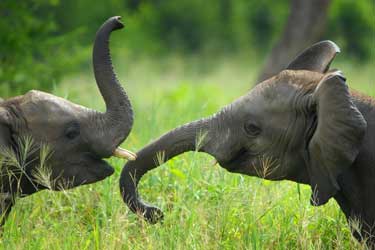
A young bull elephant is seen in the Okavango Delta, Botswana, April 25, 2018. REUTERS/Mike Hutchings

GABORONE (Reuters) – Botswana, home to almost a third of Africa’s elephants, lifted a ban on big game hunting on Wednesday, citing growing conflict between humans and wildlife and the negative impact of the hunting suspension on people’s livelihoods.

Conservationists estimate the southern African country has around 130,000 elephants, but some lawmakers say the number is much higher and causes problems for small-scale farmers.

“The Government of Botswana has taken a decision to lift the hunting suspension,” the Environment Ministry said in a statement.

“The Ministry would like to reiterate that it will work with all stakeholders to ensure that re-instatement of hunting is done in an orderly and ethical manner”.

It said the return of wildlife hunting would take place in accordance with laws and regulations governing wildlife conservation, hunting and licensing, but did not elaborate. Minister of Environment, Natural Resources Conservation and Tourism Onkokame Kitso Mokaila would hold a news conference on Thursday to give details, it said.

President Mokgweetsi Masisi set up a committee in June last year to consider the hunting ban, which was imposed by former President Ian Khama in 2014 after surveys showed declining wildlife populations.

At the time, the committee chair said it recommended “a legal framework that will enable the growth of a safari hunting industry and manage the country’s elephant population within the historic range”. The committee also called for “regular but limited” elephant culling.

Botswana, a mostly arid country the size of France, has a population of around 2.3 million people and its vast tracts of remote wilderness make it a magnet for foreign tourists who want to view wildlife.

Elephants Live Longer in the Wild, Study Shows

Elephants have a much longer lifespan in the wild than in captivity, according to a new study from Science.
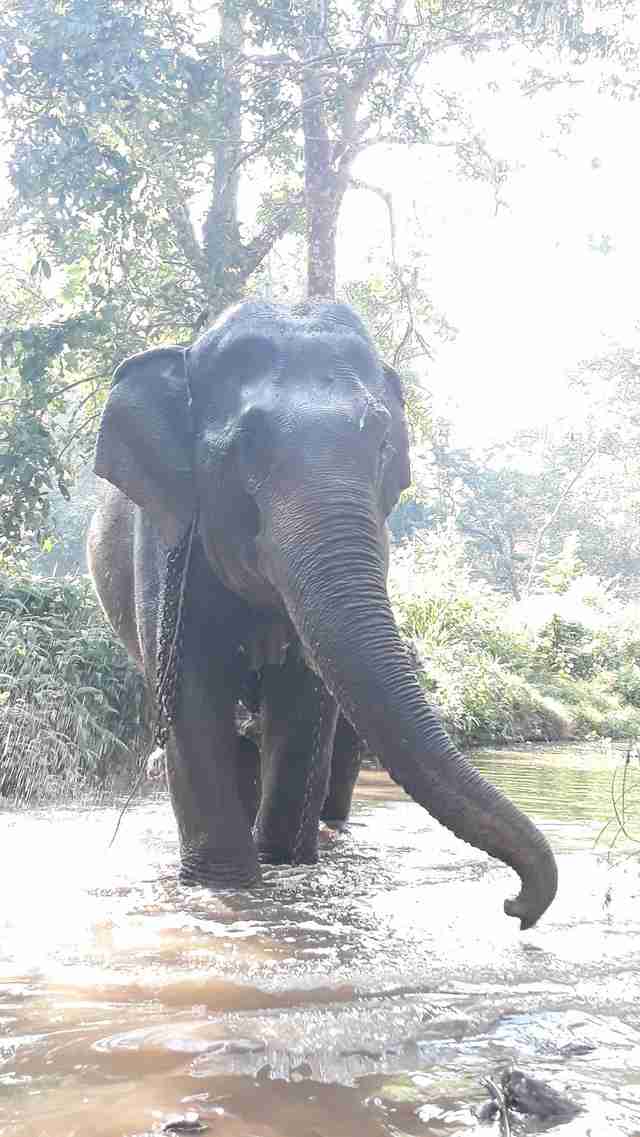
The study, which compared female African elephants in Kenya’s Amboseli National Park with those in zoos, found that the wild elephants lived three times as long on average, surviving to a median age of 56 years compared with 17 years for elephants living in captivity. The findings were similar for Asian elephants kept in captivity to support the logging industry.

Common health problems for elephants in zoos include herpes, tuberculosis, arthritis, and obesity. The effect of captivity on this highly intelligent, social and wide-ranging species also likely has psychological effects, as sometimes evidenced by unusual aggressiveness or repetitive behaviors.

The findings of this study highlight the importance of implementing conservation strategies that ensure elephants and other species have the space and resources they need to thrive. Through its Africa Heartland Program, AWF works to combine parks, private lands and community areas into large conservation landscapes that give elephants and other wildlife the room they need to thrive. It is our belief that such large-landscape conservation is the soundest strategy for securing the future of Africa’s magnificent wildlife across the continent.

To read more about AWF’s elephant conservation work, click here.

To read learn more about elephants, click here.

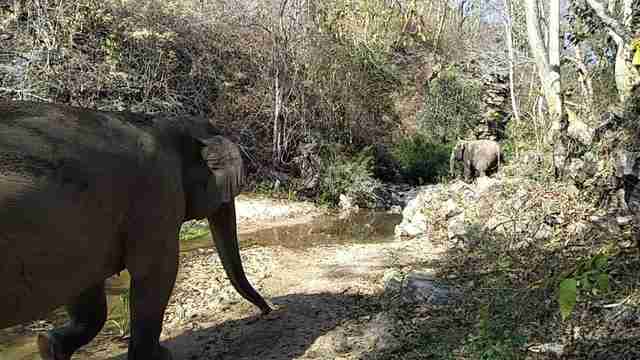
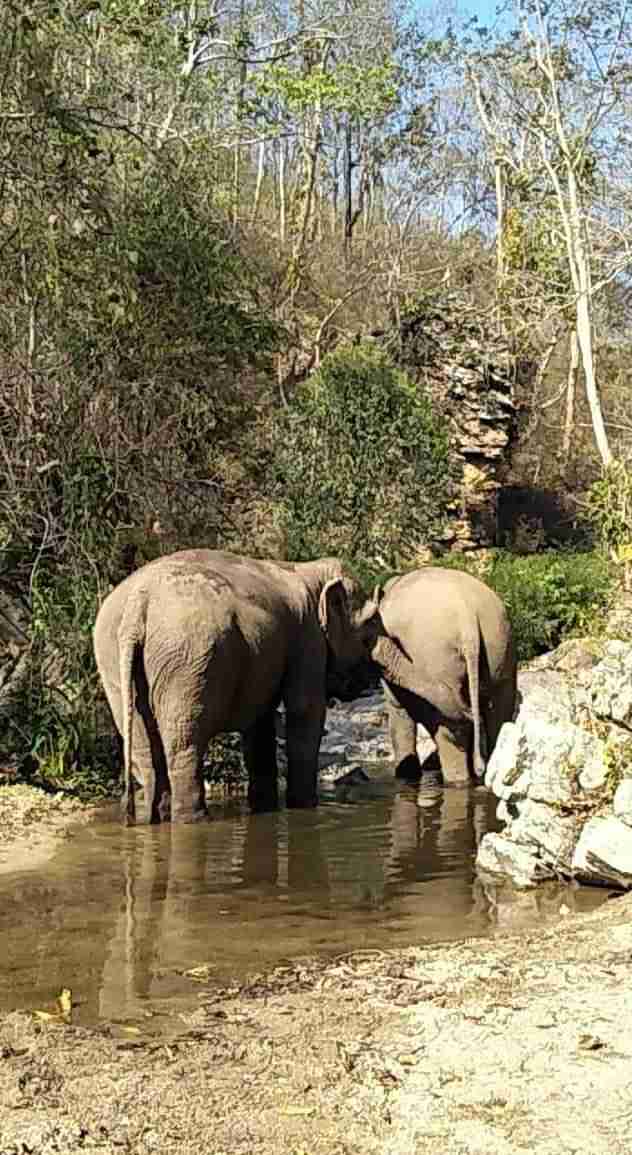
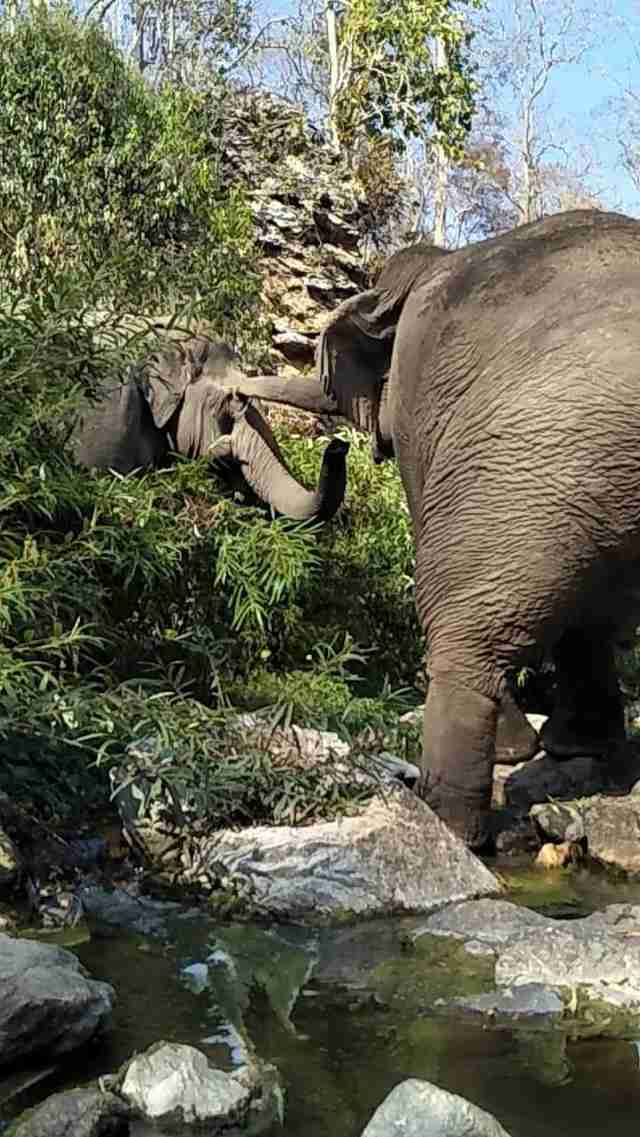
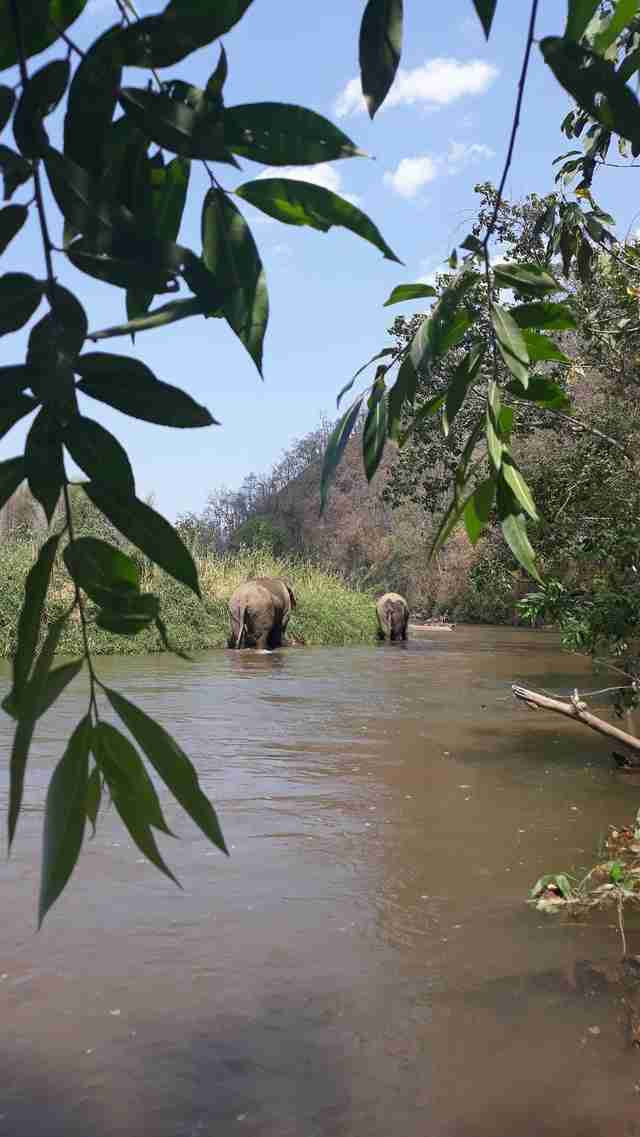
Rescued Elephant Immediately Snuggles With First Friend She Makes

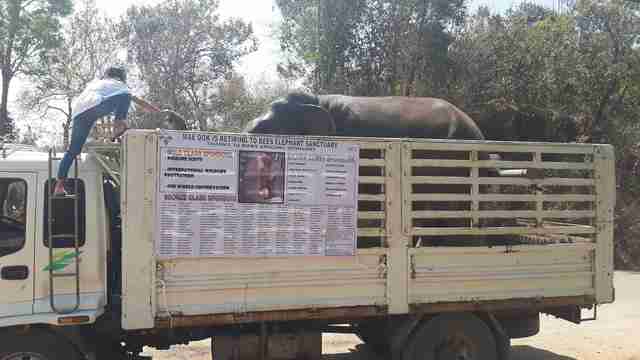
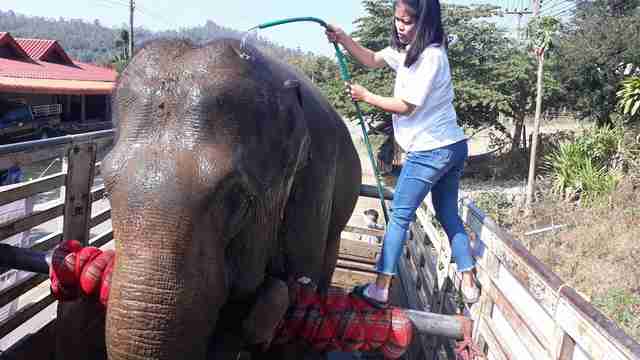
Retiring working elephant in Thailand
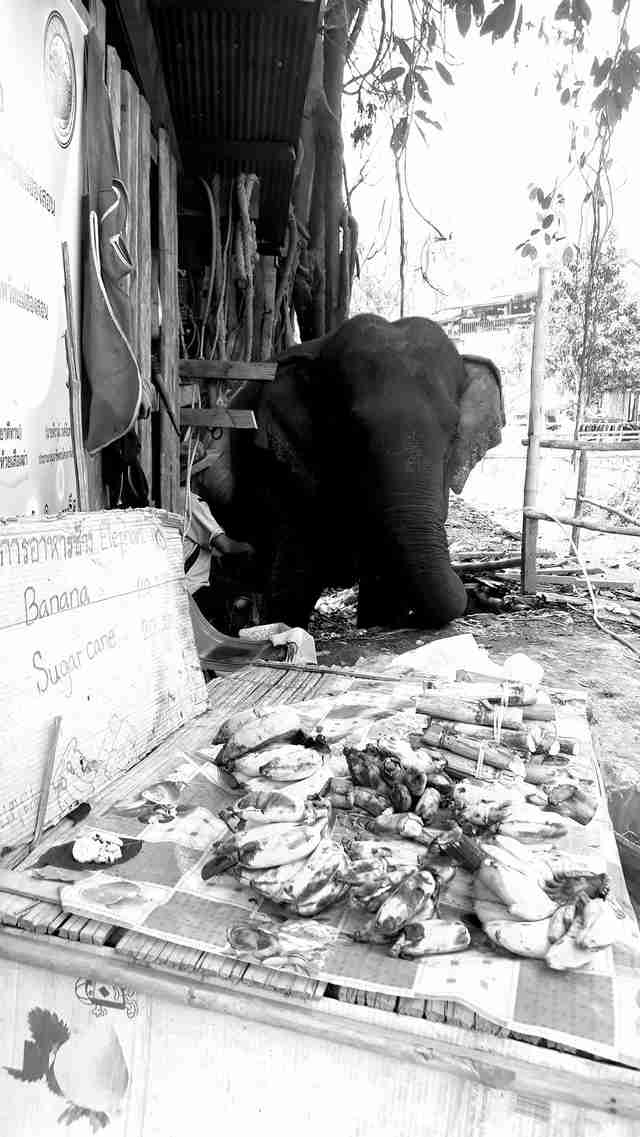
Elephant asking for food at bridge in Thailand
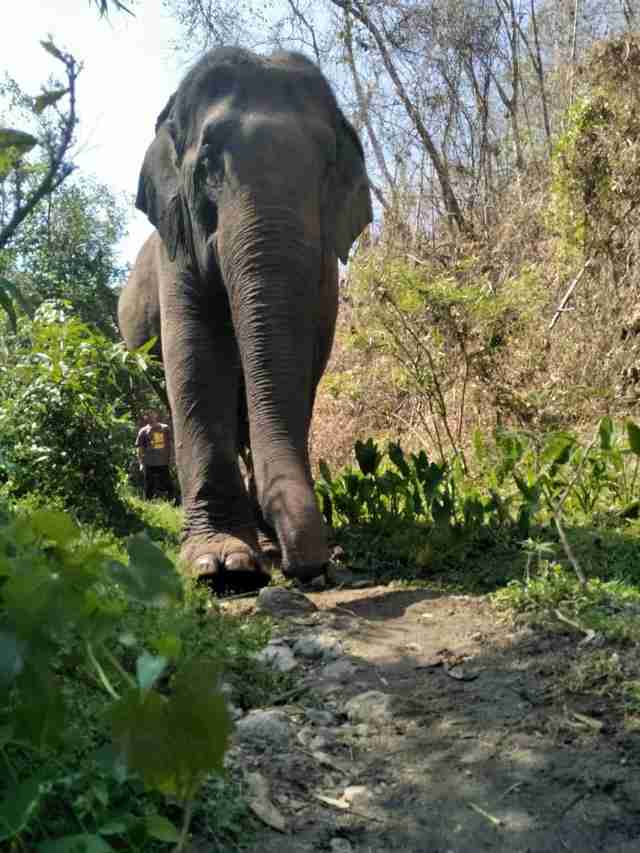
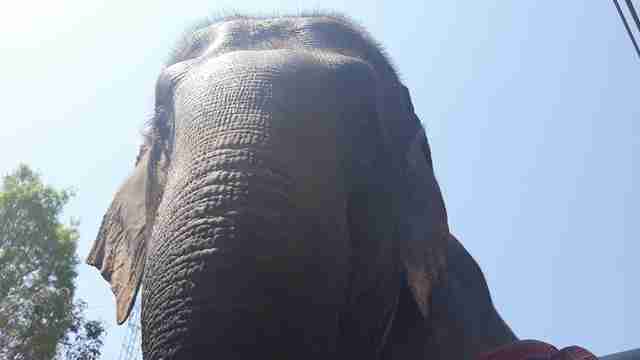
Elephant before retiring in Thailand
Retiring working elephant in Thailand
Retired elephant arriving at sanctuary
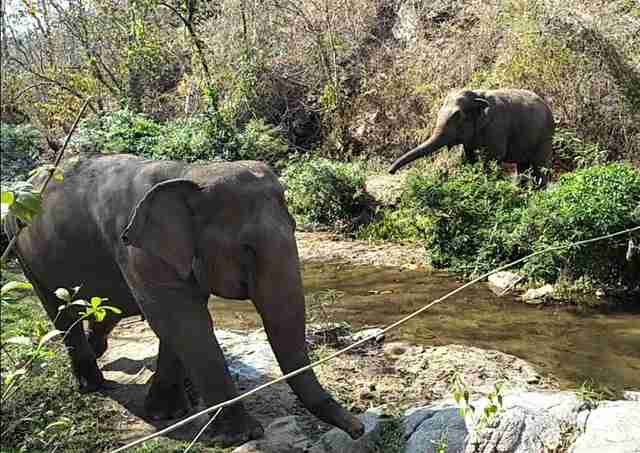
Retiring working elephant in Thailand meets first friend

Petition: Botswana Wants to Kill Elephants to Make Dog Food

  • by: Care2 Team
  • recipient: President of Botswana, Mokgweetsi Masisi
141,741 SUPPORTERS
150,000 GOAL

Talk about bad ideas! The Botswana government has announced a plan to allow the hunting and killing of elephants and use their meat to make dog food.

You read that correctly. Knowing that the elephant is on the brink of extinction, the Southern African nation has decided to do something absolutely crazy, repeal the ban on trophy hunting. Elephant carcasses would then be harvested for pet food!

Home to one-third of all African elephants, Botswana was once considered one of the last bastions of safety for the imperiled animal. But all that has recently changed. The country — which has 130,000 elephants, the most of any nation — has experienced an alarming spate of elephant poachingsIn the past 4 years, poaching has increased by 540%. And from July to September of 2018, 90 elephants were poached — compare that to 14 killed in the same amount of time in 2014.

Yet, instead of creating policies that would better protect the elephant, they are doing the opposite and making it easier to kill them.

Botswana says there have been too many interactions between people and elephants in recent years. But that is no excuse to give the green light to elephant trophy hunting. There are other ways to mitigate human-elephant interactions without having to kill them. And to turn them into dog food is just shameful.

Please sign the petition and tell Botswana you are against their new plan to turn Dumbo into Dog Chow. Tell them to ditch this terrible plan.

141,741 SUPPORTERS

Botswana’s Plan To Cull Elephants And Sell Them As PET FOOD Wins Ministerial Approval

https://greenworldwarriors.com/2019/02/27/botswanas-plan-to-cull-elephants-and-sell-them-as-pet-food-wins-ministerial-approval/?fbclid=IwAR1YqU4kzDgJh29vjP280IwQ2ihCtfSLXrJgXWY7NNHHN8W1lUXK52jSg_w

Botswana is moving towards culling elephants by lifting its wildlife hunting ban after a group of the country’s ministers endorsed the idea, but the proposal has drawn heavy criticism. Botswana’ is planning to cull elephants and sell them as pet food wins ministerial approval.

The southern African country’s President Mokgweetsi Masisi had previously tasked a government subcommittee with reviewing the hunting ban – which had been put in place by his predecessor Ian Khama in 2014.

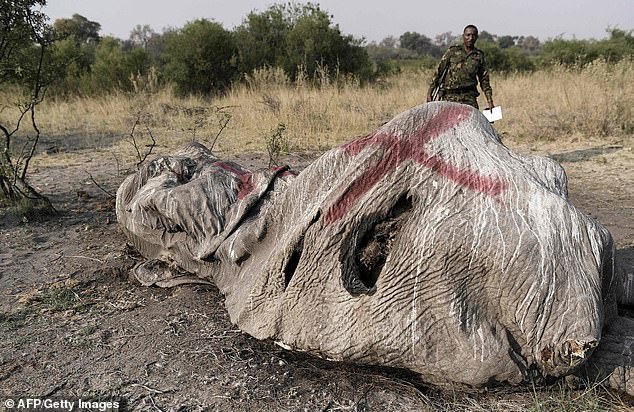
A Botswana Defence Force colonel near the marked remains of an elephant killed in the Chobe national park area

The committee decided to recommend lifting the ban last Thursday, and the country’s minister of local government and rural development Frans Solomon van der Westhuizen advocated ‘regular but limited elephant culling’, NPR reports.

Elephant meat canning – including for pet food production purposes – was also recommended by some.

Konstantinos Markus, a Member of Parliament who spearheaded efforts to eliminate the ban, argued that the ‘expansion of the elephant population in Botswana has impoverished communities.’

According to reports Markus said rural citizens of Botswana have grown hostile toward elephants, especially in the north where he said the animals have cut maize yields by nearly three-quarters.

Botswana is reportedly home to 130,000 elephants, according to the Great Elephant Census, but concern has been rising regarding the ‘growing conflict between humans and wildlife’.

The country’s Government has also said pinpoiting the precise elephant population is difficult partly because herds can roam across borders into other countries.

Botswana’s consideration of lifting the ban has drawn heavy criticism.

The Telegraph reported that an elephant conservationist who works with the country’s government called the proposed cull ‘short sighted’.

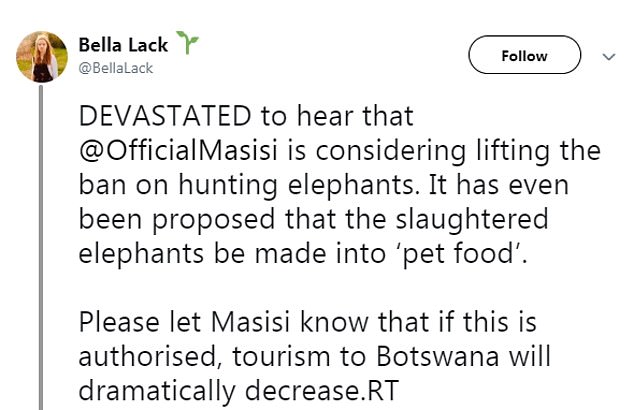
One Twitter user said she was ‘devastated’ to hear that the country was considering lifting the ban

The conservationist, who spoke on condition of anonymity, told the paper: ‘Botswana does have too many elephants, and there is huge elephant human conflict.

‘But this is not economically viable and it doesn’t take into account the reputational damage to the country. Better exploitation of sustainable tourism is a far better model.’

Online campaign group Elephants DC, which advances anti-poaching and anti-smuggling policies and has 35,000 Facebook folloewers, said: Botswana in the news for all the wrong reasons.

America should help NOW defend future impending poaching slaughters of the elephants. This nation is largest last haven of African elephants, many now whom are refugees after fleeing conflict elsewhere, in the world.’

One Twitter user said: ‘DEVASTATED to hear that @OfficialMasisi is considering lifting the ban on hunting elephants. It has even been proposed that the slaughtered elephants be made into ‘pet food’.

‘Please let Masisi know that if this is authorised, tourism to Botswana will dramatically decrease.’

African bush elephants in Botswana may lose their protection from the 2014 law

Regarding the idea that the African democracy could be set to cull the animals, one Twitter user said: ‘Conservationists around the world must join forces to ensure that this ludicrous idea never happens.

Elephants are the most majestic of creatures. Thousands have been slaughtered for their ivory, now this shocking development. Elephants will become extinct.’

Another said: ‘Guys gonna pls stop the savagery against the elephants… everybody likes elephants – they connect us into the history of life itself. The Queen and Prince Philip like to feed them bananas too. Cheers.’

But one social media user took a different approach, saying: ‘Do you know the struggle of someone in Shakawe who’s has to face this animals every other day? Have you ever had you crops completely erased by elephants. What really is your mandate?’

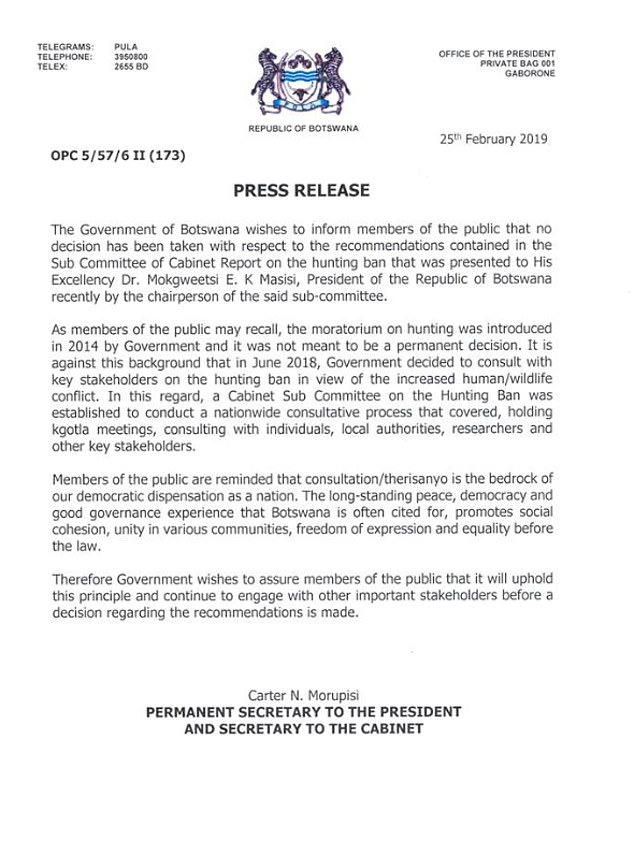
The country’s Government published a press release clarifying that ‘no decision has been taken’ regarding the hunting ban 

Last year, Sir Ranulph Fiennes, Bill Oddie, Peter Egan, and a cross-party group of MPs rallied against proposals to lift the ban, claiming that allowing hunting could force the species to the point of extinction.

When the 2014 ban was imposed, the government had said it was moved to act after indications of ‘several species in the country’ showing declines.

The ban permitted hunting in registered and private game ranches. Some have argued that the rules may have been a detriment to the animals and people alike.

NPR reports that a spokesperson for conservationist non-profit organisation Elephants Without Borders said: ‘Some people are worried that elephants have recovered in greater numbers than the environment can sustain, and there is significant concern over increasing human-elephant conflict.

‘During the past 20 years the elephant range in Botswana has expanded by 53%, causing increasing concern about the impact of elephants on biodiversity, the viability of other species and the livelihoods and safety of people living within the elephant range.’

Botswana’s Government published a statement on Twitter outlining how it had not taken a decision regarding the committee’s recommendations.

It read: ‘The Government of Botswana wishes to inform members of the public that no decision has been taken with respect to the recommendations contained in the Sub Committee of Cabinet Report on the hunting ban that was presented to His Excellency Dr. Mokgweetsi E. K Masisi, President of the Republic of Botswana recently by the chairperson of the said sub-committee.

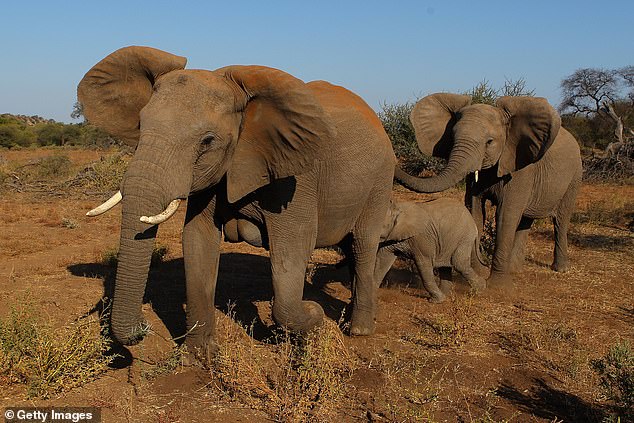
Conservationists set Botswana’s elephant population at 130,000, but lawmakers claim the actual figure is much higher than this

‘As members of the public may recall, the moratorium on hunting was introduced in 2014 by Government and it was not meant to be a permanent decision. It is against this background that in June 2018, Government decided to consult with key stakeholders on the hunting ban in view of the increased human/wildlife conflict.

‘In this regard, a Cabinet Sub Committee on the Hunting Ban was established to conduct a nationwide consultative process that covered, holding kgotla meetings, consulting with individuals, local authorities, researchers and other key stakeholders.

‘Members of the public are reminded that consultation/therisanyo is the bedrock of out democratic dispensation as a nation. The long-standing peace, democracy and good governance experience that Botswana is often cited for, promotes social cohesion, unity in various communities, freedom of expression and equality before the law.

‘Therefore Government wishes to assure members of the public that it will uphold this principle and continue to engage with other important stakeholders before a decision regarding the recommendations is made.’

The statement was attributed to Carter N. Morupisi, Permanent Secretary to the President and Secretary to the Cabinet.

Botswana, which is roughly the size of France, has a population of around 2.3 million people and contains vast tracts of remote wilderness that make it a magnet for foreign tourists who want to view wildlife.

International tourism could generate £160m for Botswana this year, rising to £280m by 2021 – more than trophy hunters spend across the whole of southern Africa.

Source: Dailymail

Just One Elephant Remains in the Knysna Forest

https://www.ecowatch.com/elephant-knysna-forest-2628279024.html?fbclid=IwAR2
WvcRVXzN4-PoDS75bvJdAdocBgGJtYYwE1MCQgHf7c6T0jmWc4wnnNJk

Lorraine Chow, Feb. 07, 2019

A sobering 15-month study on the declining population of the southernmost
herd of African elephants has determined only one elephant, a mature female,
is free-roaming in the Knysna forest in South Africa.

The analysis – titled And Then There Was One – was recently published in the
African Journal of Wildlife Research.

For the study, researchers set up camera trap across the whole elephant
range from July 2016 to October 2017 and concluded upon analysis that the
female elephant, estimated at 45 years old, was by herself.

“Because elephants move along defined elephant pathways, we placed our
cameras on these paths and covered the elephant range evenly, with spaces
between camera traps no larger than the smallest range recorded for
elephants,” one of the study’s authors Lizette Moolman, a South African
National Parks scientist, explained in an article posted to the park’s
website.

“In other words, an elephant would not reside in a gap area, between camera
trap locations, for the duration of the survey. The cameras were all active
for 15 months, and during this time the same female elephant was identified
in 140 capture events, always by herself. No other elephants were
photographically captured.”

Fellow researchers behind the study were shocked to find only one elephant
left in Knysna, as the gentle giants historically roamed the area in the
thousands.

“The brutal reality is there is no longer a population of Knysna elephants,”
study co-author Graham Kerley of the of Centre for African Conservation
Ecology at Nelson Mandela University, told Business Day. “All the mystique
of the Knysna elephant is reduced to a single elephant left in rather tragic
circumstances.”

Their numbers have declined dramatically over the past three centuries due
to hunting as well as human encroachment that has forced the elephants from
their natural habitats and squeezed them into smaller and smaller areas. The
Knysna forest was previously a site for rampant timber exploitation.

While the solitary elephant appears in relatively good shape, Kerley
explained to Business Day that she has swollen temporal glands with
excessive temporal streaming, suggesting she might be stressed from being
alone.

According to the National Elephant Center, female African elephants are
social creatures and usually roam in herds with a number of related female
adults and male and female offspring.

The maximum lifespan for females is more than 65 years, so the lone Knysna
elephant could be by herself for two more decades.

As for capturing her and moving her to other elephant populations, Kerley
noted that “would be dangerous for her and we don’t know if it would even be
of any value to her as she knows the forest and she might not be able to
settle into another area with other elephants.”

Images of her show that her breasts are undeveloped and her mammary glands
are shriveled, meaning she has likely never been pregnant or has not given
birth in a long time, according to Business Day. Artificially inseminating
her would be too risky to attempt, Kerley said.

“Considering all these factors, the debate about how we have allowed this
population to go functionally extinct and how to manage the last elephant is
very emotional and very serious as she is a symbol of how we are treating
biodiversity as a whole,” Kerley told the publication.

Original study >>
https://journals.co.za/content/journal/10520/EJC-130f909485

Poachers kill elephant in Cambodia wildlife sanctuary

https://today.rtl.lu/news/science-and-environment/a/1311855.html

ILLEGAL IVORY TRADE

AFP | Update: 26.02.2019 00:00

The body of a male Asian elephant was found in a wildlife sanctuary in
northeastern Cambodia on Sunday / © Cambodian Ministry of Environment/AFP

An elephant has been found dead with its tusks and tail sliced off in a
wildlife sanctuary in Cambodia, where wild elephant numbers have dwindled to
just a few hundred due to poaching and deforestation.

The Southeast Asian nation has emerged in recent years as a key transit hub
for the multi-billion dollar illicit wildlife trade, with demand for
products made from tusks, pangolin scales and rhino horns high in China and
neighbouring Vietnam.

According to the Mondulkiri Project, an animal rescue NGO, there are about
400 elephants in the wild in Cambodia, and about 50 held in captivity.

The body of the male Asian elephant was found on Sunday in a wildlife
sanctuary in northeastern Mondulkiri province, said Environment Ministry
spokesman Neth Pheaktra.

“The elephant’s tusks were missing and its tail was also cut off,” he told
AFP on Monday, adding the animal was killed about 10 days ago.

“There was a wound from a gunshot under its right eye,” Neth Pheaktra said,
adding authorities are still hunting for the poachers.

A baby elephant was found dead last year in the same sanctuary when it was
caught in a trap set by poachers, he said.

The Asian elephant is hunted for its precious tusks, while its tail hair is
considered lucky and embedded in rings and bracelets.

The demand for the animal parts threatens Cambodia’s dwindling elephant
population found in the northeast and southwest forests, where illegal
logging and deforestation is reducing their habitat.

Cambodia’s high levels of corruption and lax law enforcement make the
country an easy transit point for traffickers facing a crackdown in
neighbouring Thailand.

In December, Cambodian authorities seized more than one thousand elephant
tusks hidden in a storage container sent from Mozambique, the country’s
largest ever ivory bust.

Another significant haul occurred in 2016 when authorities discovered nearly
a tonne of ivory hidden in hollowed-out logs inside an abandoned container
— also owned by a company based in Mozambique.

Botswana elephant poaching ‘no hoax’

Elephants in BotswanaImage copyrightAFP

One of the last elephant sanctuaries in Africa has “a significant elephant-poaching problem”, according to the final results of an aerial wildlife survey in Botswana seen by the BBC.

Elephants Without Borders, which conducted the four-yearly survey with the government, said there was a six-fold increase in the number of “fresh” or “recent” elephant carcasses in northern Botswana amid “obvious signs” of poaching.

Mike Chase, the scientist who carried out the survey, sparked a fierce debate in the country when he went public half-way through his study in August last year with accusations there was a poaching problem and alleging the authorities were ignoring him.

Media captionDozens of dead elephants have been discovered in poaching hot spots in Botswana, Africa

He told the BBC at the time that while flying over northern Botswana, he had discovered 87 recently killed elephants in one “hotspot” area – a number now revised to 88 – and 128 overall.

The government called his figures “false and misleading” and criticised “unsubstantiated and sensational media reports”.

He received death threats and has since had one of his two research licences suspended by the government.

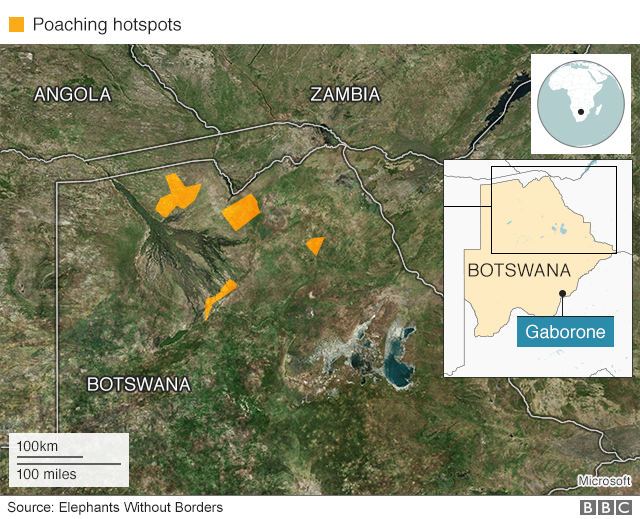
Poaching hotspots

President Mokgweetsi Masisi at the time described the allegations as the “biggest hoax of the 21st Century” and denied there had been a spike in poaching in the country.

But the final report identifies four poaching hotspots, provides photographic evidence from ground surveys and has been peer-reviewed by nine international elephant experts.

“The response from… various people was to try and deny or whitewash – label me a traitor and a liar – without having actually verified the evidence we bore witness to,” said Mr Chase.

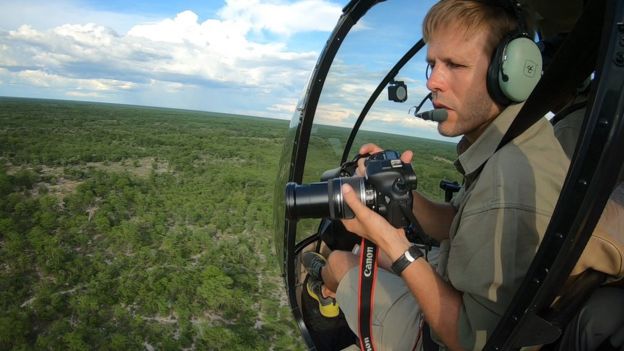
Man taking photographs from a helicopter
Image captionMike Chase said he found a six-fold increase in the number of “fresh” carcasses in northern Botswana

The government didn’t respond to the BBC’s request for an interview about the final report, but issued a statement criticising the methods used in carrying out the survey.

The statement from Thato Raphaka, permanent secretary of the Ministry of Environment, Natural Resources Conservation and Tourism, said it was “regrettable” the report showed an “astonishing number of pictures of dead elephants”.

It was critical of some of the scientific details in the report and requested the raw data to be submitted to the elephant specialist group at the International Union for Conservation of Nature for further independent review.

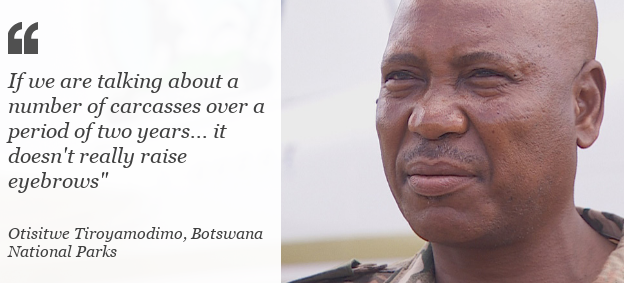
Otisitwe Tiroyamodimo, the director of the Department of Wildlife and National Parks, said the government acknowledged there was a poaching problem.

“Nobody can deny that elephants are being killed in Botswana,” but those reported by Mr Chase had mainly died “from natural causes and retaliatory killings.”

“We went there and we couldn’t find the 87 carcasses,” said Mr Tiroyamodimo.

Tusks missing

The authorities flew with Mr Chase but admit they spent only two days trying to verify carcasses seen over two months.

The BBC was given permission by the government to have access to the coordinates of one of the four areas identified as a “poaching hotspot” by the research team, and we visited the sites of 67 elephant carcasses.

Quote: If we are talking about a number of carcasses over a period of two years it doesn't really raise eyebrows,"

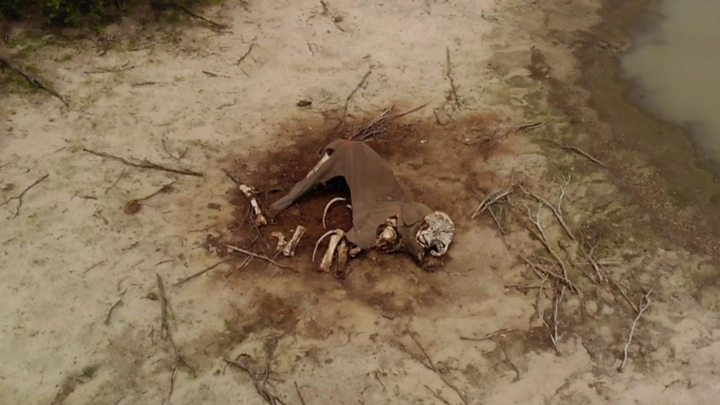
A few had apparently died of natural causes, but most had the characteristics associated with being poached: tusks were missing and branches had been used to cover the bodies to prevent them being found.

But Botswana is home to 130,000 elephants – a third of the total number in Africa – and it is an obvious target for poachers.

Even when extrapolating poaching figures from the sample found in the survey, the numbers killed will not have a major impact on such a large population.

“If we are talking about a number of carcasses that have accumulated over a period of two years, given the population of elephants in Botswana it doesn’t really raise eyebrows,” said national parks director Mr Tiroyamodimo.

Map showing the poaching hotspots

This was not satisfactory for Mr Chase.

“At what point do we say we have a problem?” he asked.

“Is it at 10? 50? 100? 150? 1,000? Lessons have taught us – when we look at Tanzania that lost 60% of its elephant population in five years – that’s how quickly poaching can settle into a population.

“We saw with our own eyes 157 confirmed poached elephants. We estimate that the total poached in the last year is at least 385 and probably far more because that is based on what we actually saw and have not had time or finances to visit all carcasses on the ground.”

But the storm over the reported spike in poaching appears to have more to do with Botswana’s bitter and complicated new politics than its wildlife.

Political feud

President Masisi was vice-president until April 2018, when then-President Ian Khama handed power over to his deputy.

Since then the two men have fallen out.

The new president has his own vision on a number of issues, among them conservation, and has reversed some of the previous policies.

Hunting was banned under President Khama and Botswana was known for a zero-tolerance approach to poachers.

It was reported that in 2015 alone 30 Namibians, 22 Zimbabweans and an unknown number of Zambians were shot on suspicion of poaching.

Presentational grey line

Humans v elephants

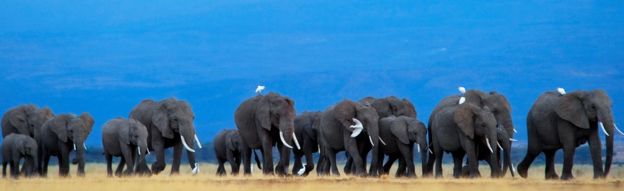
Herd of elephantsImage copyrightGETTY IMAGES

Elephants can be very destructive when they encroach on to farmland and move though villages – destroying crops and sometimes killing people. Many rural communities believe the number of elephants is increasing, even though there is no evidence of this from scientific surveys.

But their “range” – how far the elephants travel – is expanding for a number of different reasons and that is increasing conflict between wildlife and humans. Many people believe this worsened after hunting was banned in 2013, and want it to be re-introduced.

The government has to balance lifting the hunting ban to win votes against the impact it may have on Botswana’s international reputation as a luxury safari destination.

Presentational grey line

President Masisi removed “weapons of war” from the national parks’ small anti-poaching unit, saying they were illegal for non-military officers.

A consultation he initiated has just recommended that the hunting ban be lifted and that elephants be culled and their meat canned for pet food.

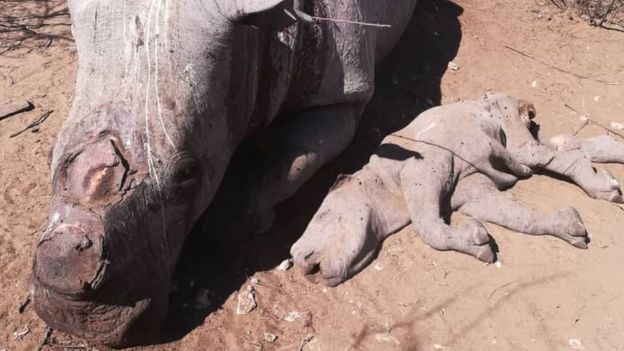
Two dead rhinos, one a calf, in Botswana
Image captionThirteen rhinos have also been killed by poachers in the last year

Botswana is also now backing regional efforts to lift a ban on the ivory trade.

The two men are locked in a political feud ahead of a party congress which will choose a new leader, with national elections due later in the year.

Mr Chase has a close relationship with the former president, so the timing of his allegations has been seen by some as a political attack on the new president – even if the final report provides evidence that poaching was going on before Mr Masisi took office.

Botswana attracts high-end tourists from across the world because of its international reputation for successful conservation.

But with the continuing political storm – and a dependency on government permits to run high-end safaris – few of the big safari operators would comment on how big a problem poaching has become.

‘Don’t shoot the messenger’

Thirteen rhinos have been killed by poachers in the last 12 months – an unprecedented number.

David Kays, who owns Ngamiland Adventure Safaris in the Okavango Delta, said it was time to admit there was a poaching problem and work together to deal with it.

“I think the government has been hiding it for a while, and now that it’s been brought out into the open, we’re now realising how serious the problem is, and these big poachers have actually infiltrated further than we expected them to be.”

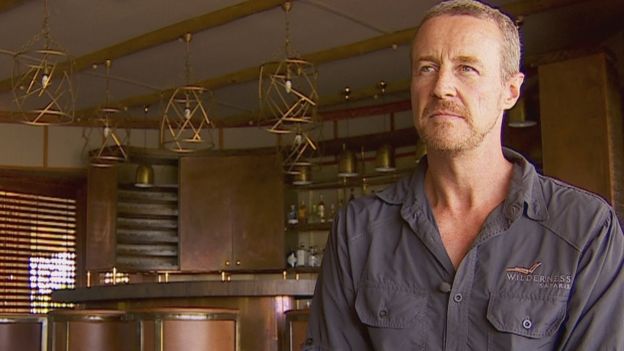
Kim Nixon from Wilderness Safaris
Image captionKim Nixon from Wilderness Safaris says all cases of poaching are reported

Wilderness Safaris operates luxury lodges in one of the concessions where some of the 88 carcasses were found.

Its chief executive Kim Nixon rejected any suggestion there was a denial of the problem.

“Whenever poaching has occurred in any of our concession areas, each and every incident has been reported as a criminal case,” he said.

“We’re not in any way mandated or allowed to do any anti-poaching – our role at best is monitoring.”

Mr Chase says “don’t shoot the messenger” adding: “I think it requires all stakeholders working together – government, private, public sectors, the NGOs.”

Botswana is still the safest place in the world to be a rhino or an elephant, but with a continuing demand for ivory in Asia, it is now firmly in the poachers’ sights.

IVORY TRADE: NOT JUST AN ELEPHANT CRISIS

IT’S NOT JUST ELEPHANTS THAT ARE THREATENED BY PEOPLE’S DESIRE FOR IVORY. AS PART OF OUR ELEPHANTS IN CRISIS CAMPAIGN, BORN FREE’S HEAD OF POLICY DR MARK JONES EXAMINES THE OTHER ANIMALS AT RISK

Ending the ivory trade is key to securing a future for the world’s elephants, more than 20,000 of which are killed by poachers each year for their tusks. The international community is finally waking up to this theat. The USA and China have already introduced near-total bans. France has tightened up its legislation. Taiwan and Hong Kong have committed to act. In the UK, the Ivory Bill is currently working its way through Parliament.

These measures are encouraging, and while much remains to be done, they bring hope that one day the slaughter may end.

But it’s not just elephants that are threatened by people’s desire for ivory. The teeth from several other species, including hippos, walruses and narwhals, are also on the traders’ and traffickers’ wish lists.

Common hippos are much less common than elephants – as few as 115,000 remain across their rapidly reducing range in sub-Saharan Africa. Yet more than 38,000 individual teeth, 26 tonnes of teeth by weight, 6,550 hippo tusks, almost 6,500 ‘carvings’, and various other hippo products were legally traded between countries in the 10 years to 2016 – many destined for EU Member States.

Walruses are also in demand for their ivory. Between 2007 and 2016, more than 150,000 carvings, 12,500 items of ‘jewellery’, and various other walrus items including teeth and tusks were declared to have been traded internationally.

The distinctive long helical ‘tusk’ of the male narwhal, which is actually an elongated canine tooth, is also coveted. More than 2,500 tusks, 2,100 carvings and various other products from these toothed whales were traded commercially between countries in the decade to 2016.

Other species such as warthogs are also targeted for their teeth, although because they are not currently classified as threatened, data on international trade is lacking.

While the international community is rightly focused on protecting elephants, we must not forget that the trade in ivory for trinkets and carvings also threatens several other species. Some UK traders have already flagged increasing interest in hippo ivory as a replacement for elephant ivory to maintain the value of some objects from which the ivory has been lost or broken, or as a means of getting around a future ban on elephant ivory.

The UK’s Ivory Bill is very welcome, but it currently only covers elephant ivory. Thanks to Born Free’s efforts, the Government has committed to consulting on extending the ban to other ivory-bearing species once the Bill becomes law. For the sake of hippos, walruses, narwhals and others, we must hold them to this commitment, so the UK can act as an example to the rest of the world.

These precious and diminishing wild animals will only be safe once we end the demand for, and trade in, all ivory products for good.

https://www.bornfree.org.uk/articles/ivory-bearing-species