11 Elephants Rescued from a mud hole

Asian elephants got stuck in a mud-filled old bomb crater in Cambodia. A collaborative rescue effort saved them all.

Our annual fund-raiser is here! Help EarthSky stay an independent voice.

On March 24, 2017, a collaborative effort between local farmers and conservationists saved 11 Asian elephants that had gotten stuck in a mud hole in the Keo Seima Wildlife Sanctuary in Cambodia.

The hole – a mud-filled old bomb crater that dates to the Vietnam War – had been enlarged by farmers to store water. Its roughly 10-foot (3-meter) walls were too high for the elephants to scale and, as the mud dried, the elephants became further entrenched.

When the farmers discovered the elephants, they notified the Department of Environment, who in turn notified the World Conservation Society (WCS) to mobilize a rescue.

The elephants, before they were freed. Image via Wildlife Conservation Society.

The team helped water and feed the elephants to hold them over while a ramp was constructed for the elephants to escape.

A few hours after the work began, all were free.

The rescue averted what would have been a tragedy, said Tan Setha, WCS Technical Advisor to the protected area. Setha said in a statement:

This herd consisted of three adult females and eight juveniles of various ages, including a male that had almost reached maturity. These elephants represent an important part of the breeding population in Keo Seima Wildlife Sanctuary, and their loss would have been a major blow for conservation.

Dr Ross Sinclair, WCS Cambodia Country Director, added:

This is a great example of everyone working together in Cambodia to save wildlife. Too often the stories around conservation are about conflict and failure, but this is one about cooperation and success. That the last elephant to be rescued needed everyone to pull together on a rope to drag it to safety is symbolic of how we have to work together for conservation.

Bottom line: Eleven Asian elephants were rescued from a mudhole in Cambodia in March 2017, thanks to a collaboration between local farmers and conservatioinists.

Elephants Get a Reprieve as Price of Ivory Falls

Demand for Ivory Drops, and Elephants Benefit

The price of ivory has dropped by more than half in the past three years. This decline may be good news for elephants that have been targeted for their tusks.

NAIROBI, Kenya — Finally, there’s some good news for elephants.

The price of ivory in China, the world’s biggest market for elephant tusks, has fallen sharply, which may spell a reprieve from the intense poaching of the past decade.

According to a report released on Wednesday by Save the Elephants, a respected wildlife group in Kenya, the price of ivory is less than half of what it was just three years ago, showing that demand is plummeting.

Tougher economic times, a sustained advocacy campaign and China’s apparent commitment to shutting down its domestic ivory trade this year were the drivers of the change, elephant experts said.

“We must give credit to China for having done the right thing,” said Iain Douglas-Hamilton, president and founder of Save the Elephants. “There is still a long way to go to end the excessive killing of elephants for ivory, but there is now greater hope for the species.”

Elephants have been slaughtered by the thousands in recent years in what appeared to be an insatiable quest for ivory. Employing a wide range of tools, including helicopters, military-grade weaponry and poisoned pumpkins, poachers have brought down herd after herd. The poachers have also killed scores of wildlife rangers.

The tusks have been spirited out through a network of African gangs and corrupt government officials. A vast majority of ivory ends up in China, where a rapidly growing middle class has coveted it for bracelets, combs, statuettes and other status symbols. That demand has pushed the price of ivory so high that the tusks from a single elephant could be worth more than $100,000. That, in turn, encouraged many hunters and traders in Africa to ruthlessly pursue more elephants.

This may be a sign of how a sustained global advocacy campaign can actually work. For several years, celebrities, political leaders and passionate wildlife advocates around the world have been urging China to put a stop to its ivory trade. In China, there are officially registered shops selling ivory and a thriving black market doing the same. Last December, China responded, announcing it was shutting down all ivory commerce by the end of 2017. It seems the price of ivory has dropped in anticipation of the ban; many analysts believe it will soon drop further.

Researchers for Save the Elephants said the Chinese ivory business seemed depressed, with vendors pessimistic about their future. Many are replacing ivory jewelry and trinkets with items made from alternative materials, like clamshell. According to the report, China plans to shut ivory factories at the end of this month and close all retail outlets by the end of the year.

But there still seem to be some high rollers out there who want their ivory.

In one store in Nanjing, researchers saw “a 38-layered magic ball,” made from ivory, selling for $248,810.

Drought forces wildlife to spread across larger areas

Hindustan Times:  Man-animal conflict increases as Kerala faces severe drought
INDIA Updated: Feb 19, 2017
http://www.hindustantimes.com/india-news/man-animal-conflict-increases-as-kerala-faces-severe-drought/story-ETkcrWYmj29vU2I2VGGN7K.html

As Kerala slips into an unprecedented drought, wild animals have started raiding human settlements in search of water and food, endangering lives of people settled in fringe areas of the forest.

Last week three people were gored to death by elephant herds in separate incidents in the forested Idukki and Wayanad districts.

In the drought-hit Wayanad – the north Kerala district saw 72% deficit rainfall during the last two monsoons – people say besides elephants, other animals like, bison, deer and boars, made regular incursions into their villages.

Pepper plantation worker Nagappan, 34, was gored to death by a tusker three days ago in the district. About one-third of the district has forest cover.

According to forest officials, usually nearly 800 elephants are spotted along the Kabani riverbanks, a favourite summer habitat of jumbos in the Nilagiris, but this year their numbers dwindled to 120 as the river has partially dried up.

“Devoid of food and water, the elephant herds have become aggressive. Small crackers or fire torches fail to deter them these days. Bison and deer are behaving like domesticated animals,” said Velayudhan, a farm labourer of Thalappadi in Wayanad.

Another farmer in Ambalavayal said he lost crops worth Rs 2 lakh in the last three weeks as animals raided his farm.

“Two weeks ago, a tusker strayed almost seven km inside the human settlement.

We dug up 12 small ponds deep in the forest to check this menace,” said Wayanad district collector, BS Thirumeni.

Fed up with monkey menace, a 52-year-old widow had committed suicide in Thiruvananthapruam last week following which forest officials put up monkey traps in the area. Her relatives claimed she resorted to the extreme step after her frequent pleas fell on deaf ears.

Free Packy the Elephant From 54 years of Captivity in The Oregon Zoo!

1,809 SUPPORTERS IN OREGON
188,811 SUPPORTERS
190,000 GOAL
Elephants don’t belong In zoos, especially not Packy.

The heartbreaking story of Packy begins when he was born at the Oregon Zoo in 1962 to his Mother Bella. Packy has spent 54 years behind bars. 

Packy is the oldest male Asian elephant in North America, and he is in extremely poor health. He was diagnosed with tuberculosis in 2013, and is still undergoing treatment. Packy is also plagued by cracked nails, lesions, and abscesses on his right foot. Records reveal that he receives Ibuphofen and Acetaminophen for lameness, and near daily attempts to manage the poor condition of his feet.

Packy has recurring abscesses and lesions on the left side of his head caused by lying on a concrete floor for extended periods of time. He also has a hygoma – a soft fluid-filled subcutaneous swelling over a bony prominence – on the right side of his head.
Due to his failing health, Packy is no longer visible to the public. He is said to be suffering alone in his enclosure, simply waiting to die without ever knowing freedom. His sad existence is a reminder of why it is inhumane and unethical to breed elephants in captivity, denying them of everything that is innate to who they are as wild animals.
The Oregon Zoo has taken a majestic animal and turned him into a tragedy. After 54 years of continued suffering, Packy deserves to spend his last years in a sanctuary where he would be free from bars. But the zoo honestly thinks that keeping him in captivity is what is best for Packy. No, it’s what’s best for the zoo, and the greed that blinds their common sense, compassion, and love for this beautiful elephant. Their selfishness has destroyed Packy. Mentally, emotionally and physically. All for human entertainment and financial gain.
In the end, Packy’s life will not be a contribution to conservation, but a testament to the tragedy of captive breeding, and the deadening existence of exploitative zoo captivity. 

Please sign this petition demanding that the Oregon Zoo release Packy the elephant to the Performing Animal Welfare Society’s (PAWS) sanctuary in California. There, he would have the opportunity to roam acres of natural habitat, play in a pond, forage for fresh vegetation, befriend other elephants, and enjoy a full, healthy, and enriched life.

Thank you very much.

more

http://www.thepetitionsite.com/657/820/269/


A savage end for the elephants killed by men who were supposed to protect them: Slaughtered beasts’ remains lie scattered after rangers poisoned them in pay dispute

 http://www.dailymail.co.uk/news/article-3295044/A-tragic-savage-end-elephants-killed-men-supposed-protecting-Slaughtered-beasts-remains-lie-scattered-rangers-poisoned-pay-dispute.html#ixzz3q6RhD4BV

  • WARNING: GRAPHIC CONTENT
  • Elephants were slayed using cyanide in Hwange National Park, Zimbabwe
  • Poachers made off with three ivory tusks after the killings, officials said
  • Deaths bring total number of elephants poisoned in October alone to 62  

Lying slaughtered on the ground with their heads barbarically hacked off, these elephants are believed to have been killed by the very men who were meant to be protecting them.

They are among 62 elephants who have been killed in Zimbabwe in the last month alone, not by poachers, but poisoned by disgruntled rangers.

Staff at Hwange National Park have reportedly not received their already low wages and it is feared that the elephant killings in the park may be a form of ‘protest’ against management.

Horrific pictures which emerged today show their remains scattered across the dusty ground after they were mutilated for their tusks. Some are too graphic to show in full.

Elephants lie slaughtered on the ground after reportedly being poisoned and mutilated by disgruntled rangers at Hwange National Park in Zimbabwe in a reported pay dispute

The most recent attack, which took place earlier this week, saw 22 elephants, including babies, poisoned using cyanide hidden in salt stones and oranges. 

Rangers working in the park are notoriously badly paid for a job where they are at constant risk, fighting off heavily armed poachers.

According to an inside source, rangers have only just received their pay due last month and management have failed to pay for fuel for the pumps for the park’s watering holes, The Telegraph reported.

‘I am afraid there are serious management problems within parks,’ an unnamed source from Zimbabwe’s National Parks and Wildlife Authority told The Telegraph.

‘Some of the rangers are very dissatisfied with their remuneration and say that they are not getting some allowances they believe they should get.

‘So many of us believe that some of the poaching at the moment is organised and executed by some rangers in parks, and we don’t know how this will be sorted out.’ 

Monday’s discovery of 22 elephant carcasses were made in the in park’s Sinamatella area alongside 35 tusks, said Caroline Washaya-Moyo, spokeswoman for the parks and wildlife management authority. 

Barbaric: Staff at Hwange National Park have reportedly not received their already low wages and it is feared that the elephant killings in the park may be a form of 'protest' against management

Barbaric: Staff at Hwange National Park have reportedly not received their already low wages and it is feared that the elephant killings in the park may be a form of ‘protest’ against management

The poachers, who apparently killed the elephants with cyanide, escaped with three ivory tusks.

The grim finding – made by park rangers Monday morning – brings the number of elephants poisoned by poachers in the southern Africa country in October alone to a staggering 62.

‘We recovered 22 elephant carcasses in the Sinamatela area and so far we have also recovered 35 tusks,’ Washaya-Moyo told AFP. ‘Initial investigations indicate that there was cyanide poisoning.’

She added: ‘We continue to lobby for deterrent penalties for people found with poisonous substances such as cyanide. We can’t continue to lose wildlife at such a rate.’

Rangers are now investigating how many of the elephants – who resided at the same park as Cecil the lion, who was shot dead by dentist Walter Palmer in July –  had fully developed tusks.

Speaking to the Associated Press, Washaya-Moyo said: ‘We are now trying to check how many elephants had fully developed tusks because babies are among those killed.

‘The rate at which we are losing animals to cyanide is alarming. 

‘Many other species are also dying from the cyanide used by poachers to target elephants. 

‘We are appealing to people in communities close to national parks to cooperate with authorities.’

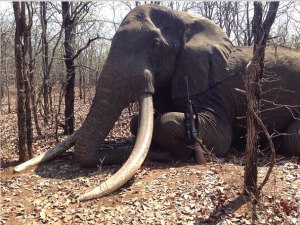
Germany may block import of tusks from giant elephant shot by hunter in Zimbabwe

2D739AC500000578-3274724-image-a-2_1444938349661

http://www.telegraph.co.uk/news/worldnews/africaandindianocean/zimbabwe/11937439/Germany-may-block-import-of-tusks-from-giant-elephant-shot-by-hunter-in-Zimbabwe.html
“Import of trophy tusks from one of Africa’s largest elephants could
be illegal, warns Germany, as reward offered for hunter’s identity”
“Germany will consider blocking the import from Zimbabwe of the tusks
ofone of Africa’s biggest elephants killed by one of its nationals, it
said on Friday amid growing global outrage over the hunt.
“The country’s nature conservation agency said it had in the past
refused entry for animals killed in trophy hunts and would not
hesitate to do so in this case if the hunt had infringed German
wildlife regulations.”

Why Not Retire the Circus Elephants Now?

2015-03-06

Retire Them Now!

Luke Sharrett for The New York Times

If the welfare of elephants were truly its only concern, the Ringling Brothers and Barnum & Bailey Circus would stop using them in performances now, and put them on a train to sunny Florida, where they could enjoy a comfortable retirement. Instead, as The Associated Press reported Thursday, its 13 wrinkly troupers will be touring the country, doing lumbering tricks in costume for paying customers, until 2018. Then they will be sent to the company’s park near Polk City, Fla., and perform no more.
Continue reading the main story
Related in Opinion

Elephants are big business for Feld Entertainment, Ringling’s parent company, and they have been for a long, long time. So it’s hardly a small thing that the circus has announced it is ending its elephant acts. Though Ringling has always had other trained animals, like horses, dogs, tigers and lions — and, notoriously, in the 1980s, goats made to resemble unicorns — Asian elephants are central to its image and marketing. Many a New Yorker remembers the elephant marches through the Midtown Tunnel to Madison Square Garden.

But big-animal circus acts belong to a different age. Circuses have long since abandoned human freak shows and brutish displays of animals as beasts to gawk at. Many cities and counties have passed ordinances forbidding some elephant shows, because of the use of chains and prods called bullhooks to control the animals. Years of pressure from animal-rights advocates surely influenced Ringling’s decision. And competitors — notably Cirque du Soleil — have shown that it is possible to dazzle audiences with entirely human feats of grace and skill.

The news from Ringling summons two powerful images: Dumbo’s mother, trapped in a circus car, cradling her child to the song “Baby Mine,” in one of the most heartbreaking of all movie scenes, and, more recently, a viral video of two adult elephants rushing to the aid of a fallen baby elephant at a zoo in Zurich. The touching video showed indelibly what scientists well know — that elephants are highly intelligent, social creatures that demonstrate powerful family bonds and nurturing skills.

Questions of cruelty aside, a concern for simple dignity and compassion leads to the conclusion that these magnificent creatures deserve better than being dolled up and sent on the road to do stunts for shrieking children.

In a world full of cruelty toward species not our own, we’ll take good news where we can. There is every reason to welcome the promise of retirement for the elephants, although it would be better if they did not have to wait so long. The Times reports that the company thinks it’s impractical to move the elephants to its 200-acre park sooner. But that seems a little convenient — a chance for a few more seasons of hucksterism that would have made P. T. Barnum proud: Come see the elephants now — before they leave the ring forever!

Please come to fill the courtroom with elephant advocates

Please come to fill the courtroom with elephant advocates

Friends of Woodland Park Zoo Elephants has filed numerous public disclosure requests to the Zoo. The Zoo has been frequently unresponsive claiming it isn’t subject to Washington State’s Public Records Act.  In order to hold the Zoo accountable and to learn more about the elephants’ plight, we filed a lawsuit on March 12th, 2014: Fortgang v. Woodland Park Zoo.  The request for summary judgment will be heard this Friday, July 25th at 1:30pm.

We need you there to show the judge WE ARE WATCHING
History could be made!  Please there!

What:    Request for summary judgment for Fortgang v. Woodland Park Zoo
When:   Friday, July 25th, 2014 at 1:30pm
Where:  King County Superior Court. 516 Third Avenue, Seattle, WA 98104
Honorable Judge Jean Rietschel’s courtroom.

What is the zoo hiding?
The Zoo has taken over $108 million dollars from tax payers since 2002.  The Zoo has use of city parkland and city buildings RENT FREE.  The Zoo acquired their “product”, the animals, from the city for FREE.  Yet the Zoo has refused to answer the most basic financial information and details about the welfare of Bamboo, Chai and Watoto, the three elephants confined in the Zoo.  When it did respond, some information was not accurate—such as how many times Chai was artificially inseminated or where the water sources are located in the yard.

   Photo credit: The Seattle Times

More recently, the Zoo has refused to provide records on the imminent transfer of Watoto to another Zoo.  Despite acknowledging that the Zoo is communicating with other zoos, it says it has no records.

It’s time for secrecy to end.  Taxpayers deserve to know what’s going on inside the walls of Woodland Park Zoo.  Please come and show your support against the Zoo’s arrogance.

We will all wear an orange tag that says in big letters:  TRANSPARENCY

Thanks so much,
Nancy Pennington and Alyne Fortgang

Copyright © 2014 Friends of Woodland Park Zoo Elephants, All rights reserved.
You are receiving this because you have opted in.

Our mailing address is:

Friends of Woodland Park Zoo Elephants

10011 Vinton Ct NW

Seattle, WA 98177

Petition for Elephants

Sign for Elephants

We the People…

  • Refuse to allow the elephant species to disappear…
  • Refuse to allow poached elephants’ tusks to fund terrorism…
  • Refuse to allow the deaths of rangers as they defend elephants…
  • Refuse to allow the bloody ivory trade to continue in the United States of America.

Sign the Petition

Pass the Word!

<!–


–>

#signforelephants

The Elephant Crisis &
How You Can Help

100 elephants per day are slaughtered in Africa for their tusks. We must end the ivory trade, or it will be the end of elephants. This May, it is vital that elephants receive 100,000 signatures across America to the White House.

We petition the president to:

Unequivocally ban the ivory commerce to save elephants from extinction


#signforelephants

How to Sign the Petition

They don’t make it easy but it’s really this simple:

  1. Create an Account with We the People
  2. Check your email for the confirmation message
  3. Follow the confirmation link to activate your account

Ok, that’s sorted.

NOW I’m Ready to Sign!

<!–

–>

The Crisis

On average, 100 elephants per day are being slaughtered in Africa so their tusks, also known as ivory, can be sold. At this rate a species that has walked the earth for millions of years will be made extinct. Poaching is being conducted in mass by sophisticated criminal syndicates that often slaughter an entire herd with machine guns. The tusks eventually end up being traded illegally in the #1 market, Asia, and the #2 market, the United States. The U.S. Department of State has also identified elephant poaching as a national security risk, as ivory is used to fund acts of terrorism such as the 2013 Westgate Mall terrorist attack in Nairobi, Kenya.

Photo by Billy Dodson

It is essential to eliminate the demand for ivory. Though many people may think ivory is illegal to trade today in the U.S., that is not the entire story. There are loopholes in the law that allow “old” or “antique” ivory to be bought and sold. The problem is, it is very difficult and expensive to tell old ivory from new ivory and thus the domestic and export ivory trades continue. These are the loopholes that are wiping out the elephant right here at home.

On Feb. 11 the president launched a new National Strategy for Combating Wildlife Trafficking which eliminated the commercial ivory import trade. However ivory continues to be smuggled into the U.S. and we need to go further. We must stop all commercial ivory sales including the domestic and export trades.

Americans Petition for Elephants

Photo by Billy Dodson

The petition urges the United States president to TOTALLY BAN the ivory trade, with only very narrow noncommercial carve-outs for museums and other cultural institutions. This immediate and historic measure for another species is required to save the elephants from extinction. It is important to know that elephants were relatively safe just 7 years ago. But at the end of the last decade the global ban was “temporarily” lifted. Today the high price of ivory is wiping elephants out faster than they can reproduce. An elephant is killed every 15 minutes.

This petition is different than many you may have come across. This one is built on the backbone of the First Amendment established in the U.S. Constitution to petition our government for change. Upon 100,000 people – like you and me – signing this petition at http://petitions.whitehouse.gov the administration must respond.

We have only one month to achieve this goal between May 1 and May 30. As the poaching crisis is urgent we ask you to please sign now.

Sign the Petition

<!–

–>

Sign

“Congress shall make no law respecting an establishment of religion, or prohibiting the free exercise thereof; or abridging the freedom of speech, or of the press; or the right of the people peaceably to assemble, and to petition the Government for a redress of grievances.”

The First Amendment, United States Constitution

“The right to petition your government is guaranteed by the First Amendment of the United States Constitution. We the People provides a new way to petition the Obama Administration to take action on a range of important issues facing our country. We created We the People because we want to hear from you. If a petition gets enough support, White House staff will review it, ensure it’s sent to the appropriate policy experts, and issue an official response.”

The White House

A small elephant with large ears and budding tusks standing in a field of tall grass
Photo by Mike Paredes

Beginning May 1 people across the nation are invited to Sign for Elephants. The petition may only be signed online as a requirement of the Administration.

It takes under five minutes to:

  1. Create an Account with We the People
  2. Check your email for the confirmation message
  3. Follow the confirmation link to activate your account
  4. Sign the petition
  5. Share with friends and family!

NOTE: A key step to Sign for Elephants is activating your account by clicking on a link sent to your email address from the White House which redirects you to the petition page. Once this is done, you can sign the petition.

http://elephantsusa.org/

Sign the Petition