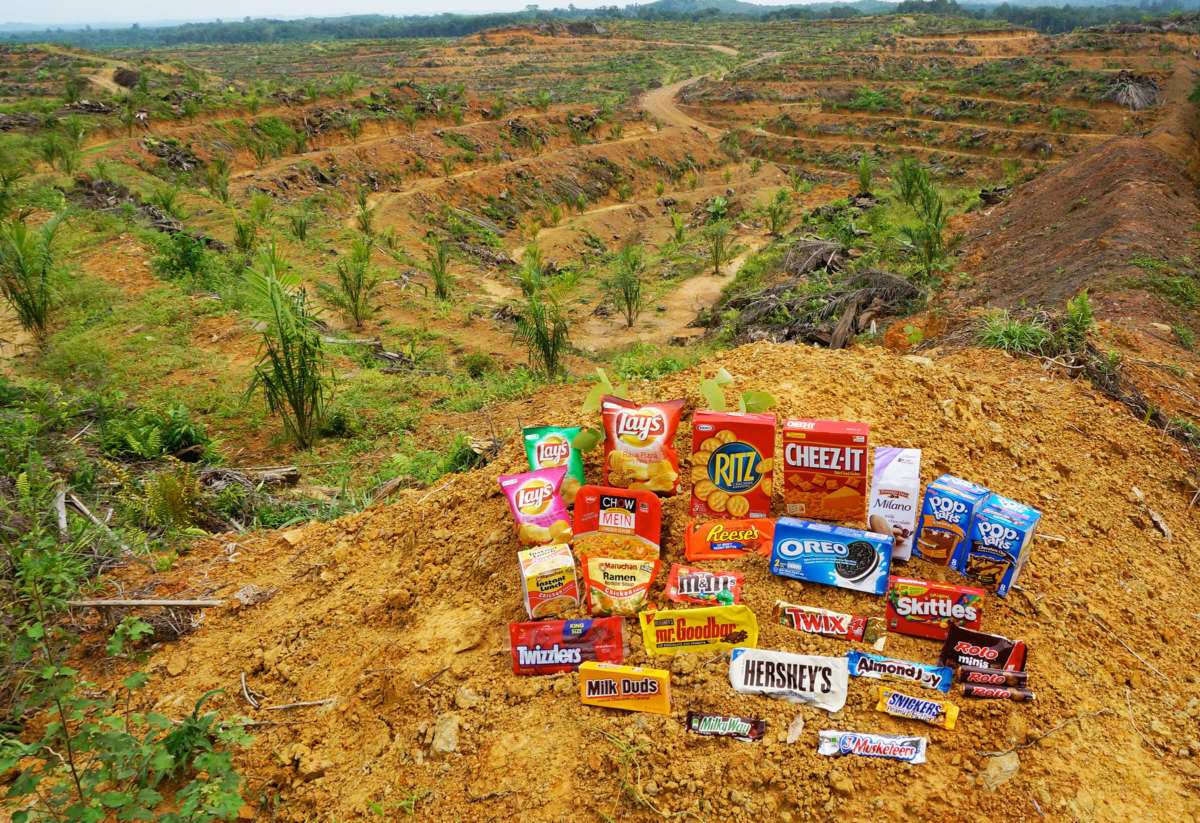
Palm Oil in Snack Foods Could Be Destroying the World’s “Orangutan Capital”

Picture a rhinoceros in the rainforest, add a herd of elephants, families of orangutans swinging through the treetops and tigers prowling the understory, and there is only one place in the world you could be.

Indonesia’s Leuser Ecosystem is one of Earth’s most ancient forest ecosystems, a laboratory of life’s potential where the alchemy of evolution has been allowed to experiment, uninterrupted for millennia. And the results are astounding. Green upon green, vines hanging from towering old-growth trees, moss growing on ferns growing on bromeliads… you get the picture.

It is the kind of place one imagines primeval nature to be wild, abundant, impenetrable.

With more than a century of proud conservation history responsible for its continued existence, the province of Aceh where the Leuser resides is, against all odds, a sparkling ecological jewel standing in stark contrast to the devastated landscape that surrounds it. Most of the rest of Sumatra — once known as Indonesia’s “Emerald Island” — and sadly much of the rest of lowland rainforests across Indonesia, too, have been exploited and denuded by wave after wave of scorched Earth, industry, colonial extraction and modern-day corrupt corporate greed. What has already been lost is incalculable, but here, in this special place, remains a rare opportunity to stop the cycle of destruction and protect a globally valuable treasure before it’s too late.

A palm oil refinery
A Musim Mas palm oil facility on the edge of the Leuser Ecosystem in Sumatra, Indonesia.
NANANG SUJANA

The Leuser Ecosystem is considered the heart of Southeast Asia’s rainforest region, which, alongside the Amazon and the Congo Basin, is one of only three tropical forest regions on Earth. The beating heart of the Leuser is the lowland forests and peat swamps of the Singkil-Bengkung region. This area is part of the last remaining healthy peat swamp ecosystem in western Sumatra. This lush jungle contains some of the world’s richest levels of biological diversity.

The lowland peat forests of the Leuser Ecosystem deserve the highest levels of protection for multiple critical reasons. Dubbed the “orangutan capital of the world,” this region is home to the highest population densities of critically endangered orangutans anywhere. This includes a special, culturally distinct subpopulation of a few thousand individuals in the Singkil-Bengkung region, which demonstrate social structures and tool-using behaviors unique from all other orangutan populations. These forests are also home to some of the healthiest remaining breeding populations of highly imperiled Sumatran elephants, rhinos and tigers.

The health of the Leuser Ecosystem’s Singkil-Bengkung landscape is internationally significant because its deep, carbon-rich peatlands are among the most valuable and effective natural carbon sinks on Earth. Conversely, when drained, cleared and burned for conversion to palm oil plantations, this soil type is transformed into a carbon bomb that emits catastrophic levels of pollution into the atmosphere.

Hundreds of thousands of people rely on the area’s rich natural resources as the basis of their livelihoods. Downstream villages are already suffering severe, sometimes deadly threats from devastating floods, landslides, and the loss of subsistence resources like fish and forest products as a direct result of the rapid rates of deforestation caused by palm oil. Communities also continue to suffer due to the loss of access to their customary lands that have been taken over by palm oil companies, without their consent, and failures of the government to take decisive action to resolve conflicts and restore to communities the rights to their lands.

The Acehnese people have fought for over a century to protect the integrity of the Leuser Ecosystem’s extraordinary forests, and in the past decade the Leuser has become internationally famous for its intact expanses of verdant trees and its stunning wealth of imperiled wildlife species. But also over the past decade, more than 18,000 hectares of forests within the Singkil-Bengkung region have been cleared, leaving roughly 250,000 hectares of rainforests remaining — and this area decreases each and every year due to deforestation and the drainage of peatlands.

RAN conducted a series of undercover investigations in 2019 due to the alarming destruction of peat forests occurring within the lowland rainforests of the Leuser Ecosystem. The field research was conducted to determine if the forest clearance was being driven by major snack food brands, even though these brands had adopted policies years ago to end deforestation in their supply chains.

The results of the investigations are definitive. Palm oil is being grown illegally inside the nationally protected Rawa Singkil Wildlife Reserve, and it is being sold to mills that provide the palm oil used to manufacture snack foods sold across the world by Unilever, Nestlé, PepsiCo, Mondelēz, General Mills, Kellogg’s, Mars and Hershey.

These mills are located immediately next to areas of illegal encroachment into the Leuser Ecosystem and lack the necessary procedures to trace the location where the palm oil they sell is grown, a key requirement for complying with the No Deforestation, No Peatlands, No Exploitation policies to which all of these brands have publicly committed.

Progress has been made by some companies implementing their No Deforestation policies. Brands like Unilever and Nestlé, for example, have begun the process of increasing supply chain transparency by publishing the mills they source from, but they have not yet achieved traceability to the plantation level, so they remain unable to offer certainty as to exactly where the palm oil they consume was grown. The findings of these investigations clearly show that paper promises are not enough to keep the forests from falling.

The Leuser Ecosystem at large, and the Singkil-Bengkung region in particular, still offer a rare and fleeting opportunity to get it right and avoid the devastating mistakes made throughout so much of Indonesia in the past. It remains possible here to prevent the destruction of habitat that drives iconic wildlife species toward extinction, to avert the human suffering from inevitable floods and landslides caused by deforestation, and to end the reckless burning of carbon-filled peatlands contributing to the climate crisis.

The international attention resulting from the release of this latest report has helped to pressure the brands to respond and take further action, but the high stakes and urgent threats to the Singkil-Bengkung demand more bold, decisive action to ensure that the area receives permanent protection.

Tell General Mills, Kellogg’s, Nestlé, Mondelēz, Mars, Hershey, Unilever and PepsiCo to cut ties to illegally produced conflict palm oil and stop the deforestation in the Leuser Ecosystem.

This article was produced by Earth | Food | Life, a project of the Independent Media Institute.

Lawsuit Launched to Protect Minnesota’s Rare Lynx From Trapping

State-permitted Fur Trapping Leads to Illegal Killings, Captures of Wild Cat

MINNEAPOLIS- The Center for Biological Diversity today
<https://www.biologicaldiversity.org/w/documents/31/Lynx_MN_Sec_9_–_NOI_12_
3_2019_to_send.pdf> notified the Minnesota Department of Natural Resources
of plans to sue the agency for permitting trapping that harms Canada lynx,
in violation of the Endangered Species Act.

In the past decade, state and federal agencies have documented captures of
16 lynx in traps set for other wildlife in Minnesota, six of which resulted
in death. As few as 50 of the rare cats may remain in the state.

“It’s outrageous that Minnesota’s lynx keep needlessly suffering and
dying in indiscriminate traps,” said Collette Adkins, the Center’s
carnivore conservation director. “The state needs to step up and implement
sensible changes to prevent the tragic deaths of these highly imperiled
cats. Minnesota’s rare animals shouldn’t be strangled in neck snares.”

Trapping of Canada lynx, unless covered by a specific permit from the U.S.
Fish and Wildlife Service, constitutes an illegal “take” under the
Endangered Species Act, even if accidental.

Every year in Minnesota, a small number of trappers kill
<https://files.dnr.state.mn.us/recreation/hunting/trapping/harvest_17-18.pdf
> thousands of bobcats, pine martens and other wildlife, largely to sell
their furs.

In a previous lawsuit filed by wildlife conservation groups, a Minnesota
federal court in 2008
<https://www.biologicaldiversity.org/news/press_releases/2008/lynx-07-14-200
8.html> held the state liable for harm to lynx caused by trapping. It
ordered the state to apply to the Fish and Wildlife Service for a permit to
cover its trapping program. But the state never obtained the permit.

The court also ordered the state to better protect lynx by issuing
regulations to restrict trapping in core lynx habitat. But even after these
additional measures went into effect, the rare cats have continued to get
caught in traps.

“Year after year we see sickening reports of lynx getting caught and even
killed by traps, but the state refuses to act,” said Adkins. “Minnesota’s
wildlife managers would rather appease a small number of trappers than
protect these beautiful wild cats. We hope this lawsuit will finally
convince the state to make lynx conservation a true priority.”

The lawsuit will seek additional measures to prevent trappers from hurting
Canada lynx, such as requiring placement of certain traps within “lynx
exclusion devices” that prevent lynx deaths. Conibear traps snap shut in a
viselike grip and have killed lynx on numerous occasions, but the department
does not require trappers to place them within exclusion devices.

Today’s notice letter starts a 60-day clock, after which the Center can
file its lawsuit to compel the state to comply with the Endangered Species
Act.

Background

Canada lynx (Lynx canadensis) are distinguished from bobcats by their tufted
ears, hind legs that appear longer than front legs, and a pronounced goatee
under the chin. Their large paws work like snowshoes and enable them to walk
on top of deep, soft snows. These cold‐loving cats feed predominantly on
snowshoe hares but may also eat birds and small mammals and scavenge
carcasses.

The lynx was listed as a “threatened” species under the federal Endangered
Species Act in 2000. Its federally designated “critical habitat” includes
northeastern Minnesota.

Trapping, habitat destruction, climate change and other threats continue to
harm the Canada lynx. Although once more widespread, lynx currently reside
in small breeding populations in Minnesota, Idaho, Montana, Washington and
Maine. A reintroduced population also resides in Colorado. Currently,
biologists estimate, 50 to 200 lynx may range in northern Minnesota.

Last year the Trump administration
<https://www.biologicaldiversity.org/news/press_releases/2018/canada-lynx-01
-11-2018.php> announced plans to remove federal protection from lynx but has
not yet moved forward with an actual proposal.

<https://www.biologicaldiversity.org/resourcespace/pages/search.php?search=%
21collection531&k=127e8fd67e> Canada lynx (Lynx canadensis), Washington Dept
FWS.
<https://www.biologicaldiversity.org/resourcespace/pages/search.php?search=%
21collection531&k=127e8fd67e> Additional photos and video available for
download here.

The Center for Biological Diversity is a national, nonprofit conservation
organization with more than 1.6 million members and online activists
dedicated to the protection of endangered species and wild places.

<https://biologicaldiversity.org/>

<https://biologicaldiversity.org/news/breaking/> More Press

https://biologicaldiversity.org/w/news/press-releases/lawsuit-launched-to-pr
otect-minnesotas-rare-lynx-from-trapping-2019-12-03-2019-12-04/?fbclid=IwAR1
XZtGtTp6cKY-SCelXobX1TlYqb3hn3ba53pezgo0dAJsOqOSgJ8XRJg4#.XefF0Mdzx3A.facebo
ok

U.S. agency agrees to designate habitat for threatened ice seals

Ringed and bearded seals live off Alaska’s northwest coast, both are listed as threatened

An adult ringed seal in Kotzebue, Alaska. Both ringed seals and bearded seals are listed as threatened in the U.S. (Mike Cameron/NOAA/Associated Press)
0
comments

A U.S. federal agency will decide by September how much ocean and coast will be designated as critical habitat for two ice seal species found in Alaska.

The Center for Biological Diversity announced Monday it had reached an agreement with the Commerce Department for the Trump administration to issue a critical habitat rule for ringed and bearded seals.

Ringed and bearded seals live off Alaska’s northwest coast. Both are listed as threatened.

Designation of critical habitat for threatened species is required by the Endangered Species Act a year after a listing. The Center for Biological Diversity sued in June because no critical habitat has been designated.

Federal agencies that authorize activities such as oil drilling within critical habitat must consult with wildlife managers to determine if threatened species will be affected.

Amid boom in Japan, ban on trading endangered otters set to take effect

Kyodo

Nov 5, 2019

Amid booming demand for them as pets in Japan, a ban on the international commercial trade of endangered otters found in Southeast Asia will take effect later this month to protect the animals, which are affected by habitat loss and smuggling.

Conservation groups have identified the Asian small-clawed otter as a species threatened with extinction, but the animals have recently become popular in Japan at “otter cafes,” where customers can pay to touch them, and as pets, fueling illegal trading.

The ban will come into effect on Nov. 26 under the Convention on International Trade in Endangered Species of Wild Fauna and Flora.

Otter cafes have been springing up across the country, with one in Tokyo’s Ikebukuro district keeping about 15 otters from Indonesia ranging in age from around 6 months to 2 years old.

Yoshiaki Nagayasu, 51, who operates two otter cafes, in Tokyo and Fukuoka, said he has been approached a number of times by people who wanted to sell him animals.

Last summer, he reported to the police a man who brought in two emaciated otters. The man was later arrested on suspicion of smuggling them.

“Smuggled otters are marketed as ‘domestically bred,’” Nagayasu said.
“It’s suspicious, but they’re tacitly accepted.”

According to Traffic, a wildlife trade watchdog, a total of 59 otters smuggled from Southeast Asia were taken into protective custody between
2015 and 2017, of which 32 were headed to Japan.

In some cases, otters procured for a few thousand yen were traded for more than ¥1 million each, according to the group.

In accordance with the ban on international trade, the Environment Ministry will restrict domestic trade as well, requiring otters imported before the ban as well as those bred in Japan to be preregistered for sale or transfer within the country.

However, some in the pet business are questioning the effectiveness of the ban, which could have loopholes.

For example, arrests have been made related to the illegal trade of the slow loris, a small nocturnal primate that came under the protection of a similar trade ban in Japan in 2007, with reports of unauthorized use of registration certificates issued for legally traded animals.

In order to prevent the false registration of smuggled baby otters as having been bred in Japan, Traffic is calling for the submission of DNA test results to prove parentage, as well as birth certificates from veterinarians.

Otter expert Hiroshi Sasaki, a professor at Chikushi Jogakuen University, says the otter boom in Japan has triggered smuggling of the wild animals.

“There is no point in the ban if we don’t eliminate illegal trade in Japan through the strict implementation of a registration system,” he said.

Sasaki and other researchers in the country, who established an organization for otter conservation in October, will conduct investigations into the illegal trade of the animals.

https://www.japantimes.co.jp/news/2019/11/05/national/japan-ban-trade-endangered-otters/

Condemn Trump’s attacks on the Endangered Species Act!


https://action.cantwell.com/action/mc-endangered-species-act-aug2019?utm_source=sp16185910&utm_medium=email&sc=sp16185910&refcode=sp16185910&ta=0

The Trump administration has drastically weakened the Endangered Species Act, one of our nation’s longest-standing environmental protection laws.


They’re taking away protections for endangered and threatened wildlife in order to pave the way for more drilling, mining, and development in our nation’s most pristine wildlife areas.


We cannot let this stand. Together, we can build the momentum to force the Trump administration to back down and restore the protections that they’re taking away.

Add your name to condemn the Trump administration’s attacks on the Endangered Species Act today!

SIGN ON

  1. SUBMIT
Paid for by Friends of Maria

Comment period reopened for grizzly restoration proposal

Comment period reopened for grizzly restoration proposal

Draft plan for N. Cascades still under review

If you’ve never commented about the possibility of reintroducing grizzly bears into the North Cascades, or have already commented but have something more to say, now’s the time.

The National Park Service (NPS) and the U.S. Fish and Wildlife Service (USFWS) said last week that they are reopening the public comment period on the Draft North Cascades Grizzly Bear Restoration Plan/Environmental Impact Statement (Draft EIS) for 90 days, through Oct. 24.

The action revives an on-and-off process that began in 2014 under the Obama administration, to consider if and how grizzlies should be reintroduced to an area that was once their native habitat and which now supports only a few of the animals.

A draft EIS on the restoration plan was released in early 2017, followed by public comment periods and public meetings, including one in Winthrop in February 2017. More than 126,000 comments and correspondence have been received on the draft EIS. The overwhelming majority supported the reintroduction proposal. In late 2017, the process was put on hold.

In August 2018, the Department of the Interior, NPS and USFWS said they intended to further evaluate input about the proposal, which meant that completion of a final EIS was further delayed. At that time, the federal agencies did not provide a timeframe for further evaluation.

Fourth District Congressman Dan Newhouse said last week, in a press release, that “I remain opposed to the transfer of grizzly bears to the North Cascades on behalf of my constituents, who would be directly affected. Introducing an additional apex predator to an area that is populated by families and livestock is extremely concerning, but I am glad the Department of the Interior is seeking real, local public comments on this issue. I encourage the people of Central Washington to make their voices heard loud and clear so the Administration will end this misguided proposal once and for all.”

Long-time habitat

A study by the NPS, released in 2018, turned up a significant body of evidence showing that grizzly bears roamed the North Cascades for thousands of years.

The EIS proposes three alternatives for re-establishing a population of 200 grizzly bears in the North Cascades Ecosystem (NCE), which includes 9,800 square miles in Washington state and another 3,800 square miles in British Columbia. The area includes the Okanogan-Wenatchee National Forest (including the Methow Valley Ranger District), North Cascades National Park, Ross Lake National Recreation Area, Lake Chelan National Recreation Area and Mt. Baker-Snoqualmie National Forest.

In addition to the three proposals to restore grizzlies to the North Cascades, the draft EIS includes a required “no action” alternative that would maintain the status quo.

Although the actual number of grizzlies in the NCE is not known, it is “highly unlikely that the area contains a viable grizzly bear population,” the original draft EIS stated. There have been only four confirmed detections of grizzly bears in the greater NCE in the past decade, all of which occurred in British Columbia and may comprise only two bears. There is no confirmed evidence of grizzly bears in the U.S. portion of the NCE since 1996, according to the draft EIS.

The alternatives, as summarized in a newsletter from FWS and NPS, are:

• Alternative A – Continuation of Existing Grizzly Bear Management (no action).

• Alternative B –  Ecosystem Evaluation Restoration. NPS and FWS would implement an ecosystem evaluation approach to grizzly bear restoration, providing for release of up to 10 grizzly bears at a single remote site on NPS or U.S. Forest Service lands in the NCE over two consecutive summers. The bears would be monitored for two years to evaluate habitat use and instances of conflicts with humans. In the fourth year a decision would be made regarding how restoration would proceed during subsequent years. That could involve repeating the release of an additional 10 bears, or a decision to transition to Alternative C.

• Alternative C – Incremental Restoration. Five to seven bears would be released into the NCE each year over a period of five to 10 years, with a goal of establishing an initial population of 25 grizzly bears. Bears would be released at multiple remote sites on national park and forest lands, After an initial population of 25 grizzly bears has been reached, additional bears would likely be released every few years. This alternative would be expected to achieve the goal of 200 grizzly bears within 60 to 100 years.

• Alternative D – Expedited Restoration. The lead federal agencies would expedite grizzly bear restoration by releasing additional grizzly bears into the NCE over time, until the restoration goal of 200 bears is reached. This alternative would be expected to achieve that goal within about 25 years.

How to comment

Comments previously submitted on the Draft EIS during the public comment period that was open from Jan. 12, 2017, through April 28, 2017, will be considered. You can view the Draft EIS online, and offer comments on it, at parkplanning.nps.gov/grizzlydeis. You can also mail or hand-deliver comments to: Superintendent’s Office, North Cascades National Park Service Complex, 810 State Route 20, Sedro-Woolley, WA 98284.

Comments will not be accepted by fax, email, or any other way. Bulk comments in any format (hard copy or electronic) submitted on behalf of others will not be accepted.

Can We Feel Secure about De-Listing the Grizzly?


Yellowstone grizzly. Photo: US Fish and Wildlife Service.

We’ve recently seen reports that the grizzly population is growing, expanding its range, and getting into trouble when its expansion takes it up against the human population. True enough, but it’s only part of the story.

A recent federal Biological Assessment on grizzlies’ current situation says the human population in Montana has also grown, and “at a relatively high rate during the past few decades, and growth is expected to continue.”

What we see here is a collision course for two expanding populations, with consequences for the future of bears – and much else.

Grizzlies have seen this sort of thing before. “The death knell for the grizzly in the Southwest was tolled not by a church bell but by a train whistle,” Arizona biologist David Brown explains in his book, The Grizzly in the Southwest. The trains brought “an ever-increasing influx of settlers, who eventually penetrated to the remotest corners of the region.”

Grizzlies will likely see something similar this time around. The Biological Assessment says “Increasing residential development and demand for recreational opportunities can result in habitat loss, habitat fragmentation, and increases in grizzly bear-human conflicts.”

The Assessment does admit that, “These impacts are likely to intensify.” But doubt surfaces when the Assessment claims that, “appropriate residential planning…can help mitigate these impacts.”

Alas, “appropriate residential planning” is left vague, undefined, amounting to little more than wishful thinking, even though the Assessment admits that development “has the potential to have cumulative adverse effects on the NCDE grizzly bear population.”

The Assessment claims that, “Monitoring of population status will provide a mechanism to identify areas of concern so that appropriate preventive or corrective actions can be taken.” Again, the appropriate actions are left undefined, leaving a big hole in hope for lasting grizzly recovery. And it’s far from clear how monitoring the situation leads to these undefined actions.

On the climate front, the Assessment claims that impact on habitat made of plant species or plant communities “ is not possible to foresee with any level of confidence.” But the closely related Draft Grizzly Bear Conservation Strategy says, “Most grizzly bear biologists in the U.S. and Canada do not expect habitat changes predicted under climate change scenarios to directly threaten grizzly bears.”

These expectations omit important evidence on climate and habitat.

For just one example of evidence on climate effects on habitat, scientists have found that “suitable days for plant growth disappear under projected climate change.”

That said, even if risks for habitat wouldn’t threaten grizzlies directly, a 2008 article in Science reported that “Direct effects of climatic warming can be understood through fatal decrements in an organism’s performance in growth, reproduction, foraging, immune competence, behaviors and competitiveness.”

A 2013 article in the Journal of Animal Ecology confirmed that analysies, reporting that, “  … organisms have a physiological response to temperature, and these responses have important consequences …. biological rates and times (e.g. metabolic rate, growth, reproduction, mortality and activity) vary with temperature.”

These important risks go unmentioned in the Assessment and Draft Conservation Strategy.

So, how bad can heat’s impact get? The authors of a report in the distinguished science journal Nature conclude that, “Our results suggest that it doesn’t make sense to dismiss the most-severe global warming projections.”

The Assessment mentions drought as a factor in fire, but omits mention of evidence that drought can force wildlife into (expanding) human-dominated areas. All in all, risks from heat and drought are largely and wrongly omitted from the Assessment or the Draft Conservation Strategy.

Given these documents’ vagueness and omissions, it’s not easy to feel secure about proposals delisting the grizzlies of the lower-48 states.

More articles by:

Grizzly bears put back on endangered list in Greater Yellowstone Ecosystem

The U.S. Fish and Wildlife Service (USFWS) announced on Tuesday that it has reinstated grizzly bears on the list of endangered and threatened wildlife in the Greater Yellowstone Ecosystem (GYE).

In a press release from the USFWS, the service said on June 30, 2017, it announced the establishment of a population of GYE grizzly bears and determined those bears no longer met the definition of threatened. USFWS subsequently removed the GYE population of grizzlies from the list of threatened and endangered wildlife.

Six lawsuits were filed in federal court against that move. A federal judge in Montana ordered USFWS to put the bears back on the list in a September 2018 court order. The relisting announced Tuesday was taken to comply with the order, according to USFWS.

Grizzly bears remain protected under the Endangered Species Act in the five other ecosystems where they are primarily found: the Northern Continental Divide Ecosystem, the Cabinet-Yaak Ecosystem, the Selkirk Ecosystem, the North Cascades Ecosystem, and the Bitterroot Ecosystem.

The relisting of GYE grizzlies as endangered stops any plans for a grizzly bear hunt in Montana, Idaho, or Wyoming.

Kazakhstan saiga population has more than doubled in last two years

A new population census from Kazakhstan has revealed an increase in saiga
antelope numbers from 152,600 to 334,400 within just two years, offering a
glimmer of hope for a critically endangered species that has been in
freefall for decades.

The weird and wonderful saiga – distinguished by its large, bulbous nose –
once roamed the steppes of Central Asia in vast nomadic herds, millions
strong, a spectacle said to have rivalled the modern-day wildebeest
migration in East Africa.

It is superbly adapted to the harsh conditions of the remote wilderness
areas that it favours, but has no defence against the threats posed by
humans. In the 19th century, it was almost annihilated by the kind of
unbridled hunting spree that drove the bison to virtual extinction in North
America.

Legal protection ensured its survival, but the respite was only temporary,
and a poaching free-for-all triggered by the break-up of the former Soviet
Union in 1991 caused a near-catastrophic fall in numbers, leading to an
unprecedented loss of more than 95% of the global population in the
following decade – one of the fastest recorded declines for a mammal.

In recent years, the saiga population has also been decimated by a number of
mass die-off events resulting in the loss of hundreds of thousands of
antelopes, with disastrous consequences for a species already pushed to the
brink by hunting and habitat loss.

The saiga’s natural resilience, buoyed by a suite of well-directed
conservation measures, has led to a series of mini-recoveries, but the
species is still in grave danger, with some groups struggling for survival.

Three of the world’s five remaining populations of saiga are found in
Kazakhstan – the others are in Russia and Mongolia.

Fauna & Flora International (FFI) is a partner in the Alton Dala
Conservation Initiative, which aims to protect and restore Kazakhstan’s
steppe, semi-desert and desert ecosystems and the species they harbour,
including the critically endangered saiga. This broad coalition includes the
Association for the Conservation of the Biodiversity of Kazakhstan (ACBK),
the Committee of Forestry and Wildlife of the Ministry of Agriculture of
Kazakhstan, Frankfurt Zoological Society and RSPB.

With support from the US Fish and Wildlife Service, the Species Fund and
Restore Our Planet, FFI is focusing its conservation efforts on the
smallest, remotest – and most threatened – of the country’s three saiga
populations, on the Ustyurt Plateau. This vast transboundary desert – shared
with Uzbekistan and Turkmenistan – covers an area of roughly 200,000 square
kilometres.

The Ustyurt saiga population is a prime target for poachers, particularly
the male antelopes, whose horns are among the myriad animal parts hoovered
up in industrial quantities for use in traditional Asian medicine.

Working with ACBK and the Kazakhstan government, FFI is monitoring the
distribution and movement of saiga, and has supported the establishment and
training of a new ranger team, and the deployment of sniffer dogs, to help
deter and foil illegal trade in saiga horn within Kazakhstan and across the
border, as well as raising awareness of the antelope’s importance within
communities through educational activities and the promotion of an annual
‘saiga day’.

Those efforts are now being rewarded. The use of satellite collaring and
telemetry to monitor saiga movements has not only helped combat the poaching
threat, but also enabled rangers to pinpoint the antelopes’ calving grounds
for the first time in many years.

Aerial surveys that ACBK conducted in the course of the national saiga
census revealed dramatic increases across all three Kazakhstan sites, but
the Ustyurt Plateau has enjoyed a particularly strong resurgence; numbers
have risen to 5,900, an increase of almost 130% since 2017.

ACBK rangers pictured during the 2019 aerial survey. (C Albert
Salemgareyev/ACBK )

Although relatively small, this population has a disproportionately
significant role to play in the long-term survival of the saiga. Such
metapopulations, as they are known in the trade, have a wider value that
transcends their actual size, particularly in the context of the
unpredictable – and, to date, unpreventable – mass-mortality events that
pose an ever-present threat to the species as a whole.

In May 2015, the largest saiga population in Kazakhstan – and the world –
suffered a devastating mass die-off, precipitated by an outbreak of
haemorrhagic septicaemia, which wiped out an estimated 70% of the global
adult saiga population in less than a month.

In the context of such cataclysmic events, which can virtually obliterate an
entire subpopulation in one fell swoop, the Ustyurt Plateau saiga subset
assumes even greater importance.

The latest survey results are a real shot in the arm for saiga conservation,
but everyone involved is painfully aware that the next setback could be just
around the corner. Eternal vigilance is the name of the game, a point
emphasised by Bakhtiyar Taikenov, head of the Ustyurt ranger team: “This is
fantastic news, especially for the Ustyurt population, which many in
Kazakhstan had already given up. When we all work together with the right
approach, we can achieve a lot. But there are still various threats and
disaster can strike at any time, so we have to be prepared. The more we can
do about poaching and other threats to saiga, the better the chances of
population recovery in the event of another natural disaster.”

<https://www.fauna-flora.org/> Fauna & Flora International
July 2019

10 ENDANGERED SPECIES TRUMP IS MOST LIKELY TO DRIVE EXTINCT

 https://www.biologicaldiversity.org/campaigns/10-species-to-go-extinct-under-Trump/?fbclid=IwAR1UbIkxXVCJUZD1ZbVzNMEwUDfUwWCZw2pJ1y9OL3K1qXvK7p-9ZGaixq0

https://www.biologicaldiversity.org/campaigns/10-species-to-go-extinct-under-Trump/?fbclid=IwAR1UbIkxXVCJUZD1ZbVzNMEwUDfUwWCZw2pJ1y9OL3K1qXvK7p-9ZGaixq0

A Listicle by the Center for Biological Diversity

The U.S. government is in charge of saving and protecting more than 1,622 animals and plants on the endangered species list. Over the past four decades, the Endangered Species Act has saved 99 percent of the species under its care from extinction. The Trump administration, however, threatens to undermine that success through a deadly combination of drastic budget cuts, policy changes, neglect and abandonment of programs that have proven worthwhile. Here are the 10 species mostly likely to be driven extinct by the Trump administration.

Download a PDF of this listicle.

African elephant1. African Elephant
Endangered Species Act protected since 1978

African elephants are highly intelligent and social animals. They display grief, altruism, compassion and self-awareness. Elephants rely on their long-term memories, coupled with seasonal cues, to travel vast distances in close-knit herds to find water and food throughout sub-Saharan Africa.

Tragically, these elephants — Earth’s largest land mammals — are being slaughtered for their ivory tusks at rates that are causing severe population declines across the continent. Habitat loss, human-elephant conflict and political instability pose additional and significant long-term challenges to the elephants’ survival.

Trump effect


Despite plummeting populations, the Trump administration is slashing $1 million from the African Elephant Conservation Fund, which provides financial support for essential protection activities, especially anti-poaching efforts. And in November 2017, U.S. Department of the Interior Secretary Ryan Zinke reversed an Obama administration ban on importing elephant trophies from Zimbabwe.


Chinook salmon2. Upper Columbia River Spring-run Chinook Salmon
Endangered Species Act protected since 1999

In the Pacific Northwest, salmon are cultural icons. They are critical to the region’s ecosystem, returning ocean nutrients to rivers that benefit both people and wildlife.Chinook, also called “king” salmon, are the largest salmon species, with adults often exceeding 40 pounds. Once found in abundance, hydropower development and irrigation diversions, along with water storage and commercial salmon harvest, threaten the species’ existence. There is now a high risk they will go extinct.


Trump effect


Despite the chinook’s critically imperiled status, the Trump administration is eliminating funding for the Washington Regional Fisheries Enhancement Group, which supports statewide salmon recovery efforts including habitat restoration and hatcheries. The administration’s budget also eliminates funding for Long Live the Kings, a nonprofit working to restore wild salmon and support sustainable fishing.


Florida grasshopper sparrow3. Florida Grasshopper Sparrow
Endangered Species Act protected since 1986

The Florida grasshopper sparrow is generally recognized as North America’s most endangered bird. Only a few inches long and weighing barely 1 ounce, these nonmigratory ground-dwellers are found only in Florida’s dry prairie. Today, more than 90 percent of these prairies are gone, lost to pastures, citrus, sod and pine farms. In just two decades, the population declined by nearly 95 percent. Before Hurricane Irma in September 2017, it was projected that there may be as few as 10 females in the wild for the 2018 breeding season. Now that number is likely lower.

A captive breeding program was initiated in 2014 to give the birds a chance at survival. The program has been instrumental in the fight to save the Florida grasshopper sparrow from extinction.


Trump effect


The Trump administration has eliminated critical federal funding for this program. It’s unclear where or how the program will raise enough money to continue operating. Without these funds, the Florida grasshopper sparrow will likely go extinct in the near future.


Whooping crane4. Whooping Crane
Endangered Species Act protected since 1967

The whooping crane is one of the rarest — and tallest — birds in North America. Standing 5 feet tall with a wingspan of 7 feet or more, the crane has become a nationally recognized symbol of endangered species. The population was once widespread, but due to hunting and habitat destruction the last migrating flock plummeted to just 15 birds before it was eventually protected in 1967. Today there are only about 500 whooping cranes left in the wild. Scientists have long recognized the risk that all or most of these birds could be wiped out from a single event such as a hurricane, disease outbreak, toxic spill or prolonged drought.

To help save the whooping crane from extinction, a captive breeding program was created at the Patuxent Wildlife Research Center in Laurel, Maryland in 1966. At that time, just 42 birds remained. Viewed as a model of wildlife conservation, for 51 years the program successfully bred whooping cranes for release into the wild, helping establish additional populations to ensure the bird’s survival.


Trump effect


Federal funding for the $1.5 million breeding program was cut in October 2017 and all full-time employees were assigned new duties. The Patuxent whooping cranes will either join the wild flocks or be shipped to other breeding centers or zoos in the coming year, dealing a death blow to this successful captive breeding program.


Oahu tree smail5. Oahu Tree Snail
Endangered Species Act protected since 1981

Oahu tree snails have been described as the “jewels of the forest” because of the colorful patterns of their shells. The snails were once so abundant and popular that their shells were used in Hawaiian folklore and lei and other ornaments. Sadly, up to 90 percent of Hawaii’s 750 known terrestrial snails have already been lost to extinction. The entire genus of the Oahu tree snail — which consisted of roughly 41 different species of tree snails found only on the island of Oahu — is highly endangered and at least half of the species are believed to be extinct.

Today, only 11 of the 41 Oahu tree snail species can be found. One is down to only a single individual. The primary threats are habitat loss and predation by introduced animals such as rosy snails, rats and chameleons. The Snail Extinction Prevention Program (SEP) was created to protect Hawaii’s most at-risk snail species, including the Oahu tree snail. This program utilizes captive propagation, emergency field actions and reintroductions into the wild.

Trump effect


The Trump administration’s proposal to eliminate the federal competitive State Wildlife Grant Program, cut general endangered species recovery funding and prioritize delisting species rather than preventing extinctions will make it even harder to save these snails.


Hawaiian tree cotton, or koki‘o6. Hawaiian Tree Cotton, or Koki‘o
Endangered Species Act protected since 1984

The koki‘o, or Hawaiian tree cotton, is one of the rarest, most spectacular trees in the world. Growing to a height of nearly 33 feet with star-shaped leaves and large red flowers, it is extremely endangered in its native habitat on the Big Island of Hawaii. Hawaii’s dry forests have decreased by almost 90 percent. Today, only four wild koki‘o trees grow in the remaining habitat. Hawaii’s Plant Extinction Prevention Program (PEPP) and the state of Hawaii are working to save the last of the Hawaiian cotton trees and hundreds of other plant species that have fewer than 50 individuals. Before PEPP, Hawaii was losing approximately one plant species every year. Since its creation in 2003, PEPP has not let any of the 238 plant species under its care go extinct, including the koki‘o. 


Trump effect


The Trump administration has proposed cutting the U.S. Fish and Wildlife Service’s budget by 8.6 percent overall, and the agency cut PEPP’s budget by 50 percent. Additional cuts are also expected for 2018.


Puerto Rican parrot7. Puerto Rican Parrot
Endangered Species Act protected since 1967

The bright green Puerto Rican parrot — recognizable for its red forehead and white-ringed eyes — was once widespread and abundant in the island’s old-growth forests. By the late 1600s, there were approximately 1 million birds. However, after decades of habitat destruction and poaching, along with recent natural disasters like hurricanes Irma and Maria, the population has plummeted. There are only about 500 left, mostly spread across captive-breeding and release facilities and wild populations in El Yunque and the Rio Abajo state forests. Most of the wild population in El Yunque — about 50 to 55 birds — remains unaccounted for after Hurricane Maria.

As with most of the critically endangered species on this list, the parrot is being saved by a variety of federal programs aimed at preventing extinction.


Trump effect


Proposed budget cuts to endangered species recovery programs will reduce funding for critical efforts like captive propagation and habitat restoration. In addition, the Trump administration’s most recent request for hurricane relief was only $44 billion — half of what Congress is expected to provide — and delays the full funding request for Puerto Rico aid. The Trump proposal would have provided no funding to restore any wildlife refuges in Puerto Rico and no funds to address impacts from the hurricanes on endangered species like the Puerto Rican parrot.


Red wolf8. Red Wolf
Endangered Species Act protected since 1967

Red wolves are some of the most endangered carnivores in the world. The wolves were once widely distributed throughout the southeastern United States. But they were nearly exterminated due to fear they might kill livestock. The population fell so precipitously that in 1975, 17 red wolves were put into a captive breeding program to stop extinction. But in 1980, red wolves were declared extinct in the wild. The captive breeding program eventually got the wild population up to 130 wolves in 2006.

Unfortunately, the population began to decline and crashed in 2014. At the beginning of 2016, only 45 red wolves remained in the wild. Mismanagement, illegal killing and hybridization with coyotes are the main threats to red wolves.


Trump effect


Instead of strengthening protections, the U.S. Fish and Wildlife Service withdrew its support of red wolf recovery and stopped releasing captive wolves into the wild. The agency has even issued permits to landowners allowing them to shoot and kill red wolves on their property. Under Interior Secretary Ryan Zinke — who voted against protections for endangered species 100 percent of the time during his congressional stint — the future of the red wolf is bleak.


North Atlantic right whale9. North Atlantic right whale
Endangered Species Act protected since 1970

The North Atlantic right whale is one of the most endangered of all large whales and can weigh up to 150,000 pounds and grow as long as 48 feet. A long history of human exploitation, coupled with recent threats like entanglement in fishing gear, ship strikes and seismic oil and gas surveys, has made current population trends so dire that experts predict the whale could vanish within 20 years. Only about 450 right whales remain. Seventeen were killed in 2017 after being hit by boats or tangled in fishing gear. Of the remaining population, as few as 100 are breeding females.

Trump effect


Despite the urgent need for increased recovery efforts, the Trump administration is slashing the National Marine Fisheries Service’s protected resources budget by $5 million and completely eliminating funding for the Marine Mammal Commission — an independent, science-based oversight agency that has been instrumental in right whale conservation efforts. On top of that, the Trump administration is pushing for expanded oil and gas drilling in areas that include prime right whale habitat.


Laurel dace10. Laurel Dace
Endangered Species Act protected since 2011

The laurel dace is a small red and black fish that is on the brink of extinction. Named after the laurel bushes that grow along streams in Tennessee’s Cumberland Mountains, the fish is found in only three creeks and threatened by drought, water pollution and invasive species. It desperately needs recovery money for captive propagation, landowner outreach, land acquisition and conservation easements. Due to the Southeast’s ongoing severe drought, by the end of 2016 the species was on the cusp of extinction, so some fish were rescued from drying pools and taken to the Tennessee Aquarium Conservation Institute to prevent the species from being lost forever.

The laurel dace, along with dozens of other Southeast species, could be saved with adequate recovery funding.


Trump effect


The Trump administration is not providing enough resources to fully fund the recovery of the laurel dace and other unique species that are facing imminent extinction due to lack of funding for recovery efforts.