A woman stands in a grove of Giant Sequoia trees in the Sequoia National Park in Central California on October 11, 2009. (Mark Ralston/AFP/Getty Images)
SAN FRANCISCO (CBS SF) — Environmentalists and the outdoor recreation industry aren’t standing for President Donald Trump’s new executive order that threatens to rescind, shrink or resize dozens of recent national monument designations, including seven in California.
Trump’s new executive order requires Secretary of the Interior Ryan Zinke to review national monument designations that are over 100,000 acres and created under Presidents Barack Obama, Bill Clinton and George W. Bush.
Trump argues that some national monument designations may “create barriers to achieving energy independence.”
But environmental groups and outdoor recreation companies see the review as the first step in an assault on public lands, with the ultimate goal being to open the land up for oil and gas drilling.
And they say they’re prepared to fight to keep these federal lands free from development.
San Francisco-based Earthjustice, a major nonprofit environmental law organization, says, “Any attempt to reverse or shrink a monument designation by the executive branch is unlawful under the Antiquities Act. Only Congress has the authority to modify a national monument. Earthjustice stands ready to defend the Antiquities Act and the national monuments protected under the law.”
According to Earthjustice, the seven national monuments in California that could be threatened are Giant Sequoia, Berryessa Snow Mountain, Carrizo Plain, Sand to Snow, San Gabriel Mountains, Santa Rosa & San Jacinto Mountains and Mojave Trails.
In Arizona, part of the Grand Canyon is also under review.
The order draws special attention to the latest designation, the 1.3 million-acre Bear’s Ears National Monument in Utah. Republican Governor Gary Herbert and the Utah legislature has asked Trump to rescind the designation of Bears Ears as a national monument.
Ventura-based outdoor retailer Patagonia has not only been a staunch supporter of Bears Ears, but with Wednesday’s executive order, it has threatened to sue.
“We’re watching the Trump administration’s actions very closely and preparing to take every step necessary, including legal action, to defend our most treasured public landscapes from coast to coast,” Patagonia said in a statement.
Trump’s executive order calls for a preliminary report with suggested legislative acts on Bears Ears be provided to the president within 45 days after the executive order was issued. A final report on suggested actions on all national monuments under review is to be provided within four months.
Zinke tried to reassure the public as he discussed the executive order stating, “nobody loves public lands more than I do. You can love them the same. But not more.”
He argued that in some cases, the designation of the national monuments may have resulted in loss of jobs, but when pressed, he didn’t list any specific communities that lost jobs as a result of the monuments. He said that would be looked at in the review process.
The racist rant inveighs against environmental destruction and calls for mass killings to make the American “way of life” more “sustainable.” It’s not unique.
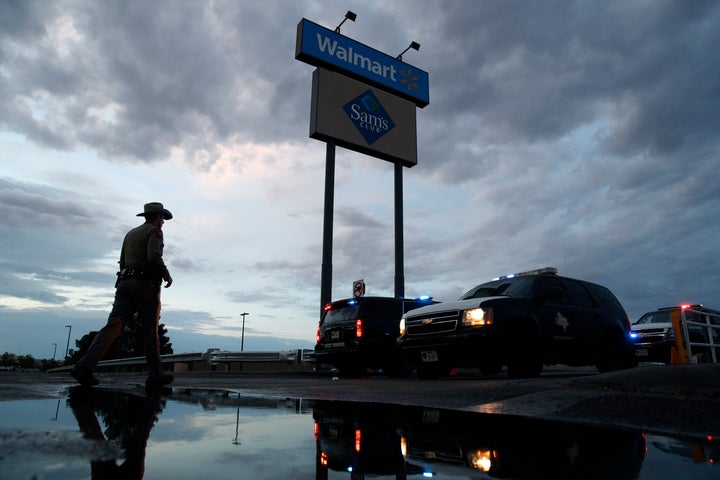
A manifesto posted online shortly before Saturday’s massacre at a Walmart in El Paso that the suspected shooter may have written blamed immigrants for hastening the environmental destruction of the United States and proposed genocide as a pathway to ecological sustainability.
Filled with white nationalist diatribes against “race-mixing” and the “Hispanic invasion of Texas,” the manifesto highlights far-right extremists’ budding revival of eco-fascism.
REAL LIFE. REAL NEWS. REAL VOICES.
Help us tell more of the stories that matter from voices that too often remain unheard.
Titled “The Inconvenient Truth,” an allusion to Al Gore’s landmark climate change documentary, the ranting four-page document appeared on the extremist forum 8chan shortly before the shooting. Authorities have yet to confirm whether Patrick Crusius, the 21-year-old Dallas-area white man arrested in connection with the shooting that left at least 22 dead, is the author.
“The environment is getting worse by the year,” the manifesto reads. “Most of y’all are just too stubborn to change your lifestyle. So the next logical step is to decrease the number of people in America using resources. If we can get rid of enough people, then our way of life can become more sustainable.”
HuffPost reviewed the document but, with consideration to the ethical concerns of broadcasting what might be a notoriety-seeking killer’s messaging, is not publishing a link to it.
The manifesto explicitly cites the 74-page message posted online by the gunman charged with killing 51 worshippers at two mosques in Christchurch, New Zealand, in March. That alleged shooter, Brenton Tarrant, a 28-year-old white Australian, thrice described himself as an “eco-fascist” motivated to repel waves of migrants fleeing climate change-ravaged regions of the world.
For years now, denial served as the extreme right’s de facto position on climate change. That is starting to change.
Just look, as Dissent magazine did in May, at this spring’s European elections. Following the European Green Party’s historic gains, the far-right Alternative for Germany’s youth wing in Berlin urged party leaders to abandon the “difficult to understand statement that mankind does not influence the climate,” an issue that moves “more people than we thought.”
ASSOCIATED PRESS
Law enforcement officials block a road early Sunday morning at the scene of a mass shooting that occurred Saturday at a shopping complex in El Paso.
In France, the far-right National Rally already took the message to heart. The party, led by Marine Le Pen, vowed to remake Europe as “the world’s first ecological civilization” with a climate platform rooted in nationalism. Le Pen railed against “nomadic” people who “do not care about the environment” as “they have no homeland,” harkening to the Nazis’ “blood and soil” slogan that, as The Guardian put it, described a belief in a mystical connection between race and a particular territory. Under that logic, “borders are the environment’s greatest ally,” as a National Rally party spokesman said in April.
In the United States, 70% of Americans recognize the climate is warming, and 57% understand humans’ emissions are the cause, Yale Program on Climate Change Communication polling shows. Republicans, long the only major political party in the developed world to outright reject climate science, are inching away from denialism but have yet to rally around a popular policy proposal.
“Someday Republicans are going to have to come up with some proposals that are responsive to these issues and, frankly, be more reasonable and more thoughtful,” Scott Jennings, a Republican consultant and a former campaign adviser to Senate Majority Leader Mitch McConnell (R-Ky.), told The New York Times last week.
More than 65 million people are displaced worldwide right now, marking ― depending on how you count it ― the highest number of refugees in history. Climate change is forecast to inflame the crisis. Catastrophic weather forced 24 million people to flee home per year since 2008, according to the Internal Displacement Monitoring Centre, the Swiss-based international organization. By 2050, that number could hit anywhere from 140 million to 300 million to 1 billion. Drought, rising seas and violent storms could compel upward of 143 million people to leave sub-Saharan Africa, South Asia and Latin America alone by the middle of the century, the World Bank estimated last year.
If we can get rid of enough people, then our way of life can become more sustainable.From a manifesto possibly written by the suspected El Paso gunman
Slashing global greenhouse gases and increasing aid to help poor countries close to the equator adapt is the obvious way to change that trajectory. The Green New Deal framework left-wing climate activists put forward late last year gained international popularity in part because its promise of good-paying jobs and meaningful work as a vehicle for wealth redistribution and ecological stability offers a powerful antidote to the toxic elixir of far-right prescriptions to social unrest.
But as planet-heating emissions continue surging and scientists’ projections grow more dire, eco-fascism is experiencing a revival in a subculture of far-right extremism online. It comes amid a rekindled interest in Ted Kaczynski, the convicted terrorist known as the Unabomber.
Kaczynski ― like his newfound online fandom, who often distinguish themselves with pine-tree emoji on social media ― subscribes to “lifeboat ethics.” The term, coined in the 1970s by the neoconservative ecologist Garrett Hardin, denotes the idea that “traditional humanitarian views of the ‘guilt-ridden,’ ‘conscience-stricken’ liberal” threatens the balance of nature. The belief traces its lineage back to 18th-century English philosopher Thomas Malthus, who theorized that population growth would eclipse the availability of resources to meet basic human needs without moral restraint or widespread disease, famine or war to thin the herd.
In September 2017, the white nationalist magazine American Renaissance asked its readers a question: “What does it mean for whites if climate change is real?” The bombastic essay wondered whether the “population explosion in the global south combined with climate change” demonstrated “the single greatest external threat to Western civilization” ― even “more serious than Islamic terrorism or Hispanic illegal immigration.”
“If continued global change makes the poor, non-white parts of the world even more unpleasant to live in than they are now, it will certainly drive more non-whites north,” Jared Taylor, the publication’s editor and an influential white nationalist, wrote in an email to the magazine Jewish Currents. “I make no apology for … urging white nations to muster the will to guard their borders and maintain white majorities.”
Two years later, white, male gunmen appear to be heeding his call.
– Environmental NGO files lawsuit against Guangxi regional bodies accusing
them of failing to look after endangered animals properly after rescuing
them
– Pangolins are among the world’s most trafficked mammals because of the
demand for their scales in traditional Chinese medicine
Alice Yan
South China Morning Post
Published: 3:50pm, 7 May, 2019
In the first lawsuit of its kind, a Chinese forestry authority has been sued
for failing to save a group of smuggled pangolins.
The forestry department in Guangxi and its terrestrial wild animals rescue
centre are accused of dereliction of duty in relation to the deaths of 32
pangolins two years ago, a court in Nanning, the region’s capital, heard on
Monday.
The case, filed by Beijing-based non-governmental organisation the China
Biodiversity Conservation and Green Development Foundation,is the first
public welfare lawsuit in China involving the endangered animals, according
to The Beijing News.
Pangolins are among the world’s most trafficked mammals and China is the
most common destination for large shipments of pangolins because their
scales are valued as ingredients in traditional medicine, their meat is
considered a luxury food item and their blood is used as a healing tonic.
The foundation said that when the Guangxi rescue centre received the live
pangolins that police seized from smugglers in August 2017, it offered to
help treat the mammals, but the offer was rejected.
The pangolins all died within 66 days. The foundation wants the two
defendants to pay compensation for the ecological losses caused by the death
of the animals and to apologise for their mistake in state media. It is
asking the court to evaluate the scale of ecological losses.
The court has yet to hand down a decision.
Zhang Zhenqiu, deputy director of the forestry department’s protection
section, told the newspaper that the accusation that it had failed to
protect the pangolins was just “hype” because they were difficult to look
after.
The authority said the pangolins died because of they had low immunity and
were stressed by the long journey from being trafficked from Vietnam.
Many had digestive system illnesses as a result of being force-fed by the
smugglers and some had serious injuries.
In February, 130 pangolins intercepted by Guangxi police from smugglers all
died soon after they were sent to two breeding bases – one in Guangxi and
one in Guangdong province.
A 1,000-acre patch of southeast New Mexico desert may offer a temporary solution to the nation’s longstanding nuclear waste problem.
Nathan Rott/NPR
Thirty-five miles out of Carlsbad, in the pancake-flat desert of southeast New Mexico, there’s a patch of scrub-covered dirt that may offer a fix — albeit temporarily — to one of the nation’s most vexing and expensive environmental problems: What to do with our nuclear waste?
Despite more than 50 years of searching and billions of dollars spent, the federal government still hasn’t been able to identify a permanent repository for nuclear material. No state seems to want it.
So instead, dozens of states are stuck with it. More than 80,000 metric tons of spent nuclear fuel, a still-radioactive byproduct of nuclear power generation, is spread across the country at power plants and sites in 35 states.
The issue has dogged politicians for decades. Energy Secretary Rick Perry recently described the situation as a “logjam.” But some hope that this remote, rural corner of New Mexico may present a breakthrough.
The Nuclear Regulatory Commission is considering a proposal by Holtec International, a private U.S.-based company, to build a massive consolidated interim storage facility for spent nuclear fuel on that patch of desert. It could eventually hold up to 100,000 metric tons of the material, storing it until a permanent repository is found.
An artist’s rendering of the proposed interim nuclear storage facility in southeast New Mexico.
Courtesy of Holtec International
The bid has support from a group of local officials, drawn by the promise of tax revenues, high-paying jobs and a stable source of income.
The same appears to be true in Washington, D.C., where lawmakers are anxious to find a solution and have indicated an openness to change laws, making it easier for private companies to manage nuclear fuel.
But familiar challenges persist.
A broad coalition of local and national groups opposes the plan, as does the state’s new governor. They’re worried about transporting the nuclear waste and the environmental impacts of storing it.
“Why should we be the ones to take this negative project on and put up with the consequences?” says Rose Gardner, a florist who lives 35 miles from the proposed site. “We didn’t get any of the nuclear generated electricity. We’re not even involved.”
Rose Gardner, a vocal opponent of Holtec’s proposal, doesn’t see why her small, rural corner of New Mexico should take on the nation’s nuclear waste.
In 1982 Congress got involved, passing the Nuclear Waste Policy Act, which called for the development of repositories for the nation’s high-level nuclear waste and spent nuclear fuel.
Five years later, it narrowed those efforts, focusing on a single area 90 miles northwest of Las Vegas: Yucca Mountain.
The federal government has spent billions of dollars assessing the viability of a deep underground storage facility there. For decades, Yucca looked like the destination for nuclear waste.
A map of current storage sites for high-level radioactive waste and spent nuclear fuel in the U.S.
Department of Energy
But efforts to move that project forward were stifled by local opposition. Stuck at an impasse, and under pressure from then-Senate Majority Leader and Nevadan Harry Reid, the Obama administration scrapped funding for the site in 2009.
The Trump administration has called for funding to revive the Yucca Mountain project, but local resistance remains and Nevada lawmakers have dug in their heels.
In the meantime, spent nuclear fuel continues to build up at scores of power plants around the country, at facilities that weren’t designed to store it.
The problem with this is two-fold.
For one, it’s expensive. The Nuclear Waste Policy Act said that the Department of Energy would find a permanent home for utilities’ nuclear waste by 1998. It didn’t. So now, the Department of Energy pays utility companies more than $2 million a day to store that nuclear waste on-site. That’s taxpayer money.
The other problem is public safety.
More than 1 in 3 Americans lives within 50 miles of a nuclear power plant, according to Columbia University. Many of those plants are now storing spent nuclear fuel on coastlines or near rivers, areas that are more prone to flooding and natural disasters.
The shuttered San Onofre power plant is one of California’s two nuclear power plants located near active earthquake faults. Spent nuclear fuel is being stored there currently.
Mark Ralston/AFP/Getty Images
“There’s no question, from a safety perspective, from a risk perspective, from an economic perspective, consolidated interim storage makes a lot of sense,” says John Heaton, a former New Mexico state legislator who’s part of a group trying to bring the facility to the state. “We’re in a seismically stable, dry place. It’s more or less a perfect site.”
A “consent-based” approach
In 2010, fresh off its decision to end funding for Yucca Mountain, the Obama administration commissioned a blue ribbon panel to look at America’s nuclear waste problem.
One of its top recommendations was to authorize and establish consolidated interim storage facilities. But to avoid another-Yucca like impasse, it also recommended using a new “consent-based approach” when finding a location.
“We believe this type of approach can provide the flexibility and sustain the public trust and confidence needed to see controversial facilities through to completion,” the report said.
But figuring out how to define that consent, and then getting it from various communities, industries and interests, will be difficult.
Ranchers and dairy producers in New Mexico worryabout what impact the Holtec facility would have on their industry, real or perceived. There’s a fear that consumers wouldn’t want to buy beef or milk from a place that’s also home to the nation’s biggest collection of nuclear material.
There are also concerns from some in the region’s biggest industry: oil and gas. The proposed site is in the Permian Basin, one of the busiest oil fields in the world.
Drilling rigs and pump-jacks dot the desert of the Permian Basin, where Holtec is proposing to build the interim nuclear storage facility.
Nathan Rott/NPR
“I understand we have to solve this problem,” says Tommy Taylor, director of oil and gasdevelopment at Fasken Oil and Ranch, a Texas-based company with wells near the proposed site. “[But] don’t put this in an oil field. That’s a bad idea. Certainly not the biggest oil field the United States has.”
Taylor feels the same way about another proposed interim storage facility in the Permian Basin, near the Texas-New Mexico border. That proposal, by Texas-based Waste Control and Storage Services, is also being considered by the Nuclear Regulatory Commission.
“My specialty is drilling wells,” Taylor says. “We use the best technology we have, the best materials we can get, and the best tools. And even though you’re trying to do the best you can — still, things happen.”
The companies behind both proposals insist that the projects would be safe. Advocates for the Holtec proposal say that the amount of radiation coming off of one of the storage containers the company plans to use is about the same as a microwave.
“This isn’t some Homer Simpson green sludge that’s going to leak out and who know’s what’s going to happen, people with three-eyes and that sort of thing,” says Jason Shirley, a Carlsbad City Council member, who was skeptical himself before seeing a video of a Holtec storage container surviving a mock missile strike. “When I’m able to explain this and educate people, they support it.”
A “missile test” of Holtec’s storage canisters.
Nuclear Energy Institute viaYouTube
“It won’t go.”
Thirty-five miles from the patch of desert Holtec wants to turn into an interim storage facility, and about 5 miles from a Texas company’s proposed site, is the boom-or-bust town of Eunice, N.M.
Pump-jacks bob among the houses, and the streets are jammed with traffic from the surrounding oil fields.
Down a quiet side street, Rose Gardner, an opponent ofboth proposals, is taking three grandchildren for a walk.
“We know it’s supposed to be consent-based,” she says. “They’re not getting consent. The actual people aren’t for it. And without community support, it won’t go.”
“I’ve got three little babies here and nobody’s speaking up for them,” says Rose Gardner, who’s worried about what the proposed facility would mean for her grandchildren’s future.
Nathan Rott/NPR
There is a history here, though, of nuclear projects that she’s well aware of.
Twenty years ago, nearby, the U.S. government built the country’s only deep-underground storage facility for radioactive material, the Waste Isolation Pilot Project. It’s designed to store lower-level nuclear waste from research laboratories and weapons facilities around the country.
A similar debate played out before the construction of that facility. Supporters touted the jobs and income it would bring. Opponents worried about safety. And there havebeen issues.
New Mexico Gov. Michelle Lujan Grisham is mindful of those and is unequivocal in her feelings about Holtec’s proposal.
“There’s nobody that’s been able to demonstrate to me that there isn’t risk here,” she says. “There is risk. We need to be clear about that. I don’t think it’s the right decision for the state.”
Back at the proposed site for Holtec’s interim storage facility, a sign lies on its side, uprooted from the ground and punctured with bullet holes.
Asked if it should be seen as an indication of the plan’s local support, former state legislator John Heaton laughs.
“You know how it is in the Wild West,” he says. “People with guns can’t resist putting holes in any sign anywhere.”
A sign at the proposed interim nuclear storage site lies on its side and is riddled with bullet holes.
It is raining trash in the suburbs of Seattle. Or, rather, bald eagles – around 200 of them – are dropping trash into people’s yards every day, and the suburbanites are not happy.
The trash – including a blood-filled biohazard container that landed in one lucky resident’s yard – is coming from a nearby landfill that takes in two tons of fresh trash a day. The bald eagles pick out the juicy morsels of food found in the landfill, and then discard the junk that they don’t want in the nearby neighborhoods.
The main issue is the open-air landfill in the area, the Cedar Hills Regional Landfill in King County. That landfill was supposed to have been closed years ago, but a proposed expansion has kept it open. In fact, that expansion is meant to keep the landfill exposed until 2040…
Many of the residents want the county to cancel the proposed expansion and finally close the landfill. In the meantime the residents are hoping to implement some sort of anti-eagle measures at the landfill, although it’s not entirely clear what those would look like.
There’s something almost poetic about the American national bird reminding people that the trash they throw in a landfill doesn’t simply disappear. In a way, these birds are a visceral demonstration of the usually hidden consequences of extreme consumption. We create too much trash, and that much trash creates consequences. That could mean eagles dropping biohazard containers in your front lawn, or it could mean nearly 20 tons of plastic washing up on one of the most remote beaches in the world.
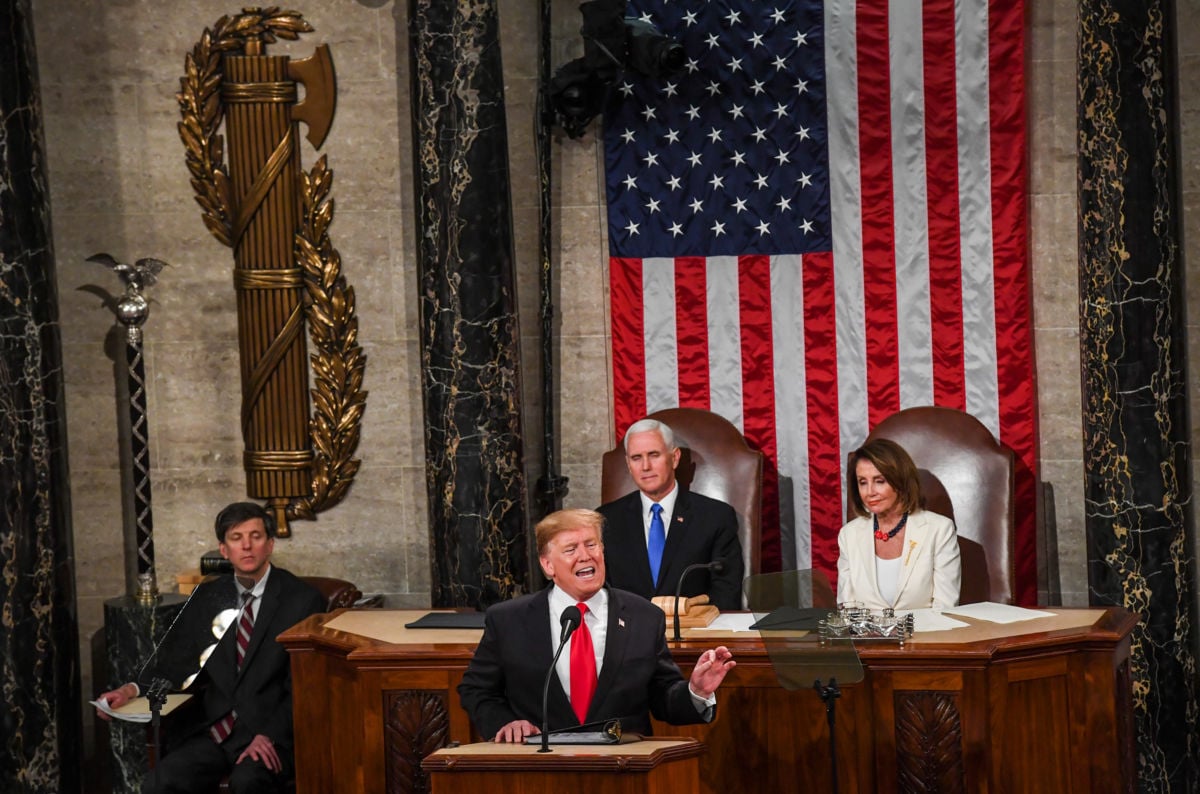
President Trump, in front of Vice President Mike Pence and House Speaker Nancy Pelosi, delivers his State of the Union address before members of Congress in the House chamber of the US Capitol, February 5, 2019, in Washington, DC.TONI L. SANDYS / THE WASHINGTON POST VIA GETTY IMAGES
If you happened to fall to Earth from space last night and found a working television, like as not you saw the president of the United States doing a passable imitation of a man giving a speech. A first-molecule surface impression, thoroughly devoid of context, would leave you thinking this person did relatively fine. Not a fireball on the stump, to be sure, but not a calamity, either. He did not fall down, throw things or curse anyone’s mother. No fake emergencies were declared.
The best thing one can say about Donald Trump’s State of the Union performance last night — and it was a performance, nothing more — was that he did not treat the assembled members of Congress, the high court, the joint chiefs, special guests and television audience like they were one of his howling rally crowds outside some abandoned airplane hangar in Alabama or western Pennsylvania. No, Mr. Trump stuck to the script on the teleprompter, and that’s when the trouble began.
As promised during the pro forma pre-speech leaks to the press, the first third of the address was suffused with fluffy bipartisan pabulum no one in the building believed for a second, least of all the speech-giver himself. Pretending at it was a hard hustle from the jump. Before he spoke a word, Trump barreled his way through House Speaker Nancy Pelosi’s ceremonial introduction of the president, oafishly denying her even a sliver of the spotlight he so desperately craves. So much for bipartisanship.
Trump cribbed 19-year-old lines from Bill Clinton about greeting the 21st century, bragged about the US being the world leader in oil exports and fracking, and strutted out a few right-wing legislative victories like cutting the estate tax and wrecking the Affordable Care Act’s individual mandate. Of course, he got the whole room to stand and cheer for the hyper-expensive might of the military more than once. When he leaned into the microphone and intoned, “The state of our union is strong,” there was Speaker Pelosi, perched over his left shoulder like Poe’s raven, shaking her head and mouthing, “Nope.”
Never miss another story
Get the news you want, delivered to your inbox every day.
Your Email
Then it got weird.
“An economic miracle is taking place in the United States,” said Trump about 30 minutes in, “and the only thing that can stop it are foolish wars, politics or ridiculous partisan investigations. If there is going to be peace and legislation, there cannot be war and investigation.” He capstoned these strange and poorly assembled comments with one last penetrating line: “We must be united at home to defeat our adversaries abroad.” It took half an hour, but he attempted in that moment to tie the ongoing Robert Mueller investigation inextricably to terrorism, war and political dysfunction.
The infamous border wall made its first appearance at the 9:33 pm mark, put up its feet and stayed a while. A word cloud of this portion of the speech would include “onslaught,” “MS-13,” “caravans,” “cruel,” “troops,” “sexual assault,” “dangerous” and “countless Americans murdered,” putting it on par (minus the ubiquitous blue duct tape) with virtually every public statement Trump has made since he first began threatening to shut down the government two months ago. No mention was made of Mexico footing the bill. He did, however, have the gall to complain about walls around the estates of the wealthy while, behind his own walls, undocumented workers are being panic-fired by the score. “Walls save lives,” he claimed. “I will get it built.” Quoth Pelosi: nevermore.
There were several moments beyond Trump’s not-so-subtle Mueller jab and his hectoring about the wall that truly made the bile rise. A few minutes after explaining how everyone was doomed without his precious “barrier,” Trump did a quick riff on repairing the nation’s infrastructure. In the aftermath of the lethal polar vortex that descended upon half the country last week, talking up infrastructure repair moments after blathering about his useless and expensive wall was Perfect Trump.
Frigid temperatures across the Midwest taxed the infrastructure that was keeping the coldest parts of America warm. Electrical grids collapsed, airline fuel lines froze and authorities encouraged the largely homebound population of the hardest-hit states to turn thermostats down to ease the burden on utility systems.
While Trump was beating the nation over the head with his wall last week, people in the center of the country were told to turn down the heat even as they risked freezing to death because the infrastructure tasked with keeping them alive and safe was groaning on the edge of collapse. The polar vortex killed at least 24 people and sent dozens more to the hospital. Not a single one of them would have been spared their fate by a wall on the southern border, but money tasked to build it could be well-used to help keep the heat on for millions. Unsurprisingly, this did not merit a mention last night.
“Already, as a result of my administration’s efforts,” said Trump during the second third of his marathon ramble, “in 2018 drug prices experienced their single largest decline in 46 years.” This, as it turns out, was one of almost 30 bald-faced lies he told last night. “A recent analysis of brand-name drugs by The Associated Press found 96 price increases for every price cut in the first seven months of 2018,” reports the science and medicine journal STAT. “At the start of last year, drug makers hiked prices on 1,800 medicines by a median of 9.1 percent, and many continued to increase prices throughout the year.”
Trump’s inaccurate crowing about lower drug prices also managed to cruise right past the pharmaceutical elephant in the room: insulin. “Insulin products cost very little to manufacture,” reports Mike Ludwig for Truthout, “but prices have skyrocketed in recent years. A vial of insulin that once cost around $25 now goes for about $400 to $500. Standing between people living with Type 1 diabetes and the insulin that keeps them alive are a number of wealthy corporations that value profit margins over human health. When people die from lack of access to medicine, health care profiteers should expect resistance.”
According to the Centers for Disease Control and Prevention, nearly 100 million people in the US have either diabetes or pre-diabetes, a number that is sure to rise as our population grows older and our diets grow worse.
For all that, the evening was not, in fact, a comprehensive dumpster fire. The Democratic congresswomen, rookies and veterans all garbed in whiteto honor a century of suffrage, owned the night. When Trump claimed credit for the number of women in the workforce, those white-robed women erupted in cheers and smiles, high-fiving each other as they leveled derisive laughter at the man behind the podium. Without downplaying their individually earned success at the polls, they made their message clear: We have this job because of you, putz. Thanks for that.Trump gave them his standard patronizing sneer, but even he knew he’d been aced.
And then there was Stacey Abrams, former candidate for governor of Georgia, who delivered the Democratic response. Abrams filled her short remarks with more dignity and truth than Trump could manage in his 90 grueling minutes. The Georgia gubernatorial election was perhaps the most blatant and destructive recent example of racist voter suppression in the US. Abrams’s words — including her call to voting rights — carried profound weight, and her vividly hopeful demeanor shined through even as she spoke of the darkest corners of modern politics. If Abrams does not announce her candidacy for the Senate soon, I will eat this keyboard at high noon on Main Street.
The State of the Union address is nothing more or less than a television show. Under normal circumstances and for most of the assembled, it is an opportunity for all the political peacocks to strut for the cameras before returning to the business of screwing us over in the holy name of someone else’s profit margin. With Trump involved, however, it is absolute farce. Nothing last night made this more obvious than the pre-speech announcement that Rick Perry had been tapped to be the designated survivor. If the building had exploded with all hands lost, we would have greeted the morning snug in the capable hands of a guy who couldn’t remember the name of the agency he currently heads.
These speeches are supposed to be about big ideas, our furthest hopes and greatest dreams. Here’s to hoping this is the last time we see Donald Trump delivering this particular address.
President Donald Trump signs a presidential memorandum to “minimize unnecessary regulatory burdens” on October 19, 2018. Since his earliest days in office, President Trump has been
SINCE THE TRUMP administration took office, it has been fighting what they call an “anti-growth” agenda put in place by the Obama administration. Regulations that required businesses to spend time and money to meet the former administration’s environmental standards were swiftly reviewed and, in many cases, rolled back.
States, municipalities, and NGOs have responded to these changes by filing lawsuits to block the administration. Some, like lawsuits against the Keystone XL pipeline, have successfully kept public land closed to additional development.
Below are 15 influential decisions made by the Trump administration that could impact the future of our nation.
Clean air
1. U.S. pulls out of Paris Climate Agreement
This is perhaps the decision that set the tone for the Trump administration’s approach to the environment: when he moved to withdraw from the Paris Climate Agreement in June of 2017. To many, it signaled less U.S. leadership in international climate change agreements. (Read more about this decision.)
2. Trump EPA poised to scrap clean power plan
The Clean Power Plan was one of the Obama’s signature environmental policies. It required the energy sector to cut carbon emissions by 32 percent by 2030, but in October 2017 it was rolled back by Trump’s EPA. Among the reasons cited were unfair burdens on the power sector and a “war on coal.” (Read more on why Trump can’t make coal great again.)
3. EPA loosens regulations on toxic air pollution
This regulation revolved around a complicated rule referred to as “once in, always in” or OIAI. Essentially, OIAI said that if a company polluted over the legal limit, they would have to match the lowest levels set by their industry peers and they would have to match them indefinitely. By dropping OIAI, the Trump EPA forces companies to innovate ways to decrease their emissions, but once those lower targets are met, they’re no longer required to keep using those innovations. (Read more about air pollution.)
4. Rescinding methane-flaring rules
Under the Affordable Clean Energy rule issued in August 2018, states were given more power over regulating emissions. In states like California, that means regulations would likely be stricter, whereas states that produce fossil fuels are likely to weaken regulations. The following month, the EPA announced they would relax rules around releasing methane flares, inspecting equipment, and repairing leaks. (Read more about methane.)
5. Trump announces plan to weaken Obama-era fuel economy rules
Under the Obama administration’s fuel economy targets, cars made after 2012 would, on average, have to get 54 miles per gallon by 2025. In August 2018, the Trump Department of Transportation and EPA capped that target at 34 miles per gallon by 2021. The decision created legal conflict with states like California that have higher emission caps. (Read more about speed bumps in the way of super-efficient cars.)
Water
6. Trump revokes flood standards accounting for sea-level rise
In August 2017, President Trump revoked an Obama-era executive order that required federally funded projects to factor rising sea levels into construction. However, in 2018, the Department of Housing and Urban Development required buildings constructed with disaster relief grants do just that. (Read more about how rising sea levels may imperil the internet.)
7. Waters of the U.S. Rule revocation
What are the “waters of the U.S.?” President Trump issued an executive order in 2017 ordering the EPA to formally review what waters fell under the jurisdiction of the EPA and Army Corps of Engineers according to the 1972 Clean Water Act. The proposed change narrowed the definition of what’s considered a federally protected river or wetland. (Read more about Trump’s plans to roll back the Clean Water Act.)
Wildlife
8. NOAA green lights seismic airgun blasts for oil and gas drilling
Five companies were approved to use seismic air gun blasts to search for underwater oil and gas deposits. Debate over the deafening blasts stem from concerns that they disorient marine mammals that use sonar to communicate and kill plankton. The blasts were shot down by the Bureau of Energy Management in 2017 but approved after NOAA found they would not violate the Marine Mammal Protection Act. (Read more about how scientists think seismic air guns will harm marine life.)
LEARN WHAT IT MEANS TO BE AN ENDANGERED SPECIES
1/5
VIEW SLIDESHOW
This critically endangered South China tiger lives at the Suzhou Zoo in China. This is a species that may be gone from the wild now. As of 2015 there were only 100 in captivity.
PHOTOGRAPH BY JOEL SARTORE, NATIONAL GEOGRAPHIC PHOTO ARK
This is a central Bornean orangutan. Bornean orangutan numbers have been more than halved in the past 60 years, mainly due to humans encroaching on its habitat.
PHOTOGRAPH BY JOEL SARTORE, NATIONAL GEOGRAPHIC PHOTO ARK
Giant panda numbers increased enough for the IUCN Red List to downlist it from endangered to vulnerable 2016.
PHOTOGRAPH BY JOEL SARTORE, NATIONAL GEOGRAPHIC PHOTO ARK
Hawksbill sea turtles are listed as critically endangered on the IUCN Red List. The tortoiseshell trade, collection of their eggs for food, and destruction of coral reefs have all contributed to their declining numbers.
PHOTOGRAPH BY JOEL SARTORE, NATIONAL GEOGRAPHIC PHOTO ARK
Asian elephants are listed as endangered on the IUCN Red List, threatened by habitat loss and poaching.
PHOTOGRAPH BY JOEL SARTORE, NATIONAL GEOGRAPHIC PHOTO ARK
9. Interior Department relaxes sage grouse protection
The uniquely American sage grouse, a bird resembling a turkey with spiked feathers, has become the face of the debate between land developers and conservationists. In both 2017 and 2018, the Trump administration Department of Interior eased restrictions on activities like mining and drilling that had been restricted to protect the endangered bird. (Read more about how the sage grouse become caught in the fight over who owns America’s west.)
10. Trump officials propose changes to handling the Endangered Species Act
In July of 2018, the Trump administration announced its intention to change the way the Endangered Species Act is administered, saying more weight would be put on economic considerations when designating an endangered animal’s habitat. (Read more about the rollbacks facing endangered animals.)
11. Migratory Bird Treaty Act reinterpretation
Companies installing large wind turbines, constructing power lines, or leaving oil exposed are no longer violating the Migratory Bird Treaty Act if their activities kill birds. This controversial change was declared by the Trump administration in December of 2017. (Read more about why legally protecting birds is important.)
Opening public lands for business
12. Trump unveils plan to dramatically downsize two national monuments
Unlike national parks, which have to be approved by Congress, national monuments can be created by an executive order, which the president said means they can be dismantled just as easily. Such was the case for Bears Ears and Grand Staircase-Escalante in Utah, which President Trump reduced and opened for mining and drilling companies in 2017. Tribes and environmental groups are challenging that interpretation in court. (Read more about the impacts of downsizing these two monuments.)
13. Executive order calls for sharp logging increase on public lands
Just a day before the longest government shutdown in U.S. history, President Trump issued an executive order that called for a 30 percent increase in logging on public lands. The decision was billed as wildfire prevention, though environmental groups say it ignores the role climate change plays in starting wildfires. (Read more about California’s historic wildfires.)
Security & Enforcement
14. Trump drops climate change from list of national security threats
The Trump administration’s decision to delist climate change from national security threats in December of 2017 meant less Department of Defense research funding and a nationalistic viewpoint on the potential impacts of wildfires, droughts, hurricanes, and other natural disasters. (Read more about how climate change is forcing migration in Guatemala.)
15. EPA criminal enforcement hits 30-year low
The size and influence of the EPA has shrunk under the Trump administration, and it’s illustrated by their diminished prosecuting power. Criminal prosecutions are at a 30-year low, and many violations that would have been prosecuted in the past are now being negotiated with companies. The administration says this is streamlining its work, but environmentalists have warned it could lead to more pollution. (Read more about the scientists pushing back against President Trump’s environment agenda.)
(CNN) — Officials have started removing hundreds of crocodiles from the site of the world’s largest statue in India, prompting an outcry from conservationists and concerns about the welfare of the reptiles.
The crocodiles are being relocated to allow for a seaplane service to carry tourists to the Statue of Unity, a 597-foot-tall statue that opened in Gujarat in October, AFP reported.
At least 15 have already been lured into metal cages and moved elsewhere in the west Indian state, the Indian Express newspaper reported, with hundreds still remaining in the waters surrounding the landmark.
But the operation has been criticized by environmentalists and politicians.
The statue is twice the height of the Statue of Liberty.
SAM PANTHAKY/AFP/AFP/Getty Images
“Have we collectively lost our minds?” Bittu Sahgal, the editor of environmental magazine Sanctuary Asia, tweeted in response to the story.
“As any environmentalist will tell you, this is sheer insanity!” Indian journalist and activist Pritish Nandy added, while others questioned whether the move contravenes the country’s wildlife protect laws.
Crocodiles are a protected species in India, listed under Schedule 1 of the country’s Wildlife Protection Act, meaning they cannot be moved unless a state government determines it is “necessary for the improvement and better management of wildlife therein.”
Local forestry official Anuradha Sahu said the state’s government had ordered the removals “for safety reasons as the tourist influx has increased,” according to AFP.
But the All India Mahila Congress, the female wing of opposition party the Indian National Congress, said the move showed Prime Minister Narendra Modi’s government was “keeping the environment at bay again.”
The Gujarat Forest Department did not immediately respond to a CNN request for comment.
The towering Statue of Unity depicts Sardar Vallabhbhai Patel, a popular political and social leader who was part of the freedom struggle that resulted in India’s independence from British colonial rule in 1947.
Twice the height of the Statue of Liberty, the landmark is estimated to have cost more than $410 million to erect.
Indian construction workers at the plinth structure of the statue.
SAM PANTHAKY/AFP/AFP/Getty Images
It is widely seen as the personal project of Modi, who announced the plans in 2010 and formally unveiled the statue in October.
But transport links to the site, which sits in a remote part of the Narmada district around 100 kilometres from the city of Ahmedabad, are limited, with most tourists currently arriving by bus.
The government finalized three seaplane routes in the region in June to improve access.
Note: the opinions expressed in this column are those of the writer and do not necessarily reflect those of High Country News, its board or staff. If you’d like to share an opinion piece of your own, please write Betsy Marston atbetsym@hcn.org.
Stones: We’ve built pyramids and castles with them and painstakingly cleared them out of farm fields, using them to build low walls for fencing. We marvel at the rocks in the Grand Canyon, Arches and Grand Teton national parks. Yet a perplexing practice has been gaining ground in our wild spaces: People have begun stacking rocks on top of one another, balancing them carefully and doing this for unknown reasons, though probably as some kind of personal or “spiritual” statement.
These piles aren’t true cairns, the official term for deliberately stacked rocks. From middle Gaelic, the word means “mound of stones built as a memorial or landmark.” There are plenty of those in Celtic territories, that’s for sure, as well as in other cultures; indigenous peoples in the United States often used cairns to cover and bury their dead. Those of us who like to hike through wilderness areas are glad to see the occasional cairn, as long as it’s indicating the right way to go at critical junctions in the backcountry.
Stone piles have their uses, but the many rock stacks that I’m seeing on our public lands are increasingly problematic. First, if they’re set in a random place, they can lead an unsuspecting hiker into trouble, away from the trail and into a potentially dangerous place. Second, we go to wilderness to remove ourselves from the human saturation of our lives, not to see mementoes from other people’s lives.
We hike, we mountain bike, we run, we backpack, we boat in wilderness areas to retreat from civilization. We need undeveloped places to find quiet in our lives. A stack of rocks left by someone who preceded us on the trail does nothing more than remind us that other people were there before us. It is an unnecessary marker of humanity, like leaving graffiti –– no different than finding a tissue bleached and decaying against the earth that a previous traveler didn’t pack out, or a forgotten water bottle. Pointless cairns are simply pointless reminders of the human ego.
I’m not sure exactly when the practice of stacking stones began in the West. But the so-called Harmonic Convergence in 1987, a globally synchronized meditation event, brought a tighter focus on New Age practices to Sedona, Arizona, just south of my home. Vortexes, those places where spiritual and metaphysical energy are reputed to be found, began to figure prominently on national forest and other public lands surrounding Sedona. Hikers near these vortexes couldn’t miss seeing so many new lines of rocks or stacks of stones.
Since then, the cairns, referred to as “prayer stone stacks” by some, have been multiplying on our public lands. Where there were just a dozen or so stone stacks at a much-visited state park on Sedona’s Oak Creek 10 years ago, now there are hundreds. What’s more, the cairn craze has mushroomed, invading wilderness areas everywhere in the West.
Why should we care about a practice that can be dismantled with a simple foot-push, that uses natural materials that can be returned quickly to the earth, and that some say nature will remove eventually anyway?
Because it’s not a harmless practice: Moving rocks increases erosion by exposing the soil underneath, allowing it to wash away and thin soil cover for native plants. Every time a rock is disturbed, an animal loses a potential home, since many insects and mammals burrow under rocks for protection and reproduction.
The multiplying rock stacks.
Robyn Martin
But mainly, pointless cairns change the value of the wilderness experience by degrading an already beautiful landscape. Building cairns where none are needed for route finding is antithetical to Leave-No-Trace ethics. Move a stone, and you’ve changed the environment from something that it wasn’t to something manmade. Cairn building might also be illegal, since erecting structures or moving natural materials on public lands often comes with fines and/or jail time. Of course, I doubt the Forest Service will hunt down someone who decided that his or her self-expression required erecting a balanced stone sculpture on a sandstone ridge. Yet it is an unwelcome reminder of humanity, something we strive to avoid as we enjoy our wild spaces.
Let’s end this invasive practice. Fight the urge to stack rocks and make your mark. Consider deconstructing them when you find them, unless they’re marking a critical trail junction. If you must worship in the wild, repress that urge to rearrange the rocks and just say a silent prayer to yourself. Or bring along a journal or sketchpad to recall what you felt in the wild.
Let’s check our egos at the trailheads and boat launches, and leave the earth’s natural beauty alone. Her geology, as it stands, is already perfect.
Robyn Martin is a contributor to Writers on the Range, the column service of High Country News. She is a senior lecturer in the honors program at Northern Arizona University in Flagstaff.







 Exposing the Big Game