Exposing the Big Game

Forget Hunters' Feeble Rationalizations and Trust Your Gut Feelings: Making Sport of Killing Is Not Healthy Human Behavior

Exposing the Big Game

37 Percent

by Stephen Capra 

BOLD VISIONS CONSERVATION

 
We live in a country that I sometimes no longer recognize. It is a place where a large segment of our population has decided that wild nature and the conservation of our precious resources have no value. Let’s be clear, they still hunt, hike and visit our National Parks, but they are angry, religiously distorted, ignorant or devoid of caring, but they have put their faith in a monster that calls himself President. Their reasoning is varied, but it comes back to money and the delusion of grandeur that spills from the lips of a man that has made exploitation of our natural world a driving force in his presidency.

In less than a year, this White House in concert with the Republican majority have rammed through legislation that has allowed the killing of wildlife in their dens, pushed to open wild oceans to drilling, opened public lands to more fracking and drilling, opened wildlife refuges to trapping, while removing protections for our precious National Monuments. They have also set their sights on the priceless Arctic National Wildlife Refuge, in their endless genuflecting to the dying oil industry.

Perhaps even more alarming is the selection of people to fill positions designed to protect the environment. Using the Republican playbook, most selections are those with strong ties to the industries doing the most harm. From the EPA to Interior, from Department of Agriculture to anything based in science, this White House and Congress have made clear, its war!

Yet across our nation, 37 percent of the public is content with this direction. Recent months have made clear that this year’s- Time Person of the Year, will not be a person, but once again a raging planet that is showing, without question, the impacts of such kamikaze policies and the crushing of bi-partisan efforts at sanity for the earth.

What is it like to be that 37 percent? How can you use our public lands and then ignore their peril? How can you sit on a beach and disregard the discharges in Florida that support Big Sugar, or live in southeast Alaska and not see the destruction of your beautiful and vital rainforest? How can you flock to Yellowstone to see and experience wolves and stand by silently as they are destroyed for ranching interests and Republican fundraising?

How can you perceive the world as us against them, rather than we are one? We are a divided nation like never before and it seems clear that those who support this President will allow him full reign and support even while it destroys the places and quality of life that they clearly take for granted. When will the drape finally be opened to expose the incompetence that we have created, a man devoid of empathy and emotion, a child leader that will destroy all that defy him and his interests. He sees our natural resources as a profit pool to be plundered for his personal enrichment.

It’s like a Jim Jones flashback to listen to supporters as they defend the undefendable. As we pull away from the Climate accords and the world watches they see a nation that no longer pretends to care. We have devolved into a nation that has sucked the world of its natural resources and now has made clear that it will continue to plunder and steal the right to life on this planet. When, many are asking, will we have the maturity and moral guidance to stop corporate special interests that are determined to drain the life out of our planet, for short-term profit.

What world does this 37 percent want to live in? They seem to believe in code words like cutting regulations, refusing to acknowledge that that means filthy water and foul air, less bees and more cancer. It is a Monsanto free world, more oil spills and mountains blown apart for cheap coal. Who wins in such a scenario, certainly not people or communities, not any part of our country or the world.

For our country to move forward we must use any measure possible to block the oil and gas industry. Time is on our side, not theirs. We must demand of our leaders that this President be removed from office. We must stop spending more on our military and focus on clean, renewable energy, not as an option, but as a human right. We must respect wildlife and stop their slaughter and we must fill positions in our federal agencies with qualified people who put our wild lands and the planet first and can never again have ties to corporate interests. Democrats must push for strong environmental goals, no matter the majority; they must use this time to stand on the principle of defending the morality of a healthy planet and its importance to our quality of life, communities and the peace and stability of our world.
We know so much more about our natural world than we did even fifty years ago. We must use our knowledge to defend and rewild our planet, not exploit it any further.

But perhaps the most important thing we can do is to awaken the 37 percent and if nothing else, shame them into making the protection of our natural resources a priority for Republicans. If they continue to ignore the reality before them, they are accomplices to destroying our nation’s best ideals- our land, water and wildlife. They are cheerleaders of their own ruin.

37 percent is not a majority, but they remain a voice filled by fear, ignorance has historically reared its ugliness, but this fight goes beyond a people or a nation, it’s about life and the planet that has been so giving.

Ignorance in this case cannot be tolerated. We fight for life, for beauty and for the freedom that comes from true wildness.

We are in a real fight now.

Stop the EPA’s approval of the Pebble Mine

https://act.credoaction.com/sign/stop_pebble_mine?sp_ref=314276685.4.181441.e.578588.2&referring_akid=.887660.7f2N3o&source=mailto_sp

83%
We’ve reached 124,861 of our goal of 150,000.

Sign the petition

The petition to the Environmental Protection Agency reads:

“The proposed Pebble Mine in Bristol Bay, Alaska would unleash billions of tons of toxic waste and cause an irreversible environmental catastrophe. Keep the Bristol Bay Proposed Determination in place and protect the environment, jobs, the region’s economy and this fragile ecosystem.”

    name*
    email*
    zipcode*
    Sign Petition

    You’ll receive periodic updates on offers and activism opportunities.

    Stop the EPA's approval of the Pebble Mine

    The world’s largest salmon fishery is again under threat of massive amounts of toxic mining waste — and this time our own government is behind it.

    In a reversal of Obama administration efforts, climate change denier Scott Pruitt and his Environmental Protection Agency (EPA) have given a Canadian company the green light to begin construction on the Pebble Mine in Alaska, which would be one of largest open-pit gold and copper mines in the world.

    Industrial polluters, Republicans in Congress and now the Trump administration are pushing for this unmitigated disaster that could destroy the pristine Bristol Bay watershed along with its jobs, economy and wildlife. We must demand that the EPA stop this reckless corporate assault on our environment.

    Tell the EPA: Stop the Pebble Mine now.

    Salmon from Bristol Bay are the lifeblood of this Alaska region, providing half of the world’s sockeye and generating roughly 14,000 jobs and a half billion a year in annual revenue. Native Alaskans have relied on Bristol Bay salmon for subsistence and livelihoods for centuries.1

    But all of that is now at risk because greedy corporate profiteers and our own EPA could cause an irreversible environmental catastrophe. In a backroom deal struck with Northern Dynasty, the owner of the Pebble Mine project, Scott Pruitt agreed to settle previous lawsuits regarding the mine, abandoned Obama-era regulatory plans and encouraged the company to apply for new permits to begin operations.2

    The public has overwhelmingly rejected the Pebble Mine project. More than 65 percent of all Alaskans, 80 percent of Bristol Bay residents — including Native people — and more than 85 percent of commercial fisherman strongly oppose the Pebble mine.3,4,5 Over 1.5 million people — including 100,000 CREDO members — have let the EPA know that the Pebble Mine is absolutely unacceptable.

    We won a huge victory a few years ago to stop the Pebble Mine, but now Trump is on the verge of reversing it. We must take action now to protect the Bristol Bay and its watershed from toxic mining pollution for good.

    Tell the EPA: Stop the Pebble Mine now.

    Thanks for all you do.

    References

    Health Care and the Environment

    by Stephen Capra
     
    The last few weeks have shown a new depth in Republican thinking. What would at first glance seem crazy, stealing heath care from up to 24 million Americans is at best going to be a very close vote that will likely mean less for average Americans and more tax cuts for the wealthiest in our country.

    To accomplish this Republicans are willing to lie repeatedly, obfuscate and threaten. They will use misleading facts and create fear among the most vulnerable, to cajole their way to this warped vision of victory.

    So when a party that dominates both Houses of Congress and the Presidency is willing to literally kill people to gain a tax cut, what is the potential that they will have concern or a sense of responsibility when it comes to the environment?

    The answer is unfolding before our eyes. From Bear Ears and Monuments across the West to the fight on Climate Change or methane releases and the countless environmental regulations they have placed in the shredder, we are witnessing genocide of the planet on a level that few can remember. Republicans continue to use terms like freedom and choice to conceal and define a narrative that enriches corporate American off the backs of native wildlife, protected habitat and the health and welfare of people that love and respect wild nature.

    Democrats in this process are fighting back, but also share some of the responsibility in the delays and Blue Dog member’s conflicts with important environmental legislation that stalled or was not implemented through Executive Orders until the final year of an Administration, regulations that should have passed in year one.

    It has taken the Trump Administration 100 days to tack public opinion against environmental protection and to inspire this congress to go for the jugular in destroying generations of responsible environmental progress. While many in America are fighting back and town hall videos represent new voices of hope, we remain trapped with a President that has shown his shallowness, his vindictive nature and his willingness to destroy the foundations of our democracy. In his disturbed mind, he sees only those loyal to him and those who oppose him. Friendship and critical analysis are fed through money and his ability to profit. Dissension is met with paranoia and callous retribution.

    So we stand at a precipice in time. In the next forty days a report will come back that could very well be the paper work the President desires to remove some of our most precious lands from Monument protection. What on the surface seems to be a very misguided and unthinkable prospect is in the Trump world another opportunity to harm those who most vehemently opposed him in the campaign-the conservation community. For those in the Steve Bannon inner circle, it is another way to blow up the Federal government, leading us towards an inevitable anarchy.

    So the question for many remains what can we do? The answer is to first, never stop fighting. The second is to realize that we are approaching the bottom, many have spoken about. It is true Trump could move to disband our National Parks, but that is something that for now seems a remote possibility. No this President is trying to break our spirit and push us into a national depression that will force people to tune out and give him free reign. Next we must continue to educate ourselves, friends and family, it is simply amazing how many people are already tuned out. Finally, we must vote out these bastards, our planet simply cannot continue a cycle of bust and boom in terms of protection of our natural heritage, we are approaching life support and that demands our energy and perseverance. We can never surrender to evil, or ignorance.

    This Republican Congress is making clear from Health Care to the removal of James Comey, that they are putting party first before the American people and our values. Power and control are the mechanisms that feed their trough and what was once considered a sacred responsibility to put county before party, has been destroyed in the haze of Citizens United and the thirst to move their radical agenda.

    Should Democrats retake control of congress or eventually the White House, they must move in the first, not the eighth year of a Presidency to change environmental regulations or use Executive Actions so that they have a sense of permanency. Democrats must also be strong, not weak, in pushing aggressive environmental protections, wilderness and Monument protections and designations. That includes those in coal country.

    Until such time as the American people fight in one voice to protect our environment, Republicans will continue to flourish from the poisoned money that flows from the fossil fuel, mining, NRA and corporate agenda. That money is breaking the Arctic ice packs, fouling our air and water, it is killing wolves in the West and Mid-West, and it is stealing protected lands from all Americans and allowing a deranged man to lead our county, while simultaneously tearing us apart.

    We can do so much better, and we will. But we are in a war, there really is no other way to describe it and we have no choice but to fight with every fiber of our being. For those in the rust belt that made Trump our President, I would remind them that their vote and actions are helping to destroy our quality of life in the West. So we can fight one another, or we can unite to save our planet, our wildlife and the moral compass of a nation that has lost direction.

    Get out into the Parks and Monuments, allow your spirit to heal and flourish, soak in the energy and life that nature provides, in that place of love and beauty, find the strength and resolve to save it from those who can never understand or fear that which is wild.

    The road is long, but you are not alone, we are many and fierce in our love of that cathedral of life, that endless bounty that is nature.

    We will fight and we will win.

    But we will also suffer and hurt, yet in that pain is the resolve to never allow this to happen again. The health, not just of people, but of the planet is in our hands.
    In such destiny is the power to change, and change we must or we will bear witness to our own demise.
    I choose to fight.

    Obama blocked this controversial Alaskan gold mine. Trump just gave it new life.

    May 12 at 7:37 AM

    The Environmental Protection Agency has reached a legal settlement with a Canadian company hoping to build a massive gold, copper and molybdenum mine in Alaska’s Bristol Bay watershed, clearing the way for the firm to apply for federal permits.

    The settlement reached late Thursday between the EPA and the Pebble Limited Partnership, a subsidiary of Northern Dynasty Minerals Ltd., could revive a controversial project that was effectively scuttled under the Obama administration. And it underscores how President Trump’s commitment to support mining extends far beyond coal, to gold, copper and other minerals.

    While the move does not grant immediate approval to the Pebble Mine project,which will have to undergo a federal environmental review and also clear state hurdles before any construction takes place, it reverses the agency’s 2014 determination that a large-scale mine in the area be barred because it would imperil the region’s valuable sockeye salmon fishery.

    In a statement, EPA Administrator Scott Pruitt said that the agreement “will not guarantee or prejudge a particular outcome, but will provide Pebble a fair process for their permit application and help steer EPA away from costly and time-consuming litigation.”

    “We are committed to due process and the rule of law, and regulations that are ‘regular’,” said EPA Administrator Scott Pruitt.  “We understand how much the community cares about this issue, with passionate advocates on all sides … We are committed to listening to all voices as this process unfolds.”


    A coalition of fishing operators, native Alaskans, environmentalists and local businesses have fought the mine proposal for more than a decade, ever since Northern Dynasty Minerals began exploring for minerals in 2004. While this area in southwestern Alaska contains a reservoir of gold worth an estimated $120 billion, its pockmarked lakes and tributaries feed into the headwaters of Bristol Bay, home to a fishery that generates $500 million a year.

    In 2014 the EPA invoked a rarely used clause of the Clean Water Act, 404(c), to issue a proposed determination that the company could not apply to the Army Corps of Engineers for any permits because a massive mine could have “significant” and potentially “catastrophic” impacts on the region.

    Alannah Hurley, executive director of the United Tribes of Bristol Bay, said in an interview that opponents of the mine “are outraged that this is happening.”

    “If there’s damage to the watershed and the fisheries, then it would be devastating to our identity as indigenous people,” Hurley said, adding that tribes and other local residents “invited” the EPA to intervene on the issue. “For the company to paint it as federal intervention is completely misleading. The people of Bristol Bay basically cried out to EPA to help us.”

    The company has sued EPA on three different fronts, arguing that the agency violated the Clean Water Act, colluded with outside groups to reach its determination and violated the Freedom of Information Act. The suit concerning the outside groups, filed under the Federal Advisory Committee Act, was the one settled Thursday in federal court in Alaska.

    Under the terms of the agreement, EPA will begin the process of withdrawing its proposed determination, which will be subject to public notice and comment. It will not take the next step in the process until 48 months from the settlement or until the Army Corps of Engineers issues its final environmental impact statement, whichever comes first.

    Northern Dynasty Minerals, which has never filed federal permit applications for Pebble Mine, would have to do so within 30 months.

    “From the outset of this unfortunate saga, we’ve asked for nothing more than fairness and due process under the law — the right to propose a development plan for Pebble and have it assessed against the robust environmental regulations and rigorous permitting requirements enforced in Alaska and the United States,” the company’s chief executive, Ron Thiessen, said in a statement early Friday. “Today’s settlement gives us precisely that, the same treatment every developer and investor in a stable, first world country should expect.”

    The firm’s stock price has already been bolstered by Trump’s election victory. After falling to as low as 25 cents a share at one point last year, the price soared after the November election, jumping 25 percent overnight and reaching as high as $3.18 earlier this year. The company has touted the likely benefits of having a new, friendlier administration in office. A series of investor presentations by Thiessen included a PowerPoint slide titled “Trump Election Victory — A Return to Normal.”

    While many congressional Republicans, including Sen. Lisa Murkowski (Alaska) and House Science  Committee Chairman Lamar Smith (R-Tex.) oppose what they’ve described as EPA’s “preemptive” veto of the project, public opinion in Alaska on the mining proposal remains split.

    Last fall a ballot measure passed with more than 65 percent that would require the state legislature to pass a measure approving any large-scale mine in the Bristol Bay region, and they would have to determine that such an operation would not imperil the area’s sockeye salmon fishery.

    Alaska Gov. Bill Walker, an independent, has said that constructing Pebble Mine “presents formidable challenges” given the valuable fishery and the rural village life that depends on it.

    “Based on the information available to me now, I do not support the Pebble Mine,” reads a statement from his 2014 campaign site.

    Taryn Kiekow Heimer, a senior policy analyst at the Natural Resources Defense Council, said in an interview that “the opposition in Alaska has grown stronger” since EPA blocked the mine’s construction.

    But in Washington, the political climate has shifted.

    Administration officials are reopening the question of whether to construct Pebble Mine, and may even reconsider the Interior and Agriculture Departments’ move in December denying another company’s request to renew a lease on the southwest border of Minnesota’s Boundary Waters Canoe Area Wilderness.

    In one of the last big mining decisions of the Obama era, the two departments rejected Twin Metals Minnesota’s lease renewal bid, and set in motion a formal review to examine whether all mining activities in 234,000 acres abutting the wilderness should be barred for the next 20 years. Twin Metals Minnesota is a subsidiary of Antofagasta Mining PLC.

    Minnesota Reps. Rick Nolan (D) and Tom Emmer (R) met with Interior Secretary Ryan Zinke on April 26 to discuss whether to reverse that decision, according to individuals who asked for anonymity to discuss a private conversation. Bob McFarlin, Twin Metals Minnesota’s government affairs adviser, said in an email that the firm has met with lawmakers and top federal officials “in both the previous and current administrations to express our concerns” about the decision to deny the company’s lease application.

    “I am optimistic that we will be able to work with the new administration to allow this initiative to move forward,” Nolan said in a statement Thursday. “Having met with all the involved agencies and parties, I know renewing these leases is the sensible and correct thing to do.”

    And Hal Quinn, president and CEO of the National Mining Association, said in a statement that his industry stands to “benefit most from the administration’s willingness to lift the regulatory burden that has impaired our ability to compete in the energy market.”

    That will ease restrictions on “access and development of much needed domestic minerals and metals,” Quinn added, which “are needed  for everything from infrastructure and manufacturing to cutting edge technologies.”

    Donald Trump’s Earth Day Statement Is Shameful

     http://www.huffingtonpost.com/entry/donald-trump-earth-day_us_58fb9b9ee4b06b9cb91759d6

    The president has moved swiftly to dismantle a wide range of protections for the environment.

    “Our Nation is blessed with abundant natural resources and awe-inspiring beauty. Americans are rightly grateful for these God-given gifts and have an obligation to safeguard them for future generations,” Trump said in the statement Saturday. “My Administration is committed to keeping our air and water clean, to preserving our forests, lakes, and open spaces, and to protecting endangered species,”

    Trump, who has claimed that climate change is a hoax that the Chinese invented, has appointed multiple climate change skeptics to fill his cabinet. Environmental Protection Agency head Scott Pruitt, one such skeptic, sued the agency more than a dozen times when the was attorney general of Oklahoma. Rick Perry, now the secretary of energy, said in 2012 he wanted to abolish the department Trump tapped him to run (he now says he regrets the comment).

    In his first 100 days as president, Trump has moved to eliminate several protections for the environment. He signed legislation repealing the Stream Protection Rule, which protected streams from mining operations. The president has also moved to eliminate the Clean Water Rule, which protects 2 million miles of streams and 20 million acres of wetlands. Getting rid of the rule could jeopardize drinking water for nearly 120 million Americans and numerous endangered species. He has also moved to get rid of car emission and pollution standards.

    The statement also noted that Trump is committed to “rigorous science” and “honest inquiry.”

    “Rigorous science is critical to my Administration’s efforts to achieve the twin goals of economic growth and environmental protection,” Trump said.  “My Administration is committed to advancing scientific research that leads to a better understanding of our environment and of environmental risks.  As we do so, we should remember that rigorous science depends not on ideology, but on a spirit of honest inquiry and robust debate.”

    But under Trump, the EPA’s Office of Science and Technology has removed “science” from its mission statement. Trump and Pruitt have questioned well established science that shows global warming is real. His administration has proposed gigantic cuts to biomedical and scientific research and, the EPA and environmental programs.

    Trump and the White House have also undermined science by distorting the truth and questioning facts. The entire field of science is built around objective observation and facts in the pursuit of truth. Thousands joined protests around the world on Saturday to highlight how Trump’s disregard for facts undermined science.

    Ten Strikes Against Nuclear Power

    http://www.greenamerica.org/programs/climate/dirtyenergy/nuclear.cfm

    NukesGreen America works to address the climate crisis by transitioning the US electricity mix away from its heavy emphasis on coal-fired power.  But all of that work will be wasted if we transition from coal to an equally dangerous source – nuclear power. Nuclear power is not a climate solution. It may produce lower-carbon energy, but it is not clean energy.

    Solar power, wind power, geothermal power, hybrid and electric cars, and aggressive energy efficiency are climate solutions that are safer, cheaper, faster, more secure, and less wasteful than nuclear power.  Our country needs a massive influx of investment in these solutions if we are to avoid the worst consequences of climate change, enjoy energy security, jump-start our economy, create jobs, and work to lead the world in development of clean energy.

    Thankfully, no new nuclear plants have been built in the US for over 30 years.  That means that a whole new generation of concerned citizens grew up without knowing the facts about nuclear power – or remembering the terrible disasters at Three Mile Island and Chernobyl. With the Nuclear Regulatory Commission now voting to allow the first new nuclear plants in the US, and after witnessing the 2011 nuclear disaster in Fukushima, Japan, it is time to remind everyone that nuclear is not the answer.

    Currently around 400 nuclear plants exist worldwide.  Nuclear proponents say we would have to scale up to around 17,000 nuclear plants to offset enough fossil fuels to address climate change.  This isn’t possible, and neither are 2,500 or 3,000 more nuclear plants that many people frightened about climate change suggest.  Here’s why:


    1. Nuclear waste The waste from nuclear power plants will be toxic for humans for more than 100,000 years.  It’s untenable now to secure and store all of the waste from the plants that exist.  To scale up to 2,500 or 3,000, let alone 17,000 plants is unthinkable.

    Nuclear proponents hope that the next generation of nuclear plants will generate much less waste, but this technology is not yet fully developed or proven.  Even if new technology eventually can successfully reduce the waste involved, the waste that remains will still be toxic for 100,000 years.  There will be less per plant, perhaps, but likely more overall, should nuclear power scale up to 2,500, 3,000 or 17,000 plants.  No community should have to accept a nuclear waste site, or even accept the risks of nuclear waste being transported through on route to its final destination.  The waste problem alone should take nuclear power off the table.

    President Obama took the proposed solution of a national nuclear waste storage facility at Yucca Mountain, Nevada, off the table, though members of the president’s Blue Ribbon Commission on America’s Nuclear Future have suggested reopening discussion of this location. But the people of Nevada have said they don’t want a nuclear waste facility there, and we would need to transfer the waste to this facility from plants around the country, which puts thousands of other communities at risk.


    2. Nuclear proliferationIn discussing the nuclear proliferation issue, Al Gore said, “During my eight years in the White House, every nuclear weapons proliferation issue we dealt with was connected to a nuclear reactor program.”  Iran and North Korea are reminding us of this every day.  We can’t develop a domestic nuclear energy program without confronting proliferation in other countries.

    Here too, nuclear power proponents hope that the reduction of nuclear waste will reduce the risk of proliferation from any given plant, but again, the technology is not yet proven – and reduced risk doesn’t mean no risk of proliferation.  If we want to be serious about stopping proliferation in the rest of the world, we need to get serious here at home, and not push the next generation of nuclear power forward as an answer to climate change. There is simply no way to guarantee that nuclear materials will not fall into the wrong hands


    3. National SecurityNuclear reactors represent a clear national security risk, and an attractive target for terrorists.  In researching the security around nuclear power plants, Robert Kennedy, Jr. found that there are at least eight relatively easy ways to cause a major meltdown at a nuclear power plant.

    What’s more, Kennedy has sailed boats right into the Indian Point Nuclear Power Plant on the Hudson River outside of New York City not just once but twice, to point out the lack of security around nuclear plants.  The unfortunate fact is that our nuclear power plants remain unsecured, without adequate evacuation plans in the case of an emergency.  Remember the government response to Hurricane Katrina, and cross that with a Chernobyl-style disaster to begin to imagine what a terrorist attack at a nuclear power plant might be like.


    4. AccidentsForget terrorism for a moment, and remember that mere accidents – human error or natural disasters – can wreak just as much havoc at a nuclear power plant site.  The Chernobyl disaster forced the evacuation and resettlement of nearly 400,000 people, with thousands poisoned by radiation. The Fukushima disaster forced the evacuation of 150,000 people, and the costs of the clean-up are still being calculated.

    Here in the US, the partial meltdown at Three Mile Island in 1979 triggered a clean-up effort that ultimately lasted for nearly 15 years, and topped more than two billion dollars in cost. The cost of cleaning up after one of these disasters is simply too great, in both dollars and human cost – and if we were to scale up to 17,000 plants, is it reasonable to imagine that not one of them would ever have a single meltdown?   Many nuclear plants are located close to major population centers.  For example, experts argue that if there was an accident at the Indian Point Nuclear Power Plant outside of New York City, evacuation would be impossible.

    And accidents aren’t limited to power plants. Also in 1979, another nuclear-related accident occurred at the Church Rock uranium mine in New Mexico, where more than 1,000 tons of radioactive mill waste was spilled into the Puerco River. The accident, occuring in a rural area of the Navajo Reservation, received little media attention, though it would have long-term consequences. A 2007 study found significant radiation still present in the area, and in 2008 Congress authorized funds for continued clean-up efforts. In the US, uranium mining occurs disproportionately on Native American lands, with Native communities facing the worst consequences of potential accidents.


    5. Cancer There are growing concerns that living near nuclear plants increases the risk for childhood leukemia and other forms of cancer – even when a plant has an accident-free track record.  One Texas study found increased cancer rates in north central Texas since the Comanche Peak nuclear power plant was established in 1990, and a recent German study found childhood leukemia clusters near several nuclear power sites in Europe.

    According to Dr. Helen Caldicott, a nuclear energy expert, nuclear power plants produce numerous dangerous, carcinogenic elements.  Among them are:  iodine 131, which bio-concentrates in leafy vegetables and milk and can induce thyroid cancer; strontium 90, which bio-concentrates in milk and bone, and can induce breast cancer, bone cancer, and leukemia; cesium 137, which bio-concentrates in meat, and can induce a malignant muscle cancer called a sarcoma; and plutonium 239.  Plutonium 239 is so dangerous that one-millionth of a gram is carcinogenic, and can cause liver cancer, bone cancer, lung cancer, testicular cancer, and birth defects.  Uranium mining and transportation increase background radiation and cancer risks worldwide, not only at nuclear power-plant sites. Because safe and healthy power sources like solar and wind exist now, we don’t have to rely on risky nuclear power.


    6. Not enough sitesScaling up to 17,000 – or 2,500 or 3,000 —  nuclear plants isn’t possible simply due to the limitation of feasible sites.  Nuclear plants need to be located near a source of water for cooling, and there aren’t enough locations in the world that are safe from droughts, flooding, hurricanes, earthquakes, or other potential disasters that could trigger a nuclear accident.  Over 24 nuclear plants were at risk of needing to be shut down in the summer of 2008 because of the drought in the Southeast.  No water, no nuclear power.

    There are many communities around the country that simply won’t allow a new nuclear plant to be built – further limiting potential sites.  And there are whole areas of the world that are unsafe because of political instability and the high risk of proliferation.  In short, because of geography, local politics, political instability and climate change itself, there are not enough sites for a scaled-up nuclear power strategy.


    7. Not enough uraniumEven if we could find enough feasible sites for a new generation of nuclear plants, we’re running out of the uranium necessary to power them.  Scientists in both the US and UK have shown that if the current level of nuclear power were expanded to provide all the world’s electricity, our uranium would be depleted in less than ten years.  

    As uranium supplies dwindle, nuclear plants will actually begin to use up more energy to mine and mill the uranium than can be recovered through the nuclear reactor process.   Dwindling supplies will also trigger the use of ever lower grades of uranium, which produce ever more climate-change-producing emissions – resulting in a climate-change catch 22. To increase our access to uranium, there will be heightened pressure to open new mines and expand existing mines, including in fragile or protected areas, bringing increased risk to mine workers and local communities, and contributing to the overall issue of increases in background radiation local to the mines and globally.


    8. CostsSome types of energy production, such as solar power, experience decreasing costs to scale.  Like computers and cell phones, when you make more solar panels, costs come down.  Nuclear power, however, will experience increasing costs to scale.  Due to dwindling sites and uranium resources, each successive new nuclear power plant will only see its costs rise, with taxpayers and consumers ultimately paying the price.   

    What’s worse, nuclear power is centralized power.  A nuclear power plant brings few jobs to its local economy.  In contrast, accelerating solar and energy efficiency solutions create good-paying, green-collar jobs in every community.

    Around the world, nuclear plants are seeing major cost overruns. For example, a new generation nuclear plant in Finland is already experiencing numerous problems and cost overruns of 25 percent of its $4 billion budget.  The US government’s current energy policy providing more than $11 billion in subsidies to the nuclear energy could be much better spent providing safe and clean energy that would give a boost to local communities, like solar and wind power do.  Subsidizing costly nuclear power plants directs that money to large, centralized facilities, built by a few large companies that will take the profits out of the communities they build in.


    9. Private sector unwilling to financeDue to all of the above, the private sector has largely chosen to take a pass on the financial risks of nuclear power, which is what leads the industry to seek taxpayer loan-guarantees and insurance from Congress in the first place. 

    As the Nuclear Energy Institute reported in a brief to the US Department of Energy, “100 percent loan coverage [by taxpayers] is essential … because the capital markets are unwilling, now and for the foreseeable future, to provide the financing necessary” for new nuclear power plants.  Wall Street refuses to invest in nuclear power because the plants are assumed to have a 50 percent default rate.  The only way that Wall Street will put their  money behind these plants is if American taxpayers underwrite the risks.  If the private sector has deemed nuclear power too risky, it makes no sense to force taxpayers to bear the burden.

    And finally, even if all of the above strikes against nuclear power didn’t exist, nuclear power still can’t be a climate solution because there is …


    10. No time  – Even if nuclear waste, proliferation, national security, accidents, cancer and other dangers of uranium mining and transport, lack of sites, increasing costs, and a private sector unwilling to insure and finance the projects weren’t enough to put an end to the debate of nuclear power as a solution for climate change, the final nail in nuclear’s coffin is time.  We have the next ten years to mount a global effort against climate change.  It simply isn’t possible to build 17,000 – or 2,500 or 17 for that matter – in ten years. 

    With so many strikes against nuclear power, it should be off the table as a climate solution, and we need to turn our energies toward the technologies and strategies that can truly make a difference:  solar power, wind power, and energy conservation.

    The really big Trump scandal (almost) everyone is missing

    <snip> from:   http://www.philly.com/philly/blogs/attytood/The-really-big-Trump-scandal-almost-everyone-is-missing-.html

    …Consider these developments in the last few days:

    The Trump administration is working on a budget that would gut environmental enforcement in this country — slashing $2 billion and 3,000 jobs at the U.S. Environmental Protection Agency. For example, an EPA program that seeks to reduce algae blooms and pollution that threatens the Great Lakes — yes, the same region where voters gave Trump his Electoral College victory — would be reduced from $300 million to just $10 million.

    — Team Trump also wants to cut a whopping $500 million or so from the National Oceanic and Atmospheric Administration (NOAA) program that sends satellites aloft to monitor extreme weather and the effects of climate change. The former head of the agency told the Washington Post, “Cutting NOAA’s satellite budget will compromise NOAA’s mission of keeping Americans safe from extreme weather and providing forecasts that allow businesses and citizens to make smart plans.” But given the president’s hostility to global warming science, that was probably the idea.

    — In the same vein, Big Auto asked the Trump administration for help in rolling back tough rules on curbing tailpipe emissions and converting to electric cars that would have reduced America’s greenhouse gas emissions by about one-third. The Trump administration asked industry, in so many words, how fast would you like us to get that out to you?

    — Those rules won’t get as much attention as Trump’s looming order on a new travel ban — ignoring findings from his own Homeland Security Department that visitors from the affected countries aren’t committing terrorist acts — or his immigration crackdown. While Immigration Control and Enforcement (ICE) continues to operate on steroids in major American cities, the administration is weighing a new policy that would separate migrant children from their mothers at border crossings. “That type of thing is where we depart from border security and get into violating human rights,” U.S. Rep. Henry Cuellar, a Texas Democrat, said.

    That type of thing also used to be major news — but not in a time when we are so easily distracted by President Trump’s roving thumbs. But the reality is that — for all the media coverage of a White House implosion — the Trump administration really is “a fine-tuned machine” when it comes to serving its corporate benefactors and gutting any pretense of regulatory oversight. I did, however, add the word “(almost)” to the headline of this piece because the New York Times is out tonight with a really good overview of all the favors that the new president’s crew has performed for Big Business, even as they poison the air and the water that Trump’s blue-collar voters ingest.

    The newspaper chronicled more than 90 rules affecting the public’s health or safety or protecting consumers that have been rolled back, eliminated or gutted in just the first six weeks of the Trump administration. It’s a startling change — one that the Times called the “leading edge” of top Trump adviser Steve Bannon’s scheme for “the destruction of the administrative state.”

    I guess you could say that screwing over the little guy to benefit billionaire campaign donors and corporations isn’t exactly brand new — but it’s never been done this fast, this blatantly, and with this little compassion. I don’t know if Trump’s policies are “High Crimes and Misdemeanors,” but I do consider them a crime against human decency. And even if Trump were to be miraculously impeached over Russia or gets 25th Amendment-ed to a farm upstate, do you think that a President Mike Pence would care a flying fig about the purity of your tap water?

    Sometimes I think about the launch of the Trump administration in terms of Ronald Reagan and his famous 1984 re-election ad, “Morning in America.” But morning in Donald Trump’s America is a place where the Houston sunrise struggles to break through the smog, where coal plants are up early dumping toxic goo into your streams, and Latin American families hide behind closed curtains, fearing a knock on their door. And the worst part is that the sun isn’t even over the treetops yet.

    The Five Most Pro-Animal House Democrats

    http://www.splicetoday.com/politics-and-media/the-five-most-pro-animal-house-democrats

    Fighting the good fight.

    Don beyer commerce secretary penny pritzker kxnosdhfv4ul.jpg?ixlib=rails 2.1

    The animal movement, for too long, has relied on individual tactics. Many activists spend their time encouraging individuals to adopt a vegan diet. A much smaller number carry out acts of terror against animal exploiters. Far from being diametrically opposed, these groups often share an understandable—but self-defeating—pessimism about collective, political engagement. The truth is we can’t afford to leave the electoral arena to animal abusers. Below are the five most animal-friendly Democrats in the House of Representatives, who we should support and push to do better.

    Using the Humane Society Legislative Fund’s 2016 scorecard, there was initially a 37-way tie for most pro-animal House Democrat, which is actually synonymous with most pro-animal representative. All of these politicians received 100-percent ratings from HSLF, while earning extra credit for leadership on animal protection issues. To break this tie, I examined scores going back to 2012. I gave newer representatives the benefit of the doubt, ranking those with shorter, but equally pro-animal records as more compassionate.

    Readers may be surprised to see that Oregon Rep. Earl Blumenauer, co-chair of the Congressional Animal Protection Caucus, is not on this list. This probably reflects a flaw in my methodology—and perhaps also that of HSLF. Since Blumenauer has served in the House since 1996, he was hobbled against newer representatives with my approach. Further, Blumenauer voted against final passage of the Agricultural Act of 2014. As the Humane Scorecard from that year notes, “Representatives had many reasons for voting as they did on this large package.”

    5. Dina Titus—The representative from Nevada voted for the Frank R. Lautenberg Chemical Safety for the 21st Century Act, which would reduce and eventually replace animal use in chemical testing. Titus also supported the inclusion of animal-cruelty crimes in the National Incident Based Reporting System, saying, “The FBI’s ability to collect data on these crimes not only enhances law enforcement’s ability to monitor and analyze trends, but will also provide evidence-based resources to study the known connection between animal-cruelty crimes and other types of violent crime. This is a significant step forward for animal welfare, our law enforcement agencies, and our communities at large.”

    4. Grace Meng—This New York congresswoman voted against the Sportsmen’s Heritage and Recreational Enhancement (SHARE) Act, which pandered to big-game hunters and other anti-animal groups. In a letter to then-Agricultural Secretary Tom Vilsack, expressing her concern about the treatment of disabled calves, Meng wrote, “As long as downed animals are allowed to be slaughtered for food, companies will have an incentive to pressure workers to engage in rough handling to try to get those animals up and walking so they can pass inspection. Conversely, once companies are no longer allowed to include downer calves in the food supply, they will have an incentive to treat these animals more humanely.”

    3. Susan Davis—The Californian signed a group letter to the Agricultural Appropriations Subcommittee, seeking increased funding for enforcement of the Animal Welfare Act, the Horse Protection Act, the Humane Methods of Slaughter Act, and a federal animal fighting law, as well as other pro-animal programs. Announcing her flawless rating from HSLF, Davis said, “How we treat animals reflects on how we treat each other. I appreciate the work the Humane Society does on behalf of animals in the wild and in the home. I enjoy working with them on these critical issues and am proud of my perfect score on their report.”

    2. Katherine Clark—The congresswoman from Massachusetts was one of two sponsors of the Pet and Women Safety (PAWS) Act, which would protect human and nonhuman victims of domestic violence. Speaking in favor of the bill, Clark said, “Sadly, domestic violence is something one in every four women will experience at some point in their lives. This isolating experience is made even worse for those who fear for the safety of their pet. Most pet lovers, including me, consider their beloved dog or cat a part of their family. No one should have to make the choice between leaving an abusive situation and ensuring their pet’s safety.”

    1. Don Beyer—Beyer, from Virginia, was one of four sponsors of the Humane Cosmetics Act, which would phase out cosmetic tests on live animals and the sale of animal-tested cosmetics. Defending the legislation, Beyer said, “It is time for us to end the painful and completely unnecessary process of testing American cosmetics on animals. Safer, more cost-effective, and completely humane alternatives already exist; and the United States is in no danger of losing its competitive role as a leader in the global cosmetics industry. Now, we need to ensure our place as a moral leader.”

    NASA Just Discovered Seven New Exoplanets… So What?

    On Wednesday, the scientists at NASA kind of freaked out. They announced the discovery of some seemingly Earth-like planets outside of our solar system, a group of rocky globes they’re calling ‘TRAPPIST-1.’

    How far away are these newly-discovered worlds? They’re about 40 light years from Earth. That means using today’s rocket technology (and a whole lot of cash), it would probably take about 11,250 years to get to TRAPPIST-1.

    I called up one of NASA’s exoplanet experts, Aki Roberge, to help us break down the find. A specialist in planet formation, Roberge helps plan future missions for NASA, and confirms that the space agency nerds are just about “as excited as we get” about TRAPPIST-1.

    Here are 5 reasons why:

    Q: Why Are Scientists Freaking Out About TRAPPIST-1?

    Roberge: To be completely blunt, the most exiting thing for actual scientists is that these planets are close enough that we’re actually going to be able to study them – particularly when the James Webb Space Telescope launches (October 2018.) When that launches, it will have a real shot at actually taking a look at the atmospheres of these planets – or if they have atmospheres at all. So it’s like a promise of future excitement, in some ways.

    I can see why people would think this is more of the same stuff [NASA’s] already been doing. And in some aspects, it is. But it’s a smaller star, it’s closer to us, and it’s got more planets – really tightly packed. The closer the system is to our solar system – the more the star is like the Sun and the planet is like the Earth, the more likely we are to understand what we’re looking at. That’s what makes it exciting.

    Q: Why is everyone calling these planets ”Earth-like?’

    Roberge: At the moment, all you really tell from the transits is these are small black dots. We just get a radius – and if we’re super lucky – as they were in the case of this system, they can get masses. The sizes and masses of these planets is really valuable information though, because it does suggests that most of them are rocky. Six of the seven planets look like they’re rocky.  And being Earth-sized, we think it’s a good place: an atmosphere thick enough to keep you warm and last for billions of years, but not so thick that you end up being a gas giant planet.

    There are, however, several reasons to think that being a rock in the habitable zone of a red dwarf star is not actually a nice place to live, and that those environments are very different from our solar system. A lot of these investigations that are going forward over the next decade are to find the answers to these questions.

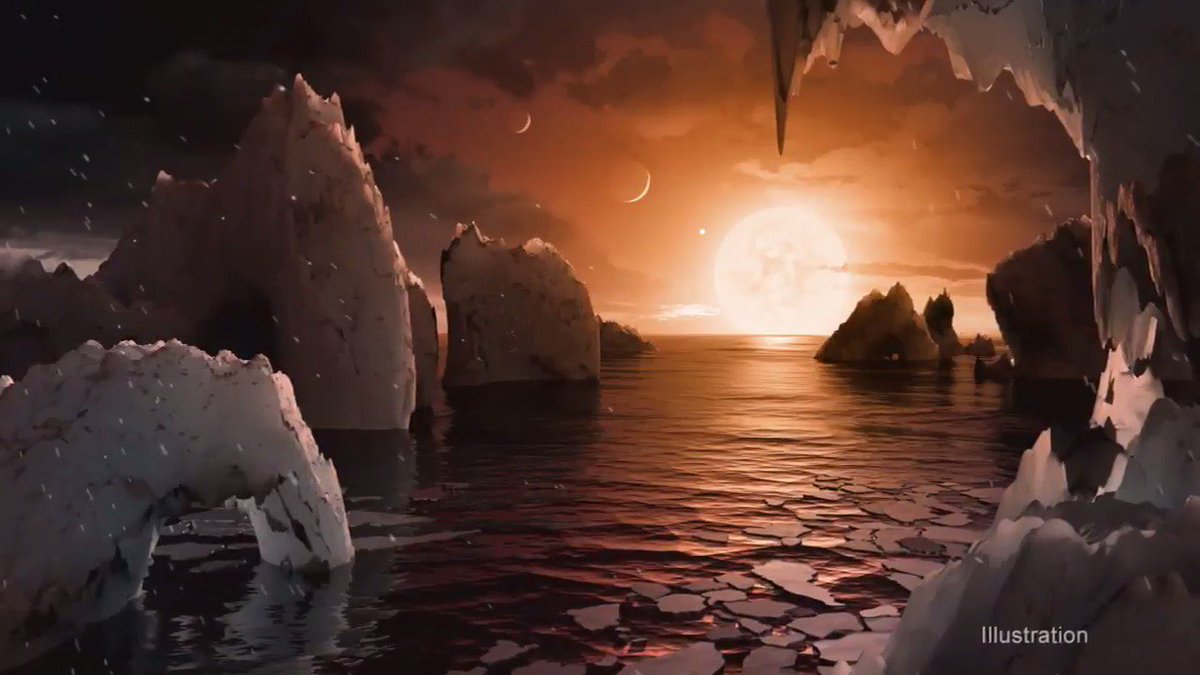
    The TRAPPIST-1 star has seven Earth-size planets orbiting it. This artist's concept appeared on the cover of Nature on Feb. 23, 2017. (Credit: NASA/JPL-Caltech)

    The TRAPPIST-1 star has seven Earth-size planets orbiting it. This artist’s concept appeared on the cover of Nature on Feb. 23, 2017. (Credit: NASA/JPL-Caltech)

    Q: Is there water on the surface of these planets?

    Roberge: Most of them are the right distance from a star that maybe they could have liquid water on their surfaces. But that’s a huge maybe. Just look at our solar system: we have three rocky planets – about the size of the TRAPPIST-1 planets. We’ve got Earth, Venus and Mars in or near what astronomers call the “habitable zone” – and they couldn’t be more different!

    Q: What’s the big deal about ‘rocky’ planets?

    Roberge: As far as we know, that’s the only kind of planet that we could have habitable conditions of life on – life that we could actually understand or recognize from interstellar distances. The Earth is unique in the solar system in one really important way: it’s the only planet that has surface life so abundant that it’s affecting the atmosphere. That is noticeable from interstellar distances. So it’s not really that we think Earth-like life is the only life that can be out there. It’s just the only life we can detect.

    Q: What can non-scientists get excited about here?

    I think this would really bring it home to people that we have neighbors. I think a lot of people are used to thinking “oh, exoplanets, those are all really distant.” As far as the laws of physics go, you could get to TRAPPIST-1 in a human lifetime (~40 years) [But, again, as stated earlier, with toaday’s technology it would probably take about 11,250 years to get to TRAPPIST-1. Hense, the ‘so what’? sentiment. Surely, we can learn to live on this wonderful planet–or not–by then]. So it becomes more of an engineering problem than a laws of physics problem.

    Editor’s Note: Questions and answers have been edited for length and clarity.

    For more of the best science & technology coverage, follow me on Twitter @hilarx.