‘Kayactivists’ protest as Arctic drill rig moors off Seattle

http://www.komonews.com/news/local/Kayakers-protest-as-Arctic-drill-rig-moors-off-Seattle-303891431.html

'Kayactivists' protest as Arctic drill rig moors off Seattle»Play Video
A small flotilla of kayakers and other protest boats follow as the oil drilling rig Polar Pioneer is towed toward a dock Thursday, May 14, 2015, in Elliott Bay in Seattle.(AP Photo/Elaine Thompson)
SEATTLE (AP) – As a massive oil drill rig moved into Seattle, about two dozen activists in kayaks paddled to the middle of Elliott Bay, linked boats and unfurled a banner to make a stand against Royal Dutch Shell’s plan to open a new frontier of fossil fuel exploration in the Arctic Ocean.

The 400-foot-long rig rising nearly 300 feet above the water dwarfed the flotilla of tiny boats on Thursday, as it passed the city’s Space Needle and downtown skyline and docked at Terminal 5.

The watery protest marked a pivotal moment for an environmental movement increasingly mobilized around climate change, but the scene also suggested how outmatched Shell’s opponents have been as they try to keep the petroleum giant from continuing its $6 billion effort to open new oil and gas reserves in one of the world’s most dangerous maritime environments.

“The environmental issues are big and this is an opportunity to present a David versus Goliath position – the people and the planet versus Shell – and create a national debate about drilling in the Arctic,” said Paul Adler, 52, of Shoreline, who paddled a single white kayak to “unwelcome” the Polar Pioneer.

Environmental groups in the Pacific Northwest are sensing a shift in the politics that surround energy production and have mobilized against a series of projects that would transform the region into a gateway for crude oil and coal exports to Asia.

“These proposals have woken a sleeping giant in the Northwest,” said Eric de Place, policy director for Sightline Institute, a liberal Seattle think tank. “It has unleashed this very robust opposition movement.”

Added Seattle City Councilmember Mike O’Brien, who joined the so-called kayaktivists on the water Thursday: “Shell’s attempt to use Seattle as a home base for Arctic drilling may be the last battle on the front of Arctic drilling, and the energy I have seen and felt from people in the region is really powerful and it gives me hope that we can stop Arctic drilling.”

hell still needs other permits from state and federal agencies, including one to actually drill offshore in the Arctic and another to dispose of wastewater. But it’s moving ahead meanwhile, using the Port of Seattle to load drilling rigs and a fleet of support vessels with supplies and personnel before spending the brief Arctic summer in the Chukchi Sea, which stretches north from the Bering Strait between Alaska and Russia.

Hurricane-force winds and 50-foot seas can quickly threaten even the sturdiest ships in the seas off Alaska. But Shell cleared a major bureaucratic hurdle Monday when the federal Bureau of Ocean Energy Management, after taking public comments and reviewing voluminous reports, approved the multiyear exploration plan.

If exploratory drilling goes well, Shell plans to invest billions more in infrastructure to open this new frontier, building pipelines under the ocean and onto the tundra of Alaska’s North Slope, along with roads, air strips and other facilities.

Shell’s last effort to do exploratory drilling in the Arctic Ocean also left from Seattle and ended badly. The Noble Discoverer and the Kulluk – a rig Shell had spent hundreds of millions of dollars to customize – were stranded by equipment failures in terrible weather, and the Coast Guard barely rescued the Kulluk’s crew. Federal investigations resulted in guilty pleas and fines for rig owner Noble Drilling.

The Kulluk ended up on a scrap heap in China. Shell is leasing the Polar Pioneer in its stead, again backed by the Noble Discoverer. But Shell says it has gained vital experience and can safely drill on its leases in the Chukchi Sea, as well as the Beaufort Sea, an even more remote stretch north of the Alaska National Wildlife Refuge.

Shell spokesman Curtis Smith called Monday’s approval an important milestone that “signals the confidence regulators have in our plan.”

Officials in Alaska have welcomed the drilling, even flying to Seattle this week to lobby for Shell’s plan. Labor groups representing port workers noted that Foss Maritime is employing more than 400 people already to service the Shell fleet.

Seattle Mayor Ed Murray, for his part, is strongly against hosting Shell’s fleet, warning that the port could face daily fines because it lacks the proper permit.

Those fines would amount to no more than $500 a day for the port – a tiny drop in a very large barrel if Shell, one of the world’s largest companies, manages to recover billions of gallons of oil from the Arctic Ocean.

Seattle’s environmentalists, however, have a sense that their time is now.

“Unless people get out there and put themselves on the front lines and say enough is enough, then nothing will ever change,” said Jordan Van Voast, 55. “I’m hopeful that people are waking up.”

When the Kulluk was being prepared in 2012 for Shell’s last Arctic venture, “it wasn’t this big civic moment,” recalled KC Golden, a senior policy adviser for Climate Solutions, an organization advocating for renewable energy.

But “now it is,” Golden said. “That’s a measure of how the awareness has grown. I think it’s a moment for Seattle.”

Jane Goodall: “We’re Destroying the Planet”

Jane Goodall: “We’re Destroying the Planet”

April 21, 2015 by

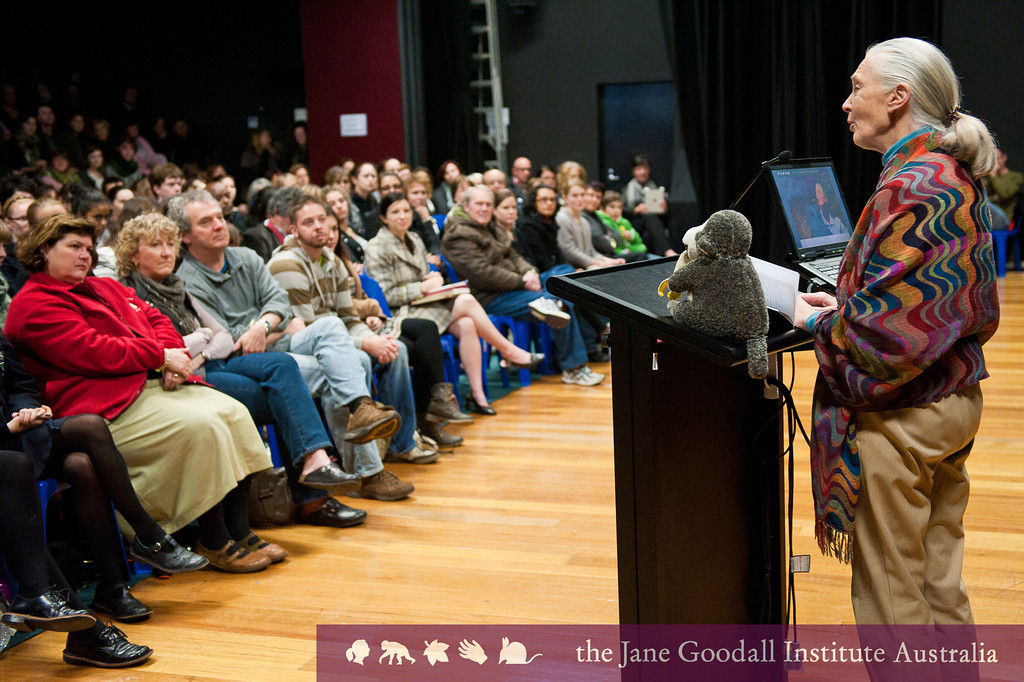
On the topic of our planet’s future, Jane Goodall, the legendary chimpanzee researcher, does not mince words: “How is it possible that the most intellectual creature that has ever walked on planet earth is destroying its only home?” Dr. Goodall, who is 81, spends 300 days year traveling the world in an effort to save it. The biggest problem, she says, is climate change. And the biggest culprit? Animal agriculture.

Jane-Goodall

In a lecture to hundreds of fans in NYC on April 15th, Dr. Goodall explained that agribusinesses are clearing rainforests in the Amazon to graze cattle and grow crops to feed them. Without rainforests – the “lungs of the earth” – the planet’s ability to convert carbon dioxide (CO2), a greenhouse gas, into oxygen is compromised.

Clearing Amazon rainforest for cattle grazing (photo: Universal Images Group/Getty Images)

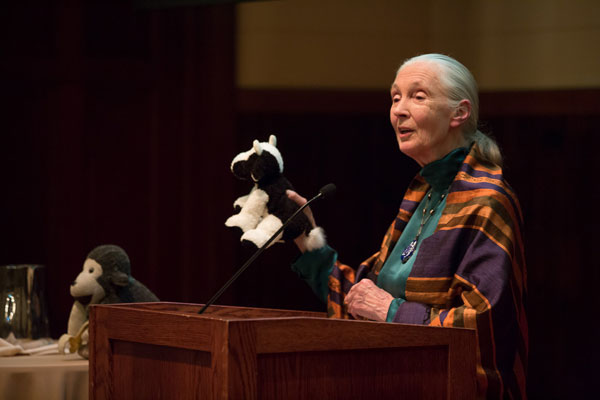
Even more harmful than CO2, Goodall said, is the methane gas emitted in cow farts. As developing countries adopt Western diets heavy in animal protein, more methane and CO2 are released into the atmosphere, further warming the planet and jeopardizing our ability to inhabit it.

Jane Goodall uses a stuffed cow to point out that methane gas is emitted in cow farts.

During her talk, Dr. Goodall described some of the other destructive effects of animal agriculture, including land and water pollution, antibiotic resistance, depletion of fresh water resources and animal cruelty, which is was motivated her to go veg. In a recent interview with the Toronto Globe & Mail, she said, “I became a vegetarian because of the horrendous suffering on factory farms and in abattoirs.”

Jane Goodall paints a grim picture of the state of the planet, but she is hopeful that humans will work together to save ourselves from ourselves. And she offers some advice that each of us can put into action today:

  • Go vegetarian.
  • Consume less. The more we buy, she argues, the more natural resources we extract from the planet. How much stuff do we really need?
  • Improve the environment in our own communities. Goodall’s Roots & Shoots program, which has chapters in 130 countries, is helping people plant trees, clean rivers and perform other community services in their own backyards.

Roots & Shoots has chapters in 130 countries

At the end of her presentation, Dr. Goodall showed a video of a newly-released captive chimpanzee hugging her when she emerged from her crate and realized she was home in the jungle. Goodall uses this remarkable event to point out that, as intelligent as chimps are, their brains are far less powerful than those of humans. And she left the audience with a challenge — to harness the brainpower that we’ve used to damage the planet to save it.

Shell lost control of an Arctic offshore drilling rig


Ted Danson with Oceana via Change.org

Oil giant Shell’s efforts to drill in the Arctic Ocean have been plagued by mistakes and near disasters. The company even lost control of an offshore drilling rig – allowing it to run aground in Alaska. You saw the destruction that the BP Deepwater Horizon oil spill caused to the Gulf in 2010. Imagine that same devastation brought to the Arctic – one of the most unique and important places left on earth. 

Now, after years of failing to find safe ways to drill in the Arctic, Shell is asking the federal government to extend its leases by five years.

I’m calling on the Bureau of Safety and Environmental Enforcement (BSEE) to deny Shell’s request for five more years to explore for offshore oil drilling in the Arctic. Please click here to join me.

I remember walking down the beach in Santa Monica over twenty years ago with my young daughters. At the time I was starring on the show “Cheers,” and during our walk we came to a sign that read: “Water polluted, no swimming.” I didn’t know how to explain to them that we allowed pollution into our oceans and beaches – and I don’t want any parent to have to explain to their children how Shell destroyed the Arctic.

Shell is the only company still actively pushing to drill in the U.S. Arctic Ocean, as other companies have walked away from the unpredictable Arctic environment or put plans on hold. Chevron recently pulled its plans to drill in the Canadian Beaufort Sea after finding the process too risky and expensive. If BSEE denies Shell’s request, the company will suffer a major blow to its dangerous efforts.

The oil industry does not have proven means to contain or clean a spill in the Arctic Ocean. A single accident could lead to serious environmental degradation, threatening iconic marine wildlife and impacting the region’s coastal communities. If Shell is given five more years, the Arctic’s polar bears, ice seals, belugas and many other inhabitants will be pushed further into harm’s way.

We have an incredible opportunity to protect the Arctic from offshore drilling. In the mid-1980s, I helped lead a successful campaign to stop Occidental Petroleum from drilling 60 oil wells in the waters beside Santa Monica. Now, along with Oceana, I desperately need your support to protect the Arctic.

Please sign our petition calling on BSEE to deny Shell’s request for five more years to drill for oil in the U.S. Arctic Ocean.

Thank you,

Ted Danson with Oceana

Pacific Plastic Threatening Wildlife

http://action.storyofstuff.org/sign/pacific-plastic-epa-superfund

The massive amounts of plastic in the ocean are threatening to kill off Hawaii’s endangered seals and sea turtles on remote Pacific islands.The Great Pacific Plastic Patch is becoming an enormous threat to sea life, and the EPA is considering declaring the remote island of Tern Island an environment disaster area.
This crisis gives us an incredible opportunity — if the EPA designates the island a Superfund site, it could mean taking the first real steps to schedule clean-up of oceanic plastic. Not only would this protect the thousands of species — a fourth of which are found in no other place on Earth — it would also put significant resources into tackling one of the greatest threats to our oceans and could become a model for tackling plastic polluting our oceans worldwide.
A high concentration of plastics from global sources has accumulated in the Northwestern Hawaiian Islands, threatening many endangered species. Designated Papahanaumokuakea National Monument in 2006, this 1,200-mile chain of scattered islands and atolls is home to more than 7,000 incredible marine species, and is one of the first ecosystems being serious threatened by the Pacific Plastic Patch.
 
Tern Island and its surrounding atoll, French Frigate Shoals, are designated as critical habitat for Hawaiian monk seals, whose total population of 1,200 has been steadily declining in the northwestern islands. It’s also nesting habitat for 95 percent of threatened Hawaiian green sea turtles. Unless the problem with plastic pollution is addressed, these fragile seal and sea turtle populations may be destroyed altogether.
Resources:
The Center for Biological Diversity: Historic Step Toward Superfund Designation Could Save Ocean Wildlife From Plastic Pollution in Hawaii, Septermber 9, 2014

Republicans- How they have sold out our environment and their Soul

by Stephen Capra

For the past few years I have spoken with many good Republican friends who feel as though they have lost the party they once so proudly belonged too. These Republicans I speak of care deeply about issues like wilderness, global climate change and wildlife, but they view it through the prism of being Republican means a far broader interpretation than that of the current Tea Party driven, oil and gas industry controlled party of today.

If you look at their plans should they take control of the Senate, their goal should be called the “Destroy Americans Wildlands and Water Act.” They only seem to see our wildlands as a place of exploitation. Their economic strategy includes getting the Keystone pipeline approved, more drilling and fracking, but removing that silly regulation that somehow tries to protect drinking water,  and of course open up more of our coasts to drilling. Let’s not forget selling off public lands in the West as their means of reducing the deficit. Its pure madness and it’s not that far removed from reality.

To watch the Republican party of 2014, is to witness a party bought and paid for by oil and gas, Koch Brothers, the religious right and the extremism of the Tea Party, which is large corporations, exploiting rural America and people who feel their lives are not working according to their white status, especially because of an African-American President of thought and reason.

Chevron is pumping millions into Senator McConnell of Kentucky’s tight Senate race with the goal of becoming the majority leader in the Senate. Now, let’s be clear, Democrats suffer from some of the same influences brought by lobbyists and the many special interests they represent, however, my focus is conservation and on this issue there is an amazing gulf.

It’s important to look at the interconnectedness of life. How would a party that fights woman’s rights that seemingly want to go to war daily, expand military budgets and subsidies to ranchers along with oil and gas interests. While rabidly fighting health care, how can we expect them to care about conservation? They are not just detached from reality; they have traded their connection to the earth for the madness of perceived wealth.

Republicans since the Reagan years rarely seem to see a wilderness bill they support. They have become obstructionists to most environmental legislation and only tend to agree if some major pork for their district is attached. They seem to have very little sense of the importance or spiritual renewal that comes with protected land.

The influence of oil and gas interests has lead governors in the southeast to demand the opening of their coasts to drilling. In North Dakota, they are just now discovering the spills, crime, loss of a night sky, and the dangers that come with putting faith in big oil. The “drill baby drill” propaganda that Fox news and many Republicans now proudly speak of has become a point of pride for many Americans.

From this also comes the carefully choreographed messaging about denying Climate Change and the long list of Republicans from oil states that speak out and pushback from sound science in such a pious manner while the planet screams for reason. It is a sickness that permeates this party and we are paying the price in funding to parks, the obsession of spending cuts from a group that gave us the Iraq war and the destruction of our economy.
The same party has leaders like representative Stephen King of Iowa who supports dog fighting and made sure to add an amendment to the Farm bill that removed protections and inspections of farm animals. Perhaps it’s our own Stevan Pearce of New Mexico, (he even spells his name weird) who proudly spoke of selling off public lands to remove our nation’s debt and who has done all he can behind the scene to block Mexican wolf recovery efforts.

It is a tragedy for this country and the world to see the decline of a once great party that has devolved into a tightly controlled group so devoid of feelings, so full of greed and drunk with power, that they would create a world where most of us are numbers and our lands and waters destroyed for the mansion on the hill.

We have become, not a nation of people, but an island of individuals. That sadly works against the shared responsibility of our public lands and waters.

Elections are less than 10 days away. Voting, like land protection, is more difficult than ever for those in states determined to reinstate the poll tax. Meanwhile our parks will absorb another year of cuts, federal agencies that mange lands will also see cuts, but God forbid, a Republican accepts a cut in military spending!

This party must come back to its roots, its origins. The years of Teddy Roosevelt and the magic he inspired. If they will not- then they must be defeated, for all the reasons I mentioned above, but most of all, if we are to protect lands, end our addiction to oil, and live in harmony with wildlife, stopping them is not about politics, but rather survival.
It comes back to morality, the morality reflected in the magic that is our planet. Something the Republican party of 2014 has turned a blind eye to.

Ecocide Is Suicide: Compassion and Personal Rewilding

1451324_650954518277931_1616731734_n

http://www.psychologytoday.com/blog/animal-emotions/201405/ecocide-is-suicide-compassion-and-personal-rewilding

We’re killing a very tired and less resilient planet at alarming rates.

It’s common knowledge that we’re losing species and habitats at an unprecedented rate in a geological epoch known as the “anthropocene” – the age of humanity. While the term has not been formally recognized as official nomenclature, we know we’re deep into a time when humans are devastating numerous species and their homes and we are behaving in the most inhumane and selfish ways. Simply put, we humans are the cause of such massive and egregious ecocide because as big-brained, big-footed, overproducing, overconsuming, arrogant, and selfish mammals we freely move all over the place recklessly, wantonly, and mindlessly trumping the interests of countless nonhuman animals (animals). Every second of every day we decide who lives and who dies; we are that powerful. Of course, we also do many wonderful things for our magnificent planet and its fascinating inhabitants, but right now, rather than pat ourselves on the back for all the good things we do, we need to take action to right the many wrongs before it’s too late for other animals and ourselves.

I see at least two ways out of the environmental and moral muck in which we’re mired that is responsible for widespread and increasing ecocide. The first centers on paying careful attention to the rapidly growing international and interdisciplinary field called “compassionate conservation” and the second is our choosing to go through a personally transformative process that I call “rewilding our hearts”. Rewilding our hearts calls for a global paradigm shift, a social revolution, in how we interact with other animals and with other humans. 

Compassionate conservation

The goals of compassionate conservation are clearly stated in the mission statement for a recently established Centre for Compassionate Conservation (see also) at the University of Technology, Sydney (Australia) and in a book I edited called Ignoring nature no more: The case for compassionate conservation.

The mission statement for the Centre for Compassionate Conservation promotes the protection of captive and wild animals as individuals within conservation practice and policy. Finding ways to compassionately and practically share space (coexistence), via trade-offs among different values, is vital if we are to reduce harm to animals.

A simple and morally acceptable approach is to utilize the universal ethic of compassion (and empathy) to alleviate suffering in humans and other animals to resolve issues of land sharing. A compassionate and practical ethic for conservation that focuses on individual well being, in combination with other values, provides a novel framework of transparency and robust decision-making for conservation that will benefit all stakeholders.

Compassionate conservation stipulates that we need a conservation ethic that prioritizes the protection of other animals as individuals: not just as members of populations of species, but valued in their own right. This is important because of what we now know about their cognitive and emotional lives (consciousness and sentience).

Because compassionate conservation requires that we must protect animals as individuals, they are not merely objects or metrics who can be traded off for the good of populations, species or biodiversity.

A paradigm shift in our approach to other animals is vital because of what we now know about the cognitive and emotional capacities of other animals and their ability to suffer (sentience).

With a guiding principle of “first do no harm“, compassionate conservation offers a bold, virtuous, inclusive, and forward-looking framework that provides a meeting place for different perspectives and agendas to discuss and solve issues of human-animal conflict when sharing space. Peaceful coexistence with other animals and their homes is needed in an increasingly human-dominated world if we are to preserve and conserve nature the best we can.

Surely, adhering to the principles of compassionate conservation will go a long way toward reducing the ecocide in which we are now engaged and for which we all are responsible.

Rewilding our hearts

My forthcoming book called Rewilding our hearts: Building pathways of compassion and coexistence lays out the details for a much-needed social movement and paradigm shift that also can help extricate us from our ecocidal ways and help to maintain our hopes and dreams for a more peaceful world for all beings in very trying times. Some of the basic ideas are reviewed here. We live in a world in which “unwilding” is the norm rather than the exception. If we didn’t unwild we wouldn’t have to rewild.

The word “rewilding” became an essential part of talk among conservationists in the late 1990s when two well-known conservation biologists, Michael Soulé and Reed Noss, wrote a now classic paper called “Rewilding and biodiversity: Complimentary goals for continental conservation” that appeared in the magazine WIld Earth (Fall 1998, 18-28. 15).

In her book Rewilding the World conservationist Caroline Fraser noted that rewilding basically could be boiled down to three words: Cores, Corridors, and Carnivores. Dave Foreman, director of the Rewilding Institute in Albuquerque, New Mexico, a true visionary, sees rewilding as a conservation strategy based on three premises: “(1) healthy ecosystems need large carnivores, (2) large carnivores need bug, wild roadless areas, and (3) most roadless areas are small and thus need to be linked.” Conservation biologists and others who write about rewilding or work on rewilding projects see it as a large-scale process involving projects of different sizes that go beyond carnivores, such as the ambitious, courageous, and forward-looking Yellowstone to Yukon Conservation Initiative, well known as the Y2Y project. Of course, rewilding goes beyond carnivores, as it must.

The core words associated with large-scale rewilding projects are connection and connectivity, the establishment of links among geographical areas so that animals can roam as freely as possible with few if any disruptions to their movements. For this to happen ecosystems must be connected so that their integrity and wholeness are maintained or reestablished.

Regardless of scale, ranging from huge areas encompassing a wide variety of habitats that need to be reconnected or that need to be protected to personal interactions with animals and habitats, the need to rewild and reconnect centers on the fact that there has been extensive isolation and fragmentation “out there” in nature, between ourselves and (M)other nature, and within ourselves. Many, perhaps most, human animals, are isolated and fragmented internally concerning their relationships with nonhuman animals, so much that we’re alienated from them. We don’t connect with other animals, including other humans, because we can’t or don’t empathize with them. The same goes for our lack of connection with various landscapes. We don’t understand they’re alive, vibrant, dynamic, magical, and magnificent. Alienation often results in different forms of domination and destruction, but domination is not what it means “to be human.” Power does not mean license to do whatever we want to do because we can.

Rewilding projects often involve building wildlife bridges and underpasses so that animals can freely move about. These corridors, as they’re called, can also be more personalized. I see rewilding our heart as a dynamic process that will not only foster the development of corridors of coexistence and compassion for wild animals but also facilitate the formation of corridors within our bodies that connect our heart and head. In turn, these connections, or reconnections, will result in positive feelings that will facilitate heartfelt actions to make the lives of animals better. These are the sorts of processes that will help the new field of compassionate conservation further develop. When I think about what can be done to help others a warm feeling engulfs me and I’m sure it’s part of that feeling of being rewilded. To want to help others in need is natural so that glow is to be expected.

Rewilding is an attitude. It’s also a guide for action. As a social movement, it needs to be proactive, positive, persistent, patient, peaceful, practical, powerful, and passionate — which I call the eight Ps of rewilding.

Compassion begets compassion and there’s actually a synergistic relationship, not a trade-off, when we show compassion for animals and their homes. There are indeed many reasons for hope. There’s also compelling evidence that we’re born to be good and that we’re natural-born optimists. Therein lie many reasons for hope that in the future we will harness our basic goodness and optimism and all work together as a united community. We can look to the animals for inspiration. So, we need to tap into our empathic, compassionate and moral inclinations to make the world a better place for all beings. We need to build a culture of empathy. We need to add a healthy dose of social justice to our world right now.

We can all make more humane and compassionate choices to expand our compassion footprint, and we can all do better. We must all try as hard as we can to keep thinking positively and proactively. Never say never, ever. We can and must keep our hopes and dreams alive (see also).

When all is said and done, and more is usually said than done, we need a heartfelt revolution in how we think, what we do with what we know, and how we act. Rewilding can be a very good guide. The revolution has to come from deep within us and begin at home, in our heart and wherever we live. I want to make the process of rewilding a more personal journey and exploration that centers on bringing other animals and their homes, ecosystems of many different types, back into our heart. For some they’re already there or nearly so, whereas for others it will take some work to have this happen. Nonetheless, it’s inarguable that if we’re going to make the world a better place now and for future generations, personal rewilding is central to the process and will entail a major paradigm shift in how we view and live in the world, and how we behave. It’s not that hard to expand our compassion footprint and if each of us does something the movement will grow rapidly.

The time is right, the time is now, for an inspirational, revolutionary, and personal social movement that can save us from doom and keep us positive while we pursue our hopes and dreams. Our planet is tired and dying and not as resilient as some claim it to be.

Rewild now. Take the leap. Leap and the net will appear. It’ll feel good to rewild because compassion and empathy are very contagious. 

Let’s make personal rewilding all the rage

Ecocide is suicide. Let’s make personal rewilding all the rage. When “they” (other animals) lose, we all lose. We suffer the indignities to which we subject other animals. We can feel their pains and suffering if we allow ourselves to do so.

Compassion begets compassion and violence begets violence.

There really is hope if we change our ways. We owe it to ourselves and to future generations who will inherit the world we leave them long after we’re gone.

Note: An excellent new book on this topic is Keeping the Wild: Against the Domestication of Earth edited by George Wuerthner, Eileen Crist, and Tom Butler.

Marc Bekoff’s latest books are Jasper’s story: Saving moon bears (with Jill Robinson; see also), Ignoring nature no more: The case for compassionate conservation (see also)and Why dogs hump and bees get depressed (see also). Rewilding our hearts: Building pathways of compassion and coexistence will be published fall 2014. (marcbekoff.com@MarcBekoff