


(I don’t know, he looks a lot like Patrick Stewart to me…)

RICHMOND, Wash. (AP) — The ancient bones of the Kennewick Man have been returned to the ground.
The Tri-City Herald reports that early Saturday, more than 200 members of five Columbia Plateau tribes and bands gathered at an undisclosed location to lay the remains of the man they call the Ancient One to rest. That’s according to an announcement Sunday by the Confederated Tribes of the Umatilla Indian Reservation.
Umatilla board member Aaron Ashley says they always knew the Ancient One was Indian. But tribes waited more than 20 years to rebury the bones.
Tribal representatives met at the University of Washington’s Burke Museum in Seattle on Friday to claim the remains.
Former President Obama signed legislation in December requiring the 8,400-year-old skeleton to be given to the tribes within 90 days.
One of the first priorities of demagoguery is the fostering of ignorance. Lies require collaboration from those who are being lied to, and for a propaganda machine to be effective it needs a special kind of public ignorance.
This can happen in societies that otherwise seem to be sophisticated and highly advanced scientifically. Invariably the case of Germany in the early 1930s is cited as proof. That, however, carries the danger of false analogies and misses what is immediate and novel. Propaganda and the nurturing of ignorance have moved on apace since the Nazis and Joseph Goebbels.
The Trump White House is demonstrating in its own innovative ways just how far habitual lying can clear the way for the triumph of ideology over truth. This can’t be simplified by charging Trump himself with being a pathological liar. His administration has invented a new and distinctly American propaganda machine that is built on lies. But not enough attention has been given to its willing partner in this exercise: a carefully nurtured kind of public ignorance that it can exploit.
One reason this isn’t being discussed is that politicians are rightly wary of insulting any constituency by calling it ignorant. Hillary Clinton’s “basket of deplorables” was a disastrously patronizing misjudgment. But in the context of the Age of Trump, ignorance is not actually a pejorative term, it’s a description of a set of beliefs in which knowledge and truth are less persuasive than prejudice and fear.
This process began long before Trump decided to run. Years of talk radio diatribes fueled by Obama-phobia and Fox News harangues prepared the soil and then Breitbart, the alt-right, and fake news softened it further. Trump understood this better than anyone and harvested its fruits.
In fact, the bedrock beneath this process was much older and a uniquely American phenomenon, a widespread consensual ignorance. There is a strain of dogmatic religious activism here that does not exist to anything like the same extent in other advanced democracies. It uses religion—or misuses religion—to resist or rollback changes in social behavior and to suggest who the alien “other” should be.
This consensual ignorance involves accepting a set of ordained beliefs while at the same time rejecting others that are not ordained, no matter whether they are based on facts. What begins as a theological system easily slips into a secular one: the habit of denying what is an inconvenient truth or of simplifying a complex exterior world into stereotypical threats.
This is not the ignorance of unlearned knowledge—it’s more potent than that. It’s a tutored ignorance, and in its most basic form it’s anti-scientific.
And that is why the present and future influence of Vice President Mike Pence needs to get close attention.
“The Bible tells us that God created man in His own image, male and female; He created them,” Pence has said. “And I believe that God created the known universe, the Earth, and everything in it including man, and I also believe that some day, scientists will come to see that only the theory of intelligent design provides an even remotely rational explanation for the known universe.”
Pence also argued that evolution should not be taught in schools without a parallel commentary of Biblical explanations as being equally valid.
With Pence in the White House it could be that control of the most scientifically advanced country in the world has now fallen into the hands of people to whom science is an enemy. The EPA’s website has already been purged of any references to Obama’s climate action plan and carbon pollution as a cause of climate change. Universities across the nation have teams working to safeguard masses of government data that contradicts White House dogma before it, too, is wiped.
That’s why this is a good moment to consult the man who, more than any other, had to struggle with how to argue that the advance of science was not a threat to the Christian faith, Charles Darwin.
The idea that when Darwin published On The Origin of Species in 1859 he provoked outrage from Biblical literalists is nonsense. Victorian Britain was a scientific powerhouse, science teaching was a key part of the drive toward universal public education and one branch of science in particular, paleontology, was assembling through the evidence of fossils a picture of the Earth’s evolution that already made the idea that our planet was only 6,000 years old risible. In the introduction to his book Darwin reviewed the work of 34 scientists who had paved the way for his breakthrough theory of natural selection.
Nonetheless the popular press took the opportunity to stir up a circulation-building debate between two sides cast as the sacred and profane. Cartoons appeared in which Darwin was half-man and half-ape, even though his revelatory theory, the tree of life, was more about the evolution of butterflies than about homo sapiens.
Darwin was very careful to accept why Victorians might have problems grasping the scale of what he had revealed.
“The belief that species were immutable productions was almost unavoidable as long as the history of the world was thought to be of short duration… the chief cause of our natural willingness to admit that one species has given birth to clear and distinct species is that we are always slow in admitting great changes of which we do not see the steps.”
After the first edition of On The Origin of Species had been subjected to review by his peers and publicly debated, Darwin incorporated some of the responses in later editions. One clergyman, Charles Kingsley, spoke for many who had no problem reconciling Darwin’s science with the work of the Creator. Darwin wrote of Kingsley: “he has gradually learnt to see that it is just as noble a conception of the Diety to believe that He created a few original forms capable of self-development into other and needful forms, as to believe He required a fresh act of creation to supply the voids caused by the action of His laws.”
Darwin himself was an agnostic. Whether he actually believed that the hidden architecture of life that he had described for the first time had divine origin doesn’t really matter. He was not a dogmatic scientist. He was open-minded and prepared to concede to those like Kingsley if they were not dogmatists and were comfortable that their own beliefs were not under threat—and recognized that science was an engine of social progress.
Darwin recalled that Sir Isaac Newton had been attacked for “the greatest discovery ever made by man, namely, the law of the attraction of gravity” by people who saw it as subversive of religion. Darwin himself was the beneficiary of a long-established British tolerance for unsettling scientific ideas. Science had not yet locked itself into the confines of a profession with its own hierarchy. From Newton onwards there were as many gentlemen amateurs probing for scientific truths as there were vocational scientists at work in England—and some of them were clergymen.
All of which makes it strange that anyone today would think it reasonable to persist, as Pence does, with the idea of “intelligent design.” Indeed, Darwin saw that idea coming and dealt with it dismissively: “It is so easy to hide our ignorance under such expressions as the ‘plan of creation’ ‘unity of design’ etc and to think that we give an explanation when we only re-state a fact.”
All along, Pence has been very careful not to make a specific denial of evolution. His classic evasion came in a 2009 interview with Chris Matthews on MSNBC:
Matthews: “Do you believe in evolution, sir?”
Pence: “I embrace the view that God created the heavens and the earth and the seas and all that’s in them.”
Matthews: “But do you believe in evolution as the way he did it?”
Pence: “The means, Chris, that He used to do that, I can’t say.”
That’s what intellectual cowardice sounds like as a politician dances within the boundaries of his base, and it becomes much more consequential now that that man is at the heart of White House policy making—Pence is the essential conduit between Trump and the agenda of Congressional Republicans. He is also the quiet agent of the religious right, supported by fellow believer Attorney General Jeff Sessions.
This movement may sail under religious colors but its agenda reflects the way that religion has become a euphemism for atavism. Buried within the code of “Make America Great Again” there was always the promise of restoring a repressive social order.
When so-called fundamentalists and evangelists embrace a crotch-grabbing sexual predator they display a shameless level of cant but it doesn’t seem to bother them. Is this really theology or a return to a kind of muscular Christianity based on a 1930s model of a white man’s world? Whatever the truth, the primary targets are clear: Planned Parenthood, abortion clinics, voting rights, gun regulations, any extension of LGBT rights, and even roll back gay marriage.
There is no Darwin-like tolerance of opposing beliefs here. No open debate with enlightened values. The Christian right movement in this country has reached the level of an intrusive crusade, sensing that its moment has come, and is bent on policing the personal choices and lives of others, particularly women.
Trump’s White House may be in chaos but that chaos hides the long game that Pence has the patience and guile to pursue. The continuing barrage of propaganda and outrageous lies still finds a ready audience among his constituency, where the mainstream media has no credibility. Consensual ignorance provides its own extensive comfort zone where yesterday has a lot more to recommend it than tomorrow.
Whether or not Pence really believes the earth is only 6,000 years old is immaterial. His version of intelligent design is really not about Old Testament divine creation but a new social order—or, rather, an old social order that was supposed to be long extinct.

Researchers have identified traces of what they believe is the earliest known prehistoric ancestor of humans—a microscopic, bag-like sea creature, which lived about 540 million years ago.
Named Saccorhytus, after the sack-like features created by its elliptical body and large mouth, the species is new to science and was identified from microfossils found in China. It is thought to be the most primitive example of a so-called “deuterostome”—a broad biological category that encompasses a number of sub-groups, including the vertebrates.
If the conclusions of the study, published in the journal Nature, are correct, then Saccorhytus was the common ancestor of a huge range of species, and the earliest step yet discovered on the evolutionary path that eventually led to humans, hundreds of millions of years later.
Modern humans are, however, unlikely to perceive much by way of a family resemblance. Saccorhytus was about a millimetre in size, and probably lived between grains of sand on the seabed. Its features were spectacularly preserved in the fossil record—and intriguingly, the researchers were unable to find any evidence that the animal had an anus.
The study was carried out by an international team of academics, including researchers from the University of Cambridge in the UK and Northwest University in Xi’an China, with support from other colleagues at institutions in China and Germany.
Simon Conway Morris, Professor of Evolutionary Palaeobiology and a Fellow of St John’s College, University of Cambridge, said: “We think that as an early deuterostome this may represent the primitive beginnings of a very diverse range of species, including ourselves. To the naked eye, the fossils we studied look like tiny black grains, but under the microscope the level of detail is jaw-dropping. All deuterostomes had a common ancestor, and we think that is what we are looking at here.”
Degan Shu, from Northwest University, added: “Our team has notched up some important discoveries in the past, including the earliest fish and a remarkable variety of other early deuterostomes. Saccorhytus now gives us remarkable insights into the very first stages of the evolution of a group that led to the fish, and ultimately, to us.”
Most other early deuterostome groups are from about 510 to 520 million years ago, when they had already begun to diversify into not just the vertebrates, but the sea squirts, echinoderms (animals such as starfish and sea urchins) and hemichordates (a group including things like acorn worms). This level of diversity has made it extremely difficult to work out what an earlier, common ancestor might have looked like.
The Saccorhytus microfossils were found in Shaanxi Province, in central China, and pre-date all other known deuterostomes. By isolating the fossils from the surrounding rock, and then studying them both under an electron microscope and using a CT scan, the team were able to build up a picture of how Saccorhytus might have looked and lived. This revealed features and characteristics consistent with current assumptions about primitive deuterostomes.
Dr Jian Han, of Northwest University, said: “We had to process enormous volumes of limestone – about three tonnes – to get to the fossils, but a steady stream of new finds allowed us to tackle some key questions: was this a very early echinoderm, or something even more primitive? The latter now seems to be the correct answer.”
In the early Cambrian period, the region would have been a shallow sea. Saccorhytus was so small that it probably lived in between individual grains of sediment on the sea bed.
The study suggests that its body was bilaterally symmetrical—a characteristic inherited by many of its descendants, including humans—and was covered with a thin, relatively flexible skin. This in turn suggests that it had some sort of musculature, leading the researchers to conclude that it could have made contractile movements, and got around by wriggling.
Perhaps its most striking feature, however, was its rather primitive means of eating food and then dispensing with the resulting waste. Saccorhytus had a large mouth, relative to the rest of its body, and probably ate by engulfing food particles, or even other creatures.

A crucial observation are small conical structures on its body. These may have allowed the water that it swallowed to escape and so were perhaps the evolutionary precursor of the gills we now see in fish. But the researchers were unable to find any evidence that the creature had an anus. “If that was the case, then any waste material would simply have been taken out back through the mouth, which from our perspective sounds rather unappealing,” Conway Morris said.
The findings also provide evidence in support of a theory explaining the long-standing mismatch between fossil evidence of prehistoric life, and the record provided by biomolecular data, known as the “molecular clock”.
Technically, it is possible to estimate roughly when species diverged by looking at differences in their genetic information. In principle, the longer two groups have evolved separately, the greater the biomolecular difference between them should be, and there are reasons to think this process is more or less clock-like.
Unfortunately, before a point corresponding roughly to the time at which Saccorhytus was wriggling in the mud, there are scarcely any fossils available to match the molecular clock’s predictions. Some researchers have theorised that this is because before a certain point, many of the creatures they are searching for were simply too small to leave much of a fossil record. The microscopic scale of Saccorhytus, combined with the fact that it is probably the most primitive deuterostome yet discovered, appears to back this up.
From Richard Leakey and Roger Lewin:
“…There was no steady progression from simple to complex forms throughout Earth history. Simple forms of life arose early on, it’s true. But…that early simplicity continued in mind-numbing sameness for billions of years, with nothing more complex than singe-celled organisms for six sevenths of Earth history. When complexity eventually arose 530 million years ago, in the form of multicellular organisms, it did so explosively; within 5 million years (an instant in geologic time), evolutionary innovation produced a myriad of multicellular forms of life. Life’s flow is therefore not smooth, but extremely erratic.”

The following is an excerpt from Richard Leaky’s book The Sixth Extinction: Patterns of Life and the Future of Humankind, chapter six, “Homo sapiens, the Pinnacle of Evolution?”
“The answer to the above question appears self-evident. Yes of course we are. In the penultimate chapter of The Origin of Species, Darwin wrote, ‘As natural selection works solely by and for the good of each being, all corporeal and mental endowments will tend to progress towards perfection.’ Homo sapiens, since its origin some 150,000 years ago, has come to occupy every continent, with the exception of the hostile wastes of Antarctica, and even there we have a toehold. This surely attests to our corporeal endowment, as we have adapted to these many environments. And there is no question about our mental endowment, which is unmatched in all of nature. We are intellectually analytical, we are artistically creative, and we have invented ethical rules by which society operates. No one can doubt that our species has advanced toward, if not perfection, than a high point–the highest point–among the diversity of life on Earth. We are the pinnacle of evolution. Or are we?
“Anthropologists and biologists have struggled with this issue for a very long time, and the resolution has never been simple. We feel ourselves unique in the world of nature, and of course we are: each species is unique, by definition, so that doesn’t help much. We are but one species among many millions in today’s world. However, we feel ourselves special, among this exuberant diversity of life, because we have an unmatched capacity for spoken language and introspective consciousness, and we can shape our world as no other species can. We judge this to place us on the top of the heap. Before the fact of evolution was demonstrated, beginning with Darwin in the mid-nineteenth century, we considered Homo sapiens to have been placed on the top by Divine Creation. In the Darwinian world, our species was said to have achieved its ascendancy through the natural selection of our special qualities. The intellectual context changed, but the outcome was the same. We judged ourselves to be the pinnacle of the world of nature.
“This assessment brings two assumptions with it–one implicit, the other explicit. The implicit assumption is that the evolution of Homo sapiens was an inevitable outcome of the flow of life, in the unfolding of evolution. The explicit assumption is that the qualities we value in ourselves as a species are indeed superior in some way to the rest of the world of nature. Through evolutionary time, life became ever more complex, producing an arrow of progress. As Darwin stated in the above passage, by means of natural selection life ‘will tend to progress towards perfection.’ We are the tip of the arrow of progress, the expression of perfection. …
“Man’s view of Man in the world of nature has changed over the centuries, reflecting the scholarly context. Only in the relatively recent past have anthropologists begun to discuss human origins as they would the origin of oysters, cats and apes. …”
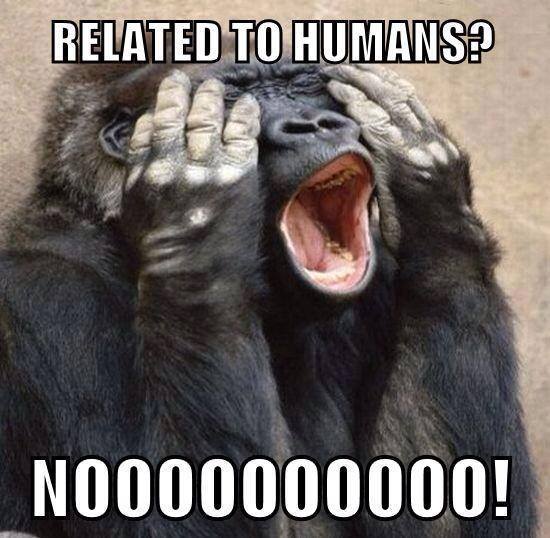

Revisionist history may seem like harmless, feel good child’s play, but the threat it poses (to all other animals at least) is that without hearing the real story, people will never learn from the past.
It’s tempting to want to believe that all that has gone wrong with the human race is the result of being led astray by our technology, and if we could just get back to our caveman roots, everything would be happy and harmonious like it surely was back then. But contrary to contemporary popular belief, that’s a world that never was.
Even the earliest human hunters drove countless species to extinction and exhausted their carrying capacities time and again, ever since plant-eating primates first climbed down from the trees and decided to take up big-game hunting.
The notion of the peaceful savage has long since been disproven, but people want to cling to it rather than accept the truth about human nature. Just look at the dead-animal adornments any warrior or tribal chief wore, and it’s easy to see the roots of trophy hunting.
The thought that any spear-wielding species who took advantage of fire to herd animals toward a cliff or into a box canyon had an innate sense of ecological fairness goes against all that made us human—envy, lust, greed, gluttony, a lack of empathy and an over-blown ego are the kinds of things that ultimately define a hunter, whether the motive for their behavior is sport or subsistence.
Richard Wrangham and Dale Peterson summed up the chapter, “Paradise Imagined,” of their book, Demonic Males: Apes and the Origins of Human Violence, thusly, “There is no such thing as paradise, not in the South Seas, not in southern Greece, not anywhere. There never has been. To find a better world we must look not to a romanticized and dishonest dream forever receding into the primitive past, but to a future that rests on a proper understanding of ourselves.”
Humans have achieved an awful lot of success as a species over the years, but judging by our planet-crushing prowess, we may have finally breached our collective britches.


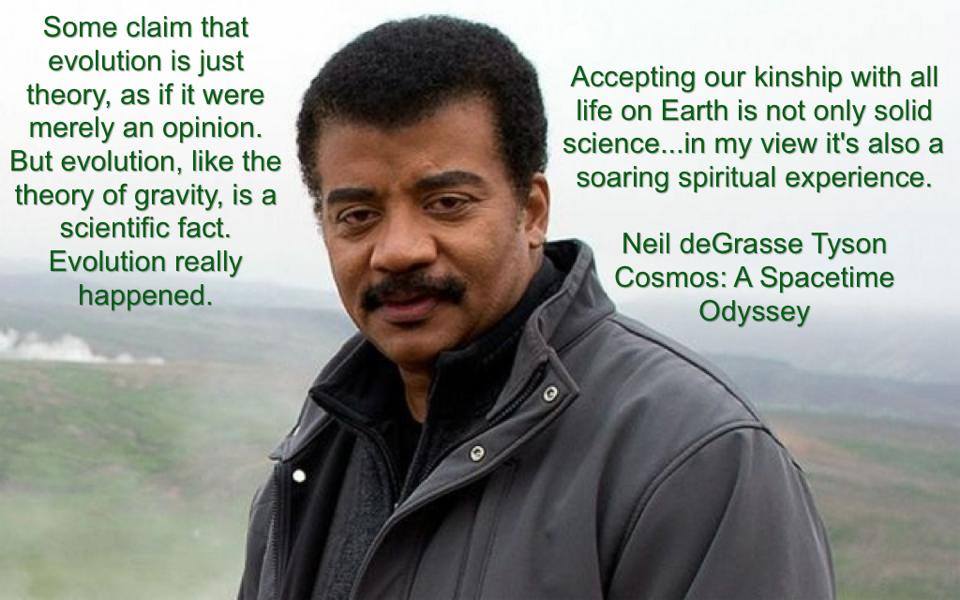
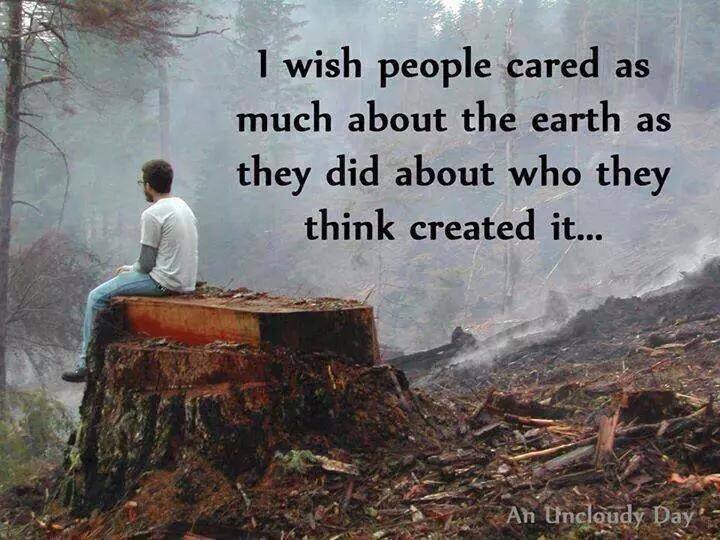
This type of willful ignorance does not bode well for the animals or the Earth. If most people don’t “believe in” evolution or climate change, how long will it take to convince them that we are animals and we must curb greenhouse gasses?
Few Americans question that smoking causes cancer. But they express bigger doubts as concepts that scientists consider to be truths get further from our own experiences and the present time, an Associated Press-GfK poll found.
Americans have more skepticism than confidence in global warming, the age of the Earth and evolution and have the most trouble believing a Big Bang created the universe 13.8 billion years ago.
Rather than quizzing scientific knowledge, the survey asked people to rate their confidence in several statements about science and medicine.
On some, there’s broad acceptance. Just 4 percent doubt that smoking causes cancer, 6 percent question whether mental illness is a medical condition that affects the brain and 8 percent are skeptical there’s a genetic code inside our cells. More — 15 percent — have doubts about the safety and efficacy of childhood vaccines.
About 4 in 10 say they are not too confident or outright disbelieve that the earth is warming, mostly a result of man-made heat-trapping gases, that the Earth is 4.5 billion years old or that life on Earth evolved through a process of natural selection, though most were at least somewhat confident in each of those concepts. But a narrow majority — 51 percent — questions the Big Bang theory.
Those results depress and upset some of America’s top scientists, including several Nobel Prize winners, who vouched for the science in the statements tested, calling them settled scientific facts.
“Science ignorance is pervasive in our society, and these attitudes are reinforced when some of our leaders are openly antagonistic to established facts,” said 2013 Nobel Prize in medicine winner Randy Schekman of the University of California, Berkeley.
The poll highlights “the iron triangle of science, religion and politics,” said Anthony Leiserowitz, director of the Yale Project on Climate Change Communication.
And scientists know they’ve got the shakiest leg in the triangle.
To the public “most often values and beliefs trump science” when they conflict, said Alan Leshner, chief executive of the world’s largest scientific society, the American Association for the Advancement of Science.
“Science ignorance is pervasive in our society, and these attitudes are reinforced when some of our leaders are openly antagonistic to established facts.”
Political values were closely tied to views on science in the poll, with Democrats more apt than Republicans to express confidence in evolution, the Big Bang, the age of the Earth and climate change.
Religious values are similarly important.
Confidence in evolution, the Big Bang, the age of the Earth and climate change decline sharply as faith in a supreme being rises, according to the poll. Likewise, those who regularly attend religious services or are evangelical Christians express much greater doubts about scientific concepts they may see as contradictory to their faith.
“When you are putting up facts against faith, facts can’t argue against faith,” said 2012 Nobel Prize winning biochemistry professor Robert Lefkowitz of Duke University. “It makes sense now that science would have made no headway because faith is untestable.”
But evolution, the age of the Earth and the Big Bang are all compatible with God, except to Bible literalists, said Francisco Ayala, a former priest and professor of biology, philosophy and logic at the University of California, Irvine. And Darrel Falk, a biology professor at Point Loma Nazarene University and an evangelical Christian, agreed, adding: “The story of the cosmos and the Big Bang of creation is not inconsistent with the message of Genesis 1, and there is much profound biblical scholarship to demonstrate this.”
Beyond religious belief, views on science may be tied to what we see with our own eyes. The closer an issue is to our bodies and the less complicated, the easier it is for people to believe, said John Staudenmaier, a Jesuit priest and historian of technology at the University of Detroit Mercy.
Marsha Brooks, a 59-year-old nanny who lives in Washington, D.C., said she’s certain smoking causes cancer because she saw her mother, aunts and uncles, all smokers, die of cancer. But when it comes to the universe beginning with a Big Bang or the Earth being about 4.5 billion years old, she has doubts. She explained: “It could be a lack of knowledge. It seems so far” away.
Jorge Delarosa, a 39-year-old architect from Bridgewater, N.J., pointed to a warm 2012 without a winter and said, “I feel the change. There must be a reason.” But when it came to Earth’s beginnings 4.5 billion years ago, he has doubts simply because “I wasn’t there.”
Experience and faith aren’t the only things affecting people’s views on science. Duke University’s Lefkowitz sees “the force of concerted campaigns to discredit scientific fact” as a more striking factor, citing significant interest groups — political, business and religious — campaigning against scientific truths on vaccines, climate change and evolution.
Yale’s Leiserowitz agreed but noted sometimes science wins out even against well-financed and loud opposition, as with smoking.
Widespread belief that smoking causes cancer “has come about because of very public, very focused public health campaigns,” AAAS’s Leshner said. A former acting director of the National Institute of Mental Health, Leshner said he was encouraged by the public’s acceptance that mental illness is a brain disease, something few believed 25 years ago, before just such a campaign.
That gives Leiserowitz hope for a greater public acceptance of climate change. But he fears it may be too late to do anything about it.
The AP-GfK Poll was conducted March 20-24, 2014, using KnowledgePanel, GfK’s probability-based online panel designed to be representative of the U.S. population. It involved online interviews with 1,012 adults and has a margin of sampling error of plus or minus 3.4 percentage points for all respondents.
Respondents were first selected randomly using phone or mail survey methods and were later interviewed online. People selected for KnowledgePanel who didn’t otherwise have access to the Internet were provided with the ability to access the Internet at no cost to them.
 Exposing the Big Game