Exposing the Big Game

Forget Hunters' Feeble Rationalizations and Trust Your Gut Feelings: Making Sport of Killing Is Not Healthy Human Behavior

Exposing the Big Game

Bye!

[Some of this stuff is wtf way out of line, like suggesting that the animals think we were gracious “Hosts”, that the animals got along with homo erectus, or Plestocene age humans, but most of this is timely and right on:]

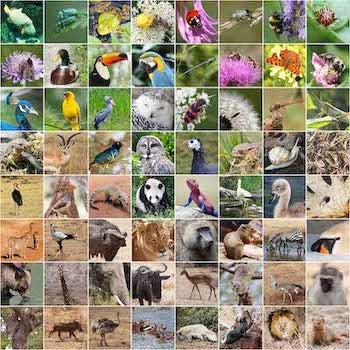
The Animal Kingdom

So you’ve probably heard about the new report saying human-caused climate change is putting about a million different species of animals and plants at risk of extinction, and we just wanted to pop on over and say that it’s true, a lot of us are on our way out the door.

Bye!

Seriously, look at the time! We can’t believe it’s been hundreds of thousands of years already! That’s a pretty long time, when you think about it, and you can’t go on coexisting as humans and animals on the same planet forever. And you know what they say: It’s better to burn out than to fade away. We’re gonna take our cue here and get out of your hair pretty soon. So arrivederci, and adios!

We’ve had some really good times, us and you humans. Who can forget the crazy days of the Pleistocene epoch? Sure, the Ice Age was no picnic, but it was honestly pretty great later on hanging out and watching y’all evolve. We’ve had this whole symbiotic thing going where animals and Homo erectuscould live side by side. Over the years, we’ve gotten to migrate with you as you’ve moved around and really had a chance to find ourselves and flourish in new places. It was paradise. It would’ve been awesome if life could’ve stayed that way forever, you know?

We’re not trying to flake or anything, believe us. Look, you guys are obviously busy with your machines and your wars and your relentless pursuit of profit. Sometimes, people and animals grow apart. And that’s okay. We’ve always been pretty chill with what you guys are doing, so don’t worry, it’s totally cool. A flourishing ecosystem that supports all of Earth’s creatures isn’t going to be everyone’s thing. It’s your habitat now, after all, and you’ve been gracious hosts to us for a long time. So thanks!

Since we’ve got you here, we do want to mention that it hasn’t been all fun and games. If we’re being honest, we’re still not totally keen on poaching, pollution, zoos, deforestation, or raising us in terrible conditions for the express purpose of slaughtering and eating us. Those things are kind of a buzzkill. Don’t get us wrong, we’re not trying to be overly critical, since you obviously have your reasons. We just wanted to get that off our chests before we get going.

Also, it’s sort of weird you breed some of us as pets. Just saying.

Do we wish we could stick around longer? Sure, a little. When the dodo peaced out back in the late 1600s, we were like, really? Already? The party’s just getting started! But now when we look around—the oceans are heating up, the food’s running out, and most of our natural environments are gone—we wonder if maybe the dodo was right to take off when it did. The vibe isgetting kinda weird in here. Not that the last couple hundred years of rapid industrialization have been all bad for us, but let’s just say the Earth’s not quite as fun for us as it used to be.

We don’t want to belabor our departure—no one likes a guest who overstays their welcome—so we’ll just do a quick soundoff of who’s heading out soon so you can say a quick toodle-oo: the Bengal tiger, Amur leopard, hawksbill sea turtle, Chinese giant salamander, Javan rhinoceros, Sumatran rhinoceros, black rhinoceros, giant panda, vaquita, eastern gorilla, Sumatran orangutan, Borean orangutan, saola, gharial, Asian elephant, Philippine crocodile, Chinese pangolin, Malayan tiger, mountain pygmy possum, Andaman shrew, western swamp turtle, Philippine forest turtle, Ploughshare tortoise, Cross River gorilla, eastern lowland gorilla, saola, South China tiger, pika, giant otter, red wolf, Tasmanian devil, peppered tree frog, northern tinker frog, mountain mist frog, armored frog, Eungella torrent frog, Sumatran elephant, African wild donkey, Saiga antelope, giant muntjac, addax, bowhead whale, beluga whale, Balkan lynx, Asiatic cheetah, gloomy tube-nosed bat, Armenian whiskered bat, Hill’s horseshoe bat, Thongaree’s disc-nosed bat, Aru flying fox, central rock rat, pygmy hog, Gilbert’s potoroo, Allan’s lerista, Carpentarian rock rat, Kangaroo Island dunnart, Darwin’s fox, Peruvian black spider monkey, the red wolf, spoon-billed sandpiper, Siberian crane, Bengal florican, regent honeyeater, orange-bellied parrot, great Indian bustard, sociable lapwing, white-billed heron, whooping crane, red-vented cockatoo, Himalayan quail, Hainan black-crested gibbon, Bulmer’s fruit bat, Philippine naked-backed fruit bat, Fijian monkey-faced bat, Northern white-cheeked gibbon, indri, Andohahela sportive lemur, Manombo sportive lemur, Sahamalaza sportive lemur, all the other sportive lemurs, Celebes crested macaque, Pagai Island macaque, Sarawak surili, kipunji, hirola, tamaraw, wild Bactrian camel, white-rumped vulture, red-headed vulture, Indian vulture, slender-billed vulture, longcomb sawfish, Ganges shark, red-finned blue-eye, finless porpoise, squatina, northern river shark, Pondicherry shark humphead wrasse, orphan salamander, cloud forest salamander, Monte Escondido salamander, El Cusuco salamander, Zarciadero web-footed salamander, Cerro Pital salamander, blue whale, black-footed ferret, Yangtze finless porpoise, Zapotec salamander, and basically everyone from the wetlands.

We’re definitely missing a bunch who are just slipping out really quickly without saying farewell. We hope that’s okay. You probably won’t even notice they’re gone! We’re not all leaving yet. Just a lot of us.

Oh, and we hope you don’t mind, we’re taking most of the plants with us too.

Humans Are Speeding Extinction and Altering the Natural World at an ‘Unprecedented’ Pace

Fishing nets and ropes are a frequent hazard for olive ridley sea turtles, seen on a beach in India’s Kerala state in January. A new 1,500-page report by the United Nations is the most exhaustive look yet at the decline in biodiversity across the globe.CreditSoren Andersson/Agence France-Presse — Getty Images
Image
Fishing nets and ropes are a frequent hazard for olive ridley sea turtles, seen on a beach in India’s Kerala state in January. A new 1,500-page report by the United Nations is the most exhaustive look yet at the decline in biodiversity across the globe.CreditCreditSoren Andersson/Agence France-Presse — Getty Images

Want climate news in your inbox? Sign up here for Climate Fwd:, our email newsletter.

WASHINGTON — Humans are transforming Earth’s natural landscapes so dramatically that as many as one million plant and animal species are now at risk of extinction, posing a dire threat to ecosystems that people all over the world depend on for their survival, a sweeping new United Nations assessment has concluded.

The 1,500-page report, compiled by hundreds of international experts and based on thousands of scientific studies, is the most exhaustive look yet at the decline in biodiversity across the globe and the dangers that creates for human civilization. A summary of its findings, which was approved by representatives from the United States and 131 other countries, was released Monday in Paris. The full report is set to be published this year.

Its conclusions are stark. In most major land habitats, from the savannas of Africa to the rain forests of South America, the average abundance of native plant and animal life has fallen by 20 percent or more, mainly over the past century. With the human population passing 7 billion, activities like farming, logging, poaching, fishing and mining are altering the natural world at a rate “unprecedented in human history.”

At the same time, a new threat has emerged: Global warming has become a major driver of wildlife decline, the assessment found, by shifting or shrinking the local climates that many mammals, birds, insects, fish and plants evolved to survive in.

Cattle grazing on a tract of illegally cleared Amazon forest in Pará State, Brazil. In most major land habitats, the average abundance of native plant and animal life has fallen by 20 percent or more, mainly over the past century.CreditLalo de Almeida for The New York Times
Image
Cattle grazing on a tract of illegally cleared Amazon forest in Pará State, Brazil. In most major land habitats, the average abundance of native plant and animal life has fallen by 20 percent or more, mainly over the past century.CreditLalo de Almeida for The New York Times

The report is not the first to paint a grim portrait of Earth’s ecosystems. But it goes further by detailing how closely human well-being is intertwined with the fate of other species.

“For a long time, people just thought of biodiversity as saving nature for its own sake,” said Robert Watson, chair of the Intergovernmental Science-Policy Platform on Biodiversity and Ecosystem Services,which conducted the assessment at the request of national governments. “But this report makes clear the links between biodiversity and nature and things like food security and clean water in both rich and poor countries.“

A previous report by the group had estimated that, in the Americas, nature provides some $24 trillion of non-monetized benefits to humans each year. The Amazon rain forest absorbs immense quantities of carbon dioxide and helps slow the pace of global warming. Wetlands purify drinking water. Coral reefs sustain tourism and fisheries in the Caribbean. Exotic tropical plants form the basis of a variety of medicines.

But as these natural landscapes wither and become less biologically rich, the services they can provide to humans have been dwindling.

Humans are producing more food than ever, but land degradation is already harming agricultural productivity on 23 percent of the planet’s land area, the new report said. The decline of wild bees and other insects that help pollinate fruits and vegetables is putting up to $577 billion in annual crop production at risk. The loss of mangrove forests and coral reefs along coasts could expose up to 300 million people to increased risk of flooding.

The authors note that the devastation of nature has become so severe that piecemeal efforts to protect individual species or to set up wildlife refuges will no longer be sufficient. Instead, they call for “transformative changes” that include curbing wasteful consumption, slimming down agriculture’s environmental footprint and cracking down on illegal logging and fishing.

“It’s no longer enough to focus just on environmental policy,” said Sandra M. Díaz, a lead author of the study and an ecologist at the National University of Córdoba in Argentina. “We need to build biodiversity considerations into trade and infrastructure decisions, the way that health or human rights are built into every aspect of social and economic decision-making.”

Scientists have cataloged only a fraction of living creatures, some 1.3 million; the report estimates there may be as many as 8 million plant and animal species on the planet, most of them insects. Since 1500, at least 680 species have blinked out of existence, including the Pinta giant tortoise of the Galápagos Islands and the Guam flying fox.

Though outside experts cautioned it could be difficult to make precise forecasts, the report warns of a looming extinction crisis, with extinction rates currently tens to hundreds of times higher than they have been in the past 10 million years.

“Human actions threaten more species with global extinction now than ever before,” the report concludes, estimating that “around 1 million species already face extinction, many within decades, unless action is taken.”

Unless nations step up their efforts to protect what natural habitats are left, they could witness the disappearance of 40 percent of amphibian species, one-third of marine mammals and one-third of reef-forming corals. More than 500,000 land species, the report said, do not have enough natural habitat left to ensure their long-term survival.

Over the past 50 years, global biodiversity loss has primarily been driven by activities like the clearing of forests for farmland, the expansion of roads and cities, logging, hunting, overfishing, water pollution and the transport of invasive species around the globe.

In Indonesia, the replacement of rain forest with palm oil plantations has ravaged the habitat of critically endangered orangutans and Sumatran tigers. In Mozambique, ivory poachers helped kill off nearly 7,000 elephants between 2009 and 2011 alone. In Argentina and Chile, the introduction of the North American beaver in the 1940s has devastated native trees (though it has also helped other species thrive, including the Magellanic woodpecker).

All told, three-quarters of the world’s land area has been significantly altered by people, the report found, and 85 percent of the world’s wetlands have vanished since the 18th century.

And with humans continuing to burn fossil fuels for energy, global warming is expected to compound the damage. Roughly 5 percent of species worldwide are threatened with climate-related extinction if global average temperatures rise 2 degrees Celsius above preindustrial levels, the report concluded. (The world has already warmed 1 degree.)

“If climate change were the only problem we were facing, a lot of species could probably move and adapt,” Richard Pearson, an ecologist at the University College of London, said. “But when populations are already small and losing genetic diversity, when natural landscapes are already fragmented, when plants and animals can’t move to find newly suitable habitats, then we have a real threat on our hands.”

Volunteers collected trash in March in a mangrove forest in Brazil. The loss of mangrove forests and coral reefs along coasts could expose up to 300 million people to increased risk of flooding.CreditAmanda Perobelli/Reuters
Image

Volunteers collected trash in March in a mangrove forest in Brazil. The loss of mangrove forests and coral reefs along coasts could expose up to 300 million people to increased risk of flooding.CreditAmanda Perobelli/Reuters

Today, humans are relying on significantly fewer varieties of plants and animals to produce food. Of the 6,190 domesticated mammal breeds used in agriculture, more than 559 have gone extinct and 1,000 more are threatened. That means the food system is becoming less resilient against pests and diseases. And it could become harder in the future to breed new, hardier crops and livestock to cope with the extreme heat and drought that climate change will bring.

“Most of nature’s contributions are not fully replaceable,” the report said. Biodiversity loss “can permanently reduce future options, such as wild species that might be domesticated as new crops and be used for genetic improvement.”

The report does contain glimmers of hope. When governments have acted forcefully to protect threatened species, such as the Arabian oryx or the Seychelles magpie robin, they have managed to fend off extinction in many cases. And nations have protected more than 15 percent of the world’s land and 7 percent of its oceans by setting up nature reserves and wilderness areas.

Still, only a fraction of the most important areas for biodiversity have been protected, and many nature reserves poorly enforce prohibitions against poaching, logging or illegal fishing. Climate change could also undermine existing wildlife refuges by shifting the geographic ranges of species that currently live within them.

So, in addition to advocating the expansion of protected areas, the authors outline a vast array of changes aimed at limiting the drivers of biodiversity loss.

Farmers and ranchers would have to adopt new techniques to grow more food on less land. Consumers in wealthy countries would have to waste less food and become more efficient in their use of natural resources. Governments around the world would have to strengthen and enforce environmental laws, cracking down on illegal logging and fishing and reducing the flow of heavy metals and untreated wastewater into the environment.

The authors also note that efforts to limit global warming will be critical, although they caution that the development of biofuels to reduce emissions could end up harming biodiversity by further destroying forests.

An elephant in the Lewa Wildlife Conservancy at the foot of Mount Kenya, outside Nairobi. More than 500,000 land species do not have enough natural habitat left to ensure their long-term survival.CreditTony Karumba/Agence France-Presse — Getty Images
Image

An elephant in the Lewa Wildlife Conservancy at the foot of Mount Kenya, outside Nairobi. More than 500,000 land species do not have enough natural habitat left to ensure their long-term survival.CreditTony Karumba/Agence France-Presse — Getty Images

None of this will be easy, especially since many developing countries face pressure to exploit their natural resources as they try to lift themselves out of poverty.

But, by detailing the benefits that nature can provide to people, and by trying to quantify what is lost when biodiversity plummets, the scientists behind the assessment are hoping to help governments strike a more careful balance between economic development and conservation.

“You can’t just tell leaders in Africa that there can’t be any development and that we should turn the whole continent into a national park,” said Emma Archer, who led the group’s earlier assessment of biodiversity in Africa. “But we can show that there are trade-offs, that if you don’t take into account the value that nature provides, then ultimately human well-being will be compromised.”

In the next two years, diplomats from around the world will gather for several meetings under the Convention on Biological Diversity, a global treaty, to discuss how they can step up their efforts at conservation. Yet even in the new report’s most optimistic scenario, through 2050 the world’s nations would only slow the decline of biodiversity — not stop it.

“At this point,” said Jake Rice, a fisheries scientist who led an earlier report on biodiversity in the Americas, “our options are all about damage control.”

For more news on climate and the environment, follow @NYTClimate on Twitter.

Brad Plumer is a reporter covering climate change, energy policy and other environmental issues for The Times’s climate team. @bradplumer

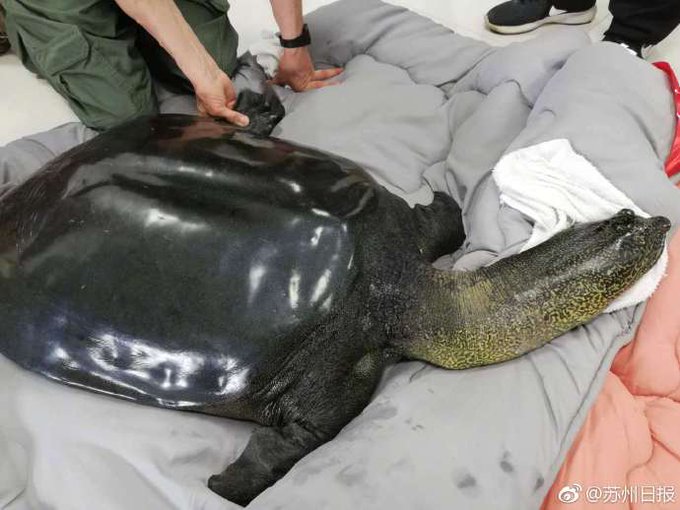
Last Female of World’s Rarest Turtle Species Dies in China Zoo

Amphibian ‘apocalypse’ caused by most destructive pathogen ever

The first-ever global tally of the disease’s toll reveals that it caused declines in at least 501 frog and salamander species.

VIDEO BY KATIE GARRETT AND JONATHAN KOLBY

FOR DECADES, A silent killer has slaughtered frogs and salamanders around the world by eating their skins alive. Now, a global team of 41 scientists has announced that the pathogen—which humans unwittingly spread around the world—has damaged global biodiversity more than any other disease ever recorded.

The new study, published in Science on Thursday, is the first comprehensive tally of the damage done by the chytrid fungi Batrachochytrium dendrobatidis (Bd) and Batrachochytrium salamandrivorans (Bsal)In all, the fungi have driven the declines of at least 501 amphibian species, or about one out of every 16 known to science.

Of the chytrid-stricken species, 90 have gone extinct or are presumed extinct in the wild. Another 124 species have declined in number by more than 90 percent. All but one of the 501 declines was caused by Bd.

“We’ve known that’s chytrid’s really bad, but we didn’t know how bad it was, and it’s much worse than the previous early estimates,” says study leader Ben Scheele, an ecologist at Australian National University. “Our new results put it on the same scale, in terms of damage to biodiversity, as rats, cats, and [other] invasive species.”

Scheele has seen the fungus’s carnage firsthand. At one of his field sites in Australia, an extended El Niño fueled mass frog breeding and dispersal—letting Bd spread as never before. Before the fungus, populations of the alpine tree frog were so abundant there, he had to watch his step when he went out at night. Now, the species is nearly impossible to find.

Hostile Planet Post Premiere Banner

Saddened and shocked, Scheele resolved to put numbers to the decline. Four years—and innumerable email conversations—later, Scheele’s team has finally combined all known reports of chytrid declines into a single consistent database, revealing Bd and Bsal‘s record-breaking toll.

“Chytrid fungus is the most destructive pathogen ever described by science—that’s a pretty shocking realization,” adds Wendy Palen, a biologist at Simon Fraser University in British Columbia who wrote about the study for Science.

Dead frogs killed from the amphibian chytrid fungus.PHOTOGRAPH BY JOEL SARTORE, NAT GEO IMAGE COLLECTION

The bulk of amphibian die-offs occurred in the 1980s—when the disease began to circulate around the globe—with a second uptick in mortality in South America in the mid-2000s. Many the affected frogs live in Central and South America, though outbreaks also occur across Europe, North America, Australia, and Africa. There are no known declines from Asia, where the fungus has co-existed for millions of years.

What’s more, the study’s counts are conservative. Earlier die-offs from the 1950s and 1960s in Europe and North America aren’t included for lack of evidence. And the 501 species tallied are just the ones that scientists know about. Researchers keep identifying new species of frogs—even after they’ve been nearly wiped out in the wild.

The study’s authors hope that the new research will act as a call to arms against the pandemic.

“I can totally understand why some people might see this issue as too little, too late, but I strongly disagree with that, because saying that does not truly take into consideration how much worse it can still get,” says study co-author Jonathan Kolby, a National Geographic Explorer and policy specialist at the U.S. Fish and Wildlife Service.

That’s why researchers are urging governments around the world to buy amphibians time by curbing the trade of wild amphibians, protecting amphibian habitats, combating invasive species that threaten amphibians, and supporting captive-breeding programs.

Origins of a killer

There are hundreds of species of chytrid fungi, and most of them are unobtrusive decomposers. But Bd is an oddball: It has a fanatical taste for the proteins in amphibian skin. In the early 20th century, human activity—such as trade and war—accidentally spread the fungus around the world.

Along the way, it evolved, spawning a highly virulent strain that’s primarily responsible for the pandemic.

Some amphibians can tolerate Bd, but in many others, it degrades the animals’ permeable skin, which they use to breathe and regulate their water levels. Runaway infections trigger a death spiral that ends in cardiac arrest.

A young treefrog (Boophis sp.) rests on a delicate fern frond. National Geographic grantee Jonathan Kolby, who took this picture, is researching the Bd outbreak.

PHOTOGRAPH BY JONATHAN KOLBY, NAT GEO IMAGE COLLECTION

Not only is Bd lethal, it’s also devastatingly effective at spreading. While most pathogens target specific hosts, Bd can infect at least 695 species to varying degrees. It also doesn’t kill its victims quickly, which increases the odds that the fungus will spread. Species it doesn’t kill, such as the American bullfrog, can act as reservoirs.

In addition, the fungus can spread by touch or by water; Bd spores can swim a short distance. And if conditions are right, the fungus can live outside of its host for weeks to months—maybe even years—at a time. “In some respects, it’s the perfect pandemic recipe,” says biologist Dan Greenberg, a Ph.D. student at Simon Fraser University. “If it were a human pathogen, it’d be in a zombie film.”

As National Geographic has previously reportedBd snuck up on researchers much like a fictional zombie plague. Scientists first started noticing frog die-offs in the 1970s, but researchers didn’t realize these “enigmatic declines”were a global phenomenon until the 1990s. Researchers described Bd in 1997; within a decade, it was the top suspect in the killings.

Study co-author Karen Lips, an ecologist at the University of Maryland, watched as the fungus spread through sites she had been monitoring for more than 15 years. From 2004 to 2008, one of her sites in Panama lost more than two fifths of its amphibian species to Bd. “You get to know this system, and it’s all completely wiped out,” she says. “It’s just horrible to see that degree of change.”

Similar scenes played out in the French Pyrenees, where midwife toads keel over by the hundreds on mountain lake shores. “Early in the outbreak, midwife toads would be calling at full volume—it’s a beautiful chorus. Once the disease has swept through, you don’t hear any calling,” adds study co-author Mat Fisher, an epidemiologist at Imperial College London. “The world becomes very quiet.”

Holding the line

Researchers say that we can’t reverse the damage that Bd has already done. The fungus is already worldwide, and purging it from the environment is impossible. While topical fungicides can heal Bd-stricken amphibians in the wild, they can’t be applied on a global scale.

In the face of this reality, the study’s authors say our best bet is to greatly curtail the global trade of wild amphibians, or at the very least improve screening procedures. The pet and meat trades probably play a major role in continuing the pathogen’s spread. A 2018 study confirmed that all major strains of Bd, including the one most responsible for the global pandemic, are present in pet-shop animals.

The frog species Mantidactylus grandidieri is one of many that calls Madagascar home. So far, Bd does not appear to have established a major foothold on the island, but wildlife officials around the world are staying vigilant.

PHOTOGRAPH BY JONATHAN KOLBY, NAT GEO IMAGE COLLECTION

Despite its impact, the fungus hasn’t attracted the same attention as wildlife diseases such as white-nose syndrome, a fungal disease that infects bats.

“If you look at the number of species impacted, [white-nose syndrome] is so incredibly dwarfed by the number of amphibians—and then you look at the levels of effort and funding and attention,” says Kolby. “Why aren’t we giving that much attention to the frogs?”

U.S. officials are monitoring the situation, but because Bd is already widespread in the United States, there’s only so much they can do. But researchers have pointed out that Bd consists of many different lineages. One 2011 study suggested that BdGPL, the deadliest strain of all, emerged when separate Bd strains hybridized.

“If we stop trying to emphasize the importance of biosecurity, disease control, and disease surveillance at the government level, it’s hard to think that we’re not going to have another hybrid event,” says Kolby. “That would start everything all over again: a new strain, with new virulence. That’s what I find scary.”

The U.S. has room to take a more proactive approach to Bsal, which has ravaged salamanders in Europe but hasn’t yet been detected in the U.S., a global haven for salamander biodiversity. In 2015, U.S. government agencies formed a task force expressly focused on Bsal. In 2016, U.S. officials moved to ban the import of 201 salamander species.

The U.S. is hardly alone in the fight against Bd; officials around the world are working to curb the fungus. Scientists have set up regional networks to track the fungi’s spread, and the World Organization for Animal Health (OIE)—the non-human equivalent of the World Health Organization—has issued recommendations for how to trade amphibian products while minimizing the risk of spreading Bd. In 2015, the OIE and CITES, the treaty that oversees the global wildlife trade, signed an agreement to work more closely together.

Even now, some species stand a chance of evolving resistance to Bd and Bsal. Of the 292 chytrid-stricken species that have survived, 60 show some signs of recovery.

To buy critical time, Scheele says, the world needs to lessen the other threats amphibians face, from habitat loss to invasive species. In addition, captive-breeding efforts such as the Amphibian Ark could act as genetic lifeboats.

But Palen notes that the basic remedies have been known for decades: “It’s pretty sobering that we haven’t been able to do those sorts of obvious things,” she says. “Maybe this is a real wake-up call.”

The World’s Giraffes Are Disappearing & We’re Only Just Discovering Who We’re Losing

Known for their distinctive long necks and spotted patterns, giraffes are one of nature’s most iconic and awe-inspiring wild animals. The discovery of four unique giraffe species now indicates an urgent need for international conservation efforts to save these majestic animals.

Over the past three decades, Africa’s giraffe population as a whole has declined by 40% with less than 100,000 individuals remaining in the wild today. Compare that to our worldwide human population which expands by over twice that amount each and every day, and you can begin to understand the scope of the issue.

Africa is the second largest and second most populous continent in the world. As is the case almost everywhere humans are found on Earth, rapid human population growth disrupts and displaces the ranges of wild animals, leading to habitat loss.

Poaching is also a contributor to a decline in overall giraffe numbers.

As a single species, giraffes were classified as “vulnerable” in 2016. However, since giraffes were recently discovered to belong to four genetically and geographically distinct species with nine subspecies, “vulnerable” status does not effectively communicate the dangerously low numbers of giraffe subgroups.

Today, the Masai giraffe species (G. tippelskirchi) population has just 32,050 individuals. The southern giraffe (G. giraffe) has just 52,050 including two subspecies: the Angolan giraffe (G. g. angolensis) and the South African giraffe (G. g. giraffe).

Some giraffe populations need immediate protection, including the endangeredreticulated giraffe (G. reticulata) with just 8,700 individuals in existence. It is estimated the northern giraffe species (G. camelopardalis) has just 5,195 individuals in the wild, including the West African giraffe (G. c. peralta) subspecies and the critically endangeredKordofan (G. c. antiquorum) and Nubian (G. c. Camelopardalis) subspecies.

Now, five wildlife protection groups have filed a lawsuit against the U.S. Fish and Wildlife Service for its failure to list northern giraffes under the Endangered Species Act, arguing that the listing of the northern giraffe species crucial for the subspecies’ survival.

Listing northern giraffes would not mandate the habitat protections granted to domestic species, however, it could drastically cut down on poaching by regulating international and interstate imports and exports of giraffe trophies and body parts.

Thank you for taking action for giraffes sharing this story and signing up for eNews so you can get the latest updates and actions to help giraffes and other wild animals.


As Chinese companies make inroads into Bolivia for infrastructure and resource extraction, locals have found that they can earn up to $215 selling jaguar fangs to Chinese employees. This new demand has now inspired hunters to go into the Amazon jungle to hunt commercially.  Sadly, that is part of a trail of blood spattered across the planet, taking the shape of Chinese characters for trinkets and various “traditional medicines” that spell out ivory, rhino horn, jaguar fangs, swim bladder, shark’s fin and a host of other ghastly products.

The color red signals danger in primates and in many human cultures, but in China it symbolizes good luck. The seas, forests, plains, and deserts of the world are now soaked in blood thanks to an ancient demand for wildlife parts to cure human maladies and to serve as status symbols that sadly have been found to have no medicinal value by scientific tests. That’s one narrative, but there is another, something more sinister than primitive superstition: eat it because it’s exotic. This is going on every day, all over the world.

Jaguar fangs in the end market in China are worth as much as their weight in cocaine. National Geographic recently published a stunning article about how the cats are “killed to order” in Suriname for the overseas Chinese market.

A scientist I know who works in the tropical forests of Guyana, far from Bolivia on the north coast of South America, says he has heard that local hunters are in touch with Chinese agents in country’s capital city of Georgetown to procure jaguars. If it’s happening in Bolivia and also in Suriname and Guyana it’s easily conceivable that jaguars are being hunted for their fangs everywhere in between across the Amazon basin. The King of the Amazon, it seems, is nothing more than a potential gaudy trinket for China’s nouveau riche to hideously flaunt.

Chinese state-owned companies have sunk their fangs into forests adjacent to Ecuador’s Yasuni National Park—called the world’s most biodiverse ecosystem by scientists—while just last year Chinese poachers were arrested at sea with 300 tonnes of endangered sharks in Ecuadorian waters. That illegal haul equaled 6,000 sharks and the crew of 20 Chinese poachers were given sentences of up to four years in prison. In fact, Chinese demand for shark’s fin basically blankets the planet.

In 2016, a staggering 8 million dead seahorses were intercepted in Peru bound for China. Farther down on the South American continent in Argentina a Chinese poaching vessel was caught (and later destroyed) carrying 180 tonnes of illegally caught squid in Argentinean waters. And Chinese appetite for South America’s wildlife is not limited to the surf and turf, but also the skies. In 2016 HK$2 million worth of wild and illegally-imported macaws were intercepted by marine police and customs officers before they could be offloaded in Shenzen.

If the Amazon railway that China envisions for South America ever becomes a reality, linking the Atlantic and Pacific Oceans, wildlife poaching and deforestation will no doubt rapidly increase. The same can be said of the proposed and China-backed Nicaragua Canal if that ever happens.

In Mexico, the vaquita is down to perhaps just a dozen individuals, thanks to Chinese demand for its swim bladder, and there are no other known populations of this incredibly beautiful sea creature. Vaquita fish bladder can be sold to the Chinese for US$30,000 and is now considered “the cocaine of the sea.”

Farther out to the east in the Caribbean Sea, Chinese appetite for rare land turtles—as well as sea turtles—was documented in the late Archie Carr’s classic book The Windward Road. Carr followed up a report that a Chinese merchant in Trinidad was in possession of a rare yellow-footed tortoise(Carr classified it as Testudo denticulate at that time).

Carr finally located Mr. Yow: “He was the most outrageous-looking Chinese I ever saw, a character from a poor melodrama, a debauched Fu Manchu. He was short, fat, and unwashed, with spiky hair, mouth slacked open, and belly hanging free…Yow said that he had only two and that he kept them to eat, not sell.”

Carr was trying to save the tortoises by purchasing them, and his friend finally prevailed by reminding Yow that he had “done favors for him in the past.” Finally: “Yow looked at the tortoises for a moment with a rapt reverence and they stirred him so deeply he could not be silent.…His voice trailed off in a long moan of falsetto ecstasy.”

Carr eventually procured the tortoises. That was in Trinidad in the 1940s, and what it shows is that there is no place that is too far away or obscure for Chinese demand for wildlife, and there never has been.

Farther north in Canada, a bear poaching ring was recently broken up and the customers of these illicit Canadian gunslingers were those seeking bear gallbladders on the Asian market. South of the border, two Michigan men were arrested for poaching black bears to sell to the traditional Chinese medicine market. Even in North America, bears are not safe from Chinese demand for their gallbladders. Chinese mining companies threaten wildlife habitats as far afield as Greenland.

Exploitation of Africa has been well-documented, with elephant herds and rhinoceros populations plummeting in recent years thanks to Chinese as well as Vietnamese demand. Nonetheless, it’s worth mentioning some specific cases here. Gabon’s forest elephants are coming under major pressure for their ivory, which will be shipped to China if the great beasts are unfortunate enough to encounter a poacher, and the same goes for the elephants of MozambiqueBotswanaKenyaEthiopia, and every other African nation that has elephants, ditto for rhinoceros.

Chinese demand and poaching are so rampant in Namibia that Namibian Chamber of Environment recently published a letter stating that the bush meat trade flourished anyplace that Chinese nationals were working on infrastructure projects, and in addition that Chinese citizens are involved in “illegal collection of shellfish on the Namibian coast Capturing and killing of Carmine Bee-eaters at their breeding colonies by means of nets; Importing Chinese monofilament nets via Zambia to the northeast of Namibia, which are destroying the fisheries of the Zambezi, Chobe, Kwando and Okavango Rivers.”

Off the coast of West AfricaChinese fishing (poaching) vessels are clearing out the sea of any and all fish species. They are literally robbing African fishermen of their livelihoods. Ploughshare tortoises in Madagascar are rounded up and snuck onto flights bound for China. The number of African pangolins being hunted and sent to China is simply mind-blowing. Chinese infrastructure projects in Africa, like the new train line in Ethiopia, will, in addition to spurring the bush meat trade as it did in Namibia and elsewhere, also drive resource extraction and environmental degradation.

There is simply no end in sight. A stack of heavy books could be written on Chinese consumption of wildlife in South America, North America, Africa, South Asia, Southeast Asia, Northeast Asia, and everywhere in between (even tiny Palau has the Herculean task of chasing away Chinese and Taiwanese fishing vessels). And when Chinese nationals are caught by local authorities for engaging in the wildlife trade, what happens?

It seems that if you throw a bunch of money their way, freedom is yours, as was the case in Suriname when Chinese nationals caught with jaguars were “fined” and then walked away. If this is how justice is carried out across the globe, and especially in the tropics, there won’t be much left of the world’s natural heritage in the not-too-distant future.

___________________________________________________________________

By: Gregory McCann

This is the first installment of the author’s series on how China chew its way through the natural resources of its Asian neighbors. Check out the other stories in this series:


There is a monster chewing its way through the wildlife of its smaller, weaker Southeast Asian neighbors. The monster can change forms—like a shape-shifter—but it goes by one name: China. The region’s wildlife is rapidly disappearing, being sucked into the vortex of the illegal wildlife trade that leads to China.

In the Burmese border town of Mong-La, everything from tree-dwelling civets to clouded leopards, from tiger claws to elephant skin, and from pangolin scales to bear gall bladder is on sale, with the vast majority of customers coming over the border from Yunnan. National Geographic just this month ran a stunning if disturbing article on the plight of the “dinosaur of the skies”—the majestic Helmeted Hornbill.

The Hornbills’ numbers are crashing and in a few short years have been downgraded from Vulnerable to Critically Endangered by the IUCN. The Chinese are after their heads, literally. Their solid red casques are considered “red ivory” They are actually made of keratin, the same stuff as your fingernails and, incidentally, rhino horn, and rhinoceros are another species which have been virtually wiped off the face of the Southeast Asian map thanks to a misplaced belief that ground rhino horn can cure cancer and a host of other human ailments.

So dire is the situation of the Helmeted Hornbill that governments in this species range (Indonesia, Malaysia, Brunei, Thailand, and Myanmar) have recently formed a joint management and conservation plan to attempt to ensure that this otherworldly bird has a future outside of China’s markets. Asia Sentinel also published a story specifically about the hornbill hunters of Sumatra last year, and how those hornbill heads are sold to Chinese middlemen in the city of Medan.

Mainland Chinese investors in Singapore and Chinese Singaporeans are buying—mostly illicitly—so much sand from Cambodia’s coastal Koh Kong province that irreparable environmental damage is now becoming manifest. A well-informed source told me that one sand barge was so enormous that it took eight tugboats to pull it to Singapore. Activists from the NGO Mother Nature were arrested after filming illegal sand barges in Cambodia, and some of this group’s members had to flee to Thailand. The removal of riverbed sand—which is prized construction material—annihilates the river’s ecology, decimating fish populations and the wildlife that depends on them, such as river dolphins, otters, and fishing cats. Chinese investors are also behind the recent clearing of mangrove forests in Koh Kong, another nefarious activity that will cause significant environmental degradation.

Chinese developers, backed by Beijing, have begun the initial stages of construction on a highly controversial hydroelectric dam in Sumatra’s Batang Toru forest, which is home to a Critically Endangered population of Sumatran Orangutan, as well as Sumatran tigers and Helmeted Hornbills—all listed by the IUCN as Critically Endangered, with the last two being Critically Endangered largely due to Chinese demand for their carcasses. Now they are all even more endangered as a result of this dam, which will flood prime forest habitat and put the 800 or so orangutans—as well as other species—at immediate risk of extinction (in the case of this sub-species orangutan, which is only found in Batang Toru) and local extinction (for tigers and helmeted hornbills).

Over in Kalimantan in Indonesian Borneo, China Power Investment, a hydroelectric company, is investing US$17 billion in a massive dam project on the Kayan River, a project which will flood primary forest in the Heart of Borneo and put a myriad of wildlife species at risk and will forever change the ecology of this region. Chinese companies are also connected with illegal logging in prime Bornean orangutan habitat in West Kalimantan’s Sungai Putri Landscape, a debacle which has been ongoing for over two years’ now.

The ghastly trade in elephant skins from Myanmar has been driven largely by Chinese demand, as is so often the case for wildlife products from the region, and Burmese timber continues to make its way into Yunnan. Much has already been written about the Chinese enclave in northern Laoswhere casinos also serve up barbecued tiger, bear, and other protected species. One can only imagine what is being taken out of the surrounding seas and forests in the Chinese enclaves of Sihanoukville and Koh Kong in Cambodia, not to mention the South China Sea.

Mong-La in Myanmar, Botun in Laos, Sihanoukville in Cambodia, and Medan in Sumatra all serve as major conduits—some might even say black holes—for the region’s wildlife into the great Chinese illegal wildlife market (vortex). The “sucking sound” is heard loudly in these places today, just as it always has in Bangkok’s Chinatown and continues to be heard there today.

Sea turtles, sea horses, sea cucumbers, shark finsyellow-margined box turtles in Taiwan, tiger bones and furs and penis, pangolin scales, rhinoceros horn, elephant skin and ivory, clouded leopard pelts, helmeted hornbill casques, bear bile, deer antlers, red coralrosewood treesmassive cave-riddled limestone outcrops (which are ancient coral reefs) ground up into construction powder, and even sand itself as mentioned at the beginning…are all being robotically sucked up in the most hideous vortex of greed and ignorance the world has ever known. If it moves, eat it; if it doesn’t move, build with it. That seems to be the Chinese mantra. Use, use, use, until there is nothing left to use anymore.

China is building so many dams on the Mekong River that this great river of the world will likely be rendered unrecognizable in the near future, and its plans for the Brahmaputra, which spills out of Tibet and into India and Bangladesh, and other Himalayan rivers, are just as scary. And it is worth noting that the Brahmaputra runs through India’s world class Kaziranga National Park, and a significant drop in the river levels there could imperil Asia’s largest population of rhinoceros, as well as further endanger tigers, elephants, leopards, and a host of other species that find refuge in Kaziranga.

China is also far and away the biggest polluter of the world’s oceans, dumping many times more plastic into the seas than any other country on the planet. Research carried out in China shows that air pollution there is so bad that it is equivalent to losing a year’s worth of education. Chinese factories are also pumping out massive amounts of the banned ozone-killing chemical CFC-11, threatening to erase over a decade’s progress in repairing damage to the ozone layer caused by this substance.

The planet, apparently, is just a place to trash, with the skies a vast chimney and the oceans the toilet bowls. This is not, of course, an attitude unique to China (though the consumption of exotic wildlife is, with Vietnam in second place), but because of China’s size and rising wealth—and the accompanying desire for more consumer products and other forms of wealth like cars and additional homes—this country’s footprint on the Earth will be gargantuan, and most likely irreparable.

Are there any signs of hope? The Chinese appear to be walking away from a dreadful hydroelectric project in Nepal, and Malaysian PM Mahathir has shut down several key Chinese-backed infrastructure projects in his country that were part of the supposed Belt and Road Initiative (BRI), all of which would have caused environmental damage, would have threatened wildlife, and plunged the country deep into debt. Mahathir also recently made a statement casting doubt on whether “foreigners” (Chinese) would get visas to live in the massive Forest City project in Peninsular Malaysia. More Southeast Asian countries need to carefully scrutinize any BRI projects lest they become “debt traps.” From an environmental perspective, the BRI is just about the worst thing that could possibly happen.

China itself is moving to protect what remains of its intertidal mudflats on the coast of the Yellow Sea, which are vital stopover points for migratory shorebirds. However, in North Korea, which still has vast intact tidal mudflats, Chinese investment threatens—and already is—transforming these into places where migrating birds cannot stopover. The trashing of Tibet continues unabated.

And of course China’s trashing of the natural world isn’t limited to Asia. Jaguars are being slaughtered for their fangs, which are sold as trinkets to Chinese consumers, and this is putting pressure on the largest wild cat of South and Central America.  The vaquita porpoise is down to a dozen individuals in Mexican waters, thanks to Chinese superstitious beliefs in the medicinal use of its swim bladder.

Nearly 100 African elephants were recently found slaughtered in Botswana with their tusks missing, which are probably already in China or Hong Kong, while fleets of government subsidized long-distance fishing vessels scour the Earth’s oceans, plundering the most remote corners and stealing from the exclusive zones of sovereign nations. I could go on, but that’s another article.

Some can argue that we need China’s cooperation, so perhaps it is better not to call the country out the way I have. Cooperation is needed, that’s true. But there is no guarantee that the world going to get it, or at least anywhere near in the amount that is needed, or get any meaningful cooperation at all, for that matter.

What will work? Economic sanctions? Good luck with that. Who has the guts to follow through with the tough sanctions that might force real, meaningful changes in China? Maybe all we can really do is be ecotourists and see what remains before it’s gone.

Nonetheless, fight the good fight. It’s worth fighting, even if the chances of success are slim.

Gregory McCann is the Project Coordinator for Habitat ID and the author of the book Called Away by a Mountain Spirit: Journeys to the Green Corridor. You can find him on Twitter, and you can support his conservation projects in Cambodia and Sumatra here.

Movie Review: Michael Moore’s Fahrenheit 11/9 Is a Must-See

Photo: 1996-98 AccuSoft Inc., All rights reserved/Courtesy of TIFF

You could argue that Michael Moore’s Fahrenheit 11/9 has too many irons in the fire, being variously an acid evocation of the rise of Donald Trump, a peroration against establishment Democrats (among them both Clintons and Barack Obama), an earnest exhortation to grass-roots activism, and an alarmist examination of the current moment’s parallels to Weimar Germany. But I’d say Moore has about the right number of irons, and that he strikes the living hell out of every one. This isn’t his smoothest film, but it’s his fullest and most original. It’s also his most urgent, which is really saying something. It’s one of the most urgent films ever made.

The thrust is that the United States of America is toast, or at least pretty close. Closer than it has been in 250 years — not that Moore thinks the country has ever lived up to its branding as a place of liberty and justice for all. (His own brand wouldn’t exist if he did.) But the Constitution, imperfect as it is, is only as strong as the democracy that protects it, and the democracy that protects it is only as strong as… Thereby hangs his tale.

It must be said that Fahrenheit 11/9 is something of a bait-and-switch. It opens funny, if you can forget for a second the broader narrative. 11/9, of course, is the day (it was early a.m.) that Donald Trump became president-elect, and Moore’s prologue and first section is a Greatest Hits collection of low points: from the media’s certainty he’d never win a primary/the nomination/the presidency to the certainty of Hillary Clinton and her followers that no halfway intelligent country would elect a vulgar, boastful, racist, misogynistic grifter. But after making the case that Trump’s presidency can be blamed on Gwen Stefani (hint: it was her salary on The Voice), Moore offers a hilariously annotated list of since-dethroned male harassers harassing Clinton about her e-mails and/or competency to occupy the Oval office, and then demonstrates how “the malignant narcissist played the media for suckers.” He includes himself.

He once had a bit of fun with Trump on Roseanne Barr’s short-lived yak show, grinning when Trump said he loved Roger & Me and hoped Moore would never make a film about him. Moore follows with a somewhat amusing but generally icky montage depicting Trump’s lechery towards his daughter.

Moore is barreling along when he segues to a spiritual cousin of Trump, Michigan governor Rick Snyder, a very rich man who joined the government in order to privatize it. And then comes Flint, the laughs stop abruptly, and Fahrenheit 11/9 becomes a story of criminal Republican malfeasance, establishment Democratic uninterest and/or impotence, and the rise of local activism that rattles the poohbahs of both parties.

We get Flint because it illustrates one kind of malignant governance. Snyder decided to build a second pipeline from Lake Huron (the existing one worked fine), drew water in the meantime from the ghastly Flint River, and ignored evidence that elevated levels of lead were sickening children—and permanently damaging their brains. Here’s the sort of rhetoric Moore does best: He portrays Snyder as criminally indifferent to the poisoning of poor and black children (Moore calls this “a slow-motion ethnic cleansing”) while incensed when General Motors complains that Flint water is corroding the steel in the cars still being made there. When the world premiere screening audience heard that Snyder restored the Lake Huron water to GM but not residents of Flint, there were gasps.

Moore gets a few cheap laughs when he goes to the state capitol to make a citizen’s arrest and then deluges the governor’s lawn with a truckload of Flint water. But it was the efforts of Flint mother LeeAnne Walters; Dr. Mona Hanna-Atisha; and the previously little-known whistleblower April Cook-Hawkins, who refused to follow orders and reduce the levels of lead on a report of children’s blood tests, that Moore is here to celebrate. They’re “ordinary” people who stepped up in the absence of politicians — among them President Obama, who visited the community but declined to declare a national disaster, offering only words of encouragement, and, in an uncharacteristically tone-deaf move, pretending to drink Flint water while only wetting his lips. Later, Moore notes that disgust with the Democrats kept many Flint voters from the polls in that vital Midwest state. It went narrowly for Trump.

That’s a yuuge point in Fahrenheit 11/9. Moore doesn’t reiterate his support for Bernie Sanders here. He’s more concerned with accusing newspapers like the New York Times of misrepresenting Sanders’s youthful constituency with a front-page story headlined, “Sanders’s Messages Resonates with One Age Group: His Own.” More damagingly, he accuses state parties of outright lying at the Democratic Convention about unanimous county majorities for Hillary Clinton. In a close election, the weeping — and, more important, rage — of Sanders’s voters made a difference. And don’t get him started on the Electoral College, a holdover from an era of American aristocracy.

After Flint, Trump is on to West Virginia and a teacher’s strike over wages that put them below the poverty line. While union leaders behaved wimpily and politicians did little, the strike spread to all 55 counties — and inspired teachers in other states to challenge legislatures. The next stop is Parkland, Florida. First, Moore meets for a strategy session with former Stoneman Douglas High School student David Hogg and his posse, and then he accompanies them to the state capitol in Tallahassee, where he captures the most cringeworthy evasions of NRA-funded Republican legislators.

Finally, Moore arrives at the most provocative chapter of Fahrenheit 11/9: He disputes the idea that comparisons to Nazi Germany are spurious, demonstrating the identical kind of rhetoric in the early 1930s on behalf of despotism — and sampling the editorial of a leading German Jewish newspaper that assured its readers that Hitler would be forced to moderate his proposals to conform to the German Constitution. That was before a trumped-up “national emergency,” the dissolution of much of said constitution, the Reichstag fire, and the appointment of Nazi-affiliated legislators and judges. Non-party journalists became Enemies of the People.

Where are the Russians in Fahrenheit 11/9? Putin shows up two or three times in passing. For Moore’s thesis, they’re only relevant in demonstrating Trump’s affection for despots, and, more important, for the ways in which his asides about postponing the 2020 election and becoming president for life might creep into mainstream of public discourse. What Robert Mueller will or won’t do is of no concern to him, either. Moore ridicules hope. After the movie’s premiere screening at the Toronto International Film Festival, Moore bridled when a questioner dared to use the “h” word. Fuck hope, he said. The new word is “action.”

After the world premiere screening, April Cook-Hawkins came onstage to a standing ovation. So did David Hogg and several of his peers, to an even longer one. But this is Canada, you say, the northernmost coordinate of this administration’s new Axis of Evil. (The other two are that old standby Iran and maybe Germany, Iraq being an unmentionable and Kim Jung-un a great guy whose people love him.)

A Michael Moore movie will always have cheap shots, and many liberals and progressives will wince when they’re aimed at the likes of Obama, who only by a miracle managed to pass the watered-down national health care bill that is currently being eviscerated. But can anyone committed to social justice not gag watching crypto-Republican Holy Joe Lieberman complain on Fox News about shrill progressives like Alexandria Ocasio-Cortez? (Bring a barf bag.) “I have a question for you guys,” said Moore on the Toronto stage. “Who’s ready to save America?” Yes, he’s a bit of a blowhard, but the air is blowing hard in the right direction. You need to see this film.

One of the largest banks issued an alarming warning that Earth is running out of the resources to sustain life

Beijing smog
A paramilitary officer in Beijing wears a mask after a red alert was issued for heavy air pollution in 2016.
 Jason Lee/Reuters
  • The planet is running out of resources, HSBC warned in a new note.
  • Earth Overshoot Day — the point in a year at which our demand for natural resources exceeds what the planet can renew — occurred on August 1, just seven months into 2018.
  • HSBC said companies and governments are not “adequately prepared” for climate effects.

One of the world’s largest banks says the planet is running out of resources and warns that neither governments nor companies are prepared for climate change.

The world spent its entire natural resource budget for the year by August 1, a group of analysts at HSBC said in a note that cited research from the Global Footprint Network (GFN).

That means that the world’s citizens used up all the planet’s resources for the year in just seven months, according to GFN’s analysis.

“In our opinion, these findings and events show that many businesses and governments are not adequately prepared for climate impacts, nor are they using natural resources efficiently,” the HSBC analysts said in the note.

Many banks and asset managers have started factoring climate risks into their decision-making — a move spurred in part by former New York City Mayor Michael Bloomberg. But it’s far less common to see multinational banks sound the alarm about climate change so explicitly in their equity research.

To calculate Earth’s natural resource budget, GFN considers the demand for natural resources — which includes food, forests, and marine products — as well as humans’ effects on the environment from factors like carbon emissions. The combined total is designed give a comprehensive picture of humanity’s global footprint.

Earth Overshoot Day , the point in a year at which we use up a year’s worth of resources, has been steadily moving forward in time since GFN first started tracking it. In 1970, we “overshot” Earth’s resource budget by only 2 days — Overshoot Day fell on December 29, according to HSBC. That date has been pushed up by almost five months since then.

HSBC’s note also warned about extreme events resulting from heat, including the wildfires in Scandinavia and broken temperature records around the world.

“As scientists work on attribution analysis for specific events — the general consensus is that climate change is making these events more likely to occur and more severe,” HSBC said.

The predicted effects of climate change are starting to become real.Wildfires have torn through California in recent years, and they’re part of a worsening trend related to rising global temperatures. Other consequences include increased frequency of hurricanes and flooding, melting ice sheets , and greater numbers of heat waves .

Recent studies have shown that global temperatures by the year 2100 could be up to 15% higher than the highest projections from the Intergovernmental Panel on Climate Change.

According to HSBC, extreme events have severe economic and social costs.

“In our view, adaptation will move further up the agenda with a growing focus on the social consequences,” the analysts said.

SEE ALSO: On August 1, we’ll have consumed more resources than the Earth can regenerate in a year — here’s how you can reduce your ecological footprint

More: HSBC Climate Change Earth Overshoot Day Environment

Extinct gibbon found in Chinese tomb a warning for the world

The piece of skull found in a Chinese royal tomb that uncovered the new genus of gibbon.

(CNN)Researchers have uncovered the skull and jaw of a now-extinct, but never-before-seen genus of gibbon, which they’ve named Junzi imperialis.

Importantly, the remains — which were uncovered from a 2,300-year-old Chinese temple — have evidenced the direct role of humans in Junzi’s extinction, the first extinction of its kind among primates, according to a new study published in the journal Science on Friday.
A female Hainan gibbon with an infant. The imperial Chinese revered gibbons.

“What’s outstanding about this study is that it represents a unique genera, that it’s something that is genuinely new to science,” said James Hansford, one of the authors of the study. “But it also represents the first known human-driven primate extinction that we know of as well.”
Many species have gone extinct. But since the end of the Ice Age, when humans started affecting species, there’s been no evidence of any human-driven ape extinctions, according to Hansford.
“All the evidence points to humans being the dominating factor behind the loss of this species,” said Susan Cheyne, a director of the Borneo Nature Foundation, who is familiar with the study.
“We thought that they had historically been much more resilient to human effects, but in fact they’ve actually been suffering for much longer than we thought,” said Hansford. “This will hopefully highlight the plight of gibbons and other primates in particular.”
A male Hainan crested gibbon.

Gibbons may be the smallest of apes but their behavior and presence are striking. They sing loudly and melodically, have developed an elaborate language, and can swing from branch to branch at speeds of up to 35 mph.
The bones were found at a royal temple in China in Xi’an, the capital of Shaanxi province, which was formally an important imperial city. The temple is thought to be the tomb of Lady Xia, the grandmother of the Qin dynasty’s first emperor, according to the study.
The imperial Chinese revered gibbons, considering them regal members of the primate family — compared to monkeys, which were seen as rascally. As such, it was unsurprising to find these bones in a royal tomb, according to Susan Cheyne. Junzi means scholarly gentleman, and testifies to how the Chinese regard the primates.
Gibbons are found across Asia, with several species — including the Hainan black crested gibbon and the Cao-vit crested gibbon — being threatened by imminent extinction. There are only 26 remaining Hainan gibbons in the world, according to Hansford.
Hainan gibbons are found only on Hainan Island, China.

Living gibbon species are suffering more and more from both habitat loss and the illegal pet trade in Asia, according to Cheyne.
“We now know almost exactly if we don’t deal with this double whammy of habitat destruction and hunting. Eliminating one without the other is not enough,” said Cheyne.
Hansford hopes that we can use the study not only to inform the present but to improve it too.
“I hope we can highlight the plight of the living gibbons as well. We use the past to help understand the modern era and look to the future as well, so we can start to conserve what we have and regenerate the things we’ve lost.”

Humans just 0.01% of all life but have destroyed 83% of wild mammals – study

https://www.theguardian.com/environment/2018/may/21/human-race-just-001-of-all-life-but-has-destroyed-over-80-of-wild-mammals-study

Groundbreaking assessment of all life on Earth reveals humanity’s surprisingly tiny part in it as well as our disproportionate impact

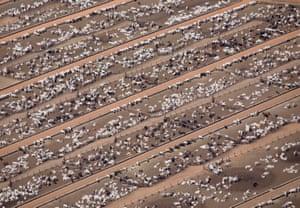
Cattle farm at Estancia Bahia, Agua Boa, Mato Grosso, Brazil
 A cattle farm in Mato Grosso, Brazil. 60% of all mammals on Earth are livestock. Photograph: Daniel Beltra/Greenpeace

Humankind is revealed as simultaneously insignificant and utterly dominant in the grand scheme of life on Earth by a groundbreaking new assessment of all life on the planet.

The world’s 7.6 billion people represent just 0.01% of all living things, according to the study. Yet since the dawn of civilisation, humanity has caused the loss of 83% of all wild mammals and half of plants, while livestock kept by humans abounds.

The new work is the first comprehensive estimate of the weight of every class of living creature and overturns some long-held assumptions. Bacteria are indeed a major life form – 13% of everything – but plants overshadow everything, representing 82% of all living matter. All other creatures, from insects to fungi, to fish and animals, make up just 5% of the world’s biomass.

Another surprise is that the teeming life revealed in the oceans by the recent BBC television series Blue Planet II turns out to represent just 1% of all biomass. The vast majority of life is land-based and a large chunk – an eighth – is bacteria buried deep below the surface.

“I was shocked to find there wasn’t already a comprehensive, holistic estimate of all the different components of biomass,” said Prof Ron Milo, at the Weizmann Institute of Science in Israel, who led the work, published in the Proceedings of the National Academy of Sciences.

“I would hope this gives people a perspective on the very dominant role that humanity now plays on Earth,” he said, adding that he now chooses to eat less meat due to the huge environmental impact of livestock.

https://interactive.guim.co.uk/uploader/embed/2018/05/all_life-zip/giv-3902Sgt2JYGV7lbj/

The transformation of the planet by human activity has led scientists to the brink of declaring a new geological era – the Anthropocene. One suggested marker for this change are the bones of the domestic chicken, now ubiquitous across the globe.

The new work reveals that farmed poultry today makes up 70% of all birds on the planet, with just 30% being wild. The picture is even more stark for mammals – 60% of all mammals on Earth are livestock, mostly cattle and pigs, 36% are human and just 4% are wild animals.

“It is pretty staggering,” said Milo. “In wildlife films, we see flocks of birds, of every kind, in vast amounts, and then when we did the analysis we found there are [far] more domesticated birds.”

https://interactive.guim.co.uk/uploader/embed/2018/05/livestock-zip/giv-3902QQbv2wCQM1xg/

The destruction of wild habitat for farming, logging and development has resulted in the start of what many scientists consider the sixth mass extinction of life to occur in the Earth’s four billion year history. About half the Earth’s animals are thought to have been lost in the last 50 years.

But comparison of the new estimates with those for the time before humans became farmers and the industrial revolution began reveal the full extent of the huge decline. Just one-sixth of wild mammals, from mice to elephants, remain, surprising even the scientists. In the oceans, three centuries of whaling has left just a fifth of marine mammals in the oceans.

https://interactive.guim.co.uk/uploader/embed/2018/05/wildlifelosses-zip/giv-39025SaTVRineiu5/

“It is definitely striking, our disproportionate place on Earth,” said Milo. “When I do a puzzle with my daughters, there is usually an elephant next to a giraffe next to a rhino. But if I was trying to give them a more realistic sense of the world, it would be a cow next to a cow next to a cow and then a chicken.”

Despite humanity’s supremacy, in weight terms Homo sapiens is puny. Viruses alone have a combined weight three times that of humans, as do worms. Fish are 12 times greater than people and fungi 200 times as large.

https://interactive.guim.co.uk/uploader/embed/2018/05/humanvother-zip/giv-3902p90ROfRxGU0x/

But our impact on the natural world remains immense, said Milo, particularly in what we choose to eat: “Our dietary choices have a vast effect on the habitats of animals, plants and other organisms.”

“I would hope people would take this [work] as part of their world view of how they consume,” he said. ”I have not become vegetarian, but I do take the environmental impact into my decision making, so it helps me think, do I want to choose beef or poultry or use tofu instead?”

The researchers calculated the biomass estimates using data from hundreds of studies, which often used modern techniques, such as satellite remote sensing that can scan great areas, and gene sequencing that can unravel the myriad organisms in the microscopic world.

They started by assessing the biomass of a class of organisms and then they determined which environments such life could live in across the world to create a global total. They used carbon as the key measure and found all life contains 550bn tonnes of the element. The researchers acknowledge that substantial uncertainties remain in particular estimates, especially for bacteria deep underground, but say the work presents a useful overview.

Paul Falkowski, at Rutgers University in the US and not part of the research team, said: “The study is, to my knowledge, the first comprehensive analysis of the biomass distribution of all organisms – including viruses – on Earth.”

“There are two major takeaways from this paper,” he said. “First, humans are extremely efficient in exploiting natural resources. Humans have culled, and in some cases eradicated, wild mammals for food or pleasure in virtually all continents. Second, the biomass of terrestrial plants overwhelmingly dominates on a global scale – and most of that biomass is in the form of wood.”