Canadians Killed More Than 750 Million Animals For Food in 2015


66947
Slaughter reports from Agriculture and Agri-Food Canada reveal that we killed at least 750,409,569 land animals for food in 2015.This is an increase from previous years, mostly due to an increase in the number of chickens killed. In recent years, we’ve killed roughly 620 million chickens each year. This number jumped to 640 million in 2014 and 660 million in 2015.

Here are the total number of animals slaughtered in Canada in 2015 by species:

Meat chickens: 660,959,987

Egg-layer hens: 36,526,578

Turkeys: 21,477,602

Ducks and geese: 5,989,919

Pigs: 21,186,243

Adult cows: 2,672,806

Calves: 225,530

Sheeps and lambs: 557,851

Goats: 61,048

Bisons: 14,186

Rabbits: 669,873

Horses: 67,946

These numbers don’t include:

  • More than 90 million tonnes of fin fishes like salmons (they are only counted by weight) killed in Canadian fish farms.
  • Tens of millions of male chicks killed at birth in the egg industry.
  • Millions of animals who died of disease or injuries on farms or en route to slaughter.
  • Thousands of deers, elks, and wild boars killed in Canadian slaughterhouses for which 2015 data is not available.

Photo: Louise Jorgensen, taken outside a chicken slaughterhouse in Toronto.

Big Food Strikes Back

from DawnWatch: This Sunday, October 9, the Magazine section of the New York Times is dubbed “The Food Issue.” It includes some terrific articles, including a piece by Michael Pollan, and a haunting photo-essay on big ag. Best of all it includes a piece, by Ted Genoways, on the undercover work of a
“Compassion Over Killing” investigator.

The article on the COK investigator, titled, “Close to the Bone,” and titled online “The Fight Over Transparency in the Meat Industry,” first tells us how little consumers know about the meat they eat. We read that the Department of Agriculture no longer oversees and verifies claims such as
“grass-fed” or “naturally raised,” and that even when the department certifies labels they are questionable, with no standard definition for “humanely raised,” and no site visits to confirm enforcement for those approved to use the label.

Genoways writes:
“Amid such dwindling transparency and oversight, animal rights activists, once regarded as the radical fringe, have taken on a somewhat unlikely role as consumer watchdogs.” He follows an investigator named Jay who get a job at a pig slaughterhouse near Austin. We read:

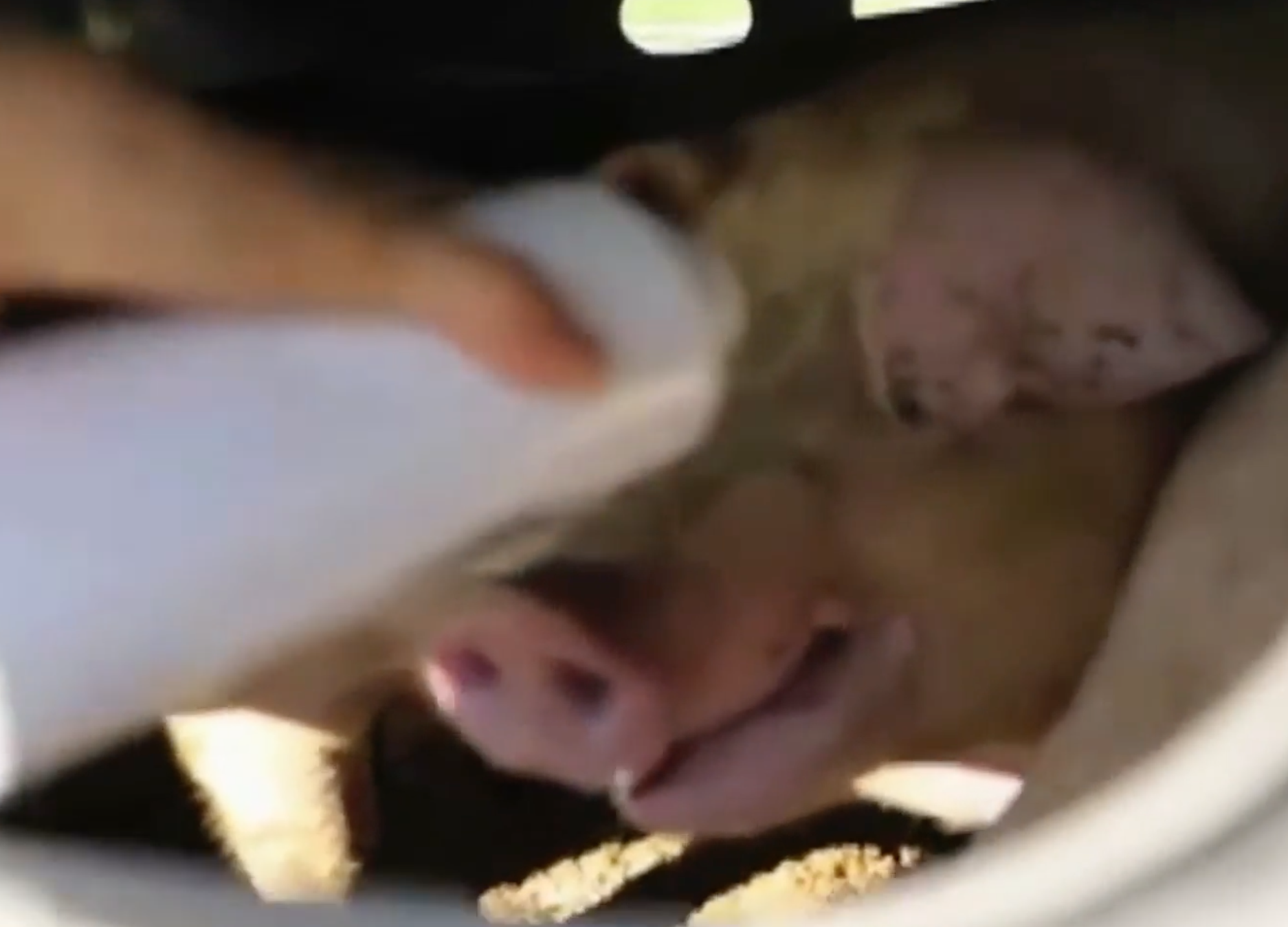
“He filmed a hog being hit in the face with plastic rattle paddles and electrically prodded on the head. He filmed another hog being repeatedly beaten then rolled and pushed by its hindquarters. He filmed hogs having their throats slit while still alive and — in one particularly harrowing sequence — appeared to capture a hog struggling to right itself in its shackle as it is carried toward processing. A spokesman for Q.P.P. said all the hogs ‘had been properly rendered insensible,’ but the video itself seems to contradict that claim. At one point, a worker shouts over the din of machinery and squealing pigs: ‘Too many sensibles. If U.S.D.A. is around, they could shut us down.'”

The article explains that because of a new kind of self-regulation, known as HIMP, the USDA was unlikely to be around.”

You’ll find the full piece on line at http://tinyurl.com/hansj7j

Michael Pollan’s article is titled, “Big Food Strikes Back.” The subheading is, “When Barack Obama took office activists hoped his administration would fight for stronger regulation of corporate agriculture. Eight years later they are still waiting.”

Pollan shares part of an early interview given by President Obama to Joel Klein of Time Magazine:

“I was just reading an article in The New York Times by Michael Pollan about food and the fact that our entire agricultural system is built on cheap oil. As a consequence, our agriculture sector actually is contributing more greenhouse gases than our transportation sector. And in the meantime, it’s creating monocultures that are vulnerable to national security threats, are now vulnerable to sky-high food prices or crashes in food prices, huge swings in commodity prices, and are partly responsible for the explosion in our health care costs because they’re contributing to Type 2 diabetes, stroke and heart disease, obesity.”

He reminds us that on the campaign trail Obama vowed “to bring CAFOs under the authority of the federal Clean Air and Clean Water Acts and Superfund program ‘just as any other polluter.’”

What follows is a fascinating study on the power of Big Ag. You’ll find it on line at http://tinyurl.com/hz3mr5v
Featured Image -- 12776

Factory Chicken Farming: An ‘unsustainable system’

From: http://www.theguardian.com/vital-signs/2015/jul/14/bird-flu-devastation-highlights-unsustainability-of-commercial-chicken-farming

An ‘unsustainable system’

This is likely, at least in part, because sunshine and warm backyard temperatures are effective at killing the virus, says Dr Michael Greger, director of public health and animal agriculture for the Humane Society of the United States.

Commercial poultry farms, on the other hand, “are designed like a disease incubator”, thanks to dark, moist and crowded conditions.

While factory poultry are more isolated, “when infected, [factory-farmed birds] are subject to wildfire-like outbreaks”, says Michael Davis, author of The Monster at Our Door: The Global Threat of Avian Flu.

On top of that, the genetic makeup of birds found in factory farms is often less diverse than those raised in backyard flocks. Due to the industry’s reliance on homogenous breeding techniques, commercially raised broilers are all pretty much genetically identical. Broilers and turkeys are artificially selected and bred to produce birds that grow quickly – at a rate 300% faster than those birds raised in 1960, according to the ASPCA – and produce as much breast protein as possible, to the point where the birds have a hard time standing upright.

Not only do commercial flocks share a limited gene pool, but some studies have suggested the industry’s vise-like focus on breast meat, in the case of broilers and turkeys, and eggs, in the case of hens, suppresses the birds’ immune systems, a theory known as resource allocation.

When a bird is bred so that all its energy goes to the production of meat or eggs, “something has to give”, says the ASPCA’s McMillan. “The science indicates that a bird’s immunity goes down.”

As Greger puts it: “There is an inverse relationship between accelerated growth and disease resistance, which means faster-growing birds are more susceptible to illness.”

While the USDA terms this outbreak “a wake-up call on biosecurity”, the idea of hermetically sealing farms, which use ventilation fans to keep birds cool, may be too difficult to enforce. “The industrial poultry system, by its very nature, is vulnerable to these kinds of infections,” he says.

It’s the system that is at fault, according to McMillan. “We are forcing birds to live in unbalanced ways, both physically and genetically,”she says. Commercial poultry flocks “are bred to suffer. We force them to live a life of misery, and from that perspective, they are going to be more prone to contracting and spreading disease. These are not healthy, balanced animals.”

Costco: It’s Time to Go Cage-Free

Featured Image -- 9459

A Costco egg supplier was recently found cramming chickens into tiny cages, forcing birds to live in cages with the decayed, mummified corpses of their dead cage-mates, and engaging in other inhumane practices that are bad for animals and food safety. This is in stark contrast to the happy hens and green fields depicted on egg cartons sold at Costco.

It’s been eight years since Costco indicated publicly that it wanted to eliminate cage confinement of chickens from its supply chain. Let the company know that now is the perfect time to go cage-free!

Take Action: http://action.humanesociety.org/site/PageServer?pagename=mconnect_costco&s_src=em_ha060915

Media Coverage of California Water Shortage Omits Biggest Culprit — Animal Agriculture

http://theirturn.net/2015/04/07/animal-agriculture-water-shortage

April 7, 2015 by

In its extensive coverage of the California drought, the New York Times has consistently focused on the cultivation of crops without so much as mentioning animal agriculture, which is far more water intensive.

The glaring omission has sent readers the message that fruits, vegetables and nuts  – not beef and dairy – are responsible for the state’s grave water shortage. Following are excerpts from the NY Times over the past three days.

April 6th: “Even as the worst drought in decades ravages California, . . . millions of pounds of thirsty crops like oranges, tomatoes and almonds continue to stream out of the state and onto the nation’s grocery shelves.”

April 5th: “The expansion of almonds, walnuts and other water-guzzling tree and vine crops has come under sharp criticism from some urban Californians.”

April 4th: ”There is likely to be increased pressure on the farms to move away from certain water-intensive crops — like almonds.”

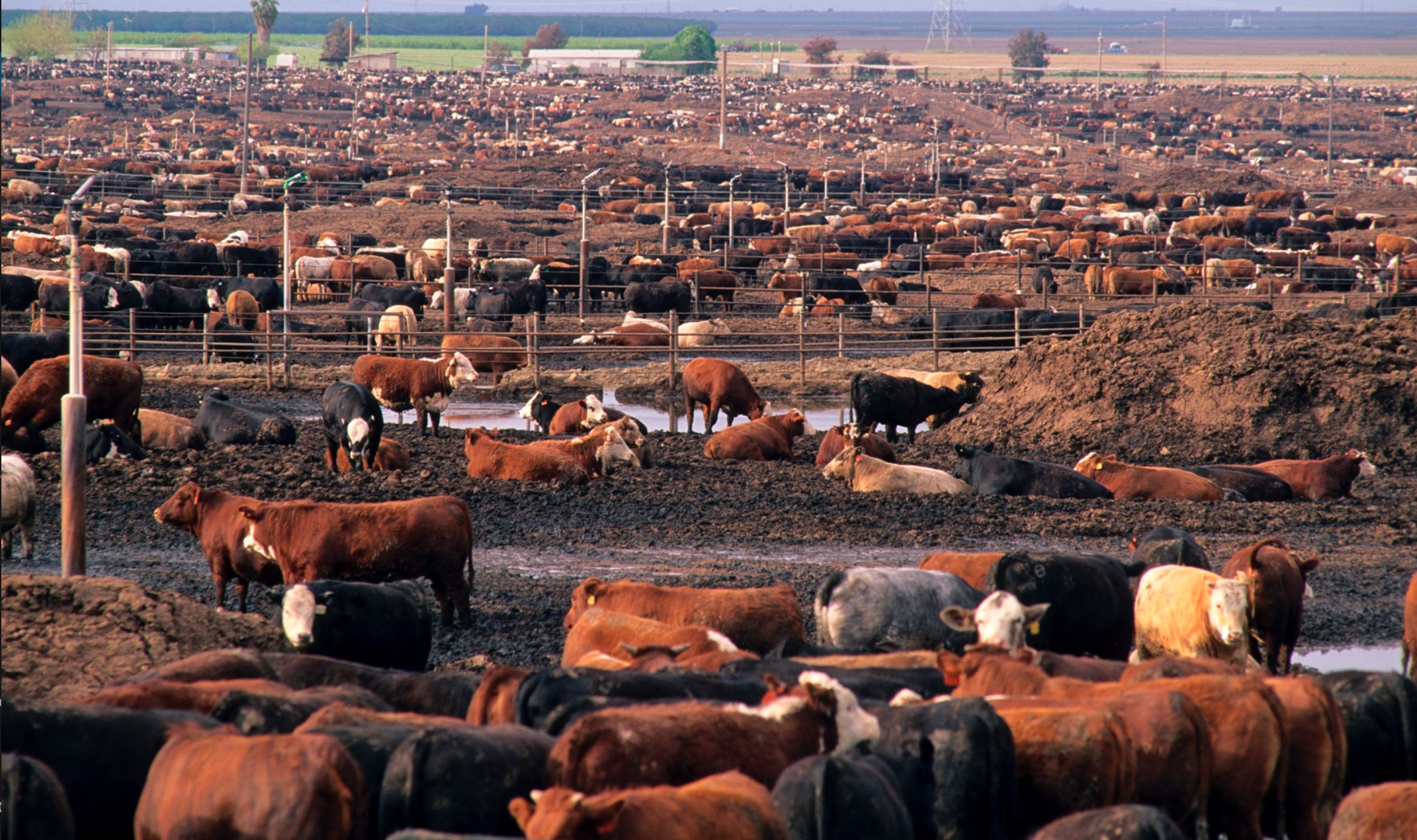
Cultivating crops might be be water intensive, but it uses a fraction of the water consumed in animal agriculture. On California’s factory farms, which house tens of millions of chickens, pigs and cows, water is used not only to hydrate these animals but also to grow their feed and clean the facilities and slaughterhouses where they are raised and killed.

Cows in a California feedlot

Eliminating animal agriculture, which inefficiently uses of a scarce resource and is altogether unnecessary, would undoubtedly help to curb California’s water shortage.

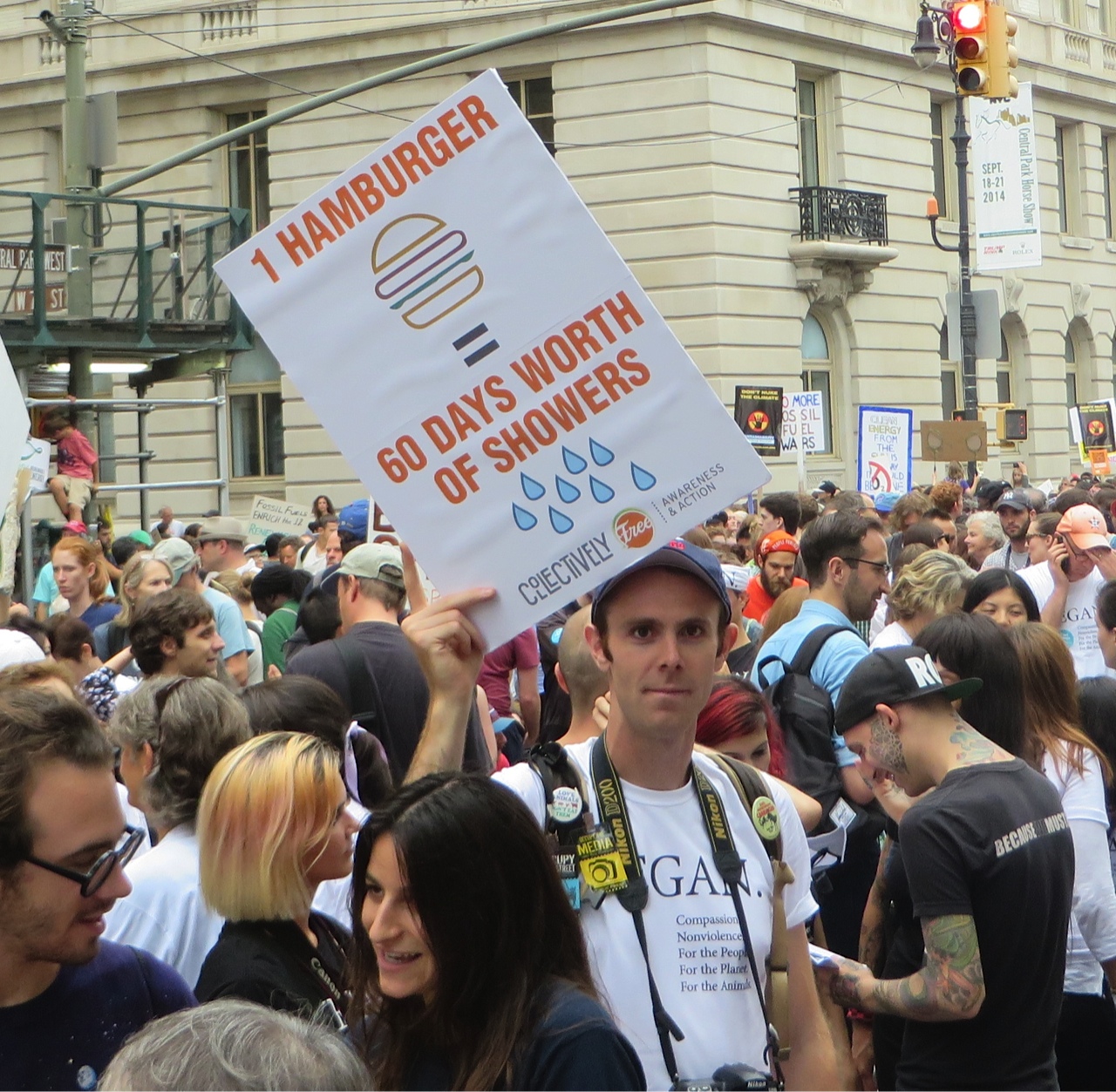
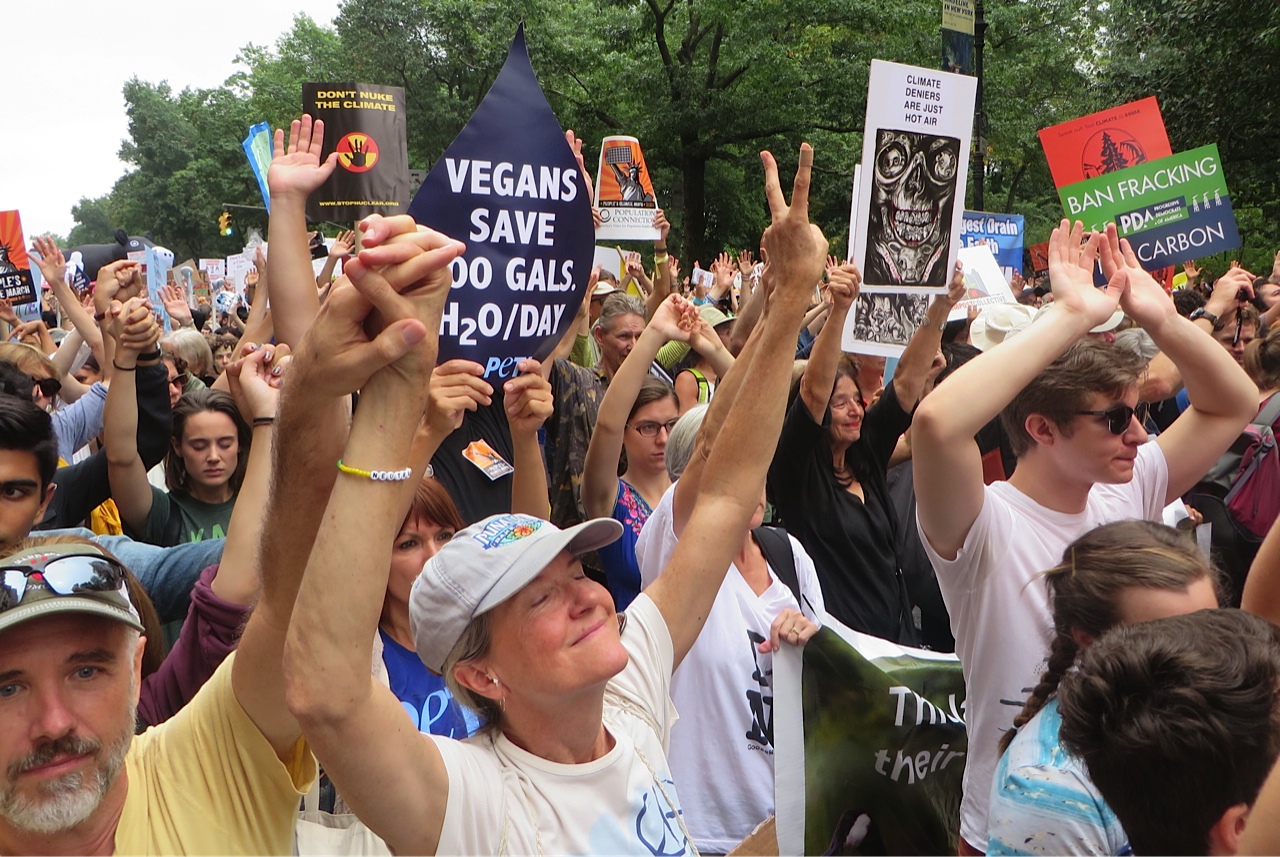
2014 Climate March participants highlighted impact of animal agriculture on water supply

Following are just a few statistics that demonstrate the impact of animal agriculture on the water supply:

  • 2,500 gallons of water are used to produce one pound of beef compared to 100 gallons for a pound of wheat.
  • Vegetables use about 11,300 gallons of blue* water per ton. Pork, beef and butter use 121,000, 145,000 and 122,800 gallons per ton respectively. (*Blue water is water stored in lakes, rivers and aquifers.)
  • Each day, cows consume 23 gallons of water; humans drink less than one.
  • The amount of water needed to produce a gallon of milk is equivalent to one month of showers.
  • 132 gallons of water are used every time an animal is slaughtered.

One year ago (March, 2014), the NY Times published an op-ed, Meat Makes the Planet Thirsty, that included statistics comparing the amount of water used for crops and animals. So why is it omitting this vital information in its current coverage of the drought? Could it be a mere oversight? Or is it something more sinister?

2014 Climate March participants highlighted the the amount of water used in animal agriculture.

Factory farms are hotbeds for viruses

http://www.desmoinesregister.com/story/opinion/columnists/iowa-view/2015/04/22/factory-farms-hotbeds-viruses/26215265/

by Michael Greger, M.D  April 22, 2015

In Iowa, poultry producers are losing birds due to the latest avian influenza (H5N2) outbreaks on factory farms. The poultry industry nationally has already lost tens of millions of dollars. Since the government compensates producers for birds who are killed to prevent the flu from spreading, taxpayer dollars, as well as animal lives, are being squandered.

The largest outbreak of bird flu in American history was an H5N2 virus, which led to the deaths of 17 million domestic birds and cost the nation more than $400 million during an outbreak in Pennsylvania that started in 1983. In 2002, the first case of human infection with an avian influenza virus was reported. The emergence and spread of virulent strains of avian influenza has been attributed by experts to the intensely overcrowded, unsanitary, and stressful conditions that often characterize large-scale factory farming in industrialized agriculture.

In nature, disease-causing strains of avian influenza rarely spread far because the birds sicken and die before they can fly to spread it to others. However, in unnatural, intensive agricultural systems, pathogens are more easily able to evolve from mild strains to dangerous, highly pathogenic forms. Nine out of 10 chickens used for egg production in the U.S. are confined in barren wire cages. These cages are stacked in often windowless sheds that typically confine more than 100,000 animals each.

Due to the extreme confinement, hens — who are highly intelligent and social animals — cannot engage in natural behaviors like nesting, perching, or even spreading their wings. High levels of stress can lead to weakened immunity, rendering animals much more susceptible to disease. This makes the average poultry factory farm a hotbed for outbreaks of avian flu.

Overcrowding vast numbers of animals beak-to-beak in their own waste presents threats to human and animal health. The poultry industry looks for easy scapegoats such as wild ducks and geese, even though these animals have flown over North America for millennia. Until our society demands hygienic and animal welfare reforms, dangerous pathogens will continue to multiply and spread. The best-case scenario is that these outbreaks will continue to squander taxpayer money on endless games of Whack-a-Mole. The worst-case scenario — the jump of a highly contagious strain to humans — is unfathomable.

MICHAEL GREGER, M.D., is the author of “Bird Flu: A Virus of Our Own Hatching” and the director of public health and animal agriculture at The Humane Society of the United States. Contact: mgreger@humanesociety.org

Factory Farm 360

http://www.all-creatures.org/articles/mdi-factory-farm-360.html

FROM

Last Chance for Animals (LCA)
February 2015

The first interactive, 360-degree video of animal life on factory farms. Brought to you by LCA’s Sam Simon Special Investigations Unit.

WATCH THE TRUTH about Pig Farms

CLICK AND DRAG ON THE VIDEO TO LOOK AROUND

  • On a factory farm, a breeding pig spends most of her life in a gestation crate too small for her to turn around in. The confinement is maddening; pigs bite on the bars until their mouths are sore and bloody.
  • After about four months, the mother is moved to a small, filthy maternity crate, where she will give birth and nurse her babies.
  • The piglets’ back teeth are cut with pliers, and their tails are clipped. The males are castrated with no anesthetic, so the meat tastes more pleasing to consumers.
  • Many piglets die of infection, or are crushed to death by their mother because her movement is so restricted. Dead piglets are gutted, and their intestines fed to mother pigs in an effort to immunize them from disease. After just weeks, the surviving piglets will be taken away and the mother re-impregnated.
  • These facilities are breeding grounds for harmful bacteria like salmonella, so pigs are given steady doses of antibiotics, spawning antibiotic-resistant germs.
  • Workers deface the pigs’ bodies with spray paint to mark their status, like whether they’re pregnant or that it’s time for them to die. Some workers have spray-painted “kill” or “die” right on animals’ backs.
  • Nearly all pork at grocery stores and restaurants in the U.S. – including bacon, ham and pork sausage – comes from these farms, where the pigs endure excruciating suffering every day of their lives.
  • You can help end this torture by choosing cruelty-free meatless options instead of pork.

WATCH THE TRUTH about Free-Range Egg Farms

CLICK AND DRAG ON THE VIDEO TO LOOK AROUND

  • This is a “free range” egg farm, but these hens are far from free. They know only concrete and metal, and beneath the grating under their feet sits piles of urine and manure.
  •  Dead hens rot among the living, spreading their disease.
  • All of these hens’ brothers were killed the day they were born, because to the egg industry, they are worthless.
  • In the U.S., no government-regulated standards exist for “free range” farms. Hens may go outside for just minutes a day. Some birds never even get outdoors, because access is blocked by the crowds.
  • The crowding and filth create a breeding ground for bacteria and parasites, making both birds and humans sick.
  • This is cruel, and it’s happening right now to hens all over the world. Help end their suffering by choosing plant-based alternatives to eggs and other animal products. Together, we can stop farm cruelty.

WATCH THE TRUTH about “Broiler” Chicken Farms

CLICK AND DRAG ON THE VIDEO TO LOOK AROUND

  • You are in a room of thousands of other “broiler” chickens, where you will spend your entire life never seeing sunlight.
  • Beneath you is a sludge of litter, urine and manure; it has so much ammonia, it’s burning your feathers off, so your chest is sore and bald.
  • You’ve been bred for constant hunger, and the lights are on all night to keep you awake and eating.
  • You’re so obese, you cannot stand (If you were a 10-year-old child, you’d weigh 500 pounds by now).
  • You probably have salmonella or another sickening bacteria, spawned from the overcrowding and filth.
  • Sound like torture? It is. And it’s reality for chickens found at nearly all stores and restaurants in the U.S.
Rescued Chicken--Pigs' Pease Sanctuary

Rescued Chicken–Pigs’ Pease Sanctuary

Tell Costco to stop selling factory farmed eggs

598875_10151079569092823_924805190_n

The egg industry forces birds on factory farms to spend their entire lives cramped in cruel, filthy, and unsustainable battery cages. There are better ways to raise birds, and that’s why California passed two groundbreaking animal protection laws, Prop 2 and AB1437, that together require all shell eggs sold in the state to be produced by farm animals that have adequate space for natural behaviors by January 2015. The problem is Costco refuses to work with The Humane League to assure they will follow this law that gave retailers years to phase in. Please sign our petition asking Costco to stop selling factory farmed eggs.

Unfortunately, a few retailers are ignoring the intention of these animal cruelty laws by planning to sell eggs from hens trapped in modified cages. They have had six years to make adjustments to follow the law, but they feel there is a loophole that allows birds to remain confined in warehouses of tiny, filthy cages stacked upon each other. We can show Costco that consumers demand trustworthy, ethical business practices from this retail giant.

Costco, the large chain of warehouse stores founded in California, is now presented with the opportunity to stand with the voters of California and pledge to be 100% cage-free in the state or turn its back on the efforts of voters who do not want to contribute to inhumane animal agriculture practices.
Please, sign our petition and ask Costco to take a stand against animal cruelty in California and make plans to extend this policy nationally. It’s time for Costco to do the right thing and end its support of farms that still use cage systems.

Sign the Petition: https://mail.google.com/mail/#inbox/14a6db80fdd5788c

59 Billion Farmed Animals Serve an Insatiable Human World

524958_3325028303604_654533903_n

There are 59 billion animals alive at any one time, farmed for their meat. The world’s domestic cattle weigh 16 times as much as all the wild animals on the planet put together. 60% of the globe’s agricultural land is used for beef production, from growing grain to raising cows. Since the early-20th century, industrial farming and global capitalism have worked hand-in-hand to provide meat at an ever cheaper price. And our appetites, so tempted, have led us to consume more and more animals. In the US, each citizen eats on average 120kg of meat per year. And that’s not even the number one spot. Our insatiable desire for meat has defined how we use our planet. But cheap meat comes at a price. Planet Carnivore gets under the skin of the health problems that over-consumption brings; of modern farming’s destructive use of resources; and of the stretched and strained farms and abattoirs that lead to horsemeat in beef burgers and challenging moral questions about our relationship with our food. Alex Renton’s brilliantly researched, utterly compelling Guardian Short serves up the grisly stories, and also looks at how we are beginning to try and pay the cheap meat bill, from innovative twists on current techniques to cutting edge scientific breakthroughs. – See more at: http://guardianshorts.co.uk/planetcarnivore/#sthash.oURzZciG.dpuf

Special Seattle Cowspiracy screening Wednesday, Nov 5

10401438_268406586684204_5581115448172125682_n
If you missed the Seattle screening of Cowspiracy: The Sustainability Secret, here’s another chance. They need to secure 55 more tickets to confirm the screening at the SIFF Film Center.
Please buy (secure) your ticket and one for a friend today! If we each bring someone who hasn’t seen it (or two someones), not only will the show go on, but we’ll educate more people around us to the suffering of the planet and how to help stop it.