Exposing the Big Game

Forget Hunters' Feeble Rationalizations and Trust Your Gut Feelings: Making Sport of Killing Is Not Healthy Human Behavior

Exposing the Big Game

Solidarity bring bill to ban fur farming

Irish Council Against Blood Sports ICABS

Ireland, Ireland


JUL 19, 2018 — https://www.change.org/p/1753085/u/23032726?utm_medium=email&utm_source=petition_update&utm_campaign=382004&sfmc_tk=r%2ff4W2iW7iRcZhCc4lpkbASvtXo40j1uSOXag2FRLd3grPSaJZ5UkLMB8X1vy9O3&j=382004&sfmc_sub=140542604&l=32_HTML&u=64667104&mid=7259882&jb=12

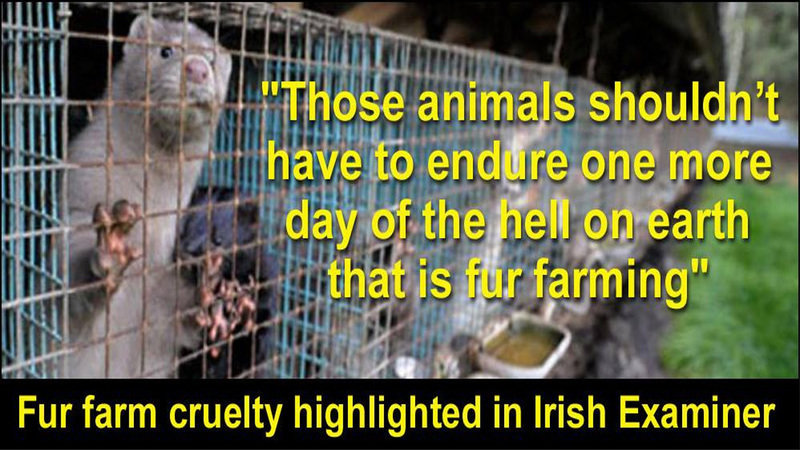
Those animals shouldn’t have to endure one more day of the hell on earth that is fur farming” – read John Fitzgerald’s Letter to the Editor in today’s Irish Examiner…

Solidarity bring bill to ban fur farming
Irish Examiner, 19 July 2018

Fair play to the Solidarity party for preparing a bill to ban the cruel practice of fur farming in Ireland. The bill will be introduced in the Dáil after the summer recess.

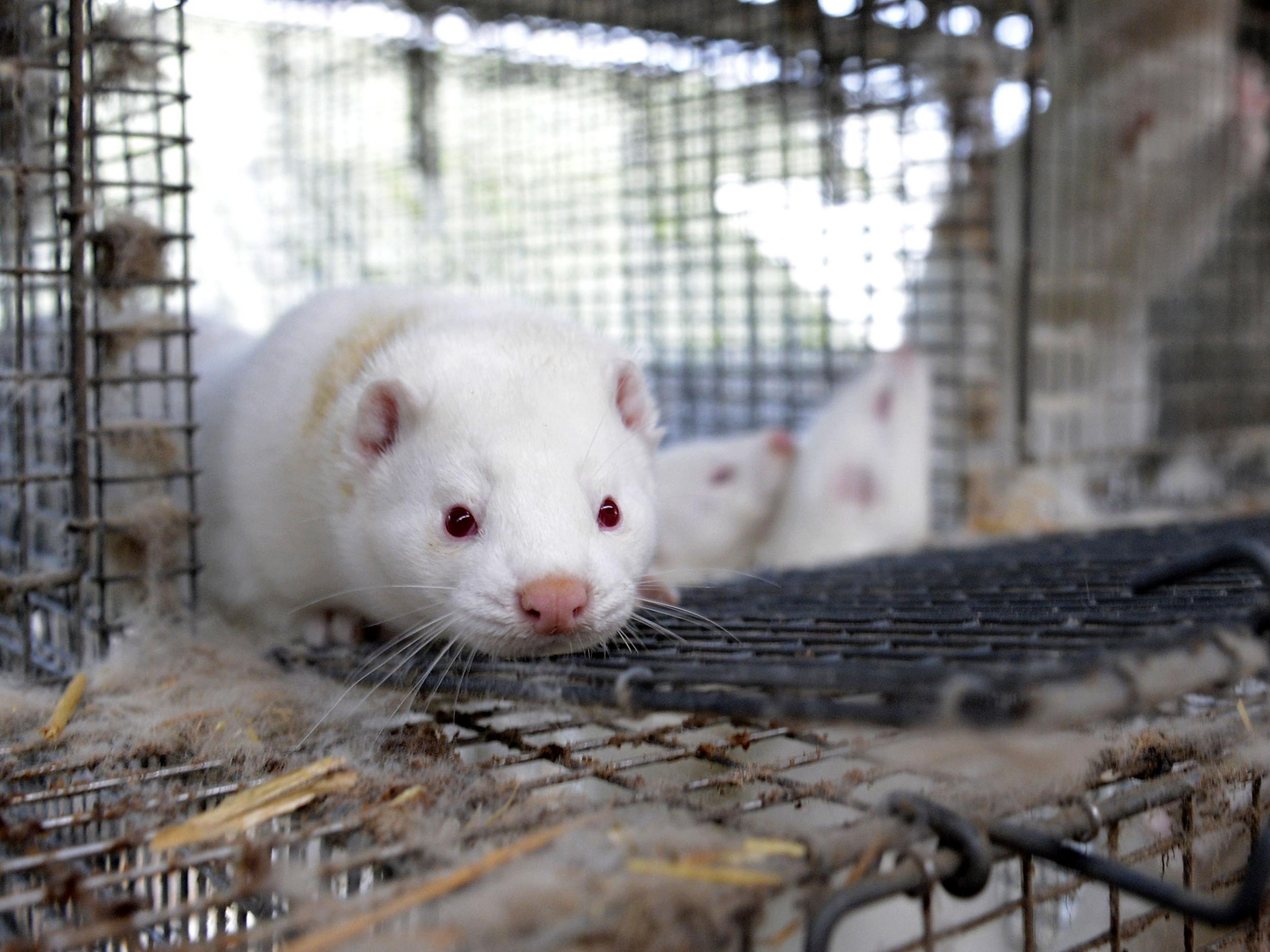
More than 200,000 mink are killed on Irish fur farms every year and their treatment cannot reasonably be likened to that of conventional farm livestock. These are wild animals, inherently unsuited to captivity, let alone to being confined in small spaces for their short lives. The cages that hold them are each about the size of two shoe boxes.

Though semi-aquatic by nature they are denied a watery environment on the farms. Their captors feed them on bits of liquidised fish organs, which they have to “earn” by licking at these through the tops of their cages.

Mink are solitary creatures in the wild whereas on the farms they are forced to mingle and co-exist with other mink. They react against these cruel and deviant conditions by indulging in repeated self-harm and cannibalism, while also suffering from extreme levels of stress as they struggle in vain to escape.

At the age of six months, they are taken from their cages for slaughter. Up to 40 mink at a time are squeezed into the killing box, and gassed to death by carbon monoxide. The skin is then ripped from their bodies. Some mink are still alive and unconscious when removed from the box and have to be “dispatched” before skinning. This is definitely not a humane farming practice. It came close to being banned in 2010 but the legislation didn’t go through owing to the collapse of the Fianna Fáil/Green Party coalition.

We earnestly appeal to the Minister for Agriculture, Michael Creed, to respond to the Solidarity bill by putting an immediate end to this practice.

Those animals shouldn’t have to endure one more day of the hell on earth that is fur farming.

John Fitzgerald
(Campaign for the Abolition of Cruel Sports)
Callan, Co Kilkenny

__________________________

ICABS ACTION ALERT

Please contact your TDs and urge them to support the upcoming Solidarity bill to ban fur farming. Contact details for TDs can be found at https://www.oireachtas.ie/en/members/tds/?term=/ie/oireachtas/house/dail/32 Also contact the political parties to urge them to back the bill – find contact details at http://www.banbloodsports.com/parties.htm

Join us in urging Minister Michael Creed and Taoiseach Leo Varadkar to put in place a long overdue ban on fur farming.

Email “Ban fur farming NOW” to Leo.Varadkar@oir.iemichael.creed@oir.ietaoiseach@taoiseach.gov.ieAnimalHealthAndWelfareAct@agriculture.gov.ie

Tel: +353 (0)1 6194000 (Leo Varadkar)
Tel: 01-607 2000 or LoCall 1890-200510 (Michael Creed)
Tweet: @campaignforleo @creedcnw Ban fur farming NOW
Comment on Facebook:
https://www.facebook.com/campaignforleo/
https://www.facebook.com/michaelcreedtd

VIDEOS

ICABS footage – Victims of Ireland’s cruel far farming
https://www.youtube.com/watch?v=artr7qwCLLk&index=2&list=PL43C1F00F38986C68

NARA footage showing caged mink in a fur farm in Donegal
https://www.facebook.com/NARAcampaignsIRELAND/videos/1694193503937318/

Mink pulled from cages and thrown into gassing box
https://youtu.be/m52k4aPXahU?t=3m6s

Animals rights groups scent blood as fashion labels go fur-free

http://www.themalaymailonline.com/features/article/animals-rights-groups-scent-blood-as-fashion-labels-go-fur-free1

NEW YORK, April 3 — Is this the beginning of the end for fur?

With more and more fashion houses going fur-free, San Francisco banning fur
sales in the city and British MPs considering outlawing all imports of
pelts after Brexit, the signs do not seem good for the industry.

After decades of hard-hitting campaigning against fur, animal rights
activists believe they scent victory.

Last week Donna Karan and DKNY became the latest in a flood of luxury
brands to say they were planning to go fur free, following similar
announcements by Gucci, Versace, Furla, Michael Kors, Armani and Hugo Boss
in recent months.

US-based animal rights group Peta (People for the Ethical Treatment of
Animals), which is famous for its spectacular anti-fur protests, declared
that “2018 is the year that everyone is saying goodbye to fur”.

“Times are changing and the end of fur farming is within reach!” it told
its 687,000 Instagram followers.

The British-based Humane Society International said the tide turned when
Gucci declared it was going fur-free in October. Another hammer blow came
this month when Donatella Versace said that “I don’t want to kill animals
to make fashion. It doesn’t feel right.”

“Such influential brands turning their backs on cruel fur makes the few
designers like Fendi and Burberry who are still peddling fur look
increasingly out of touch and isolated,” said the society’s president Kitty
Block.

Fendi’s Karl Lagerfeld shows little sign of second thoughts, however, and
has said he will use real fur as long as “people eat meat and wear leather”.

*‘Leather is next’*

But Peta, which also campaigns for veganism, has warned the leather
industry that is also in its sights, saying “You are next…”

And Professor Nathalie Ruelle, of the French Fashion Institute, told AFP
that it was telling that the new fur-free brands “did not say anything
about exotic leathers (such as crocodile, lizard and snakeskin).”

Of the big designers, Stella McCartney, a vegetarian and animal rights
activist herself, has pushed the ethical envelope the furthest, refusing to
use fur, leather or feathers.

But vegans want to go further still, with a ban on all animal products,
which for some also means wool.

But the fur industry is not taking this lying down and has become much more
vocal in its bid to counter animal rights groups’ social media campaigns.

The International Fur Federation (IFF) took Gucci to task when it went
fur-free, asking if it “really wanted to choke the world with fake plastic
fur…”

Philippe Beaulieu, of the French fur federation claimed fur-free was a
marketing gimmick “trying to surf on emotion” to please millennials.

Fake fur, he said, was the real danger to the environment. “Brands who stop
fur push synthetic fur which comes from plastic, a byproduct of the petrol
industry, with all the pollution and harm to the planet that that entails.”

*China’s passion for fur*

In contrast, fur is natural and more and more durable and traceable, he
said.

Arnaud Brunois, of the Faux Fur Institute, which he set up to counter the
IFF, disputes this.

He insisted that “from an ecological point of view it was better to use a
waste product from oil… than farm 150 million of animals then skin them
and finally treat the pelts with chemicals.”

“It is part of the real fur industry’s marketing campaign to denigrate faux
fur,” he added.

These days imitation can sometimes pass for the real thing as the British
designer Clare Waight Keller proved in her fake fur-heavy Givenchy show at
Paris fashion week earlier this month.

Luxury brand expert Serge Carreira at Sciences Po university in Paris said
“fur was marginal for most of the fashion houses who have stopped using it.”

For instance, it only accounted for ‎€10 million (RM47.6) of Gucci’s
six-billion turnover in 2017, or 0.16 per cent.

While fur coats are now rarer on the streets of cities in the West, coats
with fur collars — either fake or real, and sometimes a mixture of both,
activists claim — are everywhere.

In China, however, the picture is very different.

Fur sales grew “phenomenally” there over the last decade, said IFF CEO Mark
Oaten, and despite levelling off still dwarfs all those elsewhere combined.

The world’s biggest fur consumer is now also far by its it largest producer
in a industry worth US$30 billion (RM116 billion) globally in 2017. — AFP

*If there are no dogs in Heaven, then when I die I want to go where they
went. (Will Rogers)*

*the wild, cruel beast is not behind the bars of the cage. he is in front
of it – axel munthe*

Fur is dead: Animal welfare groups cheer San Francisco ban

SAN FRANCISCO (AP) — San Francisco supervisors voted unanimously to ban the sale of fur, further burnishing the city’s animal-loving credentials as it becomes the largest U.S. city to approve the prohibition.

Animal welfare advocates around the world cheered news of Tuesday’s vote, applauding the city for its compassion and hoping that the legislation will catch on.

The ban takes effect Jan. 1 and applies to apparel and accessories featuring real fur, including coats, key chains and gloves. An amendment added Tuesday allows furriers and other retailers to sell current inventory until January 1, 2020.

Wayne Hsiung, co-founder of animal rights network Direct Action Everywhere, said in a statement that “this historic act will usher in a new wave of animal rights legislation across the globe.”

Retailers in San Francisco, however, balked at what they called another social mandate at the cost of their ability to make a living.

“It should be a citywide public vote, it shouldn’t be decided by the Board of Supervisors,” said Skip Pas, chief executive officer of West Coast Leather, which sells fur-trimmed items but deals largely in leather.

San Francisco, named for the patron saint of animals, has a reputation for a strong social conscience, often at a cost to businesses.

Its board banned the sale of menthol cigarettes and other flavored tobacco, which voters will consider in June. In 2016, San Francisco approved what was then a groundbreaking paid parental leave law, requiring private employers to offer six weeks of fully paid leave.

Katy Tang, the supervisor behind the fur ban legislation, has successfully pushed to prohibit performances by exotic animals and to forbid the sale of non-rescue cats and dogs from pet stores.

Mayor Mark Farrell said he plans to sign the legislation.

About 50 clothing and accessory retailers downtown will be affected by the legislation, said Jim Lazarus, senior vice president of public policy at the San Francisco Chamber of Commerce. Reselling vintage and used fur by outlets not usually in the business of trading fur, such as secondhand stores, pawn shops and nonprofits, will still be allowed.

The chamber estimates San Francisco fur sales account for at least $40 million a year. The city’s Office of Economic Analysis estimated fur sales at $11 million in 2012, based on census figures.

The city says even if sales numbers are much higher than its estimate a prohibition is unlikely to significantly harm the overall local economy.

The Fur Information Council of America and the International Fur Federation wrote to supervisors before the vote, seeking to partner with the city to launch a rigorous certification program that it said would ensure animal and environmental health.

The organizations did not have immediate comment on Tuesday’s vote.

The prohibition will hit retailers large and small, although smaller businesses will probably have a harder time adjusting. Luxury department stores Neiman Marcus and Saks Fifth Avenue both feature fur salons. Representatives for the stores did not respond to requests for comment.

Benjamin Lin, 72, owns B.B. Hawk in the South of Market neighborhood. His showroom features chinchilla, sable, fox, and Blackglama mink.

He is considering keeping his current location but selling fur at a smaller place nearby, outside San Francisco.

“I cannot fight it,” he said of the ban. “I will not win. I do not have the energy and the money.”

San Francisco joins two other California cities, West Hollywood and Berkeley, in saying no to fur.

Renewed calls on Irish Govt to end fur farming as Norway announces ban

Irish Council Against Blood Sports ICABS

Ireland, Ireland

JAN 17, 2018 — There are renewed calls on the Irish Government to end fur farming as Norway this week announces that a total ban will come into affect.

Norway’s government has pledged to shut down all of the country’s 250+ fur farms by 2025, becoming the 14th European nation to phase out fur farming.

Meanwhile in Ireland, where just three fur farms remain, the government has so far refused to take action to stop this vile industry. Please join us in renewing an appeal to Agriculture Minister Michael Creed and the Irish Government to put in place a fur farming ban.

Watch our video footage of mink caged on Ireland’s largest fur farm in Laois
https://www.youtube.com/watch?v=BvX1O9GvsQ4

ACTION ALERT

Demand a ban on fur farming in Ireland. Contact Prime Minister Taoiseach Leo Varadkar and Agriculture Minister Michael Creed now.

Email “Ban fur farming NOW” to Leo.Varadkar@oir.iemichael.creed@oir.ietaoiseach@taoiseach.gov.ieAnimalHealthAndWelfareAct@agriculture.gov.ie

Tel: +353 (0)1 6194000 (Leo Varadkar)
Tel: 01-607 2000 or LoCall 1890-200510 (Michael Creed)
Tweet: @campaignforleo @creedcnw Ban fur farming NOW
Comment on Facebook:
https://www.facebook.com/campaignforleo/
https://www.facebook.com/michaelcreedtd

“Norway pledges to shut down all fox and mink fur farms by 2025” – Read the Independent UK report
http://www.independent.co.uk/news/world/europe/norway-fur-farm-ban-close-deadline-20225-mink-fox-animal-rights-erna-solberg-a8162196.html

Norway is banning all fur farms
Norway’s government has pledged to shut all fur farms by 2025, a move welcomed by animal rights charities. The country is the 14th…

“Ban Fur Farming” demo this Saturday 4th November in Laois

Irish Council Against Blood Sports ICABS

Ireland, Ireland

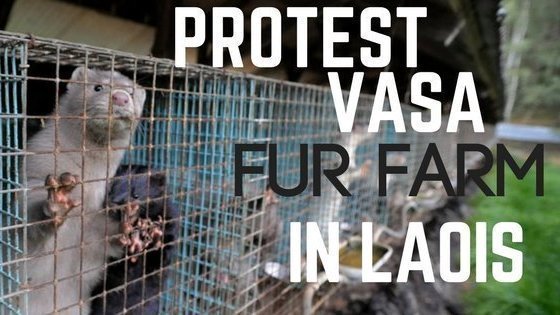
NOV 2, 2017 — A “Ban Fur Farming” demo will be held this Saturday 4th November, 11am to 2pm, outside ‘Vasa Ltd’ fur farm in Vicarstown, County Laois.

The protest is being organised by the National Animal Rights Association who point out that “over 50,000 mink are murdered on this farm every year – all for the sake of ‘fashion’.”

“These animals are suffering every single day, with no one to speak up for them,” NARA states. “Will you be their voice? Please join our campaign to shut down this hellhole once and for all!”

Footage filmed by ICABS at this fur farm – https://www.youtube.com/watch?v=BvX1O9GvsQ4 – shows mink desperately jumping against the bars of the cages that keep them permanenely trapped. After six months, the animals are dragged from the cages and gassed with Carbon Monoxide before the fur is pulled from their bodies. It’s time for the Irish Government to recognise the cruelty and ban this shameful industry.

Find out more details about Saturday’s demo at
https://www.facebook.com/events/135511527092474/

ACTION ALERT

Demand a ban on fur farming in Ireland. Email Minister Michael Creed and Taoiseach Leo Varadkar now.
Email: michael.creed@oir.ie, minister@agriculture.gov.ie, taoiseach@taoiseach.gov.ie, AnimalHealthAndWelfareAct@agriculture.gov.ie

Tel: +353 (0)1-607 2000 or LoCall 1890-200510.

Leave a comment on Facebook:
https://www.facebook.com/michaelcreedtd

Tweet “Ban fur farming NOW” to: @creedcnw

Tel: +353 (0)1 607 2884 or LoCall 1890-200510.

SAMPLE LETTER

Dear Minister Michael Creed / Taoiseach Leo Varadkar,

I support a total ban on fur farming and an immediate closure of Ireland’s fur farms.

In these hellholes, animals suffer a horrendous life of misery before being cruelly gassed to death. There is absolutely no justification for allowing this cruelty to continue.

Please ban fur farming now.

Yours sincerely,

[Name/Location]

Shocking video shows fox cubs being raised in cramped cages on a fur farm before being ELECTROCUTED to be made into coats

Over 110,000,000 animals are killed on fur farms every year according to Animal Defenders International (ADI), an animal protection charity
It placed hidden cameras on a Polish fur farm to give insight into the fur trade
The film follows the short lives of three fox cubs named Borys, Eryk and Aleska
Almost £4.5million of fur products were imported to the UK from Poland in 2016

Shocking footage shows arctic foxes being raised from cubs in cramped cages before they are electrocuted to death at seven-months-old for the fur trade.
Over 110,000,000 animals are killed on fur farms every year according to Animal Defenders International (ADI), an animal protection charity.
The organisation placed hidden cameras on a Polish fur farm to give a rare insight into the fur trade.
The film, called A Lifetime, follows the lives of a family of foxes, focusing on three cubs named Borys, Eryk and Aleska.

Throughout the video, the cubs are kept in a small wire cage until the day of their death.
The video starts as the cubs are nursed by their mother and baby Aleska takes her first halting steps.
After a few weeks their mother is removed and the growing cubs explore their small world and play together.

As their coats change to the thick white fur that should protect them through the winter months, their days are numbered.
At less than 7 months of age, Borys and Eryk are dragged from their cage by their tails, hung upside down, and electrocuted.
Aleska can only watch on as her terrified brothers are killed in front of her.

Aleska will be used to produce next year’s babies for the fur trade.
Actress Joanna Lumley, who supports the campaign, said: ‘Be comfortable in your own skin, and not that of a poor defenceless animal caged and killed to provide it. Say no to fur and yes to helping these fashion victims. Please help ADI stop this brutal trade.’
The UK trade information database shows that almost £4.5 million worth of fur products were imported into the UK from Poland in 2016.
Europe-wide exports value over €994 million, with Italy, Greece, France, Germany and the UK reporting the highest export value.
Despite a ban on fur farms, the UK is one of the largest exporters of fur in Europe, exporting over €25 million pounds worth of garments per year.
The UK imported over £4.5 million worth of fur skins, and clothing items from China in 2016.

http://www.ad-international.org/fur/go.php?id=4440&ssi=19

Animal Defenders International
Millbank Tower, Millbank
LONDON, SW1P 4QP, UK
Tel: +44 (0)20 7630 3340

Fur Sales On The Rise

Fur Sales On The Rise

July 5, 2016 by Leave a Comment

The News

There is a perception in the animal rights community that fur consumption is declining when, in fact, it is on the rise.

  • From 1990 – 2015, fur sales in the U.S. grew by approximately 50%
  • From 2013 to 2014, U.S. fur sales grew by 7.3%
  • In 2014, fur sales in the U.K. increased by 20%
  • From 2011 – 2013, global fur sales jumped by more than 50% – from $16 billion to $36 billion

According to the Fur Information Council of America (FICA), the largest U.S. fur association, the number of designers who use fur has dramatically increased, climbing from 42 in 1985 to approximately 500 today. FICA also asserts that 55% of the people who buy fur today are under 44, dispelling the myth that fur is primarily consumed by older people.

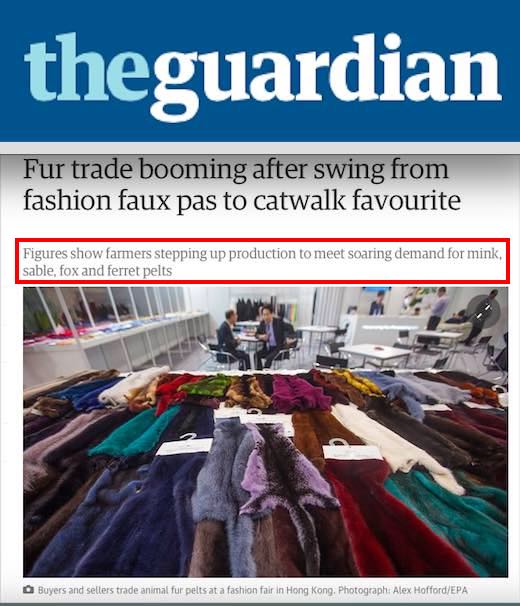
A 2015 article by the Guardian documented the rise of the fur industry.

A 2015 article published in the Guardian documented the rise of the fur industry.

“The fur industry’s statistics reflect what we’re seeing in the streets — that fur consumption is on the rise,” said Edita Birnkrant, Campaigns Director for Friends of Animals, an international animal advocacy group. “For the sake of the animals, we have to organize and take a more aggressive approach on their behalf.”

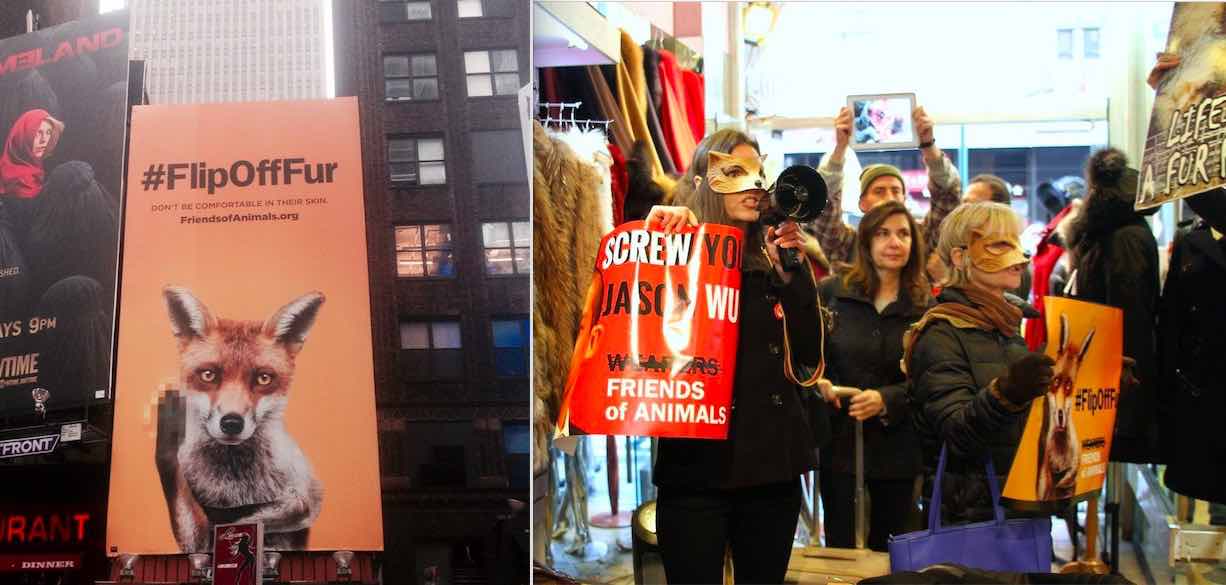
Friends of Animals holds in store protests and puts up anti-fur billboards.

Friends of Animals holds in store protests and puts up anti-fur billboards.

The increase in fur sales can be attributed to many variables, including high demand from China; the use of technology to make fur suitable for warm climates; the growing use of fur trim; the increased use of fur in men’s clothing; the growing practice of dying fur; and the consumption of fur among celebrities with a large social media following. According to Mark Oaten, CEO of the International Fur Federation, “…with this increase in demand, farmers are deciding to invest more in fur farms and increase production.”

Dying fur and the growing use of fur trim has led to an increase in fur sales and by extension in the number of fur farms.

Dying fur and the growing use of fur trim have led to an increase in fur sales and, by extension, the number of fur farms.

While the animal rights community appears to be losing the war against the fur trade (despite occasional victories), some activists have responded to the increased prevalence of fur by engaging in more provocative anti-fur tactics…..

Continued: http://theirturn.net/2016/07/05/fur-sales-rise/

PETA Exposé Shows How a Fur Farmer Kills and Skins Mink

wikimedia commons

http://www.peta.org/blog/the-truth-about-fur-the-harsh-reality-of-mink-farming/

Written by PETA | February 18, 2015

All around the world at fur farms like this one, minks—as well as rabbits, foxes, and other animals—are crammed into barren cages and have the skin ripped off their bodies, all to make fur coats, collars, and trinkets. Fur farmers use the cheapest killing methods available, including suffocation, electrocution, poison, and gas. At this farm, minks are picked up by their sensitive tails and shoved into a box to be gassed. One mink in this video- like many animals killed for their fur- doesn’t die immediately. The farmer then tried to break his neck against the side of his crude wooden “kill box.”

The fur industry would have you believe that fashion justifies such torture, but there’s never any excuse for such barbaric treatment of animals. The farmer in this video casually described the techniques for ripping the bloody pelts off minks’ bodies, snapping the animals’ penis bones and using old pruning shears to cut off their paws.

Do you have friends or family members who still think that fur is in fashion? Remind them that in some countries, even cats and dogs are skinned alive for their fur, which is then mislabeled and sold to unsuspecting consumers in countries all over the world.

Share this video and encourage them to choose only animal-friendly clothing. Join PETA in the fight to help minks and other animals used for fur.

It’s All a Game: New Tags Allow Wolf-Pelt Transport To Canada

USFWS Helps to Market Wolf Pelts: ‏

http://fwp.mt.gov/news/newsReleases/fishAndWildlife/nr_0722.html

Fish & Wildlife

Wed Jan 21 10:57:00 MST 2015

With the recent approval from the U. S. Fish & Wildlife Service, Montana wolf hunters and trappers who harvest wolves will now obtain internationally recognized pelt tags to allow for the export of wolf pelts directly out of country, usually to Canadian fur auction houses.

Montana’s CITES wolf-pelt tags were obtained under the Convention on International Trade in Endangered Species, an international agreement between governments. Its aim is to ensure that international trade in specimens of CITES-listed wild animals and plants does not threaten their survival.

“This is a big change from the past couple of years in terms of hunter and trapper harvest opportunity to sell wolf pelts,” said Brian Giddings, statewide furbearer coordinator for Montana Fish, Wildlife & Parks in Helena.

Any hunter or trapper who harvests a wolf taken during the 2014-2015 season—Sept. 6, 2014 through Feb. 28, 2015—can now have it tagged with a CITES pelt tag.

As a condition of CITES approval, however, no prior season harvested wolf can receive a CITES tag, Giddings said.

Additionally, Montana’s wolf CITES tags cannot be used for any other method of mortality such as road-killed, federal Wildlife Services’ control action, landowner/livestock control, or incidental take. Nor can CITES tags be used for wolves taken on Tribal lands.

Hunters and trappers have strict reporting requirements. Upon the harvest of a wolf, hunters and trappers must call 1-877-FWP-WILD—1-877-397-9453—within 24 hours to file a report. Wolf pelts must be tagged within 10 days of harvest.

State tags issued earlier this hunting and trapping season can be replaced with the new wolf CITES tags by contacting the nearest FWP regional office. Once one receives a wolf CITES tag the old state-issued wolf tag can be removed and discarded.

For more information on CITES wolf-pelt tags contact your nearest FWP office.

To learn more about Montana’s wolf hunting season, visit FWP online atfwp.mt.gov. Click “Hunting Guides” and choose Wolf.

Featured Image -- 7624

Gap Brand Drops Fur After Customers Threaten Boycott

https://www.thedodo.com/fur-piperlime-gap-boycott-741787373.html

Just days after the retail giant Gap, Inc. was targeted for selling fur items in one of its upscale franchise chains, the company has vowed to stop selling fur at the store. Spokesperson Debbie Mesloh issued this statement regarding its brand Piperlime:

Your opinions and views matter to us. That is why, effective immediately, Piperlime will no longer sell real fur products, whether they are made by our company or not. This is an expansion beyond our existing policy of prohibiting real fur in our branded products. We are committed to the ethical sourcing of our products, which includes the humane treatment of animals. We are also committed to our customers and welcome your feedback.

The move comes in response to a Change.org petition that gained over 50,000 signatures. The petition urged Gap, which has previously touted its decision not to sell fur or angora in its stores, to uphold the same standard for its franchise brands. As of last week, Piperlime, a chain launched in 2006, wasn’t meeting those standards. When customers threatened to boycott, the tables were turned.

Brands’ decisions not to sell fur and angora reflect a growing shift away from the fur industry, which is widely known for its many inhumane methods. One 2011 survey from the RSPCA found that 95 percent of people reported that they would not wear real fur, while 93 percent wanted clothing to be clearly labelled as real or fake fur.

Despite this trend, fur has been making a comeback in recent years on fashion runways, thanks in large part to a powerful lobbying push from the fur industry. But not everyone’s buying into it. Many designers are joining the anti-fur bandwagon, including names like Stella McCartney, Tommy Hilfiger, John Bartlett, and Calvin Klein. See this page for more animal-friendly designers.

File