In the midst of a pandemic and all the social distancing that involves, life still goes on out in the boonies, where game wardens ply their trade among the hunters and fishers of Texas.
And since I get their press release reports, I like to pass them on, since you never know what’s going to turn up next in our great state.
One of the current occupations, designed to rid our countryside of marauders, is the hunting of feral hogs, which is not only legal, but encouraged, everywhere.
I have a friend who shoots them and burns their carcasses in a pit on his farm. But that’s sort of a waste, don’t you think? Rumor has it that those big old pigs make great pork roasts.
A game warden in Freestone County was called by a landowner who said he allowed a man to hunt hogs on his land, but the man also killed a deer, which isn’t legal except during the proper season.
The guy said he had shot it by accident. Questionable?
So, he got charged with a bunch of stuff.
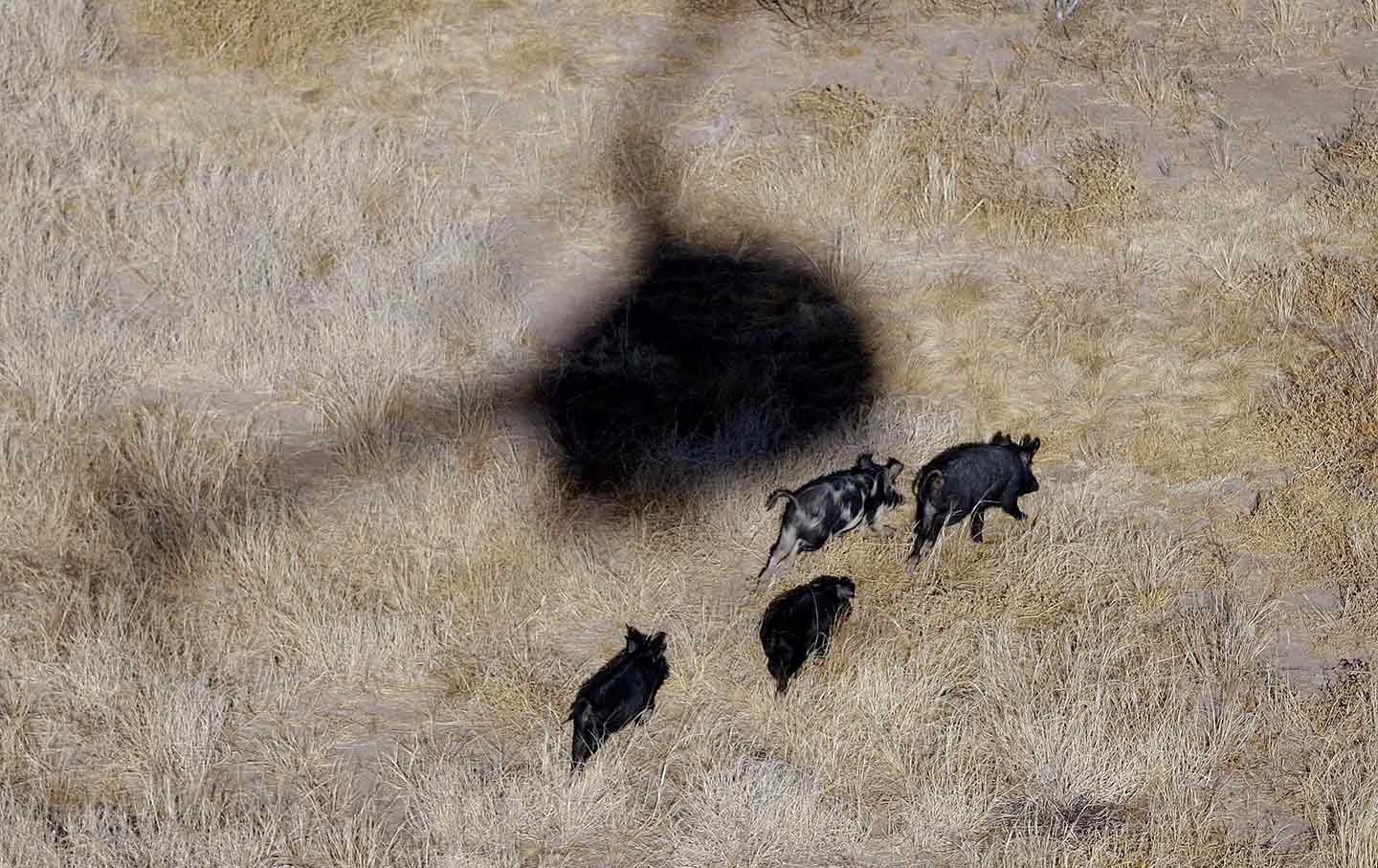
In the same county, there were people hunting hogs from a helicopter. And that’s allowed, with proper credentials.
A man and wife were working cattle on their land when the helicopter began to hover and shoot feral hogs. They waved their arms and the helicopter flew away, but the warden found it and filed charges.
If the copter pilot had gotten permission, he probably could’ve bagged all the hogs he managed to shoot.
Somebody needs to get rid of them all because they’re not only tearing up pastures and woodlands but destroying people’s lawns and flower gardens.
One report that I liked said meat from hogs killed by hunters had been given to needy people. That also happens with deer killed illegally.
The government is preparing a decree which, if passed, will extend the boar hunting season. According to the government the aim of the law is to limit the significant damage caused by big game on farmland every year. Animal rights activists, however, are not happy.
Public consultation on the law finished during the week.
Hunting organisations, in their defense, say that they pay €30 million to farms every year to compensate for any damage caused mainly by wild boar.
Among the proposals, is one which will extend the hunting period, thus enabling hunters to start hunting in June.
As the season ends at the end of March this means hunting boar will be allowed for most of the year. It will also extend the hunting season for deer and fox.
n that is already tense
“Obviously there’s a risk of tension,” says its director-general, Yves Verilhac. “We have more and more people testifying, telling us that there were problems because they were denied access to a road [because of an ongoing hunt].
“France is the country that hunts the most species over the greatest period of the year. And we want to be champions of biodiversity! There is a problem”
Hunters say that they are not all going to take their rifle out as early as June even though the law would give them the opportunity to do so.
The derogations already existed previously. This public consultation process was highly subscribed. More than 25,000 comments were submitted and received.
USDA is offering $75 million in funding for the eradication and control of feral swine through the Feral Swine Eradication and Control Pilot Program (FSCP) in a joint effort between USDA’s Natural Resources Conservation Service (NRCS) and Animal and Plant Health Inspection Service (APHIS).
In the 2018 Farm Bill, $75 million was designated to establish a “feral swine eradication and control pilot program” over the next five years to help landowners with trapping and to use modern technology to control feral hogs. The $75 million will be a 50-50 split between NRCS (for on-farm trapping and technology related to capturing and confining feral swine) and APHIS (for operational removal of feral swine).
“Our intent is to work on joint projects together – we are laying framework now for what those projects will consist of and identifying areas where feral swine populations are high,” said Dale Nolte, program manager for the USDA APHIS National Feral Swine Damage Management Program. “Our focus will be to reduce agricultural damage from feral swine.”
NRCS plans to direct up to $33.75 million of the allocated FSCP funds toward partnership efforts to work with landowners in identified pilot projects in targeted areas. Applications are being accepted now through Aug. 19 for partners to carry out activities as part of these pilot projects in select areas of Alabama, Arkansas, Florida, Georgia, Louisiana, Mississippi, North Carolina, Oklahoma, South Carolina and Texas that have been determined to have the highest feral swine population densities and associated damages in the country.
Pilot projects will consist broadly of three coordinated components: 1) feral swine removal by APHIS; 2) restoration efforts supported by NRCS; and 3) assistance to producers for feral swine control provided through partnership agreements with non-federal partners. Projects will last from one to three years.
“The projects selected for funding will allow APHIS and NRCS to collectively reduce the damage and disease caused by one of the most destructive and formidable invasive species in the United States,” said APHIS Administrator Kevin Shea. “Overall, this pilot program builds upon and expands work already underway by APHIS’ National Feral Swine Damage Management Program to both manage feral swine and eliminate populations in partnership with local government, the private sector, industry and academia.”
NRCS is accepting proposals from non-federal partners to provide landowner assistance for on-farm trapping and related services as part of the pilot projects described above. NRCS will provide funding for these services through partnership agreements. The funding limit for a single award is $1.5 million. Awardees will be required to provide at least 25% of the partnership agreement budget as a match to NRCS funding.
David Herring, president of the National Pork Producers Council and a pork producer from Lillington, N.C., issued a statement thanking USDA for implementing this important Farm Bill program to reduce feral swine populations.
“Wild pigs are difficult to control and when in close proximity to domestic production, they are almost impossible to control. Most seriously, we are concerned about the spread of feral swine carrying diseases, including African swine fever (ASF), an animal disease affecting only pigs and with no human health or food safety risks,” Herring said. “While outbreaks of ASF continue throughout China and other parts of Asia, there are no reported cases in the United States. With no vaccination available, prevention is our only defense and that’s why this program is so vitally important.
Additional information on the complete funding announcement and about specific pilot projects, including target areas and the roles for which partner assistance is being requested, can be found on the FSCP webpage. Applications must be submitted through Grants.gov by 5 p.m. Eastern Time on Aug. 19.
“Nambia’s health-care system is increasingly self-sufficient,” said President Trump last September, during a meeting with African leaders at the United Nations. No singular slip of the tongue, Trump repeated the gaffe again in a speech whose audience included the presidents of both Namibia and Zambia. Hilarity ensued in the Twitterverse: “Can’t wait for Trump to visit Nambia and their technologically advanced neighbors in Wakanda,” quipped Stephen Colbert. (Wakanda is the fictional home of the Marvel Comics’ character Black Panther.)
Yes, it is funny in the abstract, this malapropism of the dear leader. But whether Trump is ignorant, blind, or demented, he consistently confuses individuals for races, races for nations, nations for continents, continents for contagion, and contagion for individual irresponsibility. That’s why all this is ultimately so unfunny in practice: The Trump administration has cut global development aid, reduced funds for UN peacekeeping in war-torn countries, and urged a “merit-based” system of US immigration policy where “merit” excludes “people from high crime countries which are doing badly” and whose preemptive breadth apparently finds no merit in anyone from “hut”-dwelling Nigerians or from any African country, real or (mostly) imagined.
At the same time, Trump, ever the tone-deaf imperial entrepreneur, just loves Africa’s “tremendous business potential…”: “I have so many friends going to your countries, trying to get rich. I congratulate you. They’re spending a lot of money.”
Sometimes it’s just so hard to know where to begin, but let me follow one small thread—to wit, the entrenched narrative of the Great White Hunter and erstwhile Deliverer of Little Brown Brothers. Indeed, there’s a literal manifestation of this mindset within the extended Trump clan: After a 2011 safari to Zimbabwe where he killed an elephant, a leopard, a crocodile, a Cape buffalo, and oh-so-much-more, our president’s son Donald Trump Jr. wrote of his beneficence: “Bottom line with out [sic] hunters’ $ there wouldn’t be much left of africa [sic].”
This logic may seem opaque to the uninitiated: After all, there has been a 65 percent decline in the population of forest elephants across central Africa just in the decade between 2004 and 2014. In addition, the population of savannah elephants declined continent-wide by 8 percent every year between 2010 and 2014. At that rate, the population will decrease by half every nine years. If Trump Jr.’s wisdom escapes you, it might help to recall the controversy around Corey Knowlton, a man who won an auction at the Dallas Safari Club back in 2014. He bid $350,000 for the privilege of shooting a black rhino, a species close to extinction then, and which may be extinct by now. Mr. Knowlton explained that he was actually helping their survival because he planned to cull only an older cranky bull, giving younger black rhino males the chance to rise to the top of the hierarchy of aggression. It’s the circle of life! Plus, the money would go to the government of Namibia, which needs it to pay its park rangers to protect against poachers, which Mr. Knowlton most emphatically is not. (That would be the circular thinking of life.)
It oughtn’t be so surprising, then, that this past November of the first year of his presidency, Donald Trump Sr. drafted a policy that reversed an Obama-era ban on importing trophies from elephant kills in Zimbabwe and Zambia, using an exception to the Endangered Species Act that permits importation of trophies if “hunting actually benefits conservation for that species.” Wayne Pacelle, president of the Humane Society, describes the arrangement as nothing more than “pay-to-slay,” and, after a great deal of public outcry, President Trump suspended the suspension of the ban, promising a thorough review before making a final decision. As CNN reported on January 9, 2018, “White House officials declined to say whether the review is ongoing, when it might conclude, or when the President’s decision may be announced.”
The thrill of the kill is not just about going on African safari, however. Hunting rare and “exotic” animal populations is a billion-dollar business just within the United States. The Fish and Wildlife Service allows the killing of certain rare or threatened species if game-hunting businesses take measures such as contributing 10 percent of hunting proceeds to conservation efforts. At Ox Ranch in Uvalde, Texas, trophy hunters pay $7,500 to kill a Himalayan tahr, $9,500 for an Arabian Oryx, $12,000 for a sitatunga antelope, $15,000 for a black wildebeest, and $35,000 for an African bongo antelope. “We love the animals, and that’s why we hunt them,” says Ox Ranch’s CEO, Jason Molitor. And according to John Tomecek, of Texas A&M’s AgriLife Extension Service, “Ranchers can sell these hunts and enjoy the income, while doing good for the species.”
More enjoyable yet, Ox Ranch “offers its guests the opportunity to drive and shoot World War II-era tanks. People fire at bullet-ridden cars from atop an American M4 Sherman tank at a shooting range built to resemble a Nazi-occupied French town.”
Elsewhere in Texas, wild boars have been deemed far from extinct. Indeed, there’s an overpopulation of them, at least as asserted by many farmers over whose land they roam. In an act of public-spirited volunteerism, Ted Nugent—hard-rock singer and self-proclaimed guru to Donald Trump—Ted Nugent saved the day. Nugent enjoys “machine-gunning hogs,” as he expressed it. “Pigs turn me on.” Armed with a helicopter and a machine gun he flew over a range spraying a wide arc of bullets down upon on the ground. In a swooping rain of firepower, he killed 455 of the varmints. He had quite a good time, apparently, since he conducted the hunt live on SiriusXM, and dedicated the kill to Bill Maher and “other animal rights freaks.”
It should be noted that there is a law in Texas against aerial sport hunting, but in an efficient economy of public-private exchange, Nugent’s sortie was not considered “sport-hunting,” but rather population control. It’s a view that he and that other happy hunter Donald Trump Jr. share. As does their friend Joe Arpaio, newly pardoned by Trump and newly announced candidate for Senator from Arizona. In 2011, then-Sheriff Joe, in his endless hunt for migrant laborers, launched what he has called an “air posse.” As the word “posse” implies, it was made up of 30 private planes, staffed by “citizen vigilantes and deputies from human smuggling and drug enforcement units,” armed with M-16s and a .50-caliber machine gun. According to Arpaio, “We’re going to use our automatic weapons if we have to, and I’m tired of my deputies having to chase these people and I’m sure the air posse will be able to spot these guys running as they constantly do from us.”
Kafka once observed that “A myth becomes true and effective by daily use, otherwise it only remains a bewildering play of fantasy. For that reason, every myth is bound up with the practical exercise of a rite.” The rite of hunting reminds us that without the Great White Hunter’s money, there’s not much else to Africa. Without a little culling of the herds, feral bulls will ravage everything in sight.
As the wise man said: Myth is always bound up with the practical exercise of a rite.
ANDERSON Co., S.C. (WSPA) — One person is dead in what appears to be a hunting accident in Anderson County.
Authorities received a call around 8:35 p.m. Wednesday about a hog-hunting accident on Gentry Road in Starr, Anderson County Deputy Coroner Charlie Boseman said.
Boseman said it appears a hunter was killed in an accidental shooting.
The victim has been identified as Kenneth Jason Young, 40, of Starr.
Boseman said Young lived on Good Hope Church Road and was hunting in a nearby field. Boseman said a man and woman were also hunting hogs. They were not hunting with Young, nor did they know him, according to Boseman.
He said the woman was using a heat sensor scope and fired a shot – not realizing she was shooting at a person, Boseman said.
It appears Young was kneeling when he was fatally wounded.
The Anderson County Sheriff’s Office and S.C. Department of Natural Resources are investigating the shooting.
Though a new Texas law allows hunters to shoot feral hogs and coyotes from hot air balloons, it’s not easy to find a balloonist offering the activity.
“I have never had a phone call from anybody asking to do this,” said Pat Cannon of Lewisville, spokesman for the Balloon Federation of America. “I think that people have not stopped laughing yet.”
The law went into effect Sept. 1, but state permitters, insurers and balloonists say they haven’t heard of anyone planning to hunt hogs from hot air balloons. They point to factors like visibility and difficulty steering that make the activity hard.
The Texas Parks and Wildlife Department has not granted any of the permits needed for hot air balloon hunting, said Steve Lightfoot, a department spokesman. Rob Schantz of Jacksonville, Florida, who heads one of the country’s few balloon insurance agencies, said no balloonists had asked if the activity could be covered under their policies. His agency will not offer coverage for aerial hunting.
Among other logistical challenges, the balloon’s burners make a “horrendous roaring noise,” Schantz said. “It would scare anything away, and if they had a chance to take a shot, you could shoot somebody’s dog or shoot a person.”
The new law, authored by state Rep. Mark Keough, R-The Woodlands, is just one of Texas legislators’ attempts to curb the feral hog population in the state. Called a menace, the estimated 2 million feral hogs in Texas are responsible for about $400 million in damage each year, and their population would grow rapidly if left unchecked. A “pork-chopper” bill – allowing hogs to be hunted from helicopters – has been on the books since 2011, and state officials haveconsidered poisoning the animals with a lethal pesticide.
Lightfoot said department rules that govern hunting from a helicopter are similar to those for gunning from a hot air balloon. Among them is a requirement that there be an agreement with a landowner permitting aerial hunting on his or her property. Lightfoot said Tuesday the department had received one phone call inquiring about the needed permits, but that none had been issued.
Keough said in a statement the new law “will open a whole new industry towards eliminating the growing population of feral hogs in the State of Texas.” After the measure passed both legislative chambers in May, state Rep. John Cyrier, R-Lockhart, wrote a letter to Gov. Greg Abbott saying it could lead to “future catastrophes” without increased oversight of commercial ballooning.
Judith McGeary, executive director of the Farm and Ranch Freedom Alliance, said feral hogs pose a very significant problem to farmers and rural communities, as they destroy land and can carry diseases.
“There hasn’t been a good way to control them,” she said. Hunting from a hot air balloon isn’t expected to be a magic bullet, she said, but it seems like a “reasonable additional tool to add.”
But balloonists and pilots point to numerous challenges that make hunting from a hot air balloon difficult, if not impossible.
First, hot air balloons only fly under certain conditions. Wind, clouds, thermals and time of day are taken into account by the balloonist, and aren’t always conducive to hunting. For example, because balloons float on the wind, they couldn’t circle a pack of feral hogs while the hunters tried to shoot them.
“Let’s just assume you have a herd of feral hogs running one way and … they turn left. The balloon can’t turn left,” said Schantz, the insurance underwriter. “The balloon just keeps going and the feral hogs are off on their merry way the other way.”
For similar reasons, balloons would likely be unable to stop to retrieve the carcasses of shot hogs, said Joe Reynolds, a private pilot in Austin. Because the animals can weigh hundreds of pounds, it would also be difficult to hoist them into the balloon’s basket, and they might exceed the balloon’s load limit, said Reynolds.
Ideally, Cannon said, hot air balloon hunting would take place over land that has a large feral hog population, is owned by one person, and is in a fairly rural area – as balloons must fly at higher altitudes over houses and populated zones. A GPS tracker could help balloonists navigate boundaries that demarcate one property from the next, and make notes of where shot feral hogs fall. The landowner or someone else on the ground could pick up the carcasses.
Still, spotting those property limits from the air can be difficult, Cannon said. If the balloon is accidentally flown over a neighbor’s property, and “somebody points a gun down and shoots and discharges a weapon over that guy’s land,” Cannon said, “he could be prosecuted for that.” Dogs, donkeys or other animals could be mistaken for feral hogs and coyotes from the vantage point of a balloon.
Reynolds, the private pilot, said he’s fielded calls about the activity. But it often becomes immediately apparent “that the reality of it is not going to work.”
“I can’t speak for every balloon pilot in the world,” he added, “but nobody that I’ve talked to is going to try to take any of this on.”
Disclosure: The Texas Parks and Wildlife Department has been a financial supporter of The Texas Tribune. A complete list of Tribune donors and sponsors can be viewed here.
The Texas Tribune is a nonprofit, nonpartisan media organization that informs Texans — and engages with them — about public policy, politics, government and statewide issues.
A Florida mom was arrested after police say she left her two young children inside her car in near-freezing temperatures so that she could go hog hunting.
Kayla Shavers, of New Port Richey, was charged with child neglect on Thursday, WTSP reports.
The 31-year-old who said she went after the hogs because they had been tearing up her property, allegedly left her 9-year-old and 8-month-old alone in the car, which was not running, around 7 a.m. on Thursday. The temperature was 38 degrees, according to WPTV. The 9-year-old did not have a coat.
The 9-year-old called 911, saying he was cold and “a police car would be warmer,” according to Bay News 9. Police say they aren’t sure how long the children were alone in the car, but after arriving at the scene it was about 40 minutes before Shavers emerged from the woods, clad in camo.
“Kudos to that little 9-year-old boy,” Sheriff Chris Nocco told WTSP. Nocco says the boy may have saved the baby’s life.
Authorities say Shavers claimed she was close enough to the car to respond if her children needed help. She also allegedly said she left the keys in the car for the 9-year-old to turn it on if needed, but he apparently wasn’t able to do so.



 Exposing the Big Game