Spain animal rights groups call for ban on hunting with dogs

2010-06-22-coyotes

http://www.globalpost.com/dispatch/news/afp/140116/spain-animal-rights-groups-call-ban-hunting-dogs

Animal rights groups on Thursday urged Spain to ban the use of dogs in hunting, which they said leads to the abandonment of roughly 50,000 greyhounds each year when they become too slow to hunt with.

Greyhounds, known as “galgos”, are used in Spain for hunting, but when the end of the November-February hunting season comes around their owners often decide they have no further need for them.

Campaigners say many are just abandoned and often starve to death or die in car accidents.

In some cases hunters dispose of their greyhounds by hanging them from trees or throwing them down wells, or they torture poorly performing dogs by breaking their legs or burning them.

“For them they are not pets, they are tools just like a wrench is to a plumber, they have no affection for the greyhounds,” Beatriz Marlasca, the president of BaasGalgo, an association dedicated to the rescue of abandoned greyhounds, told a news conference.

“We either stop this from above or else it will never end. We must eliminate the root of the problem starting by banning hunting with dogs,” she added at the news conference attended by three other animal rights groups.

Marlasca’s group alone finds homes for around 200 abandoned greyhounds a year in Spain, Belgium and the Netherlands.

“A ban on hunting with dogs, as already exists in other European nations, would be a measure that would avoid much suffering to all these animals,” said Silvia Barquero, the vice president of Pacma, a small animal rights party.

Wisconsin is Too Open to Hunting With Dogs

[First, I have a couple of pet peeves to air: 1) I’m getting real tired of all the articles these days that start out as a question when the author and readers clearly know the answer. Like this one: “Is the state too open to hunting with dogs?” This isn’t a question, it’s a statement! Why not just come right out and say, “The State is Too Open to Hunting With Dogs.” We all know it is, so I took the liberty in change the title to reflect the answer.

2) Another thing that gets extremely old are articles that start out something like, So and So, an expert on animal behavior, is not against hunting and even raises lamb for food…” as though So and So’s concessions to cruelty make them more credible. Okay, that’s all I have to say; enjoy the article.]

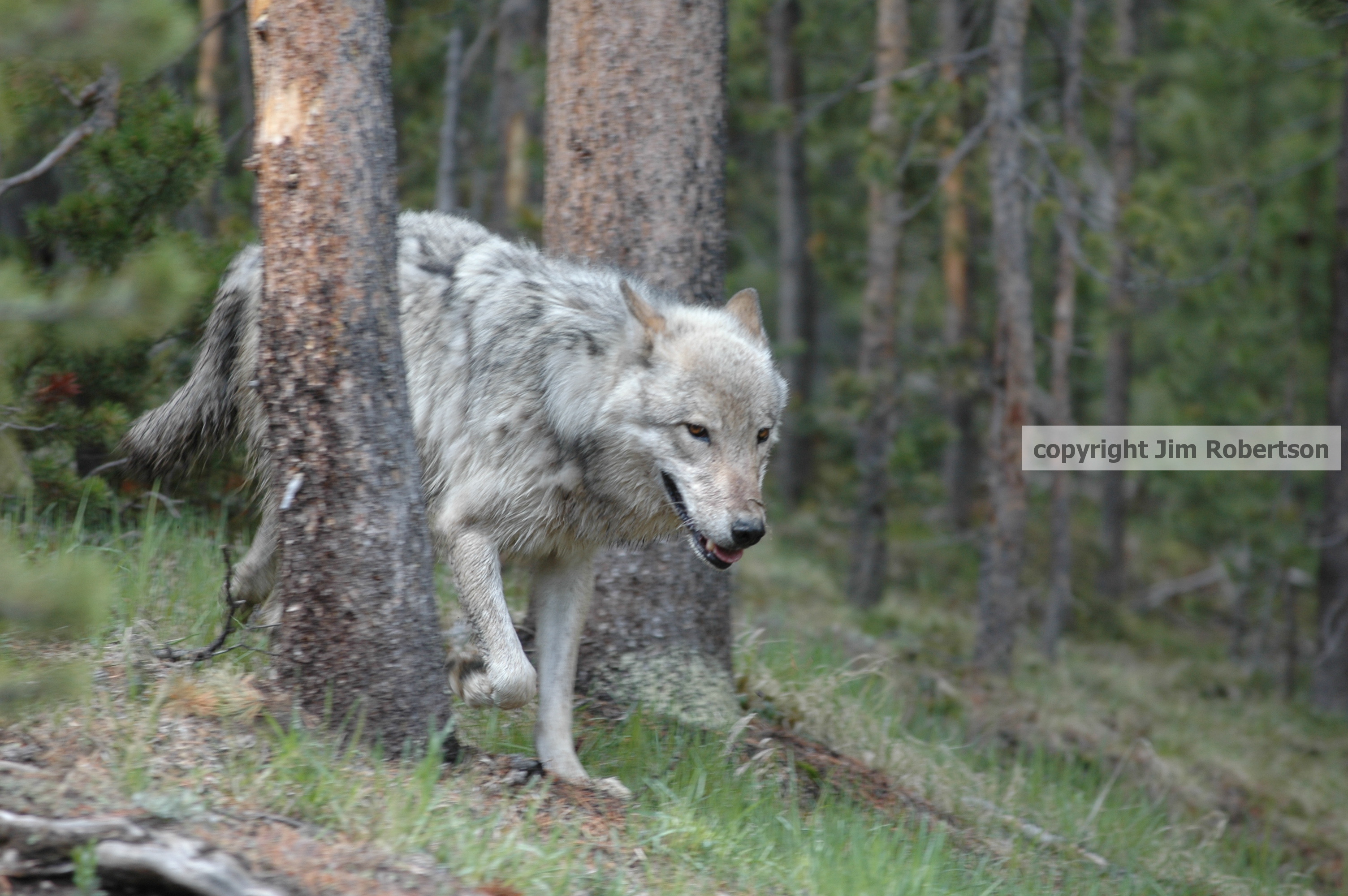
Bill Lueders: Is state too open to hunting with dogs? copyrighted Hayden wolf in lodgepoles
October 18, 2013 12:30 am  •  By Bill Lueders

Patricia McConnell, an expert on animal behavior, is not against hunting and even raises lamb for food. But the University of Wisconsin-Madison zoologist and author is appalled by what she regards as blatant cruelty to animals sanctioned and abetted by the state.

“I’m sure most people don’t know this goes on in Wisconsin,” McConnell says. “I think most people would be horrified.”

McConnell is referring to the use of dogs to hunt other animals, like bear, with often deadly consequences. Joe Bodewes, a Minocqua-based veterinarian, described the damage to dogs by bear in a recent letter to the Wisconsin State Journal.

“Broken and crushed legs, sliced-open abdomens and punctured lungs,” he wrote. “Dogs lying mangled and dying on the surgery table — all in the pursuit of sport.”

Bodewes, in an interview, says his small clinic treats about a dozen dogs a year mauled by bears while hunting. Usually two to four die. Recent cases include a dog whose jaw “was snapped off below the eyes” and one whose back muscles were “ripped loose from its spine.” Both survived.

Now Wisconsin is about to become the only state to let dogs be used in wolf hunts. A judge’s injunction blocking the use of dogs in last year’s inaugural hunt has been lifted; the case is now before a state appeals court. This year’s hunt, with a kill goal of 275 wolves, began Tuesday. Dogs can be used beginning Dec. 2.

McConnell and others warn of inevitable violent clashes. And with good reason.

According to the state Department of Natural Resources, wolves have killed 23 hounds so far this year, tying a 2006 record. All were being used to hunt or pursue bear, says DNR wildlife damage specialist Brad Koele.

Their owners can receive up to $2,500 per animal from the state. Many have already applied.

“People who choose to put their dogs at extreme risk of horrific injury are compensated,” McConnell says. “Some of these dogs die painful deaths, in a blood sport that it some cases is no better than organized dog fights.”

A recent study found that Wisconsin has a higher dog casualty rate than Michigan, which also allows their use in bear hunts. The lead author, a Michigan Tech wildlife ecologist, speculated that Wisconsin’s compensation program creates “an incentive for abuse” — that is, hunters who deliberately put their dogs at great risk.

Since 1985, a DNR tally shows, the state has spent $441,651 to reimburse hunters for hounds killed by wolves, usually while hunting or pursuing bear. Until last year these payments, and more than

$1 million paid for wolf depredations of other animals, came in part from the state’s Endangered Resources Fund.

Now these payments come from application and license fees paid by prospective wolf hunters. Last year, Koele confirms, none of these fees went for wolf population monitoring or hunt management costs.

McConnell and Bodewes trace the state’s policies back to small but politically powerful advocacy groups. These prominently include the Wisconsin Bear Hunters Association, the state chapter of Safari Club International and United Sportsmen of Wisconsin.

These three groups collectively spent nearly $400,000 since 2004 lobbying state officials, including their support for the wolf hunt law. Group officials did not respond to interview requests.

Former Republican state Rep. Scott Suder, the wolf hunt bill’s lead Assembly sponsor, helped United Sportsmen snare a $500,000 state grant, which Gov. Scott Walker yanked after concerns were raised about the group’s fitness and honesty. Suder ending up leaving a lucrative state appointment to become a lobbyist.

The owners of dogs killed by wolves while hunting wolves are not eligible for compensation. While McConnell is glad state funds won’t go to this purpose, she notes that hunters have “no motivation to report” dogs killed or injured.

A DNR official says the agency may try to gather information about dog casualties in its post-hunting-season questionnaire.

Bill Lueders is the Money and Politics Project director at the Wisconsin Center for Investigative Journalism.

Wisconsin on record pace for number of bear-hunting dogs killed this year

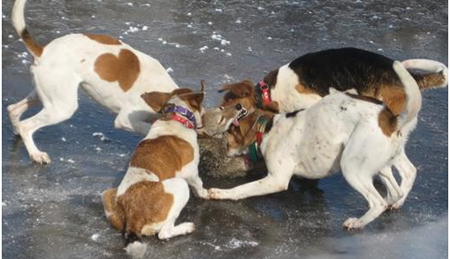
There’s a-near crisis situation going on in the cheese and crackers state, Wisconsin. It seems their hound hunters are losing dogs to wolves. Too bad for the dogs, but then again the only time they’re allowed out of their pen is to chase down and tree black bears so their “masters” can stumble up and shoot the terrified ursine.

Apparently the taxpayers are expected to foot the bill if a one of the hound hunters’ frantic dogs has a lethal run-in with a wolf. As the article below informs us, the Wisconsin Department of Natural “Resources” has a compensation program wherein hounders are paid $250.000 for their losses, if they choose to take up the barbaric sport. Of course, “it is possible, however, that because of the potential for compensation a hunter might be more likely to

photo Jim Robertson

photo Jim Robertson

put a dog at risk.”

According to Wisconsin newspapers:

This has been a deadly year for bear-hunting hounds.

According to the Wisconsin Department of Natural Resources’
<http://dnr.wi.gov/topic/wildlifehabitat/wolf/dogdeps.html#table&gt; dog
depredation report, 23 hounds have been killed by wolves while being used to
hunt bears or being trained to hunt bears since June 3, tying the record 23
killed in 2006, according to Brad Koele, DNR wildlife damage specialist.
Three pet dogs have also been killed.

Only six dogs were killed last year, but Koele says that was an aberration –
at least 20 were killed in each of the four years before that. Black bear
hunters in Wisconsin can use dogs until Oct. 1 and can hunt without dogs
until Oct. 8.

“It’s not that this year is abnormally high, it’s that last year was
abnormally low,” says Koele. “I don’t have an answer for why.”

The owners of the dogs can claim up to $2,500 from the state, though Koele
says not all of them receive or ask for the full amount.

“Not all claims are maximum payments,” he says.

Livestock, hunting dogs and pets are all eligible for compensation.

The death toll could be higher. Last year Republicans passed a bill
establishing a wolf hunt in the state, but a provision in the bill allowing
hunters to use dogs is tied up in court. However, dogs used to hunt wolves
would not be eligible for compensation.

According to a <http://www.ncbi.nlm.nih.gov/pubmed/23613910&gt; study earlier
this year from Michigan Tech, Wisconsin DNR data show that payouts for wolf
attacks on hounds “costs the state more than it has spent for wolf attacks
on any other category of domesticated animal, including calves, missing
calves or cattle.”

(Here’s a
<http://dnr.wi.gov/topic/wildlifehabitat/wolf/documents/wolfdamagepayments.p df> table showing the compensation paid out in Wisconsin since 1985, when
the program started.)

The Michigan Tech study found that the rate of wolf attacks on bear-hunting
hounds in Wisconsin is two to seven times higher than in Michigan.

Researchers at the college, who teamed up with Michigan DNR researchers for
the study, have a couple of ideas as to why.
<http://www.mtu.edu/news/stories/2013/april/story88261.html&gt; This bulletin
from Michigan Tech says the research team found that bear baiting season
starts earlier in Wisconsin and lasts longer.

“The longer you bait, the more opportunity you provide for wolves to
discover and potentially defend bear-bait sites,” said Joseph Bump, a
Michigan Tech wildlife ecologist, in the bulletin. “Most hunters release
their dogs at bait sites, and the longer the bait has been around, the more
likely hunting dogs are to encounter territorial wolves who have found and
are possibly defending the bait. So it appears that baiting is an important
factor.”

There’s another factor: Michigan doesn’t pay dog owners for their dead dogs.

“Compensation can have multiple effects,” Bump says. “It is a reporting
incentive, but it also creates an incentive for abuse. The net effect of
compensation is far from clear, and it is an important factor to study
further.”

Koele says providing an incentive for reporting attacks is important for
tracking efforts by the state. Wisconsin contracts with USDA Wildlife
Services to do a site investigation to verify that the depredation was
caused by wolves, he says.

“We don’t just pay based on what a hunter tells us,” he says. “There’s
actually an investigation to make sure we’re justly paying them.”

He says it is possible, however, that because of the potential for
compensation a hunter might be more likely to put a dog at risk.

“There could be that abuse occurring out there,” he says. “We really
wouldn’t know.”