Exposing the Big Game

Forget Hunters' Feeble Rationalizations and Trust Your Gut Feelings: Making Sport of Killing Is Not Healthy Human Behavior

Exposing the Big Game

Watson – The Movie

Image may contain: one or more people and text

WATSON – The Movie poster

Just saw the new movie poster for WATSON. Amazing!!! I’m honoured that Leslie Chicott made this incredibly well done film about my life and about Sea Shepherd. Love the poster, love the film and I adore Leslie and Louise. Thank-you Terra Mater and Participant.

WATSON has been shown three times to sold out theatres at the Tribeca Film Festival in NYC and it was shown at the Dallas Earth X Conference yesterday.

It is of corse difficult to promote a film about one’s self especially when it’s named WATSON. But what is important is that it is the story of what has become a global movement.

The film is a brilliant distillation of a half century of activism. It is my hope that it will be inspiring to a younger generation now facing challenges and struggles for greater and more perilous than anything that I have experienced during my lifetime.

The film hopefully will soon have a theatrical release.

Sea otters’ stone tools provide new clues for archeologists

Animal archeology could reveal where sea otters lived in past, how tool use evolved

A sea otter cracks open mussels with a rock at Elkhorn Slough, near the study site. (Jessica Fujii/Monterey Bay Aquarium)

36 comments

Archeologists dig up clues about the lives of ancient humans by studying the tools and piles of trash they left behind. Now, it turns out they can do the same thing with another species of skilled tool users in the midst of their own “Stone Age” — sea otters.

This kind of “animal archeology” could open up a new window into the past and has already generated new discoveries, such as the fact that most otters appear to be right-handed, researchers say.

Sea otters use stones as tools to pound and crack open snails, mussels, clams and other seafood that can be hard to open with their teeth and paws.

It turns out all that pounding can also be damaging to the shell-cracking tools involved — that is, the stones — “creating a distinctive archeological record that parallels and may even pre-date that of the humans they currently live alongside,” reports a new study led by Michael Haslam, an independent archeologist based in London, England.

Within their first hour of being out there, they had already found something that we’d missed for decades.– Tim Tinker, biologist

Canadian biologist Tim Tinker, a co-author of the new paper published today in the journal Scientific Reports, has been studying sea otters on the California coast with his team for decades. He had noticed their pounding leaves the shells unusually damaged.

“They’re the most destructive things in the natural environment other than humans,” said Tinker, an adjunct professor at the University of California, Dalhousie University and the University of Victoria, who is now based in Halifax. “There’s really nothing that can smash a clam or urchin or snail with the same sort of force that a sea otter can.”

Sea otters enjoy mussels crusted to drainage pipes at Bennett Slough Culverts. (Michael Haslam)

Several years ago, Haslam, then a research fellow at Oxford University, invited Tinker to a meeting about the new field of “animal archeology.” Haslam had studied the use of stone tools in monkeys and apes using archeological techniques, and proposed doing similar research on sea otters.

Tinker said he was skeptical, since sea otters mostly use rocks that they collect in the bottom of the ocean. After use, they drop the rocks back into the sea, where they would be very difficult to find again.

But he invited Haslam and Natalie Uomini, an archeologist and anthropologist at Max Planck Institute for the Science of Human History, to California to see the otters.

A sea otter eats a mussel that it opened with a stone that it rests on its belly. (Jessica Fujii/Monterey Bay Aquarium)

After visiting several sites where sea otters were floating on their backs, carrying rocks on their chests and using them to crack food open, Tinker and his team took their visitors to Bennett Slough Culverts in Moss Landing, Calif., where otters pull off and eat mussels encrusted on a series of drainage pipes. The otters can’t collect stones from the bottom there because it’s muddy. But humans had piled rocks along the side of the road that the otters were pounding the mussels on.

Rock study

Tinker, a biologist, said the archeologists “immediately did something we’d never done — climbed down, scrambled over the rocks, right down into the water, basically, and started studying the rocks that the otters were pounding their mussels on.”

Uomini recalls that initially, they didn’t see anything unusual about the rocks. Then they started noticing broken mussel shells piled up in certain places.

“At first we thought, ‘Hey, that’s funny. Somebody must have come here, and had a picnic and eaten loads of mussels,'” said Uomini, who mostly studies stone tools made by ancient human relatives 500,000 to a million years ago..

Then it occurred to her that since the mussels were raw, that “somebody” was probably otters, not humans.

“And then we realized these piles of mussels were everywhere, and that there were damaged rocks near them.”

Natalie Uomini sets up her camera to observe otters at Elkhorn Slough, close to Bennett Slough Landing in Moss Landing, Calif. (Michael Haslam)

Tinker said he was dumbfounded: “Within their first hour of being out there, they had already found something that we’d missed for decades.”

That highlights the power of researchers from very different disciplines working together on problem “and bringing different ways of looking at nature together,” he added.

The team examined the piles of shells, which the archeologists call middens — the same word used to describe the trash heaps left by ancient humans that are also a rich source of archeological information.

They shot video of the otters pounding the mussels against the rocks and mapped the rocks themselves.

They found the otters tend to pound on points and ridges on the side of the rocks facing the water, leaving them smooth, worn down and lighter in colour.

The otters pound mussels on ridges and points on the side of the rocks facing the water, causing characteristic damage. (Michael Haslam)

Caught right-handed

The pounded shells also show an unusual pattern — the right shell is always broken, and the left never is.

Tinker said video observations showed the otters were holding the shells in a very precise way as they pounded.

“Right before they hit the rock, they slightly twist the shell so that their right hand is the one that’s really smashing it on the rock,” he said. The finding suggests that most otters — like most humans — are right handed.

Wild sea otter at Bennett Slough Culverts opening mussels using emergent anvil stone. (Jessica Fujii/Monterey Bay Aquarium)

Jessica Fujii, a senior research biologist with the Monterey Bay Aquarium and co-author of the paper, says the team hopes to see if they can find similar patterns on similar rocks at other locations used by otters. So far, they’re not sure if those patterns apply just to otters eating mussels or if they’re similar for other shellfish.

In any case, Fujii said using archeological methods opens up lots of new research opportunities.

“It’s kind of a whole new field.”

By looking for those sea otter signatures from the past, researchers may be able to uncover new information, such as how widely they were distributed before they were nearly wiped out by the fur trade in the early 20th century. (They are currently still listed as endangered on the IUCN Red List, threatened in the U.S., and a species of special concern in Canada). It may even be possible to get information about how sea otters’ diets have evolved over time or how and when tool use evolved in sea otters, the researchers suggest.

And knowing what rocks — and piles of shells — look like after being pounded by a feasting otter can prevent archeologists from confusing them from those left behind by ancient humans, the researchers note. Previously, Tinker said, biologists had assumed that because sea otters moved so much from place to place, they never left big piles of shells in any one place. But it turns out some underwater otter middens at Bennett Slough Culverts could contain more than 100,000 shells. Similar piles may well have been mistaken for human middens in the past.

Sea otters leave the right side of the mussel shell broken and the left side unbroken. Observations suggest they tend to be right-handed. (Michael Haslam/Neil Smith/Scientific Reports)

Erin Rechsteiner is a research ecologist with the Hakai Institute and a PhD candidate at the University of Victoria who studies sea otters on the B.C. coast. She wasn’t involved in the study, but has worked with some of the co-authors.

She says B.C. sea otters use rocks to pry abalone off boulders or break open shells.

“You rarely see them eating snails without using a rock.”

She has never seen them using fixed boulders like the ones at Bennett Slough Culverts, but wonders if they break mussel shells open the same way with individual rocks.

Rechsteiner said she thinks looking for an archeological record for otters is a “cool idea.”

“I think it could give us a lot of insights into the past.”

The new study was funded by the European Research Council, the Max Planck Institute for the Science of Human History, the Monterey Bay Aquarium, the US Geological Survey and the University of California, Santa Cruz.

Amid seal and sea lion boom, group calls for hunt on B.C. coast

Quickest way to reverse declining salmon stocks is to introduce a harvest: Pacific Balance Pinnipeds Society

Some fishermen want to see a cull of sea lions and seals which they say are overpopulated on the B.C. coast. (Nic Amaya/CBC)

For the first time in decades, a small-scale seal hunt is taking place on Canada’s West Coast — all in the hopes that it leads to the establishment of a commercial industry to help control booming seal and sea lion populations and protect the region’s fish stocks.

In early November, a group called the Pacific Balance Pinnipeds Society (PBPS) started using First Nations hunting rights as part of a plan to harvest 30 seals. The society plans to test the meat and blubber to see if it’s fit for human consumption and other uses.

“We can look at opening up harvesting and starting a new industry,” said Tom Sewid, the society’s director and a commercial fisherman. “Since the [West Coast] seal cull ended in the 1970s, the population has exploded.”

Sewid, a member of the Kwakwaka’wakw group of Indigenous peoples, points out that the animals have been hunted for thousands of years. Recent decades with little or no hunting have been an anomaly, he said, pointing to research that shows seal numbers are even higher now than in the 1800s.

Out go the nets, in come the sea lions

What’s become an ongoing battle between humans and sea lions played out on a recent nighttime fishing expedition, when Sewid and a crew of commercial fishermen set out in a 24-metre seine boat to fish for herring off the coast of Parksville, B.C.

The crew’s goal was to catch about 100 tonnes of herring, which rise to the surface to feed after dark. But the faint barking of sea lions was soon heard over the thrum of the boat’s diesel engine.

“All them sea lions out there are all happy — [they’re] all yelling, ‘Yahoo, it’s dinner time!'” Sewid said.

Once the crew spotted the herring, they let out hundreds of metres of net, while a smaller boat helped to circle it around the huge mass of fish. The crew then closed the bottom of the net, capturing the herring.

Watch sea lions pillage fishermen’s nets:

CBC News BC
Sea Lions feeding in fishing nets
 WATCH

00:00 00:27

Many Sea Lions are caught in fishing nets, as they try to feed. 0:27

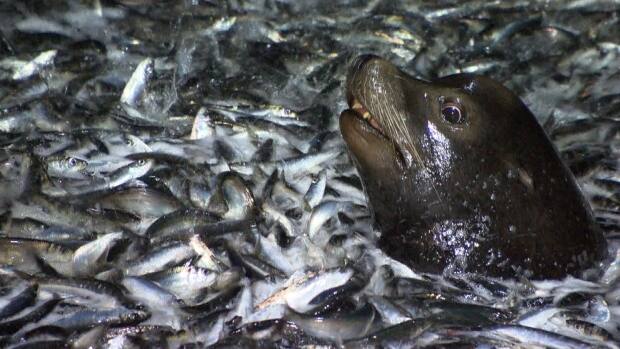
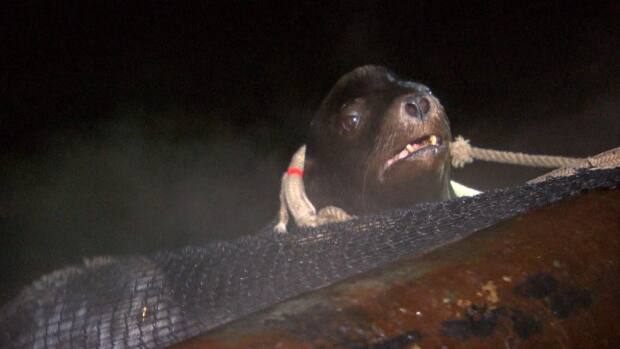
But the catch also provided some uninvited visitors with a captive dinner: Dozens of sea lions jumped over the floats holding up the net and started to gorge.

“These guys, it’s just a buffet for them,” said Sewid, as the bodies of the sea lions glistened in the boat’s floodlights. “Just like pigs at a trough.”

Sewid said the sea lions have learned there’s an easy meal to be had whenever they see or hear the fishing boats.

“They’re not afraid of us. They’ve habituated themselves to seeing that humans and fishing equates easy access to food, which is not right,” he said. “The animal kingdom is not supposed to be like that.”

Restarting a banned hunt

The hunting of seals and sea lions — which are collectively known as pinnipeds — has been banned on the West Coast for more than 40 years. It’s one reason their numbers have exploded along the entire Pacific coastline of North America.

According to one study, the harbour seal population in the Salish Sea is estimated at 80,000 today, up from 8,600 in 1975. The study also says seals and sea lions now eat six times as many chinook salmon as are caught in the region’s commercial and sports fisheries combined.

That adds up to millions of tonnes of commercially valuable fish.

Sewid’s group is proposing to cull current populations of harbour seals and sea lions by half, which would see thousands of the animals killed each year.

Tom Sewid is leading the effort to secure what he calls a sustainable harvest of seals and sea lions along the B.C. coast. (Greg Rasmussen/CBC)

The society’s small-scale “test” harvest is taking place between B.C.’s southern Gulf Islands and as far north as Campbell River, on Vancouver Island. It’s being carried out under the provisions of the Aboriginal Fisheries Strategy, which gives some First Nations harvesting and management rights for food and ceremonial purposes.

Testing the meat to see if it’s safe for human consumption is a first step in a plan to eventually gain permission for what the PBPS envisions as a sustainable, humane commercial hunt, which would largely be carried out by coastal First Nations.

“All the meat that’s in there, you’re looking at the high-end restaurants [that would sell it],” Sewid said. “The hides can also be used.”

Seal blubber is particularly valuable, he said, because it can be rendered down into an oil that’s in demand because of its high Omega-3 fatty acid content.

Watch fishing crew struggle to free sea lions entangled in their nets:

CBC News BC
Sea Lions freed from fishing nets
 WATCH

00:00 00:49

Watch as fishing crew struggles to free sea lions trapped in their nets. 0:49

One of the biggest hurdles facing the group is convincing the federal Department of Fisheries and Oceans to open a commercial hunt on the West Coast.

The seal hunt that takes place in the Atlantic and Arctic is controversial, and has long been subject to protests and fierce opposition from animal rights groups. The group expects a West Coast harvest to also face fierce confrontations.

Canadian Inuit have been waging a counter-campaign, highlighting the importance of the animal and the longstanding tradition of their hunt.

Most Canadian seal products are also banned in Europe and a handful of other countries, but the society says demand is strong in Asia.

Supporters and opponents

The PBPS does have a growing list of supporters, including 110 First Nations groups, a number of commercial fishing organizations, and some sectors of B.C.’s economically important sport fishing sector.

However, one key player, the Sport Fishing Institute of B.C., opposes a large commercial hunt, fearing it would generate public outrage and might not achieve the goal of enhancing fish stocks.

The institute’s director, Martin Paish, says the group sees some value in targeting some seals and other fish predators at specific times of year in a number of key river systems; he believes a limited hunt would help protect salmon stocks and boost the billion-dollar-a-year B.C. sport fishing industry.

“Our goal is to use predator control in a careful manner to improve chinook [salmon] production where it is needed,” said Paish.

Carl Walters is a fish biologist and UBC professor who supports cutting B.C.’s population of seals and sea lions by half. (Nic Amaya/CBC)

Fisheries scientist Carl Walters, a professor emeritus with UBC, believes culling the regions sea lions and seals could dramatically boost salmon stocks. He points to numerous studies showing how pinniped populations have been increasing, while salmon numbers have been plummeting.

“They’re killing a really high percentage of the small salmon shortly after they go into the ocean, about half of the coho smolts and a third of the chinooks,” he said.

Advocates of a hunt are also pitching it as a way to help B.C.’s endangered southern resident killer whales, which feed mainly on salmon.

“The thing that would benefit southern resident killer whales is to see improved survival of small chinook salmon — and I think the only way we can achieve that is by reducing seal numbers,” Walters said.

Peter Ross, from the Coastal Ocean Research Institute, says there would be little benefit to salmon from a seal and sea lion cull. (Nic Amaya/CBC)

Others disagree, including Peter Ross, the vice-president of research and executive director of the Coastal Ocean Research Institute.

“Killing of seals and sea lions is not going to have any positive impact for any salmon populations in coastal British Columbia,” he said.

While a few localized populations of salmon might benefit from a cull, Ross said climate change, habitat destruction and overfishing are all bigger factors in the overall decline of stocks.

Other subspecies of orcas, however, feed mainly on seals, so a hunt would reduce their access to prey.

Back on the boat, Sewid concedes a hunt would be controversial — but he firmly believes it’s necessary.

“All the indicators are there,” he said. “It’s time to get the balance back.”

The fishing crew from the Western Investor are shown harvesting herring in November. But they say they are being hampered by dozens of sea lions in their nets almost every night. (Nic Amaya/CBC)

Groups threaten to sue unless feds reassess how salmon fishing harms orcas


FILE – In this Aug. 7, 2018, file photo, Southern Resident killer whale J50 and her mother, J16, swim off the west coast of Vancouver Island near Port Renfrew, B.C. The younger whale later died. (Brian Gisborne/Fisheries and Oceans Canada via AP, file)

AA

SEATTLE (AP) — Two conservation groups say the federal government is violating the Endangered Species Act by failing to consider how salmon fishing off the West Coast is affecting endangered killer whales.

The Arizona-based Center for Biological Diversity and the Washington state-based Wild Fish Conservancy on Tuesday notified President Donald Trump’s administration that they intend to file a lawsuit within 60 days unless officials reevaluate whether the fishing further jeopardizes orcas that frequent the inland waters of the Pacific Northwest.

The population “southern resident” orcas is down to 74 — the lowest number in decades. No calf born in the last three years has survived as the orcas struggle with a dearth of their favored prey, chinook salmon, as well as pollution and vessel noise.

The conservation groups note that commercial and recreational fishing claimed more than 200,000 chinook off the Pacific Coast last year.

Another sea lion confirmed shot and killed in Puget Sound

Seal Sitters MMSN Co-Investigator Lynn Shimamoto responds to a dead California sea lion in West Seattle. (Photo Copyright: Robin Lindsey, Seal Sitters MMSN)

AA

Following another necropsy, a 10th sea lion has been confirmed to be shot and killed in Puget Sound, according to the Seal Sitters Marine Mammal Stranding Network.

The group, which responds to reports of stranded or dead sea lions, noted on their blog Sunday morning that the shot sea lions now totals 10.

Sixteen dead sea lions have been reported throughout King and Kitsap counties, some of whom suffered “acute trauma,” which can be caused by a number of incidents, including human interaction (boating collisions or shooting), or animal attacks (killer whales or sharks). The latest confirmed shooting death was a sea lion found in West Seattle on Friday.

The Seal Sitters Marine Mammal Stranding Network noted in an earlier post that the number of sea lions shot recently is six times higher than the yearly average between September and November, worrying that the “high season” for violence against the animals is still to come.

Killing sea lions remains illegal under the Marine Mammal Act. The punishment for killing one can be up to a year in prison and a $25,000 fine. Laws recommend that a minimum distance of 100 yards is best for keeping sea lions safe.

The Seal Sitters join NOAA and the Sea Shepherd Conservation Society in trying to stop the violence. NOAA is reportedly working on developing guidelines to encourage fisherman to use nonviolent methods to deter sea lions, while also investigating the recent slayings.

“We are concerned about a number of recent reports of marine mammal deaths caused by gunshots in the greater Seattle area,” Greg Busch, assistant director of NOAA Fisheries’ West Coast Office of Law Enforcement, said in a statement last week. “All marine mammals are protected by the Marine Mammal Protection Act and OLE investigates all reported unlawful takes of sea lions.”

Two organizations, Marine Animal Rescue and Sea Shepherd Seattle, offer rewards for any information leading to an arrest in the shootings.

If you have a tip for investigators, NOAA’s hotline is 800-853-1964. If you see a dead marine mammal offshore, or one that’s alive or dead on the shore, report it to Seal Sitters at 206-905-SEAL.

SeattlePI reporter Zosha Millman can be reached at zoshamillman@seattlepi.com. Follow Zosha on Twitter at @zosham. Find more from Zosha here on her author page.

Sick sea lions appear on area beaches

image - sea lion

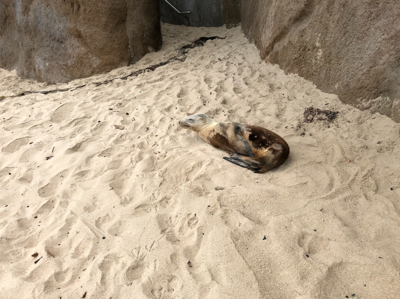
This sea lion, Grazer, is seen curled up with his flippers folded tightly over his abdomen prior to his rescue by trained Marine Mammal Center responders in Monterey. The posture is known as “lepto pose” and is an indication the sea lion is suffering the effects of the disease. Photo courtesy of Marine Mammal Center

Sea lions sick with leptospirosis have been showing up on California beaches in near record numbers, the Marine Mammal Center reports. As a result, staff and volunteers at the center have been busy in a normally quiet time of the year. 

Leptospirosis is a bacterial disease that was first diagnosed in sea lions in the 1970s, says center Director of Veterinary Science Dr. Shawn Johnson. It can be present in humans and other mammals as well, but a strain that affects marine mammals — and sea lions in particular — is sickening the pinnipeds at a rate not seen since 2004. The center has confirmed more than 250 sea lions have come under its care because of the disease so far this year and the number continues to climb. 

“We’re still rescuing animals every day,” Johnson said recently. “So we could easily become the largest outbreak.” 

The center sees cases of leptospirosis every year but the outbreaks appear to be cyclical with a large one showing up every five years or so. The last notable one was in 2011 and infected nearly 200 sea lions, according to the center. 

While sea lions with the disease are showing up along the entire California coastline, Johnson says there appears to be more in Monterey, Santa Cruz and San Mateo counties. He adds that there are generally more sea lions in this area this time of year so that doesn’t necessarily point to the region as being more susceptible to the disease. 

Of the roughly 220 infected sea lions identified in October, about 30 had been found along the San Mateo County coast, Johnson said, noting that his office receives calls for about five sickened sea lions per day. 

Now, in late November, the center reports that the rate of incoming sick sea lions has slowed. But, with the number of leptospirosis-infected sea lions topping 250, this cycle still comes in as the second-highest outbreak ever recorded.  Sea lions with the disease are often found with their flippers tucked in and their bodies scrunched in response to abdominal pain. The disease affects their kidneys which may prompt them to drink seawater or eat the sand in response to the reflex that’s telling them to drink, Johnson said. 

Normally, marine mammals do not consume water directly as they get all the hydration from the fish they eat. 

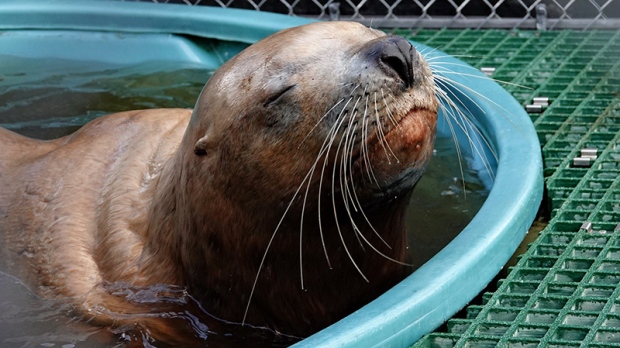
As part of their treatment back at the Marin-based center, the sea lions receive fresh water, antibiotics and other support. In spite of this treatment, roughly two-thirds of the sick sea lions will die from their infections, according to the center. 

The cause of the periodic outbreaks is not entirely clear but could be attributed to changes in ocean temperature, migration shifts or a lack of herd immunity. 

The center has partnered with researchers from the University of California, Los Angeles, to better understand the outbreaks. The researchers are collecting blood and urine samples from young sea lions at Año Nuevo to determine whether they have any evidence of kidney disease or antibodies that could point to previous exposure to the disease. 

Scientists are puzzled by the fact that sea lions appear to be more likely to catch the disease than other pinnipeds. 

“Why are sea lions so susceptible to this infection whereas elephant seals and harbor seals aren’t?” Johnson said. “There’s a lot of unanswered questions.” 

Because a sea lion with leptospirosis could potentially pass on its infection to humans, beachgoers are asked to keep their distance. 

Beachgoers who see a sick sea lion are asked to call the Marine Mammal Center rescue line, (415) 289-7325. 

The center is also looking for volunteers to help monitor the beaches for sick animals or to help out at the Marin headquarters. 

For more information on volunteering, visit the Marine Mammal Center website at www.marinemammalcenter.org.

New group calls for seal and sea lion cull on B.C.’s coast

Some B.C. First Nations and fishermen want the government to establish a new seal hunt on the west coast. As Jill Bennett reports, their reasons for the new hunt are being met with skepticism by opponents.

– A A +

Members of the Tsawwassen First Nation are teaming up with commercial and sport-fishers on B.C.’s coast to call on the new federal fisheries minister to allow a West Coast seal and sea lion harvest. The group, called the Pacific Balance Pinnipeds Society, says that growing populations of seals and sea lions endangers future salmon populations.

“If we want to see salmon around for our next generations, we have to go out there and bring that balance to the animal kingdom,” said Thomas Sewid, the director of the newly established society. “To go out, harvest those seals, utilize the whole carcass so the meats are going to markets in Europe and China, the fat is being rendered down for the omega 3s.”

WATCH HERE: Pod of hungry orcas hunt for sea lion between boats


The federal government has banned the cull of seals and sea lions on the West Coast since the 1970s, which still exists on the East Coast. The group is hoping to have a change in policy now that Jonathan Wilkinson, the MP for North Vancouver, is the new fisheries minister.

“I think we are going to see the balance to our oceans and our waters come back in place because of that minister,” said Sewid. “He understands. He has been out sport-fishing. He has seen big fat sea lions tear salmon off his hooks.”

READ MORE: Sea lion pulls young girl into water off Steveston Wharf in Richmond, B.C.

Sea lions are known to be aggressive, not just to animal populations, but towards humans as well. Last May, a sea lion that swam near Steveston Fisherman’s Wharf snagged a little girl by her dress and pulled her into the water. There were multiple Steveston Harbour Authority signs posted at the popular tourist destination warning people not to feed the sea mammals that frequent the area.

But there is some disagreement on how large an effect seals and sea lions actually have on the fish populations.

Scientists at Ocean Wise say their research does not support the idea a harbour seal cull improves the abundance of Chinook salmon in B.C. The scientist describes the fish population as “complex” and that the seal population has recovered from historical culls, and is no longer increasing significantly.

READ MORE: Hunters call for more licences, possible seal cull to combat growing population off N.L.

“Studies show only four per cent of the harbour seal diet is salmon. Herring and hake are their primary prey, with hake making up about 40 per cent of their diet,” said a statement from Ocean Wise. “Hake is actually a big salmon smolt predator, so a seal cull could actually have the opposite of its intended effect: by reducing the number of seals, the abundance of hake would likely increase, resulting in decreased salmon numbers overall.”

We also have a healthy and growing population of transient, or Biggs, killer whales, which eat marine mammals like seals and sea lions. So harbour seals are already being culled very effectively without any human interference at all. Reducing the seal population in the Salish Sea would mean a reduction in food for transient killer whales.

READ MORE: WATCH: Sea lion feeding frenzy on commercial herring catch

Ocean Wise has also found that with an increase in transient killer whales, which eat seals, the population is expected to slowly decline over time.

But Sewid’s group has provided numbers from the federal Department of Fisheries and Oceans that show a massive population boom that needs to be controlled. According to those numbers, harbour seals in the Georgia Straight have gone up from 12,500 in 1987 to 45,000 today.

As for sea lions, those same numbers from the population grew on B.C.’s coast from 13,000 in 1984 to 36,140 in 1997.

The populations have slowed since the mid-1990s, and has been relatively stable since. One of the challenges Sewid says in convincing people that the animals should be culled is that they look “cute.”

“They don’t understand that seals and sea lions are eating hundreds of salmon fry when the fry are going out to sea, down the rivers and when the salmon are coming home to spawn, those overpopulations over seals and sea lions are eating all that fish,” said Sewid. “We have to bring that balance on.”

— With files from Jill Bennett

Sea lion that was shot in the head euthanized after health takes downturn

steller sea lion uclueletThe adult male Steller sea lion was found unresponsive but still alive with a bullet on his skull on a rocky shoreline of Ucluelet last Thursday, Oct. 11, 2018. (Marine Mammal Rescue Centre Handout)

130
130
https://vancouverisland.ctvnews.ca/sea-lion-that-was-shot-in-the-head-euthanized-after-health-takes-downturn-1.4151840
CTV Vancouver Island
Published Friday, October 26, 2018 4:53PM PDT 
Last Updated Friday, October 26, 2018 5:16PM PDT

A sea lion rescued in Ucluelet after being shot in the head earlier this month has died at a Vancouver recovery centre, veterinarians say.

The Steller sea lion dubbed “Ukee” was euthanized after spending two weeks in critical care at the Vancouver Aquarium Marine Mammal Rescue Centre.

Head veterinarian Dr. Martin Haulena said the choice to put down the sea lion was difficult, but had to be made.

“He wasn’t responding to treatment, and his condition had taken a significant downturn in the last two days,” Haulena said in a statement. “At this point we had to evaluate his quality of life. Although we are disappointed we couldn’t return him to full health, we are glad we could end his suffering and make his final days more comfortable.”

Ukee was found on a rocky shoreline of Ucluelet with gunshot wounds to his head and was severely emaciated. Experts said the 8 to 10-year-old sea lion also appeared to be blind and unable to forage for any food.

On Oct. 11, a massive team of personnel including staff from the rescue centre, Department of Fisheries and Oceans, Parks Canada and other local volunteers staged an operation to rescue the animal.

At under 350 kilograms, he was far under normal weight for adult Steller sea lions, but was still the biggest animal ever admitted to the rescue centre, staff said.

After Ukee was rescued, Haulena had strong words for whoever may have shot him.

“This is clearly a serious animal welfare issue,” he said at the time. “It is unacceptable to shoot sea lions. Based on his body condition, this individual has been suffering for many weeks.”

Anyone who sees a marine mammal in distress is asked to immediately report it to the rescue centre at 604-258-7325 or the DFO hotline at 1-800-465-4336.

https://www.facebook.com/plugins/post.php?href=https%3A%2F%2Fwww.facebook.com%2Fvanaqua%2Fposts%2F10155586545395800&width=500

How the killer whale became the Achilles heel of Trans Mountain pipeline approval

Southern resident killer whales are designated under the Species At Risk Act, which means federal prohibitions exist against anything that would harm them or habitat considered critical to their survival.(Valerie Shore/Shorelines Photography)

It’s been a summer of dramatic killer whale news — from a mother holding up her dead calf for 17 days in a gut-wrenching display of grief, to a boatload of scientists shooting a sick whale with a dart full of antibiotics.

Now, B.C.’s ailing southern resident killer whale population is proving itself a wedge in one of the most headline-grabbing issues in the province.

In the 200-page decision released by the Federal Court of Appeal Thursday morning, effectively quashing the government’s approvals to build the Trans Mountain expansion project, B.C.’s southern resident killer whales are mentioned no fewer than 57 times.

The court ruled that the National Energy Board (NEB) review failed to assess the impacts of marine shipping — saying it was so flawed, it should not have been relied on by the federal cabinet when it gave final approval to proceed in November 2016.

Activists, lawyers and academics say the decision demonstrates environmental corners cannot be cut when governments seek social licence for major infrastructure projects — especially in a case where increased tanker traffic and vessel noise are known to be key threats to killer whales.

“It’s very clear from this decision that environmental assessment considerations and Species At Risk Act decisions aren’t optional, and they need to be taken seriously,” said Dyna Tuytel, a lawyer with Ecojustice, who represented conservation groups that filed a court challenge to the federal government’s approval for a pipeline expansion.

“There’s a risk in taking shortcuts,” said Eric Taylor, a professor of zoology at the University of B.C., and the chair of the Committee on the Status of Endangered Wildlife in Canada.

“It’s going to come back and bite you, as it’s done here.”

Narrow reading of the law

According to the ruling, the shortcut, or “critical error” made by the NEB, was to define the scope of the project as only the pipeline and the marine terminal for the purposes of its environmental assessment.

So although the project looked at marine shipping during the review, it did not assess it to environmental standards, nor did it apply the Species At Risk Act to the effects of marine shipping on endangered species.

B.C.’s southern resident killer whales are considered at risk because of their small population, low reproductive rate and threats including marine traffic and lack of food. (Dave Ellifrit/Center for Whale Research)

“The NEB acknowledged that on the facts there were significant adverse effects of the project on southern resident killer whales — but the board, by defining the project narrowly, was able to say that the project was not likely to cause significant adverse effects,” said Tuytel.

Taylor called the decision to leave out the project-related tanker traffic in the review “unfathomable.”

“The oil is not going to sit there in barrels, it’s got to move out by ships. And ship traffic has clearly been identified as a threat to this endangered species. So it’s unconscionable that they ignored it,” he said.

Cutting corners

Tuytel called the ruling “fairly unusual.” But Taylor said he wasn’t surprised, given the threats to southern resident killer whales have been clear for over a decade.

“I think the court really had no other choice than to do this,” he said.

The whales, which are also threatened due to toxic contamination levels and low supplies of Chinook salmon, are designated under the Species At Risk Act, which means federal prohibitions exist against anything that would harm them or habitat considered critical to their survival.

In June, the federal Department of Fisheries and Oceans pledged measures to slow down vessel traffic, noting the population was facing an imminent threat to survival.

Fuel spills and underwater noise from tankers are just some of the threats that have endangered the southern resident killer whale population. (Michael Mcarthur/CBC)

Since the time the NEB reviewed the project, B.C.’s southern resident population has declined from about 82 to 75.

The project would increase capacity from five ships a month through Burrard Inlet to a maximum of 34 oil tankers capable of carrying 120,000 tonnes of diluted bitumen at a time.

According to the NEB report, Trans Mountain acknowledged the additional noise the project would create, but argued that the shipping lanes “will continue to host marine vessel traffic with or without the project, and that the impacts to the southern resident killer whales will continue to exist with or without the project.”

Killer whales a ‘flare’ for other issues

This is not the first time whales have played a role in halting a major Canadian infrastructure project.

Last year, energy giant TransCanada scrapped plans for a port for its proposed Energy East pipeline after protesters raised alarms about impacts on the calving grounds of the vulnerable beluga population in the St. Lawrence Estuary.

Taylor said the pipeline and its associated infrastructure are likely to have impacts on many species, but because of the popularity of killer whales, they tend to act as a “flare” for many of the issues associated with the project.

“If this was a lichen, many, many fewer people would be paying attention,” he said.

Marineland Doesn’t Seem to Want to See Us; Here’s How They Can Keep Us Away

http://www.bornfreeusa.org/weblog_canada.php?p=6403&more=1

by Barry Kent MacKay,
Senior Program Associate

Born Free USA’s Canadian Representative

http://www.bornfreeusa.org/weblog_canada.php?p=6403&more=1

Published 08/17/18

Top: Small bucket is the only water source for numerous large animals in enclosure at Marineland.
Bottom: Animals at Marineland struggle to find shade from the blazing hot sun during heatwave.

My last two blogs were accompanied by photographs of animals I saw imprisoned at Marineland, Niagara Falls, Ontario, when I went there with Zoocheck’s Rob Laidlaw last July 5th, during a blistering heat wave. The harbor seals were not affected by record temperatures, being in a small pool in a cool interior, but at no time when we observed them did they open their eyes, an unnatural condition as verified by an expert on seal eyes, not to mention all memories I have of wild harbor seals with their soulfully bulbous eyes wide open. There have been concerns raised about the effects of chlorine on eyes and I thought I could smell chlorine, but whatever the reason, seeing the animals so confined, eyes tightly shut, certainly depressed me.

But, no more so than conditions out in open paddocks where there waslittle or no shade for numbers of large, hoofed herbivores, and water only appearing to be available in containers about the size of a bucket or pail.

On August 8, I received an email from Stephanie Littlejohn, Law Clerk, Hunt Partners LLP, a Toronto-based law firm calling itself “a unique blend of corporate and civil advocacy” consisting of “recognized litigation leaders and trusted advisors.” Ms. Littlejohn wrote: “Please find attached a Notice of Trespass for Marineland of Canada (Inc.), which is being served upon you.”

The notice prohibited me from entering Marineland’s property “At any time for any reason whatsoever” under the Trespass to Property Act. “I got one too,” laughed Rob, when I called to tell him.

Doubtless, Ms. Littlejohn and her colleagues are very professional corporate and civil advocates. Their opinions on animal welfare may differ from their client’s. Ms. Littlejohn might never even have been to Marineland or know much about animal husbandry. But, Rob’s and my expertise includes animal welfare and we both passionately care about animals. Whether any others care about animals with only pots of water and little or no shade in searing heat, or seals with eyes tightly shut, Rob and I do care how animals are treated.

Ironically, I actually don’t want to ever visit Marineland. I was so depressed by my first time there that I avoided the place for 37 years, only returning to see an exhibit that had been falsely advertised; it wasn’t there. Having paid admission, Rob and I looked at the other animals. I’m happy to wait another 37 years, by which time Ms. Littlejohn will probably be a retired lawyer and I’ll be long gone.

For now, I would gladly pay the maximum trespass fine of two thousand bucks if I thought it would eliminate my concerns, or better yet, that Marineland simply had no animals for me to worry about. If Ms. Littlejohn, Hunt Partners LLP, and Marineland want to keep me out, just eliminate the concerns I addressed &ndahs; or better yet, stop imprisoning animals – and I promise to never again cross Marineland’s doorstep. Honest.