Exposing the Big Game

Forget Hunters' Feeble Rationalizations and Trust Your Gut Feelings: Making Sport of Killing Is Not Healthy Human Behavior

Exposing the Big Game

Drunk men wearing moose heads didn’t actually terrorize drivers on Interstate 35


We’re in the middle of moose hunting season in some states, but don’t expect to see any of the animals driving down the road with a man strapped to the roof.

“This actually happened,” begins an Aug. 29 Facebook post showing a photo of three moose heads poking out truck windows and a man in hunting gear tied down overhead.

“They tied the guy on the roof. The driver and passengers put on moose heads. Then they went down road I-35…. causing 16 accidents. Yes; they went to jail.. Yes; alcohol was involved… Yes; men cannot be left alone.”

This post, which has been shared more than 24,000 times, was flagged as part of Facebook’s efforts to combat false news and misinformation on its News Feed. (Read more about our partnership with Facebook.)

Because this actually did not happen.

Interstate 35 spans the country from Texas to Minnesota but the booze-fueled, predator-becomes-prey chaos described in the Facebook post would have likely made national news, and most certainly warranted local attention. And yet, the top search results are posts debunking this tall tale. Back in 2016, it was even wilder: this imgur.com post claims they also killed three people and that charges were pressed against the woman who left them unattended. In 2011, it didn’t even happen on Interstate 35 — it happened in Maine.

People were sharing this tale via email and on hunting message boards, according to Minnesota newspaper the Pioneer Press: “This actually happened with some guys from Maine. They dressed the truck up with the guy dummy spread eagle on the roof of the truck. The drivers and passengers put on moose heads. Down the Maine Toll interstate they went causing about 16 accidents. They went to jail.”

“Great story and completely bogus,” a spokesman for the Maine State Police then told the paper.

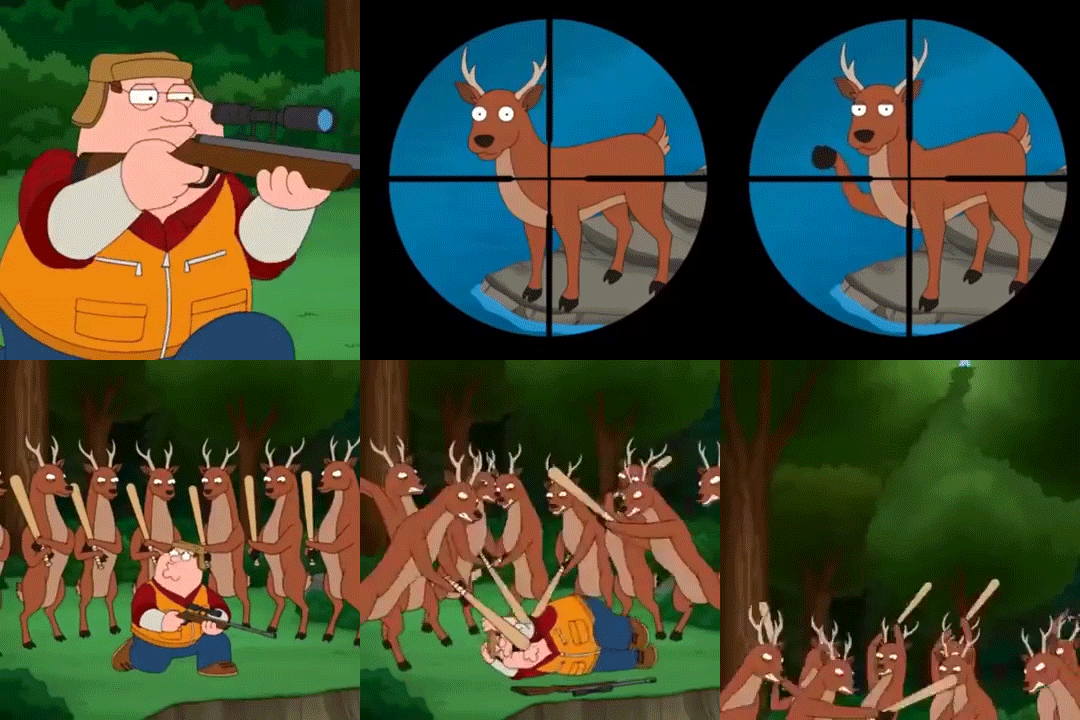
#Family Guy GIF - Find & Share on GIPHY

Youths aged 16 and older can now join in the moose hunt, which begins this weekend

For the Buckle family of Corner Brook, hunting is a family affair — one that goes back decades.

Matthew Buckle was waddling through snow to bring partridges back to his father almost as soon as he could walk. His wife, Tammy Buckle, also started hunting and fishing as a child, going out as a family with her 16 siblings. [!!]

“All my fondest memories of spending time with my father, it’s always been hunting and fishing,” Matthew Buckle said.

“It’s what I grew up doing. It’s what I love doing.”

Now the couple brings their own three children out hunting as well and this year their daughter Emily, who just started Grade 12, hopes to shoot her first moose.

Emily’s goal is possible this year due to recent changes in hunting regulations in Newfoundland and Labrador. One of the most significant changes is the new minimum ages of 16 for big game hunting and 12 for small game hunting, Fisheries and Land Resources Minister Gerry Byrne told CBC’s Corner Brook Morning Show on Friday.

Watch out, moose: hunting season starts Saturday. (CBC)

“We’ve taken a number of very deliberate actions to increase access to our outdoor heritage,” Byrne said.

Minimum hunting ages were previously 18 for big game and 16 for small game.

‘I want them to learn what I know’

The reduction in hunting age will give young people more opportunities to spend time in nature, Byrne said.

“One of the big considerations in this was when you provide an opportunity for our young people to get access to the outdoors, to get access to hunting, they learn very, very important skills at an early age,” he said.

“Not only do they learn better safety skills that they retain for a lifetime, but they also retain important conservation principles and values.”

Young hunters have to fulfil the same safety requirements as adults. (Ashley Taylor/Labrador Hunting and Fishing Association )

That’s a key motivation for the Buckles.

“I want them to learn what I know,” said Matthew.

“I want them to learn about nature and the ethics of hunting. I want them to know where our food comes from and how to get clean, organic, free-range meat for your future.”

Those lessons have resonated with daughter Emily, who says she enjoys time spent hunting with her family and values the food from their hunts.

“When you kill something, you get to eat it and you get to know where it comes from,” she said.

The shared experience is a source of pride and enjoyment for the whole family, Matthew said.

“It definitely makes me proud to see my own kids involved in the things that I love to do. It’s so enjoyable just to see them in nature, to see them interacting without their iPhones, without their Xbox.”

Training requirements same for youth and adults

The eligible age for hunting licences has been lowered, but the safety restrictions are just as stringent as they are for adult hunters, Byrne said.

“There will be no 16-year-olds that will be hunting big game without adult supervision,” said Byrne, who said the same is true for small game.

‘There are very, very strict requirements that are in place to be able to receive a licence and participate in the hunt, and safety and training are part of those requirements.”

Eligible hunters of all ages must complete a hunting test for firearm safety and a hunter education program, and the province is offering youth hunter skills workshops a few times a year in different locations around the province. A recent workshop in Deer Lake had about 50 attendees, Byrne said, and another will be held in Happy Valley-Goose Bay this weekend.

There will be no 16-year-olds that will be hunting big game without adult supervision.– Gerry Byrne

Safety is a key consideration for the Buckle family as well, and Tammy is a hunting safety instructor.

“‘When it does come to the firearms component, safety is of the upmost importance to us,” she said.

The couple have worked to instill a respect for and knowledge of hunting safety in their children from a young age, she said, including not just firearms but also rabbit snares and fish hooks.

Emily Buckle completed her firearms safety training before obtaining her first moose licence, and plans to practise before she goes out to hunt herself.

Such experiences, when done safely, are a valuable way to preserve both provincial and family traditions, Byrne said.

“It’s a great experience for a mother and a son, or a father and a daughter, to be out in our Newfoundland and Labrador outdoor heritage to participate in this.”

Read more from CBC Newfoundland and Labrador

With files from The Corner Brook Morning Show

Moose hunting banned in Cariboo wildfire zones

The ministry-imposed ban affects areas west of Quesnel and Williams Lake

The Ministry of Forests, Lands, Natural Resource Operations and Rural Development announced today that two areas affected by wildfire in the Cariboo will be closed to moose hunting from Oct. 15-31 and Nov. 1-15.

The closures affect an area north of Highway 20 and west of Williams Lake and Quesnel, after the Chilcotin Plateau Fire ravaged the area this summer. The press release noted that the area is also important to First Nations sustenance hunting.

Doug Donaldson, Minister of Forests, Lands, Natural Resource Operations and Rural Development, said: “This has been an unprecedented wildfire season, with parts the Cariboo particularly hard hit. With moose populations already declining in this management zone, we need to take steps now to protect wildlife and ensure healthy moose populations in the future.”

The closure comes after First Nations groups in the region called for the province to instate a moratorium on moose hunting.

Contacted for comment, Nazko First Nation chief Stuart Alec said: “It’s great news to hear that the province is taking steps to address the situation and the concerns of the Nazko people and others concerned about the moose populations.

“We are looking forward to working further with the province to maintain moose populations in the region.

“We have not been hunting in the wildfire zones, and are focusing our hunts north of the Blackwater River.”

The ministry indicated that the areas impacted by the hunting ban will be assessed over the winter to inform what level of sustainable hunting will be available in the coming years.

Heart in mouth: Moose hunters worry parasite may ruin organ-eating tradition

Some New Brunswick hunters who eat the hearts of moose are wondering if they can keep the tradition alive after finding white spots on some of the organs this year.

“I’ve been hunting moose for 25 years and we always save the heart,” hunter Charles Leblanc wrote on Facebook. “We cook it up at the camp and everybody loves it. Has anyone else seen white spot on their moose heart this year? For us, it’s the first time.”

Leblanc lives in Cocagne but hunted this year near Harcourt.

– High-risk areas for Lyme disease expand to include Moncton

Two of the five moose he and his family killed had the white spots, which gave the seasoned hunter a bad feeling.

“Nobody wanted to take a chance and try them,” Leblanc said over the phone Wednesday.

The first infected heart he came across only had a few spots but the second one was full of them.

After his Facebook post, other hunters chimed in with similar experiences.

Tastes like liver

Eating moose heart has been a “treat” Leblanc has enjoyed since he began hunting with his father-in-law in 1993.

“It tastes best when cut thinly and cooked on a barbecue like a slice of steak,” Leblanc said.

“Everybody loves it. It’s basically like liver. It’s less strong than liver. You cut it all up and fry it in butter.”

Leblanc, whose diet depends on moose meat for part of the year, is concerned the white spots on the heart have greater consequences.

“My concern is, is there something wrong with the rest of the meat from that moose? We haven’t talked to the meat cutter yet. He might find those white spots in the meat.”

Parasite is likely

Although several ideas about the abnormalities have floated around online, wildlife pathologist Pierre-Yves Daoust suspects a parasite.

“The first thing that crossed my mind is parasitic larvae,” said the professor at University of Prince Edward Island. “There are number of different parasites that can do that.

“Most of them should not be a concern for human consumption.”

But with only a photo to study, Daoust said it’s hard to determine what parasite got into Leblanc’s moose hearts.

It appears to be at the intermediate stage, Doaust said, and would need the intestines of a carnivore, such as a wolf or a coyote, to mature.

“Most of these parasites could not do this to a human,” he said. “We’re not its final host.”

“Having said that, it would not be advisable for anyone to eat these cysts. But in all those cases, the cyst would be destroyed by proper cooking of the meat.”

Both Dr. Jim Goltz, veterinarian and pathologist for the New Brunswick government, and Bob Bancroft, a wildlife expert, agreed with the diagnosis.

“The structures are likely tapeworm cysts, but I’d need a specimen to be sure,” Goltz wrote in an email Wednesday.

“There are several possibilities here — most are immature stages of three tapeworm species that also infect dogs and wolves,” Bancroft said, also by email.

“These immature stages can be found on the lungs, liver, spleen, heart and kidneys.

“Each cyst has lots of immature tapeworms. I wouldn’t eat that heart and one should be careful to keep entrails away from dogs.”

Extent of infection not known

Daoust said he couldn’t speculate about much else because he hasn’t received many samples from hunters.

“Again, if these are parasitic larvae, they are not uncommon. But I could not tell you if there are 100 moose killed, there is only one affected like this.”

Luckily for Leblanc, Daoust said, there’s hope yet.

“I would not recommend that the entire carcasses be condemned,” he said. “It may not have affected the animal whatsoever.”

B.C. veterinarian wants 2,900-km wildlife death trap removed

Collapsed, 100-year-old Yukon Telegraph line believed to be killing moose across north

  •  Feb. 27, 2018 9:30 a.m.
  • A B.C. veterinarian hopes public anger over an illegal spate of wildlife snaring in the northwest will invigorate her mission to eradicate a much larger, potentially deadlier threat to wildlife.

“This is an underdog problem. It’s not a popular cause like animal abuse and neglect, but it’s a clear case of animal cruelty without anyone being deliberate or intentional. It’s just a consequence of what humans have left out in the wilderness.”

Dr. Veronica Gventsadze is speaking about the 100-year old Dominion Government Telegraph Service line, a network of five-millimetre iron cables snaking through 2,900 kilometres of wilderness from Ashcroft, B.C. to its termination point in Dawson City, Yukon. Known as the Yukon Telegraph, this logistical marvel of its time connected the gold fields of the north to southern Canada.

The line was abandoned in the 1940s and 50s as wireless technology advanced.

But the galvanized cable was of such high quality it still shows no sign of corrosion or breakage today. As the original poles collapse, and trees topple, the cable either sags to the forest floor or lies in tangles beneath moss and foliage, creating a perfect trap for moose and, further north, caribou.

“A bull moose crashes through the forest with his antlers, and that’s it. That’s how he gets around,” Gventsadze says. “There must be a tremendous amount of anguish not being able to free himself [from the wire], possibly lying there exhausted, hungry—he’s live prey for a bear. The wire is like nothing found in nature, so the moose not having a chance to escape or protect itself is a completely unnatural situation.”

The Squamish-based veterinarian began a grassroots campaign to see the line removed in June, 2016, during an otherwise-regular visit to her Rosswood cabin in the Nass Valley, near Terrace. Her husband was picking lobster mushrooms when he stumbled across a one-kilometre stretch of the fallen line. He counted the corpses of three moose in varying stages of decomposition, she says.

“This is grizzly bear country, so the moose will be dragged off pretty quickly. We don’t know how many have been there before.” Since her husband’s discovery Gventsadze has found other sites along the Stewart branch of the telegraph service.After being told last year there was very little Conservation Officers Service could do in the matter, Gventsadze contacted the Terrace office again last month upon reading news reports of a prolific and intentional snaring operation in the Kitimat River Valley, which the COS is still investigating.

Speaking to Black Press at the time, CO Sgt. Tracy Walbauer said evidence of dead moose, grizzly bears, wolves and coyotes had been found in the illegal snaring.

“Those animals observed in the snares endured a great deal of suffering before death,” Walbauer said.

READ MORE: Public’s help sought in cruel and prolific animal snaring

READ MORE: $1,000 offered for conviction of snaring culprit

Based on photographs, Gventsadze is certain the snare wire was cut from the telegraph line. She says she also once found a snare intentionally fashioned directly within a tangle of telegraph cable on the ground. Though of minor concern compared to the thousands of kilometres of unintended hazard to wildlife, the snaring connection she says only deepens the telegraph’s deadly post-use legacy.

While a remediation project of this magnitude does not fit within the budget and mandate of the COS, CO Zane Testawich told the Terrace Standard he hopes to offer some community-level support in the spring, possibly by organizing a cleanup of the Rosswood site identified by Gventsadze’s husband.

In the meantime, neither provincial or federal departments have returned Gventsadze’s calls of who is responsible for remediation.

Andrew Gage, staff counsel with West Coast Environmental Law, says finding a legal avenue to force remediation will be difficult on a project initiated by the fledgling Dominion Government in 1899. Political pressure may be the only way forward, he says.

“These sites do get cleaned up where there’s particular health concerns and public outcry over them, but there’s a lot that don’t get cleared up without that pressure.”

Gventsadze admits the costs of a remediation project on this scale would be large, but hopes elected officials will see it as an employment and skills-training investment for northern communities.

This was the case in Northwest Territories, where in 2015 a program partially sponsored by the federal government led to the removal of 116 kilometres of telephone wire from a Second World War pipeline project in the Mackenzie Mountains, along what’s now the Canol Trail. The program was renewed the next year, and a further 126 km of wire was removed, along with 27 racks of caribou antlers tangled within it, according to Northern News Services. The project was completed in January this year, seeing 80 tonnes of wire remediated from more than 350 kilometres of terrain. Indigenous and Northern Affairs said a key element of the program was to provide local workers with training in project management, field operations and occupational health and safety.

In Yukon Territory, the Carcross Tagish First Nation spearheaded the Southern Lakes Wire Recovery Project in 2015. In this case, the wire belonged to the same Yukon Telegraph line at the centre of Gventsadze’s concern.“It is still a very unrecognized problem,” she says. “But once people start talking about it, others will probably come out of the woodwork who have been making local efforts to remove these lines themselves.

“Just because we can’t witness these moose suffering and dying, it doesn’t make their deaths any less acceptable.”

Dr. Gventsadze has set up a petition for the cleanup of the Yukon Telegraph line at change.org.


https://www.agassizharrisonobserver.com/news/b-c-veterinarian-wants-2900-km-death-trap-removed/

Moose caught in telegraph wire euthanized by Yukon wildlife officer

Auditor General of : Demand cleanup of abandoned telegraph wire that is killing wildlife in Pacific Northwest

‘You could see that this truly epic battle between the wire and the moose had gone on,’ says Ken Knutson

CBC News Posted: Sep 15, 2015 6:30 AM CT Last Updated: Sep 15, 2015 6:30 AM CT

This moose was found caught in telegraph wire adjacent to the White Pass and Yukon Route railway on Friday. Ken Knutson, Yukon conservation officer, says it likely had been trapped for a day or two.

This moose was found caught in telegraph wire adjacent to the White Pass and Yukon Route railway on Friday. Ken Knutson, Yukon conservation officer, says it likely had been trapped for a day or two. (Claudiane Samson/CBC)

Related Stories

Something needs to be done about old telegraph wire left in the bush, says a Yukon conservation officer who had to kill a badly-entangled bull moose on Friday.

“Clearly it’s got to be cleaned up,” says Ken Knutson.

“It’s been known for a while that it’s a hazard. Something like this really brings it home where you’ve got an animal alive in front of you … and you’ve got to euthanize it.”

A dog musher called conservation officers after spotting the distressed bull moose caught in telegraph wire adjacent to the White Pass and Yukon Route railway, about three kilometres from the South Klondike Highway.

“You could see that this truly epic battle between the wire and the moose had gone on,” Knutson said.

“It was wrapped numerous times around pine trees that were five, six inches. It had mowed some of them down. On both sides of the track it was all churned up. So he’d put up quite a struggle.”

Knutson says there was no way the moose would have freed itself from the wire on its own.

“There were multiple wraps around its antlers,” he said. “It was around his neck, around its body and its hind legs — there was a big snarl.”

‘I could have literally gone up and touched him’

Ken Knutson

‘He was in the height of his glory. The kind you want out there breeding,’ says Ken Knutson, Yukon conservation officer, about the nearly 500-kilogram moose he had to euthanize last week. (Claudiane Samson/CBC)

Knutson says the animal had likely been trapped for a day or two.

“He was worn out,” he says. “I could have literally gone up and touched him and he wouldn’t have done anything, which is clearly not normal behaviour.”

Had the situation been different, he says he might have been able to save the moose. But due to the weak physical condition of the animal and the lack of extra resources available to Knutson at midnight on Friday, he made the decision to shoot it.

Knuston says although the meat will be donated, it’s a waste of a healthy 500-kilogram bull.

“He was in the height of his glory; the kind you want out there breeding.”

Knuston says he thinks White Pass and Yukon Railway may own the old telegraph line. The railway company did not immediately return calls on Monday.

Plans are in the works to clean up similar abandoned wire that has been snagging caribou and moose for years along the Canol Trail in N.W.T.

Auditor General of : Demand cleanup of abandoned telegraph wire that is killing wildlife in Pacific Northwest

Moose attacks hunter after getting shot

https://www.upi.com/Top_News/World-News/2017/10/10/Moose-attacks-hunter-after-getting-shot/4911507614607/

By Ray Downs  |  Oct. 10, 2017 at 2:01 AM

 
This week, a Canadian hunter was attacked by a moose and had to be airlifted to a hospital. Photo by UPI/Shutterstock/Tom Reichner

Oct. 10 (UPI) — A Canadian hunter was attacked by the moose he shot and had to be airlifted out of the woods for medical treatment.

“I’ve got hoof prints in my forehead,” hunter Rodney Buffett told the St. John‘s Morning Show after leaving the hospital Monday.

Buffett was with his fiancee on Newfoundland’s south coast when he saw the moose and fired a shot, reported the CBC. The shot hit and the moose went down.

Buffett, who’s an avid hunter and has several photos of his hunting endeavors on his Facebook page, went up to the animal to begin carving it. But the moose got up.

“I thought he was dead,” Buffett said.

The moose lunged at Buffett, knocking him down and proceeded to stomp on him.

“I held onto his antlers and tried to steer him away, but it seemed like forever,” he said.

Buffett was able to kick the moose a few times and the animal took off — but he was so injured, he couldn’t move and a medical helicopter was called in to take him to the hospital, where he was treated and released.

Hunter airlifted to hospital after wounded moose fights back

With hoof prints stamped on his forehead, Rodney Buffett hopes to hunt again
this weekend

CBC News <http://www.cbc.ca/news/cbc-news-online-news-staff-list-1.1294364>
Posted: Oct 09, 2017 5:01 PM NT Last Updated: Oct 09, 2017 7:23 PM NT

A Newfoundland man was attacked by a bull moose near Grand Bank on Saturday
after shooting it twice. (Radio-Canada)

Rodney Buffett entered the woods on the weekend as the hunter, but emerged
hours later on a medevac chopper as the hunted.

Buffett survived a five-minute battle with a wounded moose near Grand Bank
on Newfoundland’s south coast.

He was released from hospital on Monday morning without any broken bones, or
bottles of moose meat, but did return home to Fortune with a souvenir.

“I’ve got hoof prints in my forehead,” he told the St. John’s Morning Show.

Moose fights back after being shot

The moose-mauling began when Buffett spotted the animal on Saturday morning.
He sized up the 14-point bull before taking two shots, both of which hit the
animal, he said.

The moose went down quickly and put its four legs in the air. An experienced
hunter, Buffet began to approach the animal, as he has done many times
before.

“I thought he was dead. I laid my gun down and turned back to my fiancée and
told her to bring down my knives. When I turned around again he was up.”

The moose lunged toward the hunter and drilled him with its antlers. Buffett
said the moose tossed its head back and flicked him up in the air before he
crashed to the ground.

The moose began stomping on him as Buffett tried to grab hold of it.

“I held onto his antlers and tried to steer him away,” he said. “But it
seemed like forever.”

Buffett’s fiancée watched helplessly from a hill above him, binoculars
pressed to her eyes.

Airlifted to hospital in St. John’s

After Buffett landed some kicks to the moose’s forehead, the animal let him
go and trotted off into the woods.

“I couldn’t move after that,” he said.

Paramedics made a three-kilometre trek through the bush to find Buffett.
They called for help and a medevac helicopter came from St. John’s to
airlift him to hospital.

Buffett received stitches and staples to his head, hands and chest, but was
otherwise intact. He was held in hospital for extensive testing over the
weekend, but said he did not suffer a concussion or internal injuries.

“They tells me I’m hard-headed,” he said.

Despite the terrifying experience, Buffett plans to head back into the woods
as soon as possible. An avid hunter since he was old enough to shoot a gun,
he won’t be deterred by one bad day in the woods.

“I’m hoping to be back moose hunting again about Friday or Saturday with any
luck at all,” he said. “I’d go today, but no, [the doctor] wouldn’t let me.”

While he can joke about the experience now, Buffett was too shaken up to
sleep on Saturday night.

“Every time I closed my eyes I could see the moose coming after me.… It’s
something I’ll never forget.”

http://www.cbc.ca/news/canada/newfoundland-labrador/moose-hunting-hunter-att
acked-newfoundland-labrador-1.4346689

Conserving Moose… or Not

http://www.bornfreeusa.org/weblog_canada.php?

Canadian Blog

by Barry Kent MacKay,
Senior Program Associate

Conserving Moose… or Not 11/10/16

Moose© Henry Schimke

North America’s moose population extends from Alaska to the East Coast, through boreal and mountain forests. Throughout much of that range, the species is in decline. Where I live, in Ontario, the population has declined by 20% in just the past 10 years.

There are now about 92,000 moose spread over a vast region. In Minnesota, moose are nearly gone from the northwest and are less than half of their earlier numbers in the northeast. In other places, they are either in decline, holding steady, or—in a few instances—increasing.

98,000 people want to hunt moose in Ontario… which outnumbers the moose!

The threats to moose are vast, including a suite of problems associated with global climate change—which is increasingly evident as you move north. Pressure from all manner of incursions, including forestry practices, mining, roads, recreational use, and so on, can reduce the ability of moose to survive.

But, most of these threats to moose directly benefit human short-term interests. So does hunting, for a vocal minority. And, hunters don’t want to stop hunting (although, of all of the immediate threats to moose, not shooting them is the easiest step that could be taken).

I understand that hunters don’t care, but not that they still claim to be “conservationists.” Of course, if they want to keep killing a species that’s in decline, they are no such thing.

That includes First Nations hunters who, exercising treaty rights, can kill any moose they wish to, without even having to report the numbers. However, when Ontario Environment Commissioner Diane Saxe recently published her first annual report with a section entitled “Ontario’s Moose Population Under Threat,” it was too much for moose hunter Rob Learn. He points to the number of collisions between moose and cars to explain that there are plenty of moose, and that the limit placed on how many can be killed by non-First Nations’ hunters guarantees species survival. He makes the valid point that the determination of how many moose there “should” be, as decided by the Ontario Ministry of Natural Resources and Forestry, is not entirely objective.

And then, there are the natural predators—mainly wolves and bears—who are scapegoated as a cause for moose declines. Killing, as always, becomes the solution.

Here’s a thought; don’t kill them. There’s a long list of North American wildlife species, from northern cod, to passenger pigeons, to bison, to Carolina parakeets, that plummeted from numerous to suddenly rare—even extinct—because the killing didn’t stop in time. We have time.

There are three times more Ontario government employees in Ontario than there are moose. Within their ranks lies the means to save these animals. Let’s start by stopping the killing. It might not happen… but it should.