Exposing the Big Game

Forget Hunters' Feeble Rationalizations and Trust Your Gut Feelings: Making Sport of Killing Is Not Healthy Human Behavior

Exposing the Big Game

South America’s Glaciers May Have a Bigger Problem Than Climate Change

undefined

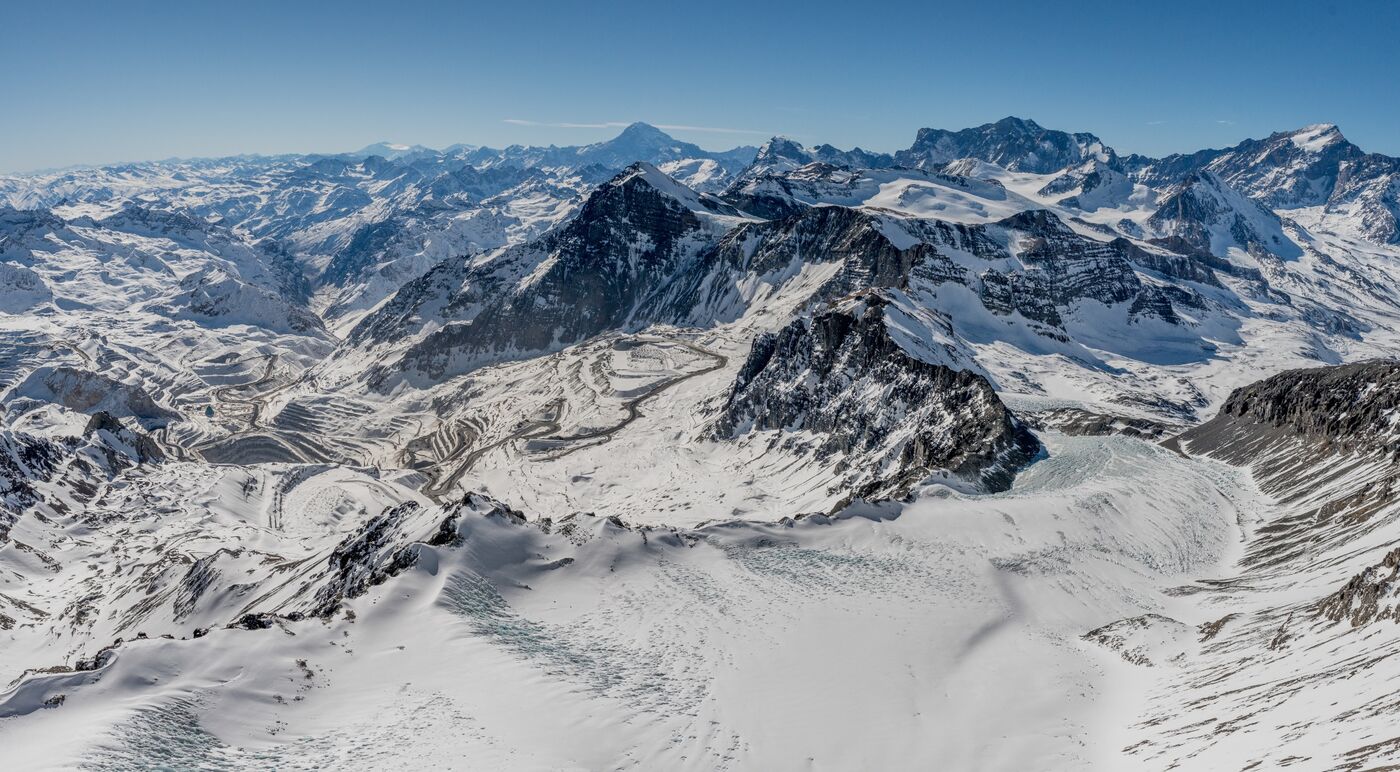
An aerial view of the Andina and Los Bronces mines, and of a glacier located in the Andes mountains above Santiago, Chile.

Photographer: Tomas Munita/Bloomberg

Massive layers of ice cover some of the continent’s rich copper deposits. Uncovering those minerals threatens to hasten their demise.

Government geologist Gino Casassa steps down from the helicopter and looks around in dismay.

Casassa is standing at the foot of a glacier, 4,200 meters (13,800 feet) above sea level. The sky over the Andes is a deep blue, but something is not right: It’s July—mid-winter in South America—and yet it’s mild for the time of year, above 0 degrees Centigrade. He takes off his orange ski jacket and walks on the bare rock.

“This should all be covered by snow this time of year,” he says, pointing to Olivares Alfa, one of the largest glaciers in central Chile, just a few meters away. “There used to be one single glacier system covering this whole valley; now it’s pulled back so much that it’s divided into four or five smaller glaciers.”
relates to South America’s Glaciers May Have a Bigger Problem Than Climate Change
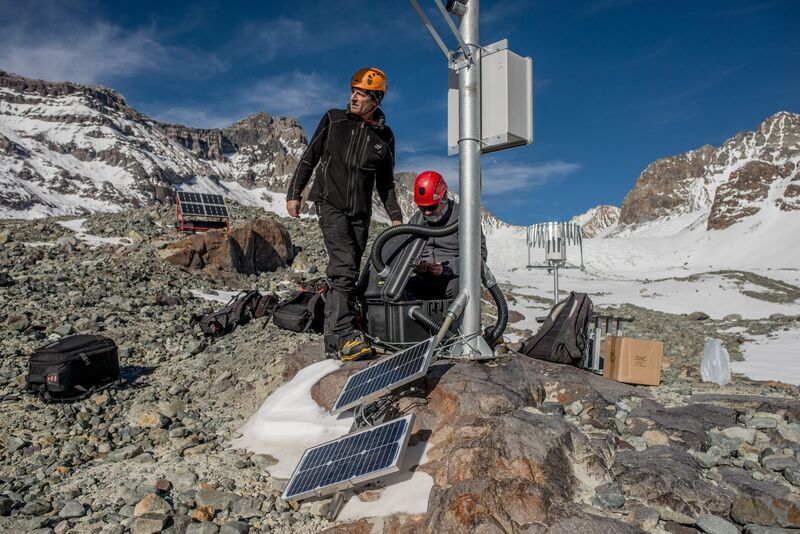
Gino Casassa, left, and hydroelectric engineer Diego Gonzalez collect data from a meteorological monitoring station on Olivares Alfa glacier.
Photographer: Tomas Munita/Bloomberg

Chile has one of the world’s largest reserves of fresh water outside the north and south poles, but the abundant glaciers that are the source of that precious commodity are melting fast. That’s not just an ecological disaster in the making, it’s rapidly becoming an economic and political dilemma for the government of Latin America’s richest nation.

A toxic cocktail of rising temperatures, the driest nine-year period on record and human activity, including mining, is proving lethal for the ice of Chile’s central region. Built up over thousands of years, the ice mass is now retreating one meter per year on average.

Less than two decades from now, some glaciers will have disappeared, while the total volume of all glaciers in Chile will have shrunk by half by the end of the century, says Casassa. That’s an acute problem since Chile, which has 80% of South America’s glaciers, is also the Americas country most at risk of extremely high water stress, according to the World Resources Institute. More than 7 million people living in and around the capital, Santiago, rely on the glaciers to feed most of their water supply in times of drought.

Chile’s government is well aware of the issue. A glacier unit was established in 2008 and tasked with producing an inventory of glaciers with the aim of protecting them and raising awareness of their importance. But its resources are limited: it had a staff of just seven last year—Casassa is the unit’s director—and has so far published a single register of glaciers, in 2014, using decade-old data. The unit is due to issue a second inventory later this year allowing the first ever comparison of all Chile’s glaciers.

Not everyone is content to wait. An opposition bill now before parliament aims to lock in legal protection for glaciers. But President Sebastian Pinera’s center-right government has come out against it, arguing that if implemented, the measures would harm Chile’s economic development, and specifically its lucrative mining industry.
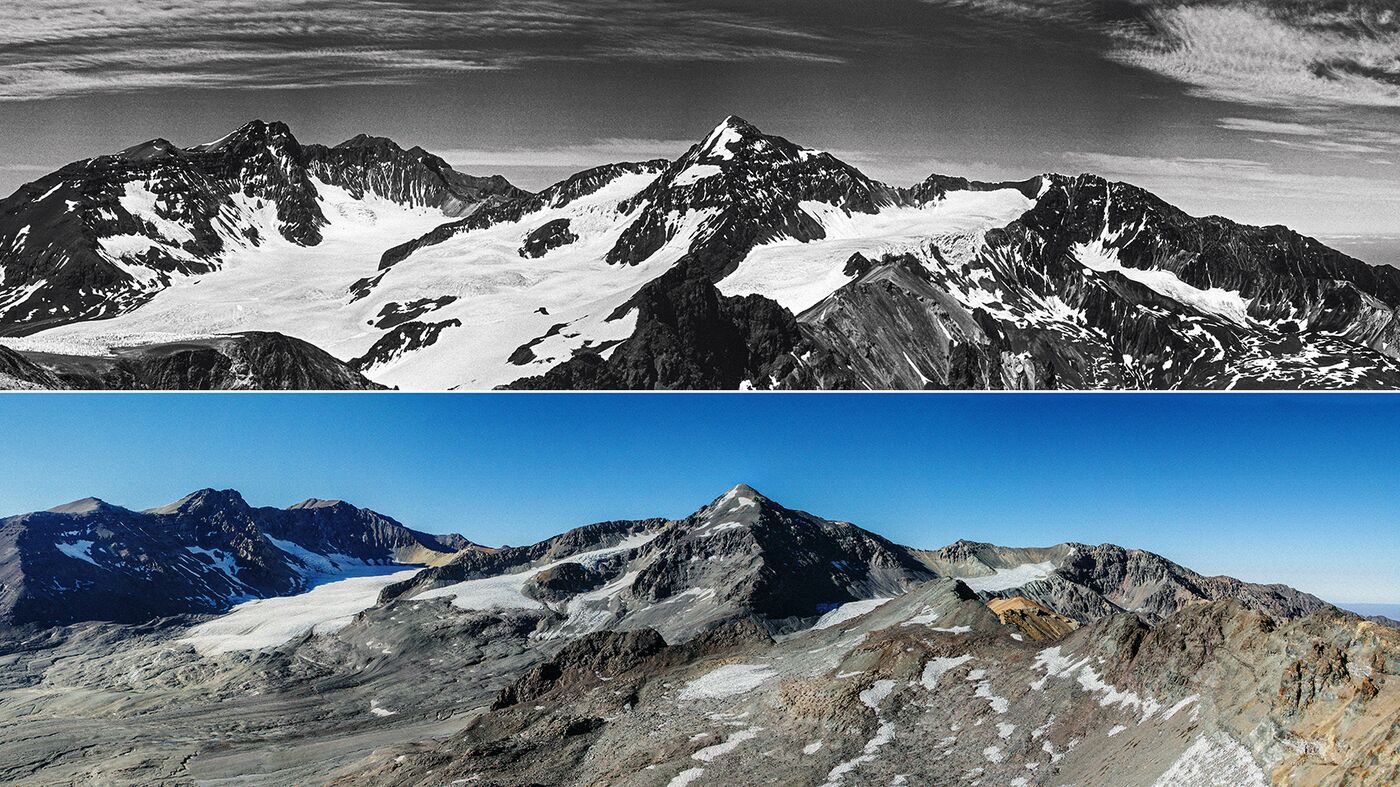
relates to South America’s Glaciers May Have a Bigger Problem Than Climate Change
Top: French glaciologist Louis Lliboutry photographed Portillo del Cerro Negro peak (4,600 meters) and Olivares Alfa glacier on his first expedition, between Jan. 26-31 in 1953. Bottom: Olivares Alfa glacier seen from the same place on Jan. 29, 2019. The glacier has lost 66% of its mass since 1953.
Source: Courtesy of Marc Turrel, author of the book “Louis Lliboutry, el hombre que descifró los glaciares”. Photography by Louis Lliboutry; Alex Cattan and Marc Turrel

Glaciers happen to cover some of the massive copper deposits that make Chile the world’s largest producer of the metal, with about a third of the world’s copper output coming from its mines each year. Mining is key to Chile’s economy, making up 10% of its gross domestic product and comprising just over half its exports.

That economic reality is at the heart of the government’s quandary, evaluating the trade-offs required to protect the environment while supporting an industry worth some $19 billion to the economy. Chile’s minister for mining, Baldo Prokurica, insists the twin aims are not mutually exclusive.

“Mining can be done without damaging the environment and that’s what we want to do,” Prokurica said in an interview in Santiago, pointing out that countries with similar challenges such as Canada, Norway and the U.S. have higher environmental standards and still manage to mine without a glacier law.

The bill proposes all glaciers and their surroundings become protected areas, bans non-scientific interventions and considers any violations of the rules to be crimes. That’s too broad brush for Chile’s government, which plans its own environmental legislation. “I believe in preserving the glaciers, but also in mining,” said Prokurica.

Pinera’s minority government is still on the back foot over the bill in the same year that it’s due to host the United Nations COP25 climate change summit, making it an easy target for charges of hypocrisy by opponents.

“If they don’t support the glacier bill, it will show their bid for COP was playing to the gallery,” says Guido Girardi, the opposition senator who sponsored the legislation. “We’re facing a catastrophe and not protecting glaciers is not an option anymore.”

Glaciers have long been the bane of the mining industry. During the 1970s, state-owned copper miner Codelco removed glaciers covering a rich deposit in the mountains northwest of the capital to allow development of its Andina mine. At a time when Chile had almost no environmental protections, the act was celebrated as a great feat of engineering.

Scientific advances mean that it’s now known glaciers help lower temperatures and increase air humidity for a 50-kilometer (30-mile) radius. They’re also the reason that rivers in central Chile carry about the same volume of water during the current extreme drought as in normal conditions. In a dry year, as much as two-thirds of the water in river systems feeding Santiago comes from the glaciers high up in the Andes.
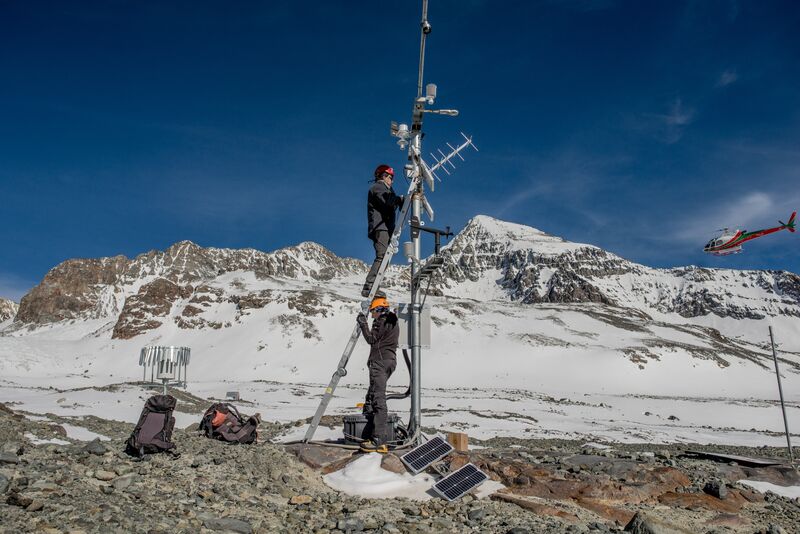
relates to South America’s Glaciers May Have a Bigger Problem Than Climate Change
Casassa and Gonzalez inspect a meteorological monitoring station in a valley next to the Andina and Los Bronces mines.
Photographer: Tomas Munita/Bloomberg

The upshot is that as drought conditions become more prevalent from Cape Town to Chennai in India, Chile remains relatively sheltered. Some 70% of the country’s population of 18 million lives in areas where glaciers make the difference.

But that natural safety net is coming under increasing strain. While most mines in Chile are in the country’s northern Atacama desert, miners are moving south in search of newer and richer deposits—and encountering glaciers on the way.

“Requests to explore and mine in areas with a large presence of glaciers are only increasing,” said Francisco Ferrando, a glaciologist and professor at Universidad de Chile in Santiago.

Most of Chile’s glaciers are in the southern Patagonia region, and while a few are located inside national parks and hence protected, the majority aren’t, meaning that any intervention is treated on a case-by-case basis. White glaciers, where the ice is in direct contact with air, enjoy wider protection than less well-known rock glaciers—masses of frozen water that have sat beneath layers of rock for millennia.

Miners’ Challenge

The world’s largest copper deposit sits near the Olivares glacier

Source: Sentinel satellite image from July 13, 2019

An academic paper from 2010 found that a third of all rock glaciers in central Chile had been directly impacted by mining activities such as road building, drilling platforms and depositing waste on top of the ice. In addition, dust from trucks and explosions in pits as well as vibrations from heavy machinery accelerate the melting. Mining itself is water intensive since it’s needed in each step to produce copper, with usage forecast to rise.

Almost every large mining company operating in Chile has impacted glaciers, including Anglo American Plc. at its Los Bronces mine and Antofagasta Plc. at Los Pelambres, according to the paper.

Anglo American’s Los Bronces operation and Codelco’s Andina mine are exploiting the world’s largest copper deposit in the Andes, about 40 miles from Santiago. Only a rock ridge separates them from the Olivares Alfa glacier. The two giant pits, the mining trucks and dust from the explosions are clearly visible from a helicopter.

With both companies planning new billion-dollar projects to maintain production at current levels, alarm bells have been set off among environmentalists, who say that mining is hastening the process of desertification.

It’s a charge miners reject. Joaquin Villarino, the president of industry group, Mining Council, has said that glaciers are shrinking because of climate change, and that pollution from transport and other industrial activities in Santiago are also having an impact. The glacier bill contains “serious errors,” he said.

All the same, miners are taking action. While Codelco is doing early engineering work on an expansion of its open-cast Andina mine, its sister mine, Los Bronces, will go partly underground in a $3 billion plan to avoid impact on the surface.
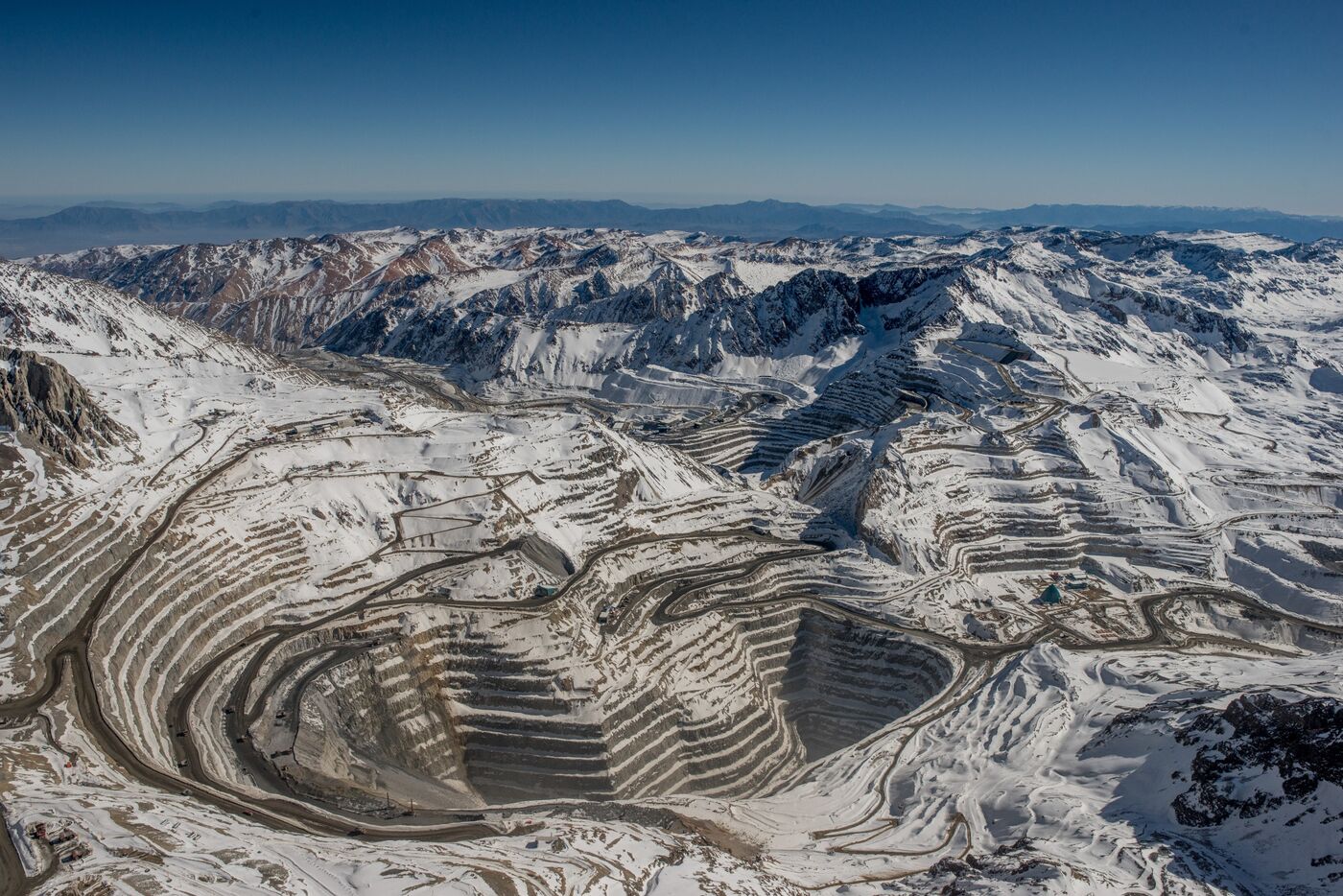
relates to South America’s Glaciers May Have a Bigger Problem Than Climate Change
The Andina and Los Bronces mine pits in the Andes mountains above Santiago.
Photographer: Tomas Munita/Bloomberg

Owner Anglo American “acknowledges the importance of glaciers and has the conviction that mining activity and the preservation of the environment can coexist,” the company said in an emailed response to questions. Codelco declined to comment on its plans for Andina.

Pinera’s administration is going on the offensive. Approval of the glacier bill would force four mines including Andina and Los Bronces to halt operations, costing billions of dollars and more than 34,500 jobs, according to a report by the government’s copper commission Cochilco. Copper output would fall by 11% through 2030, impacting global metals markets, it said.

Casassa, the geologist, sees the impact of climate change accelerating but shares the government’s assessment that there is no need for specific glacier legislation.

The government may be powerless to stop the bill, however, since it lacks a majority in either chamber of parliament. Lawmaker Girardi says it could clear both the senate and chamber of deputies by early next year, an outcome he sees as of global significance.

“All the changes we are seeing, all the climate catastrophes across the world are just the beginning,” Girardi said. “Chile’s glaciers are strategic, not just for our country, but for all humanity.”

— With assistance by Maria Jose Campano, and Samuel Dodge
It’s 2019. Why Haven’t Humans Gone Back to the Moon Since the Apollo Missions?

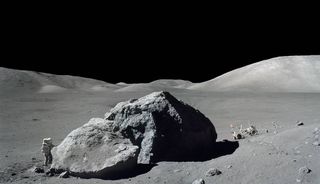
On Dec. 13, 1972, scientist-astronaut Harrison Schmitt is photographed standing next to a huge boulder during the final Apollo moon-landing mission, Apollo 17. This mosaic is made from two photos shot by fellow Apollo 17 moonwalker Eugene Cernan.

On Dec. 13, 1972, scientist-astronaut Harrison Schmitt is photographed standing next to a huge boulder during the final Apollo moon-landing mission, Apollo 17. This mosaic is made from two photos shot by fellow Apollo 17 moonwalker Eugene Cernan.
(Image: © Eugene Cernan/NASA)

In retrospect, Apollo 11 was even more exceptional than we thought.

NASA put two astronauts on the moon on July 20, 1969, just eight years after President John F. Kennedy announced the audacious goal and a mere 12 years after the dawn of the Space Age.

Five more crewed missions hit the gray dirt after Apollo 11, the last of them, Apollo 17, touching down in December 1972.

Related: Apollo 11 at 50: A Complete Guide to the Historic Moon Landing

CLOSE
Volume 0%

More coverage:

Humanity hasn’t been back to Earth’s nearest neighbor since (though many of our robotic probes have). NASA has mounted multiple crewed moon projects since Apollo, including the ambitious Constellation Program in the mid-2000s, but none of them have gone the distance.

So what was different about Apollo? It was incubated in a very particular environment, experts say — the Cold War space race with the Soviet Union.

“This was war by another means — it really was,” Roger Launius, who served as NASA’s chief historian from 1990 to 2002 and wrote the recently published book “Apollo’s Legacy” (Smithsonian Books, 2019), told Space.com. “And we have not had that since.”

Apollo 11 Moon Landing Reconstructed Using Orbiter Imagery
Volume 0%

The Soviet Union fired the first few salvos in this proxy war. The nation launched the first-ever satellite, Sputnik 1, in October 1957 and put the first person in space, Yuri Gagarin, in April 1961. These shows of technological might worried U.S. officials, who wanted a big win of their own. And they believed putting the first boots on the moon would do the trick.

This wasn’t viewed as empty flexing. The United States wanted, among other things, to show the world that the future lay with its political and economic systems, not those of its communist rival.

“The Apollo days were not, fundamentally, about going to the moon,” John Logsdon, a professor emeritus of political science and international affairs at The George Washington University’s Elliott School of International Affairs in Washington, D.C., told Space.com. “They were about demonstrating American global leadership in a zero-sum Cold War competition with the Soviet Union.”

Watch NASA’s Artemis-1 Mission Launch to Moon in New Animation
Volume 0%

So NASA got the resources it needed to pull off its moon shot. And those resources were immense — about $25.8 billion for Apollo from 1960 through 1973, or nearly $264 billion in today’s dollars. During the mid-1960s, NASA got about 4.5% of the federal budget — 10 times greater than its current share.

The stakes haven’t been nearly as high since the end of the Cold War, so subsequent moon projects haven’t enjoyed such sustained support. (They likely also suffered from some been-there-done-that sentiment.) For example, the Constellation Program, which took shape under President George W. Bush, was canceled in 2010 by President Barack Obama.

Obama directed NASA to instead send astronauts to a near-Earth asteroid. But President Donald Trump nixed that plan in 2017, putting the agency back on course for the moon.

Watch Apollo 11’s Moon Landing in Amazing Simulation
Volume 0%

NASA initially targeted 2028 for the first crewed lunar landing since the Apollo days. But this past March, Vice President Mike Pence instructed NASA to get it done by 2024.

The accelerated timeline might actually make this newest moon shot more achievable, NASA Administrator Jim Bridenstine has said, citing the “political risk” that doomed Constellation and other programs.

Buzz Aldrin and Michael Collins Talk With Trump For Apollo 50th Anniversary
Volume 0%

Political risk exists “because priorities change, budgets change, administrations change, Congresses change,” Bridenstine said May 14 in a town-hall address to NASA employees.

“So, how do we retire as much political risk as possible?” he added. “We accelerate the program. Basically, the shorter the program is, the less time it takes, the less political risk we endure. In other words, we can accomplish the end state.”

The 2024 landing is part of a program called Artemis, which aims to build up a long-term, sustainable human presence at and around the moon. The main goal is to lay the foundation for crewed trips to the ultimate human-spaceflight destination: Mars. NASA aims to put boots on the Red Planet sometime in the 2030s.

Swarm of ladybugs so large it registers on National Weather Service radar in California

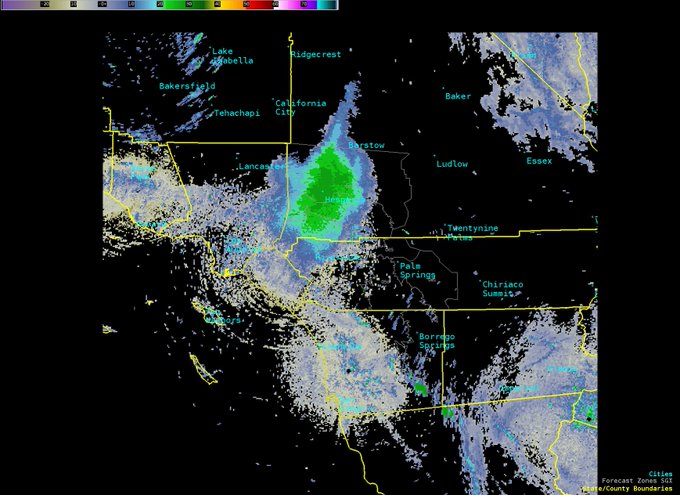
A swarm of ladybugs moving through San Diego County was so large it registered on the National Weather Service’s (NWS) weather radar Tuesday night, CBS Los Angeles reports. The NWS office in San Diego tweeted out a video of the radar that looked to be showing precipitation but was in fact what they called a ladybug “bloom.”

Embedded video

NWS San Diego

@NWSSanDiego

The large echo showing up on SoCal radar this evening is not precipitation, but actually a cloud of lady bugs termed a “bloom”

1,163 people are talking about this

NWS Meteorologist Miguel Miller told local news radio station KNX-AM the 80-mile-long and 80-mile-wide blob was heading toward San Diego County from the San Gabriel Mountains.

11-foot gator breaks into Florida home by crashing through window

Imagine waking up in the middle of the night, walking into the kitchen to get a midnight snack — and then almost becoming a snack yourself. That’s what happened to one family in Clearwater, Florida, when they woke up in the middle of the night to find an alligator in their kitchen.

The 11-foot gator broke into the family’s home through a low window in the kitchen, the Clearwater Police Department said on Facebook. The homeowner immediately called the police and a trapper responded to the scene to remove the gator.

untitled-collage-5.jpg
An 11-foot alligator broke through a window, at left, into a Florida family’s kitchen.CLEARWATER POLICE DEPARTMENT

The beastly reptile was captured and there were no injuries, the police said. The department shared several photos of the unwanted visitor on Facebook. One shows the gator sticking its head through the broken glass window. Another photo shows the mess he made in the kitchen, knocking over a table and chairs.

It’s unclear what drew the gator inside the family’s kitchen. It seems he wanted in so badly, he was willing to smash through glass.

In 2017, a Florida golf course made headlines after a massive 800-pound alligator moseyed across the green. Last year, a gator was spotted walking across the tarmac at Orlando International Airport. Luckily, passengers who spotted the creature were safely inside the plane, although they were briefly delayed, as the gator prevented the plane from taxiing to its gate.

While burglars are usually not gators, Florida has seen more than its fair share of gators in odd places. Last month in Sarasota, Florida, another family had a middle-of-the-night encounter with an 11-foot gator. It didn’t break into their kitchen, but it did take a dip in their pool. 

If you happen to encounter a gator in the wild — or in your kitchen — your safest option is to keep your distance. Jack Hanna, director emeritus of Columbus Zoo and Aquarium, advises staying at least 40 to 50 feet away from any potential alligator hazard. At 20 feet, Hanna says an alligator could “outrun any human.”

But if you can’t get away, wildlife experts recommend you fight back. If an alligator bites you, make a commotion by hitting or kicking it or poking it in the eyes. Gators will retreat from prey they can’t easily overwhelm.

An Asteroid with Its Own Moon Will Zip Past Earth Tonight

An animation shows what the orbit of a moon around asteroid 1999 KW4 looks like.

(Image: © Dr. Steven Ostro et al./NASA)

A very big asteroid with its own little moon is going to zip past Earth tonight (May 25) — close enough that, with some preparation and a decent telescope, amateur astronomers may spot it blotting out the stars.

This moon-and-asteroid system, called 1999 KW4, is made up of two rocks. The big one is about 0.8 miles (1.3 kilometers) wide, according to NASA, and shaped like a spinning top. The smaller one is more elongated and stretches 0.35 miles (0.57 km) along its longest dimension. It points lengthwise toward its much larger twin.

Together, the asteroid and its minimoon will pass Earth at such a strange, steep angle that NASA called them “the least accessible … for a spacecraft mission of any known binary near-Earth asteroid.”

Related: Doomsday: 9 Real Ways Earth Could End

CLOSE
Volume 0%

But that doesn’t mean they aren’t interesting to look at.

The two asteroids will pass closest to Earth at 7:05 pm EDT (1105 GMT), when they’ll be just 3,219,955 miles (5,182,015 km) from the planet’s surface. That’s more than a dozen times the distance between the Earth and the moon in its orbit around our planet, and much too far for the space rocks to pose any threat. In fact, this is the fourth approach the binary asteroids have made toward Earth since they were discovered in 1999, and not the closest. This is not the first time, according to EarthSky, that astronomers plan to make radar images of these asteroids as they pass.

A 2001 series of radar images taken with NASA's Goldstone radar telescope shows 1999 KW4.

(Image: © Dr. Steven Ostro et al./NASA)

Back on May 25, 2001, according to NASA, the asteroids passed about 6.7% closer to Earth than they will this time, at a distance of 3,005,447 miles (4,836,798 km). Seventeen years from now, on May 25, 2036, the rocks will pass 55.2% closer to Earth, at a distance of just 1,443,511 miles (2,323,106 km) — again, posing no threat worth worrying about.

These big rocks have been frequent flyers in our planet’s neighborhood for a long time.

“1999 KW4 approaches within 0.05 AU of Earth several times each century,” NASA’s report on the object said. “This trend exists from at least [the year] 1600 [to] 2500.” [Black Marble Images: Earth at Night]

“AU” refers to “astronomical units,” a unit equal to the distance between Earth and the sun. So 0.05 AU is equal to one-twentieth the distance between Earth and sun, or about 4,650,000 miles (7,480,000 km). The two asteroids have passed even closer to Earth, without incident, several times a century since William Shakespeare was writing, and they will continue to do so until this article is at least 500 years old.

EarthSky reported that during the space rocks’ closest approach, they’ll be most visible in the Southern Hemisphere, appearing as fast-moving shadows against stars in the constellation Puppis. The two asteroids will remain visible for several days, though, according to EarthSky. North American asteroid hunters may spot the objects near the constellation Hydra on the evening of May 27.

NASA said that its Planetary Defense Coordination Office will continue to closely monitor the asteroids.

Originally published on Live Science.

Elephant Remembers Old Trainer in Emotional Reunion

https://www.msn.com/en-us/news/good-news/elephant-remembers-old-trainer-in-emotional-reunion/ar-AAB5qoG?OCID=ansmsnnews11

Stephanie Officer
Ad 00:35 – up next: “Elephant Reunites With Old Trainer”
Elephant Reunites With Old Trainer

As the adage goes — an elephant never forgets.After 35 years, Kristy the Asian elephant still has fond memories of her former zookeeper, Peter Adamson. He was Kristy’s trainer in the early ’70s and ’80s, when she lived at a zoo in Scotland that is now closed.

The pair reunited at the Neunkircher Zoo in Germany while Adamson was visiting friends in Germany.

He found out Kristy was still alive at 52 years old and still healthy. The average lifespan for Asian elephants is 48 years.

Adamson contacted the zoo and officials arranged the emotional reunion.

As that reunion unfolded, a pair of baby elephants got a second chance at life.

a close up of a man: Kristy the Asian elephant was reunited with her trainer after more than 30 years.© Provided by CBS Interactive Inc. Kristy the Asian elephant was reunited with her trainer after more than 30 years.The calves somehow slipped into a pit in Sri Lanka, struggling there for three hours before wildlife officials brought in an excavator to dig an escape route.

It took a little upper body strength, some wiggling and a little bit of help before both tots were able to climb out.

Wildlife officials used loud crackers to chase the calves back into the wild, so they could run right back to their mothers — capping an adventure they may never forget, either.

The Rapid Decline Of The Natural World Is A Crisis Even Bigger Than Climate Change

A three-year UN-backed study from the Intergovernmental Science-Policy Platform On Biodiversity and Ecosystem Services has grim implications for the future of humanity.
 

Nature is in freefall and the planet’s support systems are so stretched that we face widespread species extinctions and mass human migration unless urgent action is taken. That’s the warning hundreds of scientists are preparing to give, and it’s stark.

The last year has seen a slew of brutal and terrifying warnings about the threat climate change poses to life. Far less talked about but just as dangerous, if not more so, is the rapid decline of the natural world. The felling of forests, the over-exploitation of seas and soils, and the pollution of air and water are together driving the living world to the brink, according to a huge three-year, U.N.-backed landmark study to be published in May.

The study from the Intergovernmental Science-Policy Platform On Biodiversity and Ecosystem Services (IPBES), expected to run to over 8,000 pages, is being compiled by more than 500 experts in 50 countries. It is the greatest attempt yet to assess the state of life on Earth and will show how tens of thousands of species are at high risk of extinction, how countries are using nature at a rate that far exceeds its ability to renew itself, and how nature’s ability to contribute food and fresh water to a growing human population is being compromised in every region on earth.

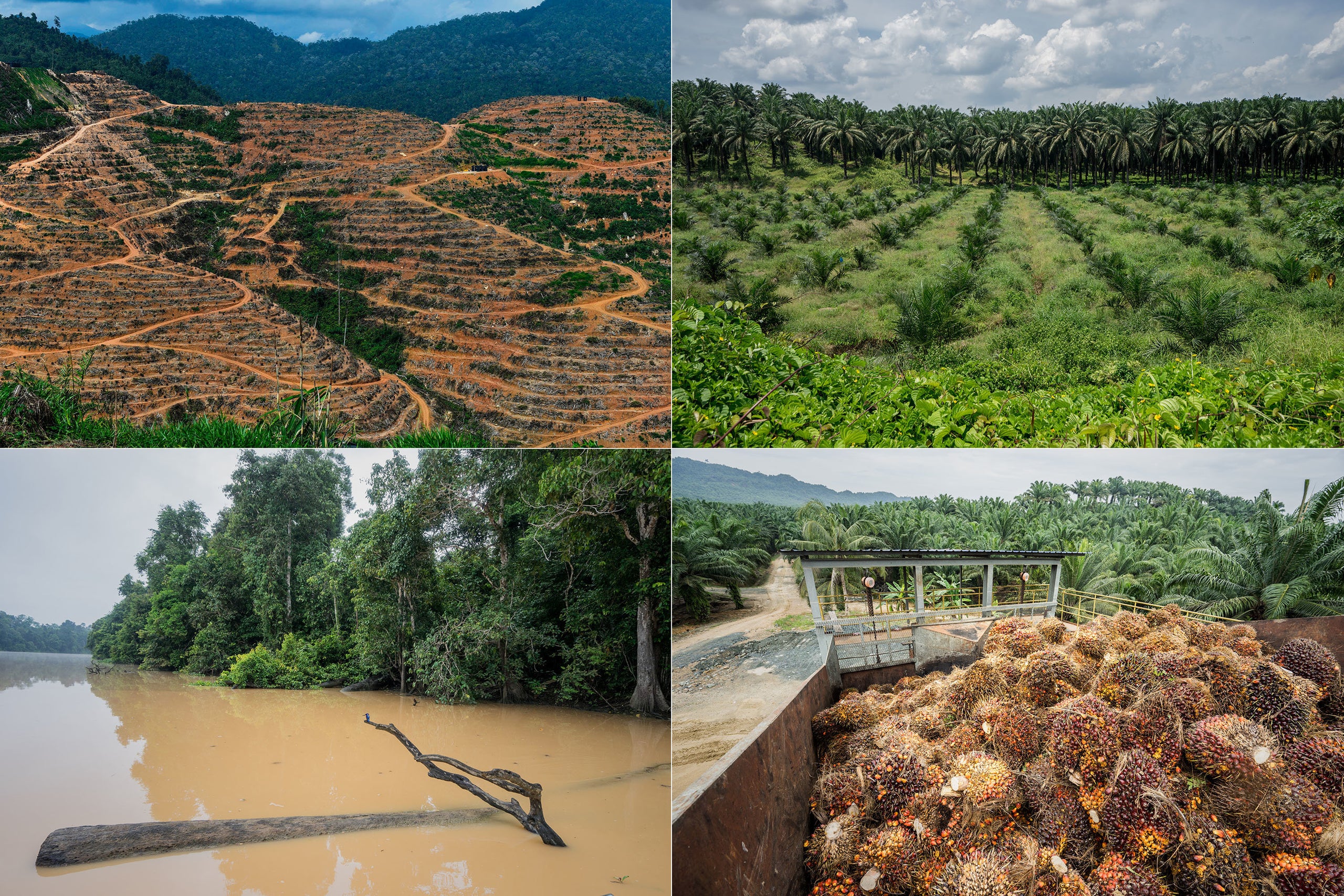
Left top: A durian plantation in Raub, on the outskirts of Kuala Lumpur. Soaring demand for durians in China is being blamed

Left top: A durian plantation in Raub, on the outskirts of Kuala Lumpur. Soaring demand for durians in China is being blamed for a new wave of deforestation in Malaysia.
Right top: A palm oil plantation encroaches on a wildlife reserve in Sabah, Malaysia.
Left bottom: The Kinabatangan River flows through a wildlife reserve in Sabah, Malaysia. The overuse of pesticides during the heavy equatorial rains creates a deadly runoff into the fragile river and its tributaries.
Right bottom: A palm oil plantation and factory in Sabah, Malaysia.

Nature underpins all economies with the “free” services it provides in the form of clean water, air and the pollination of all major human food crops by bees and insects. In the Americas, this is said to total more than $24 trillion a year. The pollination of crops globally by bees and other animals alone is worth up to $577 billion.

The final report will be handed to world leaders not just to help politicians, businesses and the public become more aware of the trends shaping life on Earth, but also to show them how to better protect nature.

“High-level political attention on the environment has been focused largely on climate change because energy policy is central to economic growth. But biodiversity is just as important for the future of earth as climate change,” said Sir Robert Watson, overall chair of the study, in a telephone interview from Washington, D.C.

“We are at a crossroads. The historic and current degradation and destruction of nature undermine human well-being for current and countless future generations,” added the British-born atmospheric scientist who has led programs at NASA and was a science adviser in the Clinton administration. “Land degradation, biodiversity loss and climate change are three different faces of the same central challenge: the increasingly dangerous impact of our choices on the health of our natural environment.”

Around the world, land is being deforested, cleared and destroyed with catastrophic implications for wildlife and people. Forests are being felled across Malaysia, Indonesia and West Africa to give the world the palm oil we need for snacks and cosmetics. Huge swaths of Brazilian rainforest are being cleared to make way for soy plantations and cattle farms, and to feed the timber industry, a situation likely to accelerate under new leader Jair Bolsonaro, a right-wing populist.

Industrial farming is to blame for much of the loss of nature, said Mark Rounsevell, professor of land use change at the Karlsruhe Institute of Technology in Germany, who co-chaired the European section of the IPBES study. “The food system is the root of the problem. The cost of ecological degradation is not considered in the price we pay for food, yet we are still subsidizing fisheries and agriculture.”

This destruction wrought by farming threatens the foundations of our food system. A February report from the U.N. warned that the loss of soil, plants, trees and pollinators such as birds, bats and bees undermines the world’s ability to produce food.

An obsession with economic growth as well as spiraling human populations is also driving this destruction, particularly in the Americas where GDP is expected to nearly double by 2050 and the population is expected to increase 20 percent to 1.2 billion over the same period.

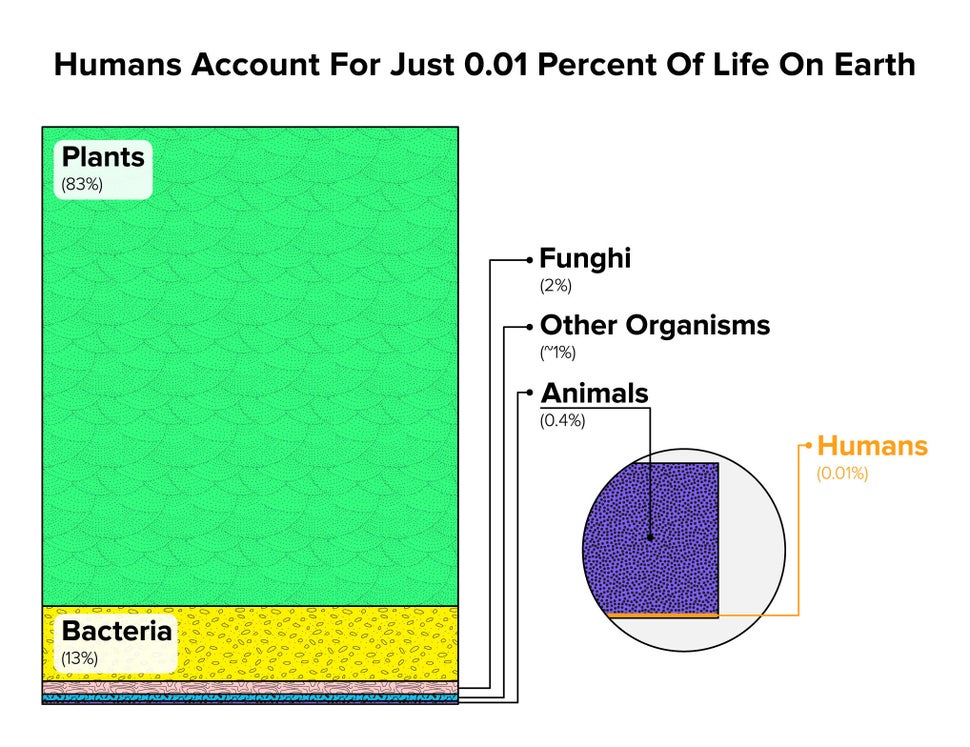
Human have had a huge impact on the world but we make up a tiny fraction of the living world. In the first ever calculation o

Human have had a huge impact on the world but we make up a tiny fraction of the living world. In the first ever calculation of the biomass of life on Earth, scientists found that humans make up just 0.01 percent of all living things. Source: Yinon M. Bar-On, Rob Phillips, and Ron Milo, PNAS, 2018

Nature is likely to be hit particularly hard over the next 30 years, said Jake Rice, chief scientist emeritus at the Canadian government’s department of oceans and fisheries, who co-chaired the Americas study. High consumption and destructive farming will further degrade land and marine ecosystems, he added, although the pace of destruction is diminishing because so much has already gone.

“The great transformation has already taken place in North America but the remote parts of South and Central America remain under threat. A new wave of destruction is transforming the Amazon and Pampas regions [of Latin America],” said Rice.

All of this comes at a huge cost and has implications for the systems that prop up life on this planet, throwing into doubt the ability of humans to survive.

Future generations will likely experience far less wildlife, said Luthando Dziba, head of conservation services at South African National Parks, who co-chaired the section of the IPBES report that focuses on Africa.

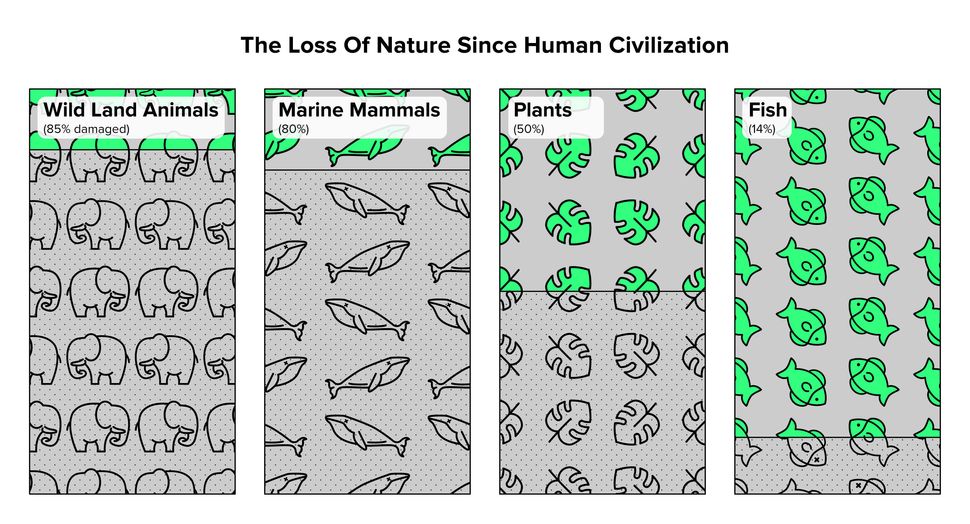
Humans have caused the loss of around 80 percent of wild land and marine mammals, and half of plants. Source: Yinon

Humans have caused the loss of around 80 percent of wild land and marine mammals, and half of plants. Source: Yinon M. Bar-On, Rob Phillips, and Ron Milo, PNAS, 2018

“Africa is the world’s last home for a wide range of large mammals but the scientific consensus is that under current scenarios to 2100 more than half of African bird and mammal species could be lost,” said Dziba.

Around 20 percent of Africa’s land surface has already been degraded by soil erosion, loss of vegetation, pollution and salinization, he said, adding that the expected doubling of the continent’s population to 2.5 billion people by 2050 will put yet further pressure on its biodiversity.

While people are familiar with the threats to whales, elephants and other beloved animals, the problem goes far deeper than that. Animal populations have declined by 60 percent since 1970, driven by human actions, according to a recent World Wildlife Fund study.

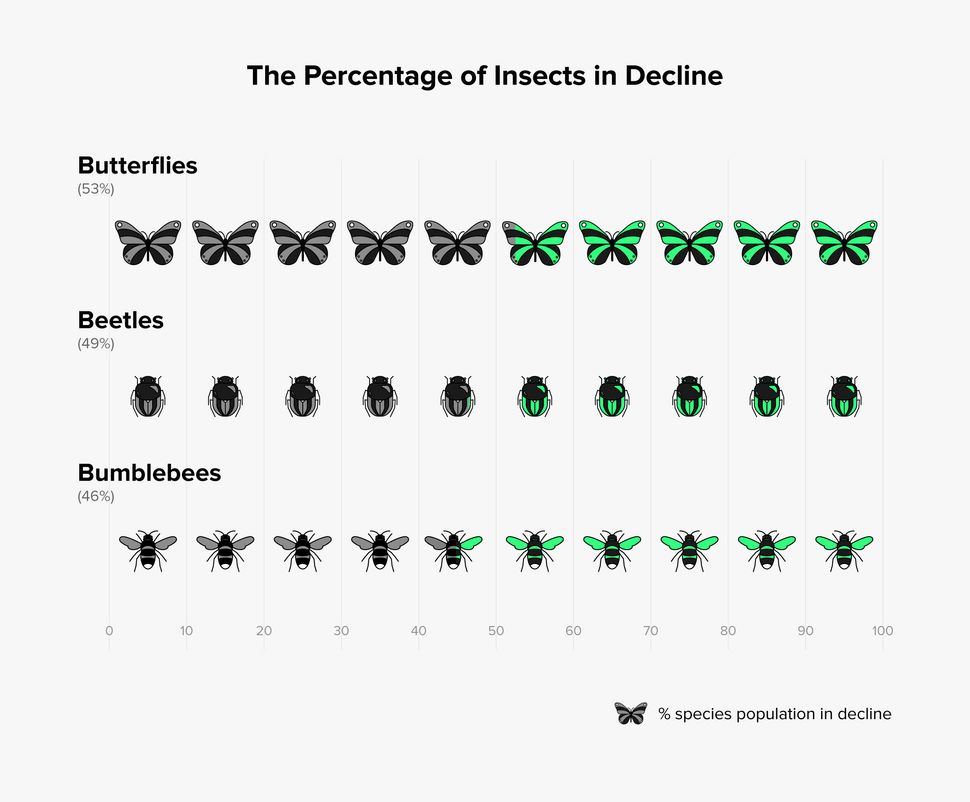
And insects, vital to the diets of other animals, as well as the pollinators of our food, are facing a bleak future as populations appear to be collapsing. Land use changes and increased pesticide use are destroying habitats and vastly reducing numbers. In Europe, up to 37 percent of bees and 31 percent of butterflies are in decline, with major losses also recorded in southern Africa, according to the pollinators section of the report.

A major assessment of insect studies conducted over the last few decades found that 41 percent of insects are in decline. Sou

A major assessment of insect studies conducted over the last few decades found that 41 percent of insects are in decline. Source: Sánchez-Bayoa and Wyckhuy, Biological Conservation, 2019

“Species which are not charismatic have been politically overlooked,” said Rounsevell. “Over 70 percent of freshwater species and 61 percent of amphibians have declined [in Europe], along with 26 percent of marine fish populations and 42 percent of land-based animals … It is a dramatic change and a direct result of the intensification of farming,” he said.

This destruction is also driving mass human migration and increased conflict. Decreasing land productivity makes societies more vulnerable to social instability, says the report, which estimates that in around 30 years’ time land degradation, together with the closely related problems of climate change, will have forced 50 to 700 million people to migrate.

“It will just be no longer viable to live on those lands,” said Watson.

The study will also recognize that much of the remaining wealth of nature depends on indigenous people, who mostly live in the world’s remote areas and are on the frontline of the damage caused by destructive logging and industrial farming. According to IPBES, indigenous communities often know best how to conserve nature and are better placed than scientists to provide detailed information on environmental change.

Brazil – which nationwide hosts about 42,000 plant species, 9,000 species of vertebrates and almost 130,000 invertebrates – has an indigenous population of almost 900,000 people, says the report.

“What surprised me the most about this study was that it became clear that the older cultures, like the indigenous peoples of the Americas, have different values which protect nature better [than Western societies],” said Watson. “No one should romanticize indigenous peoples, and we cannot turn the clock back, but we can learn a lot from them on how to protect the planet.”

Indigenous people, however, continue to experience discrimination, threats and murder. In Brazil, for example, Bolsonaro’s election has cemented a pro-corporate, anti-indigenous agenda that has already started to undermine the rights of the country’s native communities.

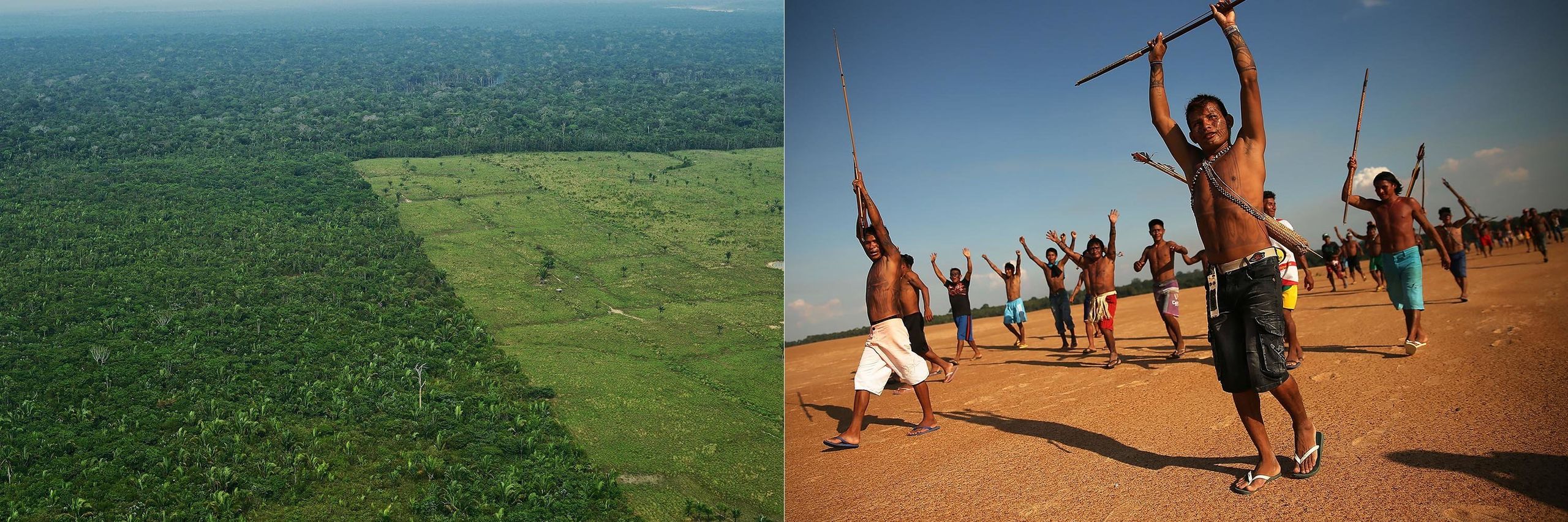
Left: Aerial view of deforestation in the Western Amazon region of Brazil.<br> Right: Members of the Munduruku indigenous tri

Left: Aerial view of deforestation in the Western Amazon region of Brazil.
Right: Members of the Munduruku indigenous tribe on the banks of the Tapajos River protest against plans to construct a hydroelectric dam on the river in the Amazon rainforest on November 26, 2014 near Sao Luiz do Tapajos, Para State, Brazil.

Although their conclusions are stark, the IPBES authors are not entirely gloomy about Earth’s prospects. In offering practical options for future action, they want to show that it is not too late to slow down or even reverse degradation.

They will also recognize that individual and community actions to plant trees, regenerate abandoned lands and protect nature can have a major positive impact.

Many other solutions to save nature have been put forward by individuals and countries.

Veteran biologist E.O.Wilson proposed that half the Earth needs to be protected to have any hope of avoiding disaster. Elsewhere, indigenous people in Latin America have argued for the creation of one of the world’s largest protected land areas, stretching from the southern tip of the Andes to the Atlantic.

Several countries are taking bold initiatives to restore land, both to help meet climate targets and to protect and enhance biodiversity. Pakistan intends to plant 10 billion trees (although its previous billion tree campaign was not without controversy), Ethiopia has mobilized communities to regenerate 15 million hectares of degraded lands and the Green Wall project is pushing for a 4,970-mile long belt of vegetation across Africa. Meanwhile, the U.N. Environment program has reported a surge in the number and size of marine protected areas.

Public awareness of the crisis is also growing, with new social movements setting up to put pressure on governments to act urgently. The Extinction Rebellion movement, which began in London in October, argues that we face an unprecedented emergency. Backed by academics, scientists, church leaders and others, including Naomi Klein, Noam Chomsky and Vandana Shiva, it claims to have spread to 35 countries in its first two months. Children too are joining in. On March 15, thousands of young people across 30 countries plan to strike from school and protest against inaction on climate change.

But despite these moves to reverse the ongoing destruction of the natural world, the big picture remains worrying. Ambitious global agreements like the Aichi targets set in Japan in 2010 and the U.N.’s Sustainable Development Goals around protecting nature, may not be met at current rates of progress, say the report authors.

Ultimately, Watson concludes that saving nature will require a major rethink of how we live and how we think about nature, but that it is possible to turn this dire situation around if governments want it to happen.

“There are no magic bullets or one-size-fits-all answers. The best options are found in better governance, putting biodiversity concerns into the heart of farming and energy policies, the application of scientific knowledge and technology, and increased awareness and behavioral changes,” Watson said. “The evidence shows that we do know how to protect and at least partially restore our vital natural assets. We know what we have to do.”

For more content and to be part of the ‘This New World’ community, follow our Facebook page.

HuffPost’s ‘This New World’ series is funded by Partners for a New Economy and the Kendeda Fund. All content is editorially independent, with no influence or input from the foundations. If you have an idea or tip for the editorial series, send an email to thisnewworld@huffpost.com

Donald Trump: World-renowned primatologist Jane Goodall likens US President to a chimpanzee

‘To impress rivals, males seeking to rise in the dominance hierarchy perform spectacular displays: Stamping, slapping the ground, dragging branches, throwing rocks,’ says prominent conservationist

Primatologist Jane Goodall has since been echoed by prominent psychologist Professor Dan P McAdams

Primatologist Jane Goodall has since been echoed by prominent psychologist Professor Dan P McAdams ( EPA )

World-renowned primatologist Dame Jane Goodall has likened Donald Trump‘s behaviour to that of a chimpanzee.

The British conservationist first gained international recognition for studying chimps in what is now Tanzania and has studied the primates for more than 50 years.

“In many ways the performances of Donald Trump remind me of male chimpanzeesand their dominance rituals,” she told The Atlantic during the 2016 presidential election.

“In order to impress rivals, males seeking to rise in the dominance hierarchy perform spectacular displays: Stamping, slapping the ground, dragging branches, throwing rocks.”

A more aggressive display was likely to lead the male to higher positions in the hierarchy and allow it to maintain its status for longer, she said.

Mr Trump’s election campaign was littered with bombastic statements and since becoming President, he has issued increasingly aggressive threats towards North Korea.

In his first address to the UN General Assembly, he said the US may have no choice but to “totally destroy” North Korea.

Dame Jane’s analysis of Mr Trump’s behaviour has since been echoed by prominent psychologist Professor Dan P McAdams.

Describing what he called a male chimpanzee’s “charging display” in an article in The Guardian, Professor Adams, of Northwestern University, said: “The top male essentially goes berserk and starts screaming, hooting, and gesticulating wildly as he charges toward other males nearby.”

He added: “Trump’s incendiary tweets are the human equivalent of a charging display: Designed to intimidate his foes and rally his submissive base, these verbal outbursts reinforce the President’s dominance by reminding everybody of his wrath and his force.”

Dame Goodall has previously condemned the Republican President’s plans to scrap key US climate change policies as “extremely depressing”.

Mr Trump resolved to take America out of the Paris climate change agreement, although in recent months has appeared to soften on the issue.

“There’s no way we can say climate change isn’t happening: it’s happened,” Dame Jane said in March during her first trip to the US since the election.

“There is definitely a feeling of gloom and doom among all the people I know.

“If we allow this feeling of doom and gloom to continue then it will be very, very bad, but my job is to give people hope, and I think one of the main hopes is the fact that people have woken up: people who were apathetic before or didn’t seem to care.”

“It’s a miracle!”: Bees living on Notre-Dame cathedral roof survive blaze


Notre-Dame cathedralImage copyrightGETTY IMAGES
Image captionCathedral beekeeper Nicolas Geant says the bees would have got “drunk” on smoke from the fire

Notre-Dame’s smallest residents have survived the devastating fire which destroyed most of the cathedral’s roof and toppled its famous spire.

Some 200,000 bees living in hives on the roof were initially thought to have perished in the blaze.

However Nicolas Géant, the cathedral’s beekeeper, has confirmed that the bees are alive and buzzing.

Mr Géant has looked after the cathedral’s three beehives since 2013, when they were installed.

That was part of an initiative to boost bee numbers across Paris.

The hives sit on top of the sacristy by Notre-Dame’s south side, around 30m (98 ft) below the main roof. As a result, Mr Géant says they remained untouched by the flames.

European bees – unlike other species – stay by their hive after sensing danger, gorging on honey and working to protect their queen.

High temperatures would have posed the biggest risk, but Mr Géant explained that any smoke would have simply intoxicated them.

“Instead of killing them, the carbon dioxide makes them drunk, puts them to sleep,” he told AP.

Beekeepers commonly use smoke to sedate the insects and gain access to their hive.

“I was incredibly sad about Notre-Dame because it’s such a beautiful building,” Mr Géant said in an interview with CNN.

“But to hear there is life when it comes to the bees, that’s just wonderful.”

“Thank goodness the flames didn’t touch them,” he added. “It’s a miracle!”


Fossil ‘mother lode’ records Earth-shaking asteroid’s impact: study

AFP.

Washington (AFP) – Scientists in the US say they have discovered the fossilized remains of a mass of creatures that died minutes after a huge asteroid slammed into the Earth 66 million years ago, sealing the fate of the dinosaurs.

In a paper to be published Monday, a team of paleontologists headquartered at the University of Kansas say they found a “mother lode of exquisitely preserved animal and fish fossils” in what is now North Dakota.

The asteroid’s impact in what is now Mexico was the most cataclysmic event ever known to befall Earth, eradicating 75 percent of the planet’s animal and plant species, extinguishing the dinosaurs and paving the way for the rise of humans.

Researchers believe the impact set off fast-moving, seismic surges that triggered a sudden, massive torrent of water and debris from an arm of an inland sea known as the Western Interior Seaway.

At the Tanis site in North Dakota’s Hell Creek Formation, the surge left “a tangled mass of freshwater fish, terrestrial vertebrates, trees, branches, logs, marine ammonites and other marine creatures,” according to Robert DePalma, the report’s lead author.

Some of the fish fossils were found to have inhaled “ejecta” associated with the Chicxulub event, suggesting seismic surges reached North Dakota within “tens of minutes,” he said.

“The sedimentation happened so quickly everything is preserved in three dimensions — they’re not crushed,” said co-author David Burnham.

“It’s like an avalanche that collapses almost like a liquid, then sets like concrete. They were killed pretty suddenly because of the violence of that water. We have one fish that hit a tree and was broken in half.”

The fossils at Tanis include what were believed to be several newly identified fish species, and others that were “the best examples of their kind,” said DePalma, a graduate student and curator of the Palm Beach Museum of Natural History in Florida.

“We look at moment-by-moment records of one of the most notable impact events in Earth’s history. No other site has a record quite like that,” he said.

“And this particular event is tied directly to all of us — to every mammal on Earth, in fact. Because this is essentially where we inherited the planet. Nothing was the same after that impact. It became a planet of mammals rather than a planet of dinosaurs.”

The paper is to be published in the Proceedings of the Academy of Natural Sciences.