Exposing the Big Game

Forget Hunters' Feeble Rationalizations and Trust Your Gut Feelings: Making Sport of Killing Is Not Healthy Human Behavior

Exposing the Big Game

Seismic Testing to Begin in Atlantic Ocean in Push for Offshore Drilling

Seismic Testing to Begin in Atlantic Ocean in Push for Offshore Drilling

The Interior Department announced it is moving forward with seismic surveys in the Atlantic Ocean following President Donald Trump‘s executive order last month to aggressively expand offshore drilling in protected areas off the Arctic and Atlantic oceans.

Six permit applications by energy companies—ones that were rejected by the Obama administration—are being reviewed by the department.

The oil and gas industry has long pushed for seismic surveys used to search for oil and gas deposits deep below the ocean’s surface.

However, environmental groups warn that the surveys are an extremely loud and dangerous process.

“Seismic airguns create one of the loudest manmade sounds in the ocean, firing intense blasts of compressed air every 10 seconds, 24 hours a day, for weeks to months on end,” Dustin Cranor, Oceana‘s senior director of U.S. communications, told EcoWatch. “The noise from these blasts is so loud that it can be heard up to 2,500 miles from the source, which is approximately the distance from Washington, DC to Las Vegas.”

“These blasts are of special concern to marine life, including fish, turtles and whales, which depend on sound for communication and survival,” Cranor said. He noted that the government’s own estimates show that seismic airgun blasting in the Atlantic could injure as many as 138,000 marine mammals like dolphins and whales, while disturbing the vital activities of millions more.

Furthermore, Greenpeace said “pursuing this development stands at cross-purposes with the nation’s necessary and rapidly accelerating move away from fossil fuels, and with previous commitments to address global climate change.”

Sea Shepherd Conservation Society’s Capt. Paul Watson explained, “One of the major threats to the survival of cetaceans, is noise pollution. More seismic testing and military LFS testing will result in more strandings. This decision equates to a death sentence for thousands of whales and dolphins.”

Seismic data has not been gathered in the mid- and south-Atlantic regions, from northern Florida to Delaware, for at least 30 years.

The Interior Department said that the surveys are needed to update information about the Outer Continental Shelf that was gathered more than three decades ago, “when technology was not as advanced as today.”

The Associated Press reported that any new drilling activity is expected to be limited to the coasts of Virginia, North and South Carolina and Georgia.

Interior Sec. Ryan Zinke said that the surveys will help “a variety of federal and state partners better understand our nation’s offshore areas … and evaluate resources that belong to the American people.”

Industry groups applauded the department’s decision to review the permit applications. “There has been no documented scientific evidence of noise from these surveys adversely affecting marine animal populations or coastal communities,” Randall Luthi, president of the National Ocean Industries Association, said.

Trump’s executive order was aimed at rolling back President Obama’s permanent ban on new offshore oil and gas drilling in the Arctic and Atlantic oceans.

“Renewed offshore energy production will reduce the cost of energy, create countless new jobs, and make America more secure and far more energy independent,” Trump said before signing the document last month.

But Greenpeace said that Atlantic drilling would threaten the region’s vibrant fishing and tourism industry, warning that “a spill equivalent to the BP Gulf oil disaster could coat beaches stretching from Savannah to Boston.”

Additionally, Cranor pointed out that more than 120 East Coast municipalities, 1,200 elected officials, and an alliance representing 35,000 businesses and 500,000 fishing families have publicly opposed offshore drilling and/or seismic airgun blasting.

“These individuals and groups understand that nearly 1.4 million jobs and more than $95 billion in gross domestic product are at risk if dangerous offshore drilling activities occur in the Atlantic Ocean,” Cranor explained.

Conservation groups have filed a lawsuit against President Trump, challenging his decision to reverse President Obama’s ban.

Trump expands offshore drilling with executive order

President Trump signed an order Friday to kick off the process of undoing former President Obama’s restrictions on offshore oil and natural gas drilling.

In a White House signing ceremony joined by energy industry officials and lawmakers from coastal states, Trump pitched his executive order as a massive job and economy booster.

“We’re unleashing American energy and clearing the way for thousands and thousands of high-paying American energy jobs,” Trump said at the ceremony.

He said Obama had closed off 94 percent of the country’s outer continental shelf, which “deprives our country of potentially thousands and thousands of jobs and billions of dollars in wealth.”“Renewed offshore energy production will reduce the cost of energy, create countless new jobs and make America more secure and far more energy independent,” he said, calling the order “another historic step toward … a real future with greater prosperity and security for all Americans, which is what we want.”

The order came on Trump’s 99th day in office, during a week in which he signed numerous executive orders. He has now signed more executive orders in his first 100 days than any recent president.

The offshore drilling policy goes further toward fulfilling Trump’s promise to enable the production and use of more domestic energy, with an emphasis on fossil fuels. He promised on the campaign trail repeatedly to unleash the United States’ energy potential.

The order immediately repeals most of Obama’s ban on drilling in large parts of the Arctic Ocean, north of Alaska, which Obama intended to be indefinite.

It also asks Interior Secretary Ryan Zinke to revise Obama’s plan for offshore drilling rights sales between 2017 and 2022. Zinke is asked specifically to consider drilling in the Arctic and Atlantic oceans, which haven’t had new drilling rights sales in years.

Trump is also asking Zinke to consider repealing or changing “burdensome regulations that slow job creation,” including safety rules put in place after the 2010 BP Deepwater Horizon disaster in the Gulf of Mexico.

“This executive order starts the process of opening offshore areas to job-creating energy exploration,” Trump said at the ceremony.

The oil industry and its allies cheered Trump’s order as a major shift in federal policy toward their priorities.

“We are pleased to see this administration prioritizing responsible U.S. energy development and recognizing the benefits it will bring to American consumers and businesses,” American Petroleum Institute President Jack Gerard said in a statement.

“Developing our abundant offshore energy resources is a critical part of a robust, forward-looking energy policy that will secure our nation’s energy future and strengthen the U.S. energy renaissance,” he said.

House Natural Resources Committee Chairman Rob Bishop (R-Utah) welcomed the policy as “a thorough review of the morass of bad policies developed and imposed by the prior administration.”

Environmentalists were joined by leaders, including governors of Democratic coastal states, in blasting the order.

“No matter how much money it spends or how many lobbyists it places inside the Trump administration, Big Oil can never nor will never drown out the voices of millions of Americans across the country who speak out against dangerous offshore drilling,” said Michael Brune, executive director of the Sierra Club.

The governors of California, Oregon and Washington called the move shortsighted. The order doesn’t specifically call for Pacific drilling — where there have been no new leases in decades — but doesn’t rule it out.

“We still remember what happened in Santa Barbara in 1969, Port Angeles in 1985, Grays Harbor in 1988 and Coos Bay in 1999. We remember the oil soaked beaches and wildlife and the devastating economic impacts to local communities and the fishing industry,” California Gov. Jerry Brown, Oregon Gov. Kate Brown and Washington Gov. Jay Inslee, all Democrats, said in a joint statement.

“Now is not the time to turn back the clock. We cannot return to the days where the federal government put the interests of big oil above our communities and treasured coastline.”

Fukushima clean-up falters six years after tsunami/Japan bans Fukushima rice after radiation breaches limits

Exploration work inside the nuclear plant’s failed reactors has barely begun, with the scale of the task described as ‘almost beyond comprehension’

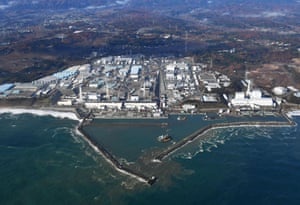
This aerial photo shows Fukushima Dai-ichi nuclear power plant in Okuma, Fukushima Prefecture
Cleaning up the Fukushima Daiichi nuclear plant is expected to take 30 to 40 years. Photograph: AP

Barely a fifth of the way into their mission, the engineers monitoring the Scorpion’s progress conceded defeat. With a remote-controlled snip of its cable, the latest robot sent into the bowels of one of Fukushima Daiichi’s damaged reactors was cut loose, its progress stalled by lumps of fuel that overheated when the nuclear plant suffered a triple meltdown six years ago this week.

As the 60cm-long Toshiba robot, equipped with a pair of cameras and sensors to gauge radiation levels was left to its fate last month, the plant’s operator, Tokyo Electric Power (Tepco), attempted to play down the failure of yet another reconnaissance mission to determine the exact location and condition of the melted fuel.

Even though its mission had been aborted, the utility said, “valuable information was obtained which will help us determine the methods to eventually remove fuel debris”.

The Scorpion mishap, two hours into an exploration that was supposed to last 10 hours, underlined the scale and difficulty of decommissioning Fukushima Daiichi – an unprecedented undertaking one expert has described as “almost beyond comprehension”.

Cleaning up the plant, scene of the world’s worst nuclear disaster since Chernobyl after it was struck by a magnitude-9 earthquake and tsunami on the afternoon of 11 March 2011, is expected to take 30 to 40 years, at a cost Japan’s trade and industry ministry recently estimated at 21.5tr yen ($189bn).

The figure, which includes compensating tens of thousands of evacuees, is nearly double an estimate released three years ago.

The tsunami killed almost 19,000 people, most of them in areas north of Fukushima, and forced 160,000 people living near the plant to flee their homes. Six years on, only a small number have returned to areas deemed safe by the authorities.

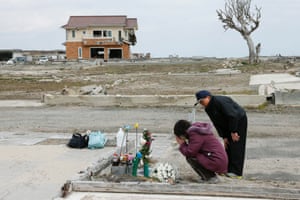
Grieving people
Pinterest
The tsunami on 11 March 2011 killed almost 19,000 people. Photograph: Kimimasa Mayama/EPA

Developing robots capable of penetrating the most dangerous parts of Fukushima Daiichi’s reactors – and spending enough time there to obtain crucial data – is proving a near-impossible challenge for Tepco. The Scorpion – so called because of its camera-mounted folding tail – “died” after stalling along a rail beneath the reactor pressure vessel, its path blocked by lumps of fuel and other debris.

Advertisement

The device, along with other robots, may also have been damaged by an unseen enemy: radiation. Before it was abandoned, its dosimeter indicated that radiation levels inside the No 2 containment vessel were at 250 sieverts an hour. In an earlier probe using a remote-controlled camera, radiation at about the same spot was as high as 650 sieverts an hour – enough to kill a human within a minute.

Shunji Uchida, the Fukushima Daiichi plant manager, concedes that Tepco acquired “limited” knowledge about the state of the melted fuel. “So far we’ve only managed to take a peek, as the last experiment with the robot didn’t go well,” he tells the Guardian and other media on a recent visit to the plant. “But we’re not thinking of another approach at this moment.”

Robotic mishaps aside, exploration work in the two other reactors, where radiation levels are even higher than in reactor No 2, has barely begun. There are plans to send a tiny waterproof robot into reactor No 1 in the next few weeks, but no date has been set for the more seriously damaged reactor No 3.

Naohiro Masuda, the president of Fukushima Daiichi’s decommissioning arm, says he wants another probe sent in before deciding on how to remove the melted fuel.

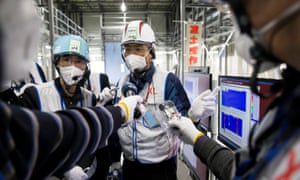
A Tepco employee speaks to the media at the company’s Fukushima Daiichi nuclear power plant.
Pinterest
A Tepco employee speaks to the media at the company’s Fukushima Daiichi nuclear power plant. Photograph: Reuters

Despite the setbacks, Tepco insists it will begin extracting the melted fuel in 2021 – a decade after the disaster – after consulting government officials this summer.

But Shaun Burnie, a senior nuclear specialist at Greenpeace Germany who is based in Japan, describes the challenge confronting the utility as “unprecedented and almost beyond comprehension”, adding that the decommissioning schedule was “never realistic or credible”.

The latest aborted exploration of reactor No 2 “only reinforces that reality”, Burnie says. “Without a technical solution for dealing with unit one or three, unit two was seen as less challenging. So much of what is communicated to the public and media is speculation and wishful thinking on the part of industry and government.

“The current schedule for the removal of hundreds of tons of molten nuclear fuel, the location and condition of which they still have no real understanding, was based on the timetable of prime minister [Shinzo] Abe in Tokyo and the nuclear industry – not the reality on the ground and based on sound engineering and science.”

Even Shunichi Tanaka, the chairman of Japan’s nuclear regulation authority, does not appear to share Tepco’s optimism that it will stick to its decommissioning roadmap. “It is still early to talk in such an optimistic way,” he says. “At the moment, we are still feeling around in the dark.”

‘The situation is not under control’

On the surface, much has changed since the Guardian’s first visit to Fukushima Daiichi five years ago.

Then, the site was still strewn with tsunami wreckage. Hoses, pipes and building materials covered the ground, as thousands of workers braved high radiation levels to bring a semblance of order to the scene of a nuclear disaster.

Six years later, damaged reactor buildings have been reinforced, and more than 1,300 spent fuel assemblies have been safely removed from a storage pool in reactor No 4. The ground has been covered with a special coating to prevent rainwater from adding to Tepco’s water-management woes.

Workers who once had to change into protective gear before they approached Fukushima Daiichi now wear light clothing and simple surgical masks in most areas of the plant. The 6,000 workers, including thousands of contract staff, can now eat hot meals and take breaks at a “rest house” that opened in 2015.

But further up the hill from the coastline, row upon row of steel tanks are a reminder of the decommissioning effort’s other great nemesis: contaminated water. The tanks now hold about 900,000 tons of water, with the quantity soon expected to reach 1m tons.

Tepco’s once-vaunted underground ice wall, built at a cost of 24.5bn yen, has so far failed to completely prevent groundwater from leaking into the reactor basements and mixing with radioactive coolant water.

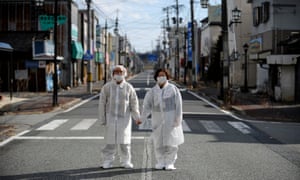
Couple hold hands on Fukushima street
Pinterest
Much has changed in Fukushima since the disaster. Photograph: Franck Robichon/EPA

The structure, which freezes the soil to a depth of 30 metres, is still allowing 150 tonnes of groundwater to seep into the reactor basements every day, said Yuichi Okamura, a Tepco spokesman. Five sections have been kept open deliberately to prevent water inside the reactor basements from rising and flowing out more rapidly. “We have to close the wall gradually,” Okamura said. “By April we want to keep the influx of groundwater to about 100 tonnes a day, and to eliminate all contaminated water on the site by 2020.”

Critics of the clean-up note that 2020 is the year Tokyo is due to host the Olympics, having been awarded the Games after Abe assured the International Olympic Committee that Fukushima was “under control”.

Mitsuhiko Tanaka, a former Babcock-Hitachi nuclear engineer, accuses Abe and other government officials of playing down the severity of the decommissioning challenge in an attempt to win public support for the restart of nuclear reactors across the country.

“Abe said Fukushima was under control when he went overseas to promote the Tokyo Olympics, but he never said anything like that in Japan,” says Tanaka. “Anyone here could see that the situation was not under control.

“If people of Abe’s stature repeat something often enough, it becomes accepted as the truth.”


Too much caesium found in rice grown near Fukushima Daiichi nuclear plant, which was hit by tsunami in March
Japan bans Fukushima rice
Japanese rice that was found contain radioactive contamination well above the legal limit is displayed in Fukushima city. Photograph: Jiji Press/AFP/Getty Images

Japan has banned shipments of rice grown near a tsunami-hit nuclear power plant, after detecting radiation exceeding the legal limit.

The cabinet secretary, Osamu Fujimura, said on Thursday that a sample of rice from a farm contained 630 becquerels of caesium a kg.

Caesium was among the radioactive materials that leaked from the FukushimaDaiichi nuclear plant after it was damaged by the earthquake and tsunami in March.

Under Japanese regulations, rice with more than 500 becquerels of caesium per kilogram must not be consumed.

Officials have tested rice at hundreds of spots in Fukushima, but none had previously exceeded the limit. Only last month Fukushima declared that rice grown in the prefecture was safe.

Captain Paul Watson’s Sunday Sermon

 By Captain Paul Watson

I have family and friends who are Christians, Muslims, Jews, Atheists, Buddhists, Wiccans and even a few Scientologists and Mormons.

I have family and friends who are Conservatives, Liberals, Republicans, Democrats, Independents, Socialist, Communists, Anarchists and even a couple of Nihilists and possibly a Fascist or two.

I have family and friends from places flying hundreds of different flags and speaking hundreds of different languages.

I have family and friends who are wealthy, middle class, poor and homeless.

I have family and friends who are vegan, vegetarian and omnivore and possibly a couple of breatharians or so they say.

Some people have faith in anthropocentric fantasies, others have faith in science.

I have no problem with what people believe in or don’t believe in.

My concern is what connects us all and that is water. All of us without exception are citizens of this water planet – the Planet Ocean.

All of us owe our existence to the Ocean and the one great truth in my life is a simple one and that is; If the Ocean dies we all die!

It does not matter what you believe, it does not matter what your politics are. We are all united by the fact that if phytoplankton is diminished, we are all diminished. If forests are diminished we are all diminished and if biodiversity is diminished, we are all diminished.

Ecology has no politics, nationality, nor religion.

Since 1950 we have seen a 40% diminishment in phytoplankton mass in the world’s seas. Phytoplankton produce most of the oxygen that we depend upon for our collective survival.

How many people are aware of this? Sadly very few.

How many people even care? Again sadly very few.

Each of us are on average 65% water. This water passes into and out of our bodies beinging nutrients and removing waste from every single cell.

So if someone is 100 kilos, 65 kilos of what we are is H2O.
Of the remaining 35%, only about half is composed of human body cells. The other half is composed of trillions of cells from up to 10,000 species of bacteria.

In other words there is no such thing as an individual human being. We are all symbionts – a large complex mobile community of species of bacteria and fungi, and these species are interdependent. Bacteria cleans our skin, manufactures vitamins in our body, digests our food and perform numerous functions required to keep us alive.

This interdependence has allowed us to survive on this planet for tens of thousands of years. If an alien life form were to arrive here without a protective suit, it would quickly die because of the bacteria that we have evolved to co-exist with.

Kill off enough microflora in the body and we die. We exist because bacteria exist.

Every living thing from bacteria to the great whales is interdependent. The first law of ecology is diversity, the second is interdependence and the third is the law of finite resources. Lack of resources caused by over population of one species diminishes diversity in other species and thus diminishes biodiversity.

I have often been criticized for saying that worms, bees, trees and plankton are more important than human beings. However the truth is that these species can live without us but we cannot live without them. We need them and they don’t need us. Some species are more important than other depending on how they contribute to the collective life support system. Phytoplankton produces oxygen, trees absorb carbon dioxide, bees pollinate plants and worms keep the soil healthy.

When people ask me what my politics are, my answer is biocentrism and the laws of ecology.

When people ask me what my religious beliefs are, my answer is biocentrism and the laws of ecology.

I am a symbiotic self-aware mobile community of human and bacterial cells living within an Oceanic eco-system on the Planet Ocean.

We tend to view the sea as the Ocean. However the sea is only a part of the Ocean. The Ocean is water and it is in the sea, in the atmosphere, under the soil, deep in the rocks , locked up in ice and it flows through every cell of every plant and animal on the planet. It is water in constant circulation, pumped by the sun, circulated in rain, rivers, streams etc, and cleansed by estuaries, condensation, marshes and wetlands.

Everything connected by the one most important element composed of two molecules of hydrogen and one molecule oxygen connected so tightly and so intimately that all water is essentially one molecule.

We humans are here for the following reason:

1. Because of the sun. The sun is energy. Plants eat sunlight and animals eat plants.
2. Because of water. Water is life.
3. Because of the evolution of bio-diversity. The machinery of life.
4. Because of phytoplankton and trees to provide oxygen.
5. Because of phytoplankton, trees and plants absorbing carbon dioxide.
6. Because life is dictated by the natural laws of ecology.
7. Because 65.2 million years ago, an asteroid slammed into our planet ending the age of dinosaurs and laying the foundation for the evolution of mammals and the evolvement of primates into hominids. Without that asteroid there would still be life on this planet, just not life as we know it.

We are part of the Continuum – the flow of life.

The energy within us is eternal. The water within us is eternal. That which we think and believe we are – our consciousness is ephemeral.

 Image may contain: text

Toronto filmmaker Rob Stewart was an aquatic guardian angel for the “demons” of the deep


by PAUL WATSON
Special to The Globe and Mail
Published Saturday, Feb. 04, 2017 6:17PM EST
Last updated Saturday, Feb. 04, 2017 6:44PM EST

At the age of 22, Robert Stewart was a young and energetic man who understood that the most powerful weapon in the world is the camera, and armed with a camera he set out in the year 2002 to change the world.

He succeeded.

With his award winning film Sharkwater he actually did change the world. He transformed fearsome monsters into beautifully awesome creatures, deserving of both respect and empathy.

Rob was a man passionate about sharks. He saw them as beautiful sentient beings whose existence contributes to a healthy oceanic eco-system. He set out to prove that his intuitive perception about the true nature of sharks was real, and he did just that.

When Rob boarded my Canadian flagged ship the Ocean Warrior we explored the once shark-abundant waters around Costa Rica’s Cocos Island and the enchanted islands of the Galapagos.

Despite the obstacles, together we found the sharks and together we found trouble with frequent confrontations with shark-finning poachers. Together we were arrested for our interventions for filming crimes in a nation where such crimes are ignored and even protected by the authorities and where a camera is considered as something subversive.

His images contrasted the beauty of sharks within their element against the ugly images of the horror of their living finless bodies tossed overboard, drifting helplessly to the bottom of the sea to die slowly, their shocked eyes open, allowing us, for a moment, to glimpse their pain as the spark of life was slowly extinguished.
Rob once told me that he understood that his work was dangerous but that the least of those dangers was being killed by a shark. He was literally a shark hugger and the image of him with his arms around a large shark, his hand affectionately stroking what most people considered a fearsome creature, was revolutionary and enlightening.

The man knew sharks. He understood their importance and his confidence with his views about sharks allowed him to approach and film some of the most amazing images ever captured about these spectacular apex predators.

In addition to being a marine biologist, Rob Stewart had the four most important virtues needed to be a world class expert on sharks and the reality of our relationship with the living diversity within oceanic eco-system.

These virtues are passion, empathy, courage and imagination. He had the courage to follow his passion with a remarkable empathy for his subject and the imagination to transform the focus of his work through the media of film in a way that changed the perception of sharks to tens of millions of people around the planet.

Rob died doing what he loved. He took chances. Three deep dives in one day using a rebreather was dangerous and he knew it was dangerous. These device,s even in the hands of a professional diver like Rob, are unpredictable. Some people have asked why he was using a rebreather. The answer is that it allowed him to stay down long and because it does not produce bubbles, allowing him to get closer to the sharks,, which are animals that are easily spooked by bubbles. It allowed him to be like one of his subjects rather than a suspicious invader from another world.

Speaking with Rob and looking into his eyes revealed a deep sadness at what our species has done to the sharks. We slaughter tens of millions of them every year to the point that many shark species hover on the brink of extinction and that is why the film he had been working on is called Sharkwater Extinction.

Rob was an incredible educator in the spirit of Captain Jacques Cousteau. He brought the aquatic realm onto land and confronted us with the reality of the true nature of sharks. That in itself was heroic, even more so than his extraordinary feats of underwater documentation. It was heroic because he was championing a creature that has for centuries inspired fear and loathing. As a filmmaker, he was the antithesis of Stephen Spielberg and Sharkwater was the Anti Jaws.

It was my privilege to stand with Rob to present Sharkwater at the Toronto Film Festival. It was my privilege to dive with him in the Galapagos and at Cocos Island.

Rob pioneered a new and intimate approach to documenting sharks and I believe he inspired other courageous film makers like Michael Muller (White Mike) and Madison Stewart (Shark Girl). He laid the groundwork for both film makers and conservationists.

Most importantly he has left a legacy.

He will be greatly missed, by his family and friends, by his fellow Canadians and by caring and dedicated people around the world who will never forget his work, his courage, his talent, his resolve, his imagination and his awesome passion for life, beauty and truth.
Paul Watson is a marine wildlife conservationist, environmental activist and founder of the the anti-poaching proup the Sea Shepherd Conservation Society.

With his award winning film Sharkwater he actually did change the world. He transformed fearsome…
THEGLOBEANDMAIL.COM

For Filmmaker Rob Stewart — Watch Sharkwater

by Karen Dawn

02/02/2017

On day three of the search, Rob’s body was found at the bottom of the ocean he loved, 300 ft from where he was last seen alive. It seems most likely that he passed out and sank, painlessly, doing what he loved. I will leave the piece below intact, because now more than ever we can honor him by watching and sharing his beautiful work, his legacy.

——————————————————————————————————————————————————————- Update:

Rob Stewart: Missing Canadian film-maker’s body found in Florida

As I write this piece, the search continues for activist and Sharkwater filmmaker Rob Stewart, who has been missing for two days. On Saturday, he posted on Instagram and Facebook:

So happy to be shooting #Sharkwater2 with the best cameras and equipment in the world. For the first time I can show you sharks through my eyes, because the cameras can shoot that fast, and high res enough for you to see the personality in sharks’ faces that people who spend their lives with sharks fully understand.

Just before sunset on Tuesday, he surfaced from his third dive of the day, a dive of 200 feet, just off the Florida Keys. His diving partner was pulled onto the boat, then immediately passed out. As the crew attended to his partner and turned the boat around to pick up Rob, he disappeared. The crew thinks he may have also passed out and floated away.

The divers had been using closed-circulation rebreathing devices, which are considered riskier than standard scuba equipment, but they allow humans to dive without blowing bubbles that can spook sharks. Rob wants us to see the creatures he adores as close up as possible.

Rob is wearing a dry suit. Because it contains his body heat, it precludes using thermal imaging scanning technology at night and so has slowed down the search. But the coastguards have said it also gives him the best possible chance of survival, and that the conditions couldn’t be better, which is why the search is still going at full force after two days.

Tyler MacLeod, a close friend and Sharkwater production manager, tells us that thirty-six year old Rob is a strong swimmer and diver. People have survived for days in the current conditions. Not only is Rob strong, many of us consider him to be blessed. If anybody is going to be gently nudged to shore by a dolphin, or, in his case, more likely a shark, it is Rob.

MacLeod also says that Rob taught him about the power of manifesting, and he asks all of us to use our thoughts to manifest Rob’s safe return. I was struck by that call as I am currently rereading Wayne Dyer’s beautiful book, Manifest Your Destiny. It is about the power of focusing one’s thoughts, energies and intentions. It is important to note that manifesting your destiny is not necessarily the same as manifesting your desires, though they are generally connected.

Rob’s destiny is surely to help us save sharks, to save the oceans, to save life on Earth. All who know him would say that is also his number one desire. Our desire for him to live many more decades to continue to inspire us energizes the search. But, thinking about Rob’s actions, and the risks he takes, we should acknowledge that long life is not his number one priority. While we all hope it is part of his destiny, it may or may not be so.

Unable to think about anything else yesterday, I watched Sharkwater, hoping I was honoring him more than worry possibly could. By encouraging others to watch his wonderful movie, I am doing my best to help him in his mission. Unless you are already absolutely in love with sharks, and passionately committed to saving our oceans, Sharkwater, available for free on Vimeo, will change the way you see the world.

Watch it today, and share it. No matter where Rob Stewart is right now, miraculously alive, or blissfully returned to the oceans he adores, I know that would please him. And it will help manifest both his most cherished desire and his destiny.

Comments

OCEAN ACIDIFICATION IS HAPPENING. Oppose Pruitt Today

It may sound complicated, but really, it’s simple—if you add carbon emissions to seawater, the ocean turns more acidic. Ocean acidification is happening. We can’t sit back and watch politics harm our coastal communities.

Recently, Scott Pruitt—the nominee for the head of the EPA (Environmental Protection Agency) was asked directly by Senators about ocean acidification, he wasn’t even willing to admit that ocean acidification is happening.

shark

OCEAN ACIDIFICATION IS HAPPENING.

We gave Scott Pruitt a chance, we listened to what he had to say at his confirmation hearings and his answers on ocean acidification are a total deal-breaker. Ocean acidification is happening. Shellfish growers in the Pacific Northwest nearly went bankrupt as a result. Lobstermen in Maine are concerned enough about acidification that they have traveled to Washington, D.C. to urge Congress to support important research that will tell them how lobster might be impacted.

hello-crab-coral

AMERICA’S CLEAN WATER AND AIR THAT SUSTAIN US CREATE A SHINING EXAMPLE FOR MUCH OF THE WORLD, AND THE EPA IS THEIR DEFENDER.

Pruitt demonstrates no understanding of the present reality of ocean acidification and the urgent risk it poses to American marine life, fishermen and the communities that depend on them. Americans must protect our water and air from further pollution while we work collaboratively towards win-win solutions to challenges like ocean acidification. Because Pruitt ignores the established science about our ocean, he is the wrong choice to lead the EPA.


For the ocean,

Sarah Cooley, PhD
Director, Ocean Acidification
Ocean Conservancy

The Laws Of Ecology And The Survival Of The Human Species

http://www.huffingtonpost.com/paul-watson/the-laws-of-ecology-and-t_b_11324490.html

08/05/2016

by Captain Paul Watson Founder of the Sea Shepherd Conservation Society

I was raised in a small fishing village on the Passamaquoddy Bay in New Brunswick, Canada and I still vividly remember the way things were in the Fifties. The way things were then is not the way things are now.

I’m not talking about technological, industrial or scientific progress. I’m referring to the health and stability of eco-systems. What was once strong is now weak. What was once rich in diversity is now very much the poorer.

I have been blessed, or perhaps cursed, with the gift of near total recall. I see the images of the past as clearly as the days that were. As a result it has been difficult for me to adapt to diminishment. I see the shells on the beaches that are no longer there, the little crabs under the rocks, now gone, the schools of fishes, the pods of dolphins, the beaches free of plastic.

I began traveling the world in 1967 — hitch-hiking and riding the rails across Canada; joining the Norwegian merchant marine; crossing the Pacific and Indian Oceans; traveling through Japan, Iran, Mozambique and South Africa, working as a tour guide in Turkey and Syria, co-founding the Greenpeace Foundation in 1972 and, in 1977, founding the Sea Shepherd Conservation Society.

2016-08-04-1470340589-1361975-seashepherdfoundercaptainpaulwatson903.jpg

Sea Shepherd founder Paul Watson some forty years ago when he founded the non-profit.

Many things that I saw then no longer exist – or have been severely damaged, changed and diminished.

In the Sixties we did not buy water in plastic bottles. In the Sixties the word ‘sustainable ‘was never used in an ecological context, and except for Rachel Carson, there were very few with the vision to see into the future, where we were going, what we were doing.

But slowly, awareness crept into the psyche of more and more people. People began to understand what the word ecology meant. We saw the creation of Earth Day, and in 1972, the first global meeting on the environment in Stockholm, Sweden that I covered as a journalist.

Gradually, the insight into what were doing became more prevalent and to those who understood, the price to be paid was to be labeled radicals, militants, and a new word – eco-terrorist.

The real “crime” of eco-terrorism was not burning down a ski lodge, toppling a power line or spiking a tree. Such things are only outbursts of desperation and frustration. The real crime of eco-terrorism was having thought, perception, and imagination. In other words, the questioning of the modern economic, corporate and political paradigm.

The word eco-terrorism should be more accurately used for the destruction caused by progress like the Union Carbide disaster in Bhopal or the BP Deep Water Horizon spill in the Gulf of Mexico.

2016-08-04-1470340757-6508043-anoilrig756.jpg

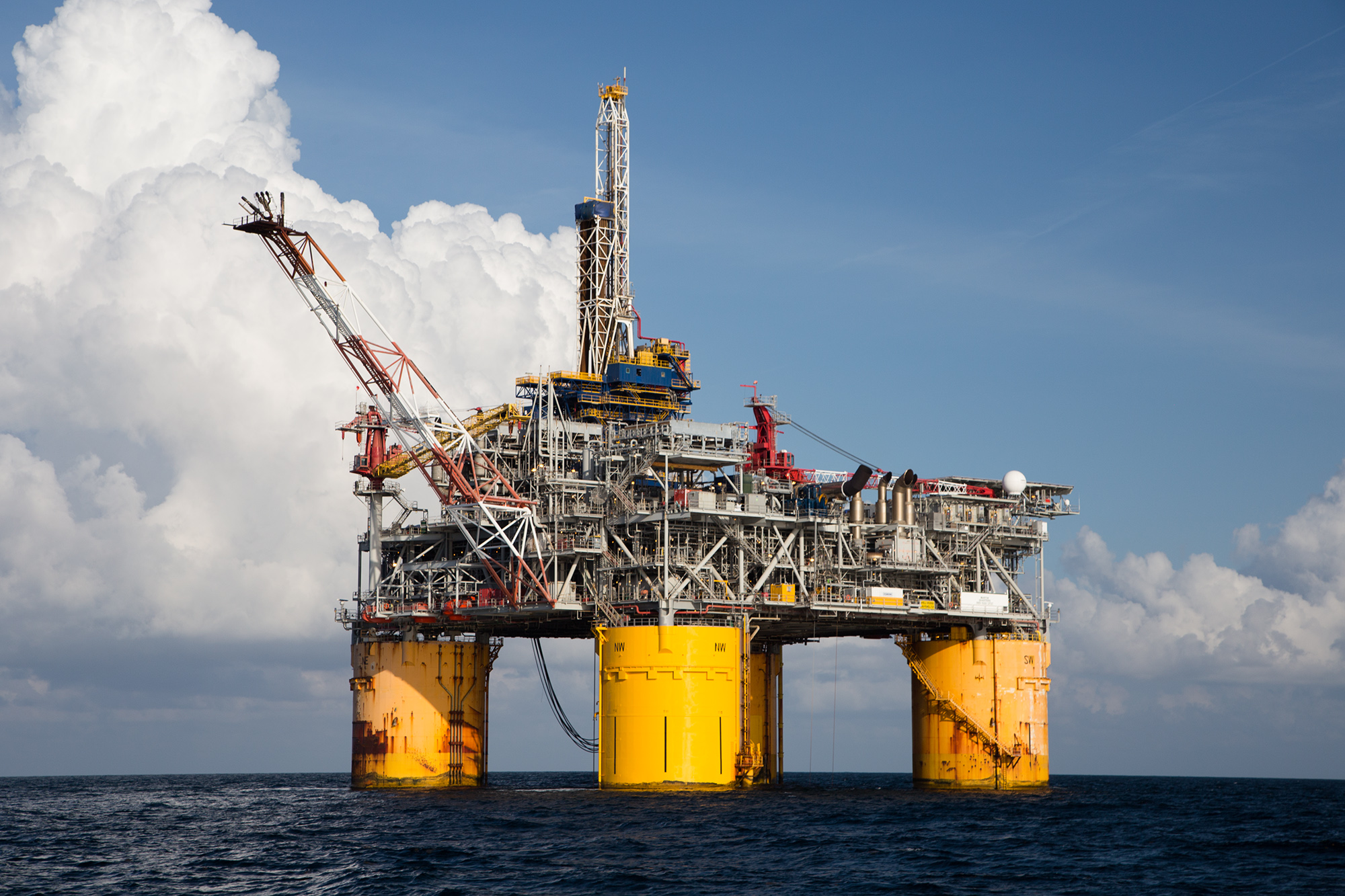
Picture of an oil rig taken during Sea Shepherd’s Operation Toxic Gulf in 2014.

In the Seventies, the late Robert Hunter, along with Roberta Hunter, Dr. Patrick Moore, David Garrick, Rod Marining and myself observed and wrote down the three laws of ecology. What we realized was that these laws are the key to the survival of biodiversity on the planet and also the key to the survival of the human species. We realized that no species could survive outside of the three basic and imperative ecological laws.

The law of diversity: The strength of an eco-system is dependent upon the diversity of species within it.

The law of interdependence: All species are interdependent with each other.

The law of finite resources: There are limits to growth and limits to carrying capacity.

The increase of population in one species leads to the increase in consumption
of resources by that species. This leads to diminishment of diversity of other species, which in turn leads to diminishment of interdependence among species.

For example, increasing diminishment of phytoplankton populations in the sea is causing diminishment of many other species as well as a 40% diminishment in oxygen production since 1950. Diminishment of whale populations has contributed to the diminishment of phytoplankton populations because whale feces are a major source of nutrients (esp. iron and nitrogen) for phytoplankton.

The planet simply cannot tolerate 7.5 billion (and growing) primarily meat and fish eating necrovores. The killing of 65 billion domestic animals each year is contributing more greenhouse gases to the planet than the entire transportation industry. The industrial stripping of life from the sea is causing unprecedented biodiversity collapse in marine eco-systems.

Ecological systems globally are collapsing from coral reefs to rainforests because humanity is exploiting resources far beyond the capacity of eco-systems to create and renew natural resources.

Diminishment of eco-systems is also leading to the breakdown of human social structures causing global conflict in the form of wars and domestic violence. Terrorism is not the cause of society’s problems, it is merely a symptom.

Humans are compromised by medieval paradigms like territorial dominance, hierarchical desires and superstitious beliefs combined with primitive primate behavior like greed and fear.

2016-08-04-1470345289-7416340-bloodbathinleynarclaimedfourpregnantfemales377.jpg

Sea Shepherd’s 2010 Faeroe Islands Dolphin Defense Campaign: Operation Grindstop. Photo credit: Sea Shepherd /Sofia Jonsson

The fishing village that I lived in as a child is no longer a fishing village. The relative innocence of our lives as children of the Fifties and Sixties is no more. The African bush, the Arctic tundra, the marine reserve of the Galapagos Islands, the Great Barrier Reef, the Amazonian rainforests that I once traveled through are no longer what they recently were.

Humans have this amazing ability to adapt to diminishment. It’s a trait that was exceptionally useful when we lived as hunter-gatherers. We adapted to food shortages, to changes in the weather and to the world as it evolved around us. Today we are trying to adapt to the destruction brought on by ourselves and that adaption is taking the form of more and more control by governments and corporations and a blind reliance on corporate technologies.

We no longer have the empathy we once felt. I vividly remember the events of October 23rd, 1958. I was seven years old on the day of the Springhill Mine Disaster in Nova Scotia. 75 men died and 99 were rescue. I remember crying for the fate of people I did not know and feeling excited every time a miner was brought to the surface alive. I no longer have that capacity. Perhaps I lost it when I became an adult, or perhaps society no longer has room for such emotions.

Disaster happened and we grieved for people we did not know. A few weeks ago nearly 100 people were viciously murdered within a few kilometres of where I live when a deranged man mowed them down with a large truck in Nice, France. Last week, a priest was beheaded in France. Every week brings us more stories about mass killings in the Middle East, Africa, America etc. It’s a worldwide pain-fest of chaos and violence and yet it is met with complacency for the most part and a predictable Facebook posting of — “say a prayer for Paris, or Orlando, or Nice, or Beirut, or Istanbul” in a litany of self-indulgent adaptation to tragedy, before being quickly forgotten.

This is not the world of my childhood. We remembered the horrors of World War II with real emotion. I remember talking with both World War I and World War II veterans and feeling their pain. Today it’s just another short-term item on the news, in a world that seeks to escape through movies, celebrities, video games and increasingly more fanatical religious fervor.

Here is the reality. As human populations increase, the consumption of resources increases with it. But because resources are finite and the rate of renewables is overcome by demand, this can only lead to one result — the collapse of resource availability.

And because we are literally stealing resources from other species, this will lead to
diminishment of species and habitats, which will contribute to even more resource diminishment.

2016-08-04-1470342962-4408964-draggingontotheship273.jpg

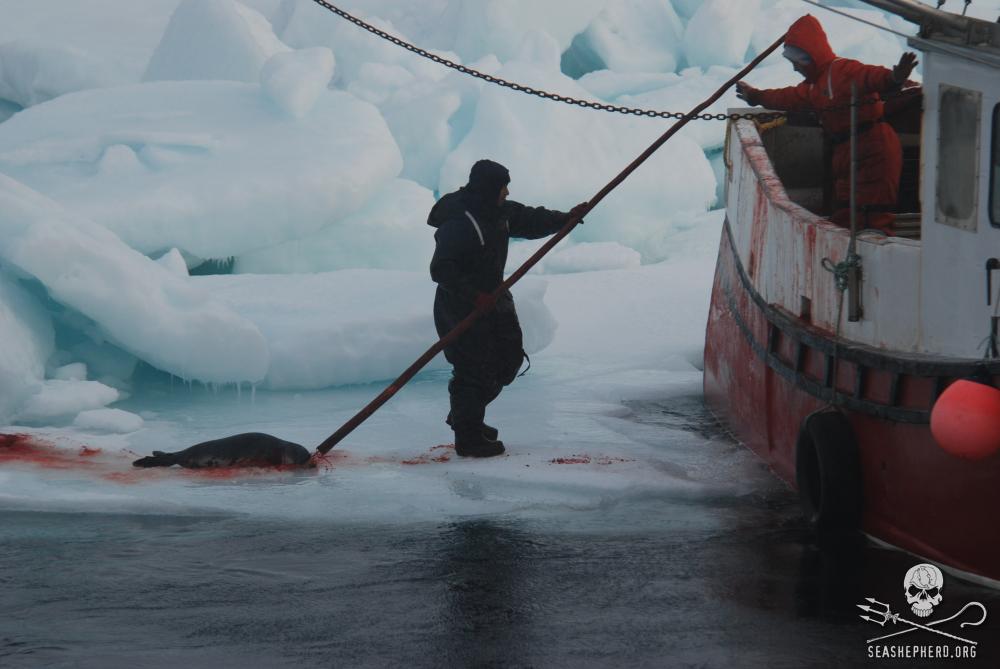
Sea Shepherd’s 2008 Seal Defense Campaign photographs the murder and carcass dragging of a seal. Photo credit: Sea Shepherd / Greg Hager

At COP 21, I called for an end to worldwide government subsidies for industrialized fishing and at least a 50-year moratorium on commercial industrialized fishing. That solution was not given a moment’s thought at a conference that did not even take into account the imperative role of the Ocean in addressing climate change.

My opinion of COP 21 is that governments were not looking for solutions. They were looking for the appearance of solutions. They certainly did not want to hear about solutions from people like me. They want solutions that are accompanied by jobs and profit. The one thing they do not want is any form of economic sacrifice.

I also do not believe that the majority of humanity — certainly not the leadership — understand the true gravity of the situation. There are six viewpoints concerning climate change: 1. Denial 2. Acceptance, with the view of it being a positive development. 3. Acceptance with the belief that science and technology will save the day. 4. Acceptance, but refusal to fully appreciate the consequences. 5. Apathy. 6. Acceptance with the resolve to find real solutions.

Those who are in denial have vested self interests in doing so, motivated primarily by greed or ignorance. My old Greenpeace colleague Patrick Moore sees climate change as an opportunity for longer growing seasons and better weather. (He lives in Canada and I don’t think he’s really thought it through.) Others like Elon Musk see our salvation in science, in moving off-world or developing artificial eco-systems on Earth. Most responsible world leaders recognize the problem but are too politically-impotent to address it with realistic solutions because those solutions would not be politically popular. And as with everything, the majority of the world is apathetic and too self-absorbed with entertaining themselves (developed world) or surviving (underdeveloped world).

On this path we are on now, the future is somewhat predictable. More resource wars, more poverty, more accumulation of wealth by the minority of privileged people, more disease, more civil strife and with the collapse of biodiversity – global mass starvation, and pestilence.

The rich tapestry of all our cultures and all our achievements in science and the arts hangs by threads linked to biodiversity.

If the bees are diminished, our crops are diminished. If the forests are diminished, we are diminished. If phytoplankton dies, we die! If the grasses die, we die!

We exist because of the geo-engineering contributions of millions of diverse species that keep our life support systems running. From bacteria to whales, from algae to the redwoods. If we undermine the foundations of this planetary life-support system, all that we have ever created will fall. We will be no more.

We made the mistake of declaring war on nature, and because of our technologies it looks like we are going to win this war. But because we are a part of nature, we will destroy ourselves in the process. Our enemy is ourselves and we are slowly becoming aware of that indisputable fact. We are destroying ourselves in a fruitless effort to save the image of what we believe ourselves to be.

In this war, we are slaughtering — through direct or indirect exploitation — millions of species and reducing their numbers to dangerously low levels while at the same time increasing human numbers to dangerously high levels.

2016-08-04-1470343170-9873528-dolphinoffalandintestines645.jpg

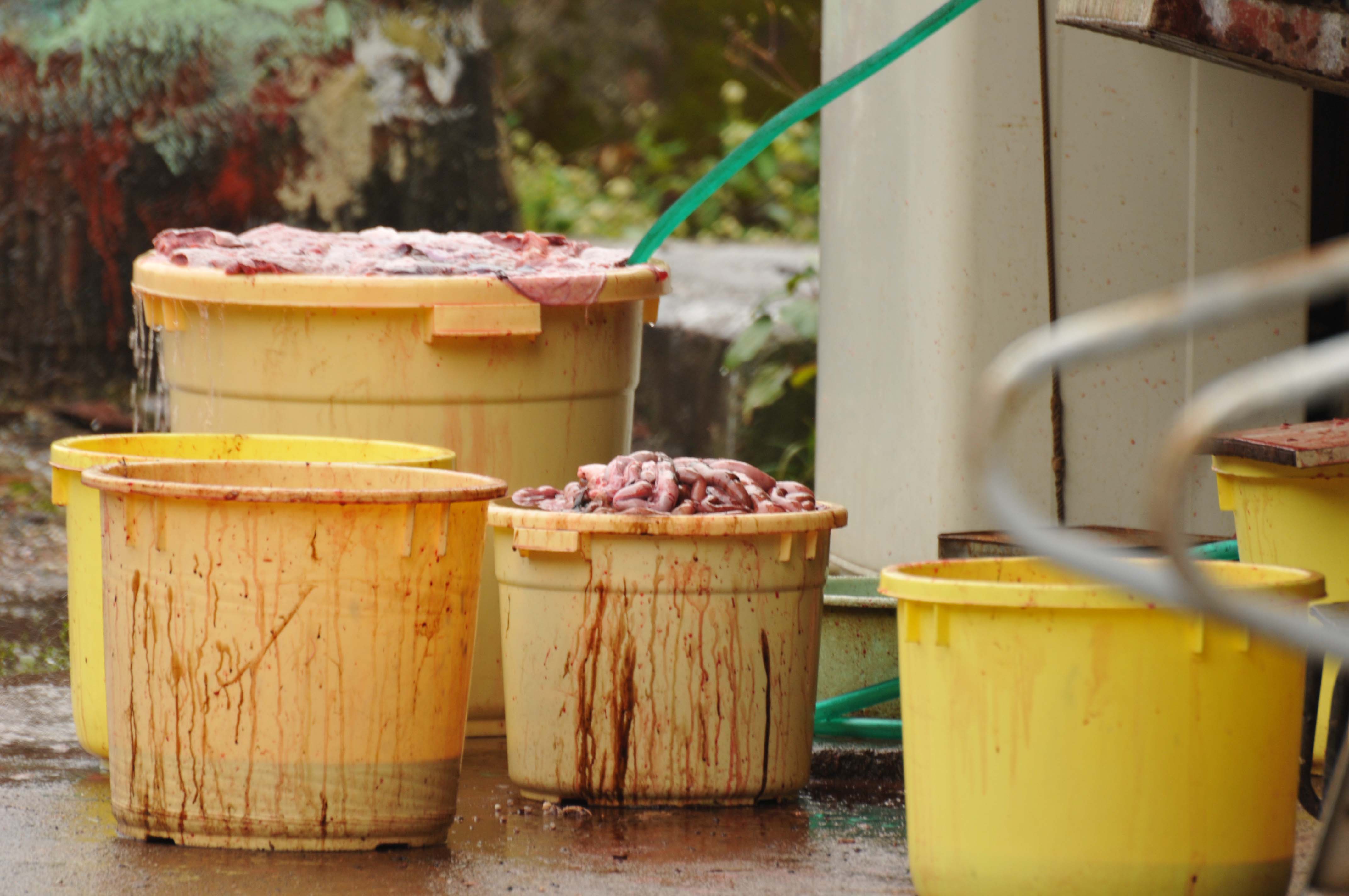
Dolphin offal and intestines photographed during the 2011-12 Taiji Dolphin Defense Campaign. Photo credit: Sea Shepherd / Christoph Heylen

We are fighting this war against nature with chemicals, industrialized equipment, ever increasing extraction technologies (like fracking) and repression against any and all voices that rise up in dissent.

In our wake over the past two centuries we have left a trail of billions of bodies. We have tortured, slain, abused and wasted so many lives, obliterated entire species; and reduced rich diverse eco-systems to lifeless wastelands as we polluted the seas, the air and the soil with chemicals, heavy metals, plastic, radiation and industrialized farm sewage.

We were once horrified by the possibility of a Chernobyl or a Fukushima. But the accidents happened and we adapted and accepted. Now we are complacent.

In the process we are becoming sociopathic as a species. We are losing the ability to express empathy and compassion. We idolize soldiers, hunters, and resource developers without giving a thought to their victims. We revel in violent fantasies hailing two-dimensional fantasy killers as heroes. We have become increasingly more Darwinian in our outlook that the weak (other species) must perish so that the strong (ourselves) may survive. We forget that Darwinism recognizes the laws of ecology and we cannot pick and choose when it comes to the laws of nature. In the end nature controls us, we do not control nature.

The consequences of our actions are not going to happen centuries from now. They are going to happen within this century. Oceanic ecosystems are collapsing — now! The planet is getting warmer — now! Phytoplankton is being diminished — now!

To be blunt — the planet is dying now, and we are killing it!

From what I have experienced and from what I see there is only one thing that can prevent us from falling victim to the consequences of ignoring the laws of ecology.

We must shake off the anthropocentric mindset and embrace a biocentric understanding of the natural world. We can do this because we have wonderful teachers in indigenous communities worldwide who have lived biocentric lifestyles for thousands of years just as our species all once did. We need to learn to live in harmony with other species.

We need to establish a moratorium on industrialized fishing, logging and farming.

We need to stop producing goods that have no intrinsic value — all the useless plastic baubles for entertainment and self-indulgence. We need to stop mass-producing plastic that is choking our global seas. We need to stop injecting poisons into the soil and dumping toxins into the sea. We need to abolish cultural practices that destroy life for the sole purpose of entertaining ourselves.

Of course it won’t be easy but do we really want the epitaph for our species to be, “Well we needed the jobs?”

Without ecology there is no economy.

I am not a pessimist and I’ve never been prone to pessimistic thoughts. There are solutions. We see people of compassion, imagination and courage around us working to make this a better world — devoting themselves to protecting species and habitats; finding organic agricultural alternatives; and developing more eco-friendly forms of energy production. Innovators, thinkers, activists, artists, leaders and educators — these people are among us and their numbers are growing.

It is often said that the problems are overwhelming and the solutions are impossible. I don’t buy this. The solution to an impossible problem is to find an impossible solution.

It can be done. In 1972, the very idea that Nelson Mandela would one day be President of South Africa was unthinkable and impossible — yet the impossible became possible.

It’s never easy but it is possible and possibilities are achieved through courage, imagination, passion and love.

I learned from the Mohawks years ago that we must live our lives by taking into account the consequences of our every action on all future generations of all species.

If we love our children and grandchildren we must recognize that their world will not be our world. Their world will be greatly diminished and unrecognizable from the world of our childhoods. Each and every child born in the 21st Century is facing challenges that no human being has ever faced in the entire history of our species:

Emerging pathogens from the permafrost. (Just this summer, an anthrax virus from a recently thawed reindeer carcass broke out killing 1,500 reindeer and hospitalizing 13 people in Russia.) Eruptions of methane opening huge craters in the earth in Siberia, mass-accelerated extinction of plants and animals, pollution, wars and more wars, irrational violence in the form of individual, religious and state terrorism, the collapse of entire eco-systems.

This is not doom and gloom fear mongering. It is simply a realistic observation of the consequences of our deliberately ignoring of the laws of ecology. I call it the Cassandra Principle.

Cassandra was the prophetess of ancient Troy whose curse was the ability to see the future and to have everyone dismiss her prophecies. No one listened to her, instead they ridiculed her. Yet she was right. All that she predicted came to pass and Troy was destroyed.

Years ago I had a critic in the media label me as a doom and gloom Cassandra. I replied, “Maybe, but don’t forget one thing. Cassandra was right.”

2016-08-04-1470346349-3492535-sscsgalapagosdirectorseanohearngimenezonasharkfinningarrestoperation226.jpg

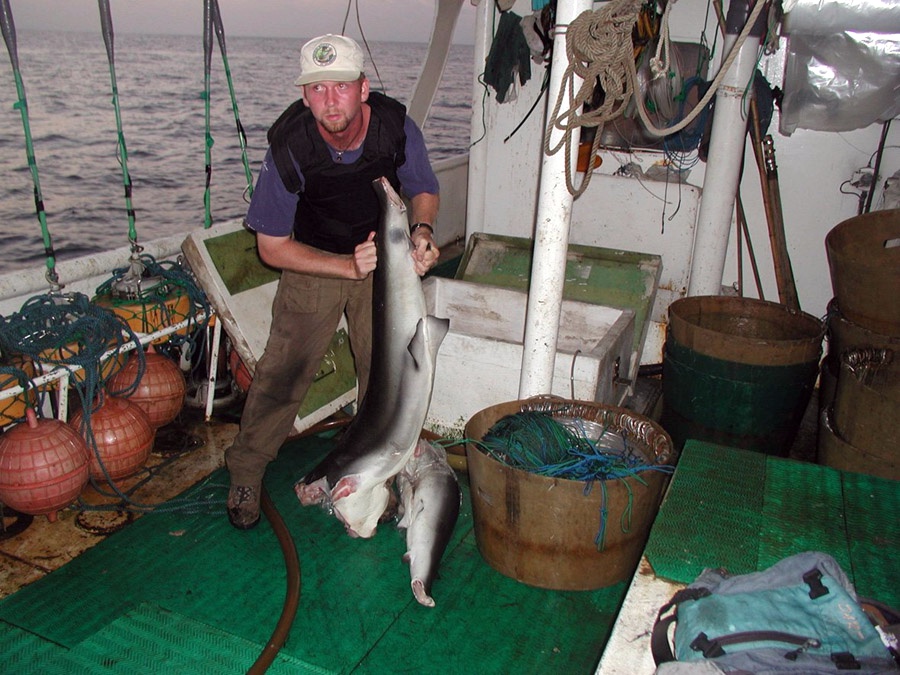
Sea Shepherd’s Galapagos Director Sean O’Hearn-Gimenez on a shark finning arrest operation om 2007.

And over the years I have made predictions (that were ridiculed and dismissed) that have come true. In 1982 I publicly predicted the collapse of the North Atlantic Cod fishery. It happened a decade later. In 1978 I predicted the destruction of one half of the African elephant population in Defenders magazine. I was wrong. Some two thirds of the population have been destroyed. In 1984, I predicted ecological destruction by salmon farms including the spreading of viruses to wild salmon populations. Every prediction was based on observation with reference to the laws of ecology and every prediction was dismissed.

Nothing has changed. Today I am predicting the death of worldwide coral reef eco-systems by 2025, the total collapse of worldwide commercial fishing operations by 2030; and the emergence of more virulent viral diseases in the coming decades. It does not take any exceptional foresight to predict that war will be the major business of the next half-century, as well as the rise of more authoritarian governments.

Recently my old friend Rod Marining, also a co-founder of Greenpeace, said to me: “The transformation of human consciousness on a mass scale can not happen, unless there are two factors. First, a huge mass visual death threat to survival of our species, and two, the threat of the loss of a people’s jobs or their values. Once theses two factors are in place humans begin to transform their thinking over night.”

I have seen the future written in the patterns of our behavior, and it is not a pleasant future, in fact it is not much of a future at all.

The four horses have arrived. As death sits astride the pale horse, the other three horses of pestilence, famine and war and terrorism are stampeding at full gallop toward us while our backs are turned away from them. And when they trample us, we may look up from our latest entertainment triviality to see ourselves in the dust of the ecological apocalypse.

I also see the possibility of salvation. By listening to the words and observing the actions of indigenous people. By looking into the eyes of our children. By stepping outside the circle of anthropocentrism. By understanding that we are part of the Continuum. By refusing to participate in the anthropocentric illusion. By embracing biocentrism and fully understanding the laws of ecology, and the fact that these laws cannot — must not — be ignored if we wish to survive.

Global Fisheries Are Collapsing — What Happens When There Are No Fish Left?

http://www.truth-out.org/news/item/35574-global-fisheries-are-collapsing-what-happens-when-there-are-no-fish-left

(Photo: Paul Symes)(Photo: Paul Symes)

“Commercial overexploitation of the world’s fish stocks is severe,” UN Secretary General Ban Ki-moon said back in 2012. “Many species have been hunted to fractions of their original populations. More than half of global fisheries are exhausted, and a further third are depleted.”

According to the UN Food and Agriculture Organization, 85 percent of global fish stocks are “overexploited, depleted, or recovering from depletion.”

To see more stories like this, visit “Planet or Profit?”

Yet despite these alarms having been sounded loud and clear, life in the oceans is continuing to deteriorate at an ominously rapid pace.

Total Collapse?

Fisheries for the most sought-after species of fish have already collapsed.

The populations of all large predator fish in the oceans have declined by 90 percent in the 50 years since modern industrial fishing became widespread around the world, according to a shocking paper by scientists with Dalhousie University in Halifax, Canada, published in Nature in 2003.

“We are losing species every day without ever knowing about them. Sometimes humans can be like a plague to the environment.”