Human “Progress”

Rosemary commented: “We are seeing a longing for so-called ‘traditional’ ways of life, a manic nostalgia for something that really never was–except it was a less crowded world.”

To which I replied: I’ve thought that same thing many times. The only reason human life ever seemed to be in any kind of harmony with the rest of nature is that there were a LOT fewer of us. Sorry, but there’s no way an ever-growing population of humans can hope to be sustainable.

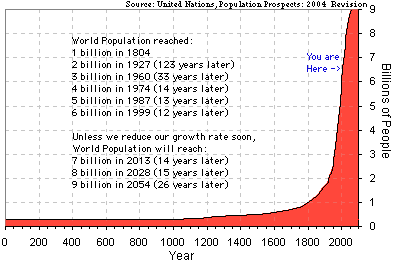
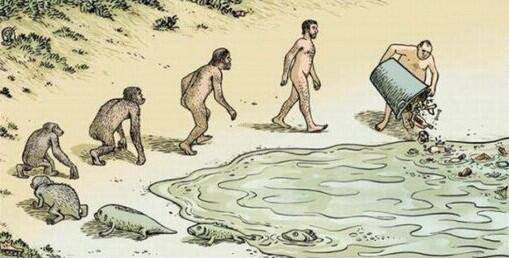
Here is a simple yet accurate depiction of human evolutionary “progress.”

1527138_271312873037188_1829199472_n

NASA-backed Study Says Humanity is Pretty Much Screwed

Hope you’ve enjoyed civilized life, folks. Because a new study sponsored by NASA’s Goddard Space Flight Center says the world’s industrial societies are poised to collapse under the weight of their own unsustainable appetites for resources. There goes the weekend . . . and everything after it for the rest of our lives.

The research article appears in the peer-reviewed scientific journal Ecological Economics, but Dr. Nafeez Ahmed, executive director of the Institute for Policy Research & Development, has a more understandable (but no less harrowing) summary over at The Guardian. Either way, the news isn’t good—as the researchers point out, history doesn’t seem to hold out any favor for advanced societies.

The fall of the Roman Empire, and the equally (if not more) advanced Han, Mauryan, and Gupta Empires, as well as so many advanced Mesopotamian Empires, are all testimony to the fact that advanced, sophisticated, complex, and creative civilizations can be both fragile and impermanent.

Who’s to blame? You. Me. Everyone walking around outside your window. Even the technology we invented to save us from ourselves is contributing to our decline.

Technological change can raise the efficiency of resource use, but it also tends to raise both per capita resource consumption and the scale of resource extraction, so that, absent policy effects, the increases in consumption often compensate for the increased efficiency of resource use.

Is there a way out? Of course. But you’re probably not gonna like it. Dr. Ahmed sums up the researchers’ suggestions:

The two key solutions are to reduce economic inequality so as to ensure fairer distribution of resources, and to dramatically reduce resource consumption by relying on less intensive renewable resources and reducing population growth.

Which is just as difficult and improbable as it sounds.

Seriously, you should read the whole rundown of what the research says. It’s eye-opening, and a serious call to action—if the crushing bleakness of what we’ve done to ourselves hasn’t already doomed you to abandon all hope. Here, watch a funny video to make you feel better. [The Guardian]

Your Cause is Lost Without Population Control

Despite how keenly aware Homo sapiens are of the potential overpopulation of other species, they don’t seem to think the same laws of nature apply to them. If any other large mammal added a staggering 200,000 to their population each day, humans would be in a panic to control their numbers—by any means possible.

But while humans are surging well past 7 billion, they act like the laws of carrying capacity and finite resources don’t apply to them. I wouldn’t want to be around when nature brings the hammer down and finds humans in contempt. It ain’t gonna be pretty…

By sheer coincidence, I just read the following passage from Rudyard Kipling’s 1893 classic, The Jungle Book. Clearly the monkeys (the Bandar-log) represent humans in Kipling’s story as they “danced about and sang their foolish songs,” ignorant of the consequences of their actions and describing themselves thusly, “We are great. We are free. We are wonderful. We are the most wonderful people in all the jungle! We all say so, and so it must be true.”

Sound familiar, humans?

As Paul Ehrlich, author of The Population Bomb, pointed out, “Whatever your cause, it will be a lost cause without population control.”

That sentiment was echoed by an outspoken Facebook friend, Stephanie Theisen, “EVERYTHING that is wrong today stems from human OVERPOPULATION. This is a subject that MUST be faced. Immediate child bearing restrictions have to be implemented, like decades ago. The Earth is full of destructive, greedy, narcissistic humans, we are not miracles, we are a virulent cancer.”

1795497_611414028914288_1804650880_n

A Real-Time Map of Worldwide Births

This simulation gives an eerily omniscient vantage on the world as it fills.

James Hamblin Oct 30 2013graph

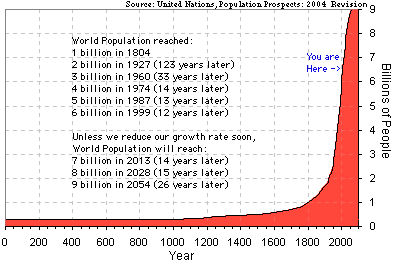
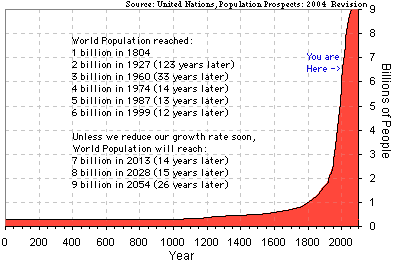
In 1950, there were 2.5 billion humans. Today there are just over 7 billion. In another 30 years, according to U.S. Census Bureau projections, there will be more than 9 billion.

Brad Lyon has a doctoral degree in mathematics and does software development. He wanted to make those numbers visual. Last year he and designer Bill Snebold made a hugely popular interactive simulation map of births and deaths in the U.S. alone—the population of which is on pace to increase 44 percent by 2050. Now, Lyon takes on the world.

Watch if you dare: http://www.theatlantic.com/health/archive/2013/10/a-real-time-map-of-births-and-deaths/280609/

What Goes Up…

To all those of breeding age who are considering starting a family or adding yet another human child to this already dangerously over-crowded world, I politely urge you, with all due respect, to please think again. If not for the fragile planet’s sake or for the sake of every other struggling life form headed for mass extinction, then for the child’s sake, your sake and for sanity’s sake. Go ahead and adopt, whether human or non-human, but please don’t add to every environmental woe known to—and caused by—man by falling prey to the ill-advised notion that propagating is our duty or prerogative.

The world as we know it is headed for collapse. Do you really want your precious offspring to witness the unraveling of all of Earth’s systems or suffer the reckoning that’s soon to befall those unfortunate enough to be here when humankind’s self-serving environmental crimes come back on them? Can’t you see that the sheer weight of the human race is crushing everything and everyone else?

As a good friend, a young woman wise beyond her years, put it, those who consider reproducing to be a positive prospect for the twenty-first century “must be closing their eyes, plugging up their ears, and singing ‘Lalalala!’ very loudly.”

What goes up must come down, people; and for the past couple of hundred years or so, the human population has been accelerating skyward—breaking all sound barriers in a headlong quest to defy gravity, burst out of the Earth’s atmosphere and sail on to oblivion—taking all of creation with it.

graph

China Encourages More Breeding

http://www.usatoday.com/story/news/world/2013/11/15/china-one-child-policy/3570593/

BEIJING — China made its first major change to its “one-child policy” in nearly 30 years to grapple with a massive shift in its population toward the elderly, who cannot work and need support, say experts.

Introduced by the Communist Party in 1979, the policy was meant to help the impoverished country feed its people. China credits the policy with keeping family expenses down so parents could more easily raise their standards of living.

But China demographer He Yafu says that the policy threatens to harm stability because the segment of the Chinese population that is elderly is growing at a faster rate than previous years….

[This sounds a lot like the story of the Little Old Lady Who Swallowed a Fly]

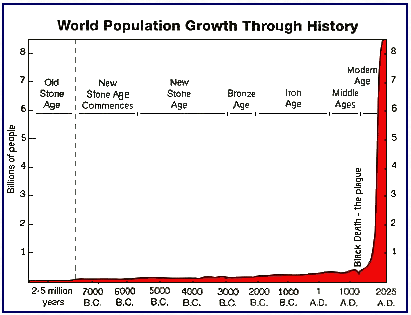
world-population-through-history-to-2025

Here’s Something REALLY Scary!

Center Op-ed: Dear 7 Billionth  Baby

BabyToday isn’t just Halloween — it’s the  second anniversary of the world’s population reaching 7 billion people. A  lot has happened in the first two years of Earth’s 7 billionth baby: The human  population keeps growing, each person leaving a little less of our planet’s  limited resources for other species (with some consuming more than others —  we’re looking at you, fellow Americans).
Stephanie Feldstein, the  Center’s new Population and Sustainability director, has a new op-ed in The  Huffington Post in honor of Baby 7 Billion’s 2nd birthday. It takes a close  look at our growing environmental footprint, and imparts some early wisdom for  the landmark babe on living as sustainably as she can throughout her years  ahead.
“You’ll make choices throughout your life — from what you eat to  where you live to how many kids you have — that will help or hurt other  species,” writes Stephanie. “It’s up to you to make sure future generations  don’t know polar bears and panthers only as stuffed animals.”
Read  Stephanie’s whole op-ed in The Huffington Post and sign up for our monthly  newsletter Pop X.

http://www.biologicaldiversity.org/news/center/articles/2013/huffington-post_10-24-2013.html

Human Infestation Down One

http://www.theglobeandmail.com/news/world/body-of-australian-man-recovered-from-crocodile-infested-river/article13948311/

Body of Australian man recovered from crocodile-infested river

DARWIN, Australia — The Associated Press

Published Monday, Aug. 26

Police have recovered the body of a man who attempted to swim across a crocodile-infested river in the Australian Outback as well as the carcass of a crocodile that was shot by authorities, officials said Monday.

Sean Cole, 26, was snatched by a crocodile and dragged under the water Saturday as he and a friend were swimming in the Mary River during a birthday party.

[How dare they call this river “crocodile-infested”! Crocs have lived there for 50 million years; humans didn’t reach Australia and begin their infestation until 50 thousand years ago.]

Northern Territory wildlife ranger Tom Nichols said Cole’s body and that of a 4.7-metre-long crocodile floated to the river surface early Monday. The crocodile was one of four that rangers shot in the hours after the attack.

“We believe that croc was responsible,” Nichols said, though he noted that further tests to match the bite marks on Cole’s body would be conducted.

[How many non-humans have to die when one exalted Homo sapien foolishly decides to challenge a dangerous river, probably in a drunken bet. And what if the bite-marks don’t match? Will rangers kill 400 more ancient crocodiles before they find the culprit?]

The river is infested with crocodiles, and officials said that ascroc locals the men would have known that.

“They just did something silly,” Nichols said.

Crocodile expert Grahame Webb, a Darwin zoologist, said he would not give a swimmer an even chance of crossing the 80-metre-wide river.

“Someone swimming in an area with crocs like that … crocs are going to zero in on them almost every time,” Webb said.

Mary River Wilderness Retreat manager Erin Bayard said the resort has several signs prohibiting swimming. Guests are advised not to go within five metres of the water’s edge because of the risk of large crocodiles lunging from the river to drag people in.

[Typical–a human dies doing something silly and at least three innocent crocodiles are killed for it.]

Enough about the “Royal Baby” Already!

If there’s one thing we Americans understand, it’s that royalty isn’t a birthright, it’s a financial status.

A baby is born every 8 seconds—what’s the big deal about this one? Sorry, but to us the so-called “Royal Baby” is just another of the 3,000 human offspring born into this world every 20 minutes (meanwhile, during the same 20 minutes, another plant or animal becomes extinct—27,000 species each year). The majestic brat is really only one more of the hundreds of thousands of little darlings born that day, or the 1.5 million people born every week.

(That’s like adding a city the size of Phoenix or Philadelphia. In just one week! And around the world right now, one in ten people lack access to clean drinking water, one in eight doesn’t have enough food to eat, while one in five lives on less than $1 a day.)

According to the Population Clock, there will be 125 million births in the world this year. By the time this group is ready to start school, there will have been at least another 625 million new humans born.

In light of all this, the birth of the “royal” baby hardly seems newsworthy.

graph