Climate change no issue with human population of, say, 10

I use the extreme example of 10 to cut to the chase, get to the point.

With a low human population, human-caused climate change would not be a concern.

With a low human population, neither would habitat loss or any other of the current threats to the diversity of life on Earth.

It wouldn’t matter if every person in a low human population was the most rapacious sort of capitalist. They couldn’t make a dent. It wouldn’t matter if every one was socialist, communist, racist, atheist, Buddhist, Confucionist, Taoist, Christian, Jew, or Muslim. What packs the most clout is the sheer mass of the human population

This mass is the great hulking monster behind the threats to climate and biodiversity. And yet the growth of the human population has important sources of support. For the political leaders yearning for military might, it means bigger armies. For organized religion(s), it means bigger congregations. For the business world, it means more customers — and a labor supply abundant enough to make labor cheap. Over all this hangs a silence amounting to a near-universal taboo.

Everything I know or think I know persuades me that continuing on our present course will, sooner or later, plausibly beginning in the lifetime of children born since 1980, create conditions that will set off a severe and sharp culling of the human herd. But we’ll be bringing a lot down with us as we go, and we are already seeing all the evidence we need of that.

++++___________________________________________________++++

“Research suggests that the scale of human population and the current pace of its growth contribute substantially to the loss of biological diversity. Although technological change and unequal consumption inextricably mingle with demographic impacts on the environment, the needs of all human beings—especially for food—imply that projected population growth will undermine protection of the natural world. 

“Numerous solutions have been proposed to boost food production while protecting biodiversity, but alone these proposals are unlikely to staunch biodiversity loss. An important approach to sustaining biodiversity and human well-being is through actions that can slow and eventually reverse population growth: investing in universal access to reproductive health services and contraceptive technologies, advancing women’s education, and achieving gender equality.”

Eileen Crist, Camilo Mora, Robert Engelman. The interaction of human population, food production, and biodiversity protection. Science 21 April 2017

~~~~~~~~~~~~~~~~~~~~~~~~~~~~~~~~~~~
“The individual scientist can survive for a long time by lying low in the valley of specialized intellectual interest … We in science must get up and face the wind, confront the future.”

William Bevan, “The Sound of the Wind That’s Blowing.”

American Psychologist. July 1976

HUMAN POPULATION GROWTH AND CLIMATE CHANGE

https://www.biologicaldiversity.org/programs/population_and_sustainability/climate/?fbclid=IwAR0IVSbh5phNB7dFjcypdp-dA8Y7D_KtQWYFYyrZRZu5xpsWwhCb4Vattec

The largest single threat to the ecology and biodiversity of the planet in the decades to come will be global climate disruption due to the buildup of human-generated greenhouse gases in the atmosphere. People around the world are beginning to address the problem by reducing their carbon footprint through less consumption and better technology. But unsustainable human population growth can overwhelm those efforts, leading us to conclude that we not only need smaller footprints, but fewer feet.

Portland, Oregon, for example, decreased its combined per-capita residential energy and car driving carbon footprint by 5 percent between 2000 and 2005. During this same period, however, its population grew by 8 percent.

2009 study of the relationship between population growth and global warming determined that the “carbon legacy” of just one child can produce 20 times more greenhouse gas than a person will save by driving a high-mileage car, recycling, using energy-efficient appliances and light bulbs, etc. Each child born in the United States will add about 9,441 metric tons of carbon dioxide to the carbon legacy of an average parent. The study concludes, “Clearly, the potential savings from reduced reproduction are huge compared to the savings that can be achieved by changes in lifestyle.”

One of the study’s authors, Paul Murtaugh, warned that: “In discussions about climate change, we tend to focus on the carbon emissions of an individual over his or her lifetime. Those are important issues and it’s essential that they should be considered. But an added challenge facing us is continuing population growth and increasing global consumption of resources. . . . Future growth amplifies the consequences of people’s reproductive choices today, the same way that compound interest amplifies a bank balance.”

CO2 Emissions by Country

The size of the carbon legacy is closely tied to consumption patterns. Under current conditions, a child born in the United States will be responsible for almost seven times the carbon emissions of a child born in China and 168 times the impact of a child born in Bangladesh.

The globalization of the world economy, moreover, can mask the true carbon footprint of individual nations. China, for example, recently surpassed the United States to become the world’s leading greenhouse gas emitter. But a large portion of those gases is emitted in the production of consumer goods for the United States and Europe. Thus a large share of “China’s” greenhouse gas footprint is actually the displaced footprint of high-consumption western nations.

The United States has the largest population in the developed world, and is the only developed nation experiencing significant population growth: Its population may double before the end of the century. Its 300 million inhabitants produce greenhouse gases at a per-capita rate that is more than double that of Europe, five times the global average, and more than 10 times the average of developing nations. The U.S. greenhouse gas contribution is driven by a disastrous combination of high population, significant growth, and massive (and rising) consumption levels, and thus far, lack of political will to end our fossil-fuel addiction.

Coal-fired power plantMore than half of the U.S. population now lives in car-dependent suburbs. Cumulatively, we drive 3 trillion miles each year. The average miles traveled per capita is increasing rapidly, and the transportation sector now accounts for one-third of all U.S. carbon emissions.

Another one-fifth of U.S. carbon emissions comes from the residential sector. Average home sizes have increased dramatically in recent decades, as has the accompanying footprint of each home. Suburban sprawl contributes significantly to deforestation, reducing the capacity of the planet to absorb the increased CO2 we emit. Due to a dramatic decrease in household size, from 3.1 persons per home in 1970 to 2.6 in 2000, homebuilding is outpacing the population growth that is driving it. More Americans are driving farther to reach bigger homes with higher heating and cooling demands and fewer people per household than ever before. All of these trends exacerbate the carbon footprint inherent in the basic energy needs of a burgeoning U.S. population.

Globally, recent research indicates that assumptions regarding declining fertility rates used by the Intergovernmental Panel on Climate Change to develop future emissions scenarios may be overly optimistic. While fertility rates have generally declined over the past few decades, progress has slowed in recent years, especially in developing nations, largely due to cutbacks in family planning assistance and political interference from the United States. And even if fertility rates are reduced to below replacement levels, population levels will continue to climb steeply for some time as people live longer and billions of young people mature and proceed through their reproductive years. Per-capita greenhouse gas emissions may drop, but the population bulge will continue to contribute to a dangerous increase in greenhouse gases in the atmosphere.

Time is short, but it not too late to stop runaway global warming. Economy-wide reduction of greenhouse gas emissions to a level that brings atmospheric CO2 back from 386 parts per million to 350 or less, scaling back first-world consumption patterns, and long-term population reduction to ecologically sustainable levels will solve the global warming crisis and move us to toward a healthier, more stable, post-fossil fuel, post-growth addicted society.

Mass wildlife loss caused by human consumption

Media captionIs your food destroying Brazil’s savanna?

“Exploding human consumption” has caused a massive drop in global wildlife populations in recent decades, the WWF conservation group says.

In a report, the charity says losses in vertebrate species – mammals, fish, birds, amphibians and reptiles – averaged 60% between 1970 and 2014.

“Earth is losing biodiversity at a rate seen only during mass extinctions,” the WWF’s Living Planet Report adds.

It urges policy makers to set new targets for sustainable development.

The Living Planet Report, published every two years, aims to assess the state of the world’s wildlife.

The 2018 edition says only a quarter of the world’s land area is now free from the impact of human activity and the proportion will have fallen to just a 10th by 2050.

The change is being driven by ever-rising food production and increased demand for energy, land and water.

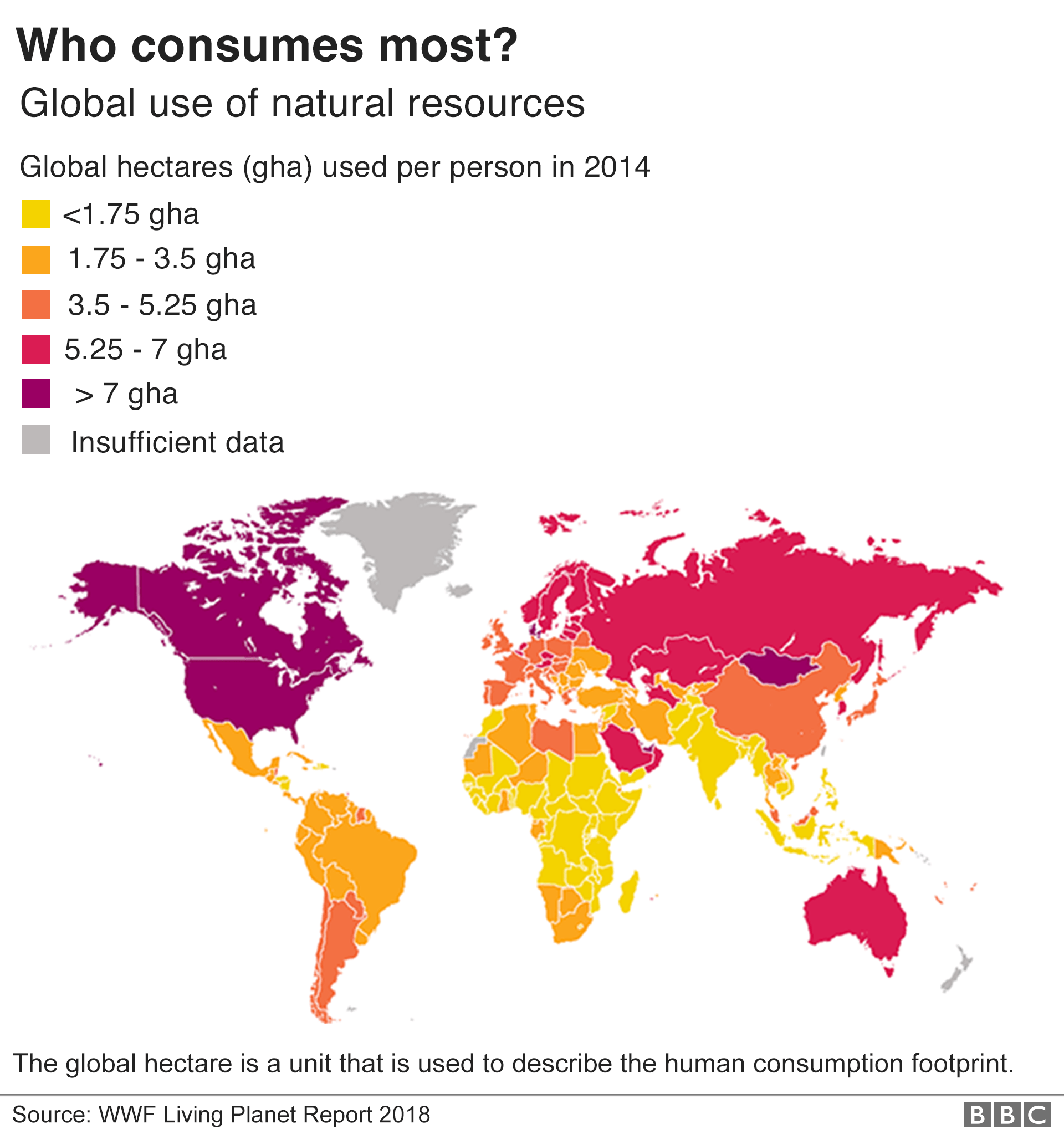
Map showing human consumption per country as measured in global hectares
Presentational white space

Although forest loss has been slowed by reforestation in some regions in recent decades, the loss has “accelerated in tropical forests that contain some of the highest levels of biodiversity on Earth”, the report notes.

It says South and Central America suffered the most dramatic decline in vertebrate populations – an 89% loss in vertebrate populations compared with 1970.

Marine freshwater species are particularly at risk, the report says. Plastic pollution has been detected in the deepest parts of the word’s oceans, including the bottom of the Mariana Trench in the Pacific.

Freshwater species – living in lakes, rivers and wetlands – have seen an 83% decline in numbers since since 1970, according to the report.

Media captionThe Truth Behind My Fried Chicken

The WWF calls for “a new global deal for nature and people” similar to the 2015 Paris agreement to tackle climate change by reducing greenhouse gas emissions.

“Decision makers at every level need to make the right political, financial and consumer choices to achieve the vision that humanity and nature thrive in harmony on our only planet,” the report says.

The data, gathered from peer-reviewed studies, covers more than 16,700 populations belonging to 4,000 species around the world.

The WWF’s methodology has been criticised. One conservationist told the BBC in 2016 that the data in the 2016 report was skewed towards western Europe, where figures were more readily available.

Presentational grey line

What the numbers show

By Robert Cuffe, Head of Statistics, BBC News

This report shows that many species are dwindling at an alarming rate. But it doesn’t tell us that we’ve lost 60% of our wildlife.

The Living Planet Index looks at the falls in each species, rather than in the total wildlife population.

A huge percentage fall in a rare species will not make much difference to the total number of animals in the world. But it will make a difference to the average fall.

Imagine there were only two species in the world: frogs and pandas. Say that fecund frogs, whose numbers remain in the millions, see zero fall. The poor, prudish pandas whose shyness has seen their number drop from 100 to only 20 see an 80% fall.

On average, there would be an average fall in the populations of species of 40%. But the total population of animals would not be much changed.

The former is what the Living Planet Index tells us about: how much individual species are growing or shrinking.

But that is not the same as stripping 40% (or 60%) of wildlife from the planet.

Democrat Wants To Tax Parents With More Than Two Kids As “Irresponsible Breeders”


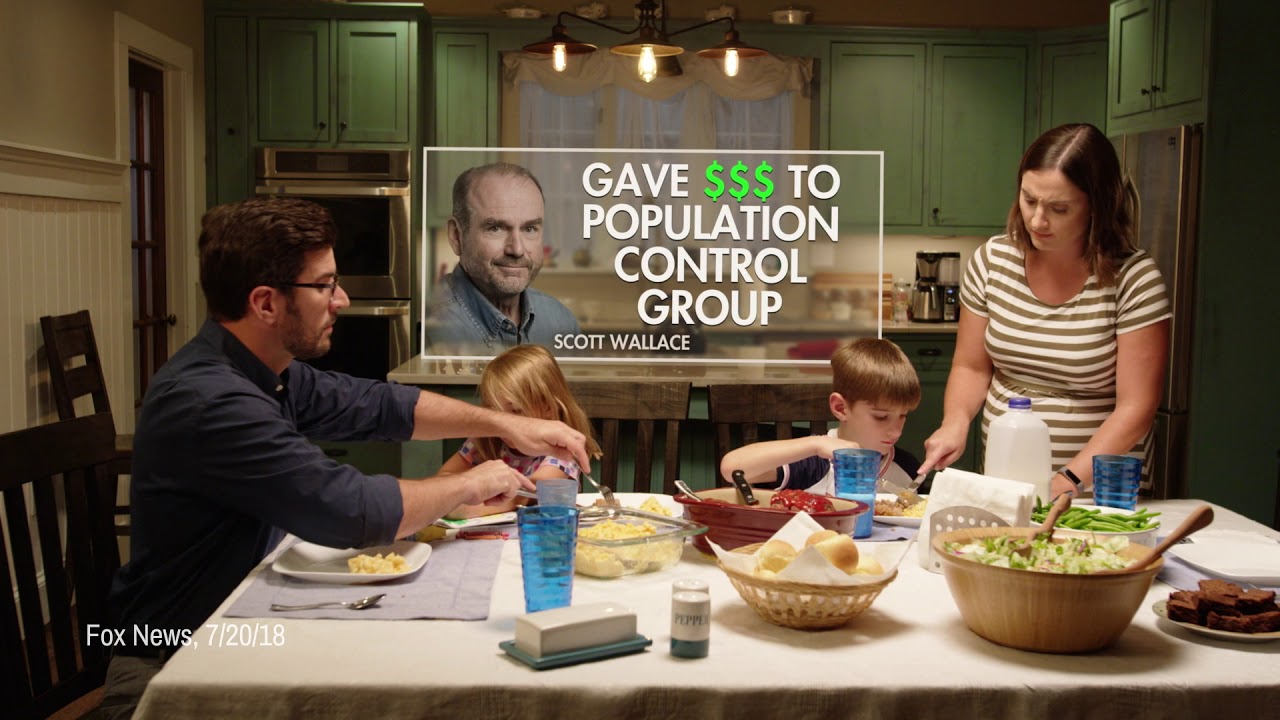
A democrat congressional candidate in Pennsylvania has desires to tax parents who have more than two children as “irresponsible breeders.”  Scott Wallace is a population control zealot who has donated over $7 million to population control groups.

Wallace is also supported and endorsed by both Planned Parenthood and NOW (National Organization for Women). According to The Daily Wire, Wallace, a millionaire and democrat who believes in taxing families with more than two kids for being privileged, also believes that the tax would be on “the privilege of irresponsible breeding.”

Between 1997 and 2003, Wallace gave $420,000 to Zero Population Growth (ZPG) — now Population Connection — an organization co-founded by “Population Bomb” author Paul Ehrlich, Fox News reported.

From before its inception, ZPG had announced its intentions to tax large families for the “privilege of irresponsible breeding.” A 1968 brochure advocated abortion to stabilize population growth and claimed that “no responsible family should have more than two children.” Therefore, “irresponsible people who have more than two children should be taxed to the hilt for the privilege of irresponsible breeding.” –PJ Media

Wallace’s fund (Wallace Global Fund) also gave $20,000 to the Center for the Advancement of the Steady State Economy (CASSE) in 2010. CASSE is an environmentalist group that sees economic growth as undesirable. The group supports an economy with “stable or mildly fluctuating levels” and a society with equal birth and death rates. CASSE calls this stagnant state of affairs “maturing.”

CASSE still supports zero population growth and executive board member Herman Daly has pushed for reproduction licenses (permission from the government to have children). This bureaucratic control over birth would allow women to have only two children unless they buy the license for more children from other women who do not reproduce. Daly called this program the “best plan yet offered” to limit population growth.

_________________________________________________________________________________

No, congressional candidate Scott Wallace does not want to tax families for ‘breeding’

https://billypenn.com/2018/09/14/no-congressional-candidate-scott-wallace-does-not-want-to-tax-families-for-breeding/

The multimillionaire is facing Republican incumbent Brian Fitzpatrick in the race for Pa.’s 1st District.

Candidate Scott Wallace (center) with his wife, three adult children, and son-in-law

Candidate Scott Wallace (center) with his wife, three adult children, and son-in-law

 FACEBOOK / WALLACE CAMAPIGN

Full Statement

“Scott Wallace wants to tax families of five for ‘irresponsible breeding’”

Our Analysis

Scott Wallace’s family foundation has caused quite a few headaches for the multimillionaire, who is running for U.S. Congress in Pennsylvania’s 1st District.

The GOP and conservative media outlets have used grants made by the Wallace Global Fund, which the candidate led for more than a decade, to paint the Democrat as anti-Israel and anti-police. Wallace will face Republican incumbent Brian Fitzpatrick in a recently redrawn district that includes Bucks County and left-leaning Philly suburbs.

A number of stories published this summer by right-leaning outlets focused on grants the foundation made to so-called population control groups. Now, a particularly incendiary claim has made its way into a TV ad created by the National Republican Congressional Committee.

The ad claims Wallace “wants to tax families of five for ‘irresponsible breeding.’” The NRCC released a similar web ad that states Wallace “thinks families with more than two children should be ‘taxed to the hilt.’”

Does Wallace, who has three children, actually advocate for a multi-child tax? We decided to fact-check the claim.

When contacted for comment, NRCC Regional Press Secretary Chris Martin cited a Fox Newsarticle from July that reported on the Wallace Global Fund’s donations to groups that advocate limiting population growth.

As Fox News reported, the Wallace Global Fund donated money to a group called Zero Population Growth — now known as Population Connection — between 1997 and 2003. From the article:

The group, shortly after being founded in 1968, released a brochure advocating abortion to stabilize population growth and claimed that “no responsible family should have more than two children.” To deal with larger families, it also called for families to be “taxed to the hilt” for “irresponsible breeding.”

According to Wallace’s spokesperson, Zoe Wilson-Meyer, the candidate inherited the foundation from his parents in late 2003, after the donations were made. While the foundation’s 990 tax form for that year lists Wallace as “president,” internal meeting minutes show he was elected to that position in December 2013, according to Wallace Global Fund Executive Director Ellen Dorsey.

Regardless of when Wallace took over his family’s foundation, it’s clear that he supports the aims of groups that seek to stabilize population growth through voluntary family planning.

His father, the late Robert B. Wallace, was co-chairman of Population Action International, which advocates for increased access to birth control and other family planning methods.

“When my generation took over the foundation in 2002 after my parents had both passed away, we developed an increasing focus on the climate crisis, which has only reaffirmed the importance of our population work,” Wallace wrote in an essay for the Universal Access Project. “The population trajectory, combined with the inevitable aspirations of people in emerging economies to burn more fossil fuels and own more stuff – just like Americans! – is worse than unsustainable; it’s a pathway to disaster. And population growth won’t abate unless women have access to voluntary family planning, and girls are protected against coerced early marriage and childbearing.”

Under Wallace’s leadership, the foundation gave grants to Population Action International as well as the Population Council and Worldwatch Institute. The grants were earmarked for purposes including eradicating female genital mutilation, “research on population and the environment,” and “global reproductive health and rights,” according to the foundation’s Form 990 tax documents.

The NRCC’s Martin also pointed to an endorsement for Wallace by the Population Connection Action Fund, the political arm of the group that produced the 1968 brochure.

This isn’t the first time the NRCC has tried to link candidates endorsed by the fund to the brochure’s content. As The Morning Call reported, Martin emailed reporters about the organization’s endorsement of Democrat Susan Wild in Pennsylvania’s 7th District: “Out of curiosity, how many children does Susan Wild think families should be able to have before they’re taxed to the hilt?”

Brian Dixon, a spokesperson for the Population Connection Action Fund, told the paper, “We do not advocate for increasing taxes on parents of any size family. We believe that parents should have exactly the number of children that they want.”

Dixon reiterated that statement when contacted by PolitiFact Pennsylvania, adding that he has never seen the 1968 brochure.

“Even if it exists, it was written 50 years ago,” Dixon said. “The world has changed a lot since.”

Wallace’s campaign spokesperson said he does not personally advocate for a multi-child tax, and PolitiFact Pennsylvania was unable to locate any public records to contradict that statement.

Our Ruling

When Scott Wallace held the reins, the candidate’s family foundation awarded grants to nonprofits that advocate for family planning in order to limit population growth worldwide. An NRCC ad attempts to link Wallace to statements made in a 50-year-old brochure produced by a group his family foundation gave money to between 1997 and 2003.

But Wallace has never personally called for the taxation of people with more than two children or accused them of “irresponsible breeding.” We rate this claim False.

“But my child…” said 7.6 billion

No automatic alt text available.

A summary of a speech by Leilani Munter at the United Nations last night…:

Humans are the most dangerous animal on Earth. We represent just 0.01% of all living things and yet in our short time here we have already had a catastrophic effect on the natural world: we have destroyed 83% of all wild mammals and 50% of all plants.

Of all mammals on Earth, 60% are now livestock, 36% are humans, and just 4% are wild animals. Farmed poultry makes up 70% of all birds on the planet, with just 30% being wild. How sad is it that most of the birds on Earth are not able to fly. That’s what wings are for.

We are adding 1 billion people to our planet every 12 years and for every billion people comes 10 billion farm animals at our current rate of meat consumption. This is not sustainable.

Every single environmental crisis we face: climate change, ocean acidification, habitat loss, pollution, species extinction – all of them are accelerated by our rapidly growing population. We cannot address the others without addressing the core issue of the problem.

Charles Darwin once said “It is not the strongest of the species that survives, nor the most intelligent that survives. It is the one that is most adaptable to change.”

Humans must show evolutionary adaptation by reducing population growth and meat consumption, as well as replacing the fossil fuel economy with a renewable energy economy. Otherwise we are up shit creek without a paddle.

Image may contain: night and sky

Image may contain: grass and outdoor


Poll: Nearly 70 Percent of Voters Don’t Want Roe v. Wade Overturned

http://nymag.com/daily/intelligencer/2018/06/poll-nearly-70-of-voters-dont-want-roe-v-wade-overturned.html

By 

They have the right to choose whether you have the right to choose. Photo: SAUL LOEB/AFP/Getty Images

Depending on whom you believe, Anthony Kennedy’s retirement either means that Roe v. Wade will definitely be overturned — or else that it will probably be overturned (but definitely chipped away at).

Regardless, one thing is certain: If the Supreme Court’s new conservative majority takes the right to reproductive autonomy away from the American (female) people, the vast majority of the U.S. electorate will be displeased. A new poll from the Kaiser Family Foundation finds that 67 percent of voters do not want Roe v. Wadeoverturned. Opposition is overwhelming among Democrats and independents. But, in another sign that the congressional Republicans do not actually represent the consensus views of their constituents, some 43 percent of GOP voters want Roe upheld (the percentage of Republican Congress members who’d be willing to espouse that position in public is in the single digits).

Photo: Kaiser Family Foundation Health Tracking Poll; Chart: Andrew Witherspoon/Axios

What’s more, an analysis of Cooperative Congressional Elections Study data by the progressive think tank Data For Progress recently found that there is no state in the country where banning abortion in all circumstances has the support of even one-quarter of voters.

In the run-up to the 2016 election, polls showed that nearly half of Trump voters approved of Planned Parenthood. Shortly after Trump’s victory, that organization convened a series of focus groups with such voters, to understand how they could square their support for reproductive health care with voting Republican. Michelle Goldberg reported on the results on Slate:

In several focus groups, the moderator asked if people expected Trump to veto a defunding bill, and most hands went up. The new mother in Harrisburg pointed out that Trump avoided social issues in the campaign: “That was never Donald Trump’s platform.” Said a Phoenix man in his 30s: “I think this is coming from the bible-thumper mentality. I don’t see Trump having that mentality, but [Mike] Pence, Paul Ryan, those guys, it’s like they call up God from their cellphone. They’re so out of touch with reality.”

Conventional wisdom holds that this Supreme Court opening will help Republicans in November midterms by energizing religious voters. And there’s likely some amount of truth to that. But it’s worth remembering that these religious voters want things that the vast majority of Americans — and a significant number of Republicans — do not.

By going vegan, America could feed an additional 390 million people, study suggests

By going vegan, America could feed an additional 390 million people, study suggests
It takes much more land to produce edible protein from pigs, cattle and chickens than it does to grow it from plants, according to new research. (Chuck Liddy / TNS)


More than 41 million Americans find themselves at risk of going hungry at some point during the year, the U.S. Department of Agriculture says.

But it doesn’t have to be this way. New research suggests the country could feed all 327 million Americans — plus roughly 390 million more — by focusing on plants.

If U.S. farmers took all the land currently devoted to raising cattle, pigs and chickens and used it to grow plants instead, they could sustain more than twice as many people as they do now, according to a report published Monday in the Proceedings of the National Academy of Sciences.

Set aside your cravings for cheeseburgers, bacon and chicken wings for a moment and consider the argument made by Ron Milo, a systems biology and sustainability researcher at the Weizmann Institute of Science in Israel, and his coauthors.

The researchers examined Americans’ eating habits and agricultural production in the years 2000 to 2010. For their calculations, they used a U.S. population of 300 million (in reality, it grew from 282 million to 309 million during that period, according to the Census Bureau).

With the help of computers, they figured out how to remove beef, pork, chicken, dairy and eggs from the American diet and replace them with plant-based foods that were “nutritionally comparable.” That means the replacement foods had to provide the same amount of calories, protein, fiber, vitamins and minerals without increasing fat or cholesterol — and they had to do it using the smallest amount of land possible.

Here’s what they found:

Imagine an area of land that can produce 100 grams of edible protein from plants. If you take that same amount of land and use it to produce eggs instead, you would end up with only 60 grams of edible protein — an “opportunity food loss” of 40%, the study authors found.

And that was the best-case scenario.

If that land were used to raise chickens, it would produce 50 grams of protein in the form of poultry. If it were devoted to dairy cows, it would provide 25 grams of protein in the form of milk products. If that land became a home for pigs, they would provide 10 grams of protein in the form of pork. And if you put cattle there, you’d get just 4 grams of protein in the form of beef.

Milo and his colleagues then scaled up their results to see how many more Americans could be fed by making each of those changes.

Eliminating eggs and replacing them with plants that offer the same nutrients would make it possible to feed 1 million additional people.

At the other end of the spectrum, swapping plants for beef would result in enough food to “meet the full dietary needs” of 163 million extra people.

In the middle were dairy (getting rid of it would result in food for 25 million more people), pigs (cutting them out would feed 19 million more people) and poultry chickens (without them, farmers could feed 12 million more people).

If beef, pork, chicken, dairy and eggs all were replaced by a nutritionally equivalent combination of potatoes, peanuts, soybeans and other plants, the total amount of food available to be eaten would increase by 120%, the researchers calculated.

To put that in perspective, the amount of food that’s currently wasted due to things such as spoilage and inefficient production methods is between 30% and 40% of what U.S. farmers produce.

“The effect of recovering the opportunity food loss,” the authors wrote, “is larger than completely eliminating all conventional food losses in the United States.”

That’s not to say there wouldn’t be a few downsides. Although a completely plant-based diet would provide more nutrients overall, consumption of vitamin B12 and a few other micronutrients would decline, the study authors noted.

The economic effects of eliminating all livestock-based agriculture are also unknown, they added. But two of the plusses include better health (which should reduce medical costs) and fewer greenhouse gas emissions, they wrote.

Even if you’re not ready to go vegan, Milo and his colleagues have certainly served up some food for thought…

[I have a thought, how about we go vegan AND REDUCE our population.]

Earth’s overpopulation exasperating climate change

https://www.bozemandailychronicle.com/opinions/letters_to_editor/earth-s-overpopulation-exasperating-climate-change/article_c811b4f6-1c1a-5083-9420-24afcbf82792.html

Every social and environmental issue is exacerbated by overpopulation. Fifty years ago, there were 3.4 billion people living. Now that number is 7.6 billion. Human population has grown more in the last several decades than in the past three million years. We add 80 million mouths to feed every year. At that rate, world population will grow to 12 billion by 2050.

Five results from overpopulation are: 1) hunger and starvation; 2) squandering natural resources until we run out; 3) landscalping and the loss of land fertility; 4) cultural, economic, and political upheaval; and 5) harm to wild things. 

In about 300 years, the acreage needed to feed humans has gone from less than 10 percent to nearly half of Earth’s land acres—more than a five-fold rise. Earth’s atmosphere, seas, and forests can’t soak up our industrial, transportation, and agricultural emissions of carbon dioxide, methane, and other greenhouse gases.

Between 1990 and 2003, U.S. per capita greenhouse gas emissions went up by 3.2 percent. But overall U.S. emissions went up 20.2 percent! How can this be? Our population rose 16.1 percent. So, unless we get a handle on population, we’ll never succeed in reducing greenhouse gas production. 

Economist Edwin S. Rubenstein recently wrote “The impact of U.S. population growth on global climate change.” He concludes that, “Over the long run, U.S. population growth is the most important factor in CO2 emissions emanating from this country.”

Experts writing in the Lancet say that “Prevention of unwanted births today by family planning might be one of the most cost-effective ways to preserve the planet’s environment for the future.”

 Norman A. Bishop

Bozeman

Volunteer to Distribute Free Endangered Species Condoms

http://www.all-creatures.org/alert/alert-20180115.html

Action Alert from All-Creatures.org

FROM

Center for Biological Diversity
January 2018

ACTION

Valentine’s Day is just a few weeks away and soon people will be busy thinking about romance, fancy dinners and, well, getting busy. The world could use a little more love right now, but as our human population grows, there’s less room and fewer resources for wildlife.

Help us give away free Endangered Species Condoms on Valentine’s Day. They’re a fun, unique way to break through the taboo and get people talking about how human population growth affects wildlife.

The good news is that safe sex saves wildlife — so this Valentine’s Day show wildlife some love by helping hand out free Endangered Species Condoms.

Be a part of the Center for Biological Diversity’s Endangered Species Condom project, and distribute free condoms featuring six endangered species threatened by unsustainable human population growth.

SIGN UP NOW USING THIS FORM to join our volunteer distributor network. And note that Valentine’s Day requests must be submitted by Jan. 18 for consideration.

The Center distributes thousands of condoms every year as a part of our Population and Sustainability Program to spotlight the toll human population growth and overconsumption have on our planet. Sign up to receive condoms and help educate people across the country about how endangered species — from Ozark hellbenders to monarch butterflies — are affected by our rapidly growing numbers.

Here’s how it works:

The condoms are distributed for free through the Center’s volunteer network nationwide and at specific times of the year — particularly around certain holidays and, of course, Earth Day.

Due to the high volume of requests, we’re not able to send condoms to everyone who signs up. So the more you tell us about your ideas for cool events and opportunities to engage people in conversation about human population and endangered species, the easier it is for us to make sure the condoms are sent where they can have the greatest impact. Submissions are reviewed on the 1st of every month, so if your request is urgent, please let us know. Unfortunately we’re unable to ship condoms anywhere outside of the United States.

See two of the six condoms available.

endangered species condoms

endangered species condoms


Thank you for everything you do for animals!