PETITION: NO shutdowns and NO cuts to Planned Parenthood

Tell Republicans, NO shutdowns and NO cuts to Planned Parenthood >>

Right-wing extremists are coming after Planned Parenthood harder than ever. Republicans are even going as far to say that they will SHUT DOWN THE GOVERNMENT again if Planned Parenthood isn’t defunded.

Add your name to tell Congress to reject any efforts to defund Planned Parenthood and shut down the government:

The GOP is threatening yet ANOTHER government shutdown. This time, Senator Ted Cruz, the ringleader of the defund Obamacare campaign that led to the 2013 government shutdown, is determined to defund Planned Parenthood. Cruz and 27 other Republican men stated that they would oppose ANY bill that continues funding for Planned Parenthood.1

They are planning cuts. BIG cuts that would wipe out the funding Planned Parenthood relies on to provide affordable, critical, and lifesaving healthcare to MILLIONS of women — particularly leaving low-income and uninsured women with nowhere left to turn.

Republicans are determined to continue their attacks on women’s health care, and they are even willing to shut down the government to get their way. 28 Republican men are willing to inflict major damage to the economy unless women are denied critical healthcare services. We can’t stand for this. We only have 18 days to take action. We need to act NOW.

Please, sign the petition and tell Congress to STOP a government shutdown and to continue funding Planned Parenthood:

1451324_650954518277931_1616731734_n

“Earth Overshoot Day” Marks Deficit in Planet’s Natural Resources

http://www.commondreams.org/newswire/2015/08/13/earth-overshoot-day-marks-deficit-planets-natural-resources

Overconsumption Pushing Earth Into Overshoot Earlier Each Year

TUCSON, Ariz. – Today is Earth Overshoot Day, the day humanity exhausts the resources the planet can replenish in a year. This year overshoot comes four and a half months too soon and a week earlier than last year. The Center for Biological Diversity is partnering with the Global Footprint Network to raise awareness about overshoot and the impact of unsustainable overconsumption on the planet.

“As we continue to clearcut trees, burn fossil fuels and consume wild animals, the Earth can’t keep up,” said Leigh Moyer, the Center’s population organizer. “We see evidence of this in shrinking habitat, the global climate crisis and crashes in wildlife populations. We’re blowing through nature’s capital, and wildlife and the planet are suffering for it.”

Overshoot takes into account the amount of resources used by the Earth’s human population and the waste we produce, particularly carbon dioxide buildup in the atmosphere. The Global Footprint Network calculates Earth Overshoot Day by dividing the amount of ecological resources the planet generates each year by humanity’s ecological footprint (the amount of land and water needed to produce the resources we consume and absorb the waste we create), then multiplying by 365, the number of days in a year. The result is the number of days that the Earth’s resources will last at humanity’s current rates of consumption. This year the planet’s resources lasted 224 days, or until Aug. 13. The rest of the year is in “overshoot.”

“We’re currently using more than the equivalent of one and a half Earths every year,” said Moyer. “And if everyone lived like Americans, we’d use four and a half Earths. Since we only have one Earth, this clearly isn’t sustainable.”

In addition to raising awareness about overshoot, the Center is launching a public petition urging the Target retail chain to discontinue use of single-use plastic shopping bags from its stores nationwide. Target positions itself as a sustainable retailer with goals to reduce waste and cut back on greenhouse gas emissions, but continues to give away a billion plastic bags a year, many of which end up in landfills, as litter or as ocean pollution.

The Center’s Population and Sustainability program promotes a wide range of solutions to address overshoot, including reducing meat consumption, developing wildlife-friendly renewable energy sources, and universal access to birth control and family planning.

###

At the Center for Biological Diversity, we believe that the welfare of human beings is deeply linked to nature – to the existence in our world of a vast diversity of wild animals and plants. Because diversity has intrinsic value, and because its loss impoverishes society, we work to secure a future for all species, great and small, hovering on the brink of extinction. We do so through science, law, and creative media, with a focus on protecting the lands, waters, and climate that species need to survive.

What Humans Are Really Doing to Our Planet…

…in 19 Jaw-Dropping Images, (and one fitting cartoon).

http://www.filmsforaction.org/articles/what-humans-are-really-doing-to-our-planet-in-19-jawdropping-images/

By Michael McCutcheon / mic.com

Last week, Pope Francis and church officials encouraged everyone to consume less and think more about our impact on the environment.

It’s a timely warning because the next six months will be critical to our future.

Ahead of a series of major events later this year, The Foundation for Deep Ecology and the Population Media Center released a collection that illustrates the devastating effects of out-of-control growth and waste, and it’s breathtaking.


“This is an issue that people care about, and oftentimes it’s just not discussed by mainstream media,” Missie Thurston, director of marketing and communications at the Population Media Center, told Mic.It’s difficult to always know the impacts of our daily choices, like the real effect of buying a bottled water or an extra TV or laptop. With 220,000 more people on the planet every day, and the average person generating over 4 pounds of waste a day — an almost 60% increase since 1960 — the impact of that growth and change in behavior is rarely seen like this.

Source: Peter Essick/Foundation for Deep Ecology

Electronic waste, from around the world, is shipped to Accra, Ghana, where locals break apart the electronics for minerals or burn them. 

Source: Pablo Lopez Luz/Foundation for Deep Ecology

Mexico City, Mexico, one of the most populous cities in the Western Hemisphere.

Source: Digital Globe/Foundation for Deep Ecology

New Delhi, India, where many landfills are reaching a breaking point. The surrounding population of Delhi totals some 25 million people

Source: Mike Hedge/Foundation for Deep Ecology

Los Angeles, California, which is famous for sometimes having more cars than people.

Source: Mark Gamba/Corbis/Foundation for Deep Ecology

Kern River Oil Field, California, USA.

Source: Daniel Dancer/Foundation for Deep Ecology

Former old-growth forest leveled for reservoir development, Willamette National Forest, Oregon, per thePopulation Media Center.

Source: Jason Hawkes/Foundation for Deep Ecology

Coal power plant, United Kingdom.

Source: Cotton Coulson/Keenpress/Foundation for Deep Ecology

North East Land, Svalbard, Norway, where rising global temperatures are fundamentally changing the ecology.

Source: Digital Globe/Foundation for Deep Ecology

The world’s largest diamond mine, Russia.

Source: Daniel Beltra/Foundation for Deep Ecology

Amazon jungle burns to make room for grazing cattle, Brazil.

Source: Garth Lentz/Foundation for Deep Ecology

Tar sands and open pit mining in an area so vast, it can be seen from space. Alberta, Canada.

Source: Daniel Dancer/Foundation for Deep Ecology

Tires discarded in Nevada.

Source: Garth Lentz/Foundation for Deep Ecology

Vancouver Island, Canada.

Source: Yann Arthus Bertrand/Foundation for Deep Ecology

Industrial agriculture in Almeria, Spain, stretches for miles.

Source: Garth Lentz/Foundation for Deep Ecology

Tar sands, Alberta, Canada.

Source: Lu Guang/Foundation for Deep Ecology

A man turns away from the smell of the Yellow River in China.

Source: M.R. Hasasn/Foundation for Deep Ecology

Bangladesh, where much of the world’s clothing and goods are manufactured.

Source: Darin Oswald/Idaho Statesman/Foundation for Deep Ecology

Black Friday, Boise, Idaho.

Source: Zak Noyle/Foundation for Deep Ecology

A remote bay in Java, Indonesia, where local residents, without infrastructure for waste disposal, discard waste directly into streams and rivers.

The rest of the year is going to be critical. In September, world leaders will try and agree on sustainable development goals that will take us through 2030. In December, in Paris, the United Nations will attempt to finally set binding limits on pollution. 2015 will dictate how we address our degrading planet over the next few decades.

The Population Media Center and partners hope these photos will help generate awareness and action. Because as the word spreads, so does the will to make sure we never have to see images like these again.

________________________________________________

And yet, an all-too common human reaction is…

10488339_622632861184325_4969467225920094096_n

Population and Meat Consumption

http://www.populationconnection.org/article/population-meat-consumption/

safe_imageAlthough rates of consumption vary greatly from country to country, global meat consumption is on the rise. As their middle classes expand, populous countries like China and India have seen an increased demand for meat products. And although growing concerns about the undeniable health and environmental impacts of meat-heavy diets have led to the meatless Monday trend in the U.S., Americans still eat more meat than almost anyone else in the worldan average of 270.7 pounds per person every year.

Factory farming and the use of pesticides and fertilizers have allowed us to mass-produce more food, including meat, than previously possible. However, this increased productivity comes at a cost. Meat production is incredibly resource intensive and environmentally damaging. And if, as projected, global population reaches 9.6 billion people in 2050, the costs will only grow.

Meat and Resource Consumption

Producing meat is a very inefficient process. Livestock production requires significant inputs of food, water, land, and energy in order to raise, transport, and process the animals. We produce more meat today than ever before—about 300 million tons each year. This increased productivity has been made possible due to factory farming methods and increased feedstock production, which has been enhanced with fertilizers and technological and genetic advances. According to the Worldwatch Institute, global meat production has tripled since the 1970s and has risen by 20 percent just between 2000 and 2010.

Such a high rate of meat production takes a heavy toll on natural resources. Growing sufficient crops to feed livestock requires a tremendous amount of land—land which could be more efficiently used for crops. Taking into account the amount of cropland devoted to feedstock, an estimated 75 percent of the world’s agricultural land goes into meat production. Meat production is also extremely water-intensive; producing one pound of meat requires between 5,000 and 20,000 liters of water, while producing one pound of wheat requires much less—between 500 and 4,000 liters.

And the resource costs of meat production don’t end with food and water; fossil fuels are also an essential part of the equation. In terms of the fossil fuel energy required to produce animal protein, broilers—that is, chickens raised for consumption—are the most efficient with an energy input to kcal ratio of 4:1. Pork is much less efficient at a ratio of 14:1, and beef is even less efficient; the ratio for energy input to protein is 40:1. For all animal protein production, the average ratio of energy input to protein is 25:1, over 10 times greater than the energy needed to produce one kcal of plant protein. The inefficiencies of meat production are also apparent in the feedstock inputs. For each kilogram of broiler meat produced, 2.3 kilograms of grain is required. One kilogram of beef requires a total of 43 kilograms of grain and forage input.

“There will not be enough water available on current croplands to produce food for the expected population of 9 billion in 2050 if we follow current trends and changes towards diets common in western nations.”

—Malin Falkenmark, Senior Scientific Advisor, Stockholm International Water Institute (SIWI)

Meat and Pollution

Meat production is not only resource intensive. It is also a source of significant air and water pollution. In order to feed the growing livestock population, the agricultural process has continued to intensify, relying heavily on the application of chemical fertilizers and pesticides. Aside from the depletion of resources necessary to produce these fertilizers, runoff from their use causes extensive environmental damage. This is compounded by the effect of manure runoff from the livestock production system. In China, agriculture is the leading driver of water pollution due to manure and fertilizer runoff, both associated with the industrialized livestock production system. Phosphorus, nitrogen, and other nutrients from this runoff flow into waterways and cause toxic algal blooms. These blooms then deprive areas of oxygen, hurting fish populations and affecting those who rely on fishing for income or for sustenance.

Global meat production is also responsible for a significant fraction of all greenhouse gas emissions—between 7 and 18 percent, according to the Food and Agriculture Organization of the United Nations. Methane, carbon dioxide, and nitrous oxide are the primary greenhouse gasses associated with livestock production. This includes direct emissions from enteric fermentation (a digestion process for ruminants such as cattle and sheep) and indirect emissions from the conversion of forests and other vegetated lands into arable land for feed production. Additional greenhouse gas emissions linked to the production process come from the application of chemical fertilizers on crops that feed the livestock, manure management, and international transport. According to the U.S. Environmental Protection Agency, ruminant livestock produce 80 million metric tons of methane each year, making up 28 percent of all methane gas emissions worldwide.

Toward a Sustainable Future

Meeting global animal protein demands places a heavy burden on our natural1451324_650954518277931_1616731734_n resources, thus threatening our ability to feed our rapidly growing global population. As demand for meat increases, so too will associated greenhouse gas emissions. Soil will erode as land is continually used for crop production—most of which is converted into livestock feed—water resources will be strained, and forests will be degraded as agricultural land expands to meet animal protein demands.

According to Vaclav Smil, professor of environment and geography at the University of Manitoba, if everyone in the world ate as much meat as the average person in the Western world, we would need two-thirds more land than we are currently using. As global population grows and demand for animal proteins increases, this shortfall will only grow. Reducing meat consumption and choosing sustainably produced meats could help lighten the burden meat production currently places on our resources. However, in order to feed the more than 9 billion people projected to live on our planet by 2050, we will need to make dramatic changes to our meat production systems, as current practices are simply unsustainable. Stabilizing our population will be vital as we strive to meet global nutritional needs.

Human Population Growth: “Anomalous and Unnatural”

“There is one especially interesting aspect of the current political landscape, and that is the matter of human populations. At one time a widely debated and much analyzed problem of the day, human population pressure has mysteriously slipped from both political and popular ‘environmental’ agendas.”[

[So wrote the late Canadian naturalist, and outspoken author, John A. Livingston in his 1994 book, Rogue Primate, back when there were only 5.67 billion of us as opposed to today’s 7.3 billion.]

“There is plenty of talk about food distribution (there is enough food for everyone in the world if we could only get it to them) and both industrial and low-impact agriculture, but the matter of absolute human numbers appears to have receded, if not from our private reflections, from our public utterances.

“The deadliest and most insidious form of thought repression is self-censorship. It has

8 is enough, but 13 is definitely too many for anyone!

8 is enough, but 13 is definitely too many for anyone!

become popular…to label those who would dare weigh the interests of Nature in the context of human populations as “ecofascists.” Yet another trump card [like the derisive term “food Nazi” often used against vegans by hard line meat eaters]. Charges of fascism and misanthropy, as well as of racism and Malthusianism are familiar to all who tend the vineyards of Nature’s inherent worth in the face of the human blight. The self-censorship that sometimes can follow, though craven and submissive, is usually defended as necessary and unavoidable pragmatism.

“It was not always thus. There was a period in which a great deal of attention was given to exploding humanity. From the later1940s to the early 1970’s there was a formidable outpouring of articles and books on the social and ecological implications of unrestrained human breeding.…

“The inexorable laying waste of Nature has broadened, deepened, and accelerated proportionately. By 1975 the world’s human population was no longer 2000 millions [as it was in 1948] but 4000 millions.…

“The fact that the human population bubble has not yet burst in all its horror does not mean that it will not. The fuse is no longer sputtering. It is burning steadily now. No organism can increase its numbers infinitely.

“No doubt the familiar devices of distancing and denial are at work in the disappearance of the population question. It has seemed to me for quite some time that the continuing reportage of the Ethiopian and Somalian famines tends to focus on the human misery, the ‘failure’ of the rains and the bitterly drawn-out political violence. Little attention is given to the human role in the ecological synergy that causes desertification. Although much is made of the hideous suffering of the children, few commentators note that if there were such a thing as natural justice, these little ones would not have been. Even fewer address the ironical human ability to proliferate even under the most appalling privation. No wild animal can do that.

“There are machismo tenets in some human cultures that much rigidly reject family planning no matter what the consequences. In others, repeated reproduction has become a perceived means of offsetting child mortality. There are those whose ‘leaders’ are sufficiently chicken-hearted and sexist to deny women a choice in the matter of abortion. There are still others with ‘policy-makers’ bent on providing more customers for the chain stores, more victims for the financial institutions, and more non-corporate taxpayers by enhancing natural increase through immigration. There are even governments desirous of rapid population increases for purely political reasons. In all nations, rich or poor, there is unanimity on the point that the effect of human numbers on Nature is a second-order consideration, and externality.

“Anyone who knows anything about living organisms knows that the human reproductive wave is anomalous and unnatural. No other animal, especially a large one, could possibly get away with it. In Nature, explosions do occur at times, but either they are cyclic and normal, as with lemmings, or there is some unusual, local reason for them (more often than not traceable to human activity). In either case they tend to die back as suddenly as they arose. [Humans may not have arisen “suddenly,” but one thing is for certain, they will die back.]

CFI: Pope’s Climate Encyclical Hampered by “Irrational Opposition” to Family Planning

PRESS RELEASE
For Immediate Release
Contact: Paul Fidalgo
Phone: (207) 358-9785
E-mail: press@centerforinquiry.net

June 18, 2015

The Center for Inquiry has reviewed the encyclical, Laudato Si, issued today by the head of the Catholic Church, Pope Francis.

The Center for Inquiry shares Pope Francis’s concern about the environment and welcomes his recognition of the scientific consensus regarding the cause of climate change, namely greenhouse gases generated by human activity. We also applaud his recognition that our environmental crisis extends beyond climate change, as we are depleting our water supplies and decreasing biodiversity. However, we regret that the Pope does not acknowledge that the Catholic Church has contributed to these problems by its irrational and adamant opposition to responsible family planning.

Indeed, not only does Pope Francis fail to acknowledge the harm caused by the Church’s opposition to birth control, but, astonishingly, he uses this encyclical to inveigh once again against family planning, claiming that legitimate concern about population growth is “one way of refusing to face the issues.”

It is the Catholic Church that is “refusing to face the issues.” Overpopulation is certainly not the sole cause of our environmental crisis, but there’s no question it is a significant contributing cause, and a rapidly expanding population will only exacerbate our environmental problems.

The pope’s continued unjustified opposition to birth control ultimately will detract from the weight given his other observations, some of which have merit. No one who thinks using a condom constitutes a grave moral evil can be taken seriously as an expert on the world’s problems. Pope Francis expends much energy decrying the misuse of technology. In the final analysis, his encyclical demonstrates that the world suffers as much from dogmatic thinking as it does from abuses of technology.

* * *

The Center for Inquiry (CFI) is a nonprofit educational, advocacy, and research organization headquartered in Amherst, New York, with executive offices in Washington, D.C. It is also home to both the Committee for Skeptical Inquiry and the Council for Secular Humanism. The mission of CFI is to foster a secular society based on science, reason, freedom of inquiry, and humanist values. CFI‘s web address is http://www.centerforinquiry.net.

1451324_650954518277931_1616731734_n

People are precipitating “a global spasm of biodiversity loss.”

Sixth mass extinction is here, researcher declares

Jun 19, 2015

There is no longer any doubt: We are entering a mass extinction that threatens humanity’s existence.

That is the bad news at the center of a new study by a group of scientists including Paul Ehrlich, the Bing Professor of Population Studies in biology and a senior fellow at the Stanford Woods Institute for the Environment. Ehrlich and his co-authors call for fast action to conserve threatened , populations and habitat, but warn that the window of opportunity is rapidly closing.

“[The study] shows without any significant doubt that we are now entering the sixth great ,” Ehrlich said.

Although most well known for his positions on human population, Ehrlich has done extensive work on extinctions going back to his 1981 book, Extinction: The Causes and Consequences of the Disappearance of Species. He has long tied his work on coevolution, on racial, gender and economic justice, and on nuclear winter with the issue of wildlife populations and .

There is general agreement among scientists that rates have reached levels unparalleled since the dinosaurs died out 66 million years ago. However, some have challenged the theory, believing earlier estimates rested on assumptions that overestimated the crisis.

The new study, published in the journal Science Advances, shows that even with extremely conservative estimates, species are disappearing up to about 100 times faster than the normal rate between mass extinctions, known as the background rate.

“If it is allowed to continue, life would take many millions of years to recover, and our species itself would likely disappear early on,” said lead author Gerardo Ceballos of the Universidad Autónoma de México.

Conservative approach

Using fossil records and extinction counts from a range of records, the researchers compared a highly conservative estimate of current extinctions with a background rate estimate twice as high as those widely used in previous analyses. This way, they brought the two estimates – current extinction rate and average background or going-on-all-the-time extinction rate – as close to each other as possible.

Focusing on vertebrates, the group for which the most reliable modern and fossil data exist, the researchers asked whether even the lowest estimates of the difference between background and contemporary still justify the conclusion that people are precipitating “a global spasm of biodiversity loss.” The answer: a definitive yes.

“We emphasize that our calculations very likely underestimate the severity of the extinction crisis, because our aim was to place a realistic lower bound on humanity’s impact on biodiversity,” the researchers write.

To history’s steady drumbeat, a human population growing in numbers, per capita 1451324_650954518277931_1616731734_nconsumption and economic inequity has altered or destroyed natural habitats. The long list of impacts includes:
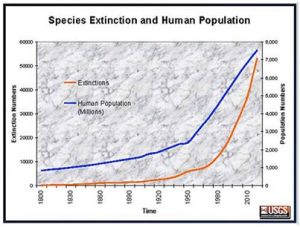
  • Land clearing for farming, logging and settlement
  • Introduction of invasive species
  • Carbon emissions that drive climate change and ocean acidification
  • Toxins that alter and poison ecosystems

Now, the specter of extinction hangs over about 41 percent of all amphibian species and 26 percent of all mammals, according to the International Union for Conservation of Nature, which maintains an authoritative list of threatened and extinct species.

“There are examples of species all over the world that are essentially the walking dead,” Ehrlich said.

As species disappear, so do crucial ecosystem services such as honeybees’ crop pollination and wetlands’ water purification. At the current rate of species loss, people will lose many biodiversity benefits within three generations, the study’s authors write. “We are sawing off the limb that we are sitting on,” Ehrlich said.

Hope for the future

Despite the gloomy outlook, there is a meaningful way forward, according to Ehrlich and his colleagues. “Avoiding a true sixth will require rapid, greatly intensified efforts to conserve already , and to alleviate pressures on their populations – notably habitat loss, over-exploitation for economic gain and climate change,” the study’s authors write.

In the meantime, the researchers hope their work will inform conservation efforts, the maintenance of ecosystem services and public policy.

Explore further: Research group suggests modern extinction rate may be higher than thought

More information: Accelerated modern human–induced species losses: Entering the sixth mass extinction, Science Advances, advances.sciencemag.org/content/1/5/e1400253

Pregnant mom of 12 pleads not guilty to child neglect

8 is enough, but 13 is definitely too many for anyone!

8 is enough, but 13 is definitely too many for anyone!

http://www.komonews.com/news/national/Pregnant-mom-of-12-pleads-not-guilty-to-child-neglect-306992381.html

TULSA, Okla. (AP) – A pregnant mother of 12 pleaded not guilty to a child neglect charge Thursday after authorities found her children in a trash-strewn Tulsa home with collapsing ceilings and no running water.

Special Judge Deborrah Ludi-Leitch entered the plea on behalf of the 38-year-old woman, who appeared by video from jail. The judge also appointed a public defender to represent the woman and set a June 30 court date.

A 41-year-old man who was living with the woman and also charged with child neglect is due in court for his initial hearing on Monday. No attorney information for either could be found in jail records.

The Associated Press is not naming the adults in order to protect the identities of the children.

The woman has had at least 33 Oklahoma Department of Human Services referrals and investigations, according to a police search warrant affidavit. Some of the children have been in and out of state custody throughout their lives, according to the affidavit.

A DHS employee who visited the house last week photographed the home and contacted police.

When officers arrived at the house, the woman told authorities she was three months pregnant with her 13th child, a police detective said.

Tulsa Police Det. Aubrie Thompson said Tuesday that four of the children have been taken into DHS custody and police were trying to locate the other eight. A message left with Thompson was not returned Thursday.

In addition to trash littered feet deep in some areas of the house, the yard was filled with trash and mattresses that the woman said she put outside more than three months ago because they were infested with bed bugs. Police also found a box of drugs, including methamphetamine, in the backyard in a hole covered with leaves, according to the affidavit.

The affidavit says the woman told police that if her children lived at the house all the time, they “would be really sick.”

We Are Breeding Ourselves to Extinction

 Mar 8, 2009

AP photo / Andy Wong
China has long imposed a limit of one child per family in an effort to reduce population growth.

By Chris Hedges

All measures to thwart the degradation and destruction of our ecosystem will be useless if we do not cut population growth. By 2050, if we continue to reproduce at the current rate, the planet will have between 8 billion and 10 billion people, according to a recent U.N. forecast. This is a 50 percent increase. And yet government-commissioned reviews, such as the Stern report in Britain, do not mention the word population. Books and documentaries that deal with the climate crisis, including Al Gore’s “An Inconvenient Truth,” fail to discuss the danger of population growth. This omission is odd, given that a doubling in population, even if we cut back on the use of fossil fuels, shut down all our coal-burning power plants and build seas of wind turbines, will plunge us into an age of extinction and desolation unseen since the end of the Mesozoic era, 65 million years ago, when the dinosaurs disappeared.

We are experiencing an accelerated obliteration of the planet’s life-forms—an estimated 8,760 species die off per year—because, simply put, there are too many people. Most of these extinctions are the direct result of the expanding need for energy, housing, food and other resources. The Yangtze River dolphin, Atlantic gray whale, West African black rhino, Merriam’s elk, California grizzly bear, silver trout, blue pike and dusky seaside sparrow are all victims of human overpopulation. Population growth, as E.O. Wilson says, is “the monster on the land.” Species are vanishing at a rate of a hundred to a thousand times faster than they did before the arrival of humans. If the current rate of extinction continues, Homo sapiens will be one of the few life-forms left on the planet, its members scrambling violently among themselves for water, food, fossil fuels and perhaps air until they too disappear. Humanity, Wilson says, is leaving the Cenozoic, the age of mammals, and entering the Eremozoic—the era of solitude. As long as the Earth is viewed as the personal property of the human race, a belief embraced by everyone from born-again Christians to Marxists to free-market economists, we are destined to soon inhabit a biological wasteland.

The populations in industrialized nations maintain their lifestyles because they have the military and economic power to consume a disproportionate share of the world’s resources. The United States alone gobbles up about 25 percent of the oil produced in the world each year. These nations view their stable or even zero growth birthrates as sufficient. It has been left to developing countries to cope with the emergent population crisis. India, Egypt, South Africa, Iran, Indonesia, Cuba and China, whose one-child policy has prevented the addition of 400 million people, have all tried to institute population control measures. But on most of the planet, population growth is exploding. The U.N. estimates that 200 million women worldwide do not have access to contraception. The population of the Persian Gulf states, along with the Israeli-occupied territories, will double in two decades, a rise that will ominously coincide with precipitous peak oil declines.

The overpopulated regions of the globe will ravage their local environments, cutting down rainforests and the few remaining wilderness areas, in a desperate bid to grow food. And the depletion and destruction of resources will eventually create an overpopulation problem in industrialized nations as well. The resources that industrialized nations consider their birthright will become harder and more expensive to obtain. Rising water levels on coastlines, which may submerge coastal nations such as Bangladesh, will disrupt agriculture and displace millions, who will attempt to flee to areas on the planet where life is still possible. The rising temperatures and droughts have already begun to destroy crop lands in Africa, Australia, Texas and California. The effects of this devastation will first be felt in places like Bangladesh, but will soon spread within our borders. Footprint data suggests that, based on current lifestyles, the sustainable population of the United Kingdom—the number of people the country could feed, fuel and support from its own biological capacity—is about 18 million. This means that in an age of extreme scarcity, some 43 million people in Great Britain would not be able to survive. Overpopulation will become a serious threat to the viability of many industrialized states the instant the cheap consumption of the world’s resources can no longer be maintained. This moment may be closer than we think.

A world where 8 billion to 10 billion people are competing for diminishing resources will not be peaceful. The industrialized nations will, as we have done in Iraq, turn to their militaries to ensure a steady supply of fossil fuels, minerals and other nonrenewable resources in the vain effort to sustain a lifestyle that will, in the end, be unsustainable. The collapse of industrial farming, which is made possible only with cheap oil, will lead to an increase in famine, disease and starvation. And the reaction of those on the bottom will be the low-tech tactic of terrorism and war. Perhaps the chaos and bloodshed will be so massive that overpopulation will be solved through violence, but this is hardly a comfort.