Exposing the Big Game

Forget Hunters' Feeble Rationalizations and Trust Your Gut Feelings: Making Sport of Killing Is Not Healthy Human Behavior

Exposing the Big Game

Trump’s Lies Are Killing His Supporters as COVID Starts to Sweep Rural America

In the finest traditions of Abraham Lincoln and Franklin Roosevelt — two of the U.S.’s most noteworthy wartime presidents — Donald Trump, the coronavirus “war” “president,” yesterday accused the state of New York of padding its coronavirus death toll, after New York revised its numbers to reflect thousands who died of COVID-19 before it had a name.

We’ve gone from “Fourscore and seven years ago” to “Nothing to fear but fear itself” to “Everything we have is documented and reported great,” which is how Trump responded to New York’s revised numbers. And you wonder why a new poll shows that 45 percent of Fox News viewers believe the coronavirus death toll numbers are inflated. The president said so!

Meanwhile, back in the middle of March when the COVID crisis was first beginning to roar but could have been better contained, the White House realized it had a shortage of face masks for its staff. This set off a scramble to get masks from Taiwan roundabout the 14th of that month. “At the time, the U.S. government was discouraging the public from wearing masks, saying that healthy people didn’t need them,” reports The Washington Post.

“A protest movement is taking hold targeting states that have extended social-distancing rules, closed schools, and restricted access to large religious gatherings,” reports The Daily Beast. “And it’s being fed by loyalists and political allies of President Donald Trump.”

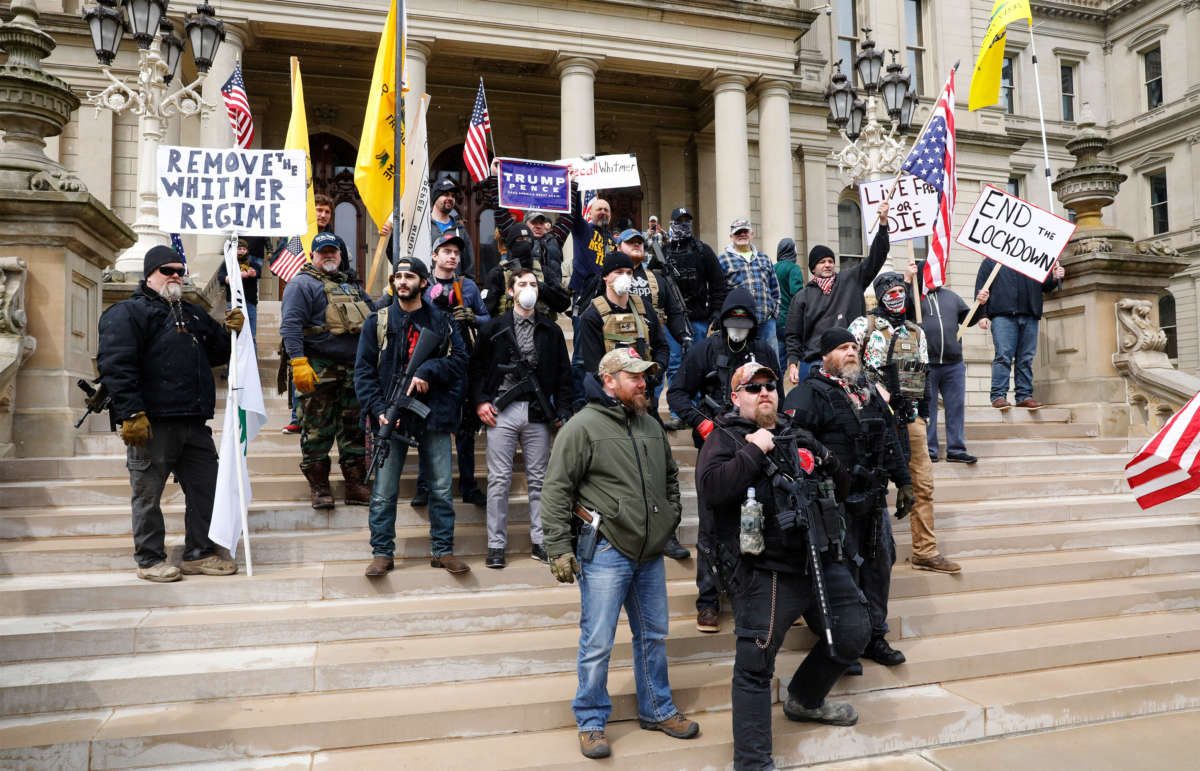
These pro-Trump protests have been popping up in Idaho, North Carolina, Oklahoma, and other states that have not yet felt the full brunt of the pandemic. The most vivid example to date came just yesterday in Michigan, where thousands of right-wing protesters — a number of them packing AR-15s — swarmed the capitol building in Lansing to protest Gov. Gretchen Whitmer’s stay-at-home order. “Lock her up!” they chanted, because of course they did.

While Trump himself is largely responsible for this incredibly dangerous burst of deeply misplaced faux-patriotism, his ideological allies have been busy online. A misinformation-laden video denouncing Anthony Fauci, for now the other face of the daily coronavirus briefings, has gone viral with more than 6 million views. It accuses Fauci and others of being part of the “Deep State,” Trump’s favorite rhetorical target. Given Trump’s recent unsubtle hints that Fauci is telling too much truth, the appearance of this video puts one in mind of the old saying about how there are no accidents in politics.

Evangelical churches have been filled to capacity with Trump supporters who have been led to believe that these stay-at-home orders issued by state governors are an attack on their constitutional right to gather in worship as they please. Evangelicals, of course, have been the unshakable bedrock beneath Trump’s dwindling base of support.

Jerry Falwell Jr., president of the evangelical Christian crown jewel Liberty University, has been ardent in his outspoken belief that COVID is nothing to fear and a plot to undermine Trump. “Since March 29, when the first case was diagnosed in a Liberty student living off-campus, confirmed coronavirus cases in the Central Virginia health district, which surrounds Lynchburg and Liberty, have grown from seven to 78, reports The New York Times. “One person has died.”

Even as Trump’s most ardent supporters crush themselves together to protest necessary coronavirus restraints, COVID hotspots have begun to bloom in regions that have been, to date, the geographic core of his support.

Nebraska, Idaho, South Dakota and other rural farm belt states are experiencing spikes in confirmed COVID cases. In Nebraska alone, the state’s health department reports a 30 percent increase in cases over the last three days. That is the accelerating curve New York, Massachusetts and Washington State can tell Nebraska all about.

The so-called “curve” of cases does appear to be flattening nationally because a majority of people, especially in urban areas, are devoutly complying with the strictures of social distancing. There are about 30,000 new cases every day right now; the number is no longer accelerating, but is still horrifying to contemplate.

What happens when this thing really and truly burns through rural America? It has already begun, and because of all those Trump supporters standing shoulder to shoulder at capitols and churches to shout their defiance of science and the “Deep State” into the virus-polluted air, it will get worse.

It will get worse within days, if the pattern holds, and there is no reason to expect otherwise. The match has been lit. In two weeks, these rural areas — which have lost so many of their hospitals thanks to decades of conservative budget cuts — are going to be locked into the same nightmare the urban areas have been dealing with since March, but with far less medical infrastructure prepared to confront it.

It begs the deadly, wretched question: How many Trump voters are going to die between now and November? How many people who listened to their president and his Fox News mouthpieces, who jammed the Michigan capitol steps and the megachurches on Easter because the president said it was safe, will be dead by June?

Quite a lot, I fear. This is the very living essence of tragedy and farce. Trump has labored mightily to convince his people that this is all some sort of ruse to keep him from being re-elected, and millions of those people have swallowed it whole.

This is a snake eating its own tail in real time while the snake-handler-in-chief cheers it on … except we are not talking about snakes. These are people, all of whom are somebody’s children, many of whom have children. They trusted Donald Trump, and that will get many of them killed while subsequently prolonging a pandemic that has already infected 2 million people worldwide.

I wonder if they will still think it was worth it come the summertime. I wonder if they will want a word with Mr. Trump once the virus he called a hoax has its way with them.

How did coronavirus start and where did it come from? Was it really Wuhan’s animal market?

Police tape blocks off Wuhan’s Huanan market, linked to several of China’s first coronavirus patients. Scientists are trying hard to determine how Covid-19 started, where it came from and how it spread to humans.
 Police tape blocks off Wuhan’s Huanan market, linked to several of China’s first coronavirus patients. Scientists are trying hard to determine how Covid-19 started, where it came from and how it spread to humans. Photograph: Noel Celis/AFP via Getty Images

In the public mind, the origin story of coronavirus seems well fixed: in late 2019 someone at the now world-famous Huanan seafood market in Wuhan was infected with a virus from an animal.

The rest is part of an awful history still in the making, with Covid-19 spreading from that first cluster in the capital of China’s Hubei province to a pandemic that has killed about 80,000 people so far.

Stock footage of pangolins – a scaly mammal that looks like an anteater – have made it on to news bulletins, suggesting this animal was the staging post for the virus before it spread to humans.

But there is uncertainty about several aspects of the Covid-19 origin story that scientists are trying hard to unravel, including which species passed it to a human. They’re trying hard because knowing how a pandemic starts is a key to stopping the next one.

Prof Stephen Turner, head of the department of microbiology at Melbourne’s Monash University, says what’s most likely is that virus originated in bats.

But that’s where his certainty ends, he says.

On the hypothesis that the virus emerged at the Wuhan live animal market from an interaction between an animal and a human, Turner says: “I don’t think it’s conclusive by any means.”

“Part of the problem is that the information is only as good as the surveillance,” he says, adding that viruses of this type are circulating all the time in the animal kingdom.

The fact that the virus has infected a tiger in a New York zoo shows how viruses can move around between species, he says. “Understanding the breadth of species this virus can infect is important as it helps us narrow down down where it might have come from.”

Scientists say it is highly likely that the virus came from bats but first passed through an intermediary animal in the same way that another coronavirus – the 2002 Sars outbreak – moved from horseshoe bats to cat-like civets before infecting humans.

A pangolin
Pinterest
 Pangolins are ‘the most illegally traded mammal in the world’. Photograph: Themba Hadebe/AP

One animal implicated as an intermediary host between bats and humans is the pangolin. The International Union for Conservation of Nature says they are “the most illegally traded mammal in the world” and are prized for their meat and the claimed medicinal properties of their scales.

As reported in Nature, pangolins were not listed on the inventory of items being sold in Wuhan, although this omission could be deliberate as it’s illegal to sell them.

“Whether the poor pangolin was the species at which it jumped, it’s not clear,” Turner says. “It’s either mixed in something else, mixed in a poor pangolin, or it’s jumped into people and evolved in people.”

Prof Edward Holmes, of the University of Sydney, was a co-author on a Nature study that examined the likely origins of the virus by looking at its genome. On social media he has stressed that the identity of the species that served as an intermediate host for the virus is “still uncertain”.

One statistical study looked at a characteristic of the virus that evolved to enable it to latch on to human cells. Pangolins were able to develop this characteristic, but so were cats, buffalo, cattle, goats, sheep and pigeons.

Another study claimed to have ruled out pangolins as an intermediary altogether, because samples of similar viruses taken from pangolins lacked a chain of amino acids seen in the virus now circulating in humans.

The study Holmes worked on suggested that the scenario in which a human at the Wuhan market interacted with an animal that carried the virus was only one potential version of the Covid-19 origin story. Another was the possibility that a descendent of the virus jumped into humans and then adapted as it was passed from human to human.

“Once acquired, these adaptations would enable the pandemic to take off and produce a sufficiently large cluster of cases to trigger the surveillance system that detected it,” the study said.

Analysis of the first 41 Covid-19 patients in medical journal the Lancet found that 27 of them had direct exposure to the Wuhan market. But the same analysis found that the first known case of the illness did not.

This might be another reason to doubt the established story.

 How coronavirus changed the world in three months – video

Prof Stanley Perlman, a leading immunologist at the University of Iowa and an expert on previous coronavirus outbreaks that have stemmed from animals, says the idea the link to the Wuhan market is coincidental “cannot be ruled out” but that possibility “seems less likely” because the genetic material of the virus had been found in the market environment.

Perlman told Guardian Australia he does believe there was an intermediary animal but adds that while pangolins are possible candidates, they “are not proven to be the key intermediary”.

“I suspect that any evolution [of the virus] occurred in the intermediate animal if there was one. There has been no substantial changes in the virus in the three months of the pandemic, indicating that the virus is well adapted to humans.”

So-called wet markets – where live animals are traded – have been implicated in previous outbreaks of coronaviruses, in particular Sars.

Dr Michelle Baker, an immunologist at CSIRO who studies viruses in bats, says some of the research on Covid-19’s origins have stepped off from what was known from the past.

But “we really don’t know” how accurate the origin story is, she says: “There’s some sort of connection [to the Wuhan market] and there were people exposed to the market that were infected.”

Baker says what is “very likely” is that the virus originated in a bat. “It’s a likely scenario but we will never know. The market was cleaned up quite quickly. We can only speculate.”

“These wet markets have been identified as an issue because you do have species interacting,” she says. “It’s an opportunity to highlight the dangers of them and an opportunity to clamp down on them.”

Turner adds: “We’ve found the ancestors of the virus, but having broader knowledge of the coronavirus in other species might give us a hint about the evolution of this thing and how it jumped.”

 Why are coronavirus mortality rates so different? – video explainer
  • Due to the unprecedented and ongoing nature of the coronavirus outbreak, this article is being regularly updated to ensure that it reflects the current situation at the date of publication. Any significant corrections made to this or previous versions of the article will continue to be footnoted in line with Guardian editorial policy.

Malaysian bears in peril as China pushes cure for Covid-19

4.4kShares
facebook sharing button 3.7k
twitter sharing button 189
whatsapp sharing button 71
sharethis sharing button
Beijing is said to have approved the use of bear bile to treat Covid-19. (Chiew Lin May/Bornean Sun Bear Conservation Centre pic)

PETALING JAYA: Two environmental groups have warned of a threat to the survival of the already endangered Malaysian sun bear, now that China is promoting bear bile as treatment for Covid-19.

Spokesmen for Monitor Conservation Research Society and the Malaysian Ecotourism and Conservation Society (Ecomy) told FMT they feared a rise in incidents of poaching.

Loretta Shepherd, Monitor’s communication coordinator, cited a recent study showing poachers were continuing to hunt for sun bears to cater to a demand by traditional Chinese medicine practitioners in Sabah and Sarawak.

According to the study, conducted last year, bear bile products were sold in 35% of traditional medicine outlets in Sabah and 19.3% of those in Sarawak.

Shepherd acknowledged that greater environmental awareness and reductions in the sun bear population had caused a steady drop in the use of bear bile over the years, but she said the threat of extinction remained serious.

She warned of the possibility of local traditional medicine practitioners following Beijing’s suit in promoting bear bile as a cure for Covid-19.

“Desperate consumers may easily be swayed,” she said.

“There is a very real chance that our sun bears will be at increased risk. We could see an increase in the use of bear bile medicine and a rise in the poaching of sun bears.”

A recent news report said Beijing had approved the use of bear bile to treat Covid-19, weeks after it banned the sale of wild animals for food, citing the risk of diseases spreading from animals to humans.

Last month, China’s National Health Commission issued guidelines recommending the use of an injection that contains bear bile powder, goat horn and three other medicinal herbs for the treatment of critically ill coronavirus patients.

Ecomy CEO Andrew Sebastian said he found it “repugnant” that Beijing was promoting the use of bear bile.

He accused China of “always fuelling the demand and supply chain” for wildlife.

“The demand for bear bile will increase and poachers will target the animals for current and future use.

“Local consumption is also something we need to be worried about,” he said.

Sebastian warned of a strain on the resources that the government has invested in for the protection of wildlife.

Nevertheless, he called for the investment of more resources into efforts to combat wildlife trafficking, saying such resources were especially needed in monitoring and the enforcement of laws.

He also claimed there is no possibility that a vaccine against Covid-19 could be found from wildlife sources.

Shepherd said promoting bear bile as medicine would perpetuate the notion that wild animals could continue to be exploited despite the availability of viable, legal and safe alternatives that do not endanger wildlife or people.

Will COVID-19 Trigger Extinction of All Life on Earth?

Pythagoras was misunderstood, and Socrates, and Jesus, and Luther, and Copernicus, and Galileo and Newton, and every pure and wise spirit that ever took flesh. To be great is to be misunderstood.~ Ralph Waldo Emerson 

Small lives matter. Indeed, the “human body contains about 100 trillion cells, but only maybe one in 10 of those cells is actually — human.” We are comprised of bacteria and other tiny living organisms, as well as non-living entities such as viruses. One such virus has captured the attention of the world, and with good reason. The novel coronavirus could trigger extinction of humans, and therefore the extinction of all life on Earth.

I frequently hear and read that COVID-19 is a nefarious attempt by the so-called “elite” among us to depopulate the burgeoning human population on Earth. Other conspiracy theories abound, including COVID-19 as an attempt to further reduce human rights, promote expensive medical therapies, and otherwise enrich the wealthy at the expense of the bamboozled masses.

I do not doubt the ability of the informed wealthy to fleece the ignorant masses. Nor do I doubt the ability of the informed wealthy to turn virtually any situation into an opportunity for monetary gain. A quick glance at the past two centuries provides plenty of examples. However, I doubt the monetarily wealthy among us are interested in accelerating human extinction, even for financial gain. As I explain below, the ongoing reduction in industrial activity as a result of COVID-19 almost certainly leads to loss of habitat for human animals, hence putting us on the fast track to human extinction. I doubt the knowledgeable “elite” are interested in altering the sweet deal they are experiencing with the current set of living arrangements.

The aerosol masking effect, or global dimming, has been described in the peer-reviewed literature since at least 1929 (A. Ångström, “On the Atmospheric Transmission of Sun Radiation and on Dust in the Air,”Geografiska Annaler, volume 11, pages 156-166). Coincident with industrial activity adding to greenhouse gases that warm the planet, industrial activity simultaneously cools the planet by adding aerosols to the atmosphere. These aerosols block incoming sunlight, thereby keeping cool our pale blue dot. Reducing industrial activity by as little as 35 percent is expected to cause a global-average temperature rise of 1 degree Celsius within a few weeks, according to research on the aerosol masking effect. Such research was deemed collectively too conservative by a paper in the 17 January 2019 issue of Science, which is among the most highly respected of peer-reviewed journals. As pointed out by the lead author of the paper in Science on 22 January 2019: “Global efforts to improve air quality by developing cleaner fuels and burning less coal could end up harming our planet by reducing the number of aerosols in the atmosphere, and by doing so, diminishing aerosols’ cooling ability to offset global warming.” The “cooling effect is “nearly twice what scientists previously thought,” and this 2019 paper cites the conclusion by Levy et al. (2013) indicating as little as 35% reduction in industrial activity drives a 1 C global-average rise in temperature, thereby suggesting that as little as a 20% reduction in industrial activity will drive a 1 C spike in temperature within days or weeks. Additional support for the importance of the aerosol masking effect comes in the 18 July 2019 issue of Geophysical Research Letters and also from the 27 November 2019 issue of Nature Communications. Additional research indicates loss of aerosols exacerbates heat waves. So, too, does the ongoing, abrupt loss of Arctic ice.

As I have explained previously for Weekly Hubriscivilization is a heat engine. However, slowing or stopping industrial civilization heats the planet faster than maintaining the ongoing, omnicidal approach. Of course, the situation is worse than that. Human extinction might have been triggered several years ago when the global-average temperature of Earth exceeded 1.5 C above the 1750 baseline. According to a comprehensive overview published by European Strategy and Policy Analysis System in April 2019, an “increase of 1.5 degrees is the maximum the planet can tolerate; … at worst, [such a rise in temperature above the 1750 baseline will cause] the extinction of humankind altogether.” Earth’s global-average temperature hit 1.73 C above the 1750 baseline by April, 2018, the highest global-average temperature experienced by our species on Earth, according to a 2017 paper in Earth System Dynamics by James Hansen and colleagues. The much-dreaded 2 C above the 1750 baseline was crossed by 13 March 2020. In other words, human extinction via the death-by-a-thousand-cuts route might be locked in with no further heating of Earth.

In light of the ongoing pandemic, the ongoing Mass Extinction Event, and abrupt, irreversible climate change, I am pleasantly surprised humans still occupy Earth. I strongly suspect the ongoing reduction in industrial activity will reduce the aerosol masking effect sufficiently to trigger a 1 C temperature spike, as described in the peer-reviewed literature. In fact, I suspect it already has. The outcome is not yet obvious because the timing of the outbreak of the novel coronavirus was favorable for human habitat. Trees produced leaves in the Northern Hemisphere spring of 2020 as a result of carbohydrates stored the previous year. Grain crops were harvested before the novel coronavirus emerged. I suspect the results of the recent and ongoing rise in temperature, which has already been reported in China and India, will become obvious to most humans when many more trees die. Large-scale die-off of trees likely will approximately correspond with catastrophic crop failure. This might occur by the end of this year, although I would rather it not.

Every civilization requires bread and circuses. There is little doubt the circuses attendant to industrial civilization will continue until the end of the planetary show for Homo sapiens. Bread, however, requires wheat. Wheat production requires a delicate balance of growing conditions that, like habitat for humans, teeters on the brink. The path to near-term human extinction thus runs from a tiny virus underlying a pandemic through a reduction of industrial activity that overheats a planet already running a fever.

Deadly diseases and their potential impacts have been described for decades. As a minor example, I delivered the commencement address to the graduating class in the Master of Public Health Program at the University of Arizona on 17 August 2007. As part of my address, I pointed out that we will “see pestilence — what we call disease, when it happens one person at a time — making a big comeback.” Unfortunately, we are evidently headed for our cosmic exit far earlier than I was willing to admit in 2007.

COVID-19 could very well be the event that accelerates human extinction via reduction of industrial activity. If so, the resultant catastrophic meltdown of the world’s nuclear facilities bodes poorly for all life on Earth. As Albert Einstein indicated when he realized his research on particle physics led to the development of nuclear power: “If I had known they were going to do this, I would have become a shoemaker.”

Nuclear catastrophe is only one of the means by which humans are capable of causing extinction of all life on Earth. Anthropogenically driven abrupt, irreversible climate change could produce the same tragic result.

History is replete with examples of human hubris. We thought we were mighty, and we thought we were human, whatever that means. Collectively, we certainly have left our mark on Earth. How embarrassing for the big-brained human species that a microscopic virus could pull the trigger on our extinction. How wonderful for thoughtful individuals that we get to ponder our deaths, and therefore our lives. We get to contemplate not only our lives, but also how we live.


One of America’s largest meat producers has ominous warning about the grocery store supply

‘…severe, perhaps disastrous, repercussions’

Sean Gallup/Getty Images

Smithfield Foods, one of the nation’s largest meat producers, has an ominous warning about America’s food supply.

The company announced on Sunday that it was closing its Sioux Falls, South Dakota, plant after nearly 300 employees there tested positive for coronavirus, the Associated Press reported. The plant is one of the largest pork processing centers in America, and is responsible for producing 18 million servings of food per day.

In a statement, Smithfield president and CEO Kenneth Sullivan said the COVID-19 outbreak is having disastrous impacts on the U.S. food supply chain.

“The closure of this facility, combined with a growing list of other protein plants that have shuttered across our industry, is pushing our country perilously close to the edge in terms of our meat supply,” Sullivan warned.

“It is impossible to keep our grocery stores stocked if our plants are not running. These facility closures will also have severe, perhaps disastrous, repercussions for many in the supply chain, first and foremost our nation’s livestock farmers,” he explained.


Other meat processing plants have also closed temporarily because of outbreaks of the coronavirus, including a Tyson Foods facility in Columbus Junction, Iowa, where more than two dozen employees tested positive.

Smithfield said there will be some activity at the plant on Tuesday to process product that’s already in inventory. It will resume operations in Sioux Falls after receiving further directions from local, state and federal officials. The company said it will continue to pay its workers for the next two weeks.

The closure of Smithfield’s plant and other food processing centers is strictly to protect the health of workers.

The Department of Agriculture has said there is no evidence that COVID-19 has been transmitted through food or its packing, the AP reported.

Smithfield Foods is owned by the Chinese-based WH Group. The company, which is known as Shineway Group outside of Asia, bought Smithfield Foods in 2013. WH Group is the largest pork producer in the world.

Editor’s note: This story was updated to include Smithfield Foods being owned by Chinese-based WH Group.

Trump retweets post calling for firing of Dr. Anthony Fauci

Sign up for our special edition newsletter to get a daily update on the coronavirus pandemic.

President Trump on Sunday night retweeted a post that called for the ousting of Dr. Anthony Fauci after the infectious disease specialist appeared on CNN.

The tweet from DeAnna Lorraine, a former GOP candidate for Congress, included the hashtag #FireFauci and referred to Fauci’s concession that more lives could have been saved if the US had acted sooner to stop the spread of coronavirus.

“Sorry Fake News, it’s all on tape,” Trump wrote, insisting his travel ban was the action needed to stem the virus. “I banned China long before people spoke up.”

Earlier on Sunday, Fauci appeared on CNN’s “State of the Union” and acknowledged the country “could’ve saved lives” if it had started mitigation efforts earlier.

“You know, Jake, as I have said many times, we look at it from a pure health standpoint,” Fauci told host Jake Tapper.

“We make a recommendation. Often, the recommendation is taken. Sometimes it’s not. But we — it is what it is. We are where we are right now.”

Lorraine’s tweet was critical of Fauci’s cable news appearance and used the hashtag #FireFauci to encourage Trump’s fanbase to add the medical expert to the president’s list of perceived enemies.

Enlarge ImagePresident Donald Trump and Dr. Anthony Fauci
President Trump and Dr. Anthony FauciReuters

“Fauci is now saying that had Trump listened to the medical experts earlier he could’ve saved more lives,” wrote Lorraine.

“Fauci was telling people on February 29th that there was nothing to worry about and it posed no threat to the US public at large,” she continued. “Time to #FireFauci.”

https://nypost.com/2020/04/13/trump-retweets-post-about-firing-dr-anthony-fauci/

‘IT’S BATSHIT CRAZY TO EAT BATS’: BILL MAHER BLASTS CRITICS WHO SAY ‘CHINESE VIRUS’ IS WRONG, INACCURATE

Pause

Unmute

Current Time 1:14
Duration 4:16
Loaded: 39.88%

Quality

Fullscreen

Bill Mayer defended referring to COVID-19 as the “Chinese virus” as scientists have been naming diseases and other conditions after their country of origin for years.

Speaking during an episode of Real Time With Bill Maher, the host also dismissed suggestions that referring to COVD-19 as the Chinese Virus is racist and that the country needs to be blamed for the pandemic.

“It’s not racist to point out that eating bats is bat**** crazy,” he said in reference to the wet markets in the Chinese city of Wuhan where the outbreak was first detected.

“Scientists, who are generally pretty liberal, have been naming diseases after the places they came from for a very long time,” Maher said. “MERS stands for Middle Eastern Respiratory Syndrome, it’s plastered all over airports and no one blogs about it.

“So why should China get a pass?

Maher also hit out at a tweet from Congressman Ted Lieu who said it was “just as stupid to call it the Milan virus” given the large number of confirmed cases in northern Italy.

“No, that would be way stupider because it didn’t come from Milan. And if it did, I guarantee we’d be calling it the Milan Virus,” Mayer added. “Can’t we even have a pandemic without getting offended? When they named Lyme Disease after a town in Connecticut, the locals didn’t get all ticked off.

“This isn’t about vilifying a culture. This is about facts, it’s about life and death,” Mayer said. “So when people say, ‘what if people hear Chinese Virus and blame China?’ the answer is, we should blame China.

“Not Chinese Americans, but we can’t stop telling the truth because racists get the wrong idea. There are always going to be idiots out there who want to indulge their prejudices, but this is an emergency.

“Sorry Americans, we’re going to have to ask you to keep two ideas in your head at the same time. This has nothing to do with Asian Americans and it has everything to do with China.

“We can’t afford the luxury anymore of non-judginess towards a country with habits that kill millions of people everywhere, because this isn’t the first time. SARS came from China, and the Bird flu, and the Hong Kong flu, and the Asian flu. Viruses come from China like shortstops come from the Dominican Republic.”

Officials and organizations have commend political figures, including President Donald Trump, for referring to COVID-19 as the “Chinese virus” or “Wuhan virus” for creating stigma around Asian communities and fueling racist attacks.

“I think we’ve been very clear right since the beginning of this event that viruses know no borders and they don’t care [about] your ethnicity, the color of your skin, how much money you have in the bank,” Mike Ryan, head of the World Health Organization’s health emergency programs, told the South China Morning Post.

“It’s really important that we are careful in the language we use lest it lead to profiling of individuals associated with the virus.”

New York Attorney General Letitia James also hit out at those calling it the Chinese Virus while setting up a dedicated hotline to deal with the sharp rise in the number of coronavirus-linked hate crimes in the city.

“As we face an unprecedented and uncertain time for New York, the United States, and the world, we must reiterate the fact that this pandemic does not give anyone an excuse to be racist, xenophobic, or biased,” James said.

There are more than 1.7 million confirmed cases of COVID-19 around the world, with 103,257 deaths according to Johns Hopkins University. A total of 378, 838 people have managed to recover from the virus.

Bill Maher
Bill Maher Performs During New York Comedy Festival at The Theater at Madison Square Garden on November 5, 2016 in New York CityNICHOLAS HUNT/GETTY

Centers for Disease Control and Prevention Advice on Using Face Coverings to Slow Spread of COVID-19

  • CDC recommends wearing a cloth face covering in public where social distancing measures are difficult to maintain.
  • A simple cloth face covering can help slow the spread of the virus by those infected and by those who do not exhibit symptoms.
  • Cloth face coverings can be fashioned from household items. Guides are offered by the CDC. (https://www.cdc.gov/coronavirus/2019-ncov/prevent-getting-sick/diy-cloth-face-coverings.html)
  • Cloth face coverings should be washed regularly. A washing machine will suffice.
  • Practice safe removal of face coverings by not touching eyes, nose, and mouth, and wash hands immediately after removing the covering.

World Health Organization advice for avoiding spread of coronavirus disease (COVID-19)

Hygiene advice

  • Clean hands frequently with soap and water, or alcohol-based hand rub.
  • Wash hands after coughing or sneezing; when caring for the sick; before, during and after food preparation; before eating; after using the toilet; when hands are visibly dirty; and after handling animals or waste.
  • Maintain at least 1 meter (3 feet) distance from anyone who is coughing or sneezing.
  • Avoid touching your hands, nose and mouth. Do not spit in public.
  • Cover your mouth and nose with a tissue or bent elbow when coughing or sneezing. Discard the tissue immediately and clean your hands.

Medical advice

  • Avoid close contact with others if you have any symptoms.
  • Stay at home if you feel unwell, even with mild symptoms such as headache and runny nose, to avoid potential spread of the disease to medical facilities and other people.
  • If you develop serious symptoms (fever, cough, difficulty breathing) seek medical care early and contact local health authorities in advance.
  • Note any recent contact with others and travel details to provide to authorities who can trace and prevent spread of the disease.
  • Stay up to date on COVID-19 developments issued by health authorities and follow their guidance.

Mask and glove usage

  • Healthy individuals only need to wear a mask if taking care of a sick person.
  • Wear a mask if you are coughing or sneezing.
  • Masks are effective when used in combination with frequent hand cleaning.
  • Do not touch the mask while wearing it. Clean hands if you touch the mask.
  • Learn how to properly put on, remove and dispose of masks. Clean hands after disposing of the mask.
  • Do not reuse single-use masks.
  • Regularly washing bare hands is more effective against catching COVID-19 than wearing rubber gloves.
  • The COVID-19 virus can still be picked up on rubber gloves and transmitted by touching your face.

Hundreds of U.S. Meat Workers Have Now Tested Positive for Virus

  • Cases reported in Colorado, South Dakota, Pennsylvania
  • ‘You cannot make sacrifices like this with people’s lives’

We’re tracking the latest on the coronavirus outbreak and the global response. Sign up here for our daily newsletter on what you need to know.

There’s been a spike in coronavirus cases at meat plants in the U.S., with hundreds of reported infections in just the last week. That’s adding to questions over the fragility of the food-supply chain and raising concerns over worker safety.

As many as 50 people at a JBS SA beef facility in Colorado’s Weld County tested positive, adding to more than 160 cases at a Cargill Inc. meat-packaging plant in Pennsylvania, union officials said on Friday. South Dakota Governor Kristi Noem on Friday reported 190 cases at a Smithfield Foods Inc. pork facility, the Associated Press said. The Cargill and Smithfield plants are being shuttered, while JBS said it will continue operations.

Workers are also starting to die. Two more deaths were reported by union officials on Friday, one at the Greeley, Colorado meat plant and one in Pennsylvania. Both those facilities are owned by JBS SA, the world’s top meat producer, which didn’t confirm the deaths.

“As our communities and our country collectively face the coronavirus challenge, JBS USA has had team members impacted by COVID-19,” the American unit of the Brazilian meatpacker said in an emailed statement. “We are offering support to those team members and their families. Out of respect for the families, we are not releasing further information.”

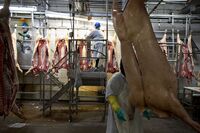
Pork Processing At A Smithfield Foods Plant

Employees work on pig carcasses at a pork processing facility in Missouri, U.S.

While it’s unclear whether the deaths and other cases have anything to do with the workplaces, the news exposes the vulnerability of global supply chains that are needed to keep grocery stores stocked after panic buying left shelves empty. President Donald Trump and Vice President Mike Pence both addressed the sudden jump in cases at meat plants when speaking to reporters on Friday.

Deaths Expose Fears for Strength of U.S. Food-Supply Chain

Pence said as many as 300 people have been “impacted” by the coronavirus at the Colorado meat plant. It’s unclear what that figure was referring to, whether it was people who have been quarantined, or possible cases.

Trump also referred to the outbreak at Colorado meat plants on Friday. Neither Pence nor Trump specified exactly which plant they were talking about. Greeley is about 65 miles northeast of Denver.

“We’re looking at this graph where everything’s looking beautiful and is coming down and then you’ve got this one spike. I said, ‘What happened to Denver?,’” Trump said. “And many people, very quickly.”

Uproar Among Workers Supplying the World’s Meat Is Spreading

Plants across the U.S. are starting to reduce output or idle as cases spread from the main cities to rural America. Laborers have, in some cases, staged walk-outs to protest working conditions. In meat plants, stations on processing lines can be close together, creating challenges for social distancing. Workers share break and locker rooms.

The deaths reported Friday bring the total reported for JBS employees to three. On Tuesday, the Retail, Wholesale and Department Store Union, which represents thousands of poultry workers, said two of its members working at a Tyson Foods Inc. plant in Camilla, Georgia, died from the virus.

Smithfield said it will close its South Dakota plant for three days. The company will suspend operations in a large section of the plant on April 11 and completely shutter on April 12 and April 13. The facility has 3,700 employees.

Deep Cleaning

During the suspension, “essential personnel will repeat the rigorous deep cleaning and sanitization that have been ongoing at the facility and install additional physical barriers to further enhance social distancing,” Smithfield said in a statement. “Employees will be paid for any previously scheduled hours during the temporary closure.”

The Cargill plant is located in an area where there are large manufacturing plants and a large influx of people coming in from New York City. Those were among factors that contributed to a high number of cases in that region of Pennsylvania, it’s not a Cargill-only issue, said Wendell Young IV, president of Local 1776 of the United Food & Commercial Workers. The Minneapolis-based company declined to comment on the number of cases at the facility that employs 900 people.

Farm Bill With $8.6 Billion in Food-Stamp Cuts Passes U.S. House

A farmer feeds cattle in a barn at a dairy farm in Illinois, U.S.

“We’ve taken extra steps to focus on safety,” said Jon Nash, head of Cargill’s North American protein business. The company is implementing temperature testing, providing and encouraging employees to wear face coverings, doing enhanced cleaning and sanitizing, among other measures, he said, while also citing temporary wage increases, bonuses and waiving co-pays for Covid-19 testing.

“Our facility will re-open as soon as is it is safe to do so.”

Threat of Sick Workers at U.S. Meat Plants Forces Policy Changes

JBS said there were 36 employees who work at the Greeley plant with the virus, fewer than the 50 positive cases reported by the local union. JBS also confirmed “increased absenteeism” at the beef production facility.

The company said it was working in partnership with the U.S. federal government, Colorado Governor Jared Polis and Senator Cory Gardner to secure Covid-19 tests for all team members at the Greeley plant, which it’s aiming to complete through Monday. JBS will also “further enhance previously announced deep cleaning efforts at the facility,” it said in a statement, while adding it planned to continue operations.

The Greeley plant employs more than 3,000 workers, according to the JBS website.

Meanwhile, the local union sent a letter to Governor Polis along with company and county officials demanding that the Greeley plant be shut down for at least a week for “extensive and repeated deep cleanings.” The union asked that employees be paid regular wages during the shutdown, and that upon re-opening workers receive an additional $3 per hour as “hazard pay” on top of usual hourly rates.

“You cannot make sacrifices like this with people’s lives,” Kim Cordova, president of Local 7 of the United Food & Commercial Workers Union, said by telephone. “People can live without beef.”

WHO investigating reports of coronavirus patients testing positive again


Volume 90%

The World Health Organization (WHO) confirmed on Saturday it is investigating reports of some recovered coronavirus patients testing positive for the illness after initially testing negative.

The move is in response to a report from South Korea on Friday that 91 patients who had been cleared of COVID-19 and were being prepared for discharge tested positive again. Officials say that, rather than being reinfected, patients may be suffering from a “reactivated” coronavirus.

“We are aware of these reports of individuals who have tested negative for COVID-19 using PCR (polymerase chain reaction) testing and then after some days testing positive again,” the WHO told The Hill in a statement.

“We are closely liaising with our clinical experts and working hard to get more information on those individual cases. It is important to make sure that when samples are collected for testing on suspected patients, procedures are followed properly,” it added.

The WHO’s clinical management guidelines state that patients can be discharged from the hospital after two negative coronavirus test results at least 24 hours apart.

Current studies have shown that as many as 14 days can take place between the start of symptoms and clinical recovery in mild cases of the coronavirus.

“We are aware that some patients are PCR positive after they clinically recover, but we need systematic collection of samples from recovered patients to better understand how long they shed live virus,” the WHO said.

The novel coronavirus has infected more than 1.7 million people worldwide and killed more than 103,000.


Coronavirus: New York has more cases than any country

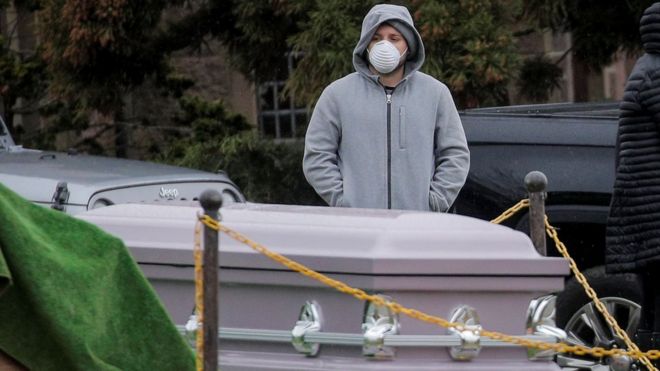
Mourners attend a funeral at The Green-Wood Cemetery, amid the coronavirus disease in Brooklyn, New YorkImage copyrightREUTERS
Image captionMourners attend a funeral in Brooklyn, New York, as the city’s coronavirus death toll hit a record high for a third day

New York state now has more coronavirus cases than any single country outside the US, according to latest figures.

The state’s confirmed caseload of Covid-19 jumped by 10,000 on Thursday to 159,937, placing it ahead of Spain (153,000 cases) and Italy (143,000).

China, where the virus emerged last year, has reported 82,000 cases.

The US as a whole has recorded 462,000 cases and nearly 16,500 deaths. Globally there are 1.6 million cases and 95,000 deaths.

While New York state leads the world in coronavirus cases, its death toll (7,000) lags behind Spain (15,500) and Italy (18,000), though it is more than double the official figure from China (3,300).

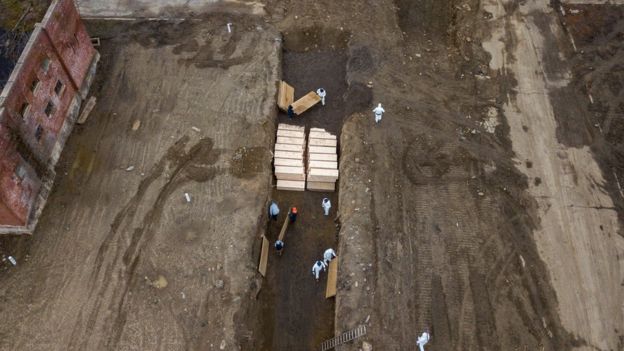
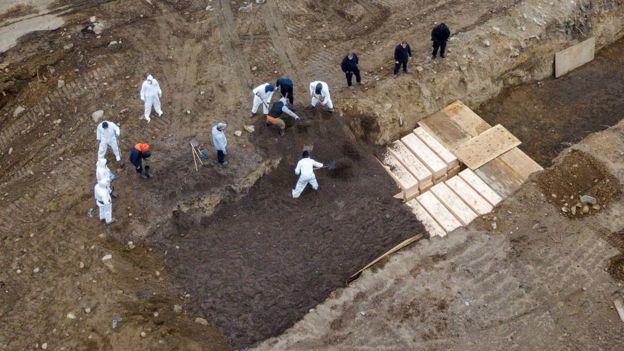
Photos have emerged of workers in hazmat outfits burying coffins in a mass grave in New York City.

Drone pictures show bodies being buried in a wide trench on New York's Hart IslandImage copyrightREUTERS
Image captionAbout 40 coffins were buried on Thursday
Drone pictures show bodies being buried on New York's Hart IslandImage copyrightREUTERS

Drone footage showed workers using a ladder to descend into the huge pit where the caskets were stacked.

The images were taken at Hart Island, off the Bronx, which has been used for more than 150 years by city officials as a mass burial site for those with no next-of-kin, or families who cannot afford funerals.

Burial operations at the site have ramped up amid the pandemic from one day a week to five days a week, according to the Department of Corrections.

Prisoners from Rikers Island usually do the job, but the rising workload has recently been taken over by contractors.

New York City Mayor Bill de Blasio indicated earlier this week the city’s public cemetery might be used for burials during the pandemic.

“Obviously the place we have used historically is Hart Island,” he said.

Media captionIs it too soon for a thriller movie on coronavirus?

The number of coronavirus deaths in New York state increased to 799 on Wednesday, a record high for a third day.

But Governor Andrew Cuomo took heart from the fact that the number of Covid-19 patients admitted to New York hospitals dropped for a second day, to 200.

He said it was a sign social distancing was working. He called the outbreak a “silent explosion that ripples through society with the same randomness, the same evil that we saw on 9/11”.

Another glimmer of hope was heralded on Thursday as official projections for the nationwide death toll were lowered.

Banner image reading 'more about coronavirus'
Banner

Dr Anthony Fauci, a key member of the White House’s coronavirus task force, told NBC News’ Today show on Thursday the final number of Americans who will die from Covid-19 in the outbreak “looks more like 60,000”.

In late March, Dr Fauci estimated “between 100,000 and 200,000” could die.

The 60,000 projection would match the upper estimate for total flu deaths in the US between October 2019 to March 2020, according to government data.

But Vice-President Mike Pence stressed on Thursday that Covid-19 is about three times as contagious as influenza.

The White House has previously touted estimates that 2.2 million Americans could die from coronavirus if nothing was done to stop its spread.

Stay-at-home orders have in the meantime closed non-essential businesses in 42 states, while drastically slowing the US economy.

New data on Thursday showed unemployment claims topped 6 million for the second week in a row, bringing the number of Americans out of work over the last three weeks to 16.8 million.

Chicago meanwhile imposed a curfew on liquor sales from 21:00 local time on Thursday to stop the persistent violation of a ban on large gatherings.

Media captionHow caravans are helping frontline medics with a place to stay

The measure, due to remain in place until 30 April, comes after health officials this week said black Chicagoans account for half of all the Illinois city’s coronavirus cases and more than 70% of its deaths, despite making up just 30% of the population.

“We are putting this curfew in place because too many individuals and businesses have been violating the stay-at-home order,” said Mayor Lori Lightfoot on Wednesday.

Gun violence in Chicago on Tuesday left seven dead and 14 injured, which city officials said was unforgivable given the virus crisis.

“Every one of those ER beds taken up by a gunshot victim could be somebody’s grandmother, somebody with pre-existing conditions, somebody that is in danger of losing their lives because of the pandemic,” Supt Charlie Beck said.

Media caption‘I just had a baby – now I’m going to the frontline.’

Figures from Louisiana, Mississippi, Michigan, Wisconsin and New York reflect the same racial disparity in coronavirus infections.

Presumptive Democratic White House nominee Joe Biden joined growing calls on Thursday for the release of comprehensive racial data on the pandemic.

He said it had cast a spotlight on inequity and the impact of “structural racism”.

Meanwhile, a court has blocked parts of Texas’ temporary abortion ban, which the state announced last month citing the coronavirus outbreak.

The order against “medically unnecessary” procedures was introduced to reserve valuable medical resources for those treating Covid-19 only, the state’s Republican attorney general said in March.

Media captionItalian PM Giuseppe Conte said he might begin to relax some measures by the end of this month

But Judge Lee Yaekel, a George W Bush appointee, granted a temporary restraining order against the ban on Thursday.

“As a minimum, this is an undue burden on a woman’s right to a previability abortion,” he wrote in his ruling.

Alabama, Iowa, Ohio and Oklahoma have introduced similar abortion bans.

While there is still no vaccine for Covid-19, America’s culture wars have proved similarly incurable.

Legal battles have also ensued over whether guns shops should be closed during the pandemic, and if religious services should be exempt from state orders that ban large gatherings.