Exposing the Big Game

Forget Hunters' Feeble Rationalizations and Trust Your Gut Feelings: Making Sport of Killing Is Not Healthy Human Behavior

Exposing the Big Game

Coronavirus: Officials urge LA County residents to skip grocery shopping, stay home this week

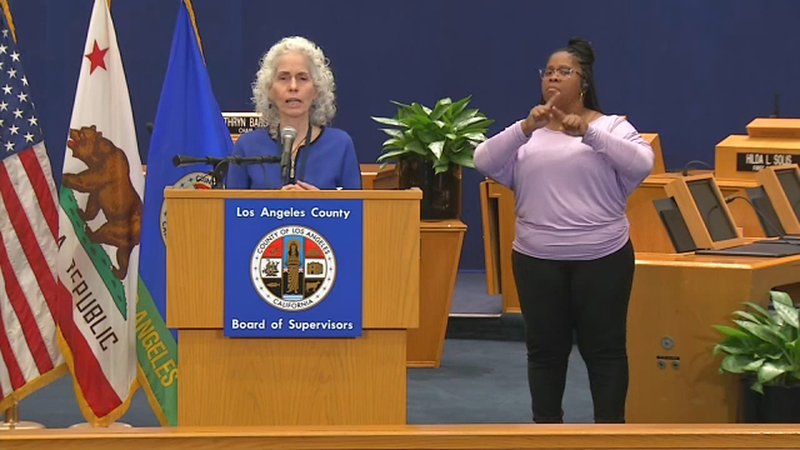
LOS ANGELES (KABC) — Officials are advising all residents of Los Angeles County to stay home this week, which they are calling critical in the widespread efforts to curb the spread of COVID-19.

At a Monday afternoon press conference, county public health director Dr. Barbara Ferrer said people should try not leave their homes for groceries or medications, but should instead arrange for them to be delivered, if necessary.

“If you have enough supplies in your home, this would be the week to skip shopping altogether,” she said.

The recommendation comes as the number of cases across L.A. County topped 6,000. The county’s death toll now stands at 147.

Officials are advising all residents of Los Angeles County to stay home this week, which they are calling critical in the widespread efforts to curb the spread of COVID-19.

Those venturing out to the stores will soon see some major changes to keep customers and employees safe.

Many stores are already enforcing physical distancing and limiting the number of people allowed in at a time.

Ralphs is limiting the amount of shoppers allowed inside to 50% capacity to allow for improved physical distancing.

One-way aisles are also being implemented by many chains, like Vons.

Walmart was the first to announce the new measure aimed at helping customers keep their distance. Vons says it is also joining the effort.

Shoppers are taking the opportunity to take one last trip to the store before hunkering down at home.

“We went back and forth, me and my sister, about whether to come out or not. We’re gonna stay in for two weeks, so we decided to make one last (trip.) We’re almost out of water,” Studio City resident Kina Cosper said. “We’re here and then we’re like done for two weeks.”

Ralphs, which is owned by Kroger, has installed plexiglass at checkout lines. The chain is also encouraging employees to wear face masks and gloves.

Globally, the number of people dying appeared to be slowing in New York City, Spain and Italy. The news was cautiously welcomed by leaders, who also noted that any gains could easily be reversed if people did not continue to adhere to strict lockdowns.

The U.S. is still awaiting the peak, and Surgeon General Jerome Adams offered a stark warning about the expected wave of virus deaths.
“This is going to be our Pearl Harbor moment, our 9/11 moment,” he told “Fox News Sunday.”

Dr. Fauci: ‘It Boggles My Mind’ China Allows Wet Markets Linked to Viral Outbreaks – Should They Close Permanently?

Article Hero Image

Should countries with “wet markets” be pressured to permanently close them to prevent viral outbreaks?

Yes
Maybe
No

Corona beer stops production

New York (CNN Business)Production of Corona beer is being temporarily suspended in Mexico because of the coronavirus pandemic.

https://www.cnn.com/2020/04/03/business/corona-beer-production/index.html

Grupo Modelo, the company that makes the beer, posted the announcement on Twitter, stating that it’s halting production and marketing of its beer because the Mexican government has shuttered non-essential businesses. The Anheuser-Busch Inbev-owned company also makes Modelo and Pacifico beers.
This week, the Mexican government announced the suspension of non-essential activities in the public and private sectors until April 30 in an effort to curb the spread of the virus. The country has more than 1,500 cases and 50 deaths, according to Johns Hopkins.
Grupo Modelo is ready to enact a plan to “guarantee the supply of beer” if the Mexican government decides to include breweries as essential, according to a statement.
Constellation Brands (STZ) handles the distribution and import of Grupo Modelo’s beers in the United States. CEO Bill Newlands said in an earnings call the brand has “ample supply to meet consumer demand” and doesn’t expect shortages in the near term.
close dialog
Corona’s coincidental name with the virus hasn’t dented sales. Constellation said sales of its beer brands grew 8.9% for the first three months of this year, with Modelo and Corona being its top sellers. Sales accelerated in the first three weeks of March, the company said, with its beers growing 24% compared to a year ago.
Corona Hard Seltzer, which launched in early March, is also off to a “strong start,” according to a company earnings release.
Beer and other alcohol are rising in sales this month as Americans are being forced to hunker down in light of the coronavirus. Sales numbers from Nielsen (NLSN) show beer sales rose 34% year-over-year for the week ending on March 21.

Where will the bodies go? Morgues plan as virus grows


5
VIEW ALL PHOTOS
A body wrapped in plastic is prepared to be loaded onto a refrigerated container truck used as a temporary morgue by medical workers due to COVID-19 concerns, Tuesday, March 31, 2020, at Brooklyn Hospital Center in the Brooklyn borough of New York. (AP Photo/John Minchillo)

PHILADELPHIA (AP) — There are the new dead. And then there are the bodies waiting in overcrowded mortuaries to be buried as cities struggle to meet demand and families wrestle with rules on social distancing that make the usual funeral rituals impossible.

Med Alliance Group, a medical distributor in Illinois, is besieged by calls and emails from cities around the country. Each asks the same thing: Send more refrigerated trailers so that we can handle a situation we never could have imagined.

“They’re coming from all over: From hospitals, health systems, coroner’s offices, VA facilities, county and state health departments, state emergency departments and funeral homes,” said Christie Penzol, a spokeswoman for Med Alliance. “It’s heart-wrenching.”

The company has rented all its trailers and there’s an 18-week wait for new materials to build more, she said.

Bodies wrapped in plastic are loaded on to a refrigerated container truck operating as a makeshift morgue while being handled by medical workers wearing personal protective equipment due to COVID-19 concerns, Tuesday, March 31, 2020, at Brooklyn Hospital Center in the Brooklyn borough of New York. (AP Photo/John Minchillo)

With U.S. medical experts and even President Donald Trump now estimating the death toll from the coronavirus pandemic could reach 240,000 nationwide, the sheer practicalities of death — where to put the bodies — are worrying just about everyone as cities, hospitals and private medical groups clamor to secure additional storage.

The need is compounded by private mortuary space that is occupied longer than usual as people wait to bury their loved ones— regardless of how they died— because rules on social distancing make planning funerals difficult.

It’s a crisis being repeated worldwide.

In Spain, where the death toll has climbed to nearly 12,000, an ice rink in Madrid was turned into a makeshift morgue after the city’s municipal funeral service said it could no longer take coronavirus bodies until it was restocked with protective equipment. In Italy, embalmed bodies in caskets are being sent to church halls and warehouses while they await cremation or burial.

And in the coastal Ecuadorian city of Guayaquil, macabre images and pleas from families on social media show dead loved ones wrapped in plastic or cloth, waiting for days to be taken away by overwhelmed morgue workers.

In the U.S. epicenter of New York City, where the death toll was nearly 1,900 on Saturday, authorities brought in refrigerated trucks to store bodies. At Brooklyn Hospital Center, a worker wheeled out a body covered in white plastic on a gurney and a forklift operator carefully raised it into a refrigerated trailer.

Cities and states that haven’t been hard-hit yet are trying to prepare for the worst.

It’s hard to say exactly how much morgue space is available nationwide. Many cities and counties submit emergency preparedness plans for review by state and federal officials, but tallies aren’t always complete and private mortuaries aren’t always included. Trade groups like the National Association of Medical Examiners don’t track those capacities either.

But, in general, few morgues in the country can hold even 200 to 300 bodies.

In Washington, D.C., which has a morgue that can hold about 270 bodies, officials said they would seek help from federal partners if needed. Dallas has a plan for refrigerated space as part of its emergency preparedness efforts. And Chicago is already using a trailer outside the medical examiner’s office for the bodies of coronavirus victims, and may use a refrigerated warehouse if needed.

Meanwhile, the Federal Emergency Management Agency has asked the Defense Department for 100,000 body bags, Pentagon spokesman Air Force Lt. Col. Michael Andrews said Thursday.

On a daily basis, the system works at essentially full capacity in most jurisdictions, said Robert A. Jensen, co-owner of Kenyon International Emergency Services, a private disaster response company based in Texas.

“They’re not made for surge. They’re made to handle the daily numbers,” said Jensen, whose company has helped with mass fatality incidents from 9/11 to Hurricane Katrina to the 2004 tsunami in Thailand, all of which involved using refrigerated trucks to store bodies.

In Pennsylvania, the state coroner’s association is working to figure out resources and help with what will likely be regional planning.

Brian Abernathy, Philadelphia’s Managing Director, said the city had secured refrigerated trucks to help with any overflow storage needed for bodies. The city had reported 26 deaths as of Friday.

“This isn’t because we expect a large influx of people succumbing to the illness, but rather it’s likely that there will be fewer funerals, which will cause backups in both our city morgues as well as the hospital morgues,” Abernathy said.

Brian Murphy, the CEO of Arctic Industries, which manufactures walk-in coolers and quick-assemble modular structures in Miami and Los Angeles, said he is getting calls seeking help. In the past, most clients were from the food industry, but with restaurants shuttered, calls about mortuary needs have risen.

He says his company is prioritizing work related to COVID-19 and is considering working more hours to meet needs.

“Everything is very much in flux,” Murphy said.

The families of the dead, meanwhile, are making do.

Rosina Argondizzo of Glenview, Illinois, was buried in March with just a priest and four people present: her husband of 58 years, her son Peter, his wife and their son. Another son who lives in Italy didn’t travel. Peter Argondizzo said his 79-year-old mother, who died after contracting pneumonia and the flu, would have had a very different funeral in normal times.

“We’re Italian so it would have been a lot of people. … It would have been big,” he said, adding they would have hosted a meal in her honor, something they now hope to do at a later date. “She would have wanted everyone to have been well-fed.”

David Dittman said he inquired about waiting to hold a funeral for his 94-year-old mother, Ruth, who died after battling cancer, so more family could attend.

But the funeral home handling arrangements in Connecticut didn’t want to hold the body for more than two weeks.

He said he understood: “Especially with this rush of people that may be coming at them. They may be overwhelmed, you know.”

Coronavirus outbreak sparks face mask debate: Should you wear them?

Get all the latest news on coronavirus and more delivered daily to your inbox. Sign up here.

Should the general public wear masks during the coronavirus epidemic in the U.S.?

The debate over wearing face masks to protect against the novel coronavirus is wide-ranging, with health officials signaling a possible shift in the recommendations for the general public.

Currently, major health organizations — including the Centers for Disease Control and Prevention (CDC) and the World Health Organization (WHO) — have continued to urge those who are healthy to leave surgical masks and the more protective N95 respirators to medical professionals, who across the country are reusing single-use medical masks due to widespread shortages.

DO SURGICAL MASKS PROTECT AGAINST CORONAVIRUS? 

As the pandemic rages on, however, some have challenged such recommendations. On Twitter, social media users on Monday slammed a tweet from the U.S. Surgeon General that linked to an article about the WHO standing by its recommendations for healthy people to not wear face masks.

But officials at the CDC are now mulling a change to current guidelines, recommending all Americans cover their faces with nonmedical homemade masks, scarves or even bandanas when in public, The Washington Post reported.

“If the CDC does put out such guidance, I would respect it. I can tell you having drafted many CDC guidelines over the years that these are done very carefully and on the best available evidence,” former CDC Chief Medical Officer Dr. Robert Amler told Fox News on Tuesday. “Those guidelines, when they do go out, are not casual or frivolous.”

“It’s protective for people around you — that’s going to be the case whether or not there is a shortage,” he added of masks.

Though such guidelines have yet to be confirmed — Dr. Anthony Fauci, the director of the National Institute of Allergy and Infectious Disease, told CNN on Tuesday that “the idea of getting broad community-wide use of masks is under active discussion” at the CDC — experts seem to have mixed opinions, some encouraging the change while others expressing worry it could give people a false sense of security and ultimately lead to less adherence to crucial social-distancing guidelines.

CORONAVIRUS: WHAT YOU NEED TO KNOW

“Homemade masks theoretically could offer some protection if the materials and fit were optimized, but this is uncertain,” Jeffrey Duchin, a health official in Seattle and King County, Wash., home to the first major COVID-19 outbreak in the U.S., told the Post. “It’s also possible that mask-wearing might increase the risk for infection if other recommendations (like hand washing and distancing) are less likely to be followed or if the mask is contaminated and touched.”

Others argue there is little proof that masks do much to prevent acquiring a disease, but could be useful to stop the spread from asymptomatic carriers, as the virus can be transmitted via respiratory droplets when an infected person coughs or sneezes. Even walking through a crowded area could heighten the risk of coming into contact with infectious droplets, experts say.

When arguing for the use of masks, some infectious disease experts have also pointed to Asian countries as an example of how ubiquitous use can affect “crowd psychology.” In other words, if everyone wears a mask, there is less stigma attached to them and people may be less inclined to think the wearer is sick, experts explained to The New York Times.  (It’s worth noting that In East Asia — namely in countries such as China, Taiwan and Japan, among others — surgical masks are not only worn by sick people hoping to prevent the spread of illness but also for air-quality reasons, as well as after natural disasters, according to a 2014 report on the history of surgical mask usage in Asia.)

CLICK HERE FOR FULL CORONAVIRUS COVERAGE

That said, there is also a risk of contamination from the face-covering itself, experts warned.

“If your hands are contaminated, and then you touch the mask, you can contaminate the outside of it. You can then contaminate yourself by touching the outside of it” and then touching your eyes, nose or face, Amler said.

Additionally, Amler and other medical experts have expressed concern specifically about the general public using N95 respirators, an important piece of personal protective equipment (PPE) that filters out some 95 percent of particles, including bacteria and viruses. These respirators require training to use properly — training that most people in nonmedical fields don’t have. Though the CDC may change its guidelines to recommend the public cover their faces while in public, the use of N95s would not be included in such advice.

Other health professionals who spoke to Fox News warned against the use of surgical masks, citing current shortages, but were open to the use of bandanas or scarves.

“Save the surgical masks for healthcare professionals. Even if you can purchase them online, don’t. Health care workers and first responders need them more than average individuals,” Summer Johnson McGee, the dean of University of New Haven’s School of Health Sciences, told Fox News.

CORONAVIRUS COULD BE AIRBORNE, STUDY SUGGESTS

“If you have to go out for essential shopping, which is the only reason anyone should be outside their homes at this point, maintaining a distance of at least 6 feet from others plus the use of a bandana or scarf to cover your nose and mouth should offer sufficient protection,” she added.

Coronavirus ‘rapid escalation and global spread’ has WHO chief ‘deeply concerned,’ he says


The aggressive spread of the novel coronavirus has officials with the World Health Organization (WHO) on edge.

During a virtual press conference at the WHO’s Geneva headquarters on Wednesday, WHO Director-General Tedros Adhanom Ghebreyesus said he is “deeply concerned” about the “rapid escalation and global spread” of the virus.

CLICK FOR COMPLETE CORONAVIRUS COVERAGE 

“Over the past five weeks, we have witnessed a near exponential growth in the number of new cases, reaching almost every country, territory, and area,” Tedros said, adding that officials expect to see 1 million confirmed cases and 50,000 deaths in the “next few days.”

Though scientists have learned an “enormous amount” about the virus in the past few months — after knowing “almost nothing” about it following the initial outbreak in Wuhan, China, he noted — the number of unknowns related to the virus, including its “behavior,” makes controlling the outbreak that much harder, he said.

“Every day, our staff talk to thousands of experts around the world to collect and distill that evidence and experience,” he added. “We constantly review and update our guidance as we learn more, and we are working to adapt it for specific contexts.”

Also speaking at the news conference, according to CNBC, was Dr. Maria Van Kerkhove, the WHO’s technical lead on the outbreak.

“COVID-19 is a real threat,” she said. “It is a real threat to everyone on the planet.”

CORONAVIRUS OUTBREAK SPARKS FACE MASK DEBATE: SHOULD YOU WEAR THEM?

As of Thursday morning, the novel coronavirus has infected more than 951,901 people across 180 countries and territories, resulting in over 48,284 deaths.

In the U.S., all 50 states plus the District of Columbia have reported confirmed cases of COVID-19, tallying over 216,722 illnesses and at least 5,137 deaths.

RedRover Relief
Emergency Boarding Grants

We provide financial assistance for pet boarding while pet owners are hospitalized due to the COVID-19 virus.

The RedRover Relief Emergency Boarding grant program helps animals who need temporary boarding while their owners are hospitalized due to the COVID-19 virus. This grant will cover the cost of up to two (2) weeks of boarding while a pet owner is hospitalized.

Once an application has been submitted, you can expect to receive a response by email or phone within one business day. Please be sure to check your email for confirmation that your application was submitted, as well as for a response to your application.

NOTE: RedRover recognizes the fluidity of the novel coronavirus pandemic and will continue to follow expert recommendations concerning COVID-19 as it relates to pets.

If you are looking for boarding assistance because of domestic violence, please visit our Safe Escape grant page for more information and assistance.

2 Steps to Apply

STEP01

Read the eligibility guidelines below to make sure the situation meets our grant guidelines.

Review Guidelines

STEP02

If the situation qualifies for a grant, complete the RedRover Relief Emergency Boarding grant application below.

Step 1

Eligibility Guidelines

This is a national program and we will not know what boarding resources are available in your area. Please reach out to local boarding facilities (kennels, veterinarians, animal shelters/humane societies, etc.) to find somewhere reasonably priced before submitting this application.

RedRover will cover the cost of vaccinations that are needed for the animal to enter boarding. Any requests for veterinary care beyond vaccinations will be taken on a case-by-case basis as this grant is intended to cover the cost of boarding.

RedRover will make payment to the kennel and/or veterinarian once care is complete and RedRover has received a final invoice. Kennels and veterinarians must be willing to provide a Form W-9 (for tax purposes) if grants exceed $600 in a calendar year.

Before submitting an application, notify the boarding kennel and/or veterinary clinic that the pet owner is seeking financial assistance and give them permission to release information to RedRover.

RedRover cannot help if any of the following apply:

The program is unable to respond to funding requests by email, phone, fax or mail, all applications must be submitted through this website.

Emergency Boarding Grants

Nation’s top coronavirus expert Dr. Anthony Fauci forced to beef up security as death threats increase

(CNN)Dr. Anthony Fauci, the country’s top medical expert on the coronavirus pandemic and a member of President Donald Trump’s coronavirus task force, is facing threats to his personal safety and now requires personal security from law enforcement at all times, including at his home, a source confirms to CNN.

A law enforcement official told CNN that the Department of Health and Human Services Inspector General, the agency’s law enforcement arm, asked the US Marshals Service for assistance following threats to Fauci. The Marshals then deputized HHS officers to act as personal security for the doctor.
The Washington Post first reported the threats to Fauci and the increased security.
A source also confirmed to CNN last week the presence of several members of the Washington, DC, Metropolitan Police Department stationed at all times around Fauci’s home in the district. The source added the stepped up visible police presence was a response to growing threats to Fauci’s safety, though the source of the threats was not identified.
During the White House coronavirus task force briefing with reporters on Wednesday, Fauci was asked whether he or White House coronavirus response coordinator Dr. Deborah Birx, who also serves on the task force, had received threats of any kind or whether they had been assigned a security detail. He said he was not able to answer.
close dialog.
“Anything that has to do with security detail I would have to have you (ask your question) to the inspector general of HHS,” he said, referencing the Department of Health and Human Services.
Fauci’s response was quickly interrupted by Trump, who stepped up to the podium to say the nation’s most visible infectious disease expert doesn’t require protection.
“(He) doesn’t need security, everybody loves them,” said Trump. “Besides that, they’d be in big trouble if they ever attacked.”
However, as Fauci’s profile in the pandemic crisis has grown, so has the concern for his welfare. Fauci’s guidance to Trump for the country to remain as locked down as possible to help control the virus spread has not earned fans among some fervent right-wing voices.
Fauci was among the health advisers on Trump’s team encouraging a continuation of the current guidelines after the President heard from business leaders and some conservative allies that the restrictions were more damaging than the virus itself.
In fact, Trump’s decision to extend those guidelines came after Fauci and Birx gave a strong presentation with the new models that showed 100,000 to 200,000 people could die, a source familiar with the President’s decision told CNN.
“You don’t make the timeline, the virus makes the timeline,” Fauci told CNN last month when asked about how long the novel coronavirus could affect daily life in the US.
“You may see in a relatively shorter period of time, when you’re seeing the inkling of the flattening and coming down,” he said in reference to slowing the speed of the outbreak. “But you know, you can’t make an arbitrary decision until you see what you’re dealing with. You need the data.”

Coronavirus droplets could travel 27 feet, warns MIT researcher

Coronavirus testing (Getty Images)

CAMBRIDGE, Mass. — An MIT researcher has warned that coronavirus droplets could travel up to 27 feet, which could have major implications for social distancing.

Lydia Bourouiba, Ph.D., an associate professor at MIT and expert in fluid dynamics, explained that a sneeze, for example, results in a turbulent gas cloud that could contain coronavirus droplets. The research was published in the Journal of the American Medical Association.

“Recent work has demonstrated that exhalations, sneezes and coughs not only consist of mucosalivary droplets following short-range semiballistic emission trajectories but, importantly, are primarily made of a multiphase turbulent gas (a puff) cloud that entrains ambient air and traps and carries within it clusters of droplets with a continuum of droplet sizes,” she wrote.

During the ongoing coronavirus pandemic, people have been advised by the Centers for Disease Control and Prevention to maintain social distancing of at least six feet to limit the risk of exposure. However, Bourouiba’s research indicates that the droplets could travel further much further than that.

Fox News reached out to the CDC with a request for comment on this story.

“Owing to the forward momentum of the cloud, pathogen-bearing droplets are propelled much farther than if they were emitted in isolation without a turbulent puff cloud trapping and carrying them forward,” she wrote. “Given various combinations of an individual patient’s physiology and environmental conditions, such as humidity and temperature, the gas cloud and its payload of pathogen-bearing droplets of all sizes can travel 23 to 27 feet (7-8 m).”

Bourouiba explained that the range of the droplets, both large and small, is extended through their interaction with and trapping within the turbulent gas cloud.

“Droplets that settle along the trajectory can contaminate surfaces, while the rest remain trapped and clustered in the moving cloud,” she wrote. “Eventually, the cloud and its droplet payload lose momentum and coherence, and the remaining droplets within the cloud evaporate, producing residues or droplet nuclei that may stay suspended in the air for hours, following airflow patterns imposed by ventilation or climate-control systems.”

In a separate project, experts used a supercomputer to quickly model the risks posed by viruses on a plane.

Researchers harnessed the Frontera supercomputer at the Texas Advanced Computing Center at the University of Texas at Austin.

The research study, which was led by Ashok Srinivasan, a professor in the Department of Computer Science at the University of West Florida, was published in the journal PLOS ONE.

Inside NYC’s Wet Markets – A “Ticking Time Bomb”

MARCH 30, 2020 BY  — LEAVE A COMMENT

https://theirturn.net/2020/03/30/inside-nycs-wet-markets-a-ticking-time-bomb/

The News

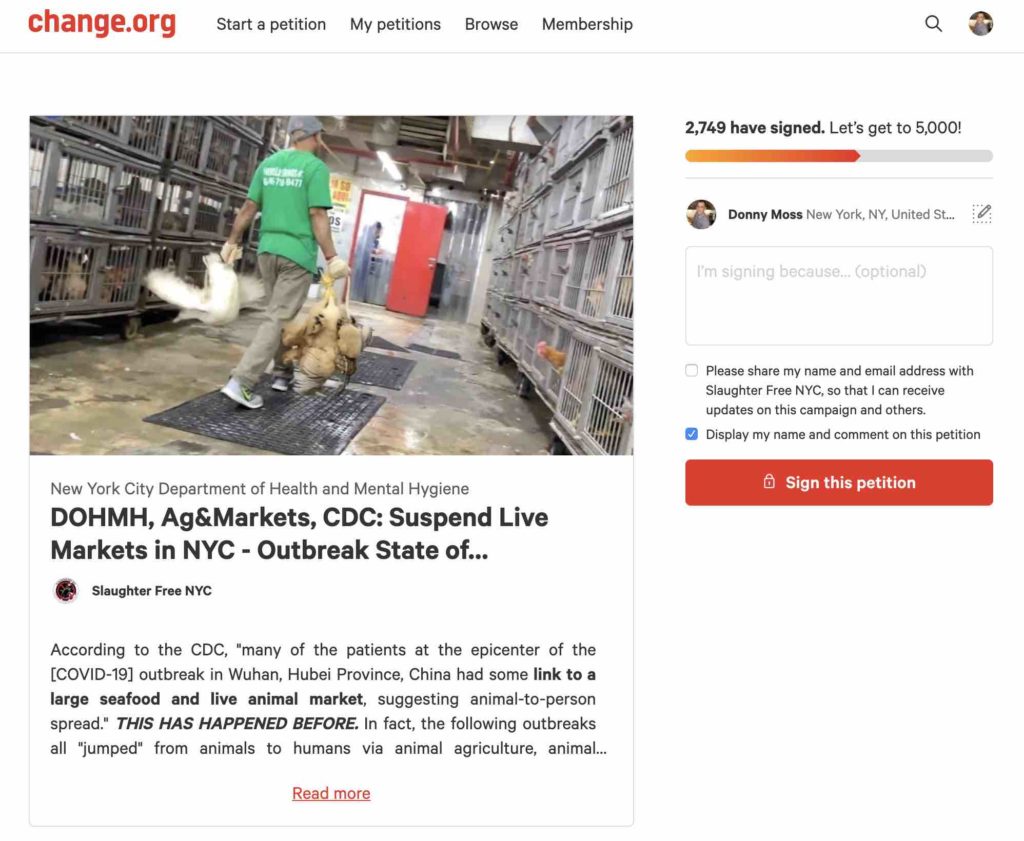
New York City has over 80 wet markets – businesses that sell live animals to the public and slaughter them onsite.  New York’s live animal markets are located in all five boroughs.

Since 2016, public health and animal rights advocates have been sounding alarm bells about the City’s wet markets, pleading with health officials and lawmakers to shut them down in order to prevent the transmission and spread of infectious disease. COVID-19 is believed to have been transmitted from animal to human in a wet market in Wuhan, China.

Sheep and chickens are among the approximately 10 different species of live animals sold at NYC’s wet markets

NYC’s wet markets sell approximately ten animal species, including goats, sheep, chickens, guinea hens, rabbits, pigeons, Muscovy ducks, and quail.  The animals are confined in small cages or pens where they can sicken each other and the people who work and shop there. Animal feces, body parts, feathers and blood are tracked in and out by customers and pedestrians who then carry the refuse on to the subways and into their homes, offices and communities.

Wet markets, or live animal markets, are storefront slaughterhouses that sell live animals to public and slaughter them on site

“New York City’s wet markets are a ticking time bomb,” said Jill Carnegie, a co-organizer with Slaughter Free NYC, an organization advocating to shut down wet markets and other slaughterhouses in NYC. “If avian flu or another infectious disease is transmitted to just one human, it could spread very rapidly in New York City and beyond, as we have seen with COVID-19.”

The COVID-19 pandemic has increased the advocates’ sense of urgency. Slaughter Free NYC is now asking Mayor Bill de Blasio, Health Commissioner Dr. Oxiris Barbot and Deputy Commissioner of Disease Control Dr. Demetre Daskalakis to prohibit the slaughter of live animals in the five boroughs of New York. In February, the organization launched a petition with its demand.

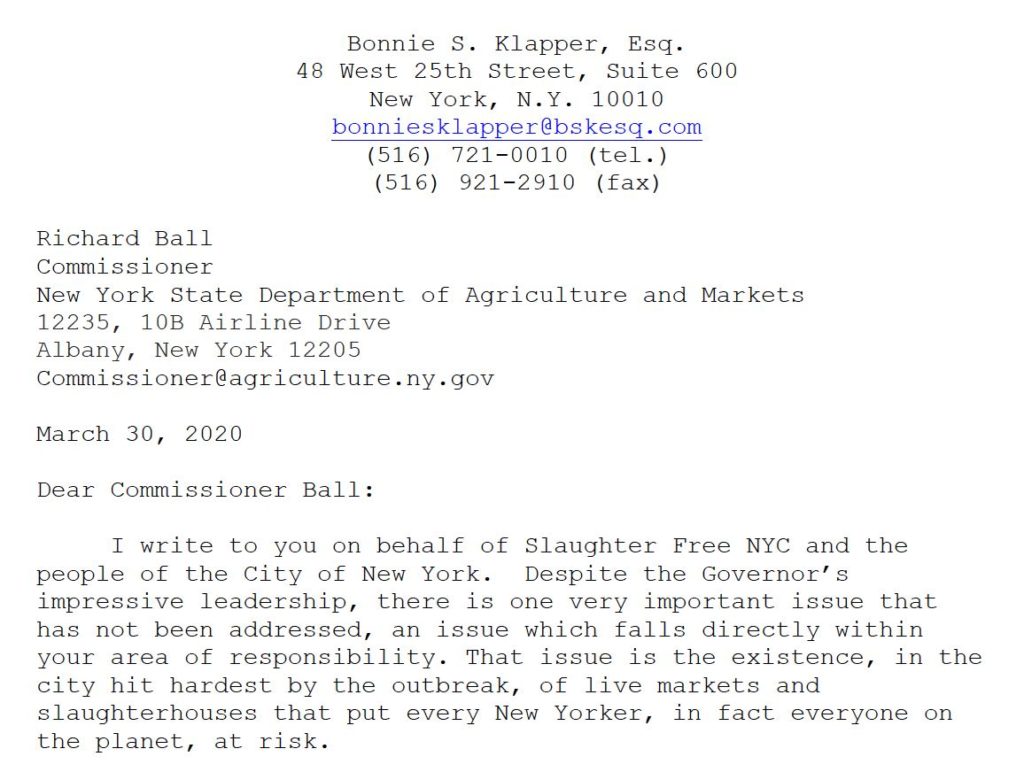
In a letter to NY Governor Andrew Cuomo and the NY State Department of Agriculture & Markets, Bonnie S. Klapper, a New York City-based attorney working on several cases involving animal agriculture, wrote that City and State health authorities are turning a blind eye to the well-documented health code violations

Click letter to view in full

The NYC Department of Health claims that it has no regulatory authority over these markets and defers to NY State Department of Agriculture & Markets, but state health officials have told me that these wet markets are never inspected unless they receive numerous complaints,” Klapper told TheirTurn. “That said, no amount of oversight can prevent disease transmission in storefront slaughterhouses where sick animals are coming into contact with humans.”

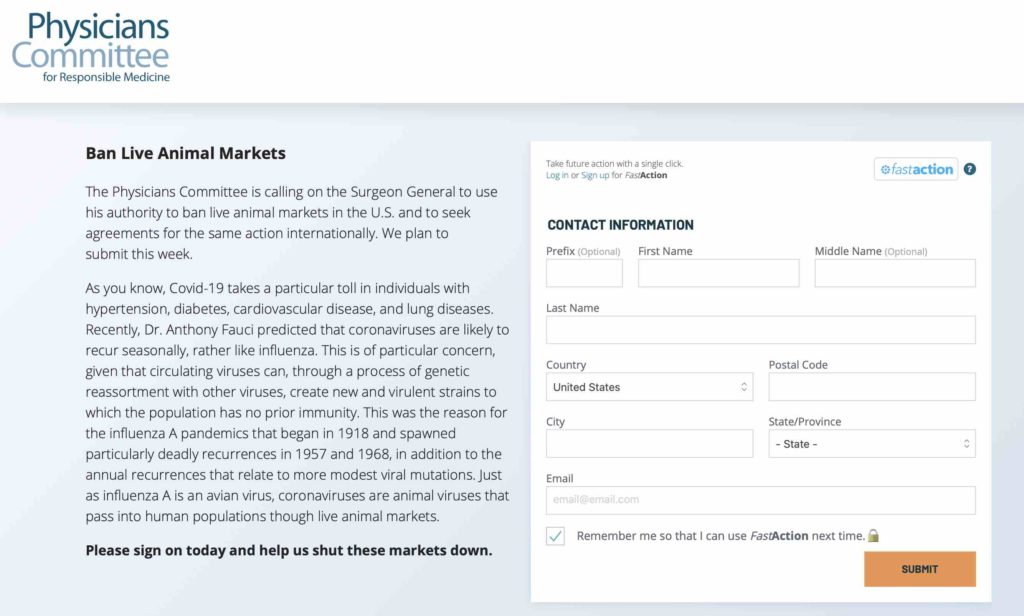
PCRM Petition to the Surgeon General to outlaw live markets in the United State

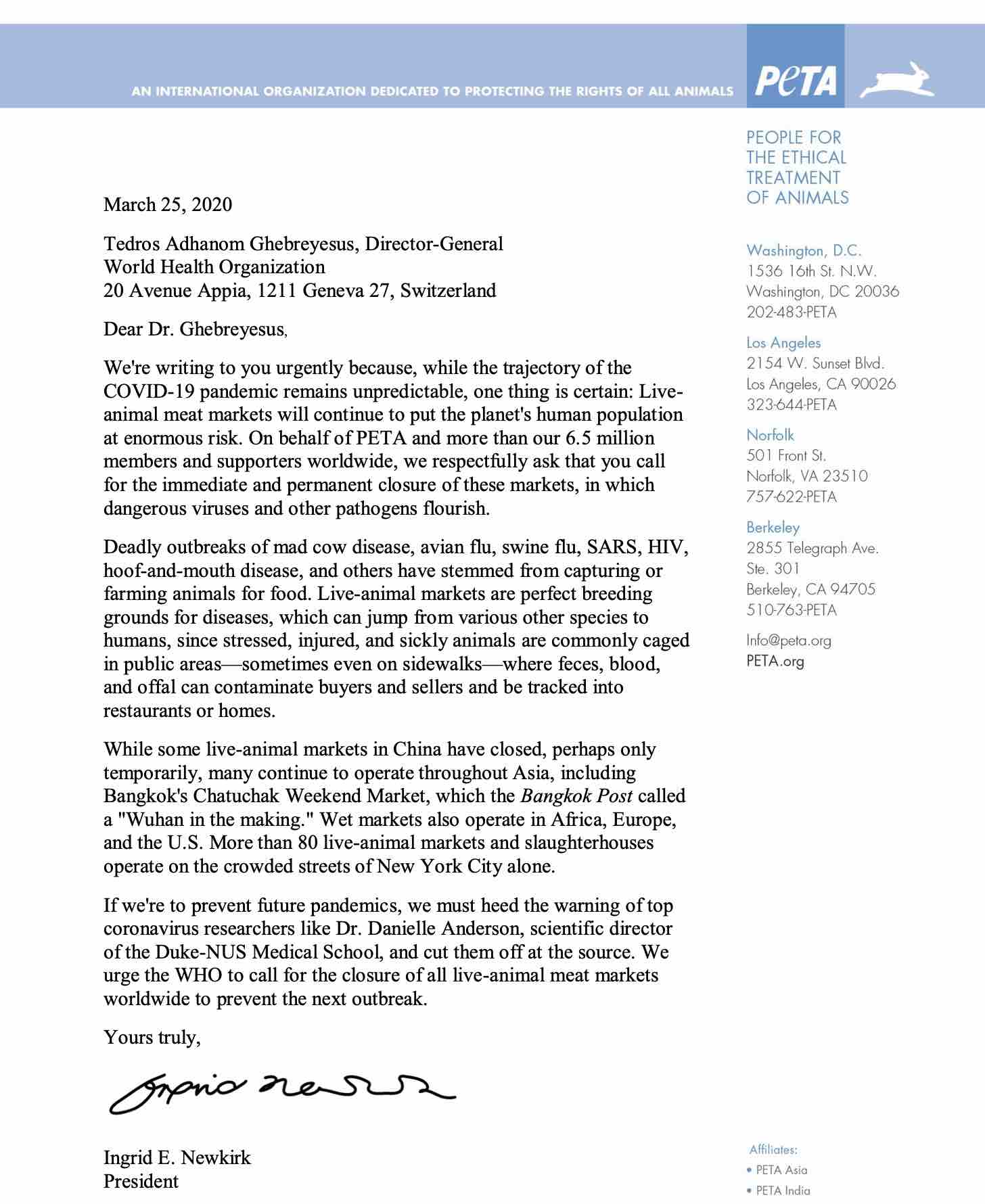
On March 25th, People for the Ethical Treatment of Animals (PETA) sent a letter to the Tedros Adhanom Ghebreyesus, the Director-General of the World Health Organization (WHO) encouraging him to call for the permanent closure of [wet] markets:  “Deadly outbreaks of mad cow disease, avian flu, swine flu, SARS, HIV, hoof-and-mouth disease and others have stemmed from capturing or farming animals for food. Live animal markets are perfect breeding grounds for diseases, which can jump from various others species to humans . . . If we’re to prevent future pandemics, we must heed the warning of top coronavirus researchers like Dr. Danielle Anderson, scientific director of the Duke-NUS Medical School, and cut them off at the source.”

In partnership with The Save Movement, an organization that stages vigils at slaughterhouses around the word, Slaughter Free NYC conducts vigils and educational outreach at New York City’s wet markets.