Exposing the Big Game

Forget Hunters' Feeble Rationalizations and Trust Your Gut Feelings: Making Sport of Killing Is Not Healthy Human Behavior

Exposing the Big Game

$13K fine for killing grizzly deemed ‘scandalous’ by conservationists

ttp://www.cbc.ca/news/canada/edmonton/alberta-man-fined-grizzly-bear-1.4301983

‘The grizzly bear in Alberta is a threatened species,’ says group that had hoped for higher fine

The Canadian Press Posted: Sep 22, 2017 7:54 AM MT Last Updated: Sep 22, 2017 10:20 AM MT

A collared grizzly bear that was being tracked for research by officials in Jasper National Park was killed by a hunter.

A collared grizzly bear that was being tracked for research by officials in Jasper National Park was killed by a hunter. (Government of Yukon)

 An Alberta man charged with killing a collared grizzly bear that was being tracked for research will pay nearly $13,000 in fines, but some say that’s not enough to protect the threatened species.

Ronald Raymond Motkoski pleaded guilty earlier this month in an Edson, Alta., courtroom to possession of wildlife and was fined $2,500. He’s also required to pay $5,000 to Alberta’s BearSmart program and $5,202.76 for the cost of the tracking collar.

Neither he nor his lawyer could be reached for comment this week.

Motkoski was charged in June 2016 after Fish and Wildlife officers were notified by fRI Research that a collar put on grizzly bear No. 141 in Jasper National Park had stopped working near Edson, about 200 kilometres west of Edmonton.

It was determined the three-year-old male grizzly had been shot and killed.

Motkoski told researchers he shot the bear

The Crown prosecutor withdrew a charge of hunting wildlife in a closed season and providing a false or misleading statement. A spokesperson for the province said the charges were withdrawn because some of the evidence did not suggest a reasonable likelihood of conviction.

Another man, John Peter Grant of Fort McMurray, Alta., pleaded guilty on Feb. 2 to unlawful possession of wildlife related to the death of the same bear and was fined a total of $6,000.

Critics say the fines are too low.

“It’s absolutely scandalous,” said Jill Seaton, chair of the Jasper Environmental Association. “The grizzly bear in Alberta is a threatened species.”

Gordon Stenhouse, a scientist with the fRI Research grizzly bear program, said he also had higher expectations.

“I thought there would be a different outcome,” he said, noting the maximum fine is $100,000.

A threatened species

Grizzly bears were listed as threatened in Alberta in 2010 when it was determined there were only about 700 left. A recovery strategy was introduced aimed at reducing conflicts between bears and people.

Poaching remains a problem in Alberta, with statistics showing at least 39 grizzly bears have been killed illegally since a legal hunt ended in 2005.

Bear No. 141 was considered important because he was fitted with a GPS collar in Jasper and left the park within a few weeks.

“It’s quite rare that a bear in Jasper takes off,” said Stenhouse.

Officials with Jasper National Park declined to comment.

Stenhouse said that valuable research was lost with the death of the bear.

No. 141 “was one of a very few bears that we have seen make long-distance movements from Jasper National Park over the past 18 years of research in this area,” he said in an impact statement prepared for court.

“The movements and habitat use of this bear were of significant interest to us in learning more about home range establishment and response to human activities.”

‘An unfortunate loss’

Despite getting about $5,000 to replace the bear’s tracking collar, he said it’s also a financial hit for the program.

“This is an unfortunate loss and does not address any of our time, effort or cost that our research team invested in the successful capture of this bear,” he said.

Losing even one bear hurts the province’s recovery plan, he said.

“From a broader perspective, the key issue is on the common and ongoing problem of the illegal killing of bears,” said Stenhouse. “Some members of the public appear to remain unwilling to share a common landscape and co-exist with this species.”

Should those attitudes continue, he said it’s unlikely that future generations will see grizzly bears anywhere other than the most remote areas of the national parks.
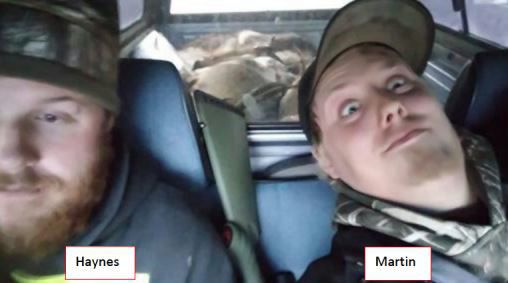
Poaching suspects left lengthy digital trail for investigators to follow

William Haynes and Erik Martin
William Haynes, left, and Erik Martin pose for a selfie in Haynes’ pickup truck. The image was sent from Martin to his girlfriend on November 19, 2016, according to case reports. In the back of the vehicle, multiple deer can be seen. According to case reports, the deer were illegally killed in Oregon and transported across state lines to Washington.

Washington Department of Fish and Wildlife case report

For individuals who apparently got a thrill by stalking and illegally killing wild animals, William J. Haynes and Erik Christian Martin did a poor job of covering their own tracks.

The suspected poachers unwittingly provided law enforcement officers with a huge cache of evidence, allowing Washington Department of Fish and Wildlife investigators to build a massive case against them and five other members of an alleged poaching group.

Based on case reports reviewed by The Daily News, there’s little sign the men ever thought about getting caught.

Instead, the 23-year-old Longview residents are suspects in an investigation into the killing of more than 50 animals including deer, elk, bears and bobcats in two different states. Along the way, they left a digital trail of shocking evidence for Fish and Wildlife investigators to follow.

The painstaking task required two Fish and Wildlife officers and a sergeant, who spent a majority of the past winter and early spring diligently retracing the suspects’ bloody steps.

Investigators were also assisted by more than 30 officers from multiple agencies, including the Cowlitz County Sheriff’s Office.

“We’ve used a lot of our manpower in this region in Western Washington to accomplish this case,” Fish and Wildlife Sergeant Brad Rhoden said in an interview.

Rhoden said he doesn’t want intense interest in the case to lead to a negative perception of honest hunters.

“I don’t want anybody to view the majority of our hunters in Washington as these types of individuals,” he said. “I don’t think there’s a sportsman out there who would say this is OK.”

Haynes is facing 61 separate charges in Skamania County District Court, including 26 charges of first-degree illegal hunting of big game. All of the charges are related to the use of dogs while hunting, which is illegal in Washington without a special permit that’s only granted in specific instances. Haynes was previously convicted of second-degree unlawful hunting of big game in Cowlitz County on Oct. 3, 2013. As a result, all of Haynes’ big game charges could be considered Class C felonies, which are punishable by up to five years in jail and a $10,000 fine.

Martin, who does not have any previous violations, is facing 28 separate charges for gross misdemeanors.

In addition to Haynes and Martin, three other suspects have been named in the investigation.

They are Joseph Allen Dills, 30, of Longview; Eddy Alvin Dills, 57, of Longview; and Bryan Christopher Tretiak, 31, of Morton. All of the suspects are awaiting preliminary appearance hearings in Skamania County later this month. Two female suspects were named in the case reports but no charges have been filed against them yet.

Dills, who has bear claws and dog paws tattooed on his left arm, pleaded guilty in Wahkiakum County District Court in 2008 to second-degree unlawful hunting of big game and second-degree criminal trespassing. He’s now facing 64 separate charges, including four first-degree unlawful big game hunting charges for the illegal use of dogs.

Had Haynes and Martin known that the contents of their phones would result in so many charges, it’s possible they may have opted not to document such a staggering number of alleged illegal hunting activities.

A mountain of evidence

Based on case reports, it’s not clear if Haynes or Martin thought twice before agreeing to allow two Oregon State police officers to look through their devices on December 3, 2016.

According to reports, the troopers had stopped the men after recognizing Haynes’ Toyota pickup as the same vehicle that appeared in several images captured by Oregon Department of Fish and Wildlife game cameras. The motion-activated cameras were set up in response to past illegal big game hunting activity in the Mount Hood National Forest during the months of November and December.

Upon questioning, Haynes and Martin confessed to illegally killing two buck deer and a silver gray squirrel, according to reports. The two men admitted to taking only the heads of the two deer and the entire squirrel back to a house in Longview, leaving the rest of the animals to rot.

At this point, Senior Trooper Craig Gunderson requested that Washington Fish and Wildlife Sergeant Brad Rhoden assist with recovering the illegally transported deer heads.

When Rhoden arrived, Gunderson informed him that Haynes and Martin had consented to having their cell phones searched. According to reports, it was at this point that the true scale of the ensuing investigation began to emerge.

An initial look through the devices revealed numerous photos of antlered deer skulls, dead bull elk, and — perhaps most disturbing — bear hunting with the use of dogs.

Gunderson seized the phones as evidence and obtained a search warrant to have a forensic analysis performed on the devices.

On Dec. 16, 2016, Rhoden met with Gunderson and several other officers to transfer evidence from the analysis.

The contents of Haynes’ phone provided hundreds of photos and videos documenting a pattern of brutal killings on more than 20 separate occasions.

In some cases, bears were still alive as Dills’ dogs gnawed on their flesh, Rhoden said.

Martin’s phone also held numerous photos and videos of the unlawful harvest of big game.

In addition to incriminating photos, videos and text messages, the evidence included crucial metadata which allowed investigators to pinpoint exactly where the illegal killings occurred using GPS coordinates.

Investigators could not have retraced the suspects’ steps if Haynes had not granted his phone’s camera permission to access its GPS location data.

“What was most difficult about this case is that we had to pore through so many records,” Rhoden said.

Alaska hunting guide charged with herding grizzly bears to clients

ANCHORAGE — An Alaska master hunting guide has been charged with using assistants on snowmobiles to herd grizzly bears toward clients, making it easier for hunters to shoot the animals.

Brian Simpson, 55, of Fairbanks, also is charged with guiding on a national preserve without a permit.

Simpson is charged with two counts of aiding in the commission of a state game violation and three counts of guiding on federal land without authorization. All five counts are misdemeanors.

Two assistant guides working for Simpson are charged with using motorized vehicles to drive or herd game.

The charges stem from spring hunting trips last year in western Alaska, according to the Office of Special Prosecutions.

In a complaint filed this month, prosecutors said two hunting clients in April 2016 arrived in Shishmaref and traveled to Serpentine Hot Springs within Bering Land Bridge National Preserve.

On April 26, according to the complaint, the hunting party spotted a bear and Simpson ordered an assistant to “turn it around.” The assistant used a snowmobile to chase the bear in deep snow, trailing from 30 yards behind, until it was tired. The assistant guide then chased the bear toward the hunter. One of the hunters shot the bear from 150 yards away.

A similar scenario played out two days later, according to the complaint.

After a hunting party guided by Simpson spotted a bear, a second assistant guide chased the animal with a snowmobile, cut it off from escaping and herded it toward the hunting party. A hunting client shot the second bear.

The assistant guide told an investigating trooper that chasing bears with snowmobiles was common practice in hunts guided by Simpson.

An arraignment for Simpson is scheduled for Sept. 15 in Nome.

Two from brief reality TV show admit to hunting violations

SEARCY, Ark. (AP) – An Arkansas man who starred on the short-lived reality TV show “American Stuffers” and his son have pleaded guilty to hunting violations in central Arkansas.
Court records show 40-year-old Daniel Ross of Romance and 19-year-old Hunter Ross of Rose Bud pleaded guilty last Tuesday in White County District Court to misdemeanor charges and each was fined $8,500.
Daniel Ross pleaded guilty to hunting during a closed season, night hunting and transporting illegally taken wildlife. In exchange, more than 40 similar charges being dropped.
Hunter Ross pleaded guilty to hunting during a closed and night hunting while more than 30 similar charges were dismissed.
The pleas were first reported by The Daily Citizen newspaper.
The Animal Planet reality show “American Stuffers” in 2012 was about Daniel Ross’ taxidermy business, which preserved pets that had died.

© 2017 Associated Press

Asia’s Illegal Wildlife Trade Makes Tigers a Farm-to-Table Meal

Photo

Tigers caged in a zoo at the Kings Romans casino complex in Laos. CreditAdam Dean for The New York Times

BOKEO PROVINCE, Laos — The tiger paced back and forth in its cage, groaning mournfully. A second big cat slept soundly in the corner, while a third stared blankly at the bars.

Next to this cage was another containing three more tigers, and after that three more cages: a line of small pens, each holding at least one cat. Most likely, none had long to live.

The tigers were property of the Kings Romans Group, which operates a casino here, along with hotels, a shooting range, a cockfighting and bullfighting ring, a Chinatown-themed shopping center, and this shabby zoo.

Ten years ago, the Hong Kong-based company signed a lease with the Laotian government to develop this 12-square-mile plot in northwestern Bokeo Province, just across the Mekong River from Thailand. It’s called the Golden Triangle Special Economic Zone.

Most businesses in the duty-free complex are owned and staffed by Chinese citizens and patronized by a predominantly Chinese clientele. Many are drawn here by the promise of vices not as easily found back home, including products made from exotic animals like tigers.

Conservationists maintain that this zoo is actually a farm raising animals for slaughter, and that it plays a significant role in perpetuating the illegal wildlife trade, swapping tigers with similar operations in Thailand and illegally butchering animals for their bones, meat and parts.

Photo

The front of a casino that is part of the Kings Romans Casino complex in Laos. CreditAdam Dean for The New York Times

Tigers, bears, snakes and countless other species, many endangered, are held on farms throughout Southeast Asia. Operators illegally capture animals in the wild and then pass them off as captive-bred, or breed the animals on site and illegally sell them into the trade.

These facilities are part of a contraband industry whose profitability by some estimates is surpassed only by the global trade in drugs and arms, and by human trafficking.

Few tourists were present at Kings Romans during a recent visit. The ghost-town feel was reinforced by boarded-up shops, half-finished construction sites and posters advertising events that had long since come and gone.

But restaurants at Kings Romans still offered expensive plates of bear paw, pangolin (an endangered scaly mammal) and sautéed tiger meat, which can be paired with tiger wine, a grain-based concoction in which the cats’ penises, bones or entire skeletons are soaked for months.

When a group of foreigners showed up at the God of Wealth, Kings Romans’ fanciest restaurant, the suspicious proprietor told their translator, “You can eat here, but do not ask for the special jungle menu” — the menu offering wildlife options.

Nevertheless, the staff offered tiger wine for $20 a shot glass, and served a bear’s paw to patrons at a nearby table. In May, a photographer for The New York Times who visited the restaurant was offered plates of tiger meat for $45.

Photo

Gambling at the Kings Roman casino in The Golden Triangle, Laos. CreditAdam Dean for The New York Times

Nearby, half a dozen jewelry and pharmaceutical shops displayed exorbitantly priced tiger teeth and claws, as well as rhino-horn carvings and shavings, elephant skin and ivory.

“The place is just a mess,” said Debbie Banks, of the nonprofit Environmental Investigation Agency in London. “Pretty much anything goes.”

In 2015, Ms. Banks and her colleagues, along with the nonprofit group Education for Nature-Vietnam, reported that meals, medicine and jewelry made from numerous protected species — including tigers, leopards, rhinoceroses, bears and elephants — were openly sold in the special economic zone.

Their documentation spurred the Laotian government to raid some businesses here and to burn a few tiger skins on television. But Ms. Banks said little had changed since that “cosmetic effort.”

Like the rest of the complex, the Kings Romans zoo was largely deserted save for animals kept in cages. A woman and her young daughter wandered in to look at the bears. Many showed signs of captivity-induced stress, including uncontrolled headbanging. Staff members were nowhere to be found.

Approximately 700 tigers live on farms in Laos. Thousands more are believed to be kept throughout Southeast Asia, and an additional 5,000 to 6,000 are housed in over 200 breeding centers in China. Fewer than 4,000 of the big cats remain in the wild; farmed tigers now far outnumber total wild populations.

Continue reading the main story

Photo

An entrance to the zoo holding tigers, bears, deer, monkeys and peacocks, a part of the Chinese-owned Kings Romans casino complex. CreditAdam Dean for The New York Times

At an international conference on the endangered species trade last fall, Laotian government officials acknowledged a growing problem with wildlife farms and committed themselves to closing down the country’s tiger farms. So far, little has changed.

One source who works closely with the government, who asked not to be named for fear of reprisals, said that some Laotian politicians remained deeply involved in the farms and that the country’s forestry department lacked the authority to shut them down.

Representative Ed Royce, Republican of California and chairman of the House Foreign Affairs Committee, has singled out Laos as an international hub for illegal wildlife trafficking, saying in 2015 it was “quite clear officials are profiting.” Laotian government officials did not respond to repeated requests for comment.

Treaty Limits Breeding

According to the Convention on the International Trade in Endangered Species, or Cites, a treaty to which China and all Southeast Asian nations are signers, tigers are to be bred only for conservation — not for their parts, and not on a commercial scale that does not benefit wild tigers.

“Farming tigers for trade confuses consumers and stimulates demand,” said Grace Ge Gabriel, Asia regional director of the International Fund for Animal Welfare. “The increased market demand for tiger parts also fuels poaching of tigers in the wild, because wildlife consumers prefer animals caught in the wild.”

In Laos and several other Asian countries, conservationists have compiled ample evidence that many zoos and farms serve as fronts for commercial breeding.

Continue reading the main story

Photo

At the center, a jar of tiger bone wine for sale at the New Tender Fish Restaurant, which also served tiger meat and pangolin.CreditAdam Dean for The New York Times

In 2016, Tiger Temple in Thailand made headlines when monks there were accused of abusing tigers and selling them into the illegal wildlife trade. Eventually, 40 dead cubs were discovered in a freezer, along with pelts and other wildlife products. Temple representatives said that the bodies and parts did not prove wrongdoing.

Thailand has some 1,450 tigers in captivity, the majority of which are kept at popular attractions like Tiger Temple, where tourists pay to take photographs and play with cubs and young adults.

When the tigers reach sexual maturity and can no longer be handled safely, they often disappear, sold on the black market for up to $50,000, according to Karl Ammann, a Kenya-based investigative filmmaker who is making a documentary about the tiger farming industry.

Conservationists also have accused tiger farms in China — two of which are supported by government investment — of illegal activity.

Chinese law permits some tiger skins to be traded legally, although tiger bone has been banned since 1993. But in 2013 Ms. Banks of the Environmental Investigation Agency and her colleagues found that farms were stockpiling tiger bones to make wine and that skins from wild tigers were sold as being from captive-bred tigers.

After inquiries from The Times, Meng Xianlin, executive director-general of the Chinese Cites management authority, declined to be interviewed. Several other Chinese officials did not respond to repeated interview requests.

Photo

Serving a dish of tiger meat at a restaurant called The God of Wealth in the Golden Triangle, Laos.CreditAdam Dean for The New York Times

Past violators often re-enter the wildlife farming business. Construction has already begun on a zoo next door to Tiger Temple. Officials in Vietnam recently granted permission for the wife of Pham Van Tuan, a twice-convicted tiger trafficker, to import 24 tigers from the Czech Republic “for conservation purposes.”

Vuong Tien Manh, deputy director of Vietnam’s Cites management authority, said in an email that Vietnam had seized a number of frozen tigers and tiger bones over the past five years, most of which were suspected to have originated from Laos.

He added that Vietnam’s policies did not permit commercial breeding of tigers, but the country has some 130 tigers in captivity. All tiger farms are strictly monitored, Mr. Manh said, no matter who the owners are.

Bear Bile Collected

Though tigers are the most contentious of Asia’s farmed wildlife, they are by no means the only species caught up in the industry.

An estimated 10,000 bears are legally kept on Chinese farms for their bile, an ingredient in traditional medicine that is collected through a tube permanently implanted in the animals’ gall bladders, or through a hole in their abdomens.

Countless other species — crocodiles, porcupines, pythons, deer and more — are also farmed throughout China and Southeast Asia.

Continue reading the main story

Photo

Tourists pose with tigers in an enclosure at Tiger World in Chiang Mai, Thailand, in May. CreditAdam Dean for The New York Times

Some proponents, including government officials, believe that such facilities should be legal and encouraged, arguing that they relieve pressure to hunt wild animals by satiating demand with captive-bred animals.

Others say there is no evidence to back this assertion. “I can’t think of any species in Southeast Asia that benefits from commercial captive breeding,” said Chris Shepherd, the Southeast Asia regional director for Traffic, a nonprofit wildlife trade-monitoring group.

Scott Roberton, the director of counter-wildlife trafficking at the Wildlife Conservation Society’s Asia program, added that the risks associated with legalizing trade in farmed tigers and other endangered species are the same as those associated for decades with the ivory trade.

“Legal trade stimulates demand, confuses law enforcement efforts, and opens a huge opportunity for laundering illegal products, which is why ivory markets are now being closed globally,” he said.

“There just isn’t the capacity within these countries to manage a legal trade in a watertight way,” Dr. Roberton said.

“Laundering” of animals as farmed that were actually caught in the wild is a frequent practice. In Chengdu, China, one-third of 285 bears rescued from bile farms and now living at a rehabilitation center run by Animals Asia, a nonprofit group, are missing limbs, a sign that they were caught in the wild by snares.

Photo

A bear, with damaged teeth, at the zoo. CreditAdam Dean for The New York Times

A 2008 investigation by Vietnamese officials and the Wildlife Conservation Society found that about half of 78 wildlife farms surveyed regularly launder animals caught in the wild. In 2016, a study of 26 Vietnamese wildlife farms found that all engaged in laundering.

The pet trade is also a problem. Indonesia annually exports over four million reptiles and small mammals labeled captive-bred — including thousands shipped weekly to the United States. But virtually all are caught in the wild, according to Dr. Shepherd.

“I’ve been to almost every reptile farm in Indonesia, and none have breeding facilities,” he said. “Wildlife dealers are running circles around everyone. It’s a joke.”

Though modern wildlife farming emerged in the 1990s and has only grown in popularity, wild populations of farmed species have continued to plummet, Dr. Shepherd said.

Tigers, for example, are effectively extinct in Cambodia, Laos and Vietnam, while just seven to 50 remain in the wild in China.

“No matter how many tigers are farmed, we still have wild tigers getting killed,” he said.

What Becomes of the Tigers?

Heeding these arguments, Laotian government representatives attending a major Cites meeting last September announced their intention to end tiger farming in their country.

Photo

Deer at the zoo. CreditAdam Dean for The New York Times

International nongovernmental organizations are advising Laotian authorities on how to carry through with that announcement, but there has been no progress to date.

In April, Vietnamese reporters discovered a tiger farm in Laos on a main highway near the center of Lak Sao, a town near the border with Vietnam. Conservationists later confirmed that it might hold an additional 200 animals.

“There are some countries in Southeast Asia that are equipped to combat criminal networks, and some that are still struggling,” said Giovanni Broussard, Southeast Asia regional coordinator for the Global Program for Combating Wildlife and Forest Crime of the United Nations Office on Drug and Crime.

“Laos,” he said, “is in the category of those that are still struggling.”

Though most tiger farms in Laos do not allow visitors, conservationists fear that owners will simply shift to a model embraced in Thailand, in which petting zoos serve as a front for illegal trade.

Even if the authorities move forward with shutting down the farms, what to do with the country’s 700-plus captive tigers is a challenge. Euthanizing them would bring unwanted media attention, but releasing them into the wild is not an option. There’s not much prey, and the tigers lack survival skills and have no fear of humans.

Yet keeping them is a burden; it costs thousands of dollars a year to feed a single tiger, Ms. Banks said, and tigers can live up to 20 years.

Continue reading the main story

Photo

Caged tigers at the zoo. CreditAdam Dean for The New York Times

In 2002, Vietnam faced a similar dilemma when it made bear farming and bile sales illegal. Fifteen years later, around 1,200 bears still live with their original owners.

Many are kept in horrific conditions — in cages scarcely larger than their bodies, suffering from rampant disease and lacking adequate food and water — and their bile continues to be collected illegally.

Animals Asia runs a rehabilitation center near Hanoi that houses 160 bears rescued from the trade, but the center has permission to keep only 200 animals. Even if that cap were eliminated, however, the group lacks the funds and space to care for all of Vietnam’s remaining captive bears.

“Obviously, we can’t do this all ourselves,” said Tuan Bendixsen, Animals Asia’s Vietnam director. “The government must take responsibility for their wildlife.”

As Laos ponders how to responsibly close its tiger farms, China is moving in the opposite direction. Since 1992, it has been petitioning Cites to permit trade in farmed tiger products.

When Chinese representatives lobbied for this change once again at the most recent Cites meeting, the proposal was turned down.

Conservationists believe that international pressure may be crucial to persuading Asian governments to close tiger, bear and other wildlife farms, but that strategy’s effectiveness is compromised by an awkward fact: An estimated 5,000 tigers are held in backyards, petting zoos and even truck stops across the United States.

While those animals are predominantly kept as pets, they compromise negotiations with other countries on this issue, said Leigh Henry, a senior policy adviser at the World Wildlife Fund.

“When fingers are pointed at China about their tiger farms, they tend to point the finger back at the U.S. and say, ‘They have as many tigers as we have, why are you not criticizing them?’” she said.

“The priority is closing the tiger farms in Asia,” Ms. Henry said, “but the U.S. needs to set a strong standard, and that starts with cleaning up the situation in our own backyard.”

Father, son charged for killing bear at Aspen-area landfill

Father, son charged for killing bear at Aspen-area landfill

Pitkin County Landfill’s enticing environment for black bears might have proved too enticing for a tandem of Indiana hunters.

Dan Roe and his son Alex are due in Pitkin County District Court on June 19 to face charges associated with what authorities say was the illegal killing of a black bear at the landfill, a popular feeding spot for area bruins.

Details are limited on what actually transpired at the landfill Sept. 13, the day the two allegedly killed the bear. The agency that ticketed the two, Colorado Parks and Wildlife, did not have information readily available Tuesday.

Both Roes face charges of willful destruction of big game, a Class 5 felony, and misdemeanor counts of failure to dress or care for wildlife, illegal possession of wildlife and hunting on private property. The 9th Judicial District Attorney’s Office filed the charges May 9.

In a statement issued to local media Tuesday, the District Attorney’s Office said: “The charges are based upon allegations that the accused persons entered private lands, an area near the Pitkin County Landfill, in order to hunt for a bear. Upon killing a black bear on private lands, the accused persons are alleged to have intentionally abandoned the bear’s carcass and edible portions of it, keeping only the bear’s hide and head.”

The landfill’s assistant solid waste manager, Jed Miller, said Tuesday the bear’s carcass was found on the property.

“Basically, they snuck in at night, shot the bear, skinned the bear and left the bear covered up with trash,” Miller said.

Colorado law requires hunters who kill bears to present the animal’s pelt and carcass to a parks and wildlife official within five days of the kill.

The bear was fully grown, Miller said, noting Colorado Parks and Wildlife officials contacted the landfill after “they became suspicious of these gentlemen’s story. They only had the bear skin versus the whole carcass. They found that very fishy and started their investigation.”

Bear hunting is allowed in Colorado in September, October and November with various restrictions enforced in different parts of the state. Rifles, muzzleloaders and archery is permitted among license holders.

The Roes have yet to make a court appearance or enter a plea, said their attorney, Richard Nedlin of Aspen.

“All I can tell you is that these are two people who have been hunting for a long time, and they have no criminal history, from what I know,” Nedlin said. “This was a special father-and-son trip, and being hunters, they would never intentionally violate that law or be on property on which they didn’t know they were not allowed to be on or didn’t have permission to be on.”

Deputy District Attorney Sarah Oszczakiewicz said the near eight-month gap between the date of the alleged offense and the filing of charges was because “that’s how long it took to connect all the dots and to be able to allow the investigation to unfold.”

The landfill, located 9 miles west of Aspen off Highway 82, has become a well-visited feeding ground for black bears.

In 2012, a Pitkin County Landfill employee was terminated for killing a bear on the facility’s property, using a bow and arrow. The county also at one time considered opening the landfill to bear hunting, but that idea failed to gain traction.

rcarroll@aspentimes.com

Top Ten Misconceptions About Sea Shepherd

  1.   http://www.maritime-executive.com/editorials/top-ten-misconceptions-about-sea-shepherd

    Sam SimonImages credit: Sea Shepherd

    By MarEx 2017-04-14 21:23:38

    MarEx spoke to Captain Paul Watson, Founder of the Sea Shepherd Conservation Society, to get his views on misconceptions about the organization.


    Is Sea Shepherd an eco-terrorist organization?

    No, none of us work for Monsanto. Seriously, since I established Sea Shepherd in 1977, we have not caused a single injury to a single person nor have we suffered a single injury to any of our crew. We don’t carry guns, and we operate within the boundaries of the law. None us have been convicted of a felony crime.

    We work in partnerships with government agencies like Mexico, Ecuador, Gabon, Italy and Liberia within their territorial waters. In International waters, we intervene against illegal activities in accordance with the United Nations World Charter for Nature that allows for intervention by NGO’s to uphold international conservation law.

    Is Sea Shepherd a protest organization?

    I established Sea Shepherd as an anti-poaching organization to intervene against illegal activities. We are not a protest organization. We investigate, document and directly intervene against illegal activities that exploit marine wildlife.

    Does Sea Shepherd comply with marine safety regulations?

    Sea Shepherd looks on marine safety as a priority in all our operations. We have an unblemished record for safety. Not one crewmember has been lost or seriously injured in 40 years. Every ship is equipped with more than adequate safety and fire fighting equipment and all crewmembers are subject to training and regular safety drills. On major campaigns like the Southern Ocean, the ships carry a medical officer with substantial medical resources.

    Sea Shepherd campaigns can be risky and I do insist that all crewmembers be aware of the risks that will be undertaken. When critics say we put our crew at risk, they are right, but our position is that risking our lives to defend endangered species or threatened habitat is an acceptable risk and far more noble than risking lives to defend oil wells, real estate, corporate interest and religion.

    Is Sea Shepherd a U.S. based organization?

    No, in fact Sea Shepherd is not actually an organization but rather a collective of numerous national entities, all registered independently within their own nations. Sea Shepherd is more of a movement with representation throughout Austral-Asia, North and South America, Europe and Africa.

    Sea Shepherd Global based in Amsterdam is the coordinating center for all Sea Shepherd entities except for Sea Shepherd USA, which is prohibited by the U.S. Federal Court from direct association with other Sea Shepherd entities that oppose illegal Japanese whaling in the Southern Ocean. The ships are registered in the Netherlands, the USA, Barbados and Australia.

    Why is Sea Shepherd so small compared to other organizations?

    After 40 years, we could have been a much larger organization like Greenpeace or Oceana. However, from the beginning we decided we would not be a fund raising bureaucracy. We do not spend large sums of donor money on fund-raising and promotion. We don’t hire people to stand on the streets to sign up members. We don’t spend money advertising.  We keep the administration to a minimum and the ships are 90 percent volunteers.

    Support comes from word of mouth, visits to the ships and from people watching Whale Wars or seeing our documentaries. We want people to know that when they donate to Sea Shepherd the money goes to ships and campaigns. Sea Shepherd believes that the passion of our volunteers accomplishes more than having an organization with a large bank account.

    Some members of the public believe we must have tens of millions of dollars to operate our ships and campaigns. The truth is we don’t. We operate 10 ships on a budget of less than five percent of the Greenpeace budget.

    Are Sea Shepherd ships manned with experienced and nautically trained professionals?

    Not in the traditional sense. Our ships are registered as yachts so we do not need to comply with strict manning regulations. Our crews are volunteers from all over the world from all walks of life. Back in 1911, Ernest Shackleton was criticized for not having a professional crew. He answered that he needed men of passion, not professionals.

    The fact is that I could not pay professionals enough to do what our volunteers do for little or no wages. We look for experienced deck and engine officers. If we can’t find an experienced engineer, we do hire one if need be. Our officers train the volunteers.

    We have had astrophysicists and math teachers serving as watch officers, we have had motorcycle and truck mechanics working in the engine room. We have had retired naval, coast guard and merchant officers.

    On major campaigns, we always carry a qualified medical doctor in addition to crew with EMT certification. It’s a balance between experienced and inexperienced crewmembers. All volunteers are vetted by a crewing director.

    Over forty years we have never lost a crewmember nor has any crewmember suffered a life-threatening injury. The ships hold monthly fire and safety drills or more if there is a change of crew.

    Is Sea Shepherd an animal rights organization?

    Some media describe Sea Shepherd as an animal rights organization. However, Sea Shepherd is not an animal rights organization. Sea Shepherd is a marine conservation organization specializing in anti-poaching activities. This misconception may be because all Sea Shepherd ships are 100 percent vegan vessels. They are vegan vessels for conservation and environmental reasons considering the ecological damage the meat and fishing industries are causing.

    Is Sea Shepherd a leftist movement, or is it a right-wing movement?

    The conservative call us liberal, the liberals call us conservatives. We are neither left nor right.  Sea Shepherd does not hold a political position on anything. We are not left nor right, we are in front. We are motivated only by conservation principles. Our clients are the marine species we defend.

    Does Sea Shepherd carry and use weapons?

    Despite accusations that we use firearms, we don’t. None of the ships have any guns onboard. Instead we the ships are armed with a far more powerful weapon – cameras.

    A favorite accusation from Sea Shepherd critics is that you are not qualified to be a Captain and therefore should not call myself a captain. Is that true?

    I find this accusation amusing, because it tends to come from week-end sailors or fishermen who rarely go out of sight of land. The truth is that I don’t hold a commercial ticket nor would I want to. Our ships are all registered as yachts, and I am qualified to be a yacht master.

    I was trained as a seaman with the Norwegian and Swedish Merchant marine, as a fireman with Canadian Pacific Steamships and I served in the Canadian Coast Guard on weather ships, buoy tenders and as a hovercraft rescue officer. I was first mate on all Greenpeace campaigns from 1971-1977.

    My qualifications have not been questioned or denied by any ports of call we have entered or cleared and my experience is deep-sea, ice navigation and trans-ocean including leading ten expeditions to the Southern Ocean and Antarctica. If I was not qualified I would not have been able to command our ships since 1978 until the present day.

    The opinions expressed herein are the author’s and not necessarily those of The Maritime Executive.

Man charged with selling bear paws, gall bladders in Cache Creek area

November 15, 2016 – 8:00 PM

KAMLOOPS – Nine charges have been laid against a man who is accused of trafficking parts of a dead bear in B.C.’s Interior and Cariboo regions.

Hong Hui Xie, who’s in his 40s, faces charges including trafficking in bear gall bladders, trafficking in bear paws and unlawful possession of dead wildlife.

“Nine counts have… been laid against a 100 Mile House resident for alleged offences that occurred in 100 Mile House and Cache Creek between October 2015 and September 2016,” the B.C. Conservation Officer Service says on its Facebook page.

Court documents show from Oct. 27, 2015 to Jan. 21, 2016, Xie allegedly trafficked in a bear gall bladder, trafficked in bear paws separate from the carcass and trafficked in deer meat while in the 100 Mile House area.

On Sept. 7, 2016, Xie allegedly trafficked in bear paws and gall bladders while in the Cache Creek area.

Xie is not being held in custody and his first court appearance is expected to be in Kamloops Provincial Court later this month.


http://infotel.ca/newsitem/man-charged-with-selling-bear-paws-gall-bladders-in-cache-creek-area/it36788#.WOJfPMUSHbE.facebook

‘Hunting in the Sticks’ TV stars fined $31,000 for poaching elk

http://www.foxnews.com/great-outdoors/2017/03/20/hunting-in-sticks-tv-stars-fined-31000-for-poaching-elk.html?utm_campaign=%3Fcmpid%3Drss_latestnews_leisure

The two men killed two Wyoming bull elk, similar to the one pictured above.

The two men killed two Wyoming bull elk, similar to the one pictured above.  (Dana Critchlow/Unsplash)

Two Kentucky men pled no contest and face nearly $31,000 in fines after they killed two Wyoming elk on a national television show.

According to the Wyoming Game and Fish Department, Ricky J. Mills, 37, and Jimmy G. Duncan, 25, both of Bedford, Ky., also lost their hunting privileges for 15 years and will be entered into the Wildlife Violators Compact, which will prevent them from hunting and trapping in more than 40 states.

Wyoming officials report that, while watching Mills and Duncan’s show “Hunting in the Sticks” on the Pursuit Channel, a tipster noticed that the two men killed an elk in an area for which they weren’t licensed. A Game and Fish Department investigator looked into the incident, and both men eventually confessed.

You’re more likely to get hit by space debris than pick a perfect bracket. Make the perfect pick with almonds. See how.

 “I believe the two defendants were driven to get kill-shot footage for the television show, and that resulted in their making bad decisions,” Mike Ehlebracht, investigative supervisor for the Wyoming Game and Fish, said via a department news release.

Through their investigation, Wyoming game wardens determined that in 2014 Duncan and Mills each killed an elk on private property in northern Converse County.

The men had elk tags but for an area in extreme northwestern Wyoming. In the area where they illegally killed the elk — Hunt Area 113 — few tags are available, and bull elk can be harvested only every other year, according to the department.

Wardens found out that Duncan and Mills attempted to poach elk the same way in 2013, and that Duncan killed an antelope without a license that year as well.

According to the department, Duncan was sentenced to pay $7,500 in fines, $6,000 in restitution for the bull elk, $4,000 for the antelope, and $240 in court costs. Mills was sentenced to pay $7,460 in fines, $6,000 in restitution for the bull elk, and $240 in court costs.

The department also confiscated the elk mounts.

In a statement, “Hunting in the Sticks” said it would pause operations as it considers how to move forward.

“Hunting in the Sticks (HITS) regrets the activities engaged in by two of its team members,” the statement reads. “HITS wishes to assure everyone that the decisions made, and actions taken, by these two members do not reflect the position, belief or concurrence of our sponsors, endorsers or any other HITS team members.”

Five rangers die in grim month for wildlife protectors

https://www.theguardian.com/environment/2017/feb/27/eight-rangers-killed-in-grim-week-for-wildlife-protectors

Rangers lost their lives in Kenya, the Democratic Republic of the Congo and India

Photo of the burial of Kasereka Matendere Mwana Zaire. A ranger for Virunga National Park who drowned after his boat capsized in Lake Edward. Two others were killed as well.
The burial of Kasereka Matendere Mwana Zaire, a ranger for Virunga National Park who drowned after his boat capsized. Two others were killed as well. Photograph: Ranger Bantu (IDPE)

Five wildlife rangers and three other men working in wildlife protection have lost their lives in four separate countries in the past month, highlighting the numerous hazards rangers and their colleagues face in protecting the world’s wild lands and species.

“It’s a tough week when we lose eight of our ranger family; some to poachers’ bullets and some to the other dangers that come with the territory,” said Sean Willmore, founder and director of the Thin Green Line Foundation, which supports widows and children of rangers killed in the line of duty.

“We are becoming accustomed to this sad reality. But we need the world community’s support to help provide training and equipment to prevent deaths and to support families left behind.”

On 17 February, a young ranger with the Kenyan Wildlife Service was shot dead by elephant poachers in Tsavo national park.

The ranger and a colleague were out on a de-snaring patrol when they came upon the tracks of known elephant poachers. The poacher ambushed the pair, killing one – officials have not yet released his name.

The other ranger pursued the poachers and reportedly killed one of them.

These particular poachers have become well known in Tsavo, which has one of the largest populations of savannah elephants in the world. A week earlier, the same group had shot and wounded an elephant, but abandoned it when they realised community scouts were on their tail. The elephant eventually perished from its wounds. Park rangers removed the animal’s ivory and sent it to Nairobi to keep it out of the black market.

The slain ranger was in his twenties and leaves behind a young wife. He had only recently graduated from the Kenya Wildlife Service Field Training school in Manyani.

“The threats [to rangers] are escalating and with that there is a corresponding need for increased support, which in many cases does not materialise.” said Chris Galliers, the chair of the Game Rangers Association of Africa and the International Ranger Federation African representative.

He added that rangers in Africa are working under difficult conditions with “reduced capacity, fatigue, and possibly the need for additional skills.”

Advertisement

“It creates a situation where cracks will begin to appear,” he noted.

Not all ranger fatalities are at the hands of poachers. Three rangers also died last week in the Democratic Republic of the Congo when their speed boat capsized in Virunga national park.

According to chief park warden, Jean Pierre Jobogo Mirindi, nine rangers were patrolling Lake Edward when a heavy wind capsized the boat. Local fishermen rescued six of the rangers, but three of them drowned after foggy conditions complicated the rescue: Bwambale Nyamikenge, Katu Mumbere, and patrol chief, Kasereka Mwana Zaire.

Virunga national park is home to a quarter of the world’s remaining mountain gorillas. But militias and political instability have also made it one of the most dangerous parks in the world for rangers: 150 rangers have been killed in the park during the last ten years.

On 24 January two men working for African Parks law enforcement team died in a helicopter crash in Central African Republic. The pilot of the helicopter was also killed. The pilot, Shaun Barendsen was from National Airways Corporation, while David Fine, head of law enforcement, and sous-lieutenant Mbenga-Nzongomblo Ponce Pilate, assistant law enforcement manager, were African Parks employees based in Chinko.

In a statement African Parks said: “The helicopter we had chartered in Chinko, Central African Republic, to assist with our law enforcement work, crashed killing all three on board. The helicopter crashed on approaching the landing strip and we are trying to gain a better understanding of the cause of the accident. We are devastated by this tragic news, for the enormous loss of three committed and passionate individuals, and for the loved ones they leave behind, to whom we send our heartfelt condolences.”

Finally, in India, a 28-year-old forest ranger passed out while trying to stamp down flames in Bandipur national park. Officials say Murigeppa Tammangol died from asphyxiation, burns and brain damage. Tammangol leaves behind a wife and a three-month-old baby.

The local press blamed the fires on “miscreants” from nearby communities. But Bandipur national park is also in the midst of a drought, with two years of unusually dry conditions.

Three other people were injured in the blaze and are recovering in the hospital.

The Thin Green Line estimates that around 100 rangers are killed in the line of duty every year – approximately two per week.

  • This article was amended on 1 March 2017. The original article stated that eight rangers were killed in a week, this was corrected to five rangers and three other people working for African Parks since the end of January.