Wildlife groups post $15,000 reward to catch wolf poacher after female killed

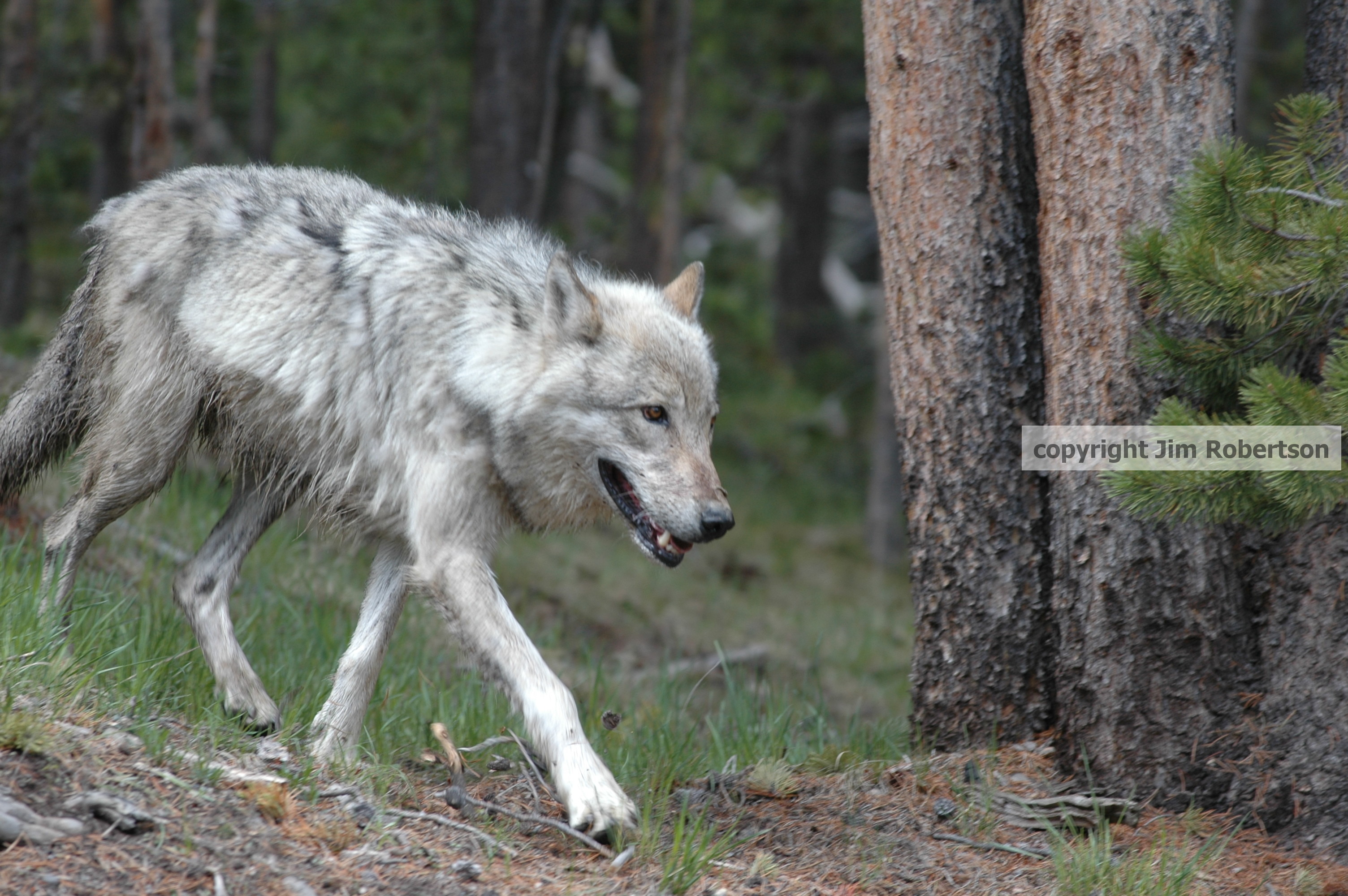
copyrighted Hayden wolf in lodgepoles

http://blog.seattlepi.com/seattlepolitics/2014/11/14/wildlife-groups-post-15000-reward-to-catch-wolf-poacher/

William White turned out to be a serial poacher. He pleaded guilty not only to killing wolves, but to importing an illegally poached moose and deer from Alberta.

November 14, 2014 |

An alliance of wildlife groups, including the Woodland Park Zoo, are offering a $15,000 reward for information leading to the conviction of the person or persons who killed a breeding female wolf in the state’s Teanaway wolf pack.

The dead wolf was discovered in the Salmon la Sac area, north of Cle Elum, on Oct. 28 and had been dead for about 10 days.

“It is our hope that this reward will help law enforcement bring the person responsible for the killing of this wolf to justice and defer future tragic killings,” said Shawn Cantrell of Defenders of Wildlife.

Poachers have posed a problem since the gray wolf began repopulating the Washington Cascades, and the Kettle and Selkirk mountains in Northeast Washington, early in the past decade.

One group was caught and punished. In 2012, three members of an Okanogan County family were each fined $73,000, and two sentenced to home confinement, for killing two wolves — including a breeding female — from the Lookout pack in the Methow Valley.

Senior U.S. District Judge Frem Nielsen rejected a slap-on-the-wrist probation penalty negotiated by the U.S. Attorney’s Office in Spokane. Instead, he sentenced William White to six months’ home confinement, and his son Tom White to three months.

William White turned out to be a serial poacher. He pleaded guilty not only to killing wolves, but to importing an illegally poached moose and deer from Alberta.

The Whites were apprehended after the third person in the case, Erin White, apparently tried to ship a blood-dripping parcel to Canada from the Federal Express office in Okanogan. It contained a wolf pelt. She claimed it was a rug.

There were 52 wolves in Washington as of the end of last year. Canis lupus is protected under the federal Endangered Species Act through the entire Cascade Range.  East of U.S. Route 97, which runs north-south in Central Washington, wolves enjoy state protection.

“The tragic, illegal killing of yet another alpha female clearly demonstrates why all our state’s gray wolves need protection,” said Dan Paul of the Humane Society of Washington.

The state Department of Wildlife has worked closely with Kittitas Valley ranchers and conservationists to minimize conflicts between the Teanaway Pack and commercial livestock operations. The pack’s habitat centers in a wild area at the border of the Alpine Lakes Wilderness Area.

Anybody with evidence on the latest wolf poaching is urged to call federal enforcement at 206-512-9329 or 509-727-8358, or state enforcement at 1-877-933-9847.
U.S. charges South Africans in illegal rhino hunting case

http://www.reuters.com/article/2014/10/23/us-usa-alabama-rhino-idUSKCN0IC2NH20141023

(Reuters) – A South African company has been indicted in Alabama for selling illegal rhinoceros hunts to Americans and secretly trafficking in the endangered animals’ horns, which sell on the black market at prices higher than gold, prosecutors said on Thursday.

The 18-count indictment charged Valinor Trading CC, which operated in the United States as Out of Africa Adventurous Safaris, and company owners Dawie Groenewald, 46, and his brother, Janneman Groenewald, 44, with conspiracy, Lacey Act violations, mail fraud, money laundering and structuring bank deposits to avoid reporting requirements.

All species of rhinoceros are protected under U.S. and international laws, including the Lacey Act, which addresses illegal poaching and wildlife trafficking, according to a statement from the U.S. Department of Justice.

“This case should send a warning shot to outfitters and hunters that the sale of illegal hunts in the U.S. will be vigorously prosecuted regardless of where the hunt takes place,” Acting Assistant Attorney General for the Environment and Natural Resources Division Sam Hirsch said in the statement.

The whereabouts of the Groenewalds, and whether they have hired a lawyer, could not immediately be determined.

National Geographic magazine reported that Dawie Groenewald was arrested in 2010 in South Africa, along with 10 others and that a multi-count case has been under way for four years.

Both Groenewald brothers are South African nationals. Janneman Groenewald lived and operated out of Alabama’s Autauga County, where he maintained company bank accounts.

Nine American hunters paid up to $15,000 per animal for a total of 11 hunts sold at hunting conventions and gun shows in the United States between 2005 and 2010.

None of the hunters was charged because prosecutors said the hunters were tricked by the Groenewalds into believing they were shooting legally at “problem” rhinos. The Groenewalds obtained no hunting permits from the Republic of South Africa or local government, the indictment said.

The hunts took place at a ranch in Mussina, Limpopo Province, South Africa co-owned by the Groenewalds and American investors, according to the indictment.

After killing or capturing a rhino, the hunters posed for photos with the carcasses that appeared on company marketing brochures, the indictment said. Dawie Groenewald, who supervised the hunts, then cut off the horns with chainsaws and knives.

The population of rhinos, indigenous to southern Africa, is being decimated by poachers who supply a demand for horns for decorative and supposed medicinal purposes, prosecutors said.

The investigation was part of ongoing Operation Crash, named for a term used to describe a rhino herd, led by the U.S. Fish and Wildlife Service. It has resulted in 26 arrests and 18 convictions, with prison terms as high as 70 months for illegal rhino hunting or trafficking in horns.

10527782_10152510443027086_4248475377290093494_n


Tackling the Tusk Trade

Michael Markarian: Animals & Politics

In a welcome break from partisan gridlock, Republicans and Democrats are joining together to protect elephants and rhinos from illegal poaching. This month, New Jersey and New York became the first two states to ban the trade in elephant ivory and rhino horns, with bills signed by Governors Chris Christie, R-N.J., and Andrew Cuomo, D-N.Y.  The new policies will help to crack down on international wildlife traffickers and dry up the demand for illegal wildlife products in the northeast, which is the largest U.S. market for ivory and a main entry point for smuggled wildlife products.

Elephants and rhinos are threatened by a global poaching crisis. Only 28,000 rhinos of five different species remain in the wild, with more than 1,000 of them poached last year for their horns. In 2012, about 35,000 African elephants were killed for their tusks, and if the current poaching rate continues, African elephants could be extinct in a few decades. In Central Africa, populations of forest elephants have declined by 65 percent during the last decade. Asian elephants are critically endangered with fewer than 50,000 left in the wild.
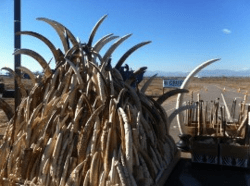
Seized Ivory Crush

Seized U.S. ivory stockpile bound for crushing. Credit: The HSUS/Iris Ho
Much of the killing is associated with criminal networks and Africa-based terrorist groups like al-Shabaab, the Lord’s Resistance Army, and others, which use the proceeds from ivory sales to fund their nefarious activities. As House Foreign Affairs Committee Chairman Ed Royce, R-Calif., noted, “While this growing problem is a grave threat to wildlife, with some animals facing extinction, it is also a threat to U.S. national security interests. As long as illegal wildlife trafficking continues, terrorists and rebel groups will have yet another way to fund their deadly objectives.”
Policymakers need to do more to address this problem. Fortunately, President Obama has announced a national strategy to crack down on elephant poaching and the ivory trade, and the U.S. Fish and Wildlife Service plans to issue new regulations that would prohibit the commercial import all African elephant ivory, including antiques, with a few exemptions for non-commercial purposes. This near-total ban on U.S. commerce in African elephant ivory, with the exception of a narrow class of antiques and certain ivory items that are exempt from regulation under the Endangered Species Act, will build on the efforts of the states to stem the tide of the poaching epidemic.
Shockingly, some members of Congress are trying to retain the status quo on the illegal slaughter of elephants, and at the request of the trophy hunting and gun lobbies and the music and antique industries, are fighting the Administration’s proposal. Sen. Lamar Alexander, R-Tenn.—whom Chattanoogan columnist Roy Exum said is “morphing into America’s newest champion of animal abuse”—and Rep. Steve Daines, R-Mont., have introduced the so-called “Lawful Ivory Protection Act,” which would handcuff the Fish and Wildlife Service and prevent the administration from taking any new action to protect elephants from the ivory trade.
These short-sighted politicians are lamenting the ability of someone to resell a gun or a guitar with a little bit of ivory on it, without regard for the fate of the largest land mammal in the world or our national security. Congress should follow the lead of New Jersey and New York, and support the global effort to stop the slaughter of elephants and rhinos—not provide aid and comfort to the organized criminal network of poachers and traffickers.

We’re Eating Pangolins Off the Face of the Earth

http://www.care2.com/causes/were-eating-pangolins-off-the-face-of-the-earth.html

We’re Eating Pangolins Off the Face of the Earth

While we’ve been focused on the poaching crisis that’s threatening the future for charismatic animals like elephants, rhinos and tigers, another species now faces the threat of extinction thanks to human appetites and could disappear before most people even hear of it.

The pangolin, which includes eight species who live in Africa and Asia, are unique little creatures in a number of ways. They’ve been described as walking artichokes and because they’re insectivores they’ve been dubbed “scaly anteaters.” These toothless animals are also the only mammal covered in true scales, which are made of keratin, and the the fact that they walk like a miniature T. rex only adds to their charm.

Unfortunately, these curious creatures are being hunted to the brink for both their meat, which is considered a delicacy by the affluent, and for their scales, which are believed to have medicinal properties.

Even with protection and international trade bans in place, pangolins are still widely traded illegally on the black market. Just days ago, 1.4 tons of pangolin scales were seized by officials in Vietnam and are believed by customs officials to have come from as many as 10,000 animals.

According to the International Union for Conservation of Nature (IUCN) Species Survival Commission (SSC) Pangolin Specialist Group, more than one million pangolins are estimated to have been taken from the wild over the past decade alone, which has made them the most illegally traded wild mammal in the world.

Until this week, only two species had been listed on the IUCN Red List of Threatened Species as endangered, while the remaining four were listed as threatened and species of least concern. Now they’ve all been upgraded over concerns that their populations are plummeting. Chinese and Sunda pangolins are now listed as “Critically Endangered,” while the Indian and Philippine pangolins are “Endangered” and all four species in Africa are listed as “Vulnerable.”

In an effort to get immediate conservation work going, the Pangolin Specialist Group also published a new action plan this week, ‘Scaling Up Pangolin Conservation,’ that outlines steps that need to be taken now to to stop the illegal trade and keep pangolins from disappearing forever.

Among many measures it hopes to see completed, the group has recommended stronger tracking of pangolin parts, more studies to get a better understanding of pangolins and their movements in the wild and working with local communities to ensure they don’t have to turn to poaching to survive.

What the group believes is the single most important step to conserving these species is reducing the demand for their meat and scales in China and Vietnam, which it hopes to do through awareness campaigns and by engaging the conservation community to help spread the word and change opinions.

“In the 21st Century we really should not be eating species to extinction – there is simply no excuse for allowing this illegal trade to continue,” Professor Jonathan Baillie, Co-Chair of the IUCN SSC Pangolin Specialist Group and Conservation Programmes Director at ZSL, said in a statement.

For more info on how to help pangolins, visit pangolins.org.

Read more: http://www.care2.com/causes/were-eating-pangolins-off-the-face-of-the-earth.html#ixzz39UZ0K5co

KWS Rangers kill poacher next to the 45-year-old elephant he had killed in Tsavo

Sunday, July 27, 2014 – 00:00 — BY RAPHAEL MWADIME

The suspected poacher killed in Tsavo West on Friday night lying with the elephant carcass they had killed.Photo/Raphael Mwadime

The suspected poacher killed in Tsavo West on Friday night lying with the elephant carcass they had killed.Photo/Raphael Mwadime

Kenya Wildlife Service rangers have killed one suspected poacher and recovered four elephant tusks  in Tsavo West National Park.

Five other poachers fled leaving behind an M16 rifle, two AK47 magazines, an axe, three saucepans and six five litre water jerry cans.

The poachers had already killed a 45-year-old elephant near the water pan and were in the process of removing its tusks.

Senior KWS Warden in charge of Tsavo West, Josephat Erupe, said KWS rangers on Friday traced foot prints of the group of poachers before getting them removing ivory from a bull elephant they had killed.

“On Friday our rangers spotted the strange foot prints that they traced to Marwa dam where the suspects had killed an elephant. At about 8pm our officers caught up with the suspects where they spotted spot lights and when they came closer, they saw the group removing tusks from the elephant. They opened fire and gunned down one suspect,” he said.

Erupe said that the rangers took ambush until Saturday morning where they realised that they had gunned down one suspect and recovered four elephant tusks and the firearm.

“We have launched an air ground operation to track the runaway suspects. It a matter of time before our security personnel catch up with them,” he told the Star at the scene of incident.

Erupe said that the poachers have devised a habit of waiting for elephant at the watering pans where they kill them.

“We have observed that the poachers wait for elephants when they come to drink water at the watering pans where they shoot them. We have enhanced security surveillance in the park in a bid to fight poaching,” he said adding that the male Jumbo aged about 45 years was killed some 50 metres from the water pan.

– See more at: http://www.the-star.co.ke/news/article-180101/kws-rangers-kill-poacher-next-45-year-old-elephant-he-had-killed-tsavo#sthash.EvqIopTK.dpuf

Jail time awaits Baudette hunting guide for years of bear and deer poaching

Photo Copyright Jim Robertson

Photo Copyright Jim Robertson

http://www.startribune.com/local/268118152.html

by: PAUL WALSH , Star Tribune

  • Updated: July 22, 2014 – 10:22 AM

Keith Slick also was sentenced for fleeing in a motor vehicle and second-degree drunken driving for briefly trying to elude a conservation officer.

A longtime big game guide in far northern Minnesota is facing jail time after admitting to years of poaching bears and deer, acts that also have cost him his hunting privileges for three years, state conservation officials said Monday.

Keith R. Slick, 33, of Baudette, pleaded guilty and was sentenced in Lake of the Woods County District Court to 90 days in jail for various misdemeanors and gross misdemeanors, including: transporting a big game animal, lending/borrowing a bear license, two counts of taking/possessing an over-limit of bear and failing to register a bear.

Along with his jail time, Slick also was sentenced to 120 hours of community service and must pay $2,090 in fines and restitution. Once out of jail, he will be on probation for two years with conditions that he surrender his weapons and agree to random searches.

Slick also was sentenced for felony fleeing in a motor vehicle and gross-misdemeanor second-degree drunken driving for briefly trying to elude a conservation officer. Slick will serve 30 days of electronic home monitoring for fleeing, with that time starting once his incarceration ends.

Ac­cord­ing to the state Department of Natural Resources (DNR), which investigated the case:

Dur­ing last fall’s bear hunt­ing sea­son, state con­ser­va­tion of­fi­cer Robert Gorecki spotted an ac­tive bear bait sta­tion be­long­ing to Slick. A search of his home un­cov­ered nu­mer­ous bear capes and skulls, as well as sets of deer ant­lers.

“There were no pos­ses­sion or reg­is­tra­tion tags found with any of the bears,” Gorecki said in a state­ment re­leased by the DNR. “The bears did not have any cuts in their ears that would in­di­cate that a site tag was at­tached at any time in the past,” Gorecki said.

A check of DNR re­cords in­di­cat­ed that Slick nev­er reg­is­tered a buck or bear tak­en in the past 10 years, which is as far back as a­gen­cy re­cords go.

A cellphone seized in the in­ves­ti­ga­tion con­tained pic­tures of Slick with a dead bear. Nu­mer­ous text mes­sages were also found with Slick tell­ing peo­ple a­bout the bear he had shot. Oth­er text mes­sages from Slick stat­ed that he had shot seven bears in his life.

Only two of the six ant­ler sets re­cov­ered had site tags on them, but they were from in­di­vidu­als oth­er than Slick.

A rifle and bow that Slick used for poaching will be auctioned by the state.

The Real Face of Poaching

What exactly is a poacher? A person who kills animals (more often endangered one) and sells them, or their parts for profit. Correct? So, what does this poacher look like? In your mind who is a poacher? If you’re imagining the quintessential pith helmet wearing, rifle clad “Van Pelt” figure, you probably want to think again.

The WWF launched an incredible campaign to break down the definition of what a poacher is. People tend to distance themselves from the crime if they weren’t directly responsible for the “dirty work,” but the wildlife trade wouldn’t exist if we all took on some responsibility and stopped participating.

When you consider the number of exotic animal “delicacies” that appear on menus across the world (don’t think the U.S. is exempt here) and look at the people who made that dish appear before you, that is a poacher.

WWF Shows Us the Real Face of Poaching, the Outcome Will Shock You When you purchase a brand new ivory statue, the person who sold it to you is a poacher. When you purchase rhino horn pills…you participate in poaching.

WWF Shows Us the Real Face of Poaching, the Outcome Will Shock You Though it may be true that these people responsible for the sale of these items are not the ones out slaughtering animals, they play a vital role in continuing the industry of poaching because they supply the one thing this cruel trade is motivated by: profit.

WWF Shows Us the Real Face of Poaching, the Outcome Will Shock You Without the people who pay for these exotic items, there would be no wildlife trade, no poachers, and no senseless killing of wild animals. It is easy to distance yourself from the crime if there is no blood on your hands, but it’s hard to forget what happened to these beautiful animals to bring that commodity to your door.

Although the wildlife trade is an enormous industry, all it takes is one person who stops buying tiger skin rugs to kick off a long chain of others who join them in conscious actions. The choice it yours!

To learn more about what the WWF is doing to help end wildlife crime, click here.

Image source: World Wildlife Fund 


FWP investigates killing of 3 young grizzly bears

http://www.ktvq.com/news/fwp-investigates-killing-of-3-young-grizzly-bears/

FERNDALE- Wardens are looking for information that could help them track down whoever killed three young grizzlies in the north end of the Swan Valley.

Agents with Montana Fish, Wildlife and Parks and the U.S. Fish and Wildlife Service said the bears were killed in the Ferndale area.

Because the investigation is ongoing, authorities aren’t giving out more details about exactly where the bears were found or how they were killed.

FWP and USFWS are hoping to hear from anyone that may help them track down the poachers. Anyone with information can contact 1-800-TIP-MONT begin_of_the_skype_highlighting 1-800-TIP-MONT FREE  end_of_the_skype_highlighting . Callers can remain anonymous and may be eligible for a reward.

photo copyright Jim Robertson

photo copyright Jim Robertson

Wildlife Products May Finance Terrorism

[Finally they have a good reason…]

The U.S. government is stepping up its crackdown on the illegal trafficking of wild animal products across the nation’s borders, saying some may be linked to terrorists, federal officials said Monday.

“Poaching in Africa is funding terrorist groups,” U.S. Trade Representative Michael Froman told a news conference at Kennedy International Airport.

He said such illegal trade is a threat to global security because it’s driven by criminal elements, including terrorists using profits from items such as rhinoceros horns and elephant tusks to finance their activities.

Paul Chapelle, the agent in charge of New York for the U.S. Fish and Wildlife Service, said one horn case resulted in 16 arrests, including that of a mobster from Ireland now serving 13 months behind bars.

A dead elephant is worth about $18,000 — mostly from the tusk.

Kennedy handles the largest cargo volume of any U.S. airport, about $100 billion a year, said Patrick Foye, executive director of the Port Authority of New York and New Jersey, which runs the airport.

And the wildlife element plays an especially powerful role in national security, said Froman, the chief U.S. trade negotiator and adviser to President Barack Obama.

More than 20,000 elephants were killed last year along with about 1,000 rhinos, meeting a rising world demand resulting in declining populations across Africa, according to officials with the Convention on International Trade in Endangered Species of Wild Fauna and Flora.

This treaty was signed by more than 170 countries to protect animals that end up as contraband including live pets, hunting trophies, fashion accessories, cultural artifacts and medicinal ingredients.

U.S. trade officials believe that groups benefiting from the poaching include the militant Lord’s Resistance Army in Uganda and South Sudan, the Janjaweed comprised of Sudanese Arab tribes, and al-Shabab, a jihadist group based in Somalia.

In February, Obama approved a new strategy for fighting trafficking through enforcement, as well as partnerships with other countries, communities and private industry. For the first time, U.S. officials are asking trading partners to agree to conservation measures for wildlife and the environment in return for signing agreements.

Kennedy customs officials are reaching out to local businesses, plus auction houses like Christie’s and Sotheby’s and even Carnegie Hall to alert them to illegally traded valuables that may come their way.

1924891_10152211828561061_1647642544_n

FWP Seeks Tips on Wolf Poached in Burnt Fork of the Bitterroot

copyrighted Hayden wolf walking

Montana Fish, Wildlife & Parks is looking for tips on a wolf that was poached in the Burnt Fork area of the Bitterroot Valley, east of Stevensville, on Saturday, May 31.

The two year old male wolf had dispersed to Montana from Oregon and was wearing a GPS collar, which provided wildlife officials with movement data and gave an estimated time of death between 6 and 9 pm on May 31.  The wolf was found shot near a road between Sawmill Saddle and Ambrose Saddle in upper Haacke Creek.

The wolf was collared in Oregon in 2013 and had made its way through Idaho and the Big Hole Valley before prior to arriving in the Bitterroot earlier this month.

Anyone with information about this incident is encouraged to call 1-800-TIP-MONT (1-800-847-6668). Callers can remain anonymous and may be eligible for a reward up to $1,000 for providing information that leads to a conviction.

-fwp-