Another Crowded Democratic Debate, Another Chance to Gloss Over the Issues

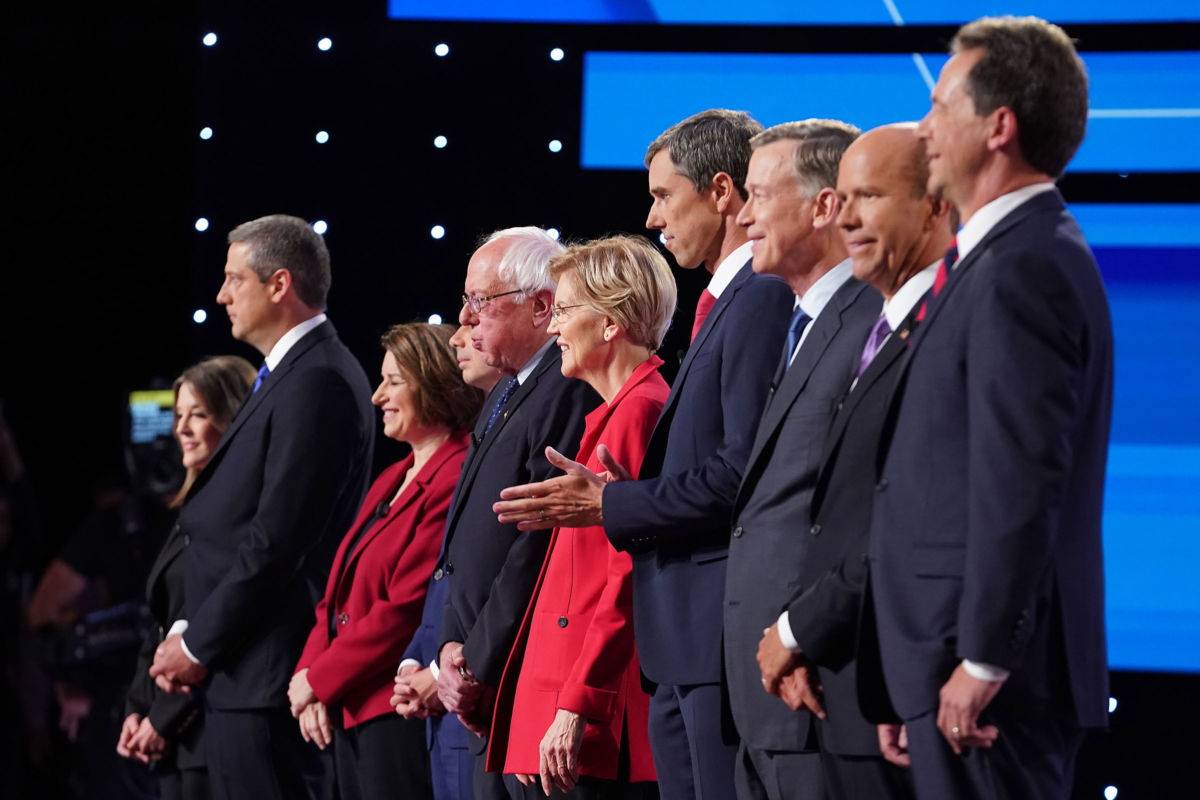
In my bleaker and more cynical moments, I wonder if the TV networks are doing this deliberately. The next big DNC-sanctioned Democratic presidential confab, broadcast this time by ABC and Univision, is taking place Thursday night in Houston. Like the other elaborately failed debate formats so far, this one will also feature 10 candidates vying for attention on the same platform, except for three hours instead of two.

“Each candidate will have one minute and 15 seconds to directly respond to questions from moderators,” reports Time, “and 45 seconds to respond to follow-up questions and rebuttals. Candidates will give opening statements, but no closing statements.”

Spiffy. There were gusts of relief sighed across the land when it was announced the debate would not be broken up into two back-to-back nights, but I did not share in the sentiment. Allowing even one more candidate to participate would have indeed necessitated two nights, but those two nights would have featured five or six candidates each, instead of Thursday’s clotted 10-candidate format I have come to detest and abhor.

Despite the fact that, once again, the Democrats are putting the equivalent of an entire college lacrosse team before the cameras, the dynamics between the candidates will be worth watching.

ABC has placed Joe Biden front and center on the debate stage, directly between the podiums to be occupied by Elizabeth Warren and Bernie Sanders. Given the operatic, bloody-eyed debacle that was Biden’s showing at the recent CNN climate town hall, and that his frontrunner status is about as firm as pudding on a Houston sidewalk in high summer, the pressure on him will be extreme. The speed-dating format may shield him for a time, but I strongly suspect Jojo will not enjoy the overall experience. If he has another bad night, watch for the vultures to begin circling his campaign bus.

As for the other participants — Kamala Harris, Beto O’Rourke, Cory Booker, Pete Buttigieg, Andrew Yang, Julián Castro and Amy Klobuchar — the night will be yet another chapter in their ongoing quest for relevance. All seven continue to poll in single digits, and between the established establishment candidate (Biden) and the two progressive standard-bearers (Sanders and Warren), there isn’t much room for any of them to stand out in a campaign-salvaging manner.

As for the topics that are sure to get short shrift in the 10-person format, the recent spate of massacres will likely bring gun reform to the fore. Donald Trump’s astonishing cruelty toward Dorian refugees from the Bahamas will certainly inspire a discussion on immigration. If the previous debates are any guide, climate change, foreign policy and Trump himself will also be featured on the spinning roulette wheel of topics.

Like as not, however, health care reform will again be a major topic. It will be featured prominently, I believe, because it is important, and because it allows the corporate media moderators to say “raise your taxes!” to Medicare for All advocates like Sanders 400 times within the confines of time restrictions that thwart proper explanations for why this is actually OK.

Speaking of health care in the U.S., a little girl from Sudbury, Massachusetts, fell suddenly ill on September 3, and was rushed to Boston Children’s Hospital for treatment. She was diagnosed with Eastern equine encephalitis (EEE), a mosquito-borne illness climate scientists have warned will become more prominent and dangerous with the ongoing onset of climate disruption. She remains in critical condition as of this writing.

To offset expenses, her parents initiated a GoFundMe campaign to help raise money for her medical care. “She remains in the ICU,” reads the fundraising request, “and while the family has a full medical insurance plan through their employer, the out-of-pocket medical costs will be massive.” As of Tuesday morning, according to the Boston Globe, the appeal had generated more than $88,000.

Here we have a heartwarming story of basic human compassion, of a community rallying to support one of its most vulnerable members, right? I see it differently. In fact, stories like this — meant to flood the heart with joyful tears — make me scream in my soul.

This is not an uplifting story about people helping other people. That is what it is framed to sound like, even as it is framed to sound like something perfectly normal and ordinary. It is a story of last-ditch desperation, one of millions taking place every single day.

It is the thoroughly commonplace tale of a family that has been financially subsumed by a sudden illness, even as they are in possession of full medical coverage, who require the largesse of strangers to run the expensive gauntlet of our for-profit medical industry.

This child should be getting treatment for free, or at least at minimal expense to her family, as should every person who falls ill in this country, because health care is a human right enshrined on the hood ornament of our founding documents: “Life, Liberty and the Pursuit of Happiness.” Try locating any of those when you are sick — and broke because you are sick.

The people who have donated to this fund are to be commended, don’t get me wrong, because we are all screwed if we don’t help each other survive the lethal cruelty of late-stage U.S.-style capitalism. The fact that this little girl could very well die if strangers don’t pony up to cover her astronomical medical bills, however, is what’s wrong with how we do medicine in this country. Stories like this one are octaves in the dying wail of a carnivorous paradigm that needs to be shattered and buried under salted earth before it kills us all.

Please remember this story as you watch the debate on Thursday night. Remember that the stakes are human lives. The stakes are us.

I don’t imagine the debate format will properly encompass the health care crisis, or any of the others. That, right there, is the problem.

Goat sacrifice to begin at Olympic National Park

Goat sacrifice to begin at Olympic National Park

(Beth Clifton collage)

284-page “management plan” garbles history,  all but ignores climate change,  & says nothing about goats as puma prey

            OLYMPIC NATIONAL PARK,  Washington––An estimated 625 to 675 mountain goats whose ancestors have peaceably roamed the icy upper reaches of Olympic National Park,  Washington,  for 14 years longer than the 80-year-old park has existed are to become sacrificial scapegoats during the summer of 2018,  and over the next three to five years,  to ecological misconceptions written into the Wilderness Act of 1964,  enshrined as National Park Service policy.

One such misconception is that “introduced” species are inherently harmful to “native” species,  even if the “introduced” species thrive as “native” just 100 miles away,  among essentially  the same suite of other animals and plants.

(Beth Clifton collage)

“Untrammeled by man”?

Another misconception is that what is now Olympic National Park,  attracting 3.4 million visitors in 2017,  ever fit the Wilderness Act criteria of being “an area where the earth and its community of life are untrammeled by man,  where man himself is a visitor who does not remain.”

The 3.4 million visitors have approximately the same cumulative ecological impact as a year-round community of 9,000 people.  And the mere existence of more than 200 sites in the park where archaeological artifacts have been found,  mentioned often in the newly published 284-page Mountain Goat Management Plan/Final Environmental Impact Statement, points toward frequent,  if not necessarily continuous use of the habitat by Native Americans for thousands of years.

Native American activities,  as well as logging,  hunting,  and ranching by settlers,  helped to shape the habitat and balance of species into which mountain goats were released in 1925-1929 by forest rangers who hoped to attract trophy hunters.

(Beth Clifton collage)

“Move half & shoot the rest”

Co-produced by the National Park Service,  U.S. Forest Service,  USDA Wildlife Services,  and the Washington State Department of Fish & Wildlife, the Mountain Goat Management Plan/Final Environmental Impact Statement recommends “the relocation of the majority of mountain goats [now present in Olympic National Park] to U.S. Forest Service lands in the North Cascades forests,  and the lethal removal of the remaining mountain goats in the park.”

What that means,  specifically,  is that efforts are to be made during the next several summers to capture 325 to 375 mountain goats by luring them into “clover traps,”  meaning stockades baited with clover,  netting them through the use of net guns,  sedating them,  flying them in helicopter slings to waiting trucks,  and then trucking them overnight to release points in habitat which,  although technically “native” for the goats,  none have ever seen before.

(Beth Clifton collage)

Goats to be moved to “huntable” habitat

The habitat in the North Cascades differs little,  in matters of concern to mountain goats,  from the habitat in Olympic National Park.  But despite the ambitions of the rangers who released the first dozen mountain goats in what is now Olympic National Park,  hunting has not been allowed in the park since it was created by an act of Congress in 1938.

Only those few mountain goats who may have descended into the Olympic National Forest,  surrounding Olympic National Park,  during hunting season,  will have had any prior experience of being hunted other than by pumas,  their main natural predator.

In the North Cascades the mountain goats may be hunted.  Indeed,  the major argument for translocating them in the Mountain Goat Management Plan is that the native mountain goats in the North Cascades have been hunted to scarcity,  and have had difficulty recovering “huntable” abundance.

(Beth Clifton)

Doublespeak

Meanwhile back in Olympic National Park,  mountain goats who become wary enough to evade capture during the early phases of the attempt to extirpate them are eventually to be shot.  Some may be gunned down from trails,  others from helicopters.

Says the Mountain Goat Management Plan about when and how the decision to stop capturing goats and start shooting them is to be made,  “The determination about whether it is no longer safe to capture more mountain goats,  from a human and mountain goat safety standpoint, would be made by a consensus of the project leaders,  consulting veterinarians,  and the capture contractor,  and would be based on the rate and type of capture-related mountain goat mortalities and environmental conditions.

“Ceasing operations would also be based on capture efficiency. When it takes approximately three times as long to safely capture a mountain goat, as compared to the hours during the initial capture operation phase during the first year, capture operations would cease.”

(Beth Clifton collage)

No remains to be left where visible

The Mountain Goat Management Planstipulates that the remains of mountain goats are not to be left within 325 feet of trails,  partly to avoid attracting dangerous scavenging wildlife into proximity to humans,  partly to avoid having Olympic National Park visitors see dead mountain goats and began objecting to the “mountain goat management plan.”

Along the way,  the Mountain Goat Management Plan argues that reducing Olympic National Park biodiversity by removing mountain goats is to be done to protect the native biodiversity of plants,  though the major ecological role of mountain goats––like that of other herbivores––is depositing plant seeds in new habitat, along with the fertilizer that the seeds need to grow.

(Beth Clifton collage)

Goats originally persecuted as campground nuisance

“The original need to manage this exotic species,”  the Mountain Goat Management Plan inaccurately claims,  “was an ecological concern related to the impacts that mountain goats impose on natural resources at the park,  particularly sensitive vegetation communities (NPS 1995; Houston, Schreiner, and Moorhead 1994).”

NewspaperArchive.com demonstrates that this is fiction.  The first public complaints about the presence of mountain goats in Olympic National Park surfaced in 1969,  and concerned salt-seeking goats licking and chewing clothing that visitors hung out to dry in campgrounds.

Four goats were translocated from Olympic National Park to the nearby Gilbert Pinchot National Forest in 1972,  but the first mention that all of the goats should be removed as a “non-native” species came only after that,  as did the first suggestion that the goats might be harming native plants.

Ranger explains safe behavior around mountain goats in Olympic National Park.

407 goats moved,  1981-1989

More goat translocations followed,  but primarily to rebuild populations elsewhere that had been hunted out.  Acknowledges  the Mountain Goat Management Plan,  “The park implemented a series of live capture operations from 1981 to 1989,  translocating 407 mountain goats to other mountain ranges throughout several western states.  An additional 119 mountain goats were legally harvested during sport hunting seasons outside the park,”  the Mountain Goat Management Plan notes,  “and three known mountain goats were illegally harvested [poached] in the park between 1983 and 1997.”

Protecting the safety of Olympic National Park visitors continued to be the main argument made for mountain goat removal before the mid-1990s,  though the first and only serious injury attributed to mountain goats before 1999 came in August 1975.

Goats kill one,  injure two,  in 80 years

Then,  according to the Port Angeles News,  “Daniel Hanify,  17,  was watching goats climbing on the rocks above him on Mt. Angeles when one goat apparently started rocks tumbling.  One large rock struck Hanify on the head.”

Hanify suffered a skull fracture,  but was able to walk to the nearest road,  with the help of two friends,  to be driven to meet a helicopter that flew him to Olympic Memorial Hospital.

A visitor suffered a non-fatal goring in 1999.  Then,  the Mountain Goat Management Plan mentions,  “Safety concerns were increased in 2010 when a visitor,”  63-year-old Robert H. Boardman,  “was fatally gored by a mountain goat while hiking on a park trail.”

Thus,  in 80 years,  fewer visitors have been killed or badly injured by mountain goats in Olympic National Park than typically die and are injured in the worst several vehicular accidents in the park and on park access roads each and every tourist season.

(Ashley Rawhouser/National Park Service photo)

Goats blamed,  not global warming

Discussion of the possible mountain goat impact on rare native plants began to be raised with increasing frequency after 1977.

Says the Mountain Goat Management Plan,  “Through herbivory and wallowing behaviors, mountain goats have directly and indirectly affected the vegetation in the Olympic Mountains.  Changes in the relative abundance of plant species have been observed as a result of mountain goat herbivory; this has altered competitive interactions among plant species.  As the mountain goat population on the Olympic Peninsula increased prior to live capture operations in the 1980s, changes in vegetation were substantial, and the status of rare plant populations became a concern.”

Not even mentioned,  however,  are the major climatic effects on park vegetation caused by global warming,  beginning to become visible during the same years,  and having an accelerating impact today,  as the year-round icepack retreats to higher elevations,  less precipitation falls,  stream temperatures warm,  and the risk of wildfires increases.

(Beth Clifton collage)

Population fluctuations

After nine years of more-or-less continuous translocations of mountain goats,  the Olympic National Park population had been reduced from a peak estimate of more than 1,000 to 389,  according to a July 1990 survey.

“Live capture operations were halted in 1990 for several reasons,  including employee safety,  animal safety,  and changing Department of the Interior rules concerning helicopter landing techniques,”  the Mountain Goat Management Plan says.  “Subsequent surveys were conducted in 1994, 1997, and 2004.  A survey conducted in 2011 revealed that the population started increasing between 2004 and 2011.  Most recently,  a 2016 survey revealed that the population has continued to increase to an estimated 625 mountain goats,  with an 8% average annual rate of increase from 2004 to 2016.  At this growth rate,  there could be approximately 725 mountain goats on the Olympic Peninsula by 2018.”

Puma at Big Cat Rescue.  (Beth Clifton photo)

Pumas

Significantly,  though discussing the population of a prey species without mentioning the species’ major predators would appear to be nonsense,  the Mountain Goat Management Plan includes no statement of the relative abundance of pumas in Olympic National Park,  and there appears to be no recent puma population assessment for the park in any other context.

To what extent pumas might suffer from no longer having mountain goats to hunt is also not discussed.

(National Park Service photo)

Contraceptive use rejected

The Mountain Goat Management Planrejects any use of contraceptives to reduce and suppress Olympic National Park goat numbers.

“Although fertility control has been demonstrated to be effective in controlling individual animal fertility,”  the plan states,   chiefly because “Where fertility control has been successful, it has limited population growth,  but has not eliminated wild ungulate populations.”

Continues the Mountain Goat Management Plan,  “Chemical agents, such as immunocontraceptive vaccines (e.g., native PZP or GnRH vaccines),  require repeated doses to the same animal,  to be highly effective at suppressing fertility.  Due to the remote, rugged, and extreme terrain where the mountain goats reside,  helicopter darting during the summer months would be necessary to either capture or vaccinate the goats.  This would require several months of flying each year.  In the Olympic Mountains, such a program would be costly, impactful, and not effective for eliminating goats or their impacts because it would be impossible to treat a sufficient number to significantly impact population dynamics. In addition,  over time,  goats would learn to avoid helicopters.”

(Beth Clifton collage)

“Wilderness values”

Finally,  says the Mountain Goat Management Plan,  echoing the language used in lawsuits against U.S. government agencies by opponents of using immunocontraceptives to stabilize wild horse populations,  “The use of fertility control adversely affects wilderness values because it is not a natural process.  Fertility control as an authorized management action would have a negative effect on the untrammeled and natural qualities of wilderness character because it would be an intentional manipulation of the biophysical environment.”

Beth & Merritt Clifton
Animals 24-7

In particular,  “If all goats were to be indiscriminately darted from the air,  this would be an adverse effect on the undeveloped quality of wilderness character.  Noise from helicopters would disrupt the natural soundscape and area closures to visitors may need to be in effect during darting operations. Most concerning is that these actions would need to take place on a regular basis to be effective until all exotic goats are eliminated.”

All of which will also be true of helicoptering mountain goats to trucks and then using gunners aboard helicopters to shoot the 300-plus who are expected to evade capture.

Iran will get the blame, but the Gulf of Oman truth is likely a lot murkier

(CNN)As the plumes rise from a brazen attack in the Gulf of Oman, oil brokers and diplomats are panicking about another lurch toward confrontation In the Middle East.

What happened is fairly clear — two tankers were struck as they sailed through this busy and strategic shipping lane — but why it happened and who did it is a lot less easy to explain, not least because it doesn’t appear to benefit any of the protagonists in the region.
The Japanese owned Kokuka Corageous tanker briefly caught fire when it was twice attacked with “some kind of shell,” its owner said. One of its 21-strong Filipino crew was injured.
The crew of the Bermuda-based Front Altair all escaped unharmed when it too was hit by a blast. The Fifth Fleet’s USS Bainbridge was nearby and responded to a distress call received at 6.12 am local time and then another 48 minutes later. It picked up 21 sailors from the Kokuka and is getting a wider view of the scene from a P8 Navy surveillance aircraft.
A tanker ablaze in the Gulf of Oman, in an unverified image supplied by an Iranian news agency.

With the rescue operation over, questions have turned to why anyone would do this. That’s not as not as straightforward to answer as it looks.
Inevitably, similarities have been drawn between Thursday’s attacks and events a month ago, when four ships were targeted near the Emirati port of Furajah. For that, officials in Washington and beyond pointed the finger at Iran.
But Thursday’s incident is significantly more blatant. Yet the same officials will doubtless blame Tehran again. If and when that happens, we should remember US National Security Advisor John Bolton promised to present evidence to the UN Security Council backing up those previous claims, but has yet to do so.

Who stands to gain?

The Russians like to ask: “Who did it benefit?” when the unexpected strikes, and this question is useful now.
Iran doesn’t appear to have a lot to gain. Say what you like about Tehran’s malicious intent, these incidents heighten the global drumbeat for greater isolation and boosts those who seek to apply military pressure on Iran. Its economy is in a bad condition. Before President Donald Trump pulled the US out of the JCPOA (colloquially known as the Iran nuclear deal), Tehran was at its peak of regional influence. With diminished economic resources, its potency is likely to wane.
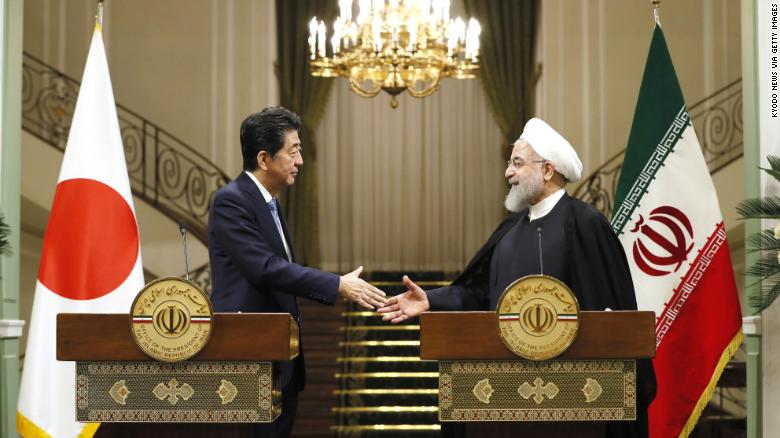
The incidents also came in the middle of a visit to Tehran by Japan’s Prime Minister Shinzo Abe, apparently trying to mediate over the nuclear deal (although Tokyo says he’s not an envoy for Washington). The apparent attacks eclipsed the Abe visit, an unexpected bit of outreach to Iran by someone Trump calls a friend.
Japanese Prime Minister Shinzo Abe, left, and Iranian President Hassan Rouhani shake hands after a joint press conference in Tehran.

You could make a case for Iranian hardliners staging such an attack to derail peace efforts. But Iran’s hardliners — particularly the Revolutionary Guard — are normally a little smarter than to bomb international shipping lanes during a crucial diplomatic meeting. Iran’s chief moderate, Foreign Minister Javid Zarif, was right to point out that “suspicious doesn’t begin to describe what likely transpired this morning.” When one party is so easily blamed, it is likely blameless, or unfathomably stupid.
What else? Reuters has reported that Tehran has been scaling up its remaining petrochemical exports ahead of tightening sanctions. Could it be looking to boost the price of oil? Maybe. But at the same time, the shipping of that same oil is going to be disrupted, so they would likely lose out all the same. It is hard to imagine an Iranian hardliner smart enough to pull this sort of apparent attack off, without also realizing they would get immediately collared.
So what about the conspiracy theory, that Saudi Arabia also seeks confrontation and higher oil prices, and would therefore permit such an attack to further its own agenda? An equally obvious explanation, it’s tough sell, too. And were such a plot uncovered, the damage to Saudi Arabia’s already beleaguered reputation in the Beltway could be terminal.
Some 20% of the world’s oil goes through the Strait of Hormuz, and that includes a lot of Saudi exports. You might argue that at $62 a barrel (the price of Brent crude after Thursday’s incidents caused a 3% spike), oil is quite cheap and can take more of a knocking. But in the long term it’s unlikely the Saudis would want the Gulf’s shipping lanes to be regarded as unsafe.
If this gets worse and the US military finds itself dragged into protecting shipping in Hormuz, Riyadh’s relationship the Trump administration — which sought to get out of foreign entanglements rather than get into them — would be tested.
There are few easy facts here, as there are few easy culprits. But the sense of uncertainty stokes rather than dampens the fears of mismanagement and conflict.

History Shows Joe Biden 3.0 Is a Bad Idea

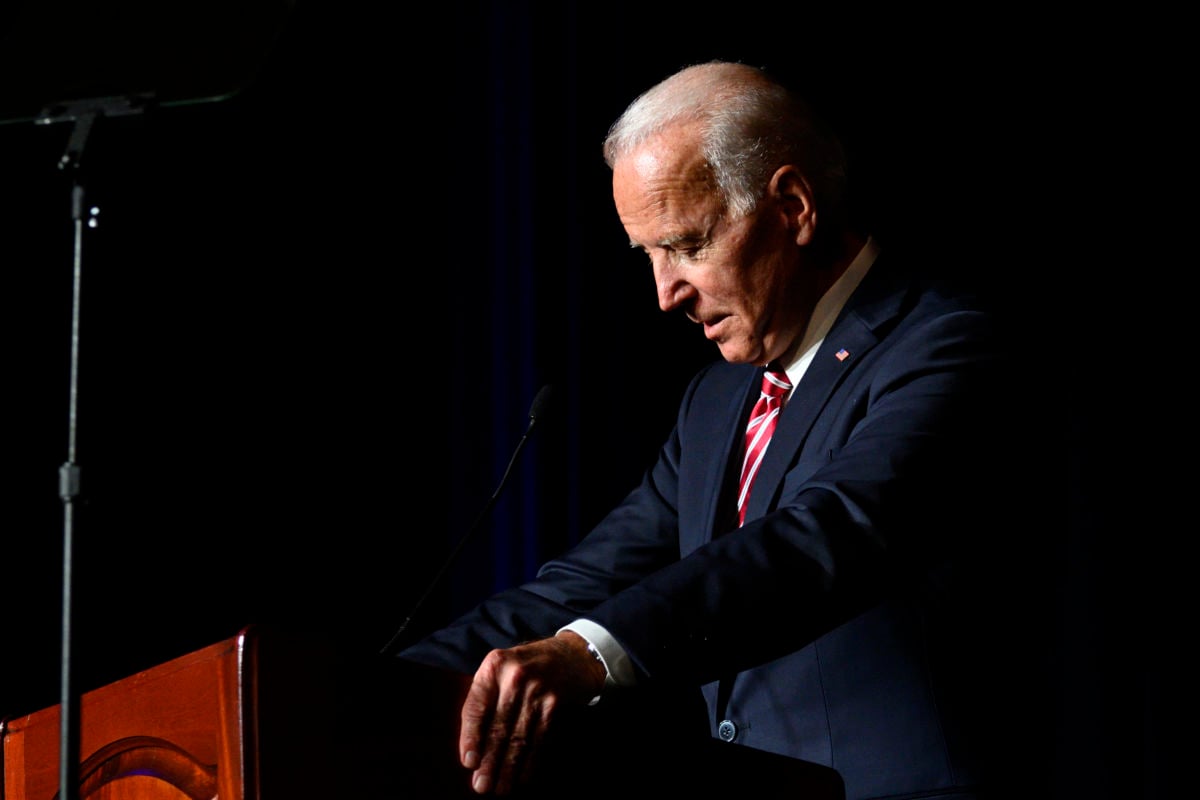
So Joe’s in now, and really, thank God. The corporate neoliberal “center” is dreadfully under-represented in the current tiny field of potential Democratic nominees. In the event candidates Buttigieg, Harris, O’Rourke, Booker, Klobuchar, Moulton, Inslee, Hickenlooper and Gillibrand fail to successfully advocate for continuing 30 years of failed conservative “centrist” Democratic policies, former Senator and Vice President Joe Biden (D-Delaware) will be there to shoot the gap.

:facebrick:

“The third time’s lucky,” reads Alexander Hilsop’s 1862 compendium of Scottish proverbs. I guess we’re all going to find out how true that is over the course of the 79 weeks standing between this ragged little patch of time and the 2020 presidential election. Senator Biden’s first run at the brass ring began on June 9, 1987, and ended in searing disgrace only 106 days later after his campaign was subsumed by plagiarism accusations and his questionable relationship with the facts of his own life.

Biden kicked off his third presidential run on Thursday with an ominous and somewhat cumbersome 6:00 am tweet — “[E]verything that has made America — America — is at stake.” The announcement tweet failed to mention Biden’s plans to attend a big-dollar fundraiser hosted by David Cohen, chief lobbyist for Comcast, the most despised company in the country. This, morosely, is par for a very long course.

Though he labels himself a friend to working people, Biden has a record of harming workers that spans decades. “His energetic work on behalf of the credit card companies has earned him the affection of the banking industry,” wrote Sen. Elizabeth Warren in 2002, “and protected him from any well-funded challengers for his Senate seat.”

“State laws have made Delaware the domicile of choice for corporations, especially banks,” writes Andrew Cockburn for Harpers, “and it competes for business with more notorious entrepôts such as the Cayman Islands. Over half of all US public companies are legally headquartered there.” Joe Biden spent 36 years as a Delaware senator until Obama raised him up in 2008, and during that time he served his core constituency with vigor.

Biden voted in favor of one of the most ruthlessly anti-worker bills in modern legislative history, the 2005 Bankruptcy Abuse Prevention and Consumer Protection Act, depriving millions of the protections provided by Chapter 7 bankruptcy. For this, and for his pro-corporate labors stretching all the way back to 1978, he has earned the financial devotion of the too-big-to-fail club many times over.

Millennial voters are touted as the sleeping giant of the 2020 election: Turn them out in large numbers, goes the thinking, and you can practically start measuring the drapes in the Oval Office today. If this is true, and I believe it is, candidate Biden began his campaign behind an eight-ball roughly the size of, well, Delaware.

“Student debt broke $1.5 trillion in the first quarter of 2018 according to the Federal Reserve,” writes Mark Provost for Truthout. “Twenty percent of student borrowers default on their loan payments. Delaware’s own senator and former vice president of the United States, Joe Biden, is at the center of the decades-long campaign by lenders to eviscerate consumer debt protections.”

Biden became chairman of the Senate Judiciary Committee in 1987, at a time when Republicans were running actively racist campaigns under the gossamer veil of being “tough on crime.” Chairman Biden, who was about to spend 106 days failing to become president at the time, was not about to miss the boat. By 1994, he had become the Democratic champion for the Violent Crime Control and Law Enforcement Act, a vicious piece of legislation which ushered in an age of mass incarceration that lawmakers today are still laboring to dismantle.

Biden’s problems on the matter of race go far beyond his full-throated support for the 1994 crime bill. “I do not buy the concept, popular in the ’60s, which said, ‘We have suppressed the Black man for 300 years and the white man is now far ahead in the race for everything our society offers,’” he said in 1975 regarding school desegregation. “‘In order to even the score, we must now give the Black man a head start, or even hold the white man back, to even the race.’ I don’t buy that.”

You can expect to see that quote at least once a day for as long as his campaign remains active. One can try to shrug off a 44-year-old quote as the words of a man whose opinions on race have “evolved” — he shared the ticket with Obama! — but his record on the issue is unavoidably long and bleak. “Joe Biden’s greatest strength is that he’s been in the mainstream of American politics for the last 50 years,” writes the NBCpolitics blog, The Fix. “And that’s his greatest weakness, too.”

In this, Biden mirrors the history of the party whose nomination he seeks, a party that was firmly on the wrong side of racial justice until the middle of the 1960s. “My state was a slave state,” he told Fox News in 2006. “My state is a border state. My state has the eighth-largest Black population in the country. My state is anything [but] a Northeast liberal state.” Later that same year, before a mostly Republican crowd in South Carolina, Biden joked that Delaware only stayed in the Union during the Civil War “because we couldn’t figure out how to get to the South.”

Joe Biden voted in favor of George W. Bush’s invasion and occupation of Iraq. I have spent the last 17 years of my life writing about that horrific war, and expect to still be writing about it right up until they wind me in my shroud. There is no lack of irony to be found in the fact that Biden ultimately decided not to run for president in 1992 because he voted against George H.W. Bush’s Gulf War resolution, believing that vote irretrievably damaged his chances for victory. Some 26 years later, his vote in favor of a different Iraq war will be around his neck like a blood-soaked millstone, and justly so.

And then there is the matter of Anita Hill, which rolls many of the most pressing issues of the day — women’s rights, the patriarchy, racism, the conservative balance of the Supreme Court, collusion with a Republican Party that thinks “bipartisanship” is hilarious — into a very hard ball.

“Joe Biden was the ringleader of the hostile and sexist hearing that put Anita Hill, not Clarence Thomas, on trial,” writes Shaunna Thomas, co-founder and executive director of the women’s group, UltraViolet. “In doing so, Biden caused tremendous harm to all survivors, he set back the movement, and he helped put Clarence Thomas on the Supreme Court. This is not a subject he can sweep under the rug. This is not something he can just get out of the way before announcing his candidacy. This is not something one line in a speech or interview will fix.”

Prior to announcing his candidacy, Biden expressed regret for his treatment of Anita Hill, going so far as to say “I’m sorry” on the Todayshow in September 2018, which speaks volumes about how long he has been contemplating this campaign (Hill was not present in the studio to hear the apology). On the day he announced this third run, CNBC reported that Biden had spoken to Hill personally. “They had a private discussion,” said a campaign spokesperson, “where he shared with her directly his regret for what she endured and his admiration for everything she has done to change the culture around sexual harassment in this country.”

According to The New York Times, however, Hill was having none of it. “Ms. Hill, in an interview Wednesday, said she left the conversation feeling deeply unsatisfied and declined to characterize his words to her as an apology,” reported the Times. “She said she is not convinced that Mr. Biden truly accepts the harm he caused her and other women who suffered sexual harassment and gender violence.”

“I cannot be satisfied by simply saying I’m sorry for what happened to you,” Hill is quoted as saying. “I will be satisfied when I know there is real change and real accountability and real purpose. The focus on apology, to me, is one thing. But he needs to give an apology to the other women and to the American public because we know now how deeply disappointed Americans around the country were about what they saw. And not just women. There are women and men now who have just really lost confidence in our government to respond to the problem of gender violence.”

Joe Biden’s first three public endorsements — from conservative Democratic Senators Chris Coons (Delaware), Bob Casey (Pennsylvania) and Doug Jones (Alabama) — tell you all you need to know about who is rooting for his candidacy. A significant number of the policies he has devoted his life to are simply terrible. He’s a bannerman for a failed Democratic Party experiment, and the only people who don’t seem capable of perceiving that failure are the “centrist” Democrats cheering him on.

Biden is planning to run on the same “But I can win!” platform that worked out so poorly in the last election. The politics blog Crystal Ball labels him as potentially “The Most Experienced New President Ever,” which was also what some people were saying about Hillary Clinton in 2016. Even in the short time between now and then, a great many Democratic voters have demonstrably left him behind.

Three decades of watching conservative Democrats assist Republicans as they drove the country to the right is enough already. Alexander Hilsop’s proverb, I strongly suspect, is dead wrong on this one. Joe Biden is leading in the polls at the moment, but if he’s still in the race after Super Tuesday, I will be stunned. At least he’ll know how to find the exit. He’s done it before.

Joe Biden’s Legislative History Under Scrutiny as He Enters 2020 Race

Former Vice President Joe Biden has entered the 2020 race for the White House, becoming the 20th Democrat to seek the nomination in the largest and most diverse field of Democratic candidates ever to run for president. Biden will face scrutiny for his long and checkered record in the coming weeks, including his 1994 crime bill, that helped fuel mass incarceration with financial incentives to keep people behind bars, and his handling of Anita Hill’s sexual harassment allegations against Supreme Court justice nominee Clarence Thomas in 1991. Biden is also known for close ties to the financial industry and voting to authorize the U.S. invasion of Iraq in 2003. In the weeks before Biden announced his bid for the presidency, at least seven women stepped forward to accuse him of inappropriate touching. We speak with Andrew Cockburn, Washington editor for Harper’s magazine, about Biden’s record. His recent piece is headlined “No Joe! Joe Biden’s disastrous legislative legacy.”

Transcript

AMY GOODMAN: This is Democracy Now! I’m Amy Goodman, with Nermeen Shaikh.

NERMEEN SHAIKH: Former Vice President Joe Biden has entered the 2020 race for the White House, becoming the 20th Democrat to seek the nomination in the largest and most diverse field of Democratic candidates to ever run for president. Biden will hold his first fundraiser tonight in Philadelphia. It will be hosted by Comcast’s chief lobbyist, David Cohen.

AMY GOODMAN: In a campaign video released on social media this morning, Biden took aim at President Trump’s response to the 2017 “Unite the Right” march of white nationalists in Charlottesville. He began by talking about Charlottesville, the home of Thomas Jefferson, and then went on to talk about what happened most recently.

JOE BIDEN: It was there in August of 2017 we saw Klansmen and white supremacists and neo-Nazis come out in the open, their crazed faces illuminated by torches, veins bulging, and bearing the fangs of racism, chanting the same anti-Semitic bile heard across Europe in the ’30s. And they were met by a courageous group of Americans, and a violent clash ensued. And a brave young woman lost her life. And that’s when we heard the words of the president of the United States that stunned the world and shocked the conscience of this nation. He said there were, quote, “some very fine people on both sides.” “Very fine people on both sides”? With those words, the president of the United States assigned a moral equivalence between those spreading hate and those with the courage to stand against it. And in that moment, I knew the threat to this nation was unlike any I had ever seen in my lifetime.

NERMEEN SHAIKH: That’s Joe Biden announcing his run for president. As a longtime senator from Delaware, Biden has run twice before for the Democratic nomination. The last time was in 2008, when he ultimately became then-Senator Barack Obama’s running mate. Biden’s third bid for the presidency comes in a Democratic political climate that is notably more progressive than the last time he sought the nomination.

Biden will face scrutiny for his long and checkered record in the coming weeks, including his 1994 crime bill that helped fuel mass incarceration with financial incentives to keep people behind bars. Biden has also long faced criticism for his handling of Anita Hill’s sexual harassment allegations against Supreme Court justice nominee Clarence Thomas in 1991. At the time, Biden was the chair of the Senate Judiciary committee. Biden is also known for close ties to the financial industry, notably helping push through a 2005 bill that made it harder for consumers to declare bankruptcy. According to The New York Times, the credit card issuer MBNAwas Biden’s top donor from 1989 to 2010.

AMY GOODMAN: One of Biden’s key legislative achievements was the 2005 bankruptcy law that made it harder to reduce student debt, preventing most Americans from claiming bankruptcy protections for private student loans. He also voted to authorize the U.S. invasion of Iraq in 2003. In the weeks before Biden announced his bid for the presidency, at least seven women stepped forward to accuse him of inappropriate touching.

Well, last month, I spoke with Andrew Cockburn, Washington editor forHarper’s magazine, about Biden’s potential run for the presidency and his recent piece headlined “No Joe!” “Joe Biden’s disastrous legislative legacy” was the subtitle. I began in Part 2 of this discussion by asking Andrew Cockburn about Biden’s role in the 1994 crime bill.

ANDREW COCKBURN: He teamed up with Strom Thurmond, this sort of very aged, old segregationist from South Carolina, you know, really the face of — the face of everything that we’d been trying to get away from. And it was really, you know, Joe — he thought this was going to really propel him to the top. As he said to a former aide, who told me — I think it was around about 1990 — the aide was telling me how he, Joe, was always trying to hold hearings on crime and drugs. Every week, his poor staff had to sit around dreaming up a new excuse for a hearing on crime and drugs. And as Biden said to his staffer, he said, “I want when people hear the words ‘crime’ and ‘drugs,’ I want them to think ‘Joe Biden.’” I mean, he was really running, you know, like a — like George Bush Sr., on a sort of Willie Horton. You know, it’s astonishing that this man, this politician, should be considered a front-runner for the Democrats.

AMY GOODMAN: Now, could he simply say he’s changed since then, that he’s completely reversed his position?

ANDREW COCKBURN: Well, not really. I mean, he sort of — he’s flubbed on a few things. I mean, he changed — you know, he’s apologized for a few things — not, I note, on busing; not on choice, where his record is truly terrible. He has said that he’s kind of sorry, a bit sorry, about his crime legislation. And he said he’s sorry he voted for the financial deregulation, the key repeal of Glass-Steagall. He said that was the worst vote ever — ever of his entire career, which I’m — there’s a lot of competition there. So, but even if — you know, just thinking of his political viability, supposing he has to go through the campaign saying, “Well, I’m sorry I did what I did on busing. I’m sorry I did what I did on crime. I’m sorry I did what I did on banks,” he’s going to sound like another shifty politician.

AMY GOODMAN: And on Anita Hill, “I’m sorry what I did on Anita Hill”?

ANDREW COCKBURN: And Anita Hill, “I’m really sorry about Anita Hill.” He’s expressed some regret for that, I should admit. So, you know, basically, his record has very little that’s good about it. You know, he has his sort of shtick of being the friend of the working man, but, you know, he’s been a much better and closer friend of the financial industry.

AMY GOODMAN: Talk about what happened with Neil Kinnock, the speech.

ANDREW COCKBURN: Well, very bizarre, that. He, Neil Kinnock, who at that time was the leader of the Labour Party, had this standard stump speech.

AMY GOODMAN: In Britain.

ANDREW COCKBURN: In Britain, yeah, British Labour Party. And he would — in his stump speech, he would say that, you know, he was — why was it that he was the first Kinnock in a thousand years to go to college, and Mrs. Kinnock, he invoked, too, as being the first from her family to go to college. And he made a moving sort of rags-to-riches sort of piece out of that. And Biden — Biden heard this, or his speechwriter did, and thought, “That sounds good,” and simply substituted the word “Biden”: “Why am I the first Biden in a thousand years to go to college?” and so on, so forth. And, well, what’s particularly ironic about it is that Neil Kinnock was known in Britain as the “Welsh windbag,” because he went on and on. And, of course, Biden himself is a terrible windbag. So, it was really bizarre to have one windbag plagiarizing another.

AMY GOODMAN: I wanted to talk about Iraq. In 2002, former chief U.N. weapons inspector in Iraq, Scott Ritter, said, quote, “Sen. Joe Biden is running a sham hearing. It is clear that Biden and most of the Congressional leadership have pre-ordained a conclusion that seeks to remove Saddam Hussein from power regardless of the facts, and are using these hearings to provide political cover for a massive military attack on Iraq. These hearings have nothing to do with an objective search for the truth, but rather seek to line up like-minded witnesses who will buttress this pre-determined result,” Ritter said. That same year, in 2002, Senator Biden said, quote, “We must be clear with the American people that we are committing to Iraq for the long haul; not just the day after, but the decade after. … I am absolutely confident the President will not take us to war alone,” he said. Talk about the significance of that then, and then what it could mean for today.

ANDREW COCKBURN: Well, it fits into Biden’s, you know, worldview, or, well, behavior on the international stage, throughout, which is as, you know, a very hard-line hawk. You know, as you just said, or as Ritter said at the time, Biden was really doing everything he could to assist George Bush in the run-up to the illegal invasion of Iraq. You know, on the Foreign Relations Committee, he summoned just pro-invasion witnesses. As far as I know, he was certainly not one of the famous of the five senators who took the trouble to go down and read the National Intelligence Estimate, that Senator Bob Graham has talked about, which was locked away down in the basement, which would have told them that there was a lot of doubts in the intelligence community as to whether Saddam had weapons of mass destruction and so forth. No, he just — he wanted — you know, he was all for war, and he was all for occupation, as you said.

And that fits in with, you know, his record since, most notably as vice president. Obama made him, made Vice President Biden — gave him really the — well, the Iraq file, but also the Ukraine file. And Biden used that to be an ardent proponent of, you know, more arms for Ukraine, for intervention in what is really a civil war in Ukraine. Of course, his family — his son — had very extensive business ties in Ukraine, which doesn’t look too good. His son Hunter was on the board of the Ukrainian gas company. So, you know, Biden, whenever he’s been given the chance, he’s been for armed intervention. He was ardently for the expansion of NATO, the post-1990 — in the 1990s, which, you know, is really the root cause of the renewed — sort of the new Cold War. I mean, Biden was there. It’s no surprise that he describes John McCain as his best friend in the Senate.

AMY GOODMAN: Biden also said, in 2002, “I do not believe this is a rush to war; I believe it’s a march to peace and security.” So, Andrew Cockburn, if you could comment on his two runs for president, both failed? You know, all the media is saying the polls show he’s the — you know, number one now, followed by Bernie Sanders. But, of course, he’s got the biggest name recognition nationally. He was vice president for eight years under President Obama.

ANDREW COCKBURN: Well, that’s right. I mean, it is largely a factor of name recognition. But also, I mean, we have to think about those two runs. And what it showed — first of all, there was, as we’ve discussed, this astonishing gaffe in 1988, where he wasn’t just plagiarizing this British politician, by the way. It turned out that his speeches also had extensive passages lifted from Robert Kennedy, Bobby Kennedy, and Martin Luther King, unbelievably. So, you know, it’s kind of — it’s hard to explain this really sort of mental issue. But then that sank his — it’s not clear that his campaign was going anywhere, anyway, at that time.

And then, in 2008, you know, he didn’t even have that excuse of a plagiarism. I mean, he made an astonishing remark about Barack Obama early on, where he described him as “clean.” I mean, it was a very sort of racist — almost racist-sounding, patronizing remark. And he got nowhere. You know, he really sputtered in his campaign, sputtered and died.

So it’s pretty bizarre to me, this sort of — this cheering squad for Biden: you know, “Run, Joe! Run!” And I think, actually, what you — clip you showed, featured, of him at the firefighters’ convention yesterday, was very telling, because sounded like I can hear Donald Trump invoking, you know, low energy again. He didn’t sound like a, you know, ready-to-go politician at all to me. He sounded sort of rather weary. I have the feeling sometimes that he — in his heart, he doesn’t want to do it. That’s why we’ve had this sort of Hamlet performance for months now. And the people around him, all these longtime aides, this is their chance for, you know, a ticket in the big game, to be in on a big-time presidential campaign, and they’re kind of pushing him into it.

Maybe I’m wrong, but I think, you know, if he does run, those poll numbers will come down in a hurry. He’s not an effective campaigner. He hates preparation. He hates like debate prep. He’s not a great fundraiser. He doesn’t like having to sort of kowtow to big donors to get money. He’s got such an inflated ego. I really think that he is not — I’m not the only person saying this; people who’ve known him for a long time think the same — that he would really — what he really wants is to be anointed — you know, “Please, Mr. Biden, please come and be our candidate. Please come and be our president” — without having to go through the hard grind, the incredible exhaustion, of a modern presidential campaign.

AMY GOODMAN: Andrew, could you talk about the media’s coverage of him? You are really among the first, if not the first one, in this period, to start really seriously analyzing Joe Biden’s record as a senator and then as a vice president. Then the rest of the media started, well, repeating some of what you had to say.

ANDREW COCKBURN: Well, yes. So, thank you. That’s kind. But that is true. But, I mean, the pack — you know, now they’re all busy at work, like CNN digging out that very damning clip you played earlier. And there’s going to be a lot more of that. I mean, already there’s things I didn’t know that are coming up. And just imagine what it’s going to be like when he has 12 other Democrats, you know, sort of chasing him around the ring. It’s going to be like Lord of the Flies or something. It’s, you know, the people — you know, oppo researchers can be pretty good these days, and there’s a lot to come out.

And he has — you know, he has so many deficiencies as a candidate, including, I should say, because the Republicans are already saying it, a “me, too” problem. I mean, if you look on sort of Republican websites and Twitter accounts, there’s a montage going around of Joe Biden with women at photo ops, including some quite young women — children, really — you know, apparently fondling them. I’m sure it’s all very just avuncular and everything, but as one person, one political fundraiser and operative, said to me — a lady said, “I was never talking to him when he wasn’t stroking my back.” You know, he’s very tactile, which, I’m sure, is entirely innocent. But, you know, don’t think that the Republicans won’t make a lot of lot of hay with that, and probably his Democratic rivals, too.

AMY GOODMAN: That’s Andrew Cockburn, Washington editor forHarper’smagazine. To see Part 1 of our discussion, go to democracynow.org.

When we come back, we look at a New York Times exposé detailing how Navy SEALs, who witnessed their platoon chief, Eddie Gallagher, commit war crimes in Iraq, were encouraged by their superiors not to speak out, and told they could lose their jobs for reporting him. Gallagher goes on trial for murder next month. We’ll speak with New York Times journalist Dave Philipps. Stay with us.

Trump’s attorney general wants god’s moral order enforced by government

As the nation lurches closer towards being ruled by a tyrannical dictator with unwavering support from the Republican Party, the American people are ignoring an even greater threat to their waning secular democracy – rule by tyrannical theocrats.

The rise of theocrats in powerful positions of authority is particularly disconcerting because not only was America created as a secular nation with a secular Constitution, but because the theocrats running the federal government represent a very small minority of the population. And now Trump has given that vicious minority what theyelected him to do in the first place; another radical Christian extremist, William Barr, in a powerful federal government position.

J. Beauregard Sessions was a legitimate threat to America’s secular government as Trump’s attorney general, but his theocratic aspirations paled in comparison to Trump’s latest theocratic cabinet member – a conservative Catholic malcontent who is unlikely to ever defend the U.S. Constitution because it is a secular document. It is noteworthy that Sessions only stated that, according to his mind, the separation of church and state in the Constitution is a concept that is unconstitutional. However, his replacement ardently believes that America’s government is duty-bound to enforce god’s laws because there is no place for secularism.

In a 1995 essay, Barr expressed the extremist Christian view that “American government should not be secular;” secularism is an abomination in Barr’s theocratic mind despite the law of the land is unmistakably secular. Furthermore, Barr contends America’s government is supposed to be imposing “a transcendent moral order with objective standards of right and wrong that flows from God’s eternal law;” eternal law best dictated by the Vatican and taught in public schools at taxpayer’s expense.

It is true that as attorney general William Barr will defend Trump’s criminality and corruption; it is one of the only reasons Trump nominated him. However, the real danger to the nation is Barr’s belief that the government’s primary function should be defending and enforcing his god’s moral edicts while ardently opposing any legislative branch effort to make secular laws according to the secular Constitution.

As noted by Michael Stone a couple of weeks ago, in addition to the racism and misogyny one expects from a radical conservative Christian, “Barr is also a bigot when it comes to non-religious people and others who respect the separation of church and state.”

Barr epitomizes the typical extremist religious fanatic by blaming everything from crime to divorce to sexually transmitted diseases on what he alleges is “the federalgovernment’s non-stop attacks on traditional religious values.” In fact, he joins no small number of Republican evangelical extremists who demand that taxpayers fundreligious instruction, specifically Catholic religious instruction, in public schools. Barr, as a matter of fact, has called for the United States government to subsidize Catholic education and categorically called for federal legislation to promote Vatican edicts to “restrain sexual immorality;” an explicit reference to his religion’s ban on homosexuality, extramarital sex, and “artificial” birth control. Don’t believe it?

In an address to “The Governor’s Conference on Juvenile Crime, Drugs and Gangs,” Barr condemned the idea of adhering to the U.S. Constitution’s mandated separation of church and state in the public education system. The theocrat said:

This moral lobotomy of public schools has been based on extremist notions of separation of church and state or on theories of moral relativism which reject the notion that there are standards of rights or wrong to which the community can demand adherence.

Barr also penned an article in The Catholic Lawyer where he complained vehemently about what he asserted was “the rise of secularism;” something he claims is anathema to a nation he believes should be ruled by theocrats. Barr attempted to give an answer to “the challenge of representing Catholic institutions as authorities”on what is considered right and wrong, or morally acceptable in a secular nation. In discussing what Barr termed was “The Breakdown of Traditional Morality,” the new attorney general complained thus:

We live in an increasingly militant, secular age…  As part of this philosophy, we see a growing hostility toward religion, particularly Catholicism. This form of bigotry has always been fashionable in the United States. There are, today, even greater efforts to marginalize or ghettoize orthodox religion…

Barr is also a bigot when it comes to people who respect the Constitution’s separation of church and state in providing equal rights for all Americans whether theocrats agree or not. Barr’s belief that government is bound to enforce Vatican dictates is what drives his assertion that, for example, equal rights laws demanding that colleges treat homosexual groups like any other student group is inherently wrong.

He claims treating LGBTQ people like everyone else is detrimental because:

“[Equality] dissolves any form of moral consensus in society. There can be no consensus based on moral views in the country, only enforced neutrality.

It is noteworthy that what Barr considers “enforced neutrality” is what most Americans understand is the U.S. Constitution’s guarantee of equal rights for allAmericans. If this country was not plagued with religious extremists, bigots, misogynists, and hate-driven conservatives there would never be a need to “enforce neutrality,” or protect all Americans’ equal rights guaranteed according to secularlaw. There is no such thing as equality in Barr’s theocratic mind and the idea of the government not enforcing the privilege and superiority the religious right has enjoyed for too long is abominable, and now he wields federal government authority to right that abomination.

It is too bad that Barr’s religious mind incites him to believe the federal government’s job is enforcing his religion’s concept of “morality,” and that the purposely-conceived “secular” law of the land is “militant” and “hostile toward religion, particularly Catholicism.” If any American believes Barr will defend the Constitution, or equal rights, or freedom from religious imposition, they are deluded beyond belief. As the religious right’s attorney general, Barr will be the de facto enforcement arm of the evangelical extremists and aid in implementing all of the horrors a theocratic dictatorship entails – beginning with an increased government assault on women.

For an idea of how an avowed anti-choice theocrat leading the Justice Department will be the enforcement arm of the evangelical extremist cult, consider Trump’s latest evangelical edict forbidding medical professionals from giving women medical options the religious right and Vatican oppose.

Trump and Pence issued a gag order banning the term “abortion” as a woman’s option to carrying an unwanted pregnancy to term. The order will certainly face lawsuits, but instead of defending a medical professional’s ability to practice medicine, or exercise their freedom of speech, the theocratic-led DOJ will defend the religious right’s assault on women and medical professionals’ free speech because such speech is opposed by evangelicals. Trump’s latest theocratic edict was, by the way, a direct result of the evangelical right’s strict adherence to Vatican dictates banning women’s bodily autonomy and self-determination regarding reproduction.

There is no good outcome going forward with an avowed theocrat serving as the nation’s top law enforcement official. This is particularly true since Barr has made no secret that he considers the secular government “militant” and “bigoted” for  not promoting “god’s eternal laws” of right and wrong. The very inconvenient truth for Americans is that long after Trump and Barr are out of power, the theocratic authorities will continue unimpeded because Trump has dutifully created a hard-line conservative judiciary specifically to ensure that America as a secular nation is, for all intents and purposes, coming to an end after resisting theocracy for over two centuries.

Rep. Ilhan Omar Slams Trump’s Remarks on Border, Venezuela, Israel


In his State of the Union address on Tuesday night, President Trump called for bipartisan unity while he attacked Democrats and the Robert Mueller investigation, denounced efforts to expand abortion rights in Virginia and New York, attacked immigrants and reiterated his demand for a border wall — with no mention of the longest government shutdown in US history, which delayed his address by a week. Women in Congress wore all white to the speech in a nod to the movement for women’s suffrage. We’re joined by Rep. Ilhan Omar of Minnesota, the first Somali American elected to the House of Representatives and one of the first Muslim women in Congress. Her guest at last night’s presidential address was a Liberian woman who fled to Minnesota in 2000 due to civil war and is now facing the threat of deportation from the United States.

Transcript

JUAN GONZÁLEZ: In his State of the Union address on Tuesday night, President Trump called for bipartisan unity while he attacked Democrats and the Robert Mueller investigation.

PRESIDENT DONALD TRUMP: An economic miracle is taking place in the United States, and the only thing that can stop it are foolish wars, politics or ridiculous partisan investigations. If there is going to be peace and legislation, there cannot be war and investigation. It just doesn’t work that way.

JUAN GONZÁLEZ: The president spent much of his speech focused on the southern border. He repeated his vow to build a border wall.

PRESIDENT DONALD TRUMP: As we speak, large organized caravans are on the march to the United States. We have just heard that Mexican cities, in order to remove the illegal immigrants from their communities, are getting trucks and buses to bring them up to our country in areas where there is little border protection. I have ordered another 3,750 troops to our southern border to prepare for this tremendous onslaught. This is a moral issue. The lawless state of our southern border is a threat to the safety, security and financial well-being of all America.

AMY GOODMAN: On the international front, President Trump announced plans to hold another summit with North Korean leader Kim Jong-un in Vietnam. This is Democracy Now!, democracynow.org. When we come back, we’ll be speaking with Congressmember Ilhan Omar. Stay with us.

AMY GOODMAN: “I’m an Alien” by Rebel Diaz. This is Democracy Now!, democracynow.org, The War and Peace Report. I’m Amy Goodman, with Juan González, as we continue to look at President Trump’s State of the Union address. On the international front, he announced plans to hold another summit with North Korean leader Kim Jong-un in Vietnam beginning February 27th. He also defended his decision to pull out of the Intermediate-Range Nuclear Forces Treaty, a landmark nuclear arms deal with Russia. Trump went on to threaten a new nuclear arms race.

PRESIDENT DONALD TRUMP: Perhaps we can negotiate a different agreement, adding China and others. Or perhaps we can’t, in which case we will outspend and out-innovate all others by far.

JUAN GONZÁLEZ: In other international news, President Trump warned against endless wars in the Middle East, while boasting about recent US-backed efforts to topple the Venezuelan government. On the domestic front, he criticized the state of New York for passing a law codifying a woman’s right to an abortion.

PRESIDENT DONALD TRUMP: To defend the dignity of every person, I am asking Congress to pass legislation to prohibit the late-term abortion of children, who can feel pain in a mother’s womb.

AMY GOODMAN: New York Governor Andrew Cuomo responded on Twitter by writing, quote, “Breaking: @realDonaldTrump just proposed rolling back Roe — the law of our nation for 46 years affirmed & reaffirmed by numerous Supreme Courts. Never. NY has a message to those who spread lies & fear to control women’s reproductive health: Not gonna happen. Not now, not ever,” Cuomo tweeted.

Trump did not mention the longest government shutdown in US history, which even delayed his speech by a week. But former Georgia gubernatorial candidate Stacey Abrams did, as she made history as the first African-American woman to give the Democratic response.

STACEY ABRAMS: Just a few weeks ago, I joined volunteers to distribute meals to furloughed federal workers. They waited in line for a box of food and a sliver of hope, since they hadn’t received paychecks in weeks. Making livelihoods of our federal workers a pawn for political games is a disgrace. The shutdown was a stunt engineered by the president of the United States, one that defied every tenet of fairness and abandoned not just our people but our values.

AMY GOODMAN: We’re joined right now by another history-making woman, Democratic Congressmember Ilhan Omar of Minnesota. She’s the first Somali American elected to the US House of Representatives, one of two Muslim women elected to Congress and the first hijab-wearing congressmember. She is a Somali-American refugee.

We welcome you to Democracy Now! and want to start off by asking you: As you sat there wearing red, white and blue last night, your hijab blue, what was your response to President Trump’s State of the Union address?

REPILHAN OMAR: Thank you, Amy, for having me.

It was a really bizarre State of the Union address, that kind of went along with the bizarrely scripted “House of Cards” scene that we just recently witnessed with the longest shutdown of our nation’s history of 35 days. You know, I expected there to be a presidential address. I expected there to be an acknowledgment of the workers that he just used as a political football. I expected there to be some imagination, a plan. It really felt like a pedestrian address. And I was taken aback by the lack of planning, vision and interest that really went into bringing a unified message.

Also, I would also say, for this particular address, there seemed to be lots of hypocrisies. You know, he talked about welcoming legal immigration as much as possible. But we know that he limited the number of refugees that could enter this country. One of my guests was a legal immigrant from Liberia who has a DEDstatus, that he signed to end in March. He talked about ending endless wars in the Middle East, while he seemed to be excited about showing our military might. He talked about working with us in regards to reducing pharmaceutical prices, you know, getting an infrastructure bill, while at the same time he talked about the Democrats and the constitutionally called-for check and balance that we have in continuing the investigation to his administration.

So, it just did not feel very well thought out. It didn’t feel like, you know, that this was the address that the people were waiting for. And I would say my sister Stacey and Bernie delivered more of a State of the Union address than the occupant of the White House did.

JUAN GONZÁLEZ: And I wanted to ask you, Congressmember, there were many — obviously, many of the Democratic women were wearing white, in this striking visual. At one point, the president remarked about the progress of women in the workforce in America, and all of the Democratic women stood up and cheered. And it seemed to unnerve him a little bit. I’m wondering if you could comment on the impact of that, of the solidarity among especially all the new women, like yourself, who are now members of Congress.

REPILHAN OMAR: I think when he made that point, I don’t think he was clued in to the fact that he was celebrating this wave of women who have now been elected to Congress. So, we took that opportunity to really celebrate ourselves. Most of us are in Congress also replacing male members. So, the fact that Congress now looks more representative was one that we wanted to celebrate. And I don’t know if he actually understood that.

AMY GOODMAN: Let’s go to that clip. This is President Trump talking about what Juan just described, the women in Congress.

PRESIDENT DONALD TRUMP: All Americans can be proud that we have more women in the workforce than ever before. And exactly one century after Congress passed the constitutional amendment giving women the right to vote, we also have more women serving in Congress than at any time before.

CONGRESSMEMBERS: USA.! USA.! USA.! USA.! USA.! USA.!

PRESIDENT DONALD TRUMP: That’s great. Very great. And congratulations. That’s great.

AMY GOODMAN: We also wanted to get your response, Congressmember Omar, to what’s happening in Venezuela. Two weeks ago, you tweeted, “A US backed coup in Venezuela is not a solution to the dire issues they face. Trump’s efforts to install a far right opposition will only incite violence and further destabilize the region. We must support Mexico, Uruguay & the Vatican’s efforts to facilitate a peaceful dialogue.” Let’s go to President Trump’s comments on Venezuela.

PRESIDENT DONALD TRUMP: [Two weeks ago, the United States officially] recognized the legitimate government of Venezuela and its new president, Juan Guaidó. We stand with the Venezuelan people in their noble quest for freedom, and we condemn the brutality of the Maduro regime, whose socialist policies have turned that nation from being the wealthiest in South America into a state of abject poverty and despair. Here in the United States, we are alarmed by the new calls to adopt socialism in our country.

CONGRESSMEMBERS: Boo!

PRESIDENT DONALD TRUMP: America was founded on liberty and independence, and not government coercion, domination and control. We are born free, and we will stay free.

CONGRESSMEMBERS: USA.! USA.! USA.! USA.! USA.! USA.! USA.!

PRESIDENT DONALD TRUMP: Tonight, we renew our resolve that America will never be a socialist country.

AMY GOODMAN: That’s President Trump, speaking at his State of the Union address, the camera focusing in on Bernie Sanders as he spoke. Congressmember Ilhan Omar, if you could respond on both of those issues, on Venezuela and socialism?

REPILHAN OMAR: The president seems to be divorced from reality, really. We saw that when he made the comment in celebrating the wave of new members of Congress who are women. He didn’t seem to recognize that most of us got elected in resisting his disastrous policies and steering our country into the right direction.

He also seems to be divorced from reality when we’re talking about the situation that’s unfolding in Venezuela. You know, we understand that there is a crisis, and we believe in furthering democracy, but it is really important that we caution ourselves from getting involved and further — furthering suffering in countries like Venezuela. When he talks about the humanitarian crisis, when he talks about the need for the people of Venezuela to have self-determination, you know, I think back to what’s happening in Saudi Arabia-led war in Yemen, that the United States is assisting, that is the worst humanitarian crisis. Over 800,000 people have faced starvation. And so, when we see this president make remarks, it really becomes easily visible to see how divorced he truly is from reality.

I remember that most of us were laughing when he made the comment around socialism. What we advocate for, what Bernie, myself, you know, Alexandria, Rashida, what we advocate for, is an America that is prosperous, an America that makes sure that everybody has access to jobs, everybody has access to housing, everybody has access to healthcare, that we don’t have an America where people are dying because they can’t afford insulin, that we don’t have an America where people are dying because they don’t have a home and they’re freezing outside, and an America where we deal with our homeless crises.

And so, when I hear him speak, there is a reality that he seems to be clearly divorced. I don’t know if he knows how popular Medicare for all is. I don’t know if he understands how popular freeing students from the shackles of debt is. I don’t know if he understands how popular it is for us to critically address climate change. So, clearly, clearly, he lacks leadership, and it’s going to be really important for the next year for us to find someone who can lead our nation into prosperity and who is not going to be a liar-in-chief in the White House.

AMY GOODMAN: Congressmember Ilhan Omar, do you consider yourself a Democratic Socialist?

REPILHAN OMAR: I consider myself a Democrat.

JUAN GONZÁLEZ: Congresswoman, I’d like to ask you about another portion of the president’s speech. In his address, he criticized Iran, calling the country, quote, “the world’s leading state sponsor of terror.” This is what he said.

PRESIDENT DONALD TRUMP: My administration has acted decisively to confront the world’s leading state sponsor of terror, the radical regime in Iran. It is a radical regime. They do bad, bad things. To ensure this corrupt dictatorship never acquires nuclear weapons, I withdrew the United States from the disastrous Iran nuclear deal. And last fall, we put in place the toughest sanctions ever imposed by us on a country. We will not avert our eyes from a regime that chants “Death to America” and threatens genocide against the Jewish people.

JUAN GONZÁLEZ: That was President Trump last night. Your response not only to the confrontational, extremely confrontational, attitude of the United States administration of President Trump via Iran, and, of course, most of the other European countries that participated in the negotiations of the accords with Iran don’t agree with the United States?

REPILHAN OMAR: Again, another example of how he’s clearly divorced from reality. This is a president who has cozied up to Saudi Arabia. And to make a statement like that with a straight face really showed how disillusioned he is with reality. And I think, you know, the kind of hypocrisy that goes with saying that we can’t continue to fight endless wars, but he stands there and also speaks of, you know, aggressions that he wants to be part of in, again, that part of the world, to me, just shows how this president is a liar-in-chief, how this president isn’t really rooted in any reality, how this president can no longer lead this country, and the work that we need to do to make sure that we have a leader that understands that there is a difference between diplomacy, and there’s a difference between starting or aggravating wars.

AMY GOODMAN: Let me ask you about Trump’s applauding the decision, his own, to recognize Jerusalem as the capital of Israel. This is what he said.

PRESIDENT DONALD TRUMP: One of the most complex set of challenges we face, and have for many years, is in the Middle East. Our approach is based on principle, realism, not discredited theories that have failed for decades to yield progress. For this reason, my administration recognized the true capital of Israel and proudly opened the American Embassy in Jerusalem.

AMY GOODMAN: Congressmember Omar, I wanted to get your response to that. And also, just before the State of the Union address yesterday, senators passed a bill that included the controversial “anti-BDS” provision aimed at preventing opposition to the Israeli government here in the United States by allowing state and local governments to sanction US companies who boycott Israel. The bill also includes an amendment opposing an immediate withdrawal of troops from Syria. If you could respond to all of these things?

REPILHAN OMAR: The move of the embassy was one that was widely criticized. It is not, I think, a move that lends itself to creating a positive environment, a peaceful environment in that region. I have, you know, for a long time spoken about the kind of policies that we need to have in that part of the region, what it means for there to be peace, and how we can’t divorce justice from peace. And it’s going to be really important that we have people not only in Congress, but in the White House, who truly understand that.

And the bill that passed was one that is similar to one that I voted against in the Minnesota House. It’s one that has been making the rounds around the country in different statehouses. It’s one that exists really to drive a wedge between Democrats and score political points for Republicans. And I just urge my colleagues to not take the bait. It’s really important for us to focus on protecting the constitutional rights of people and making sure that there is an opportunity for people in this country to fully utilize their First Amendment.

AMY GOODMAN: I also wanted to ask you about The Intercept’s reportthat a top aide to House Speaker Nancy Pelosi told health insurance executives from Blue Cross Blue Shield that Democratic leadership had major objections to Medicare for all and would continue to try to block single-payer healthcare. In a December presentation, Pelosi adviser Wendell Primus said strengthening the Affordable Care Act, lowering drug prices were instead the priorities for the party. Can you respond to this, Congressmember?

REPILHAN OMAR: We have a guarantee that the bill will have a hearing. So, I’m looking forward to finally having that scheduled. I know that Congresswoman Jayapal has been working really hard. And there — as the whip for the Congressional Progressive Caucus, I look forward to not only having conversations with our caucus members, but with the Democratic Caucus, and maybe even getting some Republicans on board.

JUAN GONZÁLEZ: I wanted —

REPILHAN OMAR: Because this is — this is a policy that is supported by the majority of Americans. And I know that when we are talking about policies like that, we can’t just talk about them as a bipartisan policy here in Congress, but we have to look at it as a bipartisan issue with the American people. And it’s in the interest of all members of Congress to legislate on behalf of the people who elected them.

JUAN GONZÁLEZ: Congressmember, I’d like to ask you about the portion of the president’s speech that he spent the most time on, which is on the issue of immigration and the wall that he insists needs to be built, although he’s changing the definition of the wall or concept of the wall with every day. I wanted to ask you about his continued urging that Congress must pass legislation that includes money for his wall.

AMY GOODMAN: If you could respond?

REPILHAN OMAR: Ah. That really — that part of the speech was very difficult to be present for. You know, I am someone who fully understands the struggles that people go through to get here, to look for an opportunity in the United States. There is a famous poem that says, you know, no one leaves for the mouth of the shark unless the mouth of the shark is safer than home. And to have a president that continues to demonize immigrants and to speak of humans as aliens and to not recognize that seeking asylum isn’t illegal is really devastating.

I brought a recipient of DED, which is delayed enforced departure, from Liberia, who arrived in this country in 2000 because of the civil war that was happening in Liberia. And for me, it’s someone I fully connect with. I left my home country of Somalia because of the civil war. I am the few fortunate ones who come here with a refugee status who automatically have a permanent status in this country. Hers was a temporary one. And because of our immigration system, she is now living with the challenges of not being able to permanently start a life here. For 18 years, she has lived through this broken immigration system, trying her best to go to school, to work, to become a taxpayer, to contribute to her society, to become a member of her church, to give back in every way that she can. She left a 2-year-old son that she hasn’t seen, and for over a decade she has been applying for a permanent status. Her brother, who is a citizen of the United States, has filed papers for her. But because the system is so broken, people don’t really have a path to permanency.

And so, what we wanted to hear from the president was a plan, a plan on how we give people a peace of mind, a permanent status to be here, to continue their lives. Being in this country for 18 years, for 20 years, for 30 years, means that you no longer have a home elsewhere. This is home. This is where your friends are. This is where the members of your church, the members of your mosque, the members of your synagogue — whatever the case may be, this is home. And so, for the president not to recognize that these are humans, there are humans behind the policies that we debate, is really dangerous, because he continues to fan the flames of hate, and he continues to use the issues around immigration as one that is divisive and one that continues to instill fear in our communities.

AMY GOODMAN: Congressmember Ilhan Omar, we want to thank you for being with us for today’s response to the State of the Union address. Congressmember Omar represents the 5th Congressional District in Minnesota, first Somali American elected to the US House of Representatives, one of two Muslim women first elected to the House of Representatives and the first hijab-wearing member of the House of Representatives.

This is Democracy Now! When we come back, we speak with an activist who was invited to the State of the Union address by New York Congressmember Alexandria Ocasio-Cortez. Stay with us.

[break]

AMY GOODMAN: “If I Was President” by Las Cafeteras, here onDemocracy Now! in the Democracy Now! studios. You can see the wholeinterview with them at Democracy Now! I’m Amy Goodman, with Juan González.