The below comes from an acquaintance on Facebook, and is shared here because the info is valuable and we gotta support our prairie dog friends:
[a prairie dog was caught in a window well of one of these good humans, and got out after being offered a “ladder”]
Thank you so much for being such a compassionate soul and caring about this little dude…
As a prairie dog advocate, I just don’t understand the irrational hatred many people have for this animal. As a declining keystone species, prairie dogs are crucial for the health of our prairie ecosystem and provide food for many animals (hawks, owls, coyotes, badgers, foxes, eagles etc) and shelter (mice, amphibians, snakes, insects). Without the prairie dogs, black-footed ferrets and burrowing owls would go extinct. For millions of years, prairie dogs have aerated, churned and fertilized the soils and made this land what it is.
These humble little creatures really deserve so much respect, but people villainize them and humans continue to do atrocious things to prairie dogs and all the other the animals that are in the burrows (bulldozing them alive, poisoning them with cheap and cruel poisons, using them for target practice).
Mike Harris, director, FoA’s Wildlife Law Program; 720 841-0400 michaelharris@friendsofanimals.org<mailto:michaelharris@friendsofanimals.org>
Jennifer Best, assistant director, FoA’s Wildlife Law Program; 720.949.7791/ jennifer@friendsofanimals.org<mailto:jennifer@friendsofanimals.org>
[cid:image002.jpg@01D43A18.8EB798D0]
A change in federal policy that would allow the removal and killing of thousands of threatened Utah prairie dogs imperils the species to appease a relentless local drive for development, Friends of Animals asserts in a lawsuit filed in federal court in Utah.
FoA’s lawsuit against the U.S. Fish and Wildlife Service challenges the agency’s April 2018 decision to rollback previous habitat conservation plans and mitigation methods established to protect the prairie dogs, which were declared an endangered species in 1973 after their population dropped to a few thousand.
More than 7,000 prairie dogs could be removed or killed over a 10-year period under the new FWS plan, plus an additional 15,000 independent of development, totaling more than a quarter of the entire population. Between 350-1,750 acres of their habitat would be lost as well.
“Most every move federal wildlife managers in the Trump administration take derails protections for threatened wildlife such as prairie dogs,” said Friends of Animals President Priscilla Feral. “They neglect to see the moral and scientific value of seeing these social, intelligent animals as a benefit to western grassland ecosystems, or worthy of our affection and protection. We’re not about to give anyone a green light to drive these animals to extinction.”
The new FWS plan fails to consider the impact that the killing or relocating will have on the connectivity of the prairie dog habitat and there is no indication there is even sufficient and suitable land to translocate the prairie dogs, FoA said in the complaint. Even if moved, 90 percent of prairie dogs will not survive past their first year in the new location and two-thirds of new sites fail completely.
FWS’s new plan comes despite a federal appeals court victory in 2017 by Friends of Animals. In that decision, the Tenth Circuit Court of Appeals overruled a state district court decision that gave Utah the right to override ESA protections with its own management plan that threatened the survival of prairie dogs.
Now, catering to the interests of developers, FWS has devised a new plan that authorizes unlimited removal and killing of prairie dogs across the entire range of their habitat and allows developers to translocate the dogs only when deemed feasible.
Prairie dogs, which are found only in North America and are social animals, play a significant role in the biological diversity of ecosystems. They fertilize and aerate soil, reducing noxious weeds and help create more nutrient-rich grass for other animals. More than 100 species benefit directly from prairie dog habitats including bison, antelope, mice, burrowing owls and predators such as golden eagles, rattlesnakes, bobcats, badgers, coyotes, foxes and ferrets. But humans have continually pushed into their ecosystem, targeting their population for extinction through poison, shooting and habitat destruction. And despite ESA protections, local officials and property developers have continued to try to push for less restrictions from the federal government to get rid of the species.
FWS’s new plan violates the Endangered Species Act and the National Environmental Policy Act, which requires the agency to carefully consider a wide range of alternatives and to vigorously examine the environmental impacts of alternatives, FoA alleges in the lawsuit.
“Any progress that has been made to save Utah prairie dogs after decades of poisoning and other indiscriminate killing is lost with this plan, which contains no real measures to protect these intelligent and valuable animals,” said Jennifer Best, assistant legal director of Friends of Animals’ Wildlife Law Program. “With this lawsuit, Friends of Animals will continue to fight to have science and the inherent value of animals considered by the federal government before it authorizes the plundering and killing of threatened and endangered species.”
Santa Fe’s native animals are running out of time, due to massive development projects, lack of concern for local wild life, and destruction of habitat by a city government which currently cares little or nothing about remaining Nature. Increasing hot temperatures are also creating hardship for prairie dogs and the other wild animals who co-exist with them on remaining open areas within Santa Fe City/County limits.
Just recently, a small colony was decimated in order for Santa Fe to have a Chik-fil-a fast food restaurant. There may be a few survivors, but not for long, due to the habitat destruction.
Also, just recently, a lovely 8 acre treed lot off Rodeo Rd. in Santa Fe was bulldozed, now a barren waste land awaiting construction for apartments–a healthy colony was there, but no more. We do not know if any escaped.Trees, grasses and bushes were bulldozed along with the wild life. Prairie dogs do not exist in a vacuum: with other animals living in symbiosis with them, such as quail, rabbits, snakes, birds, and burrowing owls, also died.
If wild life & animal groups do not help those of us who are willing to step up and fight for these native wild animals, they will suffer and die. Any “Nature” left in the Santa Fe area will be obliterated, with wall to wall tacky developments.
Where are the groups willing to help us meet to the City & County of Santa Fe, to help revise the present, non-enforceable prairie dog ordinance, which is not even currently honored? Where are the groups who are willing to meet with us, and be present at meetings with these local governments? We are hoping that a few groups will step up and provide some support by being present with these city and county entities–before it’s too late. We would appreciate hearing from you!
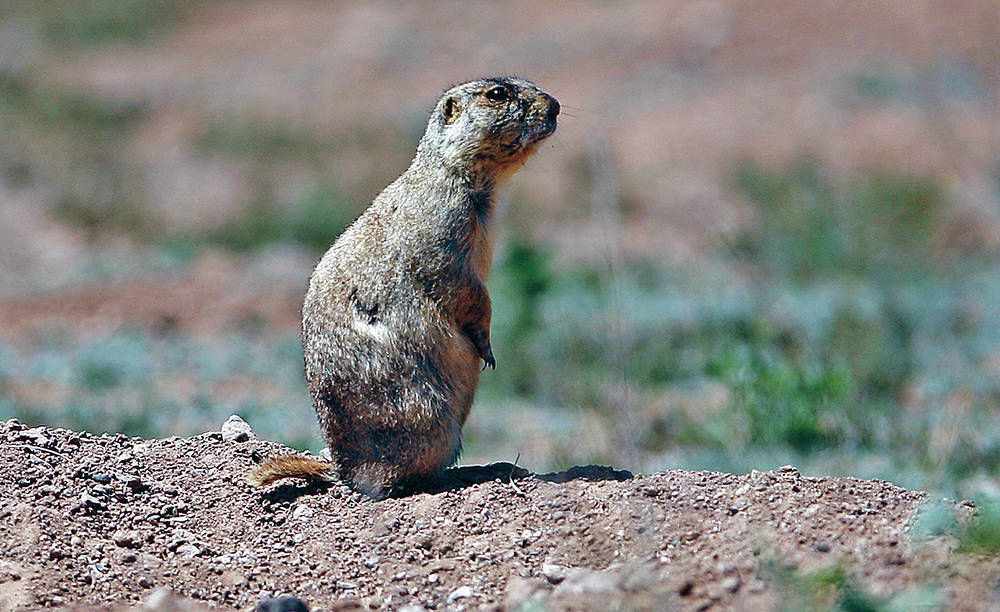
A prairie dog stands watch at the College of Santa Fe in 2009. New Mexican file photo
Why did the Santa Fe New Mexican feel it necessary to give a full feature, with color photos, to another fast-food restaurant, so “unique” on the ticky-tacky sprawl of Cerrillos Road (“Camp Chick-fil-A,” April 19)? No mention of the native wildlife that perished beside it.
There is a small area with trees next to this new fast-food wonder, where prairie dogs lived. Many people enjoyed watching them, some fed them, because this area was so denuded of vegetation, littered with human trash. These prairie dogs were refugees from other development in the area, and had no other place they could escape to when the bulldozers started. Most of them perished due to the construction. No effort was made to help them by the city.
A construction worker at the site reported to me that the city of Santa Fe “had ordered the placement of large rocks over the prairie dog holes” — most likely suffocating many of these animals.
The city has never been kind to prairie dogs. Prairie dogs were once common in the Santa Fe area, but poisoning and senseless development denuded their habitat.
In 2001, the city adopted a prairie dog relocation ordinance that remains part of the land-use code. Rather than killing these animals outright, the city has interpreted the ordinance as an excuse to remove prairie dogs from the city. With continued rampant sprawl, native wild animals don’t stand a chance of survival. As Santa Fe kills off prairie dogs, it also kills burrowing owls, snakes, song birds, trees, etc.
Santa Fe depends on tourism. Visitors marvel at the physical beauty, the “nature” that is still here — but it’s fast disappearing as we concrete everything over.
Mayor Alan Webber says we should be “nature-friendly.” Let’s help him do this by protecting remaining native wildlife. Now that the city of Santa Fe owns the old College of Santa Fe site, the open space should become a preserve for remaining wild species. Among the plethora of plans for the College of Santa Fe “midtown” is a trendy progressive “ecodistrict.”
The city needs to observe the following official ecodistrict guide, which should include prairie dog habitat:
Living Infrastructure
Goal: Enable flourishing ecosystems and restore natural capital.
Objectives: Healthy soils, water, trees and wildlife habitat; accessible nature; natural processes integrated into the built environment.
We must demand the city change its destructive attitude toward native wildlife in the area, protecting existing habitat and creating wildlife-friendly areas for prairie dogs and other wild species to live. The campus site is an excellent place to begin, especially since prairie dogs were poisoned there in the late 1990s. Now is our chance to correct our history of our abuse of nature. If the city of Santa Fe cannot provide protection for its native wildlife and ecosystems, it can no longer claim to be the City Different.
Rosemary Lowe is a wildlife/environmental activist and co-founder of People for Native Ecosystems, among other groups.
BOZEMAN –(Update 4-21-17) MISSOULA- Republican candidate for Montana’s lone seat in Congress, Greg Gianforte came under fire this week over his intentions to go prairie dog hunting with his guest to Montana, Donald Trump Jr.
(see previous story below)
Gianforte took time to talk about his hunt with the first son Friday during his many fundraisers in Montana.
Donald Trump Jr arrived at Glacier Park International Airport in Kalispell with Gianforte and Senator Steve Daines Friday afternoon to a crowd of hundreds of supporters.
For more on the Kalispell event, you can click the link HERE
Later in the afternoon Gianforte and the first son traveled to Hamilton for a rally fundraiser at the Hamilton Fairgrounds. It was there that ABC FOX Montana’s David Winter asked Gianforte about the ‘backlash’ he received about his intentions to do some prairie dog hunting from animal activists.
Gianforte responded to our David Winter by giving a message to those who haven’t tried hunting prairie dogs….”You should try it, because its fun.” the candidate told us.
Also during his speech in Hamilton Gianforte revealed a similar message to his crowd.
His supporters of roughly five hundred people cheered.
We are learning more about Trump Junior’s plans for Saturday morning and it’s sparking some controversy with local environmentalists. The Ravalli Republic reported that Gianforte told a crowd in Hamilton Monday that he plans to take Donald Trump Jr. Out to shoot prairie dogs.
It’s important to note that shooting prairie dogs in Montana is completely legal, but at least one wildlife advocate says it is far from ethical.
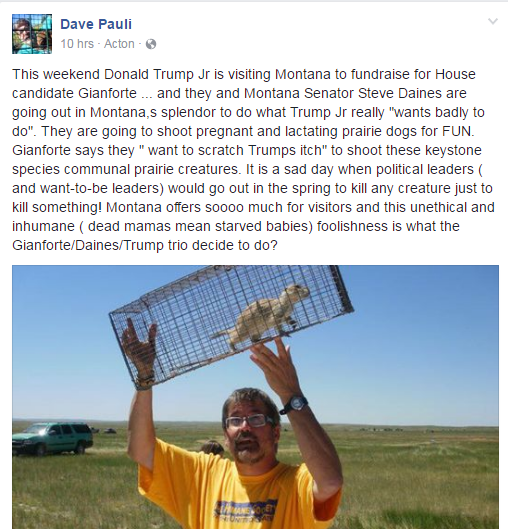
Dave Pauli Senior Advisor for Wildlife Policy with the Humane Society of The United States said, “I was disappointed I guess that any national or international politician or celebrity would have the opportunity to come to Montana in the spring and their first choice of things they want to do is shoot prairie dogs.”
In a Facebook post posted on Wednesday, Pauli voiced his frustrations about the idea of Gianforte and Trump Jr. Spending their time in Montana shooting prairie dogs.
The Facebook post has garnered a lot of attention with more than 300 likes and 400 shares in just a few hours. And there are plenty of comments on both sides of the issue.
Ruth Gessler Farnsworth simply said, “Awful.”
While Jeremy Parish said, “totally legal and encouraged. Just like the coyote slaughter in most states.”
Shane Scanlon Communication Director for Greg Gianoforte says Ginaforte is proud to hunt in Montana. Scanlon released a statement saying…
“Hunting is a big part of gain forte’s life; he’s a sportsman and an outdoorsman and tries to get out when he can. He’s just looking to have a good time with Donald Trump Jr. and shooting some prairie dogs this weekend.”
Pauli says he’d rather see the duo hit a shooting range.
Trump Junior’s first appearance in Montana will be on Friday in Kalispell, from there he will visit Hamilton and close out his trip in Bozeman.
He’s attending several fundraisers for Gianforte who is running against Democrat Rob Quist for Montana’s lone congressional seat.
Your article on SF “parks” covered many of the issues facing this city in terms of how progressive (or not) it may be. Prairie Dogs are native animals which existed in the area long before humans. Many of us have worked with these animals, defended them against long-standing ignorance about them– for a couple of decades.
Nothing much changed since people discovered that the city was systematically poisoning this species (along with birds, and other animals in the process), so parks (really man-made playgrounds) could be developed, along with the ubiquitous strip development, which continues today.
In the late 1990’s 300 people protested in front of city hall in outrage over the massive poisonings going on in the parks, to “get rid of” these native animals.
It is unclear as to whether or not poisoning continues, but the city has always been at odds with this Keystone species, which is blamed for many of the problems facing these manufactured “park” areas, from destruction of trees, irrigation hose, disappearance of grass, etc.
Much of this prejudice is long standing–and in light of what is happening in our country today with the roots of racism still with us, I believe what we do to wild animals is also a form of racism: hating beings, blaming our human-caused problems on “those others” (whether human or non-human), when we know little or nothing about them. The sheer ignorance regarding Prairie Dogs is shameful, in a city which calls itself “progressive.” What is progressive about destroying thousands of native trees & animals for real estate development?
Your article discussed Frenchy’s Field, which was never intended to be a man-made landscape, for every kind of human activity known to man. The city apparently has not educated its staff to understand the importance of Nature–even within the city limits. Children cannot learn to care about Nature if there is no Nature for them to be in.
At least 98% of Prairie Dog populations are gone, due to poisoning, shooting, and rampant development. The small colonies of animals surviving in & around Santa Fe are the refugees from these mindless, destructive human actions. Perhaps Santa Fe needs another protest down at the City Hall–in front of the Statue of St. Francis, looking down at–a Prairie Dog.
An Arizona biologist believes that their sounds should be considered language — and that someday we’ll understand what they have to say.
Con Slobodchikoff and I approached the mountain meadow slowly, obliquely, softening our footfalls and conversing in whispers. It didn’t make much difference. Once we were within 50 feet of the clearing’s edge, the alarm sounded: short, shrill notes in rapid sequence, like rounds of sonic bullets.
We had just trespassed on a prairie-dog colony. A North American analogue to Africa’s meerkat, the prairie dog is trepidation incarnate. It lives in subterranean societies of neighboring burrows, surfacing to forage during the day and rarely venturing more than a few hundred feet from the center of town. The moment it detects a hawk, coyote, human or any other threat, it cries out to alert the cohort and takes appropriate evasive action. A prairie dog’s voice has about as much acoustic appeal as a chew toy. French explorers called the rodents petits chiens because they thought they sounded like incessantly yippy versions of their pets back home.
On this searing summer morning, Slobodchikoff had taken us to a tract of well-trodden wilderness on the grounds of the Museum of Northern Arizona in Flagstaff. Distressed squeaks flew from the grass, but the vegetation itself remained still; most of the prairie dogs had retreated underground. We continued along a dirt path bisecting the meadow, startling a prairie dog that was peering out of a burrow to our immediate right. It chirped at us a few times, then stared silently.
“Hello,” Slobodchikoff said, stooping a bit. A stout bald man with a scraggly white beard and wine-dark lips, Slobodchikoff speaks with a gentler and more lilting voice than you might expect. “Hi, guy. What do you think? Are we worth calling about? Hmm?”
Slobodchikoff, an emeritus professor of biology at Northern Arizona University, has been analyzing the sounds of prairie dogs for more than 30 years. Not long after he started, he learned that prairie dogs had distinct alarm calls for different predators. Around the same time, separate researchers found that a few other species had similar vocabularies of danger. What Slobodchikoff claimed to discover in the following decades, however, was extraordinary: Beyond identifying the type of predator, prairie-dog calls also specified its size, shape, color and speed; the animals could even combine the structural elements of their calls in novel ways to describe something they had never seen before. No scientist had ever put forward such a thorough guide to the native tongue of a wild species or discovered one so intricate. Prairie-dog communication is so complex, Slobodchikoff says — so expressive and rich in information — that it constitutes nothing less than language.
That would be an audacious claim to make about even the most overtly intelligent species — say, a chimpanzee or a dolphin — let alone some kind of dirt hamster with a brain that barely weighs more than a grape. The majority of linguists and animal-communication experts maintain that language is restricted to a single species: ourselves. Perhaps because it is so ostensibly entwined with thought, with consciousness and our sense of self, language is the last bastion encircling human exceptionalism. To concede that we share language with other species is to finally and fully admit that we are different from other animals only in degrees not in kind. In many people’s minds, language is the “cardinal distinction between man and animal, a sheerly dividing line as abrupt and immovable as a cliff,” as Tom Wolfe argues in his book “The Kingdom of Speech,” published last year.
Slobodchikoff thinks that dividing line is an illusion. To him, the idea that a human might have a two-way conversation with another species, even a humble prairie dog, is not a pretense; it’s an inevitability. And the notion that animals of all kinds routinely engage in sophisticated discourse with one another — that the world’s ecosystems reverberate with elaborate animal idioms just waiting to be translated — is not Doctor Dolittle-inspired nonsense; it is fact.
Like “life” and “consciousness,” “language” is one of those words whose frequent and casual use papers over an epistemological chasm: No one really knows what language is or how it originated. At the center of this conundrum is a much-pondered question about the relationship between language and cognition more generally. Namely, did the mind create language or did language create the mind? Throughout history, philosophers, linguists and scientists have argued eloquently for each possibility. Some have contended that thought and conscious experience necessarily predate language and that language evolved later, as a way to share thoughts. Others have declared that language is the very marrow of consciousness, that the latter requires the former as a foundation.
In lieu of a precise definition for language, many experts and textbooks fall back on the work of the American linguist Charles Hockett, who in the 1950s and ’60s proposed a set of more than a dozen “design features” that characterize language, like semanticity — distinct sounds and symbols with specific meanings — and displacement, the ability to speak of things outside your immediate environment. He acknowledged that numerous animal-communication systems had at least some of these features but maintained that only human language boasted them all. For those who think that language is a prerequisite for consciousness, the unavoidable conclusion is that animals possess neither.
To many biologists and neuroscientists, however, this notion smacks of anthropocentrism. There is now a consensus that numerous species, including birds and mammals, as well as octopuses and honeybees, have some degree of consciousness, that is, a subjective experience of the world — they feel, think, remember, plan and in some cases possess a sense of self. In parallel, although few scientists are as ready as Slobodchikoff to proclaim the existence of nonhuman language, the idea that many species have language-like abilities, that animal communication is vastly more sophisticated than Hockett and his peers realized, is gaining credence. “It’s increasingly obvious just how much information is encoded in animal calls,” says Holly Root-Gutteridge, a bioacoustician at the University of Sussex. “There’s now a preponderance of evidence.”
In the 1990s, inspired in part by Slobodchikoff’s studies, the primatologist Klaus Zuberbühler began investigating monkey vocalizations in the dense and cacophonous forests of the Ivory Coast in Africa. Over the years, he and his colleagues discovered that adult male Campbell’s monkeys change the meaning of their screeches by combining distinct calls in specific sequences, adding or omitting an “oo” suffix. Krak exclusively warns of a leopard, but krak-oo is a generalized alarm call; isolated pairs of booms are a “Come this way!” command, but booms preceding krak-oos denote falling tree branches. Studies of songbirds have also uncovered similar complexity in their communication. Japanese great tits, for example, tell one another to scan for danger using one string of chirps and a different set of notes to encourage others to move closer to the caller. When researchers played the warning followed by the invitation, the birds combined the commands, approaching the speaker only after cautiously surveying the area. In the South Pacific, biologists have shown that humpback-whale songs are neither random nor innate: rather, migrating pods of humpback whales learn one another’s songs, which evolve over time and spread through the ocean in waves of “cultural revolution.” And baby bottlenose dolphins develop “signature whistles” that serve as their names in a kind of roll call among kin.
With the help of human tutors, some captive animals have developed especially impressive linguistic prowess. Dolphins have learned to mimic computer-generated whistles and use them as labels for objects like hoops and balls. A bonobo known as Kanzi communicates with a touch-screen displaying hundreds of lexigrams, occasionally combining the symbols with hand gestures to form simple phrases. And over the course of a 30-year research project, an African gray parrot named Alex learned to identify seven colors, five shapes, quantities up to eight and more than 50 objects; he could correctly pick out the number of, for instance, green wooden blocks on a tray with more than a dozen objects; he routinely said “no,” “come here” and “wanna go X” to get what he desired; and on occasion he spontaneously combined words from his growing vocabulary into descriptive phrases, like “yummy bread” for cake.
Slobodchikoff’s studies on prairie dogs have long hovered on the periphery of this burgeoning field. Unknown to Slobodchikoff, around the same time that he began recording prairie-dog alarm calls in Flagstaff, Peter Marler, the renowned animal-communication expert and one of Slobodchikoff’s former professors, was working on a similar study, one that would eventually redefine the field. In the spring of 1977, Marler sent Robert Seyfarth and Dorothy Cheney — a young husband-and-wife duo of primate scientists — to Amboseli, Kenya, to study the alarm calls of small silver-haired monkeys known as vervets. Earlier research had hinted that vervet monkeys produced different vocal warnings for different predators: a kind of bark to warn of a leopard; a low-pitched staccato rraup for a martial eagle; and a high-pitched chutter for a python. Seyfarth and Cheney decided to further investigate these findings in a controlled field experiment.
The two scientists hid a loudspeaker in the bushes near different groups of vervets and played recordings of their alarm calls, documenting the monkeys’ responses. Even in the absence of actual predators, the recordings evoked the appropriate escape strategies. Leopard-alarm calls sent monkeys scampering into the trees. When they heard eagle-alarm calls, they looked up and took cover in the bushes. In response to the warning for snakes, the primates reared up on their hind legs and scanned the ground. Contrary to the consensus of the time, the researchers argued that the sounds animals made were not always involuntary expressions of physiological states, like pain, hunger or excitement. Instead, some animals systematically used sounds as symbols. In both academia and the popular press, vervet monkeys became celebrated mascots for the language-like abilities of animals.
While the vervet research won acclaim, Slobodchikoff’s remained frustratingly sidelined. Marler, Seyfarth and Cheney worked for the well-staffed and moneyed Rockefeller University in New York; Slobodchikoff conducted his studies on a shoestring budget, compiling funds from the university’s biology department, very occasional grants and his own bank account. Slobodchikoff did not collect enough data to formally present his research at a conference until 1986. And it was not until 2006 that he published a study with the same kind of playback techniques that Cheney and Seyfarth used in Kenya, which are essential to demonstrating that an animal comprehends and exploits the variation in its calls. Although many scientists attended Slobodchikoff’s talks at conferences and spoke with him about his research in private, they rarely referenced his studies when publishing their own. And despite a few news stories and nature documentaries, prairie dogs have not secured a seat in public consciousness as a cognitively interesting species.
It did not take long for Slobodchikoff to master the basic vocabulary of Flagstaff’s native prairie dogs. Prairie-dog alarm calls are the vocal equivalent of wartime telegrams: concise, abrupt, stripped to essentials. On a typical research day, Slobodchikoff and three or four graduate students or local volunteers visited one of six prairie-dog colonies they had selected for observation in and around Flagstaff. They usually arrived in the predawn hours, before the creatures emerged from their slumber, and climbed into one of the observation towers they had constructed on the colonies: stilted plywood platforms 10 feet high, covered by tarps or burlap sacks with small openings for microphones and cameras. By waiting, watching and recording, Slobodchikoff soon learned to discriminate between “Hawk!” “Human!” and so on — a talent that he says anyone can develop with practice. And when he mapped out his recordings as sonograms, he could see clear distinctions in wavelength and amplitude among the different calls.
He also discovered consistent variations in how prairie dogs use their alarm calls to evade predators. When a human appeared, the first prairie dog to spot the intruder gave a sequence of barks, which sent a majority of clan members scurrying underground. When a hawk swooped into view, one or a few prairies dogs each gave a single bark and any animal in the flight path raced back to the burrow. (Slobodchikoff suspects that, because of a hawk’s speed, there’s little time for a more complex call.) The presence of a coyote inspired a chorus of alarm calls throughout the colony as prairie dogs ran to the lips of their burrows and waited to see what the canine would do next. When confronted with a domestic dog, however, prairie dogs stood upright wherever they were, squeaking and watching, presumably because tame, leashed dogs were generally, though not always, harmless.
Something in Slobodchikoff’s data troubled him, however. There was too much variation in the acoustic structure of alarm calls, much more than would be expected if their only purpose was to distinguish between types of predator. Slobodchikoff arranged for various dogs — a husky, a golden retriever, a Dalmatian and a cocker spaniel — to wander through a prairie-dog colony one at a time. The recorded alarm calls were still highly variable, even though the intruders all belonged to the same predator class. “That led me to think, What if they are actually describing physical features?” Slobodchikoff remembers. What if, instead of barking out nouns, prairie dogs were forming something closer to descriptive phrases?
To find out, he became a participant in his own experiment. Slobodchikoff and three colleagues paraded through two prairie-dog colonies dressed in either jeans and white lab coats, or jeans and variously colored shirts: blue, gray, orange, green. The prairie dogs produced highly similar alarm calls for each person in the lab coat, except for one especially short researcher. But they chirped in very different ways for most of the different colored shirts. In a related experiment, three slender women differing in height by just a bit meandered through a prairie-dog habitat dressed identically except for the color of their T-shirts. Again the animals varied their calls. And in another study, prairie dogs changed the rate of their chirping to reflect the speed of an approaching human.
If prairie dogs had sounds for color and speed, Slobodchikoff wondered, what else could they articulate? This time, he and his colleagues designed a more elaborate test. First they built plywood silhouettes of a coyote and a skunk, as well as a plywood oval (to confront the prairie dogs with something foreign), and painted the three shapes black. Then they strung a nylon cord between a tree and an observation tower, attached the plywood figures to slotted wheels on the cord and pulled them across the colony like pieces of laundry. Despite their lack of familiarity with these props, the prairie dogs did not respond to the cutouts with a single generalized “unknown threat” call. Rather, their warnings differed depending on the attributes of the object. They unanimously produced one alarm call for the coyote silhouette; a distinct warning for the skunk; and a third, entirely novel call for the oval. And in a follow-up study, prairie dogs consistently barked in distinct ways at small and large cardboard squares strung above the colony. Instead of relying on a fixed repertory of alarm calls, they were modifying their exclamations in the moment to create something new — a hallmark of language Hockett called “productivity.”
According to news reports, Donald Trump Jr. spent Earth Day shooting prairie dogs in Montana. His guide was Greg Gianforte, a Republican candidate for Congress and himself a hunting enthusiast. Prairie dogs are not killed to be eaten, but strictly for fun.
Fun? What’s wrong with these people? How can killing defenseless rodents in their natural habitat be seen as fun? This fact further underscores how pathetic and callous the Trump family is. C’mon, Don Jr., really?!
Trump Junior’s plans for Saturday morning in Montana causing controversy
BOZEMAN –We are learning more about Trump Junior’s plans for Saturday morning and it’s sparking some controversy with local environmentalists. The Ravalli Republic reported that Gianforte told a crowd in Hamilton Monday that he plans to take Donald Trump Jr. Out to shoot prairie dogs.
It’s important to note that shooting prairie dogs in Montana is completely legal, but at least one wildlife advocate says it is far from ethical.
Dave Pauli Senior Advisor for Wildlife Policy with the Humane Society of The United States said, “I was disappointed I guess that any national or international politician or celebrity would have the opportunity to come to Montana in the spring and their first choice of things they want to do is shoot prairie dogs.”
In a Facebook post posted on Wednesday, Pauli voiced his frustrations about the idea of Gianforte and Trump Jr. Spending their time in Montana shooting prairie dogs.
The Facebook post has garnered a lot of attention with more than 300 likes and 400 shares in just a few hours. And there are plenty of comments on both sides of the issue.
Ruth Gessler Farnsworth simply said, “Awful.”
While Jeremy Parish said, “totally legal and encouraged. Just like the coyote slaughter in most states.”
Shane Scanlon Communication Director for Greg Gianoforte says Ginaforte is proud to hunt in Montana. Scanlon released a statement saying…
“Hunting is a big part of gain forte’s life; he’s a sportsman and an outdoorsman and tries to get out when he can. He’s just looking to have a good time with Donald Trump Jr. and shooting some prairie dogs this weekend.”
Pauli says he’d rather see the duo hit a shooting range.
Trump Junior’s first appearance in Montana will be on Friday in Kalispell, from there he will visit Hamilton and close out his trip in Bozeman.
He’s attending several fundraisers for Gianforte who is running against Democrat Rob Quist for Montana’s lone congressional seat.
Environmentalists praised the three-judge appeals court panel’s decision overturning an earlier ruling and protecting the foot-long rodents, which property rights activists say threaten farm animals and development with their massive underground colonies.
“This is huge, not only for the prairie dog but for the Endangered Species Act,” Michael Harris, legal director for Friends of Animals, a conservation group involved in the case, said in a phone interview Wednesday.
The plaintiffs in the case, People for the Ethical Treatment of Property Owners, had argued that the federal government did not have authority over a species that existed only in one state.
They said that while they acknowledge the importance of the species, known to build vast underground networks of tunnels, which have been found under cemeteries and golf courses, they would ask for a review of the panel’s decision by the full court.
“Let it be on the prairie, let it be on land away from the developments,” Brett Taylor, the group’s vice president, told Reuters.
Distinguished by a black “eyebrow” marking over each eye, Utah prairie dogs numbered about 95,000 around 1920, but by 1972 their population had fallen to about 3,300 due to disease and people killing them.
The extremely social species was declared endangered the following year, but after its numbers grew again it was reclassified as threatened. Populations remain precariously low, according to the National Park Service.
Wednesday’s ruling affirmed the existing standard of allowing the federal government to limit local development using the Endangered Species Act, the 1973 law intended to protect species at risk of extinction.
In the majority opinion, Judge Jerome Holmes wrote that overturning the earlier ruling was in line with actions by previous circuit courts, which have ruled uniformly to protect the Endangered Species Act in similar cases.
(Reporting by Tom James in Seattle; Editing by Patrick Enright and Andrew Hay)


 Exposing the Big Game