Exposing the Big Game

Forget Hunters' Feeble Rationalizations and Trust Your Gut Feelings: Making Sport of Killing Is Not Healthy Human Behavior

Exposing the Big Game

Trump Jr. heads to Iowa for hunting weekend and campaign fundraiser with Rep. King


http://abcnews.go.com/Politics/trump-jr-heads-iowa-hunting-weekend-campaign-fundraiser/story?id=50792141&cid=share_facebook_widget

Donald Trump Jr. is the guest of honor at Iowa Republican Rep. Steve King‘s annual two-day Col. Bud Day Pheasant Hunt, which began Saturday.

Interested in Donald Trump Jr.?

Add Donald Trump Jr. as an interest to stay up to date on the latest Donald Trump Jr. news, video, and analysis from ABC News.

Add Interest

The hunt takes place at the Hole ‘N the Wall Lodge in Akron, Iowa and includes a campaign fundraiser for King, so having the president’s eldest son in attendance is undoubtedly a get.

“If Donald Trump Jr. defends 2nd Amendment as well as he shoots, we have nothing to worry about,” King tweeted Saturday, along with a photo of himself and Trump Jr. at the Hole ‘N the Wall Lodge.

According to the Des Moines Register, Trump Jr. didn’t bring his own gun because he flew to Iowa on a commercial flight, so he hunted with a loaned 12-gauge semi-automatic model.

The newspaper reported that Trump Jr. shot at least four pheasants and was joined by about 30 other hunters. “He is a very, very good shot,” King said. “It was a beautiful, clear day in Iowa, and the sky was so full of feathers that one could be convinced that the angels were having pillow fights.”

While King spoke to reporters on Saturday, Trump Jr. did not. But, that wasn’t the case with Trump’s hunting buddies.

“We sat up there for an hour and a half — maybe longer than that — and Don Jr. just held court. It was a lot of fun,” King told Sioux City, Iowa, ABC affiliate KCAU.

About a hundred guests turned up for the Saturday night pork chop and deep-fried pheasant dinner at the lodge.

“Tonight we’re going to have Iowa chops — these are special Iowa chops that are injected with the mysterious formula that comes out of the Remsen locker — they’re the best chops in the world and I’m already starting to drool,” King told KCAU. “And we’ll have a big batch of Iowa sweet corn, every kernel cut off with love in the kitchen by Marilyn or me.”

Women hunter numbers in Wyoming increase as male participate drops slightly

http://trib.com/lifestyles/recreation/women-hunter-numbers-in-wyoming-increase-as-male-participate-drops/article_ef24ac27-75cf-5707-8f3e-7410dac35cbd.html

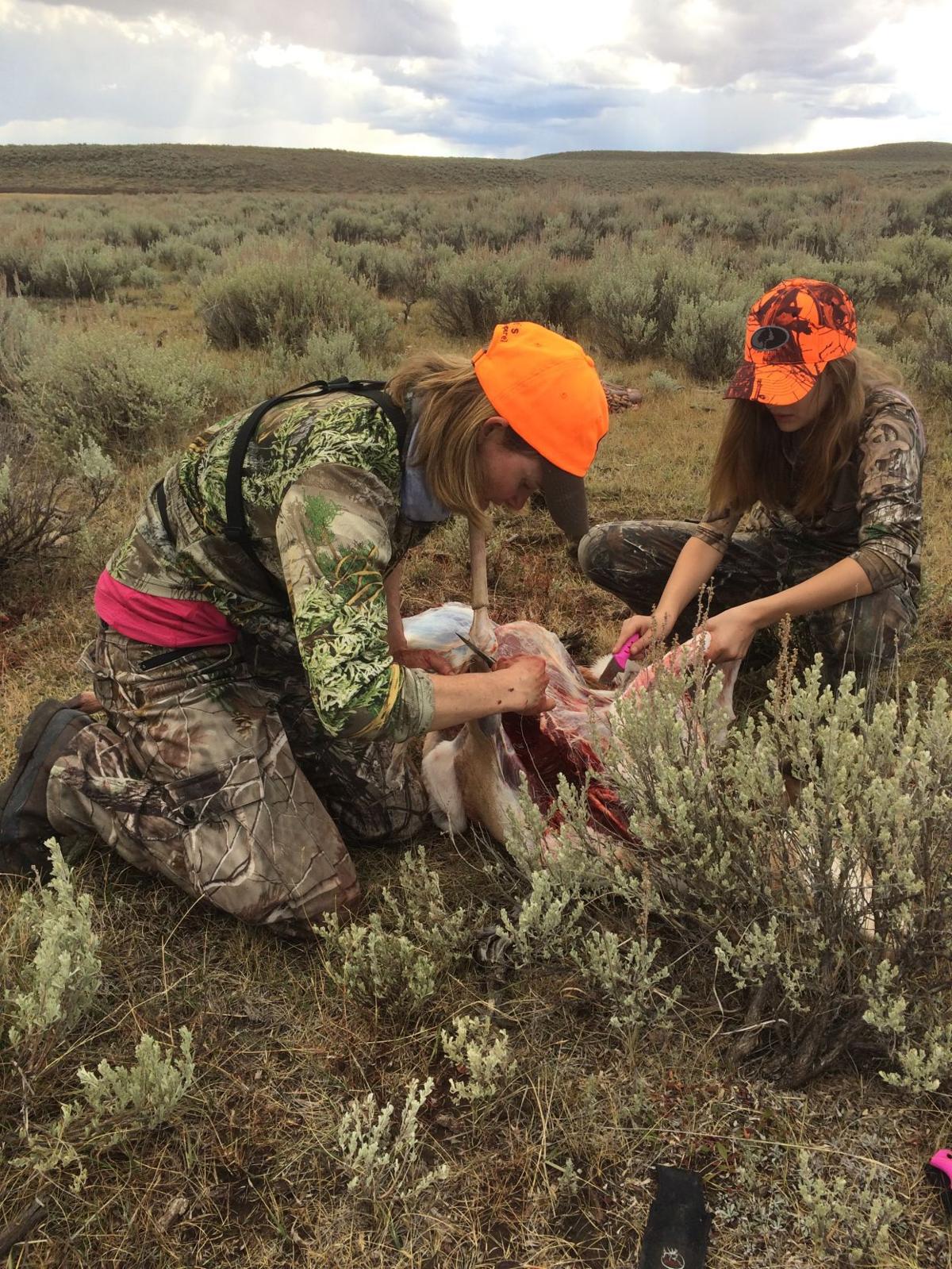
Lily Lonneker dropped her first pronghorn at 12 years old.

She rested in the grass next to her mom as they watched a a doe and a buck. And in one shot, Lily killed the doe.

“I felt really proud of myself. I didn’t know I could do that since it was my first one,” Lily said recently. “It is fun when you get an animal to know you’re feeding your family, and you know the animal died in a humane way.”

Now 14, Lily plans to chase a bull elk this year outside Jackson.

In a sport historically dominated by men, who pass their skills along to sons, stories like Lily’s are becoming ever more common.

Between 2008 and 2016, female resident hunters went from 11,189 to 14,770. Male resident hunters during the same period dropped ever so slightly from 64,649 to 64,371, according to the Wyoming Game and Fish Department.

“Wyoming is one of the states where we’re not losing resident hunters,” said Kathryn Boswell, hunter and angler participation coordinator for the department. “Our numbers are going up, and it’s because women are increasing, and they’re making up the difference.”

Boswell, who is also a founding member of the Wyoming Women’s Antelope Hunt, doesn’t have hard data explaining the increase in women hunters. But she has a few theories from what she’s heard from other women.

“It’s something they can do with their families. They want to put organic meat on the table,” she said. “And there’s a camaraderie that comes with it.”

University of Wyoming student Lexi Daugherty agrees. She’s been hunting with her father most of her life and shot a pronghorn in 2015 at the Women’s Antelope Hunt.

The 18-year-old believes improving access to hunting will also help create more conservationists. She spent the last two years working with the Rocky Mountain Elk Foundation and Game and Fish to secure a 20-acre piece of ground near Jackson that opens access to almost 17,000 acres of public land.

“Now it will be there forever, for young girls like me to go hunting on it,” she said. “And it’s something that’s really special to me.”

Hunting also teaches her skills to stay safe in the woods and find food for herself.

Casper teen Krysten Cutler started hunting and fishing with her grandfather, Dale Leatham, who has taken her across Wyoming and the world to chase wildlife.

The two went on a safari to Africa in June with other family members. The 12-year-old shot four African animals including a zebra and impala.

“Why not encourage young ladies to go hunting and fishing?” Leatham said. “It’s something you can do the rest of your life. And it doesn’t cost that much. You can always go hunting and fishing.”

For Krysten, hunting means more time with her grandpa.

“He teaches me, and I like doing it because it’s something to get us outdoors,” she said. “It bonds our relationship.”

The meat from her African animals went to local villagers, though she was able to try each species. A deer she shot recently is at the processor.

“People say that men usually only hunt, but clearly that’s not true,” she said. “I was 12 when I shot my first antelope and I know a lot of other girls who shot their first antelope when they were 12, and it should start evolving.”

Lily, the hunter from Jackson, isn’t sure after this year how much more she’ll hunt. She doesn’t have the same passion for the sport as her mom does. But she also believes in it as a way for women to stay self-sufficient.

Her mom, Gloria Courser, knows that whatever path her daughter chooses, she will be able to take care of herself in the woods.

When Courser started dating her husband in 2006, she didn’t have those skills.

“We were on a game trail and about 20 minutes in he looked back at me and said ‘Where’s the truck?’” she said. “I looked like the scarecrow on the Wizard of Oz. It was a truly teachable moment. I was out of my element.”

The next time they went, she knew where the truck was. And this fall, she was a guide for the Women’s Antelope Hunt.

Not every woman will have a passion for hunting, she said.

“It’s like when I moved away from home, I learned to change my oil. I did it one time, and decided I wouldn’t do it ever again if I didn’t have to,” she said. “But trying, learning to do it, learning how to use a firearm, understanding where meat comes from, is important.”

Michigan House approves crane hunting resolution to address overpopulation

https://www.clickondetroit.com/news/michigan-house-approves-crane-hunting-resolution-to-address-overpopulation

[No, the articles’ title doesn’t mean they think enough hunters will shoot themselves or each other in accidents during their newly proposed crane hunt that it will impact the out of control human population in the slightest bit. Unfortunately they meant that hunting canes them might keep their numbers down where humans want them.]

Michigan Rep. Jim Lower calls for Sandhill crane hunting

DETROIT – Michigan Rep. Jim Lower, of Cedar Lake, praised his colleagues in the Michigan House of Representatives for approving his resolution calling for a hunting season to address Sandhill crane overpopulation.

House Resolution 154 encouraged the Michigan Natural Resources Commission to add Sandhill cranes to the game species list and sought approval from the U.S. Fish and Wildlife Service for a hunting season in Michigan.

“I’m hopeful that the Natural Resources Commission will move forward with the idea and create a Sandhill crane hunt,” Lower said. “The establishment of a hunting season will help control the population and limit damage to local farms, where corn and wheat plants serve as a food source for the birds.”

Michigan is home to an increasing population of Sandhill cranes, with an estimated 23,082 reported in Michigan’s 2015 population survey, officials said.

Over the past 10 years, the population has grown an average of 9.4 percent annually, officials said.

While Michigan farmers are allowed to obtain nuisance permits to kill Sandhill cranes causing crop damage on their farms, Lower said the permits do not provide a solution to the overpopulation problem.

Lower said birds killed with nuisance permits are a wasted resource, as their meat cannot be harvested.

Sixteen states currently allow Sandhill crane hunting during certain seasons.

“A number of states already hunt Sandhill cranes, and their population continues to climb, along with reports of crop damage caused by cranes,” Lower said. “Still, hunting is the best tool we have to manage the population as a whole, and it’s time to utilize it in Michigan.”

Donald Trump Jr. to join Steve King for Iowa pheasant hunt

Donald Trump Jr. to join Steve King for Iowa pheasant hunt
More

Donald Trump Jr. will be in Iowa next month to join U.S. Rep. Steve King for the congressman’s annual pheasant hunt. “Happy to announce @DonaldJTrumpJr will be hunting with us this year at my annual Col. Bud Day Pheasant hunt on opening weekend of Oct. 28th,” King posted to Twitter on Monday. A campaign spokesperson confirmed Trump’s attendance at the event, which marks the start of Iowa’s pheasant season. Trump Jr. is President Donald Trump’s eldest son. He has been a prominent campaign surrogate for his father and took over management of the Trump Organization following his father’s inauguration. Trump Jr. has come under fire after it was revealed he met with a Kremlin-linked attorney during

Alberta not likely to follow through with spear hunt ban until fall 2018

‘The legislation would refer to firearms and archery equipment as the only permitted weapons to be used.’

The Canadian Press Posted: Sep 21, 2017

Alberta does not expect to make good on a promise to ban what it has called the archaic practice of spear-hunting until at least next fall as it considers rule changes that could include prohibiting other methods of taking big game.

The government made the pledge in August 2016 after an online video surfaced showing an American hunter throwing a spear at a black bear in northern Alberta and then cheering to celebrate his kill.

People around the world reacted angrily to the video. Some called the use of a spear barbaric.

Matt Besko, director of wildlife policy for Alberta Environment, said the province is looking at updating regulations that already spell out rules for standard hunting weapons such as firearms and bows, but say nothing about other methods.

“It is not just about spears,” Besko said. “When we looked at our legislation, there are other potential inhumane or unethical methods that could be used.

“The legislation would refer to firearms and archery equipment as the only permitted weapons to be used to harvest game species in Alberta. All other methods would be prohibited.”

Some other non-standard hunting methods include the atlatl, a kind of stick a hunter can use to throw a dart or a short spear at prey.

Using rocks to kill game or running an animal to the point of exhaustion or death could be prohibited under changes.

Besko said Alberta began surveying the public about non-standard hunting methods in 2014.

‘Very small’ segment of hunting community

There was already opposition to the use of spears before the government received a storm of angry letters, emails and social media comments about the 2016 bear video.

“The large majority of respondents to that survey disagreed with the use of those so-called non-standard weapons, including spears,” he said.

“There is a segment of the hunting community — and it is a very small component — that actually use spears and atlatls.”

The government has been getting some pushback.

Earlier this year, the Alberta Fish and Game Association approved a motion that called on the province to maintain legal spear and atlatl hunting.

Martin Sharren, the association’s vice-president, said there aren’t a lot of people who use spears, but the organization is wary of hunting restrictions.

“It is another hunting opportunity that if it gets taken away, it gets taken away,” he said.

Brent Watson, president of the Alberta Bowhunters Association, said his members have different views on spear-hunting and clear rules are needed to ensure that animals are hunted humanely.

Besko said no final decisions have been made and the government could include hunting rule changes as part of a broader update to Alberta’s Wildlife Act.

Draft proposals are to be presented to the government within a year.

“The earliest that a decision could be made would be for the fall of 2018 and that is if all things would align in terms of the external review process.”

Josh Bowmar, the hunter who killed the bear with the spear, was not charged after the province determined that he had legally harvested the animal.

http://www.cbc.ca/news/canada/edmonton/spear-hunting-albetra-1.4301433

Hunting is down in the US. The Trump administration wants to change that

http://www.cnn.com/2017/09/22/politics/hunters-ryan-zinke-interior/index.html

STORY HIGHLIGHTS

  • There are 2.2 million fewer hunters in America now than in 2011
  • Zinke was recommended by Donald Trump Jr., an avid hunter
  • Last week Zinke issued a new secretarial order designed to increase access to various public lands for hunters and fishers

Washington (CNN)Toy gun grasped firmly in his hand and a grin plastered wide across his face while he played “Big Buck Hunter Pro,” Ryan Zinke could have been a kid at an arcade. But the Interior secretary and former congressman was actually in the department cafeteria showing off the arcade game installed to commemorate hunting season.

“To highlight #sportsmen contributions 2 conservation I installed Big Buck Hunter in the employee cafeteria. Get excited for #hunting season!” Zinke tweeted from his personal account Tuesday.
But Zinke is not toying around when it comes to his support of hunters and fishers.
Hunting in the United States is down. A US Fish and Wildlife Service survey released last week found that there are 2.2 million fewer hunters in America now than in 2011. And the new administration is poised to change that.
On his first day in office back in March, Zinke issued two orders, one which overturned a recent ban of lead ammunition and fish tackle on Fish and Wildlife Service lands and waters. Last week Zinke issued another secretarial order designed to increase access to various public lands for hunters and fishers.
Zinke’s passion for expanding hunting rights on public lands is both personal and political. A Montanan, the secretary has been known to hunt in his spare time. During his short stint in Congress, he was a member of the Congressional Sportsmen’s Foundation. He was spotted attending their annual dinner last Wednesday, a source told CNN, just two days before he issued the most recent secretarial order.
“What really kind of expedited this whole thing, was last week the US Fish and Wildlife put out a survey saying that hundreds of Americans were enjoying the outdoors, but within that survey they found that hunting was down,” Heather Swift, Interior spokesperson said when asked about last week’s secretarial order. “And the big thing that the secretary hears over and over again is that people just don’t have access to land.”
Politically Zinke also owes a lot to hunting, angler and conservation lobbyists who were largely responsible for supporting him for the position of Interior Secretary earlier this year. The issue was especially important to Donald Trump’s son Don Jr., an avid hunter and active member of the Boone and Crocket Club, who helped with the search for Interior secretary.
“Mr. Zinke was the pick of the litter, not the best litter ever, but he was definitely the pick and that’s why we advocated for him and that’s why Jr. advocated for him as well,” said Land Tawney, the president of the Montana-based Backcountry Hunters & Anglers, a non-profit sportsmen’s organization.
Zinke and the Interior have recently made a big show of their support of hunting groups. In addition to the “Buck Hunter” game he gifted Interior employees, the department declared Thursday that October would be National Hunting and Fishing Month.
The declaration also generated the support of the National Rifle Association.
“Hunters, anglers, and target shooters are the best conservationists who contribute so much through the Pittman-Robertson and Dingell-Johnson Acts,” said Richard Childress, NRA vice president. “Last year, they contributed $1.2 billion toward conservation and protecting our natural resources. We need more mentors taking young people out and teaching them to hunt and fish, so I’m glad Secretary Zinke is promoting hunting and fishing at the federal level.”
But despite Zinke’s clear efforts to woo hunters and anglers, not all of his decisions have gone over well with the conservationist-minded group. For example, Zinke’s leaked recommendationsto the White House to shrink the boundaries of national monuments and open up some of the land to the fossil fuel industry and loggers — first reported Sunday by the Wall Street Journal — were met with opposition and confusion.
“With what’s leaked it’s super troubling. Any reduction on these monuments is an attack on the Antiquities Act,” said Tawney. “All monuments are at risk now. They can become political footballs in our eyes.”
Conservationists who want to expand their access to hunting on public park lands and at monuments are as weary of opening up national park land to fossil fuel industries as environmentalists are, since both value sustaining the land as is.
“We can have all the access we want to a concrete parking lot, but that access doesn’t mean anything if that fish and wildlife habitat isn’t there,” said Tawney.
Another pro-hunting group says what they are seeing within Interior is a fight between access and conservation.
“On the access front the department has been good. Access to our own public lands is a lot harder today than it ever has been, and that is in part introduced with the decline in hunting numbers we’ve seen,” said Whit Fosburgh, president and CEO of the Theodore Roosevelt Conservation Partnership, a non-profit coalition of conservation organizations and outdoor related businesses.
“On the conservation side however, I think it’s a much less rosy picture,” Fosburgh said. “It’s been a lot more about expanding development, opening up to oil and gas. There has been no proactive conservation vision espoused for our public lands.”
Fosburgh said that the hunting community started getting “a little bit critical” of Zinke after he first announced the National Monument Review earlier this year. And he’s skeptical of just how far the secretarial order will go.
“They use hunting and fishing for an excuse for our changes in monuments,” he said. “All of the ones under review already allow hunting and fishing very clearly.”
Fosberg’s criticism is similar to what environmental groups said following the secretarial order last week.
“Don’t be fooled: the Trump Administration is pretending to be granting hunting and fishing rights that are already guaranteed by law and policy,” said a statement from the Center for American Progress, a left-leaning thing tank. “The real story is that, with this announcement, the Trump administration is trying to create a distraction from their plans to dramatically reduce the size of America’s national monuments, which would be the largest elimination of protections on wildlife habitat in US history.”
Nevertheless, Fosburgh said most pro-hunting and conservation minded groups are still hoping for the best with the Trump administration.
“We’re very prepared, and we have been from day one. We supported his nomination and we are prepared to work with Secretary Zinke,” he said. “We’re not going to just say it’s a lost cause in September of the first year of the administration.”

Signable Petition Demands Zinke to Reject HJR 69, Trump’s Bear Cub/Wolf Pup Killing Bill

Best to click on url:

http://www.environews.tv/world-news/signable-petition-demands-zinke-reject-hjr-69-trumps-bear-cubwolf-pup-killing-bill/

(EnviroNews World News) — PETITION WATCH: The Center for Biological Diversity (the Center) has launched an online petition via the Care2 platform demanding …

Signable Petition Demands Zinke to Reject HJR 69, Trump’s Bear Cub/Wolf Pup Killing Bill

Save40Share

(EnviroNews World News) — PETITION WATCH: The Center for Biological Diversity (the Center) has launched an online petition via the Care2 platform demanding Department of the Interior (Interior) Secretary Ryan Zinke “deny any request by Alaska for predator control in wildlife refuges.” This, after House Joint Resolution 69 (HJR 69) was signed into law on April 3, 2017, by President Donald Trump.

The highly controversial bill rescinded the U.S. Fish and Wildlife Service’s (USFWS) Alaska National Wildlife Refuges Rule (Refuge Rule) which defaults wildlife management on Alaska’s 16 national refuges to the Alaska Board of Game (BOG). BOG’s wildlife management plan includes what is know as the Intensive Management Law (IM) — a code that allows extreme predator hunting methods such as killing bear sows with cubs, shooting predators from helicopters, luring bears to bait stations and shooting them pointblank, using steel-jaw traps for bears and killing wolves with pups in their dens.

The Center writes in its petition:

President Donald Trump recently signed a cruel bill into law repealing protections for wolves, bears and other wildlife on Alaska’s national wildlife refuges. The law – rushed through Congress under the Congressional Review Act (CRA) — repealed an Obama Administration rule that prohibited killing wolves and their pups in their dens, gunning down bears at bait stations and shooting them from airplanes. And it’s all in an attempt to artificially boost caribou numbers to placate sport hunters.

So far, the Center’s petition has gathered nearly 29,000 signatures and is growing fast online. The Center also points out that it recently filed a lawsuit against the Trump Administration over HJR 69, which it says is “no ordinary lawsuit” because it challenges the constitutionality of the CRA itself, alleging the 1996 law violates separation of powers laws inherent to the U.S. Government.

Interior Secretary Ryan Zinke’s Hunting And Fishing Revival

https://www.americas1stfreedom.org/articles/2017/9/12/interior-secretary-ryan-zinke-s-hunting-and-fishing-revival/

Interior Secretary Ryan Zinke's Hunting And Fishing Revival

Interior Secretary Ryan Zinke is leading a revival. It’s not the kind that occurs under a big tent full of folding chairs, fiery sermons and hallelujahs, but the kind that occurs when hunters, fishermen and outdoorsmen in general feel liberated from the shackles of an overbearing federal government; when they experience anew the freedom to take their guns and gear into America’s wild places and fish and hunt the way their fathers and grandfathers fished and hunted before them.

Zinke set the tone for this revival on his first day as Interior Secretary. He did so by repealing the Obama administration’s lead ammunition ban—a ban which served as a last slap in the face to hunters and fishermen everywhere.

Zinke set the tone for this revival on his first day as Interior Secretary.The Obama-era ban was contained in National Fish and Wildlife Service’s Director’s Order 219. The order came from Director Dan Ashe and required regional directors to work with state-level agencies to begin phasing out the use of lead ammunition on federal land. This included requiring the “Assistant Director, Migratory Birds, in consultation with National Flyway Councils and individual states, … [to] establish a process to phase in a requirement for the use of nontoxic ammunition for recreational hunting of mourning doves and other upland game birds.”

The Obama administration avoided calling the order an all-out ban by fashioning it so that its implementation occurred over a period of time rather than all at once.

On March 3, 2017, Breitbart News reported that Zinke had repealed the ban, and that the repeal was one of his first actions as interior secretary.

The reason Zinke made this one of his top priorities upon taking office is that he understands that hunters and fishermen are a crucial part of wildlife conservation: They preserve a balance in nature whereby fish and wildlife are kept at sustainable levels, rather than being able to overpopulate and ruin food supplies and habitat. And he also understands that hunters and fishermen bring a tremendous amount of money into the U.S. economy annually.

On Sept. 1, 2017, Fox News published a column by NRA-ILA’s Chris W. Cox, in which Cox observed:

Zinke knows that America’s hunters and anglers are the backbone of successful fish and wildlife management in the United States. In 2016 alone, $1.1 billion in hunter and angler excise revenues was invested by the 50 state fish and wildlife agencies to fund wildlife projects benefiting all wildlife—game and non-game species alike.

Crucially, Zinke also acknowledges the role hunting and fishing play as traditions in America. For example, a childhood in a state like Kentucky is marked by the time a son and his father spend getting ready for hunting season. They plan the hunt, tend the food plot, build the tree stand, study the movement and habits of the deer, then go out on opening day intent on bringing home food the family can eat and stories the father and son will share for the rest of their lives.

Cox put it this way:

[Zinke] also understands … within our own local communities, hunting and angling is an important tradition that’s often passed down through the generations and enjoyed by the entire family, helping to forge lifelong support of wildlife conservation and the full appreciation of our fish and wildlife resources.

In short, Zinke’s convictions about the importance of hunting and fishing mean more opportunities for outdoorsmen. This is seen via announcements like the Department of the Interior’s Aug. 9, 2017, announcement that Secretary Zinke was expanding “hunting and fishing opportunities at 10 national wildlife preserves.”

This expansion will result in responsible conservation practices, money for the U.S. economy and traditions that link generations together over time.

AWR Hawkins is the Second Amendment columnist for Breitbart News and host of Bullets with AWR Hawkins, a Breitbart News podcast

Interior Department, key House Republicans maneuver to open National Park Service lands to killing grizzly bears, wolves

https://blog.humanesociety.org/wayne/2017/08/interior-department-key-house-republicans-maneuver-open-national-park-service-lands-aerial-gunning-grizzly-bears.html

In April, President Trump signed a resolution, enabled by the Congressional Review Act and passed by Congress on a near party-line vote, that repealed a U.S. Fish and Wildlife Service (USFWS) rule restricting particularly cruel and unsporting methods of killing grizzly bears, wolves, and other predators on national wildlife refuges in Alaska. There are now multiple indications that the Trump administration and some allies in Congress are gearing up to unwind a nearly identical rule, approved nearly two years ago, that restricts these appalling predator-killing practices on 20 million acres of National Park Service (NPS) lands in Alaska. Our humane community nationwide must ready itself to stop this second assault on a class of federal lands (national preserves) set aside specifically to benefit wildlife.

Today, the Sacramento Bee’s Stuart Leavenworth broke the story that Public Employees for Environmental Responsibility (PEER) had obtained a leaked memo that appears to show that senior political appointees at the Department of the Interior have barred top officials at NPS from speaking out against a widely circulated draft bill in Congress – the SHARE Act – that includes a provision to repeal the parks rule. The bill, which will be assigned to the House Committee on Natural Resources, contains a host of anti-wildlife provisions. Top officials at NPS reviewed the bill and objected to many provisions, and memorialized those objections in an internal memo. A senior Interior Department official sent back the memo to the NPS officials with cross-out markings on nearly all of the objections raised by the NPS. That helps explain why lawmakers on Capitol Hill have not heard a negative word from the NPS about this legislative package and its provisions that amount to an assault on the wildlife inhabiting Alaska’s national preserves.

Several weeks prior, Interior Secretary Ryan Zinke had signaled his desire to reopen the NPS predator control rule, with an eye toward changing and even gutting it. The rule passed with almost no dissent when NPS adopted it in October 2015.

In short, there is a double-barreled attack on the rule, and the administration seems to be locked and loaded on both strategies – one legislative and the other executive.

In March, the House voted 225 to 193 in favor of H.J. Resolution 69, authored by Alaska’s Rep. Don Young, to repeal the USFWS rule on predator killing. Those 225 members voted to overturn a federal rule – years in the works, and crafted by professional wildlife managers at the U.S. Fish and Wildlife Service – to stop some of the most appalling practices ever imagined in the contemporary era of wildlife management. Denning of wolf pups, killing hibernating bears, baiting grizzly bears, and trapping grizzly and black bears with steel-jawed leghold traps and snares. It’s the stuff of wildlife snuff films.

Just weeks later, the Senate followed suit, passing S.J.R. 18 by a vote of 52 to 47. I was so proud of New Mexico Senator Martin Heinrich, himself an ardent sportsman, and Sens. Dick Blumenthal, D-Conn., Cory Booker, D-N.J., Maria Cantwell, D-Wash., and Tom Udall, D-N.M., for deconstructing the phony arguments advanced by the backers of the measure. If they had been arguing the case in front of a jury, they would have carried every fair-minded juror considering the evidence and honoring a standard of decency. They eviscerated the phony states’ rights arguments advanced by their colleagues. Their false subsistence hunting arguments. Their inaccurate representations of the views of Alaskans.

President Trump then signed H.R. Res. 69/S.J.R. 18 and repealed the USFWS rule.

The USFWS rule was at particular risk because it had been adopted in 2016, and the Congressional Review Act allows Congress and the president to nullify recently adopted rules with simple majority votes in both chambers and no committee review of the measures. The nearly identical NPS rule came out a year earlier and the CRA doesn’t apply to such long-standing rules. In short, the Department of the Interior could weaken the rule by opening a new rulemaking process, or Congress could repeal it (albeit without the expedited review and also perhaps without a simple majority vote in the Senate).

Today’s reporting by the Sacramento Bee, and the work of PEER, have sent up a flare, warning the world that there is maneuvering to launch an unacceptable assault on wildlife on National Park Service lands. Hunting grizzly bears over bait, killing wolves in their dens, and other similarly unsporting practices have no place anywhere on North American lands, and least of all on refuges and preserves. We’ll need you to raise your voice and write to your lawmakers, urging them to block any serious consideration of the SHARE Act in its current form. And tell Secretary Zinke that’s there’s no honor and no sportsmanship in allowing these practices on national preserves.

New wheelchair provides opportunities for quadriplegic hunter

http://www.eastoregonian.com/eo/local-news/20170718/new-wheelchair-provides-opportunities-for-quadriplegic-hunter

Nels Hadden may not be able to move his arms or legs, but he can still take down a deer with a crossbow.

There’s no magic spell or use of the Force, just the power of technology that lets quadriplegic men and women do things that would have been impossible years ago.

Hadden was paralyzed from the neck down in 2009, when he stopped to help at the scene of a crash on Interstate 84 and was struck by another car that slid out of control on the ice. He lived in Milton-Freewater at the time and has since moved to Walla Walla.

On Tuesday the nonprofit Independence Fund gifted Hadden an upgraded wheelchair with 16-inch pneumatic wheels and four wheel drive that will allow him to roll across uneven terrain. He can’t wait to use it to hit the beach for the first time in more than eight years.

“This is going to give some of those things back that were taken away from me,” he said.

Hadden has always been able to move about and control a cell phone using puffs and sips of air into a straw near his mouth, but his other chairs have always been designed for flat, even surfaces.

One of the biggest things the all-terrain chair will help with is hunting. Hadden was an avid hunter before the accident, and still is today. He may not be able to hug his children or lift a spoon to his mouth, but a Walla Walla man named Gary Parson helped him obtain a contraption that mounts a rifle, shotgun or crossbow on his wheelchair and allows him to sight it and pull the trigger using puffs of air from his mouth.

He has been hunting in the years since, and has a few sets of antlers at home to show for it. In the past, he has had to more or less park his wheelchair in one spot and hope the right animal wandered past. Now he’ll be able to move through the forest with other hunters in a manner more reminiscent of when he was a younger.

“I grew up in Pilot Rock and my family, that’s just something that we did,” he said. “It’s not just about taking an animal, it’s about getting together and joking and laughing.”

Even when he was stuck sitting in a blind not too far from the wheelchair-accessible van, Hadden has had some adventures. One night he and his nurse Miranda Amwoka were sitting in the blind when a mama bear and her two cubs walked by. The mama bear came up against the side of the blind, stuck her head in and looked right in at the two of them. Since Hadden was strapped to a wheelchair and Amwoka didn’t have a weapon, it was a pretty scary experience for both of them.

Nels’ wife Betsy said he has more Twitter followers than anyone in the family after he gathered a fan club of hunters and hunting companies interested in his exploits. A couple of them even sent free game cameras for him to review. He has more than 40,000 game camera photos saved on his computer.

Betsy was the one who found out about the Independence Fund, a nonprofit that gives all-terrain wheelchairs and other tools to veterans injured in combat so that they can resume more of the outdoor activities they enjoyed before their injuries. Hadden wasn’t injured in combat, but he is a veteran who served nine years active duty and he was injured while acting as a Good Samaritan, so Betsy convinced him to take a shot at applying anyway. He received a letter saying that usually he would not be eligible, but there was a veteran in the area who had recently given one back because he only got to use it a couple of times before he fell too ill. The group was willing to give Hadden the used chair for free.

It wasn’t a simple matter of moving the chair from one part of Oregon to another. Each chair for a quadriplegic user must fit them “like a glove” in order to avoid pressure sores, and Hadden has even more needs because of the extent of the injuries he suffered during the accident. The chair was sent to a factory where it was customized to Hadden’s measurements and needs, but when Pete Hedberg of Pacific Healthcare Associates delivered it on Tuesday it still took an hour and a half of small adjustments before Hadden was lifted into it using a sling attached to an apparatus on the ceiling. Then it was another hour of adjustments aided by a tape measure to make sure his arms were resting at equal height.

“It takes longer than normal to sit him because he had so many bones broken,” Betsy said.

Still, Hadden was excited about the long-awaited chair, which resembles a shiny red miniature ATV on the bottom.

“Wow, she’s purdy,” he drawled as he laid eyes on the chair. “Pretty fancy.”

He commented on the lights and turn signals on the chair, joking, “Wal-Mart, here we come!”

Hadden doesn’t know the exact value of his new chair, but he does know that the less-fancy one he has been using cost $40,000. Buying a new wheelchair would have cost him more than buying a new car, he said. He can’t even begin to express how grateful he is to receive one for free.

“You rely on it every day because without it you’re in bed,” he said. “It’s basically like an arm or a leg.”

For more information about the Independence Fund, visit independencefund.org.