Exposing the Big Game

Forget Hunters' Feeble Rationalizations and Trust Your Gut Feelings: Making Sport of Killing Is Not Healthy Human Behavior

Exposing the Big Game

Montana man pulls knife on hunting partner after sexual advances rebuffed: police

http://www.nydailynews.com/news/national/montana-man-threatens-hunting-partner-police-article-1.1992402

Ravalli County Sheriff’s Offic. Robert Saunders, 31, was found drunk by police and refusing to leave his hunting partner’s property, according to an affidavit.

A Montana man allegedly pulled out a knife on his hunting partner when the friend turned down his drunken sexual advances after a day of hunting and drinking together, according to police.

Robert Dale Saunders, 31, was charged with felony assault with a weapon Monday.

Saunders reportedly “became verbally abusive and aggressive” with hunting partner Michael Smith when they returned to Smith’s home in Hamilton, Montana, Sunday night, according to an affidavit obtained by The Smoking Gun.

After cursing at Smith, Saunders allegedly grabbed him around the neck and pushed against his body. Saunders then grabbed his own groin and said, “You know what this is about.”

Smith told police he rebuffed Saunders’ sexual advances and asked him to leave, but Saunders refused.

As his hands were around Smith’s neck, Saunders allegedly pulled a 4-inch hunting knife from a sheath on his hip.

Fearing for his safety, Smith said he reached for his own knife. The two men entered into a stand-off, each holding a knife in the other’s direction, according to the affidavit.

Full story: http://www.nydailynews.com/news/national/montana-man-threatens-hunting-partner-police-article-1.1992402

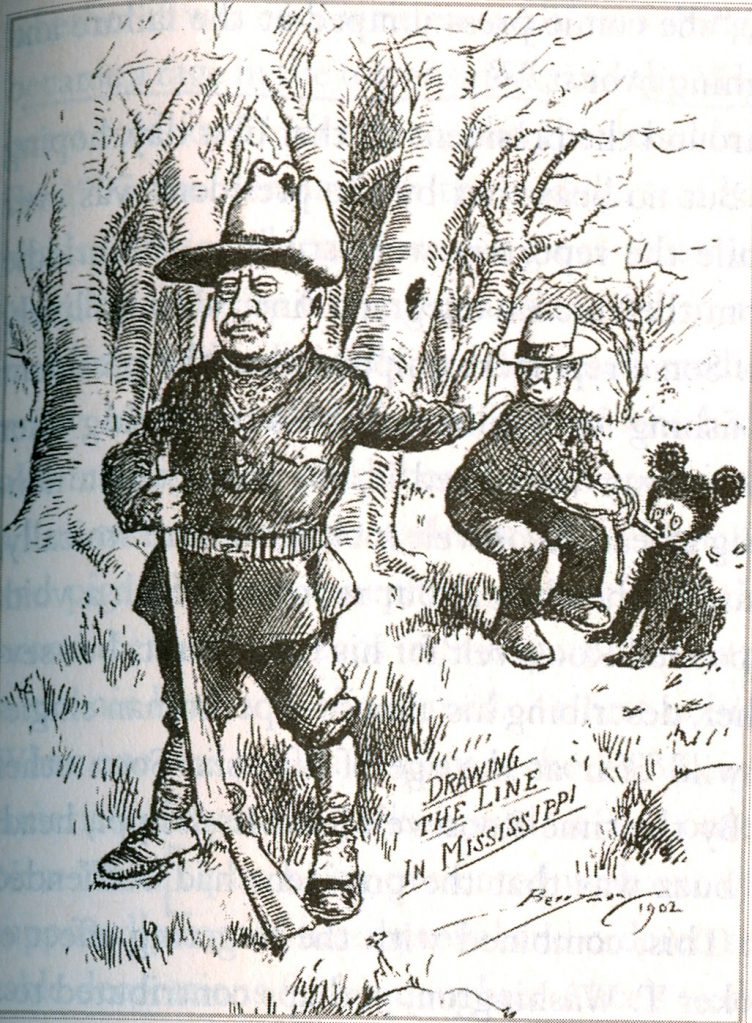
And to think Teddy Roosevelt called it a “manly sport.”

This cartoon that appeared in The Washington Post led to the creation of the first "Teddy Bear" stuffed toy.

Hunter’s Code of Conduct [translated for laypersons]

 
imagesQB1DEJIT

Respect the Environment & Wildlife

  • Show respect for the wildlife you hunt by taking only clean, killing shots…[Remember, nothing shows respect like killing.]
  • Learn to tread lightly while afield…[this may be a physical impossibility for some hefty hunters.] Use vehicles only on established roads and trails, practice low-impact camping and travel, and pack out your trash, including cigarette butts and spent shell casings…[and poop.]
  • Report illegal activities immediately[such as someone trying to murder an animal.]

Show Consideration of Non-Hunters

  • Remember that the future of hunting depends on hunters and non-hunters alike. Be considerate of non-hunters’ sensibilities, and strive to leave them with positive images of hunting and hunters[Yeah right, good luck on that one.]
  • Don’t flaunt your kill. Treat game carcasses in an inoffensive manner particularly
    Serial killer, Robert Hansen, shown here treating a carcass in an inoffensive manner.

    Serial killer, Robert Hansen, shown here treating a carcass in an inoffensive manner.

    during transport…[even though you just treated the living animal in an extremely offensive manner by taking his or her life.]

  • Be considerate of all outdoor users, including other hunters…[of course, this rule does not apply to the wildlife.]

Hunt Safely

  • Exercise caution at all times…[You don’t want to end up another statistic.]
  • Fire your gun or bow only when you are absolutely sure of your target and its background…[Enough said?] 
  • Wear hunter orange whenever appropriate…[or not.]

Support Wildlife & Habitat Conservation

  • Provide hands-on and financial support for conservation of game...[to ensure a healthy supply of victims for future hunting.]
  • Become involved in wildlife conservation organizations…[i.e.: political trophy hunting groups like the Safari Club.]
  • Purchase state and federal wildlife conservation stamps, even if such stamps are not required for hunting…[to help blur the line between hunter and non-hunter wildlife conservation contributions.]

Pass on an Ethical Hunting Tradition

  • Invite a young person or a non-hunter next time you go afield to scout or hunt…[every future school shooter need a mentor.]
  • Attend a hunter education course, and urge others to do the same…[and don’t forget to try to graduate from high school.]
  • Set high ethical standards for future generations of hunters to help ensure hunting will continue…[because all that really matters is that the sport of hunting will continue in perpetuity.]

Hunt Only with Ethical Hunters

  • Take pride in being an ethical hunter…[even if such a thing is fictitious, like
  • Smalfut Bigfoot or the Loch Ness monster.]

And remember that hunting and alcohol don’t mix…[so, you might want just to stay home and watch the ball game instead.]

Adapted from:

http://wdfw.wa.gov/hunting/conduct/

teenager who went on a shooting rampage was avid hunter

From Anti-Hunting in America:

A photo of Jaylen Ray Fryberg, the teenager who went on a shooting rampage yesterday at a Washington State High School killing a female student, and wounding four others before killing himself.

“I expect after you have many times seen a deer or woodchuck blown to bits, the thought of a human blown to bits is that much less impossible to conceive.”
-Grace Knole

In many parts of the United States hunting remains a revered right-of-passage for young boys. YouTube hosts a disturbing number of videos of boys as young as eight killing deer. Advocates of this behavior invariably highlight the benefits that come from being in nature, bonding with fathers, and pursuing an ethic of conservation. It’s important to expose the lunacy of this rhetoric. These supposed benefits are, if the above quote is onto anything, little more than rationalizations for severe violence. Violence that could all too easily carry over into the way we view, and perhaps can treat, our fellow humans. See More

Photo: A photo of Jaylen Ray Fryberg, the teenager who went on a shooting rampage yesterday at a Washington State High School killing a female student, and wounding four others before killing himself. 

 “I expect after you have many times seen a deer or woodchuck blown to bits, the thought of a human blown to bits is that much less impossible to conceive.”   
-Grace Knole

In many parts of the United States hunting remains a revered right-of-passage for young boys.  The tradition of killing one’s first deer often comes sheathed in warrior-like, and frequently sexually suggestive, rituals such as a “virgin” hunter covering his face with the blood of his first conquest. 

YouTube hosts a disturbing number of videos of boys as young as eight killing deer. Advocates of this behavior invariably highlight the benefits that come from being in nature, bonding with fathers, and pursuing an ethic of conservation. It’s important to expose the lunacy of this rhetoric. These supposed benefits are, if the above quote is onto anything, little more than rationalizations for severe violence. Violence that could all too easily carry over into the way we view, and perhaps can treat, our fellow humans.

Nation’s Cuckolded Husbands Gear Up For First Day Of Hunting Season With Wives’ Lovers

http://www.theonion.com/articles/nations-cuckolded-husbands-gear-up-for-first-day-o,37114/

The Onion • ISSUE 50•40Oct 7, 2014

COLORADO SPRINGS, CO—Packing up their shotguns and donning brightly colored orange jackets, the nation’s cuckolded husbands set out Tuesday for the first day of hunting season with their wives’ secret lovers. “You ready to do this, buddy?” said husband Walter Conelly, echoing the words of thousands of other cuckolded men across the country as he loaded gear, ammunition, and a cooler into the bed of his truck mere inches from the man who has been engaging in sexual intercourse with his wife at a nearby motel at least once a week for the last 15 months. “I went to this same place last year and there were pheasants everywhere. It’s a great little spot.” At press time, the nation’s husbands were patting the passenger seats of their trucks and instructing their acquaintances, each of whom had slept with their wives more recently than they had, to “hop in” so they could get out into the woods before it got too late

An Elmer’s Code of Ethics

Fudd

If an animal lives,

kill it.

If it gets away,

hunt it down and kill it.

If it learns to adapt to humans,

hate it and kill it year ‘round.

If it becomes endangered,

kill its mother and put it in a zoo.


If an animal proves intelligent,

respect it then kill it.

If you think it dumb,

kill it and eat it.

If it simply is,

kill it because it’s there.

If anyone’s watching,

Just call it “conservation.”

Some of the hunting industry’s “brightest minds” are working

Task Force Formed to Counter Cyber Threats to Hunters

Sportsmen, conservation organizations and outdoor personalities met at the U.S. Sportsmen’s Alliance (USSA) headquarters yesterday to develop strategies to counter the recent increase in cyber-attacks on hunters.

The group makes up the Hunter Advancement Task Force with most members sharing a common theme of having been targeted by animal rights activists through social media.

“This is a great opportunity to start developing ways to hold those responsible for the recent wave of cyber-attacks against sportsmen accountable,” said Nick Pinizzotto, USSA president and CEO.  “The task force is not only working to stop direct attacks on hunters but also discussing how best to educate the public on the vital role sportsmen play in the conservation of all wildlife.”

Attendees included outdoor television personalities Melissa Bachman and Jana Waller, Colorado hunter Charisa Argys along with her father Mark Jimerson,  Doug Saunders of the National Wild Turkey Federation, Bill Dunn of the National Shooting Sports Foundation and John Jackson of Conservation Force, Dennis Foster of the Masters of Foxhounds Association, Tony Schoonan of the Boone and Crockett Club and Mark Holyoak of the Rocky Mountain Elk Foundation. Other attendees included USSA President and CEO, Nick Pinizzotto, Evan Heusinkveld, USSA vice president of government affairs, Bill Horn, USSA director of federal affairs, Michelle Scheuermann of Bullet Proof Communications and author Michael Sabbeth.

Bachman, a television producer and host, found her life and career threatened after posting a photo of an African lion she harvested to her Facebook page last year. Almost immediately, Bachman came under attack from anti-hunters around the world. Bachman also found herself the target of death threats that “hit way too close for comfort” when anti-hunters showed up at her office.

“Regardless of your beliefs about hunting, Americans can all agree that threatening someone’s life is simply unacceptable.” said Bachman.

Other members of the task force have also had personal experiences with cyber-bullying including Waller who has had not only threats to her life, but also to her career. Waller, the star of Skull Bound TV, found herself having to defend her livelihood after an anti-hunter called her show sponsors to accuse her of poaching.Task Force

“The whole issue of harassment is so important,” said Waller. “I am scared it is going to deter people from standing tall and proud as hunters.”

While attacks on outdoor-celebrity hunters have been going on for years, average hunters have largely avoided the wrath of the anti-hunting community.  Earlier this year, however, Charisa Argys was thrown into the spotlight when a picture of her legally harvested mountain lion appeared online. The image brought a flood of criticism and threats not only to her, but to family members as well.

“Just because some anti-hunters in Europe went ballistic over a legal hunt, this issue is going to be associated with me for the rest of my life,” said Argys. “It is never going to go away. It’s going to be there forever. It could affect my job prospects and my life.”

This initial task force meeting was just the first of many to develop short and long-range strategies to protect hunters from cyber harassment.

“In the short term we are developing aggressive legal approaches to pursue both civil and criminal legal actions to prosecute anti-hunting harassers.” said Bill Horn, USSA director of federal affairs. “In the long term, we would like to cultivate strategies to provide additional legal protections for hunters who are finding themselves the target of cyber bullying.”

Pinizzotto added, “What this group discussed today and the ideas generated are a terrific first step in protecting hunters now and in the future. We have some of the brightest minds in our industry working on this critical issue.  I look forward to continuing this discussion and adding additional key groups and individuals to the team in the coming weeks.”

Good News: Unsporting Bill Shot Down

Michael Markarian: Animals & Politics


The Senate today shot down a motion to move forward on S. 2363, the dangerous if innocuous sounding “Sportsmen’s Act,” which has been portrayed as feel-good legislation but could have serious and far-reaching consequences for wildlife, public spaces, and human health and safety. The bill needed 60 votes to advance, but only received 41 in favor, and 56 opposed—a result of some Democrats opposing the bill because of its extreme provisions and Republicans uniting in opposition because they could not offer amendments on gun rights and other topics.

BALDEAGLEMYSTICLAKES

A bald eagle at Mystic Lake in Massachusetts. Photo by John Harrison
Sportsmen, of course, are already allowed to pursue their activities on the vast majority of federal public lands, including national forests, BLM lands, and most national wildlife refuges, with only national parks and some national monuments generally closed to hunting. That’s not to mention the millions of acres of state and private lands also available. But as things now stand, resource managers have the flexibility to look at the big picture and determine when it makes sense to allow hunting and fur trapping—and when it doesn’t. They consider local concerns such as whether endangered or threatened species are present, and balance the interests of hunters and trappers with other public land users and recreationalists.
S. 2363 would flip the burden and turn the current process on its head. Public lands would be “open unless closed” to hunting and fur trapping, regardless of whether they’re compatible with other land uses or threatened or endangered species, and closing lands would require a burdensome bureaucratic process. On top of that, the bill would force land managers to prioritize hunting and trapping above other outdoor activities, effectively excluding a large proportion of the American public from enjoying our national spaces, including in designated “wilderness areas.” Rather than local control, it would be a federal fiat from Washington that the default is to allow sport hunting and the use of painful and indiscriminate steel-jawed leghold traps.
The harmful legislation would also stop scientists at the EPA from restricting the use of lead ammunition, which is a known toxin that kills millions of wild animals from more than 130 species each year, including bald eagles, California condors, and other threatened and endangered species. These bullets keep on killing long after they’ve left the chamber, with animals poisoned by eating the lead fragments directly, preying on contaminated animals, or feeding on gut piles left behind by hunters.
President George H.W. Bush’s administration banned the use of lead for all waterfowl hunting in 1991, and non-lead ammunition such as copper, steel, and bismuth are readily available and affordable. That sensible policy has prevented the poisoning deaths of millions of birds, and it’s been part of the march of progress toward getting toxic lead out of the environment. There’s no compelling reason for Congress to thumb its nose at science and innovation, and forbid EPA or any other responsible agency, with appropriate authority and expertise, from even examining this issue.
POLAR_BEAR

a polar bear in the wild
Finally, this bill is a sweetheart deal for millionaire big-game hunters. Far from benefiting our nation’s rank-and-file sportsmen, this is a special order delivery for only 41 wealthy big game hunters who dropped up to $50,000 each for guided polar bear hunts in the Arctic. These trophy hunters, who compete to see their names in the Safari Club record books for killing the rarest species around the world, have been lobbying Congress to allow them to bring the heads and hides of threatened polar bears into this country from Canada in defiance of current law.
This would be the latest in a series of import allowances that Congress has approved—each time making the argument that it’s only a few animals and the polar bears are already dead and have no conservation value—but the cumulative impacts of these waivers time and time again lead to more reckless trophy killing. Do we want Congress to set this kind of precedent, encouraging trophy hunters to kill rare animals as they are about to be listed as endangered or threatened species and then to get relief from Congress to make a special dispensation for them?
Thank you to all the animal advocates who contacted your Senators and asked them to oppose this extreme and reckless “Sportsmen’s Act.” Those calls made a difference—a game-changing difference for millions of animals. Wild animals and the environment have dodged a bullet now that this terrible package of anti-conservation policies has stalled in the Senate.

New Mexico Taking Aim at Drone Use in Hunting

 http://abcnews.go.com/Technology/wireStory/mexico-taking-aim-drone-hunting-23569819

Alaska, Colorado and Montana already have outlawed the use of drones in hunting, but some sportsmen groups and animal advocates are pushing to see that regulations are passed in every state to protect the concept of fair chase.

They argue the art of hunting should be based on skills and traditions that have been honed and passed down over generations, not technological advancements such as drones.

“Hunting an animal with your physical senses, with your eyes and your ears and even to a lesser extent your sense of smell, that puts you on fairly even ground with these animals that can see far better, hear far better and smell far better than we can,” said Joel Gay, a spokesman for the New Mexico Wildlife Federation.

Drones would simply take the challenge out of hunting and could lead to the sport becoming more exclusive, Gay and others said.

There’s only anecdotal evidence of drones being used for hunting, but the national group Backcountry Hunters and Anglers and the Humane Society of the United States both say they want to get ahead of the issue before it becomes a problem.

In New Mexico, the state Game Commission is set to vote this month on a proposal that would make it illegal to use drones to signal an animal’s location, to harass a game animal or to hunt a protected species observed from a drone within 48 hours.

All of that is already illegal if done from an aircraft. The proposal calls for redefining aircraft to include unmanned, remote-controlled drones.

Vermont is also considering changes to its hunting rules, while Idaho and Wisconsin have included prohibitions on the use of aircraft to hunt wildlife in existing regulations.

But there are some groups that don’t see the need to act quickly to regulate drone-assisted hunting.

Blake Henning, vice president of lands and conservation with the Rocky Mountain Elk Foundation, said he has yet to hear from the group’s more than 200,000 members about drone concerns.

“We’ve got all kinds of other things we’re trying to address,” he said.

Like helicopters and airplanes, Henning said drone-assisted hunting will undoubtedly have to be regulated at some point, but he noted that wildlife research could benefit from the technology.

From Nepal to South Africa, scientists are already using drones to monitor endangered species and to track poachers.

In the U.S., federal aviation regulators do not yet allow for the commercial use of drones, but the government is working on operational guidelines and has said that as many as 7,500 small commercial drones could be flying within five years of getting widespread access to U.S. skies.

Colorado-man-offering-drone-hunting-lessons-in-Deer-Trail

National Wildlife Refuges Expand Hunting

[The expansion of hunting–Watch for it in a refuge near you!]

http://greatlakesecho.org/2014/04/15/national-wildlife-refuges-expand-hunting-opportunity/

By: | April 15, 2014


Hunters provide many positive economic benefits to state wildlife agencies, including expanded wildlife opportunities, habitat restoration, and continued conservation efforts. Image: U.S. Fish and Wildlife ServiceThree national wildlife refuges in the Great Lakes region will expand hunting opportunities and two more will open to hunting for the first time, according to the U.S. Fish and Wildlife Service.

The Cypress Creek National Wildlife Refuge and Middle Mississippi River National Wildlife Refuge in Illinois and thePatoka River National Wildlife Refuge and Management Area in Indiana will expand migratory bird, upland game and big game hunting.

The ones opening hunting for the first time are Shawangunk Grasslands National Wildlife Refuge in New York for big game hunting, and Cherry Valley National Wildlife Refuge in Pennsylvania for migratory bird, upland game and big game hunting.

Hunting and wildlife observation is a big economic boost to the local area, said Bill McCory, the manager of Indiana’s 7,398-acre Patoka River National Wildlife Refuge.

A lot of money is spent locally on hunting licenses, guns, clothes, tackle, bait and more.

Aside from monetary benefits from opening and expanding hunting and fishing at refuges, there are also highly valued recreational opportunities for visitors.

Jeremy Ross, a longtime hunter from the area, was a Patoka visitor even before it became a refuge. He is now on the board of directors for the Friends of the Patoka River National Wildlife Refuge.

Opening the land gives that many more people the opportunity to go out and experience nature and fulfill their love of whatever they want to pursue outdoors, said Ross.

Nationwide, 20 refuges in total are offering expanded hunting, and six are offering it for the first time.

The U.S. Fish and Wildlife Service announced the 2014 expansion of hunting opportunities at 20 National Wildlife Refuges. Another six refuges are open to hunting for the first time.

Dan Ashe, director of the Fish & Wildlife Service, said that hunters and anglers economic contributions are also a big help in restoring habitat and financing conservation throughout the refuge system.

Hunters and anglers have paid more than $15 billion in excise taxes – used by state wildlife agencies to sustain and restore habitat, educate the next generation of hunters and fund sport shooting ranges nationwide, Ashe said in a blog post.

And Ashe says that there are no intentions to stop the growth of the national wildlife refuges anytime soon.

We are committed to strengthening and expanding hunting opportunities on our national wildlife refuges wherever possible, Ashe wrote.

The National Wildlife System is composed of 560 refuges that encompass 150 million acres of land and water throughout the United States.

Miss Kansas to host hunting show for Outdoors Channel

511-yTDXm_St_80

Updated: 2014-04-14T00:05:03Z

[A fresh face, camo, the smell of a bleeding dead bird in the morning–I must be dreaming. Or is it a nightmare?! Wake up Toto, we’re not in Kansas anymore.]

April 13 By Michael Pearce

The Wichita Eagle

— Theresa Vail’s job has included a lot of cameras and fashionable clothing since she won the Miss Kansas crown last year. Friday and Saturday she got a look at a future that will contain more of the same when she reliquishes her crown June 7.

From then on, though, the cameras will be videoing her on hunts and other outdoors passions for “Limitless,” a series she’ll be hosting on the Outdoors Channel next year. The clothing will be mostly camo, made by “She,” a line of women’s outdoors apparel Vail has been hired to promote and help design.

Vail filmed her first episode for the show while at the Governor’s Turkey Hunt in El Dorado. The show was about a Flint Hills turkey hunt with her father, Mark. Both shot nice toms 20 minutes into the hunt Friday morning.

Vail has received attention for openly speaking of her love of hunting, firearms and her career in the Kansas Army National Guard. She gained more national attention when she announced she would not cover her tattoos in the Miss America competition in Atlantic City last September.

Two months later, the 23-year-old chemistry and Chinese major at Kansas State realized that her career goal of becoming a dentist might be put on hold when the Outdoor Channel called to talk about her possibly hosting a series on their network.

“I told them I didn’t want to do what everybody else was doing and they said they didn’t either,” Vail said while taking a break from Friday’s hunt. “We both wanted it to have more than just me on hunts. I was sold from there on.”

She had gotten a taste of outdoors television in late December, when she and cameraman David Blanton met for an archery deer hunt near Pratt. It snowed hard, and the windchill and temperatures were brutal. She got a nice, mature whitetail with her bow. Blanton, Realtree Outdoors host, got a look at someone he thought could easily succeed in the business.

“She just absolutely energized me more than anything. She is an amazing person, really,” Blanton said. “She really wants to teach people they can do things outside their comfort zone, to believe in themselves. They’ll see when the shows begin to air.”

Vail said about half of each segment will be based on hunting, usually with archery gear. The rest will be about a particular personal challenge. To go along with a New Mexico elk hunt she’ll be spending a day training with the state’s Smoke Jumper fire fighters.

“You have 100 pounds of gear on, and you’re running up and down buildings carrying people in a fireman’s carry,” she said. “It’s going to be pretty tough, but I thrive on things like that.”

Another show will have her participating next year in a marathon in New Mexico that honors soldiers from the Bataan Death March in World War II. She recently hosted several pageant contestants at the event, which is held largely across boot-sucking sand dunes. Vail carried 46 pounds in a rucksack to compete in the event’s toughest category.

Vail also wants to be as hands-on as possible in her hunts that will include at least three trips for elk, several for deer and possibly at least one for bear. That means she’ll be insisting on field-dressing and packing out loads of meat, when needed.

Though a longtime hunter, she admits she does have plenty to learn.

“I’m not afraid to say, ‘Hey, I don’t know how to do this,’ but I want to learn and do it myself,” she said. “That’s empowering and more people need to do it. I’ve never (backpacked the meat from an elk down a mountain), but I will learn how and that’s the kind of thing that makes me so proud.”

Friday morning’s hunt with guide Pat Post, her father and two cameramen required some quick thinking.

Post’s scouting had found where a sizable flock of turkeys was roosting in a high-rise of a sycamore over a gorgeous Flint Hills stream. The crew of five moved close to the roost while tom turkeys filled the still air with scores of gobbles.

Four toms strutted toward Post’s decoys shortly after fly-down. A mechanical problem caused Vail’s gun to only “click” when she pulled the trigger. Using the sound of her dad’s shot to cover her noise, she quickly worked the action on the semi-automatic 12 gauge and killed a nice tom five yards away.

Vail has also been hired by Bass Pro Shops for assorted company promotions and work on the She clothing line, which they own. She said she’ll finish the two semesters needed for her college degree online.

She also re-enlisted for another six years in the National Guard. Vail said they’re willing to work with her schedule since she often promotes the military. Her father has had a long career as an Army dentist.

After working with Vail on several projects, the two cameramen in Kansas to film the turkey hunt believe she’ll be able to get done all she’s mentioned, and probably more.

“She’s not afraid of trying anything,” cameraman Casey Keefer said. “There’s nothing timid at all about Theresa. She has so much drive and personality.”

Cameraman Jason Brown agreed, saying, “It’s like the title of her show, ‘Limitless,’ there are no limits in Theresa.”