Did Your Tax Dollars Pay to Hunt Down That Cow?

15242-333e1363ed3eb6b53508d726e22a5fecb3cbcb4a168d4cea6cce61d8_w_240_px     

Hawaii Monitor: Did Your Tax Dollars Pay to Hunt Down That Cow?

By  Ian Lind                 12/04/2013

State investigators are probing whether the History channel’s “American Jungle” violated state rules and regulations while filming. For example,  the episodes broadcast so far have included scenes of night hunting, which is prohibited by state law, and hunting down a cow with spears and dogs, although cattle “are illegal to hunt without a special feral cattle control permit” issued by the state.

Full Story: http://www.civilbeat.com/posts/2013/12/04/20566-hawaii-monitor-did-your-tax-dollars-pay-to-hunt-down-that-cow/

It’s All the Same To the Victim

Lately we’ve been hearing from a lot of holier-than-thou types quick to make a distinction between sport and subsistence hunters. Truth is, there’s not all that much difference between the two. Sport hunters and pseudo-subsistence hunters are often such close kin they’re practically kissin’ cousins. I know a lot of hunters, but I’ve never met one who didn’t boast about “using the meat.” By the same token, I’ve never met anyone who openly admitted to being just a sport hunter.

There are a lot of needy poor folk out there these day, including myself, but I don’t know anyone who really needs to kill animals to survive. Like sport hunters, subsistence hunters do what they do because they want to, they enjoy the “lifestyle.” If one thing differentiates the two, it’s that meat hunters have an even stronger sense of entitlement.

But, everyone has a right to feed themselves and their family, don’t they? Well, does everyone—all 7 billion humans and counting—have the right to subsist off the backs of other animals when there are more humane and sustainable ways to feed ourselves? How many self-proclaimed “subsistence” hunters are willing to give up all their modern conveniences—their warm house, their car, their cable TV or their ever-present and attendant “reality” film crew—and live completely off the land like a Neanderthal? Not many I’m sure—at least not indefinitely.

It’s unclear what makes some folks believe they have the right to exploit wildlife as an easy source of protein, but animal flesh is by no means the safest or healthiest way for humans to get it. While a steady diet of decaying meat slowly rots your system, millions of vibrant people have found a satisfying and healthy way to eat that doesn’t involve preying on others.

Text and Wildlife Photography ©Jim Robertson, 2013. All Rights Reserved

Text and Wildlife Photography ©Jim Robertson, 2013. All Rights Reserved

Movies About Hunting Humans For Sport

Friday November 22, 2013

8 (great?) hunting-humans-for-sport movies
By Dave Croy / World-Herald staff writer

Share on facebookShare on twitter
In 1924, Colliers Weekly published a short story by Richard Connell called “The Most Dangerous Game.”

It involved a big-game hunter who fell from a yacht and washed up on an island. A wealthy former Russian aristocrat named Zaroff owned the island. And Zaroff had grown bored of big-game hunting and developed a more ruthless pastime, one that involved causing shipwrecks with misleading navigation lights and hunting the surviving crew members after they swam ashore. Ultimately, of course, the hunter and the Russian had to square off mano a mano.

The story was, among other things, a commentary on the “sport” of big-game hunting, very popular at the time among the wealthy. But the notion of hunting humans for sport apparently captured the fevered imaginations of many a writer and filmmaker.

It spawned the 1932 film, “The Most Dangerous Game,” starring Joel McCrea and Fay Wray. (Filmed on many “King Kong” sets with much of the same cast and crew during a break in the making of that film.) The movie was remade in 1945 with the title “A Game of Death.” Since then, numerous films and television shows have made use of the premise, often attributing the original short story as inspiration.

With “The Hunger Games: Catching Fire” opening in theaters this weekend, it seems like the perfect time to revisit some of the better examples of this sub-genre of film.

8. “Surviving the Game” (1994)

Okay, this is not really a great film, but it has some wonderful actors playing really nasty bad guys, chewing the hell out of the scenery and generally spouting plenty of awful dialogue. Homeless Ice-T gets a job as a “hunting guide” for some rich guys, including Rutger Hauer, Gary Busey and F. Murray Abraham, (all scary enough in real life!) only to discover that he is their quarry! But Ice-T, as you might guess, won’t go down without a fight.

This is generally just a foul-mouthed knock-off of the original story, entirely propped-up by the performances of Hauer and Busey.

7. “Death Race 2000” (1975)

A schlockmeister Roger Corman production, this film put the fun back in funeral. David Carradine as Frankenstein and a pre-Rocky Sylvester Stallone as Machine-Gun Joe Viterbo are among the drivers in a high-speed cross-country race. In the futuristic world of the year 2000, U.S. democracy has given way to dictatorship, with the three-day race serving as a way to keep the populace pacified. Not only do the drivers score points for speed but for running down pedestrians, as well. The older and more infirm the pedestrian, the greater the point count.

This movie is a cartoonishly ultra-violent mess, with ridiculous “revolutionary” politics oozing through the mix, but, hey, Frankenstein’s car is a Corvette made to look like a giant alligator, and almost every minute of this “cult-classic” is good for a laugh.

6. “Battle Royale” (2000)

This financially successful critical darling from Japan is often cited as having served as a “template” for “The Hunger Games.” I submit that minimal research into this topic makes it obvious that themes like people hunting people, blood sports as “opiates for the masses” and the morality of child soldiers are recurrent throughout both history and fiction.

In this case, a class of 15-year-old schoolchildren is taken to an island, fitted with explosive tracking collars, given basic provisions and various “weapons” and told they each have three days to become the last student standing.

The ensuing violence is frequent, brutal and oddly matter-of-fact. The students’ motivations range from the comic to the melodramatic. The number of students with antisocial personality disorder seems statistically improbable for a group of 40-or-so kids.

More sophisticated critics were able to discern a greater level of depth to the proceedings than I was. I found the government’s motivations for holding the annual contest murky, the characters laughable and the action filmed with all of the grace of security-camera video.

It is never made clear in the film if the “Battle Royale” has a viewing audience outside those running the game. What I’m still trying to figure out is why this film had such a large one.

5. “Hard Target” (1993)

Based on the 1932 film “The Most Dangerous Game,” this was revered Chinese action director John Woo’s first American movie.

Sporting a mullet that appears to have been used to clean up after an oil change, Belgium’s own martial-arts hero Jean-Claude Van Damme stars as Chance Bordreaux, homeless Cajun merchant seaman in New Orleans. When Yancy Butler shows up looking for her homeless, missing father, Van Damme saves her from local hoods and agrees to serve as her bodyguard and guide. Turns out that pops was a victim of a ruthless group of human-hunters, led by creepy Lance Henriksen.

Soon, one of Jean-Claude’s homeless pals falls prey to the hunters, too. As Van Damme and Butler begin to gather evidence that the homeless men are being murdered, Henriksen and his goons decide to eliminate any threats to their operation. Will the hunters become the hunted? Will Henriksen get his due? Does the phrase “grenade in pants” ring any bells?

Solid Woo action scenes, but the cheesy script and Van Damme’s spectacular lack of acting talent keep this from being a truly awesome film.

4. “The Running Man” (1987)

With “The Running Man,” director Paul Michael Glaser (Starsky of TVs “Starsky and Hutch”) took a stab at the “over-the-top, thinly-veiled R-rated science-fiction satire,” as mastered by fellow director Paul Verhoven, and he acquitted himself pretty well, considering that he was brought in a week into the production to replace fired director Andrew Davis.

Arnold Schwarzenegger stars as Ben Richards, a former police helicopter pilot in the future wrongly convicted of killing civilians and forced to participate in a reality TV game show, “The Running Man,” where convicts are hunted by superstar “stalkers.” Richards begins killing off the hunters, one-by-one, and ultimately helps an anti-network resistance movement expose the fact that supposed “winning” contestants in the past have all been murdered.

While Ahnuld approaches the material with his usual gusto, the real standout is “Running Man” host and show-runner Richard Dawson (former “Family Feud” emcee) as the glad-handing, lady-kissing and utterly ruthless Damon Killian. Subtlety was the last thing on the minds of anyone involved in this very loose adaptation of the Stephen King novel.

More: http://www.omaha.com/article/20131122/GO/131129638/1181

574922_10150775941916188_960382052_n

What Sort of Dweeb Needs an AR15?

90823_Pred_ATACS


Back in December of 2012, while America was reeling in shock over the senseless shootings at Sandy Hook Elementary School and mourning those lost in a volley of peacetime machine gun fire, I asked the question, “Who the Hell Hunts With a Machine Gun Anyway?” While the papers were rehashing the same questions they pose whenever a mass killing makes the news: “Why did this happen?” and “How can we prevent this kind of thing in the future?,” we did not hear any mention in the mainstream media of the leading role that sport hunting plays in promoting guns and perpetuating violence.

So, who the hell hunts with a machine gun? The shocking answer is, more people than ever before. Okay, for you hair splitters out there, assault rifles are not technically considered machine guns because you have to hit the hair-trigger with each shot—but they still send out bullets at a damn high rate. The .223 semi-automatic for example (the rifle used by school shooter, Adam Lanza, and the D.C. Beltway snipers, John Mohammad and John Malvo, can fire 6 rounds per second. But what makes it so deadly is the way the bullet reacts on impact: it’s designed to bounce around inside the body once it makes contact with bone.

Why is such a lethal attack rifle legal for non-military civilians to own? According to the manufacturer, they are intended to be used for hunting animals. As the NRA well knows, hunting has been used to justify the private ownership of some of the most destructive weapons ever invented.

Assault rifles are not big on accuracy—their sole purpose is to send out a rapid-fire hail of bullets in the general direction of whatever they’re pointed at. Those who mass murder coyotes seem to feel entitled to the deadliest of armaments they can

Text and Wildlife Photography ©Jim Robertson, 2013. All Rights Reserved

Text and Wildlife Photography ©Jim Robertson, 2013. All Rights Reserved

get their hands on. A recent “contest hunt” offered up a free shotgun or a pair of semi-automatic rifles to whoever murdered the most canines. The terms of the competition were simple: hunters in New Mexico had two days to shoot and kill as many coyotes as they could; the winner got their choice of a Browning Maxus 12-gauge shotgun or two AR-15 semi-automatic rifles. (The AR-15 is the civilian version of the military’s M16 that has been in production since Vietnam.) “Nothing’s gonna stop me,” said Mark Chavez, the hunt’s sponsor, and the owner of Gunhawk Firearms “This is my right to hunt and we’re not breaking any laws.”

Bushmaster describes their .223 as a “Varmint Rifle.” Oh really? That shines new light on what some of these politicians really mean when they say they only hunt “varmints.” I’ve never been an invited guest at George W. Bush’s ranch in Crawford Texas; therefore I can only guess that this is the type of weapon the self-proclaimed “varmint” hunter uses when he goes up against a family of scary ground squirrels, marmots or a town of talkative prairie dogs.

Larger caliber Bushmaster models are categorized, ominously, as “Predator Rifles.”

Why are more and more people using military style weapons for hunting lately? I don’t know offhand, but I have a theory. If someone were to look into it, I’d bet they’d find a marked increase in assault rifles since Barack Obama was elected president. Not only are people trying to get themselves a semi-automatic or two before a feared government ban on assault weapons, but at the same time, they see wolves as a symbol of the government they fear and loath.

Now that the federal government has handed wolf “management” over to hostile states, we’re seeing a war on wolves, with AR 15s, .223 “Bushmasters” and the like being the new weapons of choice.

Melissa Bachman Poses With Dead Lion in SA

US hunter criticised over picture with dead lion in South Africa

Petition calls for TV presenter Melissa Bachman to be barred from returning to South Africa after participating in legal hunt

theguardian.com,              Friday 15 November 2013

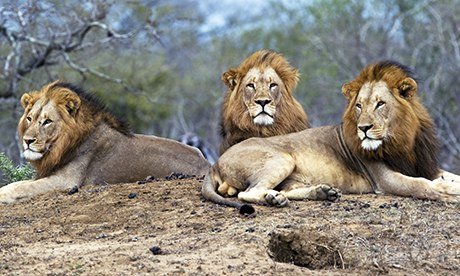
South African lions

South African lions. Photograph: Kim Sullivan/SplashdownDirect/Rex Features

An American TV presenter has been condemned for tweeting a picture of herself standing over a dead lion and boasting that she hunted it on safari in South Africa.

More than 3,500 people signed an online petition calling for the self-declared “hardcore hunter” Melissa Bachman to be banned from returning to South Africa.

The Minnesota-based celebrity posted a photo of herself smiling next to the body of an adult lion after a hunt at the Maroi conservancy in the northern Limpopo province. The caption read: “An incredible day hunting in South Africa! Stalked inside 60 yards on this beautiful male lion … what a hunt!”

The style is a familiar one for Bachman, who has previously been photographed with what appears to be the carcass of a bear. She is no stranger controversy, having been removed as a contestant on the National Geographic show Ultimate Survival Alaska last year after more than 13,000 people signed a petition criticising the inclusion of the “heartless trophy hunter”.

Her lion tweet has provoked another angry backlash. One Twitter user, Gaye Davis, asked: “If it was beautiful why kill it?” Tim Flack, a South African, commented: “People like @MelissaBachman hunting lion in SA is everything that’s wrong with our hunting industry.”

A petition on Change.org urges the South African government to bar Bachman from the country. It says: “Melissa Bachman has made a career out of hunting wildlife for pure sport. She is an absolute contradiction to the culture of conservation, this country prides itself on. Her latest Facebook post features her with a lion she has just executed and murdered in our country.”

Supporters of hunting in South Africa argue that it raises funds from wealthy tourists which are then ploughed back into conservation efforts.

Lourens Mostert, game farm manager at the Maroi conservancy, confirmed that a lion was killed and said the hunt was legal. “If it isn’t right to hunt these lions, why does out government legally give us permission?” he told the Times newspaper. “This is not the only lion that has been hunted in South Africa this year.”

The barrage of criticism prompted Bachman to make her Twitter account private. Her personal bio reads: “I’ve been an avid hunter my entire life & now I’ve turned my passion into a career as a TV producer, host and writer. I’m a hardcore hunter doing what I love!”

Colorado to consider ban on hunting with drones

[I’m curious, would drone hunting fall under the heading of “ethical hunting” or “sport” hunting?]

By Ryan Budnick
7News 11/13/2013

Colorado seeks to reinforce a federal law that bans small drone aircraft for huntingHuntingTrophiesJamieKripke600

LAMAR — Colorado is looking to prevent the unmanned aircraft from being used for hunting.

The Colorado Parks and Wildlife Commission is set to begin discussion on making it illegal to use drones to help hunters spot potential game. The topic is one of many the commission will take up during two days of meetings in Lamar starting Thursday.

“There is a ton of technology available to people that would make it very, very easy for people to hunt,” Colorado Parks and Wildlife spokesman Randy Hampton said. “We try to hold the line to make sure that hunting is done in an ethical manner.”

Read more: Colorado to consider ban on hunting with drones – The Denver Post http://www.denverpost.com/news/ci_24510883/state-drones-shouldnt-aid-wildlife-hunts#ixzz2kYsZjPYI
Read The Denver Post’s Terms of Use of its content: http://www.denverpost.com/termsofuse
Follow us: @Denverpost on Twitter | Denverpost on Facebook

Outdoors group gives disabled a chance to go hunting in Madison County

http://onlineathens.com/around-here/2013-11-01/outdoors-group-gives-disabled-chance-go-hunting-madison-county

[Nothing against persons of disability, of course, but how natural or sustainable is it to help each and every member of a grossly overpopulated species effectively predate on any other species they wish to kill?]

By Wayne Ford Friday, November 1, 2013

At least 75 disabled people will join the second annual Northeastelk-000-home17300 Georgia Ultimate Adventure Deer Hunt next weekend in Madison County.

The hunt is sponsored by Outdoors Without Limits with support from Comer Mayor Jody Blackmon, Georgia Secretary of State Brian Kemp and local landowners. The base camp for the two-day event will be at the Comer Fairgrounds.

“We’re totally inclusive. Anybody with any type disability — it doesn’t matter — they can participate,” said Kirk Thomas, executive director of Outdoors Without Limits. “We have no age limit.”

The hunters will gather Friday morning for registration, orientations, an afternoon hunt, and evening meal. The next day begins at 5 a.m. with breakfast followed by hunting teams again heading into the woods.

“Everyone on the hunt will have a guide with them,” said Thomas, who lives in the Winterville area. The two-day hunt benefits more than those who are challenged by disabilities.

“We’re asking the hunter and fishermen who love the outdoors to give a day and half of their time to make it happen for someone who otherwise would not have an opportunity,” he said. “It’s life changing and life saving.”

Thomas, who was paralyzed while hunting in November 1992 in Snow Hill, Ala., founded the nonprofit organization in 2008.

“This is the greatest blessing of my life to see these people have this opportunity,” he said. “I feel like the Lord has used me in what I have done.”

Thomas, who grew up in Meridan, Miss., said he was hunting when a tree fell on him, shattering two vertebra. Thomas, who was 6-foot-5 and 320 pounds, ended up in a hospital where his weight dropped to 225 pounds.

Doctors said he’d be hospitalized for six months, but he was released in 52 days and went back to selling heavy construction equipment. He left Mississippi in 1988 and went to work in Alabama for the Boy Scouts of America.

“I’m an Eagle Scout and both of my brothers are Eagle Scouts. The only thing Daddy wanted us to do was make Eagle. So we all made Eagle to honor him,” Thomas said.

Thomas and his family later moved to South Carolina where he worked for the Wild Turkey Federation for seven years before moving to the Athens area, where he directs Outdoors Without Limits, dedicated to creating opportunities for disabled people in outdoor related activities.

“The only way I know how to run this organization is like a big ol’ happy family and that’s everybody helping everybody,” he said.

More Women Give Hunting a Shot

[Says Tiffany Lakosky, co-host of the Outdoor Channel hunting show Crush with Lee and Tiffany and a bowhunter: “We are all part of the food chain.” Oh really? How come human remains rarely make it back into the food chain? If any a human is ever preyed upon by a non-human animal, said animal is hunted down and killed, while the human remains are embalmed and buried 6 feet under.]

http://news.nationalgeographic.com/news/2013/11/131103-sarah-palin-lope-navo1women-hunters-local-meat-food-outdoor-sports/

For truly free-range meat, some say they prefer the woods to the grocery store.
.

Kristen A. Schmitt

for National Geographic

Published November 3, 2013

In recent years, American women are spending more time in tree stands and deer blinds—and putting fresh meat on the table. Although men still account for the majority of the 13.7 million U.S. hunters, the number of women actively hunting is on the rise.

The total number of women hunters surged by 25 percent between 2006 and 2011, after holding steady for a decade, according to Census Bureau statistics. At last count, 11 percent of all U.S. hunters were women, compared to 9 percent in 2006.

Many state departments of natural resources have begun hosting Becoming an Outdoors-Woman (BOW) workshops that offer instruction in skills such as archery, shotgun, and rifle shooting.

“There is definitely a high demand. We have over 3,000 women on our mailing list, and workshops fill up quickly,” says Patricia Handy, Information & Education Program Manager at the Department of Natural Resources in Maryland.

Retailers have taken notice, too. Companies like SHE Outdoor Apparel, Cabela’s, and Próis are outfitting women hunters with clothing and accessories created for the female body, and archery manufacturers like Mathews Inc. are designing lighter bows scaled for shorter arm spans.

“Across the board, women are more independent than they’ve ever been, and they realize they are capable of hunting,” says Brenda Valentine, national spokesperson for the National Wild Turkey Federation and the self-proclaimed “First Lady of Hunting.”

The Next Food Frontier?

Gender roles in America have changed in many ways through time, but women still dominate household food and nutrition decisions. The Bureau of Labor Statistics’ 2012 American Time Use survey found that nearly two-thirds of women are involved in daily household food preparation and cleanup, compared to 39 percent of men—and women spend triple the amount of time on such tasks in an average day.

Women are also leading a surge of support for sustainable food and agriculture initiatives like CSAs and farmers markets. One of the main ideas of such initiatives is eating locally, generally meaning foods produced within your state or about 100 miles of your home. This not only supports the local economy and environment, it also means the food often tastes better because it can be harvested and sold at its peak rather than spending days in transport.

But in many parts of the country, local meat can be difficult to find. Most of the available meat at U.S. grocery stores comes from one of the large-scale commercial farms, often called factory farms, concentrated in a few regions.

Hunting offers an alternative to the grocery store that lets women provide truly free-range and organic meat for their families while also helping create a more sustainable food system, says Lily Raff McCaulou, author of Call of the Mild: Learning to Hunt My Own Dinner.

“Hunting may be the next frontier for local food,” says McCaulou, who lives in Oregon. She regularly hunts deer and elk, and recently added grouse and duck to her repertoire.

“I was pretty detached from what I ate before I started hunting. Since I’ve started hunting, I’ve changed my relationship with the meat that I eat, and I eat a lot less meat than I did before. Hunting’s a way to reclaim some closeness to the food chain.”

It can make chefs more thoughtful, too, says Georgia Pellegrini, author of the book Girl Hunter.

“Hunting made me realize that there’s a lot that has to happen before that piece of meat gets to your plate,” says Pellegrini. “As a chef, I wanted to participate in that process because it makes the experience more meaningful. You think about the ingredients differently, you think about the experience of eating it differently, and you have more control over how the animal was treated.”

Making Connections

Many hunters—both men and women—say their hobby is not just about food. It also creates a sense of intimacy and respect for both the animals and their habitats.

Writer Tovar Cerulli was a longtime vegetarian when he took up hunting, deciding that eating “the ultimate free-range meat” was an ethical and sustainable choice.

“Hunting also allowed me to gain a deeper understanding of the place I lived,” says Cerulli, author of the book A Mindful Carnivore. He argues that in a regulated, well-managed system, “there is nothing inherently ecologically damaging about hunting.” It can actually benefit the animals by preventing overpopulation, which can lead to starvation during winter months.

Hunters are also quick to note that funds from purchases of licenses, equipment, and ammunition go to support conservation efforts for a variety of species. According to the U.S. Fish and Wildlife Service, every year nearly $200 million is distributed from the federal taxes associated with hunting to support wildlife management programs, the purchase of lands for habitat conservation, and hunter education and safety classes.

There’s another factor, too: fun. Hunting is a way for women to be outdoors and enjoy nature while spending time with husbands and children who hunt.

“Women are realizing how much fun hunting is and how close it can actually bring them in their relationships with their families,” says Tiffany Lakosky, co-host of the Outdoor Channel hunting show Crush with Lee and Tiffany and a top bowhunter. “The whole concept is that I am shooting my family’s dinner tonight and we’re eating something I shot. I would say probably 90 percent of the meat we eat, we hunted.”

While shooting the family dinner isn’t a realistic option for everyone, especially in urban areas, Lakosky says she hopes even non-hunters will start giving more thought to where their food comes from.

“We are all part of the food chain. There is a balance in nature,” she says. “People go to the supermarket and they think that somebody’s growing a TV dinner somewhere to feed them. They are just not connected to it like people were 100 years ago.”

Follow Kristen Schmitt on Twitter.

New Bill Promoting Public Lands Access for Hunting Draws Praise Protest, Puke

New Bill Promoting Public Lands Access for Hunting Draws Praise from Outdoors Community
Published on Saturday, October 26, 2013

WASHINGTON –-(Ammoland.com)-Senate legislation introduced today that would  increase hunting and angling access on public lands and bolster the nation’s  outdoor recreation economy was welcomed by a broad coalition of influential  sportsmen’s groups and outdoor interests.

The Hunt Unrestricted on National Treasures Act, or  “HUNT Act,” introduced this afternoon by Sen. Martin Heinrich of New Mexico,  directs federal agencies to inventory all public lands greater than 640 acres  where hunting and fishing are legal but inaccessible with the goal of expanding  access for members of the public. The legislation finances land acquisitions  from willing sellers through a small percentage of Land and Water Conservation  Fund monies. Heinrich introduced similar legislation in 2012, when he was a  member of the House of Representatives.

Sportsmen and others hailed the measure as a way of maintainingHuntingTrophiesJamieKripke600 and  expanding sportsmen’s access to public lands that provide important fish and  wildlife habitat and offer valuable opportunities for hunting and fishing. They  note that Heinrich’s announcement coincides not only with the opening of  big-game seasons across the country but also with National Hunting and Fishing  Day and National Public Lands Day, both on Saturday.

“The HUNT Act would open millions of acres of landlocked public lands to  public access, expanding the opportunity for sportsmen to hunt, fish and  otherwise enjoy these uniquely American resources,” said Joel Webster, director  of the Theodore Roosevelt  Conservation Partnership’s Center for Western Lands. “Sportsmen need  two things to be able to hunt and fish: access and opportunity. We appreciate  Senator Heinrich’s leadership in introducing this measure and specifically  addressing the very real challenge of diminished public access to our publicly  owned lands and waters.”

“Ensuring access to America’s public lands is good for people, good for  communities and good for business,” said Frank Hugelmeyer, president and CEO  of Outdoor  Industry Association. “I applaud Senator Heinrich for introducing  legislation that reinforces the importance of outdoor recreation to the  economy and improves access for all Americans who enjoy hunting, fishing  and outdoor recreation.”

Heinrich, who often hunts and fishes public lands, acknowledged that  diminished access is a growing problem for sportsmen.

“Sportsmen say their No. 1 concern is the lack of access to our public lands  across the West,” Heinrich stated. “The HUNT Act will open up these areas to  hunting and fishing and grow our thriving outdoor recreation economy in the  process. Hunting and fishing are a way of life for millions of Americans. As an  avid hunter, I remain deeply committed to preserving our outdoor heritage for my  children and for future generations.”

“­­­­­­­­­­­­­­The  HUNT Act exemplifies a pragmatic approach to increasing access to public lands  for hunters and anglers,” said Gaspar Perricone, director of the Bull Moose Sportsmen’s Alliance. “We commend Senator  Heinrich for his efforts to identify federal landlocked lands and for providing  the necessary recourses to ensure that they are accessible by  sportsmen. The HUNT Act will further reverse the trend of declining access  to public lands for hunters and anglers.

“American outdoors families are frustrated when they have public land on the  map but are effectively locked out,” said Land Tawney, executive director  of Backcountry  Hunters & Anglers. “Senator Heinrich gets it. He hunts public lands, and  this bill corrects that problem, using commonsense tools to open up access to  land that is already in the public domain. That’s a win-win for landowners,  hunters and anglers and all families that love the outdoors.”

“Senator Martin Heinrich’s reintroduction of the HUNT Act is a means to  protect rural economies and our sportsman heritage,” said Kent Salazar,  a National Wildlife  Federation board member whose family has lived and ranched in New  Mexico for several generations. “Without access to public lands for hunting,  fishing and recreating in America’s great outdoors, our economy, our tourism and  our citizens’ health will suffer. As an avid hunter and outdoorsman, I  support Senator Heinrich’s bill because it is good for all  Americans.”

“Heinrich’s perspective on this issue is a genuine one,” said Garrett  VeneKlasen, southwest regional director forTrout  Unlimited’s Sportsmen’s Conservation Project. “Probably more than most  members of Congress, he hunts and fishes on public lands, so this bill comes  from a place of personal, intimate knowledge. He’s spot on when it comes to  public lands sportsmen’s issues.”

Inspired by the legacy of Theodore Roosevelt,  the TRCP is a coalition of organizations and grassroots partners working  together to preserve the traditions of hunting and fishing.  For more  information on the TRCP visit our  website.

Read more: http://www.ammoland.com/2013/10/new-bill-promoting-public-lands-access-for-hunting-angling-draws-praise-from-outdoors-community/#ixzz2j2LJ0bUb