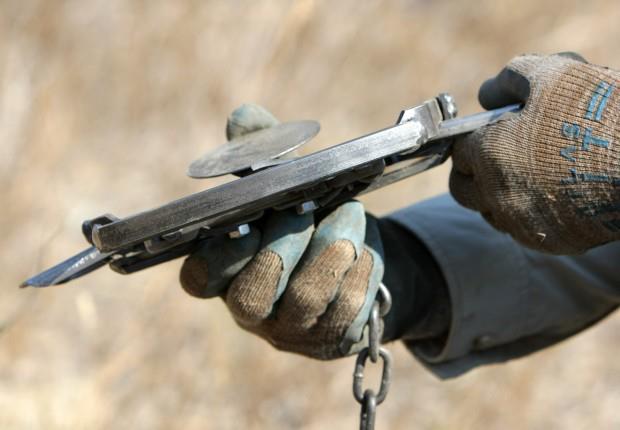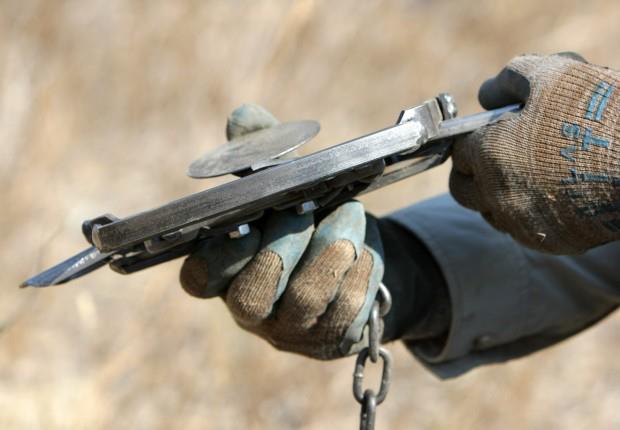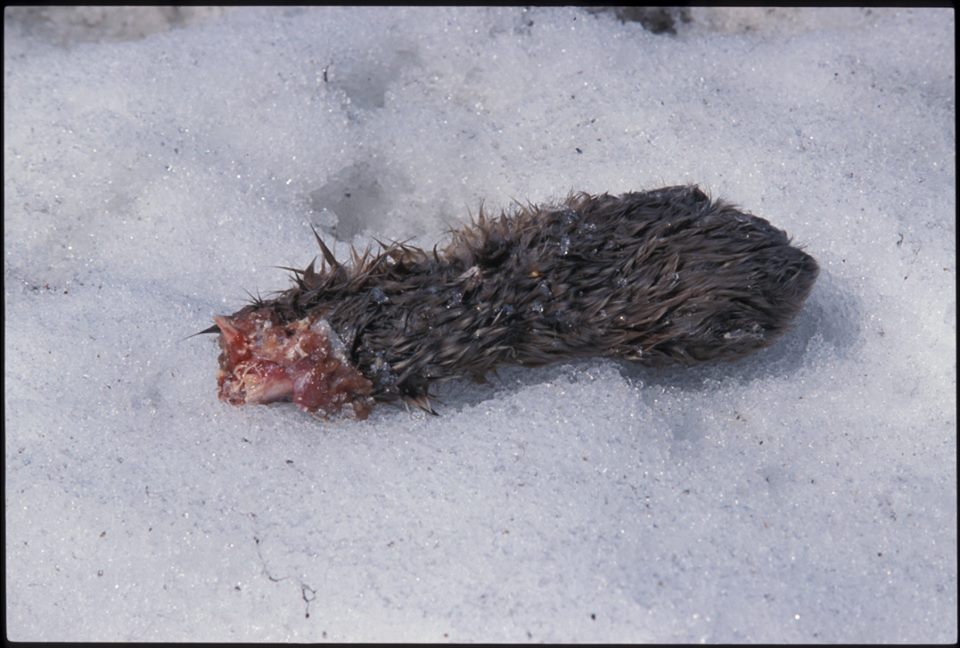
Cougar Chews Off Foot to Escape Wolf Trap

Photo Jim Robertson

Photo Jim Robertson

I’ve had more than my share of heart-wrenching experiences with the gruesome evils of trapping. On a walk near our home in Eastern Washington, my dog stepped into a leg-hold trap that clamped down onto his front paw, prying his toes apart. He cried out in terror and frantically tried to shake it off, biting at the trap, at his paw, and at me as I fought to open the mindless steel jaws. The trap continued to cut deeper into his tender flesh and my efforts caused him even more pain. Finally, after many harrowing minutes, I was able to loosen the torture device enough for him to pull his foot free.  

Another dog I freed was caught in two leg-hold traps. One was latched onto her front leg, while the second gripped her hind leg, forcing her to remain standing for untold agonizing hours. Judging by how fatigued and dehydrated she was, she had been stuck there for several days. The sinister traps caused so much damage that a vet had to amputate one of her injured legs.  

With no other hope of escape and feeling vulnerable to anyone that comes along, many trapped animals resort to amputating their own leg. Trappers callously label this grim act of despair “wring-off”. Truly, freedom is precious to any animal desperate enough to take this extreme step. But if they don’t bleed to death or die from infection, they spend the rest of their lives crippled and quite possibly unable to keep up with a demanding life in the wild. Unlike the fictional character “Little Big Man,” who was distraught to the brink of suicide when he found that an animal had chewed off its leg to escape one of his traps, most trappers who find a wring-off are indifferent to the suffering they caused as they begrudgingly pitch the chewed-off limb and reset their trap.   

While I was camped near Bowron Lakes Provincial Park in B.C., Canada, in late March, my dog found just such a discarded limb–the front leg of a trapped lynx. In what has to be one of the more deceitful abuses of trust ever, free roaming animals– safely protected within the arbitrary boundaries of parks– lose all such protection and are deemed “fair game” for trapping as soon as they step across an invisible dividing line. Trappers consider the lands adjoining parks the most “productive” and will pay tens of thousands of dollars for permits to run trap-lines in those areas. I’ve had the displeasure of seeing three-legged coyotes near the North Cascades National Park, and within the Grand Tetons National Park.  

Sidestepping the indisputable cruelty issue, pro-trapping factions try to perpetuate the myth that trapping is sustainable. But time and again entire populations of “furbearers” are completely trapped out of an area, often within a single season. The winter after I found wolf tracks in Alaska’s Katmai National Park, all seven members of a pack who had found a niche in and around that preserve were killed–permissibly “harvested”– by trappers. Though wolves are extinct or endangered in most of the U.S., 1,500 are legally trapped in Alaska each year.

The preceding was excerpt from the book Exposing the Big Game,

http://www.earth-books.net/books/exposing-the-big-game

No animal should EVER go through the evil of trapping. And yet, in Montana, the Missoulian just reported that a mountain lion just got caught in a wolf trap: Mountain lion paw in wolf trap upsets Darby ex-houndsman

http://missoulian.com/news/local/mountain-lion-paw-in-wolf-trap-upsets-darby-ex-houndsman/article_1e1f05bc-0ccf-5603-8882-45982cd49763.html

April 11, 2015 8:00 am  •  by

HAMILTON – A mountain lion paw found torn off in a wolf trap has a former houndsman from Darby asking for change in the way the state manages the predator.

A little over two weeks ago, a friend of Cal Ruark’s dropped off the trap with the severed lion paw in it.

Ruark – a former president of the Bitterroot Houndsmen Association and now a mountain lion advocate – said his friend was antler hunting in the Reimel Creek area, east of the Sula Ranger District, when he made the gruesome find.

The man told Ruark there were deep claw marks in a tree near the location of the trap.

“He told me the trees were all tore to hell,” Ruark said. “The drag on the trap was hung up on a tree and there were claw marks on the trees where the lion had stood up on its back legs and tried to climb.”

Ruark is sure the mountain lion didn’t survive.

“It might have been able to get along for a little while, but it’s dead now,” he said. “It can’t hunt on three legs.”

Every year, mountain lions die after being caught in traps set for wolves or other furbearers.

Under the current rules, those dead lions are not considered under the quota system that Fish, Wildlife and Parks uses to manage mountain lion numbers.

Ruark believes that needs to change. He will take that request before the Fish and Wildlife Commission at its regular meeting this month.

***

KC York of Hamilton is leading an effort place a referendum on the ballot that could ban all trapping on public lands.

York said between October 2013 and February 2015, 32 mountain lions were captured in traps set for furbearers other than wolves. State records showed that 21 died, six suffered some type of damage to their paws, but were released and another five were set free unharmed.

“So 84 percent of those mountain lions captured in non-wolf sets were either dead or injured,” York said. “Only one of those trappings was determined to be illegal.”

In the two years that wolf trapping has been legal in Montana, York said state FWP records show that 16 mountain lions were caught in traps set for wolves. Five of those lions died.

York said 96 percent of the trappings were considered legal.

“You can’t legally trap a mountain lion in Montana,” she said. “These trappings are considered incidental. It goes with the territory of trapping in this state.”

Anja Heister, co-founder of Footloose Montana, said no one knows for sure how often a mountain lion loses a paw or toes to a trap.

“It was a horrific sight,” Heister said about the lion’s paw in the trap. “This was an incident that was actually discovered. No one knows for sure how often it happens. Trappers have a term for it when an animal loses a foot or a toe. They call it twist off or ring off.”

***

The Ravalli Republic contacted Montana Trapping Association president Toby Walrath of Corvallis for a comment on this story. Walrath said he would either provide a written comment or a phone contact for someone else in the organization Thursday night. By Friday’s end, the newspaper had received neither.

Montana Fish, Wildlife and Parks regional wildlife manager Mike Thompson said all he could say about the issue at this point is that it was being investigated.

Ruark said he wants people to know about this.

“There are a lot of people who should be angry about this lion caught in a wolf trap,” Ruark said. “Trappers should be mad because it makes them look bad. Outfitters should be thoroughly angry because they get $5,000 a pop from their clients to kill one and now there’s one less to hunt. The fact that it’s not counted toward the quota should make local houndsmen angry, too. Everyone involved should be upset.

“But unless there’s a consequence, it’s only going to get worse,” he said. “It’s not right to ignore it when a mountain lion dies.”

If someone put all the mountain lions that died after being trapped in a pile and took a photograph, Ruark said people would pay attention.

“From my perspective, these incidental kills should be counted,” he said.

Bald Eagle Was Found In A Trap

This Bald Eagle Was Found In A Trap. Now She’s Finally Flying Free.

A female bald eagle has been released back into the wild, a month after being found stuck in a leg trap and suffering from elevated lead levels.


courtesy Jordan Spyke

Jordan Spyke, assistant director of the Montana Raptor Conservation Center (MRCC), told The Huffington Post that bald eagles can easily be lured by baited traps as they scavenge for food on the ground.

Fortunately, someone in Fort Belknap, Montana found the bird in the trap before she starved to death. On March 2, she became “Patient 14-15″ at MRCC.

“We don’t name any of our birds,” Spyke explained. “We don’t want to get attached to them or anything like that.”

Blood tests revealed that this bald eagle had elevated lead levels, likely from eating spent shot left by hunters. The trap had cut off circulation to her foot, so her toe had to be amputated. A local vet performed the surgery.

eagle surgery

Spyke and his team also treated the bird to remove the lead from her system. She was given flight therapy in their customized flight barn, the only such facility in Montana.

After a month of careful treatment, she was ready to return to the wild.

On April 1, the MRCC team put the eagle into a large crate and loaded her into their “raptor van” for the ride to the Headwaters National Park. As volunteers held the crate door open, the eagle’s eyes slowly adjusted to the light. The spectators made her nervous, they said, but she flew out and was on her way.

Spyke said releasing the bird after the “double whammy” of an amputation and lead poisoning “feels pretty great.” He said the eagle seemed happy to stretch her nearly 8-foot wingspan, too.

“It flew great,” Spyke recalls. “It came up with wings open, got the wind, and barreled out of there.”

MRCC treats about 180 raptors a year, Spyke said, many for severe injuries from gunshots, electrocution and car collisions. The center is able to rehabilitate and release about 40 percent of its patients.

After nearly disappearing in the 1960s, the American Bald Eagle population has returned to healthy levels thanks to decades of conservation efforts. The U.S. Fish & Wildlife service removed them from the endangered species

Urgent: Tell Montana Legislators to Reject Bill to Protect Fur Trapping Interests

http://ida.convio.net/site/MessageViewer?dlv_id=37281&em_id=36182.0&printer_friendly=1

In Defense of Animals

On April 7, the Montana Department of Fish, Wildlife and Parks (FWP) House Committee will vote on SB 334, and your voice is urgently needed to defeat this detrimental and deceptive bill aimed at furthering the interests of the Montana’s recreational and commercial trappers and fur dealers.

SB 334 seeks to include furbearing animals under the term “game” animal. This means that the word ‘trapping’would no longer be used, and trapping is then completely subsumed under “hunting” in a sneaky effort to hide a cruel and unnecessary activity that is generally abhorred by the public.

SB 334 would also add three animal species, currently categorized as non-game species—badgers, raccoons and red foxes—to species currently classified as “predators”, so that a fur dealer in Montana could then buy and sell the pelts from these species.

SB 334 was introduced by Rep. Jennifer Fielder, who is on the board of the Sanders County Resource Council, which serves as a front group for militia activity, and she is a strong proponent of transferring federally managed public lands to the state so that privatization and exploitation can ensue. Her husband, Paul Fielder, is a district director of the Montana Trapper Association (MTA), who is heavily lobbying for this bill.

Click here to learn more and take action.

End Bobcat Trapping in California

https://takeaction.takepart.com/actions/end-bobcat-trapping-in-california

(Photo:mlorenzphotography/Getty Images)

At the Center for Biological Diversity, we believe that the welfare of human beings is deeply linked to nature — to the existence in our world of a vast diversity of wild animals and plants. Because diversity has intrinsic value, and because its loss impoverishes society, we work to secure a future for all species, great and small, hovering on the brink of extinction. We do so through science, law and creative media, with a focus on protecting the lands, waters and climate that species need to survive.

About the Letter

Over the past few years, a rising demand for bobcat pelts in China and Russia has driven up fur prices and caused a boom in bobcat trapping in California. As a result, trappers have been targeting the boundaries of national parks, luring the cats out of these safe havens and into their deadly snares and cages. The California legislature passed the Bobcat Protection Act of 2013 to protect our parks and wildlife from such commercial exploits. Yet the problem continues because trapping continues in other parts of the state and because the law has yet to be truly enforced.

The California Fish and Game Commission is tasked with this rule making, and one option it is now seriously considering is a statewide ban on all bobcat trapping. But the commission will only choose that option if it hears loud and clear that we value our wildlife alive—not trapped, killed, skinned, and exported to be worn as fur coats in Moscow or Beijing.

Take action—urge the commission to protect these ecologically important California natives by banning all bobcat trapping throughout the state.

https://takeaction.takepart.com/actions/end-bobcat-trapping-in-california

Save Dogs from the evil of Traps

11069999_796532557082212_7990787700535584970_n


ACTION ALERT: Do you have a story about a dog caught in a trap or snare even if it was not your dog? Many animals, including dogs, are unintentionally brutally killed or injured in snares. Contact Governor Dayton, share your story, ask him to eliminate wildlife snaring.

Gov. Dayton phone #: 651-201-3400, toll-free: 800-657-3717
Gov. Dayton contact form: http://bit.ly/1EDwQgh

Please share your story with us. It may be used to pass legislation. Email: info@howlingforwolves.org

_______________________________

Bill in Legislature tries to save dogs from accidental trappings

 by: DOUG SMITH , Star Tribune

  • March 18, 2015 – 10:27 AM

Dogs continue to be trap victims, and a controversial bill in the Legislature aims to change that

Rosie Nordby knew something was wrong when she stepped outside her rural Pequot Lakes home Nov. 29 to retrieve the family’s three dogs, and Lily, a chocolate Lab with a two-week-old litter of eight puppies, was missing.

“It was like she just disappeared,” Nordby recalled this week.

She and her husband, Daren, and three kids searched, called neighbors and then authorities, fearing their hunting dog had been stolen. That night, the family hand-fed Lily’s puppies to keep them alive.

Rosie Nordby found Lily the next day, dead in a body-gripping trap set in a ditch about 750 feet from her family’s house.

“I was heartbroken,” she said. “I’m glad it was me who found her and not my kids. It was traumatic.”

Lily was one of at least 34 dogs caught accidentally in traps in Minnesota last year and among five that were killed. Since 2012, the Department of Natural Resources says 75 dogs have been caught in traps and snares, and 17 died. A group pushing for trapping restrictions claims at least 25 dogs have been killed during that time.

The issue, which gained attention in 2012 when the Legislature tightened some trapping restrictions in response to dog deaths, is again being scrutinized. A bill was introduced this session that further stiffens trapping regulations to reduce or eliminate accidental dog deaths.

Gov. Mark Dayton’s administration has testified in support of the measure.

Supporters say the changes made three years ago haven’t stopped the accidental trapping of dogs.

“We need to do something so our pets don’t get killed anymore,” said Sen. John Hoffman, DFL-Champlin, author of the bill.

Hoffman’s bill would require body-gripping traps to be either completely submerged in water or have enclosures with smaller openings and larger recesses, or be placed at least 5 feet above ground. These methods would greatly reduce the chances of a dog being accidentally trapped, he said.

The Minnesota Trappers Association and the Minnesota Forest Zone Trappers Association both oppose the measure, saying the proposals would greatly limit the effectiveness of trappers.

“Trappers want this issue to go away more than anyone,” Gary Leistico, an attorney representing the Minnesota Trappers Association, testified Tuesday at a Senate hearing in St. Paul. “We’ll continue to work with everyone, but this bill … does much more than what it’s claimed to do. It would not allow meaningful trapping in Minnesota.”

The Minnesota Forest Zone Trappers Association also opposes the bill, as does Michael Tucker, who runs a wildlife removal service and is a member of the National Wildlife Control Operators Association. Tucker told legislators the bill would severely limit the ability of businesses like his to remove problem animals.

Trappers reduce predators of ground-nesting game birds, such as raccoons, skunks, mink, fox and coyotes, the groups say.

And a section in Hoffman’s bill requiring body-gripping traps used near water to be fully submerged would greatly reduce the taking of beavers, who cause damage to culverts and roads around the northern half the state, opponents say.


“You’re taking away the most effective way to trap beaver,” said Randy Goldenman of Zimmerman, who traps beaver for Sherburne County. “I catch up to 200 a year.”

Hoffman says his bill isn’t meant to be anti-trapping and wouldn’t inhibit trapping. “It will just make it safer for dogs and our pets,” he said.

The issue is an emotional one and drew impassioned testimony. Among those testifying in support was a handler for a search-and-rescue dog, the executive director of a Cloquet animal shelter that took in a dog injured in a trap and several hunters.

Loren Waalkens of Lake City, whose beagle, Frisbee, was caught in a body-grip trap in 2011, pleaded with senators to tighten regulations. Though he saved his dog with mouth-to-mouth resuscitation, he said Frisbee now has breathing problems related to the incident.

And Waalkens said when he hunts rabbits he’s constantly concerned his dogs will encounter another trap. “It’s taken the joy of hunting from me,” he said. “Please do something about this.”

Kurt Boerner, an upland bird hunter from Wayzata, said his English setter had a close encounter with a trap, and since then he’s been on a quest to tighten trapping laws. He’s quit hunting when trapping season begins and told outstate friends not to come to Minnesota to hunt during trapping season.

“The problem isn’t trappers, it’s the regulations,” he testified.

Tim McCauley of Fridley is a board member of Dog Lovers 4 Safe Trapping MN, which has pushed for tighter trapping laws, too. He no longer hunts public lands in Minnesota during the trapping season, either, for fear of losing a dog.

“I won’t take the risk,” he said in an interview. “It would ruin my life if I lost my dog.”

Restrictions passed in 2012 require trappers to use a 7-inch overhang when using baited body-gripping traps on public lands. The overhang is intended to prevent dogs from sticking their heads in the trap to reach the bait.

Trapping proponents say the restriction is working. But the DNR reports that since 2012, 15 dogs have been trapped in boxes with overhangs.

Rosie Nordby’s dog was caught in a body-grip trap recessed in a box. The trap was recessed 6 inches, meaning it wasn’t legal. Two of the five dog deaths in 2014 were in illegally set traps.

Some, including DNR officials, say even if the recess had been a legal 7 inches, it probably wouldn’t have saved Lily because of the trap’s location. Meanwhile, the trapper was cited.

“The fine was a whopping $100,” Nordby said.

Dog Owners Beware: Trapping Season in OR is Open

538458_532697610088640_841278349_n

[The title of this Oregonian article, “Trapping season is open; keep dogs safe by having them on leash,” should have read: There are 1,200 licensed trappers (plus an unknown number of unlicensed poachers, in addition to Wildlife “Services” agents) currently setting their sinister torture devices throughout Oregon, so if you don’t want your beloved pet to join the staggering number of wild animals who suffer horrible, hellish deaths at the hands of evil, vacuous trappers, you’d better keep them leashed at all times and always carry heavy duty cable cutters.]

http://www.oregonlive.com/travel/index.ssf/2014/12/trapping_season_is_open_keep_d.html

Trapping season is open; keep dogs safe by having them on leash

by Terry Richard                         December 20, 2014

With trapping seasons under way, the Oregon Department of Fish and Wildlife reminds dog owners to be aware that there could be traps in areas where they walk or hike with the dogs.

Traps may be present on public land, though state regulations require they be set a certain distance from designated trails and public use areas. Traps can also be set on private land by permission of the landowner.

Dogs running loose can be accidentally captured in legally set traps, causing injury or even death. To keep your dog safe during trapping seasons, take the following steps:

Keep your dog on a leash.

Or, keep your dog in sight and under voice command _ don’t let your dog wander off, especially out of sight.

Keep your dog on designated trails and within designated public use areas. Traps must be set a certain distance away from these locations (more information below).

Remember lures and baits used by trappers can attract dogs too (another reason to keep your dog under your control).

Understand how to release a dog from a trap. Idaho Fish and Game and Alaska Fish and Game have brochures and videos with detailed how-tos.

Carry the appropriate tools (cable cutter and length of rope) to be prepared in case you need to release your dog from a trap or snare.

Furbearer regulations set restrictions on where trappers may set traps and snares on state and federal lands. Traps may not be set within 50 feet of any designated public trail or within 300 feet of any designated trailhead, public campground or picnic area. Also, killing traps with a jaw spread between 7.5 and 9 inches set on public land cannot be placed more than 50 feet from a permanent or seasonal water source.

It is illegal to disturb or remove the traps or snares of another person.  Individuals that see traps they believe are illegally set should not disturb the trap, but contact Oregon State Police. OSP can identify the owner of a legally set trap through a unique branding number required on each trap.

Oregon has about 1,200 licensed trappers. Before becoming licensed, trappers in Oregon must pass an education course that deals with topics such as wildlife identification, trapping ethics and setting traps to catch target animals.

Most trapping seasons opened Nov. 15 or Dec. 1 and end Feb. 28 or March 31. A few seasons are open the entire year, but winter is the most popular time to trap because pelts are in prime condition.

Petition: Demand an end to trapping, hunting, and hounding Wisconsin wildlife

xVHAyLEawJsheWD-556x313-noPad

It is vital that you not only sign, but network this petition to summon support from all of your social network. Please help us – they are destroying our innocent family. We the human(e) citizens of the world, CHOOSE A LIVING WORLD and FUNDAMENTAL REFORM OF STATE AGENCIES TO A FIRST TIME DEMOCRACY IN FUNDING AND PARTICIPATION OF THE WILDLIFE LOVING PUBLIC (95% of us disenfranchised). Watch this video for incentive to act: https://www.youtube.com/watch?feature=player_detailpage&v=vWj8tYXdvtI

We the citizens of the world support Wisconsin in strengthening anti-cruelty laws to animals to INCLUDE WILDLIFE, who are as sentient as our cats and dogs. We declare that all wild animals have the right to exist, to not be harmed by humans, and fulfill their natural role in the natural world. We demand that Wisconsin democratize wildlife management by replacing killing license oligarchic funding and control of nature for killing with general public funds tied to fair representation for the humane public ( 90% who do not kill wildlife ) in our Natural Resources Board, staffing and humane education in our schools.

Hunters and trappers have lobbied to exempt wildlife, our natural commonwealth, from anti-cruelty laws. We want our wildlife safe from trapping, hunting, and hounding disruption of fragile ecosystems and a dying planet.

Wildlife creates the web of connection that supports human life. We are warned that ecosystems are at a tipping point of biodiversity collapse – and that we… more

http://www.thepetitionsite.com/takeaction/655/892/273/?taf_id=12618360&cid=fb_na


Los Angeles Bans Animal Traps that Grip or Snare

In a victory for animal rights, the Los Angeles City Council voted unanimously to ban traps that grip or snare foxes, coyotes, and other such animals in the city, labeling such traps as inhumane.


The new rule disallows commercial trappers from using any traps that grip or snare the animals in any way. However, such traps can still be used for mice, rats, and other small rodents.


Cage traps that utilize a locking door can still be used by commercial trappers, which will allow many to stay in business.


The city’s Department of Animal Services will also create measures that ensure locking door traps are not used inhumanely, in instances such as keeping a locked animal caged for hours in summer heat.


Wildlife protection groups applaud the decision, saying that the banning of such traps will prevent suffering and it will keep other animals safe.


The impetus behind banning such traps was the fact gripping or snaring devices often do not actually kill the animal, but leave it to suffer.


In addition to eliminating suffering, banning such traps will ensure that pets are not accidentally injured or killed by snare or grip traps.


Trapping groups in Los Angeles did not offer any public comment on the ban, however, the president of a local wildlife management service told city council earlier in the year that revolving door traps are not an efficient way to catch coyotes.


Animal rights group around the country, including PETA, offered support for the ban, which may prompt other cities in the United States to propose such bans in their respected councils.

538458_532697610088640_841278349_n

Once-extinct on Olympic Peninsula, fisher population rebounds

538458_532697610088640_841278349_nBy LYNDA V. MAPES  The Seattle Times
August 11, 2014 – 1:04 pm EDT

SEATTLE — Once locally extinct, fishers are bounding all over the Olympic Peninsula.

First released into Olympic National Park in 2008 in an effort to repopulate the native carnivore, they now range from Neah Bay to Ocean Shores, from Port Townsend to Olympia, preliminary data from remote cameras and hair snags confirm.

It’s a spectacular turnaround for an animal believed to be locally extinct for at least 80 years. Over-trapping of fishers for their luxuriant, lush brown coats and loss of the big, old-growth trees in which fishers like to lounge and den caused populations to plummet. The state closed the trapping season for fishers in the 1930s.

The National Park Service with other partners began a relocation effort in 2008, in an effort to bring the animals back. From 2008 to 2010, 90 fishers were moved from central British Columbia to the Sol Duc and Elwha Valleys.

The population today isn’t known, and the question remains as to whether births are keeping pace with losses, building a population that is self-sustaining over the long term.

But the indications from a monitoring effort by federal, state and tribal biologists so far are promising. “I’m cautiously optimistic,” said Patti Happe, chief of the wildlife branch for Olympic National Park.

Tracking in such remote, wild country is tricky. The batteries in radio collars initially fitted to the animals are all dead by now, so biologists in 2013 began utilizing remote, motion-triggered cameras pointed at survey stations, including hair snags, baited with chicken drumsticks. The hair samples allow scientists to analyze fisher DNA to track the growing family tree of the initial, founder population.

Some of the new kits have ranged as far as 43 miles from their mothers’ home territory, and cameras have found fishers using habitat where the radio-collared animals were never tracked, documenting that the fishers continue to gain ground.

Sharp toothed and clawed, fishers are related to minks, polecats and martens. They hunt the small mammals that are abundant in the Olympics.

The cameras mounted to detect fishers also documented a menagerie of teaming wildlife in the Olympics: Some 43 species of animals in 2013 were captured on camera in more than 37,000 images, from spotted skunks to coyotes, cougars, bobcats, raccoons, black-tailed deer, elk, flying squirrels, mountain beavers, snowshoe hares, mice and wood rats. Black bear were the single most frequently spotted animal.

Fishers do face perils in their new home. Cougars, bobcats and coyotes take their toll. Several fishers were apparent road kill, including one carcass recovered along Highway 101 on the outskirts of Port Angeles.

Two fishers were released from live traps by a licensed trapper seeking bobcats.

But with an abundant source of food in the forests, fishers are expected to do well. Wolves are now the only mammal still missing from the original suite of life in the Olympics, after being shot and trapped to local extinction in the early 1900s. Wolves are slowly recolonizing Washington wild lands but are not yet known to have reached the Olympic Peninsula.

Fishers once occupied coniferous forests at low to middle elevations throughout much of the Western U.S. The goal of the relocation program is to restore fishers to the Olympic National Park within 10 years.

Radio-tracking initiated in the first phase of the project documented the fishers’ far-ranging travels, including one female released in the Elwha Valley at Altair campground in January 2008. She was the first animal set loose in a public event, where school children cheered as she sprang to freedom from her carrying box.

Biologists followed her “on the air” thanks to her radio collar for 2½ years, from the Elwha Valley to the northeastern portion of the Olympic Peninsula. She settled down in the upper Dosewallips in the summer of 2008, making it home until March 2009.

After a two-month walkabout in the southeastern Olympics, she cruised back down to the lower Elwha, back where she first sprang from her box. There she stayed through June 2010.

She went off the air in 2014, when the batteries on her collar died. But she is perhaps still out there, rewilding her bit of the Olympics.


Information from: The Seattle Times, http://www.seattletimes.com

Dog Deaths Prompt Idaho to Consider Changing Trapping Rules

http://www.care2.com/causes/dog-deaths-prompt-idaho-to-consider-changing-trapping-rules.html

Dog Deaths Prompt Idaho to Consider Changing Trapping Rules

Trapping for wolves and a number of other furbearers is allowed throughout the state, but these traps aren’t just a cruel way to torture and kill the animals for which they’re intended–they are posing a serious threat to non-target animals and our pets.

According to the Department of Fish and Game, in 2012, 30 dogs and 24 house cats were among more than 800 non-target animals who were caught. Trapper reports also show the number of dogs who have become victims of traps has increased from two in 2002 to 32 in 2013.

To illustrate the seriousness of the problem, in two widely reported cases last year tragedy struck when dogs were killed in baited body-crushing traps.

According to the Spokesman-Review, the first incident occurred the day after Christmas when a family watched their two-year-old dog die in less than a minute. The second incident happened in January when a woman took her four-year-old black lab for a run, whereby it was caught in a trap that was legally placed on public endowment land. Her and her husband had to call for help because the trap closed so tightly they couldn’t get it open.

In response to the growing number of dogs being trapped and increasing concerns being voiced by pet owners, the Department of Fish and Game released an instructional video in March of this year, and it’s really helpful: you just need to bring a bucket full of supplies with you, channel MacGuyver, or be kind of person who can function calmly while you’re watching your beloved dog suffer, as you try to remember how to open one of the medieval-looking torture devices without doing even more damage. No problem, right?

As infuriating as it is to think you would have to deal with that just because you want to take your dog hiking, and as easy as it would be to say the obvious solution here is to ban traps, that won’t happen. Voters already enshrined trapping as a hunting right in the state’s constitution in 2012. At least now officials are considering restrictions that could help prevent more accidents.

Last week the Fish and Game Commission voted unanimously to start making new rules for certain types of traps, and is considering other steps that were recommended by a working group, including requiring a trapper education program, posting signs, restricting the use of body-crushing traps on public land, and increasing set-backs for traps placed near trails. Once approved by the commission, these proposals go to the legislature for approval.

That’s Where You Come In

You can send a message to the Fish and Game Commission asking it to implement every possible measure to protect the public and non-target animals from the dangers traps pose.

You can also sign and share our Care2 petition asking state officials to do something to prevent the trapping of endangered Canada Lynx.

Read more: http://www.care2.com/causes/dog-deaths-prompt-idaho-to-consider-changing-trapping-rules.html#ixzz37xk0flgd