Exposing the Big Game

Forget Hunters' Feeble Rationalizations and Trust Your Gut Feelings: Making Sport of Killing Is Not Healthy Human Behavior

Exposing the Big Game

CBS Review: Documentary “Trophy” probes blurred lines between big game hunting, “conservation”

It is hard to picture yourself on the fence when it comes to issues of wildlife conservation and hunting for sport. The two seem mutually exclusive, and advocates for each could hardly be blamed for believing they could never see the other side’s point of view.

Which makes the heart-churning new documentary “Trophy” eye-opening, depressing and enlightening all at once. It shows how these issues are inextricably intertwined, because of both the costs of preserving species that face extinction, and the profit motives of the multi-billion-dollar global hunting industry whose clients will pay big bucks to bag a prized specimen of lion, elephant, rhino or other magnificent creature.

And yes, it forces the viewer to reflect on the desires of both sides: those for whom hunting is a God-given right and all God’s creatures under Man’s dominion to do with as we please; and those for whom the death of an animal is intolerable, and who will take to the streets or to social media to target hunters. (Walter Palmer, the Minnesota dentist who hunted and killed Cecil the lion in Zimbabwe in 2015, became an international pariah who received death threats.)

But there are people in the middle, trying to find a way to protect species in an imperfect, capitalist world where, for example, bans on the sale of rhino horn (enacted to protect rhinos from poachers) have actually increased poaching, decimating the species in just a few years.
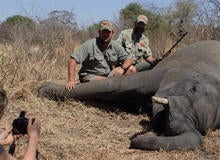
trophy-elephant-hunt.jpg

A hunter poses with the elephant he killed in Namibia in the documentary “Trophy.”

 THE ORCHARD

“Trophy” (which had its world premiere earlier this year at the Sundance Film Festival) follows several figures pursuing their personal goals involving animals, including: Philip Glass, a Texas rancher who is closing in on fulfilling a hunter’s “Big Five,” if the lion’s recent addition to the endangered species list doesn’t trip him up first; John Hume, a former property developer who has invested millions to raise rhinos and harvest their horns, to keep the animals from being slaughtered by poachers; Christo Gomes, who breeds exotic animals on his South African ranch, appealing to the tastes of his wealthy hunter clients; and Chris Moore, a Zimbabwean wildlife officer who must act like King Solomon among the local community whose livestock and family members are preyed upon by wild animals.

If you think you know these people by these brief descriptions, you are wrong. Moore uses harsh “scared straight” tactics against the children of suspected poachers in the dead of night; Gomes cries when thinking about the animals he raises, only to be killed by the clients who pay his bills; Hume goes to court, fighting to repeal South Africa’s ban on rhino horn sales and avoid financial ruin; and Glass visibly mourns the passing of an elephant, which takes a long, long time to expire from the bullets he has fired into its body.

Director Shaul Schwarz and co-director Christina Clusiau do not pull their punches when showing the glee with which a beer-swigging hunter slaughters an alligator dragged out of its pond. “It’s party time!” he says after firing his rifle at point-blank range. Nor with the Youtube commenter upset over Cecil’s death, who happens to be wearing a leopard print scarf.
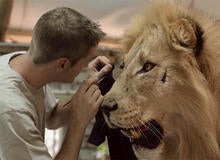
trophy-taxidermist-with-lion.jpg

A taxidermist puts the finishing touches on a stuffed lion in “Trophy.”

 THE ORCHARD

As each person rationalizes their thinking and behavior for the camera, we are left questioning our own moral compass, and where animals fall within it.

One of the most moving sentiments is from a taxidermist, Travis Courtney, who rues that the destruction of habitat forces animals into contact with people. “They always come second,” he says, putting the finishing touches on a stuffed lion.

“This might do justice to them,” he says of his handiwork. “At least that is what I aim for. So if they do become extinct one day, it’s something to show the world what they look like.”

Exceptionally well-photographed, “Trophy” captures the haunting beauty of these threatened animals, whether roaming free in a park beset by poachers or behind chain-link fences, oblivious to the safari that awaits.

The film, strangely, inspires something close to hope — despite the poaching statistics and depressing bloodlust — because, as evoked by the film’s participants in so many different ways, the value of these animals is calculated far beyond mere currency, despite the monetary impulses on view. As anti-poaching activist John Hume observes about harvesting rhino horns rather than slaughtering the animals outright, “Who would kill the hen that lays the golden egg?”

“Trophy” (distributed by The Orchard) opens in New York City and Santa Monica, Calif., on Friday, September 8, and in cities nationwide beginning September 20. (Get tickets.) The film will be broadcast on CNN in 2018. 109 mins. This film is not rated.

To watch a trailer for “Trophy” click on the video player below.  

Trophy – Official U.S. Trailer by The Orchard Movies on YouTube


Longlac man fined after shooting trophy bear; 760-pound animal was shot at the Longlac dump

Trophy bear was shot near Longlac in 2014.

The shooting three years ago of one of the largest black bears ever
harvested in Ontario has led to a stiff fine and the loss of hunting
privileges for a Longlac man.

Michael A. Gauthier was convicted after a trial in Geraldton this week and
fined $5,000 for hunting black bear within 400 metres of a waste disposal
site.

He was also fined $1,000 for possessing wildlife illegally, and received a
four-year hunting suspension. The bear was forfeited to the Crown.

According to a news release from the Ministry of Natural Resources and
Forestry, court was told that on September 13, 2014, Gauthier shot and
wounded a 760-pound bear within the Longlac waste disposal site. Several
hours later, he returned to the site where he dispatched the injured bear.

The MNRF news release refers to the animal as a trophy bear.

Skull size is the usual measurement for determining bear records.

The weight listed in the news release was the “dressed” weight, measured
after the internal organs were removed.

Ontarioblackbears.com lists the largest recorded weight for a black bear as
816 pounds.

However, the Federation for the Recognition of Ontario Wildlife says its
records show the heaviest bear ever harvested in the province was 780
pounds. It was shot by a hunter using a cross-bow in the Nipissing area in
2007.

https://www.tbnewswatch.com/local-news/longlac-man-fined-after-shooting-trop
hy-bear-707460

Another Win for the Elephants

by Sea Shepherd’s Captain Paul Watson:

Big Game little dick Theunis Botha got himself trampled by an elephant he was about to murder earlier this year.

And this week, there has been another case of justifiable self defense by another elephant who dispatched an Argentinian nimrod named Jose Monzalvez in Namibia.

Mr. Monzalvez was an executive with an oil company whose idea of a neat holiday was to go to Africa to murder an African elephant.

He got more than he bargained for and as a result another big game hunter has been justifiably put down.

I especially love how one of the hunting party with Monzalvez stressed they had valid hunting licenses, as if the elephant had no right to kill a properly licensed hunter.

It’s been a good year for Biting Back, two matadors and two elephant hunters received the appropriate justice from their innocent victims.

African elephant populations have dropped from five million a century ago to around 400,000 today and still the psychopathic headhunters are allowed to ‘legally” continue to murder them.

I’m sure I will get some angry messages asking if I have any sympathy for his family? Don’t bother asking. I don’t. My sympathies lie 100% with the elephants.

Mr. Monzalvez wanted to play the big white hunter and his victim was not in the mood to play the part of the victim.

The media did not report that the elephant was shot so hopefully the elephant got away. I do hope so!

An Argentinian man has been killed in Namibia after he was trampled by an elephant, local media report. The Namibia Press Agency said the hunter, identified as 46-year-old Jose Monzalvez, was killed on Saturday afternoon in a private wildlife area 70…
INDEPENDENT.CO.UK

BC SPCA applauds government move to end grizzly bear trophy hunt

BC SPCA applauds government move to end grizzly bear trophy hunt

August 15, 2017

The BC SPCA is applauding the provincial government’s move to end British Columbia’s grizzly bear trophy hunt.“During the fall months, government will consult with First Nations and stakeholder groups to determine next steps and mechanisms as B.C. moves toward ending the trophy hunt,” the government release states.

Announced Monday by Minister of Forests, Lands, Natural Resource Operations and Rural Development Doug Donaldson and in a B.C. government release, the ban will take effect on Nov. 30 throughout British Columbia, after this year’s season.

“The decision to end grizzly bear trophy hunting is a big step in the right direction,” says BC SPCA chief scientific officer Dr. Sara Dubois.

“It demonstrates the change in people’s opinions about trophy hunting.”

The BC SPCA is opposed to the hunting of any animal for trophy or sport. Any hunting of large predators, like bears, has huge impacts on the entire ecosystem. There is great uncertainty in population numbers and more research is needed, Dubois notes.

Additionally, government will be moving forward with a broader consultation process on a renewed wildlife management strategy for the province.”

It is encouraging the provincial government is engaging in a consultation process, Dubois says.

“We’re hopeful it will be an open and collaborative process that keeps conservation and the humane treatment of animals at the forefront of any strategy or initiatives that are developed,” she says.

“We look forward to being part of the process and ensuring conservation practices represent the values of British Columbians.”

British Columbia Will Ban Grizzly Bear Trophy Hunting

Grizzly bear cubs follow their mother in British Columbia, Canada, in 2014. The province has banned trophy hunting of grizzlies beginning at the end of November.

Mick Thompson

In a win for conservationists and environmental groups, British Columbia says it will no longer allow the trophy hunting of grizzly bears in the Canadian province starting on Nov. 30.

The new policy blocks all hunting of grizzlies in the Great Bear Rainforest but still allows people to hunt them for food elsewhere in British Columbia.

Of the approximately 15,000 grizzlies in British Columbia, about 250 are killed by hunters annually, according to government figures.

Forests, Lands, Natural Resource Operations and Rural Development Minister Doug Donaldson characterized that level of hunting as “sustainable” in an interview with the CBC.

However, he says the decision to end trophy hunting is “not a matter of numbers, it’s a matter of society has come to the point in B.C. where they are no longer in favour of the grizzly bear trophy hunt.”

This comes on the heels of an election win for the center-left New Democrat Party, beating the more conservative Liberal Party for the first time in 16 years. The NDP had promised to end trophy hunting during the campaign — which the Liberals had reinstated 16 years ago, according to the BBC.

The grizzly hunting season is opening in parts of the province in the next week, the CBC reports. According to the Toronto Star, many of the hunting permits had already been sold before the new government was formed.

The government has yet to spell out the mechanics of implementing the ban. Donaldson said in a statement that the government “will consult with First Nations and stakeholder groups to determine next steps and mechanisms as B.C. moves toward ending the trophy hunt.”

Environmental groups are delighted about the decision. For example, Joe Foy from the Wilderness Committee said that they believe some 4,000 bears have been killed during the past 16 years, and now they are commending the government of British Columbia “for ending this cruel and barbaric sport for good.”

But wildlife advocates are concerned that providing the option to hunt bears for food will create a loophole for trophy hunting to continue.

The Raincoast Conservation Foundation said that “to ensure a so-called food hunt and de-incentivize the killing of grizzlies, all trophy parts of the bear, such as the head, the hide and the paws, would have to be surrendered by hunters to provincial wildlife authorities.” The group added that “virtually no one hunts grizzlies for food.”

Donaldson told the CBC that bear parts that could be used as trophies would not be allowed to leave the province. “Hunters will no longer be able to possess the hide or the head or the paws of the grizzly bear.”

Hunting guides have criticized the decision.

The U.S. has seen several recent policy changes that roll back protections for bears. The Trump administration announced in June that it was removing the Yellowstone grizzly bear from the endangered species list, because the bears’ population has grown, as NPR’s Colin Dwyer reported.

And in March, lawmakers voted to roll back Obama-era hunting restrictions in wildlife refuges in Alaska, as Colin reported. Among other changes, it repealed a ban on baiting bears and wolves.

Hunter commits suicide after animal activists cyberbully her: report

http://nypost.com/2017/07/24/hunter-commits-suicide-after-animal-activists-cyberbully-her-report/

A popular Spanish hunter took her life after receiving threats on social media from animal rights activists, according to reports.

Melania Capitan, 27, was found dead Wednesday from an apparent suicide at her apartment in Huesca, Spain, according to Crime Online, citing Spanish hunting magazine Jara y Sedal.

 Capitan, from Catalonia, Spain, had amassed a huge fan base on social media posting images of herself hunting. Her Facebook page, where she shared hunting tips, had nearly 39,000 followers.

Some posts, however, were controversial for animal rights activists who would leave harassing messages, the Daily Mail reported. It is not known if her death was related to the cyberbullying.

The Daily Mail reported that the blond huntress left a suicide note for friends, but the contents of the letter have not been released.

Critics continued to flood her Facebook page with messages even after she died.

“She’s finished the lives of many animals and no one defended the death of them… I think our [lives are] worth the same as theirs,” one person wrote.

Others mourned her death, saying the loss was a “shame.”

“I do not like hunting, defending animals and killing for [hobby] seems horrible to me. But it’s a shame that this girl took her life,” another user wrote.

Cecil the lion’s son Xanda shot dead by big game hunters

  • by  Samuel Osborne
  • Cecil the lion’s oldest cub has been shot dead by trophy hunters.

    Xanda was killed outside the Hwange National Park in north west Zimbabwe, according to lion guardians at the national park.

    He was just over six years old and had several young cubs.

    xanda2.jpg

    Xanda’s pride of lions on the hunt for buffalo in Hwange National Park (Bert Duplessis/Fisheaglesafaris.com)

    Two years ago, Walter Palmer sparked international outrage by shooting Cecil, one of Zimbabwe’s most cherished lions.

    Richard Cooke, the professional hunter accused of killing Xanda, also reportedly killed the cubs’ brother in 2015.

    Mr Cooke handed Xanda’s electronic collar back to researchers.

    Andrew Loveridge, from the Department of Zoology at Oxford University, told The Daily Telegraph: “I fitted it last October. It was monitored almost daily and we were aware that Xanda and his pride was spending a lot of time out of the park in the last six months, but there is not much we can do about that.”

    Cecil the lion’s cubs

    He added: “Richard Cooke is one of the ‘good’ guys. He is ethical and he returned the collar and communicated what had happened.

    “His hunt was legal and Xanda was over 6 years old so it is all within the stipulated regulations.”

    https://www.facebook.com/plugins/post.php?href=https%3A%2F%2Fwww.facebook.com%2Flion.guardians.hwange%2Fposts%2F678998725616717&width=500

    Lions of Hwange National Park wrote on Facebook: “Today we heard that a few days ago, Xanda, the son of Cecil the lion has been shot on a trophy hunt by Zimbabwe PH Richard Cooke.

    “Cooke also killed Xanda’s brother in 2015, he was only about four years old then. Xanda is still a young father at 6.2 years old and has several young cubs.

    “We can’t believe that now, two years since Cecil was killed, that his oldest Cub Xanda has met the same fate.

    “When will the lions of Hwange National Park be left to live out their years as wild born free lions should…?”

    Cecil was found beheaded and skinned near Hwange National Park in 2015 and authorities said Walter Palmer, a dentist from Minneapolis, paid a $55,000 (£35,000) bribe to wildlife guides to allow him to shoot the lion with a crossbow.

    He was forced to abandon his dental practice for weeks amid the outcry over the killing

The right is mad over Kathy Griffin’s gruesome Trump video. The left asks: Remember Ted Nugent?

May 31 at 4:01 PM

At a time of strong partisan divide, when one side messes up, the other pounces like a bird of prey.

That happened after comedian Kathy Griffin, who supported Hillary Clinton, posted a 12-second video of her holding what appeared to be President Trump’s bloody, severed head. It immediately drew ire from conservatives, as well as some liberals. By Wednesday, CNN had dropped the comedian from its annual New Year’s Eve program, which Griffin has co-hosted with Anderson Cooper since 2007.

As the backlash against Griffin continues, many on social media have pointed out what they see as a double standard.

Play Video 0:29
Kathy Griffin’s full apology to Trump for severed head photo shoot
Comedian Kathy Griffin apologized for a picture of her holding a prop of President Trump’s severed head on May 30. Griffin came under fire from both conservatives and liberal figures for the image. (AP)

A few times within the past several years, a well-known conservative activist got in hot water over hateful comments about former president Barack Obama. In those instances, though, there was no image of a bloody head; just Ted Nugent’s pointed words, some of which prompted a Secret Service investigation. Trump would later host the hard rocker at the White House — a recent memory that many on Twitter brought up in the aftermath of Griffin’s controversial post.

Their cumulative sentiment: Both spewed hatred. Griffin was punished for it. Nugent became a White House guest.

You old enough to remember your silence at Ted Nugent calling for Obama to be hanged? No? So pipe down now, too. Grown-ups got this. https://twitter.com/benshapiro/status/869636473732997120 

Remember that time you sought and accepted the endorsement of violently racist pederast Ted Nugent for your presidential bid? Good times. https://twitter.com/mittromney/status/869678525925670914 

Ted Nugent called for the death of Barack Obama and Hillary Clinton. He then got invited to the White House. Your argument is null. https://twitter.com/tomilahren/status/869735211684077568 

Nugent, a gun rights activist, is known for his heated remarks about Obama that stretch back to at least 2007, when the former president was competing against Hillary Clinton for the Democratic presidential nomination. Nugent went on a rant onstage during a concert and said vile things about both Obama and Clinton, using expletives to refer to both.

Five years later, Nugent made an impassioned plea for support for then-Republican presidential candidate Mitt Romney during a National Rifle Association Conference in St. Louis. At that time, Obama was running for reelection.

“We need to ride into that battlefield and chop their heads off in November,” he said of the Obama administration in April 2012. He added: “If Barack Obama becomes the next president in November, again, I will either be dead or in jail by this time next year.”

Nugent said he was simply trying to excite voters. But the Secret Service nevertheless asked to talk to him so he could explain his comments. A Secret Service spokesman confirmed the investigation at that time but declined to give details.

You will not be surprised to learn that Spicer ducked a reporter’s question about Ted Nugent by claiming not to know what he said.

Two years later, during a hunting and outdoor trade show in Las Vegas in 2014, he called Obama a “communist-raised, communist-educated, communist-nurtured subhuman mongrel” and a “gangster” who weaseled his way into the presidency.

Nugent apologized for using the term “subhuman mongrel” during an interview with conservative radio host Ben Ferguson a month later. Ferguson then asked whether Nugent was directly apologizing to Obama, to which he replied, “Yes.”

But the controversial remarks didn’t stop there.

In a lengthy Facebook post last year, Nugent said Obama and Clinton should be tried for treason and hanged over their handling of the terrorist attack in Benghazi, Libya.

Despite his history of making inflammatory statements, Nugent, along with former Alaska governor Sarah Palin and musician Kid Rock, became Trump’s dinner guests at the White House in April. Trump had invited Palin, who brought Nugent and Kid Rock with her. Nugent posted a picture of him shaking Trump’s hand as the president sat at his desk during the visit.

https://www.facebook.com/v2.3/plugins/post.php?app_id=&channel=https%3A%2F%2Fstaticxx.facebook.com%2Fconnect%2Fxd_arbiter%2Fr%2F0F7S7QWJ0Ac.js%3Fversion%3D42%23cb%3Df20c3599c0a292c%26domain%3Dwww.washingtonpost.com%26origin%3Dhttps%253A%252F%252Fwww.washingtonpost.com%252Ff3ef813b8c704d8%26relation%3Dparent.parent&container_width=630&href=https%3A%2F%2Fwww.facebook.com%2Ftednugent%2Fphotos%2Fa.415262022296.178371.124016042296%2F10154626793642297%2F%3Ftype%3D3%26theater&locale=en_US&sdk=joey&width=500


READ MORE:

Ted Nugent, Sarah Palin and Kid Rock visited the White House for dinner with President Trump

Did Sarah Palin, Ted Nugent and Kid Rock go too far in mocking Hillary Clinton’s portrait?

Hunting Big Game: Why People Kill Animals for Fun

Hunting Big Game: Why People Kill Animals for Fun

Theodore Roosevelt poses near a dead elephant he killed during an African safari between 1909 and 1910.

Credit: Everett Historical

He fired with his gun’s right barrel, “the bullet going through both lungs,” and then with the left, “the bullet entering between the neck and shoulder and piercing his heart,” Roosevelt wrote. A third volley from another member of the hunting party brought down the great animal, “just thirteen paces from where we stood,” according to Roosevelt.

A black-and-white image of the aftermath shows Roosevelt in what was a common pose for him: standing alongside the lifeless body of a creature that he had hunted and killed. [In Photos: Endangered and Threatened Wildlife]

More than 100 years later, thousands of people each year still visit wild spaces across Africa with guns in hand. They apply for permits to recreationally hunt big animals, many of which — leopards, lions and elephants, to name just a few — represent threatened or endangered species.

And the “sport” is not without risks for human hunters — on May 19, a hunter in Zimbabwe was crushed to death by an elephant after the animal was shot by another member of his hunting party. So what motivates people to hunt these animals for pleasure, and to proudly display the bodies or body parts of their prey as precious trophies?

The slaughtering of large, dangerous animals as a spectacle dates back thousands of years, with records from the Assyrian empire (about 4,000 years ago to around 600 B.C.) describing kings that boasted of killing elephants, ibex, ostriches, wild bulls and lions, according to a study published in 2008 in the journal Bulletin of the American Schools of Oriental Research.

These hunts were carefully orchestrated and conducted for the amusement of royalty and as demonstrations of their strength, Linda Kalof, a professor of sociology at Michigan State University, told Live Science in an email.

“Ancient canned hunts were spectacular displays of royal power and dominance, and always took place with the king’s public watching from the sidelines,” Kalof said. “A successful hunt requires the death of unrestrained wild animals — animals who are hostile, shun or attack humans, and are not submissive to human authority.”

Even today, acquiring trophy animals is a way of displaying power, Kalof noted. In some African countries, where big-game hunting and trophy display are expensive forms of entertainment practiced predominantly by white men, hunting recalls ideologies that are deeply rooted in colonialism and patriarchy, Kalof said.

And then there’s the money involved. Legal hunting, which is conducted under the supervision of government agencies and official guides, involves expensive permits and is limited to specific animal populations and only in certain areas. Illegal poaching, on the other hand, circumvents all regulations and targets animals regardless of their age, sex, or endangered status.

The price tag attached to legal big-game hunting is considerable, once you tally up the costs of travel and lodging expenses, state-of-the-art equipment, local guides, and hunting permits. Government-sanctioned hunting is a booming enterprise in some African countries, with visiting hunters spending an estimated $200 million annually, The New York Times reported in 2015.

And when American dentist Walter Palmer notoriously shot a 13-year-old lion named Cecil in Zimbabwe in July 2015, he purportedly spent approximately $54,000 just on permits for the privilege.

In other words, people who hunt recreationally — and share photos of their trophies — are broadcasting that they can support lavish habits, biologist Chris Darimont, a professor in the Department of Geography at the University of Victoria in British Columbia, told Live Science in an email.

American anthropologist Osa Johnson and Jerramani, her African guide (right) pose with two dead lions in East Africa, in April 1930. With them are three Eagle Scouts who won a national Boy Scout competition to go on safari with the Johnsons in 1928, later writing the book 'Three Boy Scouts in Africa'. From left to right they are Robert Dick Douglas, Doug Oliver and David Martin.

American anthropologist Osa Johnson and Jerramani, her African guide (right) pose with two dead lions in East Africa, in April 1930. With them are three Eagle Scouts who won a national Boy Scout competition to go on safari with the Johnsons in 1928, later writing the book ‘Three Boy Scouts in Africa’. From left to right they are Robert Dick Douglas, Doug Oliver and David Martin.

Credit: Topical Press Agency/Getty Images


In a study on contemporary trophy hunting behavior, published in March 2016 in the journal Biology Letters, Darimont and his co-authors investigated whether evolutionary anthropology could provide answers about motives for recreational hunting. They suggested in their findings that men use hunting to send signals about their fitness to rivals and potential mates, noting that even subsistence hunters (those who kill animals for food) targeted animals that were more challenging for them to catch, simply to let others know that they could afford to take that risk.

“The inference is that they have the physical and mental characteristics that allow them to behave in a costly way and absorb those costs,” Darimont said.

And by sharing images of their trophies on social media, hunters can now trumpet messages about their personal wealth and social status to a global audience, he added. [Black Market Horns: Images from a Rhino Bust]

But there’s yet another side to the recreational hunting story: Some hunters argue that the money spent on their hobby is funding important conservation work. When hunters pay thousands of dollars to government agencies for the privilege of hunting certain types of wildlife in designated zones, portions of those costs can be invested in federal programs and community efforts to preserve animals living in protected areas – and even safeguard them against poaching, according to the World Wide Fund for Nature (WWF).

“In certain limited and rigorously controlled cases, including for threatened species, scientific evidence has shown that trophy hunting can be an effective conservation tool as part of a broad mix of strategies,” the WWF states on its website.

Because legal hunting provides local jobs and revenue, it can work as a deterrent against poaching and helps to conserve ecosystems, professional hunter Nathan Askew, owner of an American company that leads hunting safaris for “dangerous game” in South Africa, Tanzania, Botswana and Mozambique, explained in a Facebook post.

“The positive economic impact brought about by hunting incentivizes governments, landowners and companies to protect the animals and their habitats,” Askew said.

A black rhino (<i>Diceros bicornis</i>) in Etosha National Park, Namibia.

A black rhino (Diceros bicornis) in Etosha National Park, Namibia.

Credit: Fabian Plock/Shutterstock


By demonstrating that wildlife has economic value, hunting can actively engage local communities in efforts to stop poachers and preserve wild spaces that might not otherwise be maintained for wildlife, a representative of the hunting organization Safari Club International (SCI), told Live Science in an email.

Hunting under government supervision can also preserve the health of animal populations in the wild by weeding out individuals that are less fit. In Namibia, for example, black rhinos are listed as critically endangered, with only 5,000 individuals remaining in the wild. Yet the Namibian government maintains an annual hunting quota of five post-breeding males, to stimulate population growth by allowing younger males to breed, the SCI representative explained. [A Crash of Rhinos: See All 5 Species]

“Not only does the black rhino hunting benefit rhino population growth, it also generates hundreds of thousands of dollars in revenue that by law has to be put toward rhino conservation in Namibia. Therefore, hunting provides a direct cash benefit to rhino conservation that tourism can’t provide,” the representative said in a statement.

However, recent studies suggest that modern hunters may be overestimating their contributions to wildlife conservation. Not all countries that support recreational hunting are transparent about where that income goes, and it can be uncertain how much — if any — is actually benefiting African communities or conservation efforts.

A report that the Democratic staff of the House Committee on Natural Resources (a congressional committee of the U.S. House of Representatives) issued in June 2016 suggested that income from hunting in African countries such as Zimbabwe, Tanzania, South Africa and Namibia, from which the greatest number of hunting trophies are imported into the U.S., was not meeting conservation needs.

“In assessing the flow of trophy hunting revenue to conservation efforts, we found many troubling examples of funds either being diverted from their purpose or not being dedicated to conservation in the first place,” the report’s authors wrote.

Danish novelist Isak Dinesen (pseudonym of Baroness Karen Christence Blixen-Finecke) posing with dead lions and a rifle on a safari in Kenya, circa 1914.

Credit: Hulton Archive/Getty


Other experts have also questioned hunting’s usefullness as a tool for conservation. In fact, when it comes to lions, “trophy hunting adds to the problem,” Jeff Flocken, North American director for the International Fund for Animal Welfare, wrote in August 2013, in an opinion column for National Geographic.

Flocken argued that trophy hunting weakens the African lion gene pool because the most desirable trophy kills are young, healthy males. Removing them from the population means that their DNA won’t contribute to the next generation of lions. Killing young males also destabilizes their prides, and can result in more lion casualties as rival males compete to take their place, he wrote.

But perhaps most importantly, he added, legalized recreational hunting derails conservation efforts by simply devaluing the lives of the hunted animals.

“It’s a message that won’t be heard as long as it is common and legal to kill lions for sport,” Flocken said in the article. “Why should anyone spend money to protect an animal that a wealthy American can then pay to go kill?”

Original article on Live Science.

Rally Against Safari Club’s Trophy Hunting Slobs

What: CompassionWorks International (CWI) and Friends of Animals (FoA) are joining together for an anti-trophy hunting protest/rally outside the Safari Club International’s (SCI) New York Tri-State Chapter’s annual fundraiser dinner and auction in Manhattan.

When and Where: Saturday, May 13, 2017. From 5:30 p.m. to 6:30 p.m. outside the Columbus Citizens Foundation, 8 East 69th St. New York, NY, 10021. RAIN or SHINE.

Why: To raise awareness about legislation drafted by Friends of Animals currently moving through the New York legislature. Cecil’s Law (S1883/A4010) would ban the importation, possession, sale or transportation in New York of the African elephant, lion, leopard, and black and white rhinos-all threatened and endangered species.

“Justice arrives for threatened and endangered animals one animal and species at a time,” said Priscilla Feral, president of FoA. “We are targeting the motivations of vainglorious trophy hunters with educational and legislative remedies so well-heeled cowards who feel entitled to murder Africa’s wildlife are unable to ship the heads and carcasses back to adorn their walls of shame.”

“By passing this legislation, the state will not be encouraging or abetting the continued demise of these threatened and endangered species by sport-hunting,” said state Sen. Tony Avella. “New York is the number one port of entry into the United States from Africa. With that comes an exorbitant amount of big game ‘trophies’ being imported into the country that celebrate the unconscionable killing of the Big Five African species. While New York might not always be the final destination of these trophies, it is their entry into the country.”

“These animals are important to ecosystems, yet they are being hunted down for sport. What we are trying to do is discourage that kind of behavior by New Yorkers,” said Assembly member Luis Sepulveda. “It is important we pass this law in New York for future generations. Preserving these animals for our children and future generations is important, and if society continues this practice [trophy hunting], we are going to lose these species who are part of our ecosystem. We have to make sure these species survive. ”

Darien,Conn.-based Friends of Animals, an international animal protection organization founded in 1957, advocates for the rights of animals, free-living and domestic around the world. http://www.friendsofanimals.org&lt;http://www.friendsofanimals.org