Of the couple hundred big game hunts I have embarked upon on this fortunate continent, only about 15 were guided, and most of those were hunts where a guide was required by law (i.e., grizzly bears in British Columbia, Dall and Stone sheep in B.C., the Yukon and Northwest Territories.)
I have nothing against guided hunting trips. However, the current cost of most North American hunting trips has become almost unaffordable. Some hunts almost cause me to swallow my cigar in disbelief!
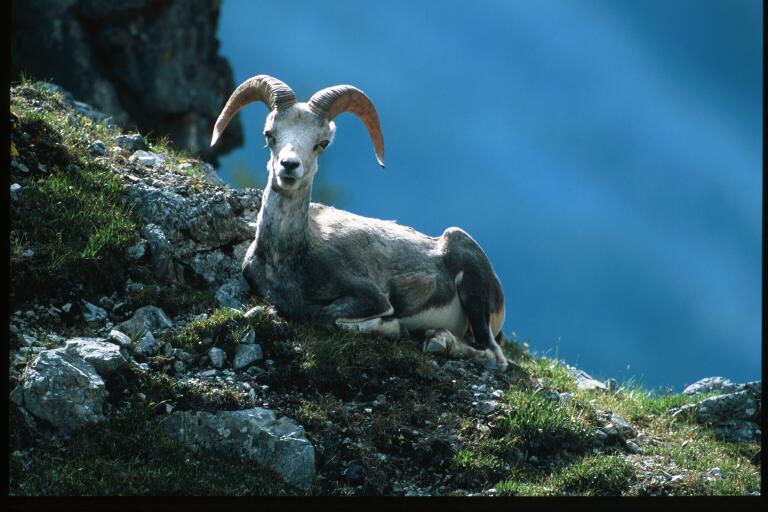
How about a Stone sheep-hunt? In northern B.C. it runs $43,000. Any additional animals taken require extra costs. For example, a Stone sheep hunt in the Yukon costs $41,500. Add mountain caribou for $6,500, grizzly bear for $8,500, moose for $11,500. That’s $68,000 and you haven’t even bought your plane ticket, bush plane flight, license or paid any tips. I daresay a fellow could spend a month or six weeks in Africa and shoot a dozen animals for about the same cost.
The cheapest Dall sheep hunt I was able to uncover was a 10-day hunt in the Brooks Range of northern Alaska for $16,500. Bear in mind that you have to fly commercially all the way to Anaktuvuk Pass before paying for a bush plane flight into the Brooks Range.
Alaska Range horseback Dall sheep hunts run about $19,000. Go to the Yukon for Dall sheep and the price is $20,500 to $23,500. One outfitter charges an extra $6,000 for a helicopter charter.
I hunted caribou in Alaska four times, only one of those was a guided trip and that cost about $2,000 plus air charter. I shot three good barren ground caribou on those four trips. Today a seven-day guided caribou hunt, two hunters per guide, costs about $7,000. That is for one caribou — not two—as it was when I last hunted caribou in Alaska in 1998.
I went on my one and only mountain goat hunt in B.C. in 1972 and it cost $1,000. Today the price runs from $10,000 to $13,500.
My last northern moose hunt was in Alaska in 2001. I hunted unguided with three partners and managed to shoot a respectable 55-inch bull. One of my partners used his frequent flier miles to buy me a commercial plane ticket. So the hunt cost me little more than my share of the bush plane flight, hunting license and groceries. I don’t think I spent much more than $1,000. Today, a guided moose hunt in Alaska starts at around $18,500. Again, that is just the outfitter’s fee.
My only guided grizzly bear hunt took place in B.C. in 1973. It cost $750. Today grizzly bear hunts run $15,000 to $17,000. Coastal brown bear hunts in Alaska cost $20,000 to $25,000. (I hunted Alaska brown bears three times in the mid-1980s as a resident, and never spent $500 on any single trip.)
One might think that deer and elk hunts in the West might be a comparative bargain. Not so. A guided mule deer hunt in Montana, for example, runs in the $5,000 to $7,000 range. Hunt in Utah with a landowner’s permit (no drawing required) and you are looking at $8,000.
A guided six-day elk hunt in Montana sells for $7,000 to $8,000. A five-day elk hunt in Colorado costs $4,800. Add two days to the hunt and the possibility of taking a mule deer buck, and the charge goes to $7,500.
Guided elk hunts in New Mexico and Utah, utilizing landowner tags, run $9,000 to $13,000 and more.
So you can see that guided hunting for big game in North America has become a high-cost activity. I wish it were not so, and that we could go back to the day when a working man had the ability to save his money and hunt anything in North America. It occurs to me that I did some hunting that a younger man could never do, unless he is making $150,000 a year.
April 1st marks the first day of the grizzly bear hunting season in British
Columbia.
“It’s the first day of the spring grizzly bear hunt, when the bears are just
coming out of hibernation and all they care about is having enough to eat
whatever food they can,” says Val Murray of Justice for B.C. Grizzlies,”for
the next 8 to 10 weeks in the province of British Columbia, those bears can
be shot.”
About a hundred people gathered in front of the B.C. legislature renewing
calls to end to the grizzly trophy hunt.
“The grizzly bear is a species of special concern, and we don’t know how
many grizzly bears are in the province. The province says 15,000 but we
don’t actually know if that number is accurate,” says NDP candidate for Oak
Bay-Gordon Head, Bryce Casavant, ” we need to be banning the trophy haunt
because it is no longer morally or ethically acceptable in this province.”
The David Suzuki Foundation revealed data showing over 13,000 grizzlies have
been killed by humans from 1975 to 2016.
he most recent numbers showing that with about 36-hundred hunting trips made
in a season, the hunters bring in about 4-point-8 million dollars.
The Commercial Bear Viewing Association says it raises 13-million dollars a
year.
Many living in close proximity with the grizzlies, say their livelihood is
priceless.
Donna Johnson of the Wuikinuxv Nation says grizzlies used to roam often in
her village growing.
“They’re few and far between, we don’t see as many as we use to, they don’t
come through the village as much. To our nation they’re like ancestors,
they’re that important to us.”
In a statement, the province tells Chek News:
“The government believes that the bear viewing and bear hunting are not
mutually exclusive and can co-exist. both bring benefits to the province,”
says Steve Thomson, Minister of Forests, Lands, & Natural Resource
Operations.
Protesters want this grizzly hunting season, to be the last one in B.C’s
history.
Some people are posting this picture as a joke. Don Jr. bringing down an elephant (under highly controlled hunting) and cutting off its tail is kind of ironic. But it’s really just sick, down to the clean knife above.
Don Jr. made his big debut tonight and some say he made a big splash and helped “humanize” his father. But he and his disgusting brother, Eric, deserve nothing but scorn for the series of wild animal kills that spread across Twitter tonight.
I was not aware of their depravity towards animals until tonight. The folks calling Don Jr. “Patrick Bateman” on Twitter were spot on.
From The Daily Beast:
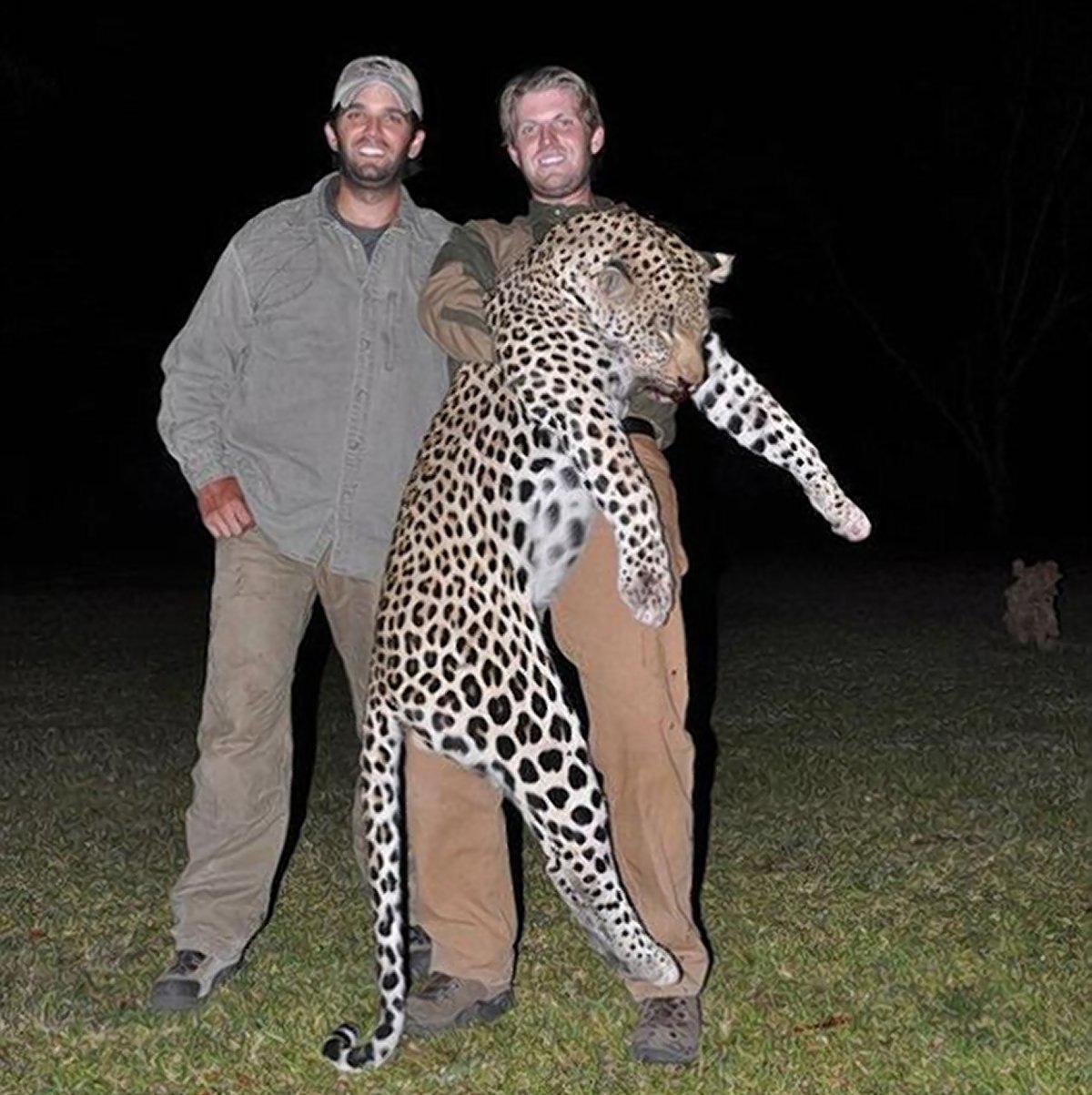
Back in 2012, photos surfaced of the elder Trump’s sons, Donald Trump Jr. and Eric Trump, proudly posing with the carcasses of dead animals they hunted while on a big-game hunting expedition in Africa. The photos showed Donald and Eric posing with a lifeless cheetah, Donald clenching a knife along with the bloody, sawed-off tail of an elephant, and the pair posing next to a crocodile hanging from a noose off of a tree.
Here are Trump’s sons holding up a dead cheetah, all smiles:
The Trump boys were hunting in Zimbabwe—the same country where Cecil was killed—and though Zimbabwean animal conservation groups looked into the incident, the hunt was deemed perfectly legal. Once the photos went viral online, Donald Trump Jr. tweeted (and then deleted): “Not a PR move I didn’t give the pics but I have no shame about them either. I HUNT & EAT game.”
Later, Donald Jr. clarified his thoughts on the big-game hunt in an interview with Deer & Hunting magazine in August 2012.
“I think what made it sort of a bigger story and kind of national and even global news was that I didn’t do what a lot of other people do, which is immediately start apologizing for what I am and that I’m a hunter and all this,” Donald Jr. told Deer & Hunter. “I kinda said, ‘No, I am what I am. I did all those things. I have no regrets about it.’”
CORRECTION: It has been noted several times in the comments that the Trump kids are holding up a dead leopard, not a cheetah. Apologies for the mistake. I relied on the news story instead of my own eyes.
Donald Trump vs. animals: The Republican nominee has a set of troubling associations for those who care about pets, cows, chickens, pigs and horses
If a presidential candidate announced that his or her administration would hurt one of your relatives, you would likely do everything possible to prevent that person from being elected. For the 95% of U.S. pet owners who describe their dog or cat as a member of the family, or the millions of other Americans who care about animals on farms and in the wild, Donald Trump presents such a threat.
From a four-legged vantage point, a Trump administration would be a disaster. Last month, the Trump campaign floated billionaire Forrest Lucas as the potential secretary of the interior in his administration, a position that oversees vital animal-related programs at the National Park Service and Bureau of Land Management.
Described as “the leading anti-animal advocate in the United States” by the Humane Society Legislative Fund, Lucas has dedicated much of his time and fortune to defending some of the worst animal abuse industries in our country.
Lucas’ anti-animal front organization, Protect the Harvest, spent a quarter of a million dollars to try to block a ballot initiative in North Dakota that would have set felony-level penalties for malicious cruelty to dogs, cats and horses. That’s relevant to Lucas’ potential influence in a Trump administration, given that the Bureau of Land Management manages tens of thousands of wild horses in the West.
Lucas’ political machine has also advanced other anti-animal causes, including so-called “right to farm” legislation in states like North Dakota, Missouri, Indiana and Oklahoma. Such legislation would leave millions of animals suffering in silence on factory farms and slaughterhouses, while undermining the Bureau of Land Management’s role in humanely administering 155 million acres of grazing land for cattle and sheep.
While Interior is not directly responsible for companion animal programs, Lucas has shown callous indifference to their protection by funneling hundreds of thousands of dollars to efforts to weaken and repeal tough standards to reform puppy mills in Missouri, the nation’s largest dog-breeding state. The Lucas group also helped kill a local initiative in Indiana that simply would have required proper outdoor shelters to protect dogs and cats from the elements.
Along with Lucas, the other members of Trump’s Agriculture Advisory Committee include some of the most vocal anti-animal business leaders and elected officials in our country. Former Iowa State Rep. Annette Sweeney, one member of that group, was the author of her state’s “ag gag” bill, a perverse inversion of justice in which the heroes who film cruelty on factory farms are instead charged as criminals themselves. That bill was signed into law by Iowa Gov. Terry Branstad, another advisor on Trump’s team.
Nebraska Gov. Dave Heineman, yet another member of Trump’s committee, is infamous for vetoing a bill that would have banned trophy hunting of mountain lions in his state, thus extending Lucas’ anti-cat efforts outlined earlier to their wild cousins as well.
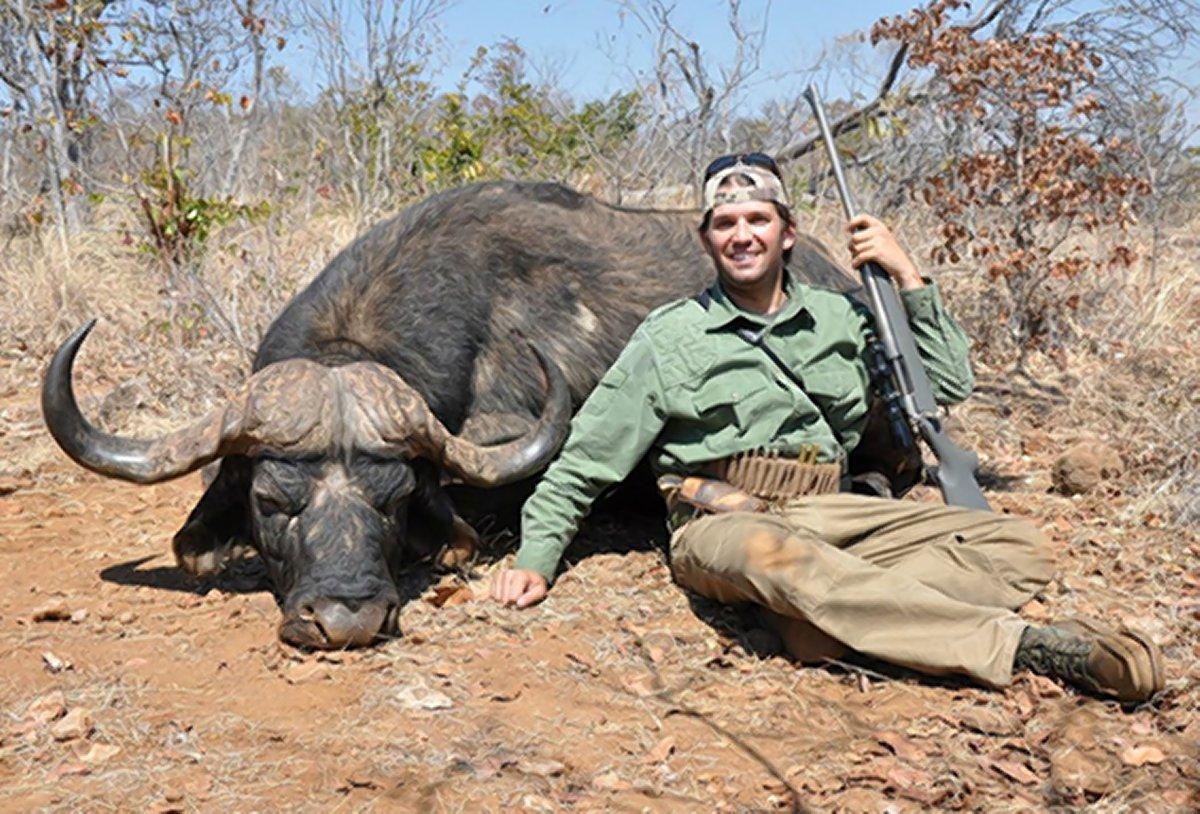
Donald Trump Jr. in Africa with an elephant tail.
But Donald Trump doesn’t need to consult his advisory board to find defenders of cruel trophy hunting practices like Heineman. He has more than enough of them in his own family.
Sons Eric and Donald Trump Jr. have offended millions of wildlife lovers with their pay-to-kill hunts for some of Africa’s most magnificent creatures, including elephants, kudus, civet cats, crocodiles, waterbucks and leopards. Pictures of the Trump boys posing with the victims of their murderous vacations have drawn condemnation across the world, but a much more muted response from their father, who justified it with a casual comment that his “sons love to hunt.”
In this midst of Trump’s anti-animal tornado, it is with wistful retrospection that many Republican animal advocates remember the past leadership by our party on many of the same issues. President Dwight Eisenhower signed the first federal Humane Methods of Slaughter Act into law, as well as legislation prohibiting the poisoning of wild horse and burro waterholes. President Richard Nixon expanded the scope and coverage of animal protection legislation by signing landmark animal protection laws including the Animal Welfare Act, Marine Mammal Protection Act, and Endangered Species Act.
President Gerald Ford expanded both the Animal Welfare Act and the Marine Mammal Protection Act, while Republican legislative leaders like Senator Bob Dole championed the protection of farm animals throughout their careers from their seats in Congress. More recently, Representative Elton Gallegly (R-Calif.) twice led Congress to ban horrific animal crush videos, and dozens of Republican representatives in both chambers have fought for legislation to protect whales, chimpanzees, horses and companion animals from cruelty and abuse.
On Election Day, those are the voices for animals that we should honor and respect. If you love your dog, cherish your cat or care about other animals on farms or in the wild, then proxy their paws in the voting booth and pull the lever for anybody but Donald Trump.
Weinstein is CEO of Ridgeback Communications. He was director of media relations for the Dole/Kemp presidential campaign and was deputy press secretary to then-House Speaker Newt Gingrich.
An estimated 100,000 black bears populate much of the forested areas of Alaska and can be occasionally observed near or on the roads. (Jessica Matthews for The Washington Post)
The Senate voted Tuesday to abolish a rule restricting specific hunting practices on national wildlife refuges in Alaska — including trapping, baiting and aerial shooting — on the grounds that state officials should be able to set the terms for wildlife conservation on public land within their own borders.
The 52-to-47 vote, which was almost entirely along party lines, represented the latest instance of Republicans using a powerful legislative tool — the Congressional Review Act — to eliminate regulations that President Barack Obama’s administration finalized before he left office in January. Independent Sen. Angus King (Maine) joined Republicans in backing the measure, and the measure needs only President Trump’s signature to become law.
With Trump’s support, congressional Republicans are working systematically to undo several environmental, labor and financial safeguards the previous administration put in place toward the end of Obama’s term. Under the 1996 law, any rule wiped off the books cannot be reinstated in a “substantially similar” form.
Although a disproportionate number of the regulations that have come under fire address energy and the environment, the larger debate has focused on whether the federal government has the right to establish sweeping rules Americans must live by or whether power should be devolved to the states.
During a sometimes-emotional debate Tuesday, Republicans and Democrats sparred over how best to define sportsmanship as well as state sovereignty.
Sen. Lisa Murkowski (R-Alaska) noted that the issue of managing wildlife “is something in Alaska that we take very, very seriously.” Recalling how she watched her grandparents and parents lobby for Alaska to become a state, she added, “It was all about fish, it was all about salmon. That’s one of the reasons we fought for statehood.”
But Sen. Martin Heinrich (D-N.M.), who spoke just before Murkowski, said the idea of allowing the killing of mother bears and cubs as well as denning wolves and pups would be putting “the federal stamp of approval on methods of take that the public views as unethical.”
“I don’t think that’s standing up for hunters,” he said. “I fear that it is endangering something that is critical to our culture and a way of life.”
Heinrich added that he had recently taken his 13-year-old son, Carter, on his first elk hunt, where “he soon learned that the hard work comes after you pull the trigger.” As his son painstakingly stripped the meat of the elk they had shot, the senator said, “Anything less would be unethical, and disrespectful to that magnificent wild animal.”
The National Rifle Association backed overturning the rule, as did the Alaska Department of Fish and Game and the Alaska chapter of Safari Club International. In mid-January the state of Alaska challenged the regulation, along with an earlier hunting rule issued by the National Park Service, in federal court.
Environmental and animal welfare groups, by contrast, lobbied against the measure.
For years the Alaska Department of Fish and Game and the U.S. Fish and Wildlife Service had negotiated on an annual basis how to establish hunting and fishing regulations for national wildlife refuges in the state, which encompass tens of millions of acres. But in 2013 the Alaska Board of Game, which is made up of political appointees, rejected the Fish and Wildlife Service’s proposed rules and instructed the state fish and game agency to write the regulations on their own.
“It was the state of Alaska that broke with this tradition,” former Fish and Wildlife Service director Dan Ashe said in an interview, noting that under federal law the agency is supposed to manage “for wildlife first” on its refuges. “We did everything we could to try to resolve the controversy, but the basic issue is what’s your basic philosophy with regard to the management of predators. And these are national wildlife refuges.”
In a statement after Tuesday’s vote, Sen. Dan Sullivan (R-Alaska) said that in his state, “many hunt for survival, both personal and cultural. Alaskans have been able to maintain these strong and life-sustaining traditions through a rigorous scientific process that allows for public participation and ensures we manage our fish and game for sustainability, as required by the Alaska Constitution.”
But Ashe and other defenders of the rule said some of the changes envisioned by state officials, such as allowing people to fly into a place where grizzlies or caribou had gathered and begin hunting that day, could disrupt the natural predator-prey balance in the wild. Ashe warned that while some hunters may want to decrease the number of bears and wolves so that the numbers of other popular game species, such as moose and caribou, rise, there will be unintended ripple effects.
“There’s a natural tension between what the state wants to do, and what the federal law compels the Fish and Wildlife Service to do,” he said.
Theodore Roosevelt with a slain elephant, in Kenya.CreditBettmann, via Getty Images
Donald Trump Jr. came in for some merciless mocking when he posed in this newspaper in a grunge-era flannel shirt, sitting awkwardly atop a tree stump at the family estate, looking glum and lonely. A rejected Cialis ad was one of the kinder suggestions.
But look deeper. Buried in that profile was something — a saffron-thin thread of hope — that could keep his father from hastening the early death of the planet. The elder Trump has repeatedly indicated his intent to withdraw American cooperation from the global agreement to negate climate change, yet another middle finger from this president to the rest of the world, and to his grandchildren. His budget would let poisons flow through American rivers and be belched into the sky overhead.
The other Donald Trump, the kid with the burden of going through life with that name, may be the only person who can stop him. In the profile, junior comes across as a little boy lost, emotionally abandoned after the divorce of parents whose every hour is spent in bold face. Sent away to boarding school. Finding some solace hunting and fishing with a grandfather in Czechoslovakia. As he tries to navigate around the toxic swagger of the old man, he relishes his time in nature. It’s not, mind you, listening to yellow-rump warblers on spring days. It’s killing things. Pheasant and deer. And bigger things, elephants and leopards, creatures so magnificent that most people cringe at the thought of ending their lives in a sporting pursuit.
But there was another famous New Yorker who did much the same thing after going through a long stretch of emotional trauma — Teddy Roosevelt. And there you find the saffron-thin thread of hope. For on the desk of Donald Trump Jr. is a bronze statue of T.R. — the most muscular defender of creation in this nation’s history.
Step one is for Trump Jr. to read up on the bronze. If he hasn’t already, he should try Edmund Morris’s “The Rise of Theodore Roosevelt” and David McCullough’s “Mornings on Horseback” for starters.
And yes, he hunted, pretty much anything. For Roosevelt, one reason to preserve all those living things was to have an opportunity to kill them later. But his love of nature was deep and consistent. “When I hear of the destruction of a species,” he wrote a friend, “I feel as if all the works of some great writer had perished.”
No doubt, Roosevelt would have detested Trump. “It tires me to talk to rich men,” he once said. “You expect a man of millions to be worth hearing, but as a rule, they don’t know anything outside their own business.”
But Trump Jr. certainly likes Roosevelt. If he takes away just one thing from the president who launched a century of progress, it should be his thunderous pitch for posterity in his New Nationalism speech of 1910. He said, “Of all the questions which can come before this nation there isn’t one which compares in importance with the central task of leaving this land even a better land for our descendants than it is for us.”
That seem rather obvious — everywhere but inside the Trump White House. The president’s budget blueprint would gut the core mission of the agency charged with ensuring clear air and water. It would cripple the departments that oversee parks and national forests. And, in another stab at his base, he would make it much more difficult to get in and out of the open spaces of America, eliminating the federal assistance that keeps many rural airports from closing.
Of course, at a time when Trump’s other proposals would literally mean death to poor people newly deprived of health care and would stop vital cancer research that could save millions of lives, the concerns of the natural world can seem secondary.
Still, that’s the only area where Trump Jr. could match his passions with a policy block. His tweets, including the recent hit-and-miss attack on the mayor of London, show him to be an otherwise meanspirited, incurious and accuracy-challenged chip off the old block.
Sickly as a child, heartbroken as a young man over the loss of his wife and mother on the same day, Teddy Roosevelt found his salvation in nature, the American wild. “I owe more than I can ever express to the West,” he said.
In a similar vein, young Trump, who gives the impression of somebody who knows he will never outrun his father’s shadow, said, “I owe the outdoors way too much” for keeping him out of trouble. One man repaid the debt. The other still could.
Donald Trump, Jr. and President Donald Trump (Picture: Getty)
Donald Trump Jr has been branded a disgrace for appearing to use the London terror attack to spread anti-Islamic rhetoric.
In a tweet after yesterday’s atrocities in the capital, which left five dead, President Donald Trump’s eldest son goaded London’s first Muslim Mayor Sadiq Khan.
With a link to an old story – from September 2016 – Trump Jr quoted Khan, saying terror attacks are ‘part and parcel of living in a big city’.
Trump Jr lay into Sadiq, asking: ‘You have to be kidding me?!’
Donald Trump Jr has been branded a disgrace (Picture: Twitter)
The POTUS’s son made no mention of the fact he’d shared an old article, allowing thousands of his followers to believe Khan’s comments were said in the aftermath of the shocking attack.
People on Twitter were quick to point out that the interview was old and completely unrelated to the March 22 attacks on London, though at time of publishing Donald Trump Jr’s tweet remains.
Thousands of people shared Trump Jr’s tweet suggesting Khan said terror attacks were to be expected (Picture: Twitter)
The error was pointed out repeatedly (Picture: Twitter)
It’s unclear if he was aware when posting that the Khan interview in the Independent was out of date, although more than 15 hours later it’s been highlighted repeatedly.
MP Wes Streeting replied to the post, saying: You use a terrorist attack on our city to attack London’s Mayor for your own political gain.
‘You’re a disgrace.’
‘We stand together in the face of those who seek to harm us and destroy our way of life. We always have, and we always will. Londoners will never be cowed by terrorism,’ he said.
Khan also assured Londoners there would be additional police on the streets to keep residents and tourists safe.
What happened outside Parliament
Members of the emergency services work to help vicitms on Westminster Bridge, alongside the Houses of Parliament in central London on March 22, 2017, during an emergency incident (Picture: Getty)
A massive police investigation is under way after a terror attack in central London.
Here’s everything we know so far about the Westminster attack:
The woman was killed on Westminster Bridge as a number of pedestrians were mowed down by a grey Hyundai i40.
It is believed the man was also killed in the incident on the bridge.
Seven people are in a critical condition, and 29 have been treated in hospital.
One woman ended up in the Thames and was treated for serious injuries after being pulled from the water.
The attacker, armed with two large knives, jumped out of the car after smashing it into the railings encircling the Palace of Westminster, fatally stabbing Pc Palmer as he entered the grounds.
He was shot dead moments later by another officer.
During a speech in Parliament, Theresa May confirmed the Westminster attacker was a British citizen who was known to the police and security services, and had been investigated some years ago over violent extremism.
May told MPs he was a ‘peripheral’ figure, adding: ‘He was not part of the current intelligence picture.’
Here’s everything we know about the attacker.
Defence Secretary Michael Fallon has said the working assumption is that the attack is linked to Islamic terrorism.
A group of French schoolchildren were among those targeted on the bridge, with three injured.
Prime Minister Theresa May later chaired a meeting of the Government’s emergency Cobra committee, branding the attack ‘sick and depraved’.
Donald Trump Jr. is the Trump who has not always seemed at ease with being a Trump. He grew up in the penthouse of Trump Tower but was happy to escape the gilded trappings of his Manhattan childhood to spend parts of the summers hunting and fishing with his maternal grandfather in the woods of what was then Czechoslovakia.
After graduating from his father’s alma mater, the Wharton School at the University of Pennsylvania, he tended bar in Aspen, Colo., rather than immediately join the family business. Several months later, on Feb. 25, 2001, during a Mardi Gras celebration in New Orleans, he was arrested on charges of public drunkenness and spent 11 hours in jail.
“I think, like anyone else, I made my mistakes,” Mr. Trump said of his arrest. “We have to be honest with ourselves. I’m not good at it, moderation. You have to have the conversation, be a realist, and say, ‘I guess I’m not doing myself any favors.’”
In 2001, Mr. Trump, the eldest of the five children from Donald J. Trump’s three marriages, went to work for the Trump Organization in the same building where he had grown up. He rose to executive vice president, and his status as a family member in good standing was on display when he appeared as a boardroom adviser on “The Apprentice,” the NBC reality show that re-established his father as a celebrity mogul nearly two decades after he had captured the public’s attention with his first best seller, “The Art of the Deal.”
Now Donald Jr., 39, has completed his own apprenticeship.
Since his father was sworn in as president, he and his brother Eric, 33, have taken over management of the Trump Organization, with Donald Jr. overseeing commercial licensing and much of the international business and Eric managing the golf courses, among other duties. Donald Jr. is also a rising figure in Republican politics and a robust defender of the family name. As a public speaker who brings in an estimated $50,000 per speech, he has impressed conservatives with a rough, straightforward manner that belies his cushy upbringing.
Like his father, he uses Twitter to thrash liberals and lend support to those who are friendly to the president’s populist agenda. Given that he is a skilled outdoorsman and a member of the National Rifle Association who owns dozens of firearms, among them a Benelli Super Black Eagle II (for hunting waterfowl) and an AR-platform semiautomatic rifle (for marksmanship competitions), Mr. Trump also connects with heartland voters in a way that his more refined sister Ivanka may not.
Photo
Donald Trump Jr. with his father and his mother, Ivana, and her father, Milos Zelnicek.CreditRon Galella, Ltd./WireImage
While Ms. Trump and her husband, Jared Kushner, have lately elevated their social profile in Washington and Palm Beach, Fla., while keeping close contact with the president, her oldest brother has largely avoided the balls and benefits, preferring to hunker down in Midtown during the workweek and spend weekends in the Catskills with his wife, Vanessa, and their five children.
“Don is the more chill version of any of the kids,” said Dee Dee Sides, who has known him since the early 2000s.
He came into his own as a public figure during the presidential campaign. On the stump he was equally at ease before crowds in both Mississippi and Michigan, and television pundits gushed about his political future after his bluntly effective speech at the Republican National Convention, with some mentioning him as a potential mayoral candidate in New York City.
“I don’t know if I could go all-in at that,” Mr. Trump said of a political career. “There is a part that is incredibly enticing. But it’s not human most of the time.”
Even as he embraces his new status in business and politics, Mr. Trump sounds, at times, as if it is some kind of anomaly.
“If I could miracle myself away,” he said, “I would live out West.”
Into the Woods
Mr. Trump’s friendships are rooted, for the most part, in hunting and fishing, sports that do not appeal to the golf-loving patriarch of the Trump family. He said he decided early on not to measure himself against his father.
“I think people are often surprised, but I never defined myself as, ‘I’m the business guy who has to supersede what my father has done,’” he said. “He’s a totally unique individual. Somehow having to top his accomplishments is never the way I perceived things.”
Photo
Donald Trump Jr., Donald J. Trump and Ivanka Trump on an episode of “The Celebrity Apprentice” in 2009.CreditAli Goldstein/NBC
He developed a distaste for living in public at an early age. In 1990, his father separated from his mother, Ivana Zelnickova, a Czech model and skier, after having an affair with the model and sometime actress Marla Maples. Donald Jr. was 12 at a time when gossip columnists, someencouraged by his father, chronicled the family soap opera. During this time, Donald Jr. did not speak to his father for a year, New York magazine reported in 2004 in an article about the Trump children.
Before the divorce, Mr. Trump found a role model in someone quite different from his father: his maternal grandfather, Milos Zelnicek, an electrician who was an avid outdoorsman. In the summers, he stayed at the Zelniceks’ home in a town near Prague for six to eight weeks at a time, and his grandfather schooled him in camping, fishing, hunting and the Czech language.
“He needed a father figure,” his mother said in a telephone interview. “Donald was not around that much. They would have to go to his office to say hello to him before going to school.”
Mr. Zelnicek, who died in 1990, allowed his grandson a freedom not readily available to a child of Fifth Avenue. As Mr. Trump put it: “He said: ‘There is the woods. See you at dark.’ I think I felt a little trapped in New York City.”
Despite the advantages of wealth, Mr. Trump said his life at home was not always easy. “In our family, if you weren’t competitive you didn’t eat,” he said. “You had to fight for what you wanted.”
His mother recalled walking into the breakfast room one morning and noticing that the chandelier was broken: “Ivanka said it was Don Jr. So I put him over my knee and spanked him. He said, ‘Mom, it wasn’t me!’”
It turned out that Ivanka lied, the former Mrs. Trump said.
The divorce was made final in 1992, and Mr. Trump’s father married Ms. Maples the next year. Donald Jr. went to boarding school, the Hill School in Pottstown, Pa., where he practiced skeet shooting, and then it was on to Wharton, where he rowed crew and joined the Phi Gamma Delta fraternity. People who knew him then saw him as distinct from his parents.
Photo
Donald Trump Jr. addressed the Republican convention last summer.CreditJosh Haner/The New York Times
“He wasn’t into the gold,” said Jennifer Ireland Kubis, a New York real estate agent who dated one of Mr. Trump’s college friends. “He was trying to escape it.”
The young Mr. Trump also earned a reputation for hard partying, which seems to have continued until the Mardi Gras arrest. He no longer drinks, and he has suggested that the discipline of the sporting life kept him from going over the edge: “I know that the benefits I got from being in the woods, from being in a duck blind, from being in a tree stand at 5 o’clock in the morning, kept me out of so much other trouble I would have gotten into in my life,” he said in a speech at a fund-raising banquet for the 2016 Western Hunting and Conservation Expo in Salt Lake City.
During his first year in the family business, he spent weekends at the Mashomack Preserve Club in Pine Plains, N.Y., where he ran into Gentry Beach, an acquaintance from college who was working at a Manhattan investment firm.
“We loved being outdoors,” said Mr. Beach, who grew up in Dallas.
Mr. Beach, 41, introduced Mr. Trump to Thomas Hicks Jr., 39, a Dallas friend whose father, an equity investor, once owned the Texas Rangers. Through the years, the three have hunted white-tailed deer in Texas, birds in Scotland and pheasant in Hungary.
“For some people — you see that in New York a lot — they go hunting once every other year and they talk about it at a cocktail party for the next two years until they do it again,” Mr. Trump said in an interview. “For me, it is the way I choose to live my life.”
Being friends with Donny, as his closest friends call him, can be tricky, given the divisiveness of his father’s politics. Ms. Sides, for one, said she did not discuss politics with her friend. “Our views are different,” she said. “Don has never asked me, and he would not ask.”
It was his father who introduced Mr. Trump to Vanessa Haydon, the woman who would become his wife, at a fashion show in 2003. A onetime model with the Wilhelmina agency who once dated Leonardo DiCaprio, she had grown up on the Upper East Side. At the time of their engagement, Mr. Trump accepted a ring from the Bailey Banks & Biddle jewelry store in Short Hills, N.J., in exchange for publicity, recreating his proposal at its Short Hills Mall location in New Jersey. Soon afterward came an unflattering headline in The New York Post: “Trump Jr. Is the Cheapest Gazillionaire: Heirhead Proposes With Free 100G Ring.” Even his father joined in the criticism, saying on the CNN talk show “Larry King Live,” “You have a name that is hot as a pistol, you have to be very careful with things like this.”
Donald Jr. and Vanessa were married at the Mar-a-Lago club in Palm Beach on Nov. 12, 2005, 10 months after his father married the former model Melania Knauss. These days Vanessa Trump’s Twitter account, with the handle @MrsVanessaTrump, frequently retweets her husband’s posts pertaining to family life, many of which include photographs of their weekends in the Catskills, where they fish and shoot, and ride A.T.V.s and snowmobiles.
Business and Politics
Although Mr. Trump has been charged with holding down the family business without input from his father — who resigned his position in the company without relinquishing his financial stake — he took advantage of his new standing within the Republican Party to dine last Saturday with a group of political heavyweights that included Senator Ted Cruz of Texas at the annual Reagan Day fund-raising dinner, where he delivered a speech.
He told the crowd that he had had virtually “zero contact” with the president since the election, but added that he had found it difficult to resist the pull of politics. “I thought I was out of politics after Election Day,” he said, adding that he had thought he would “get back to my regular life and my family.
“But I couldn’t,” he said.
Two weeks before the Dallas speech, Mr. Trump found himself in the role of real estate tycoon during a stop in Vancouver, British Columbia, for the opening of a Trump International Hotel and Tower. Although the building unveiled that day was, at 63 stories, the city’s second highest, the city’s mayor, Gregor Robertson, skipped the event after demanding for two years that the Trump name be stripped from the building’s facade.
The president’s son began his talk with a poke at the news media: “I’d like to thank the press,” he said. “Just kidding.” Outside, about 100 protesters waved signs and shouted “Love Trumps Hate.”
To a large degree, his public image has been shaped by photographs that surfaced online in 2012 and re-emerged last year. They were taken during a hunting trip in 2010 arranged by Hunting Legends International, a safari company based in Pretoria, South Africa. A licensed guide accompanied Donald Jr. and Eric, along with a ranger from the Zimbabwe national parks department, who monitored the hunt.
One photograph shows the Trump brothers taking a helicopter to the Matetsi, a region of Zimbabwe abundant with elephants and endangered leopards. Another shows Eric with his arms wrapped around the limp body of a dead leopard. Perhaps most disturbing to nonhunters and to those who do not hunt endangered or vulnerable species was the picture of Donald Jr., knife in one hand, the bloody tail of an elephant in the other.
NYT Living Newsletter
Get lifestyle news from the Style, Travel and Food sections, from the latest trends to news you can use.
Animal rights advocates, including People for the Ethical Treatment of Animals, cried foul after Hunting Legends posted the photos, and a sponsor dropped the show “The Celebrity Apprentice,” which Donald Jr., Ivanka and Eric appeared on as advisers, along with their father. Donald Jr. took to Twitter to defend himself, writing to one detractor, “I’m not going to run and hide because the PETA crazies don’t like me.”
He argues that the economic benefit of such safaris to African communities is often overlooked. Further, he said, the controversy allowed him to connect with other sportsmen. “There were people who I didn’t know who were hunters,” he said. “And, from that perspective, I get invited a lot.”
What is lost on nonhunters, he said, is the sense of community that is part of hunting trips. “Too much of hunting has turned into the notion of the kill,” he said. “It’s a component, the meat. But so much is experiential, so much is relationships. It is sitting in a duck blind with seven people, cooking breakfast. For me, it’s been a great way to see the world. The least interesting part is the three seconds it takes to pull the trigger.”





 Exposing the Big Game