Exposing the Big Game

Forget Hunters' Feeble Rationalizations and Trust Your Gut Feelings: Making Sport of Killing Is Not Healthy Human Behavior

Exposing the Big Game

Ryan Zinke, Montana Congressman, Confirmed as Trump’s Interior Secretary

Montana Republican Ryan Zinke won Senate confirmation Wednesday to lead the Trump administration’s Interior Department, garnering votes from several Democrats who threw support behind the one-term congressman.

The Senate voted 68-31 in Zinke’s favor — a solid margin for a Trump cabinet appointee after a handful of other nominees were approved by a razor’s-edge.

Image: Senate Energy and Natural Resources Committee hearing on nomination of Ryan Zinke to be Secretary of the Interior
Ryan Zinke testifies before the Senate Energy and Natural Resources Committee confirmation hearing on Capitol Hill in Washington, D.C., on Jan. 17, 2017. Michael Reynolds / EPA

Zinke, a former Navy SEAL who describes himself as a “Teddy Roosevelt Republican,” will oversee the department responsible for the management of federal lands and natural resources. He has defended expanding oil, gas and coal production, and has also warned that landowners in Western states are voicing concern over encroaching federal control.

“I have to go out there and restore trust,” he said at his January confirmation hearing.

Zinke, at the hearing, did noticeably contradict President Donald Trump by testifying that he accepts climate change is real and man-made.

“I do not believe it’s a hoax,” Zinke said, in contrast with the president, who previously tweeted that it’s a “hoax” created by China.

Related: Trump’s Cabinet: What You Need to Know About It

Zinke, 55, was also questioned at the hearing about a House vote this year that makes it easier to transfer federal lands to states.

Sen. Chuck Schumer, D-N.Y., fired off a series of tweets Wednesday explaining why he vote against Zinke, arguing that “you can’t be a Roosevelt conservationist when you vote to make it easier to sell off public lands.”

Still unconfirmed is Ben Carson as Housing and Urban Development secretary. Carson’s Senate vote has been held up since his confirmation hearing in January

Trophy Hunting is Barbaric

02/22/2017 03:50 pm ET | Updated 15 hours ago

(Photo Courtesy of the Humane Society of the United States)

Trophy hunting is a despicable practice that even many hunters disagree with because of clearly unsportsmanlike practices like hunting animals in fenced enclosures, baiting, and using dogs to chase and exhaust wild animals. But the bottom line is that trophy hunting is simply killing for fun or bragging rights and no real hunter who follows any sense of ethics would participate in this blood sport.

Last year, The Humane Society of the United States used data from the U.S. Fish and Wildlife Service to determine that between 2005 and 2014, 1.26 million trophies were brought into the U.S. This is an average of 126,000 trophy imports per year or 345 per day.

The killing of Cecil the lion by American Walter Palmer demonstrated to the world how inhumane trophy hunting is. Cecil was in Hwange National Park in Zimbabwe and wore a collar that transmitted data about his movements back to researchers. This didn’t stop Palmer and his guides from luring the lion outside of the protected preserve with meat and then stalking and killing him. People were outraged and rightfully so.

Even with Walter Palmer as one of its members, Safari Club International continues to facilitate selling trips around the world to kill the rarest animals for their heads and hides. Their recent convention in Las Vegas in February offered the following options to wealthy individuals:

· a Zambian leopard, sable, roan and plains game hunt for $81,000;

· a Canadian polar bear trophy hunt for $72,000;

· a New Zealand red stag and tahr hunt for four people for $92,000.

SCI maintains that it is a “conservation” group that contributes substantially to the economies of poor African nations. Nothing could be further from the truth. To coincide with the meeting in Las Vegas, Humane Society International (HSI) released a study conducted by Economists at Large that finds that trophy hunters have overstated their contributions to African economies and employment.

In Botswana, Ethiopia, Mozambique, Namibia, South Africa, Tanzania, Zambia and Zimbabwe, trophy hunting brings in just 0.78 percent or less of overall tourism spending and has a marginal impact on employment, accounting for 0.76 percent or less of tourism jobs.

The fact is the segment of the tourism industry in Africa that does not rely on hunting is growing faster and employs 132 times more people than the trophy hunting industry. The tourism ministries of these eight countries must recognize the damage trophy hunting causes to their brand. We should call on these ministries to lead the charge in banning trophy hunting, something Botswana and Kenya – both prosperous tourism destinations – have already done.

Trophy hunting is still big business for SCI. In 2015, revenue from the convention was $14.3 million out of a total revenue of $22.7 million. The money is used to open up trophy-hunting seasons on wolves, fight any efforts to restrict the hunting of African elephants and lions, and lobby Congress to enable hunters to import endangered polar bear trophies into the U.S. or increase hunter access to public lands.

Trophy hunters are losing ground. In 2014, the U.S. Fish and Wildlife Service restricted imports of elephant trophies from Tanzania and Zimbabwe, as well as conferring threatened and endangered status for African lions. Cecil’s shooting prompted numerous major airlines, including Delta, Virgin Atlantic, and United, to ban the transport of some or all trophies from Africa.

It is up to us to put pressure on Congress to continue to pass laws that limit trophy hunting. This will not be easy as President Trump’s sons are avid trophy hunters. We also need to encourage African nations to turn to viable alternatives to trophy hunting, like ecotourism, which promises sustained growth, much higher economic value, and greater contribution to employment.

Cecil the lion cast a light on this inhumane practice. In his memory, let’s save other big game from wealthy people who are neither hunters nor conservationists – they are cold blooded killers.

http://www.huffingtonpost.com/entry/trophy-hunting-is-barbaric_us_58adf859e4b01f4ab51c75ab

Trophy hunters overstate contribution of big game hunting to African economies: Report

Trophy hunters overstate contribution of big game hunting to African economies: Report

A new report released by the Humane Society International (HSI) finds that trophy hunters are “grossly” overstating the economic benefits of big game hunting in Africa.

HSI timed the release of the report to coincide with the start of Safari Club International’s (SCI) annual convention in Las Vegas, Nevada on February 1. US-based SCI, one of the world’s largest trophy hunting advocacy organizations, released a report in 2015 that claimed trophy hunting-related tourism contributes $426 million annually to the economies of eight African countries and creates more than 53,400 full- and part-time jobs.

But the HSI report, prepared by Melbourne, Australia-based consultancy Economists At Large, found that SCI had “grossly overstated the contribution of big game hunting to eight African economies and that overall tourism in Africa dwarfs trophy hunting as a source of revenue,” according to a statement.

In the eight countries studied for both reports — Botswana, Ethiopia, Mozambique, Namibia, South Africa, Tanzania, Zambia, and Zimbabwe — tourism is responsible for 2.8 to 5.1 percent of GDP, according to the HSI report. Trophy hunting is responsible for less than $132 million — not $426 million, as SCI’s report claimed — of the $17 billion spent on tourism in those countries every year, or just 0.78 percent of total tourism spending, the HSI report’s author, economist Cameron Murray, adds. That’s an estimated 0.03 percent of GDP for those eight countries.

“In terms of the wider tourism economy, which relies heavily on wildlife resources, trophy hunting is relatively insignificant,” Murray writes.

Meanwhile, trophy hunting has a marginal impact on employment in those eight countries, as well. The HSI report states that big game hunting provides between 7,500 and 15,500 jobs. Even SCI’s estimate of the employment numbers directly and indirectly supported by the trophy hunting industry, 53,423 jobs, represents just two percent of the 2,589,000 jobs created by the tourism industry as a whole.

SCI did not respond to Mongabay’s request for comment.

The HSI report points out that there are other, less quantifiable impacts of trophy hunting that must be taken into consideration, as well. Trophy hunting is detrimental to conservation efforts because hunters tend to kill the strongest animals, which are critical to maintaining a healthy gene pool. Also, hunting quotas are frequently established without a solid scientific basis underlying them, and age restrictions on hunted animals are often ignored — “so that, for example, lions are killed as juveniles before they can contribute to the genetic pool,” Murray writes.

While the SCI report cites the International Union for Conservation of Nature’s (IUCN) Species Survival Commission, which has said that, “Trophy hunting is a form of wildlife use that, when well-managed, may assist in furthering conservation objectives by creating the revenue and economic incentive for the management and conservation of the target species and its habitat, as well as supporting local livelihoods,” the HSI report counters that “corruption prevents trophy hunting funds from making it to conservation.”

The non-hunting tourism industry is growing much faster in Africa than the big game hunting industry, HSI report author Murray found: “Overall tourism spending grew by as much as the claimed direct value of the trophy hunting industry ($326 million) every four months on average in the eight study countries between 2000 and 2014.”

“For too long, trophy hunters have tried to justify their activity by falsely claiming that their killing helps local economies,” Masha Kalinina, international trade policy specialist for HSI, said in a statement.

“As this new report shows, those claims are a sham. In the African countries studied, trophy hunting contributes virtually nothing to local economies or jobs, and is dwarfed in comparison to tourism overall, including eco-safaris reliant on the very animal species whose populations hunters decimate. It’s time to stop pretending that slaughtering big game and posing for morbid selfies by their slain bodies is anything more than killing for kicks.”

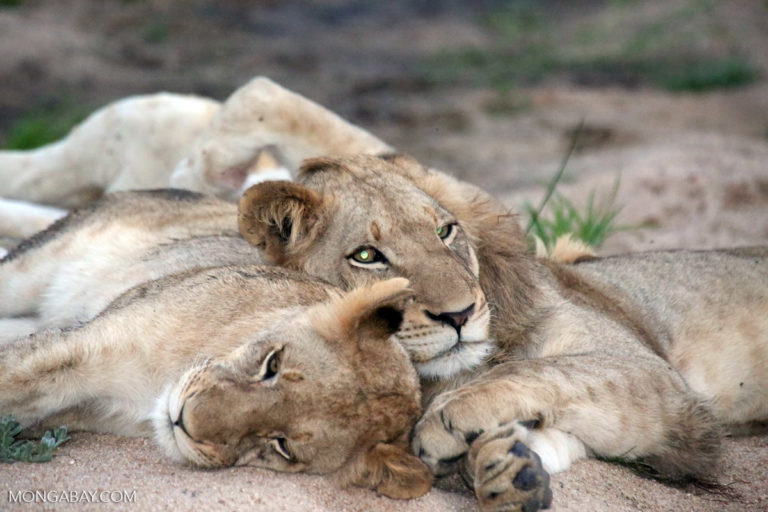
Lions in South Africa’s Kruger National Park. Photo by Rhett Butler.


‘That’s karma’: Infamous lion hunter’s death celebrated online

https://www.rt.com/viral/370432-ponzetto-lion-hunter-death-online-reaction/

© Max Rossi
 
Controversial Italian hunter Luciano Ponzetto has died after falling 30 meters (100ft) down a ravine. His death occurred while he was hunting, prompting many to describe it as “karma”.

Ponzetto, who became a figure of controversy after posting images of his trophy kills online, slipped on ice and fell down a ravine according to Corriere Della Sera. The 55 year old had been hunting birds in Colle delle Oche near Turin in Italy when the accident happened.

It seems the photos Ponzetto posted previously hadn’t left a good impression, with social media users rejoicing in Ponzetto’s death, or “divine intervention,” as it was described by some.

More: https://www.rt.com/viral/370432-ponzetto-lion-hunter-death-online-reaction/

Students put pressure on premier to ban trophy hunting of grizzlies

431125_10150547334526188_1114807436_n

– Victoria News

Students at Glenlyon Norfolk School are trying to ban trophy hunting of grizzly bears in the province.

For more than a year, Marisa Smith, Giulia Giommi and Lily Wieczorek have been researching and sending letters to B.C. Premier Christy Clark, advocating for the provincial government to abolish trophy hunting of grizzly bears.

“The grizzly bear population is really important to the ecosystem. If the grizzly bear population is taken out of the environment, then the entire ecosystem will collapse and become imbalanced,” said Marisa, 13.

“It’s really important and we need to make sure the ecosystem remains balanced…We want to stop some of these issues that are really hurting the environment and that ultimately affects us and all the animals around us.”

According to Pacific Wild, an organization that defends wildlife and its habitat on the Pacific Coast, between 300 and 400 grizzlies are killed every year in B.C. by hunters who want their heads as trophies.

Thirteen-year-old Giulia had the opportunity to see grizzly bears in their natural habitat during a bear watching tour in the summer. As part of the tour, they climbed up a tower and were able to see 12 different grizzly bears going about their business within a few hours.

“We can’t just have a place where there’s some bears alive…all of B.C. should be protected, not just some of it,” Giulia said.

Since then, the group has been spreading the word, telling local politicians about the cause.

In November they met with NDP MLA for Victoria-Swan Lake Rob Fleming, who was in support of the cause, calling the practice outdated and backwards. A few days later, the NDP pledged to ban grizzly bear trophy hunting if they’re elected into office during the next provincial election in May.

“The government has become more and more out of step with its citizens…We could be doing so much better, not just for the bears but for British Columbians who need jobs and who want to promote the wonderful tourism experience that our diverse regions have to offer,” Fleming said, adding the government should be focused on promoting bear watching tours, not killing them.

“This is another group of students who are doing amazing things in our community and learning and becoming experts on issues that our province has to tackle. It’s always great to see students learning essentially to become effective advocates and researchers on public policy.”

The girls remain optimistic they’ll be able to set up a face-to-face meeting with the premier to advocate for their cause. In the meantime, they plan on meeting with other NPD MLAs and doing a speech about the ban to the NDP caucus in the new year.

The advocacy is part of the school’s United Conservationists Environmental Club, which meets twice a week to discuss a number of environmental issues. Groups are also working on helping tigers, penguins and sharks.

Leading Animal Rights Group Attacks Trump’s “Inhumanity” In Clinton Endorsement

http://www.politicususa.com/2016/10/24/leading-animal-rights-group-attacks-trumps-inhumanity-clinton-endorsement.html

Trump represents the greatest threat ever to federal policy-making and implementation of animal protection laws, and a threat to animals everywhere.

*The following is an opinion column by R Muse*

It is probably the case that there are few Americans that actually hate animals, and if there are very many at all, they are certainly outnumbered by the uncivilized Americans that actually hate other Americans. Of course at this particular juncture in time there is plenty of evidence that the Americans exuding hatred for American people who aren’t white, aren’t evangelical fundamentalists, aren’t wealthy, and aren’t male all support Donald Trump. What is fairly certain is that even the barbaric savages that support Trump likely support efforts to protect animals from people with a predilection to abuse and slaughter innocent animals, and it is also fairly certain they are unaware that animal rights groups have endorsed Hillary Clinton for president and slammed Donald Trump as “a threat to animals everywhere.”

The national animal rights and protection group, the Humane Society Legislative Fund, announced that it was taking the “unusual step” of wading into the presidential race to endorse Democratic presidential nominee Hillary Clinton. The reason the animal rights group gave was because they believe “Trump represents the greatest threat ever to federal policy-making and implementation of animal protection laws, and we are taking the unusual step of wading actively into a presidential campaign.” The group made it very clear that it “evaluate[d] candidates based on a single, non-partisan criterion—their support for animal protection—and did not default to one party or the other.

The HSLF is a lobbying affiliate of the Humane Society of the United States that also said that Ms. Clinton’s Republican opponent was “a threat to animals everywhere.”

On the exact same day the HSLF announced their endorsement of Hillary Clinton, they launched a vicious anti-Trump ad campaign (video here) that cited his past record on animal protection; a record that should sicken any animal lover, even Trump supporters. The group also explained that its biggest concern was that a Trump administration would be stocked with anti-animal rights barbarians.

The HSLF said that based on potential policy decisions under the aegis of the U.S. Department of Fish and Game, Fish and Wildlife Service, National Park Service, Bureau of Land Management, National Institutes of Health, and various other executive level agencies, the stakes are just too high to allow a Trump presidency. The HSLF also noted that “there could not be a greater contrast among the White House hopefuls” that guarantees either the “potential for advancing animal welfare reforms at the federal level, or rolling back the recent gains and rule-making actions” that will have devastatingly adverse effects on animals. They also, rightly noted, that where Hillary Clinton has a clear, compelling record of support for animal protection,  the opposition has already assembled a team of advisors and financial supporters “intricately tied to trophy hunting, puppy mills, factory farming, horse slaughter, and other abusive industries.”

The names that Trump’s campaign has floated to run the Interior and Agriculture Department issues are a veritable “who’s who” of vicious anti-animal welfare activists. One of those names,according to Politico, is an oil magnate considered to be the front-runner for Trump’s Secretary of the Interior as well as currently serving on Trump’s agriculture advisory committee. The man, Forrest Lucas is the funding machine providing money for the front group, Protect the Harvest, behind every attack on every organization in the nation involved with protecting animals and defending wildlife.

As HSLF noted, “Lucas has never met a case of animal exploitation he wouldn’t defend,” and he is a fierce advocate “for trophy hunting, puppy mills, and big agribusiness.”  Lucas also personally provided the funding for attacks on a Missouri ballot measure (Prop. B) because its purpose is insuring there are “humane breeding standards for dogs” and regulations on horrendously inhumane puppy mills; something Lucas will not allow even though it has no impact on his oil business. Lucas opposes humane treatment of animals so ardently that he personally financed the attack on Missouri’s Prop. B  because it is one of the animal welfare movement’s most important ballot measures designed to enact humane breeding standards for dogs and crack down on puppy mills.

more: http://www.politicususa.com/2016/10/24/leading-animal-rights-group-attacks-trumps-inhumanity-clinton-endorsement.html

Leading Animal Rights Group Attacks Trump’s “Inhumanity” In Clinton Endorsement

Romania bans trophy hunting of brown bears, wolves, lynx and wild cats

image

Unexpected move reverses a trend that has seen increasing numbers of large carnivores shot by hunters each year since Romania’s accession to the European Union

In 2016, the largest hunting quotas yet gave hunters the mandate to shoot 550 bears, 600 wolves and 500 big cats over 12 months. Photograph: Radu Sigheti/Reuters

Romania has banned all trophy hunting of brown bears, wolves, lynx and wild cats in a surprise decision that gives Europe’s largest population of large carnivores a reprieve from its most severe and immediate threat.

The move on Tuesday reverses a trend which has seen the number of large carnivores being shot by hunters grow year on year since Romania’s accession into the European Union in 2007. In 2016, the largest hunting quotas yet gave hunters the mandate to shoot 550 bears, 600 wolves and 500 big cats over 12 months.

Over the last decade, hunting has grown into a multimillion-euro industry in Romania, with hunters from all over the world paying up to €10,000 (£8,800) to claim a ‘trophy’ – hunting parlance for the carcass of a hunted animal – from the Carpathian mountains.

The government has claimed that in order to exist, the industry relies on a loophole in European law which allows for the culling of wild animals that have been proven to be a danger to humans. Under the habitats directive, all large carnivores are protected in European Union member states, yet the state can order the killing of specific animals if shown to have attacked a person or damaged private property.

“Hunting for money was already illegal, but it was given a green light anyway,” environment minster, Cristiana Pasca-Palmer, told the Guardian. ‘The damages [clause in the habitats directive] acted as a cover for trophy hunting.”

Each year, hundreds of hunting associations across the country would submit two numbers; the total population of each large carnivore species, and the total number which they believed to be likely to cause damages. The second number would then act as a basis for a government-issued hunting quota for each species. These quotas were then carved up between hunting companies and sold as hunting rights to the public.

“This method raised some questions,” says Pasca-Palmer. “How can hunting associations count how many animals are causing damages a priori – before the damages have happened? By introducing the ban, what we are doing is simply putting things back on the right track, as the habitats directive originally intended.”

Wildlife NGOs claim that the methodology also tended to dramatically overestimate the populations of large carnivores. The official figure for the number of bears in Romania is over 6,000, and for wolves is 4,000. Yet with hundreds of hunting associations each responsible for monitoring a small area of land, and animals prone to wandering, it is understood that individual animals were often counted multiple times, potentially pushing the total population statistics up by thousands.

Announced late on Tuesday evening, the ban is expected to divide Romania’s population, pitching rural and urban dwellers against each other. The government’s decision has strong support in the larger cities, which have seen a growing movement against hunting in recent months. But in much of Romania’s remote countryside large carnivores are a daily threat to villagers and a persistent nuisance to livestock farmers, and many see hunting as the only solution.

Csaba Domokos, a bear specialist with wildlife protection NGO Milvus group, is convinced that the success or failure of the hunting ban rides on the government’s ability to address the rural population’s fears.

“Damages caused by large carnivores are a very real concern in the countryside,” he said. “The system up until now did not work; hunting does not reduce conflicts between carnivores and humans; in fact many studies show that with wolves and large cats, it can actually increase the problem.

“But the rural population believe that hunting is the answer, and unless they can be convinced otherwise, people may well start to take the problem into their own hands. The ban is a great step, but we don’t want hunting to be replaced by poaching.”

Domokos points out that hunters also have a vested interested in the protection of their quarry. “To some extent, hunting acts as a financial incentive for wildlife management, from preventing poaching to conserving habitats. There is some concern that once you take that away, the government will not invest enough to replace it.”

Hunters pay up to €10,000 to trophy hunt in the Carpathian mountains
Pinterest

Hunters pay up to €10,000 to trophy hunt in the Carpathian mountains. Photograph: Nick Turner/AlamyThe government’s response is to take management into its own hands. A special unit is to be set up within the paramilitary police force that will assess any reports of damages by large carnivores and deal with the culprit animal directly. The ministry of environment have discussed the possibility of relocating the target animals abroad to countries interested in ‘rewilding’.

The ban comes amid a growing push for the protection of Romania’s wild mountains that has seen anti-corruption officers convict dozens of foresters, hunters and local officials in recent years.

Gabriel Paun, an activist and conservationist behind a petition that collected 11,000 signatures in the weeks before the hunting ban, sees the government’s decision as a step towards a safer future for Europe’s wild spaces: “The Carpathian mountains are home to more biodiversity than anywhere else in Europe, but for too long they have been ruthlessly exploited for forestry and hunting. Let’s hope the government’s decision is a sign of things to come.”

Typical pr bs: Trophy hunting of lions can conserve the species, report suggests

https://www.sciencedaily.com/releases/2016/09/160922124408.htm?utm_source=feedburner&utm_medium=email&utm_campaign=Feed%3A+sciencedaily%2Fplants_animals%2Fanimals+%28Animals+News+–+ScienceDaily%29

Sure.
Date:
September 22, 2016
Source:
University of Kent
Summary:
Trophy hunters can play an important role in lion conservation, researchers have shown. These findings may surprise the public, but most lion conservationists think trophy hunting could play a key role in conserving this species because lions need large areas to thrive, and managing this land is expensive. The new work shows land under long-term management for trophy hunting can help fill this shortfall.
Share:
FULL STORY

The findings of this report may surprise the public, but most lion conservationists think trophy hunting could play a key role in conserving this species because lions need large areas to thrive, and managing this land is expensive. Their work shows land under long-term management for trophy hunting can help fill this shortfall.
Credit: © Vasilev Evgenii / Fotolia

One year after the worldwide controversy when an American dentist killed Cecil the Lion in Zimbabwe, the DICE team says hunting works but only when hunting companies are given long-term land management rights.

Dr Henry Brink and Dr Bob Smith from DICE (the Durrell Institute of Conservation and Ecology), and Professor Nigel Leader-Williams from the University of Cambridge’s Department of Geography, studied lion population trends in Tanzania’s Selous Game Reserve.

This protected area is divided into blocks in which hunting rights are allocated to different companies. Their study showed that blocks under short-term allocation were over-hunted. In contrast, lion trophy hunting levels were sustainable in blocks owned by the same company for 10 years or more, thereby also maintaining important habitat for this threatened species.

Dr Brink said DICE’s research shows that those who have secured long-term use rights to natural resources are more likely to manage them sustainably. This is an important lesson for lion conservation, as loss of habitat means this species is increasingly restricted to protected areas.

Dr Smith added that their findings may surprise the public, but most lion conservationists think trophy hunting could play a key role in conserving this species because lions need large areas to thrive, and managing this land is expensive. Their work shows land under long-term management for trophy hunting can help fill this shortfall.

This research also supports calls to change the hunting fee system in Tanzania. Nigel Leader-Williams explained that at present, the government sells hunting block fees cheaply, and raises more by setting high quotas and high fees for each trophy animal shot, which encourages those who are only allocated blocks over the short-term to shoot more lions, at the expense of long-term sustainability and profits. Increasing block fees, reducing trophy fees and reducing the hunting quota could bring in the same tax revenue, while reducing the temptation of hunters to over-use lions.

How Safari Club Int’l Works To Weaken ESA Protections

A View To A Kill

By Michael Satchell
The Humane Society of the United States
11-25-3

What weighs 21 pounds, contains 2,560 pages, and lists thousands of names and numbers? It’s not the New York City telephone directory, but here’s a hint: Its listings run from Addax to Zebra.
The answer is Safari Club International’s three-volume compendium of trophy hunters who are immortalized in this record book for doing nothing more than killing animalsóan entire alphabet of animalsóto win SCI awards competitions. The catalog is a macabre scorecard detailing who shot what animal, where and when. Thousands and thousands of animals, covering more than 1,100 species, are figuratively buried between the covers here.
You can learn, for example, that in 1910 in the Sudan, Theodore Roosevelt killed a rhino whose horns measured 24 4/8 inches and 7 4/8 inches, scoring 67 1/8 points to make the former U.S. president the No.1 hunter of Northern white rhino. Or that one Marc Pechenart shot an elephant in the Central African Republic in June 1970, earning a score of 302 points for the biggest pachyderm. The animal’s left tusk weighed 154 pounds and the right 148 pounds.
With its photographs of grinning hunters posing with lifeless animals and its meticulous rankings for the biggest tusks, horns, antlers, skulls and bodies, the SCI record book perfectly encapsulates what trophy hunting is all about: killing for killing’s sake. The book lays bare the hunters’ obsessions: a craving to shoot the largest animal, a desire to kill the most animals and rack up SCI awards, or a fetish to bring home the animal’s head and hang it on the wall.
The mother of all these obsessions, though, is the awards competition. SCI members shoot prescribed lists of animals to win so-called Grand Slam and Inner Circle titles. Thereís the Africa Big Five, (leopard, elephant, lion, rhino, and buffalo); the North American Twenty Nine (all species of bear, bison, sheep, moose, caribou, and deer); and the Antlered Game of the Americas, among many other contests.
To complete all 29 award categories, a hunter must kill a minimum of 322 separate species and sub-speciesóenough to populate an entire zoo. This is an extremely expensive and lengthy task, and many SCI members take the quick and easy route. They shoot captive animals in canned hunts, both in the United States and overseas, and some engage in other unethical conduct like shooting animals over bait, from vehicles, with spotlights, or on the periphery of national parks.
Wayne Pacelle, HSUS senior vice president for communications and government affairs, captures the essence of SCI members and their motivation:
“It’s a perverse and destructive subculture,” he says. “Thousands of animals suffer and die for the amusement of wealthy elites who have the means to pursue any form of recreation, but choose to shoot the world’s rarest and most beautiful animals. There’s no societal value to the exercise, just a selfish all-consuming mentality of killing, collecting, and showing off trophies. They know the price of every animal, but the value of none.”
High-Powered Rifles
It’s easy to parody and criticize Safari Club International, but it’s a mistake to underestimate the club’s power and influence on shaping policies that are detrimental to wildlifeóand beneficial to those members who stand tall over freshly killed animals in the SCI record books.
Since it was founded in 1971, the Tucson-based non-profit has grown to some 40,000 trophy collectors. More than half boast an annual income of more than $100,000 (compared to 6% of hunters nationwide). The average member owns 11 rifles, six shotguns, five handguns and a bow. Two-thirds spend about one month hunting each year, and a quarter of the members more than 50 days.
The club contributes large sums to mostly Republican candidates and, not surprisingly, has been able to ingratiate itself with various administrations, most notably the Bush Administration, and with the U.S. Fish and Wildlife Service (USFWS). With the help of friendly members of Congress and officials in USFWS, SCI has consistently attempted to navigate around the intent of the Endangered Species Act (ESA) and the Marine Mammal Protection Act (MMPA) and import once-banned trophies of endangered and threatened wildlife. Sometimes, the club has succeeded, sometimes not.
The latest example of SCI’s growing influence in Washington is the Bush Administration’s initiative to “save” the world’s endangered species by killing or selling them, and then using the revenues as an incentive for poor countries to improve their conservation efforts. This scheme to protect rare wildlife is a formula for disaster. It will reverse 30 years of ESA protections for hundreds of exotic creatures who are heading for, or teetering on, the brink of extinction.
The proposal, which conveniently dovetails with SCI’s agenda, offers several examples of how wildlife can be exploited for profit. It suggests imports, such as wild-caught Asian elephants for circuses and zoos, Morelet’s crocodile skins for luxury leather items like shoes and handbags, and Asian bonytongue tropical fish to supply the aquarium trade. American trophy hunters could shoot and import trophies of straight-horned markhor, a rare goat found in Pakistan, and then head north on a quickie expedition to nail Canadian wood bison.
These are only examples. If approved, the proposal portends open season on many disappearing species, particularly large mammals, the so-called charismatic megafauna. It would also be a huge incentive for poaching and smuggling. Imagine how much rich trophy hunters would offer China to shoot giant pandasóarguably the world’s most beloved animalóif they were allowed to import their stuffed remains. Picture furriers importing the hides of endangered snow leopards to swathe the ethically challenged. And now that pet tigers have earned a bad rap, might cheetahs become the newest rage among exotic pet owners?
For three decades and under strict controls, U.S. Fish and Wildlife Service has allowed only a few rare animals, such as pandas, to be brought in for scientific research and breeding. Until SCI began to push its agenda in Congress and at the Interior Department, USFWS very rarely approved the importation of endangered-species trophies. Now, the agency is proposing not only to ease those trophy import restrictions but also to allow the import of live animals for entertainment (or the pet trade) and the import of skins and hides for luxury apparel.
Such a plan goes against USFWS’s historic rationale, which quite correctly notes that fostering a commercial market for disappearing wildlife will inevitably hasten its demise.
No Trickle-Down Economics
Encouraging the sale and import of heads, hides, and live animals to enhance survival efforts in the wild may sound logicalóuntil you examine the sorry history of other purported “sustainable” wildlife-use programs. The record shows that few of the dollars trickle down to benefit either wildlife or local people in the impoverished range states because corrupt officials inevitably divert the money.
During the 1990s, in a well-intentioned-but-misguided conservation effort, the U.S. government spent more than $12 million to underwrite sustainable wildlife-use programs in Zimbabwe. The idea was to give local people the opportunity to raise money for community projects by selling hunting permits for African elephants. The program ended up subsidizing trophy hunting, and little of their trophy fees reached the villages.
USFWS’s new endangered species proposal doesn’t offer much hope to alter this historical course. Despite agency assurances, the plan isn’t the product of careful scientific assessment or innovative thinking. It’s driven, in large part, by the working relationship between the Bush Administration and SCI, and by the administration’s apparent hostility toward the Endangered Species Act.
SCI’s membership includes former President George Herbert Walker Bush, who has lobbied the government of Botswana on the group’s behalf to lift the ban on killing the nation’s dwindling lion population. What’s more, President George W. Bush appointed Matthew J. Hogan, SCI’s former Government Affairs Manager, as one of the two current deputy directors of USFWSóa classic example of the fox guarding the hen house. Interior Secretary Gale A. Norton, in turn, has worked to weaken the ESA, from abandoning federal efforts to restore grizzlies in Idaho to undermining a key provision that allows citizens to sue the government to speed up protection of imperiled species.
Aiming High…Shooting Low
SCI got off to a shaky start during its early forays into Washington politics. In 1979, when the organization was not even a decade old, it sought government approval to circumvent the spirit of the law and import an astonishing 1,125 trophies of 40 animals on the endangered species list. They included gorillas, cheetahs, tigers, orangutans, and snow leopards.
With a straight face, SCI said its goal was “scientific researchÖincentive for propagationÖsurvival of the species.” There was one small problem. The trophies weren’t dead yet. The prospect of permitting the wholesale slaughter of more than 1,000 rare animals was a bit too much, even for USFWS, and the request was denied.
As its lobbying became more sophisticated, SCI began pouring money into national political campaigns. Since the 1998 election cycle, it has contributed $596,696 to Republican candidates and $92,500 to Democrats. Not coincidentally, Congressional Republicans have made repeated attempts to amend and weaken the ESA, while USFWS, turning its back on decades of precedents, has proposed to allow hunters to import trophies of endangered animals killed in the wild. These import easements are critical to one of SCI’s true aims.
All those pictures in the SCI record books, and in the club’s glossy magazines like Safari and Hunt Forever, are a form of pornography to the blood sports crowd. Would-be big-game hunters can pore over photos of triumphant and sated trophy collectors holding up the head of a dead ungulate by its horns or standing atop the hulk of a dead elephant or posing with a dead leopard draped around his neck. But like all pornography, the image is never enough. The hunter eventually wants a taste of the real thing. And, of course, he must have a trophy to savor the experience.
As former SCI president John J. Jackson III once wrote: “A trophy of any species attests that its owner has been somewhere and done something, that he has exercised skilled persistence and discrimination in the agile feat of overcoming, outwitting, and reducing game to possession.”
Trophy collectors may rhapsodize about their spiritual love for the quarry, the hunter’s path to self-actualization, the thrill of the chase, the test of manhood, and other such philosophical jabberwocky. But at the end of the day, and after a $65,000 safari, the only thing that matters is hanging that head on the wallóand the rarer the animal, the better it feels.
An example: Kenneth E. Behring, who donated $100 million to have the Smithsonian memorialize him with the Behring Family Hall of Mammals on the Washington D.C. Mall, went to Kazakhstan in 1997 and paid the government enough to allow him to shoot a Kara Tau argali sheep.
The animal, even SCI acknowledges, is critically endangered; the species is listed on CITES Appendix I and can not be imported into the United States as a trophy without the help of a museum. Behring, who like all SCI members, regards himself as a conservationist, killed his Kara Tau argali when only 100 remained and shipped it to a Canadian taxidermist. The Smithsonian then petitioned USFWS for an import permit, but withdrew the request in the storm of negative publicity that followed.
But Behring isn’t the only SCI member with questionable ethics. Back when Teddy Roosevelt was laying waste to Africa’s wildlife, hunting may have embraced those mythic elements that SCI still loves to invoke: a Hemingway-esque mantra of danger, romance, bravery, and the thrill of slaying the beast.
On today’s safari, however, the customer is coddled in luxury tent camps, replete with flush toilets, hot showers and gourmet dining. All he (or she) has to do is shell out tens of thousands of dollars, pull the trigger when instructed, and pose for the money shot. He doesn’t even get blood on his hands. A professional guide stalks the target, lines up the shot, tells the client when to take it, acts as a backup shooter if the animal is wounded, and supervises the gutting, skinning and decapitation.
And that’s in the wild. From South Africa to New Zealand to Texas, many of these trophy collectors shoot captive animals in canned hunts staged in fenced paddocks on game ranches, a practice the Boone and Crockett Club calls “unfair and unsportsmanlike.” The animals are habituated to humans and are shot at feeding stations, salt licks and watering holes. The “spirit of fair chase,” supposedly enshrined in SCI’s code of ethics, is conveniently ignored.
SCI’s highly flexible “fair chase” code also urges members to “comply with all game laws and demonstrate abiding respect for game, habitat and property.” That admonition regularly falls on deaf ears.
In 1998, several top SCI leaders, including Behring and then-president Alfred Donau, reportedly went on a wildlife killing spree in Mozambique. According to a published report, they left animals wounded and dying and shot elephants in alleged violation of national law. Other SCI members have been convicted of killing endangered species and trying to smuggle them into the U.S.
Wealthy hunters, including SCI members, have also been caught in federal tax scams. In one celebrated case, a museum in Raleigh, North Carolina, gave trophy hunters the title of “associate curator,” which helped them persuade foreign officials to grant permits to shoot rare animals. Hunters went on to donate low-value trophies to the museum and receive wildly inflated appraisals, which were then deducted from their federal taxes. In some cases, the mounts were reacquired by the donors. Before authorities busted the ring, the museum took in 1,800 specimens and valued them at a whopping $8.4 million. At SCI’s 1999 annual convention, members were offered a document titled Secrets of Tax Deductible Hunting, advising them to declare their home trophy rooms as museums, call themselves curators, and “donate your record-book animal for the mouthwatering tax deduction.”
Incidents like these fuel the club’s negative image. Most Americans are largely ambivalent about hunting wild animals for food, but polls show strong public opposition to killing exotic animals for fun, competition, and bragging rights. To counter this perception and burnish its reputation, the club donates meat to food banks, stages “sensory safaris” where the vision-impaired can touch and feel stuffed animals, and arranges hunting for the disabled.
To Matthew Scully, author of the highly acclaimed book Dominion, such window dressing is humbug. “They practice a socially conscious sadism here,” Scully writes. “Ethics at the Safari Club is ordered libertinism, like teaching cannibals to use a table napkin and not take the last portion.”
– Michael Satchell is a senior consultant for The HSUS.
Copyright © 2003 The Humane Society of the United States. All rights reserved.
http://www.hsus.org/ace/20054