Exposing the Big Game

Forget Hunters' Feeble Rationalizations and Trust Your Gut Feelings: Making Sport of Killing Is Not Healthy Human Behavior

Exposing the Big Game

Photos of Donald Trump’s adult sons hunting in Africa resurface, spark comparisons with Walter Palmer, killer of Cecil the lion

http://www.nydailynews.com/news/politics/pics-rump-adult-sons-hunting-game-africa-resurface-article-1.2308107


A rifle-touting Donald Trump Jr. grins next to a buffalo he killed on a trip to Zimbabwe in 2011.

A rifle-touting Donald Trump Jr. grins next to a buffalo he killed on a trip to Zimbabwe in 2011.

(HuntingLegends.com/Hunting Legends)

Eric Trump is pictured with an animal he killed on a visit to Zimbabwe.

Eric Trump is pictured with an animal he killed on a visit to Zimbabwe.

(HuntingLegends.com/Hunting Legends)

Donald Jr. is seen with the tail of an elephant he killed during the 2011 hunting trip.

Donald Jr. is seen with the tail of an elephant he killed during the 2011 hunting trip.

(HuntingLegends.com/Hunting Legends)

Brothers Donald Trump, Jr. (l.) and Eric Trump (r.) are pictured with a cheetah that they killed on their 2011 trip to Zimbabwe.

Brothers Donald Trump, Jr. (l.) and Eric Trump (r.) are pictured with a cheetah that they killed on their 2011 trip to Zimbabwe.

(HuntingLegends.com/Hunting Legends)

Eric Trump is pictured with a buffalo he killed in Zimbabwe in 2011.

Eric Trump is pictured with a buffalo he killed in Zimbabwe in 2011.

(HuntingLegends.com/Hunting Legends)

1 | 5A rifle-touting Donald Trump Jr. grins next to a buffalo he killed on a trip to Zimbabwe in 2011.(HuntingLegends.com/Hunting Legends)
Their dad likes shooting from the lip, but the Trump kids prefer shooting wild animals with guns.

Pictures of Donald Trump Jr. and Eric Trump, the two adult sons of bombastic 2016 candidate Donald Trump, shooting wild animals in Africa have resurfaced, sparking unflattering comparisons of the mogul’s heirs to lion-killer Walter Palmer.

The Trump brothers went on a 2011 hunting trip in Zimbabwe, where they snapped photos of themselves with enormous dead animals they took down.

In one photo, Donald Trump Jr., known to many as “Donnie,” is seen toting a rifle and flashing a huge grin while seated next to a dead buffalo he had just killed. In another picture, Eric Trump is seen sitting atop his fresh kill, another buffalo, smiling as the dead animal lies still on the ground.

More: http://www.nydailynews.com/news/politics/pics-rump-adult-sons-hunting-game-africa-resurface-article-1.2308107

Calling all animal lovers: Trump’s sons are proud murderers of endangered species.

View image on Twitter

Horrible people doing horrible things,

More Daily Beast:

The Trump boys were hunting in Zimbabwe—the same country where Cecil was killed—and though Zimbabwean animal conservation groups looked into the incident, the hunt was deemed perfectly legal. Once the photos went viral online, Donald Trump Jr. tweeted (and then deleted

CnxlOqgW8AATJy5_1_.jpg


 http://www.dailykos.com/story/2016/7/20/1550051/-Calling-all-animal-lovers-Trump-s-sons-are-proud-murderers-of-endangered-species

Trump Jr. wants his dad to put him in charge of federal parks and lands

http://grist.org/politics/trump-jr-wants-his-dad-to-put-him-in-charge-of-federal-parks-and-lands/

Donald Trump is butting heads with the GOP establishment over the issue of federal lands. Republican orthodoxy calls for handing them over to the states. But when asked about the issue in January, Trump said, “I don’t like the idea because I want to keep the lands great, and you don’t know what the state is going to do.”

Turns out there’s one very specific reason Trump wants to keep the lands great: because his sons like to kill animals on them — his eldest son in particular.

Donald Trump Jr., a hunter of big game as well as smaller defenseless animals, recently shared his own views on public lands with The New Yorker. “I’m in the fortunate position to be able to buy some land on my own, but not everyone has that ability,” Jr. said. “As it stands, if the states get the lands back, they could remain public or they could be sold off. So, say you have a ten-thousand-acre area. Well, a state could turn that into fifty golf courses that would be private and exclusive.”

While this may not bring in votes from the golf club contingent, Jr. has been actively hunting the sportsman vote, as E&E Daily reports. He invited reporters along on a pheasant hunting trip in January, and has given exclusive interviews to Field & Stream, Bowhunter Magazine, and Deer & Deer Hunting. His father was the only presidential candidate to speak at the National Shooting Sports Foundation’s annual trade show in Las Vegas.

Big ambition runs in the family: Trump Jr. told the magazine Petersen’s Hunting that he would like to be secretary of the interior in his father’s administration. He is, to be sure, completely unqualified, but that’s never stopped a Trump before. “Between my brother and myself, no one understands the issues better than us,” Jr. told Petersen’s. “No one in politics lives the lifestyle more than us.” No one.

Big egos, it seems, run in the family as well.


British Columbia source of ‘vast majority’ of bear trophies

A grizzly bear is photographed in the Orford River, in British Columbia, in this 2011 file photo. (JOHN LEHMANN/THE GLOBE AND MAIL)

.

More than 300 shipments of grizzly bear products – including skins, skulls and rugs – have moved from Canada to the United States through U.S. ports over the past three years.

Those transactions are among nearly 17,000 imports of North American bear parts – mostly black and brown, but including grizzlies – from Canada to the United States over the same period, according to the U.S. Fish and Wildlife Service.

Most common grizzly bear parts imported into the U.S. from Canada, 2013-2015

0102030405060708090100110120130BonesRugTrophySkullSkin2

THE GLOBE AND MAIL » SOURCE: U.S. Fish and wildlife service
data
share
×
Part Number
Skin 127
Skull 122
Trophy 78
Rug 13
Bones 2

Most common grizzly bear parts imported into the U.S. from Canada, 2013-2015

The United States has no restrictions on the legal import of grizzly bear parts and products. The European Union, however, suspended imports of grizzly hunting trophies from British Columbia in 2004 over conservation concerns.

The shipments reflect a key factor in British Columbia’s controversial grizzly hunt – American trophy hunters, who pay thousands of dollars to come to the province to hunt a species protected in parts of the United States.

Faisal Moola, director-general for Ontario and Northern Canada with the David Suzuki Foundation, estimates “the vast majority” of grizzly imports to the United States over the past three years came from B.C., based on previous research he conducted and export data he recently obtained from the provincial government.

“About 40 per cent of grizzly bears being killed in B.C. are being killed by foreign trophy hunters,” Dr. Moola said.

“The reason Americans are coming to Canada to shoot grizzly bears in B.C. is because there are no more grizzly bears in places like Washington State or California – or they are legally protected and you can’t shoot them, in places like Montana or Wyoming,” he added.

According to B.C. government figures, 29 per cent of bears were killed by “non-resident” hunters – those who don’t live in British Columbia and must enter a lottery to win the right to hunt a grizzly – in 2013. The rate was 38 per cent in 2014 and 29 per cent last year.

The average number of grizzly bears killed in each of the last three years, province-wide, was 242, with the majority of those killed by B.C. residents.

According to documents obtained through a freedom of information request from the U.S. Fish and Wildlife Service, thousands of bear products – sorted into three-letter categories that include TRO, or trophy, which means “all the parts of one animal,” and SKU, for skull – have been shipped to the United States through dozens of ports since the beginning of 2013.

The U.S. import data obtained by The Globe and Mail do not distinguish between bears killed in recent hunting seasons and trophies that may be years or even decades old. The data also do not say whether the imports came from British Columbia or elsewhere in Canada, including Nunavut and the Northwest Territories, which also have legal grizzly hunts. (Alberta suspended its hunt in 2006.)

British Columbia’s grizzly hunt draws impassioned debate. Opponents decry the killing of animals for sport. Supporters maintain that a regulated grizzly hunt can help protect stocks of other animals, such as moose and caribou, while generating significant economic benefits.

There is also debate over whether British Columbia’s hunting regulations, which keep about 35 per cent of the province off-limits to grizzly hunting, do enough to protect grizzly bears.

Both the provincial government, which oversees the grizzly hunt, and an industry group that represents guide outfitters who depend on the hunt for part of their livelihoods say the number of bears “harvested” do not pose a conservation concern.

“Research completed by highly qualified experts over the past 20 years has consistently indicated that there are between 14,000 and 16,000 grizzly bears in B.C.,” the Guide Outfitters Association of British Columbia said in an April statement about the hunt. “Hunters only take 250 to 350 bears per year – a sustainable level that poses no conservation threat, especially considering that harvest is heavily biased towards mature males.”

Regulations prohibit hunters from killing bears that are less than two years old.

Conservation groups, including the Suzuki Foundation, challenge those claims, maintaining that the hunt is unsustainable and aggravates threats to grizzlies from other factors, including habitat loss.

Hunt opponents also worry that bears killed in British Columbia could be from threatened grizzly populations – either from parts of the province where hunting is restricted because of conservation concerns, or from Alaska or other states where some grizzly populations have been deemed at risk.

Grizzlies are not officially “endangered.” The Committee on the Status of Endangered Wildlife in Canada, or COSEWIC, lists grizzly bears as a species of “special concern” – one that may become threatened or endangered. Grizzly bears are also listed in Appendix II of CITES, the Convention on International Trade in Endangered Species of Wildlife Fauna and Flora, as a species that is “not necessarily now threatened with extinction but that may become so unless trade is closely controlled.”

The U.S. Fish and Wildlife Service in March proposed “delisting” grizzly bears from the Greater Yellowstone Ecosystem – which would open the door to a grizzly hunt in the area, although not in Yellowstone and Grand Teton national parks – after conservation measures resulted in bear numbers rebounding from as few as 136 in 1975 to about 700.

A comment period that closed in May resulted in more than 100,000 submissions, both for and against the proposal.

Trophy hunting of grizzly bears to continue in British Columbia

A grizzly bear is photographed in the Orford River, in British Columbia, in this 2011 file photo. (JOHN LEHMANN/THE GLOBE AND MAIL)A grizzly bear is photographed in the Orford River, in British Columbia, in this 2011 file photo. (JOHN LEHMANN/THE GLOBE AND MAIL)

British Columbia is cracking down on the use of sheep and goats as pack animals for big game hunters in its latest set of hunting and trapping regulations. But the contentious trophy hunting of grizzly bears will continue unchanged.

The provincial ministry responsible for hunting produced updated regulations on Monday, and although it has rejected a proposal to increase the number of grizzly hunting permits for resident hunters in the Peace River region, environmentalists are disappointed that the status quo remains in place.

The major changes include additional record-keeping requirements for butchers, and a new ban on bringing domesticated sheep or goats along on big game hunts to act as beasts of burden because of fears that the animals may pass on disease to wildlife. The report did not say whether this was a common practice. Steve Thomson, the Minister of Forests, Lands and Natural Resource Operations, says in the report released Monday his major concern in wildlife management right now is around the declining moose population, and he promised a new BC Moose Tracker app that will allow people to record moose sightings.

Mr. Thomson could not be reached for comment, but in a statement, ministry officials maintained that the current grizzly bear hunt is sustainable.

Auditor-General Carol Bellringer has announced she will conduct a performance audit to determine whether the province is effectively managing the grizzly bear population . The province says there are 15,000 grizzlies in B.C. and that hunting is allowed only after conservation targets and aboriginal harvests for food, social and ceremonial uses are met.

Ms. Bellringer’s report is not expected until next spring, and Ian McAllister, executive director of Pacific Wild, an environmental organization, said that means the B.C. Liberal government’s current approach won’t be effectively challenged until the May, 2017, provincial election.

“This institutionalizes the trophy hunt in wildlife practices,” Mr. McAllister said. “It’s an indication of what Premier Christy Clark is thinking about this file and that is almost inconceivable given the unprecedented input over the past year.”

Pacific Wild has led opposition to the grizzly bear hunt, particularly in the newly proclaimed Great Bear Rainforest. Mr. McAllister says the Coastal First Nations, along with a large majority of British Columbians, are opposed to trophy hunting of grizzlies. (Polls suggest anywhere between 88 and 95 per cent of British Columbians are against trophy hunting.)

The provincial government has been reluctant to curtail the hunt, however, saying it is confident in the science behind its quotas. As well, the province maintains that hunting in general is good for the economy: The province is home to 100,000 resident hunters who, along with guide outfitters, put $350-million into the economy each year by the province’s reckoning.

Mr. McAllister said he is hopeful the Auditor-General will agree that the province is not adequately managing the population of grizzly bears. He said the timing of her report at least will help raise the profile of the issue in next year’s provincial election.

“It will be a high-profile issue in the run-up to the next election.”

However, it is not clear the New Democratic Party will offer an alternative position. The party has said it is still consulting before deciding whether it would promise to restore the moratorium on trophy hunting that it put in place in 2001, when it last help power.

The lone Green Party MLA in B.C., Andrew Weaver, last year introduced a bill to ban the trophy killing of grizzly bears. That bill would treat grizzlies the same as black bears, so hunters would be required to harvest edible portions of a bear.

U.S. hunters import 126,000 wildlife ‘trophies’ annually

U.S. hunters import about 126,000 “wildlife trophies” annually and killed about 1.26 million animals between 2005 and 2014, according to the Humane Society International and The Humane Society of the United States.

Trophy hunting is the killing of animals for body parts, such as the head and hide, for display or decor rather than for food and sustenance. A recent study examining the motivation for such hunts found that U.S. hunters glamorize the killing of an animal to demonstrate virility, prowess and dominance.

A report from Humane Society International/Humane Society of the United States titled Trophy Hunting by the Numbers: the United States’ Role in Global Trophy Hunting, uses an analysis of hunting trophy import data obtained from the U.S. Fish and Wildlife Service.

Some findings:

<!–/*
* The backup image section of this tag has been generated for use on a
* non-SSL page. If this tag is to be placed on an SSL page, change the
* 'http://ads.wisconsingazette.com/www/delivery/…&#039;
* to
* 'https://ads.wisconsingazette.com/www/delivery/…&#039;
*
* This noscript section of this tag only shows image banners. There
* is no width or height in these banners, so if you want these tags to
* allocate space for the ad before it shows, you will need to add this
* information to the tag.
*
* If you do not want to deal with the intricities of the noscript
* section, delete the tag (from … to ). On
* average, the noscript tag is called from less than 1% of internet
* users.
*/–>

&amp;amp;lt;a href=’http://ads.wisconsingazette.com/www/delivery/ck.php?n=aab34001&amp;amp;amp;amp;cb=INSERT_RANDOM_NUMBER_HERE&#8217; target=’_blank’&amp;amp;gt;&amp;amp;lt;img src=’http://ads.wisconsingazette.com/www/delivery/avw.php?zoneid=6&amp;amp;amp;amp;cb=INSERT_RANDOM_NUMBER_HERE&amp;amp;amp;amp;n=aab34001&#8242; border=’0′ alt=” /&amp;amp;gt;&amp;amp;lt;/a&amp;amp;gt;

• Trophies are primarily imported from Canada and South Africa, followed by Namibia, Mexico, Zimbabwe, New Zealand, Tanzania, Argentina, Zambia and Botswana.

• Trophy hunters most want to kill American black bears, impalas, common wildebeests, greater kudus, gemsboks, springboks and bonteboks.

• Trophy hunters highly covet the so-called “African big five” — lions, elephants, leopards, white rhinos and buffalo. All of these species, except the African buffalo, are classified as near threatened or vulnerable on the IUCN Red List of Threatened Species.

• The U.S. ports of entry that received the most wildlife trophies in the past decade were New York City; Pembina, North Dakota; Chicago; Dallas/Fort Worth, Texas; and Portal, North Dakota.

“This report clearly shows the dire impact American trophy hunters are having on wildlife in other countries,” said Teresa M. Telecky, director of the wildlife department at HSI.

She continued, “It’s outrageous that every year hunters take the lives of thousands of animals, many threatened with extinction, just to win a prize and show off. These animals need protection, not to be mounted on a wall. The fact that rare, majestic species are entering the U.S. in large and small ports of entry should alarm lawmakers and the public concerned about trophy hunting.”

Hunting groups promote the hunts, offering accolades and awards to club members. The largest of these groups, Safari Club International, recently concluded its convention in Las Vegas, where more than 300 mammal hunts for more than 600 animals were auctioned off, and other hunts were arranged privately on the exhibit floor. An African lion trophy hunt can cost $13,500–$49,000. An African elephant hunt can cost $11,000–$70,000.

SCI often uses the revenue from hunt sales to lobby against wildlife protection measures.

U.S. “trophy hunters” highly covet the African big five. The import numbers for 2005–14 are 17,200 African buffalo, 5,600 African lions, 4,600 African elephants, 4,500 African leopards and 330 southern white rhinos. Photo: GraphicStock

U.S. “trophy hunters” highly covet the African big five. The import numbers for 2005–14 are 17,200 African buffalo, 5,600 African lions, 4,600 African elephants, 4,500 African leopards and 330 southern white rhinos. Photo: GraphicStock

For certain species, including lions, elephants, leopards and rhinos, the U.S. is the largest trophy-importing country.

HSI and The HSUS, in a statement on the report, pledged to continue to seek new protection under the U.S. Endangered Species Act for species that meet the criteria for listing.

The African lion is the latest species to receive ESA protection, after a multi-year effort by animal protection organizations, including HSI and The HSUS.

The groups are seeking increased ESA protections for species currently listed in a lower category of protection, as was recently done for the African elephant. HSI and The HSUS are also urging corporations — such as Swarovski Optik  — to end sponsorship of trophy-hunting advocacy organizations.

Why Sportsmen Must Be Stopped

 WATCH OUR VIDEO ABOUT SHOOTING RANGES ON PUBLIC LAND 

by Stephen Capra   Since our country’s inception, we have waged a war on wildlife. From the blood-soaked Great Plains that laid waste to bison and passenger pigeons, to the slaughter of bears, wolves, prairie dogs and coyotes. Killing it seems, is part of America’s DNA.   Despite stories of conservation and heritage, much of the bloodletting and ignorance in our nation related to wildlife has been at the hands of these groups and industries: hunters, the livestock industry, State Game and Fish Departments, with the solid support of groups that incessantly lobby Congress; the Safari Club, Wildlife Federation, (a long list of sportsmen’s groups), the livestock industry, outfitters and most importantly the NRA. Some simply want to hunt; others are dedicated to undermining federal control of public lands.   Despite all we have learned about wildlife and their value to a healthy, sustainable environment and that fact that they can feel pain, suffer loss, and have an emotional connection to their young, we continue to allow common sense protection and wildlife measures to be tossed aside by bullying tactics and mindless political giveaways. Ones that ignore how pressing conservation of our natural resources are today. By legislators, many of whom still deny climate change and have strong negative feelings towards true conservation.   Understanding that, Congress has just passed perhaps the most destructive wildlife legislation in generations and the losers are the very wildlife that we are morally entrusted with protecting.   The so-called “Sportsmen’s Heritage and Recreational Enhancement Act of 2015 passed the House last week and is poised to move to the Senate. This bill in its current form resembles legislation that many would have thought logical in the 1850’s, but is completely out of step with modern conservation.   The bill includes provisions to delist protections for wolves in the Great lakes region and Wyoming. It allows, despite recent international outcries, blockage to US Fish and Wildlife’s ability to crack down on the illegal ivory trade which has had devastating impacts on African Elephants. Further, once passed in the Senate, it will allow more ivory smuggling into the US. It condones the shooting of grizzly bears and wolves from airplanes, and the hunting of bears, cubs, wolves and coyotes while they are denning. It supports known poacher practices like baiting. The question remains: why?   As though this is not enough, it will open more public lands to trapping, decimate management of our National Wildlife Refuge System, and blocks federal agencies like the EPA from regulating toxic lead from ammunition and fishing tackle. The bill threatens the sanctity of the Wilderness Act by making hunting, fishing and recreational shooting the primary management mandate on public lands and replaces the Act’s main provision that lands be managed “for wilderness character.” It undermines the Marine Mammal Act and the Endangered Species Act by allowing the imports of Polar bears shot in Canada, so hunters will have access to their trophies. It sets up the creation of an array of gun ranges on our public lands and in all National Monuments across the West, to destroy the safety and solitude that so many seek when hiking or camping.   Perhaps more disturbing are the creation of special councils that speak directly to the Secretary of Interior and Agriculture, all to promote more hunting, trapping and access to guns and shooting…to kill more wildlife. They are to be comprised of Big Game hunting organizations, hunting and shooting manufacturers groups, firearms and ammunition manufacturers, agriculture, ranching, outfitter and guide industries, with a nod to minority sportsman, woman and wildlife conservation groups. This is nothing more an insider lobbying committee that taxpayers will be on the hook for.   Sportsmen’s groups from across the country are demanding passage of this arcane and dangerous legislation which will in time kill more wildlife and sadly people. It’s worth remembering that as a nation, the numbers of people who choose to go hunting are tiny and diminishing, despite massive investments in television and lobbying zeal.   Sportsmen represent a tiny fraction of Public Land users. This legislative push is designed to give just 6% of our people control of all of America’s outdoors and the chance to kill even more. Sportsmen, as it has been pointed out by recent studies, contribute far less to conservation than do environmental groups or that all Americans contribute through their taxes; this very small special interest group, that defies the desires of the vast majority of Americans, who prefer to hike, camp, go birding, take pictures…but not kill. We go there for the beauty and magic that wildlife that public lands represent.   The bill now heads to the Senate, where sponsors Lisa Murkowski (R) of Alaska and Martin Heinrich (D) of New Mexico will push for its passage.   In 2016, we should be doing all we can to respect, not kill, predator species. We should be looking for methods to strengthen the Wilderness Act, not gut it. Our federal agencies need to be doing all they can to stop ivory imports and preventing toxic lead in our waterways. Polar bears are in real trouble, but we just made senseless killing more likely.   This bill is not about wildlife or protection of our lands, it is about perpetuating ignorance, suffering and granting select power over our federal lands.   Legislation created for wildlife, water or lands should reflect our new realities: climate change, habitat loss and endangered species. Our policies, now more than ever, should be based on modern science, decreeing more protection not less, while working toward the goal of true biodiversity. This legislation is designed to keep hunters in charge of wildlife, which alone is reason enough to block it.   Aldo Leopold could well have spoken about this legislation when he saidA thing is right when it tends to preserve the integrity, stability and beauty of the biotic community. It is wrong when it tends otherwise.”

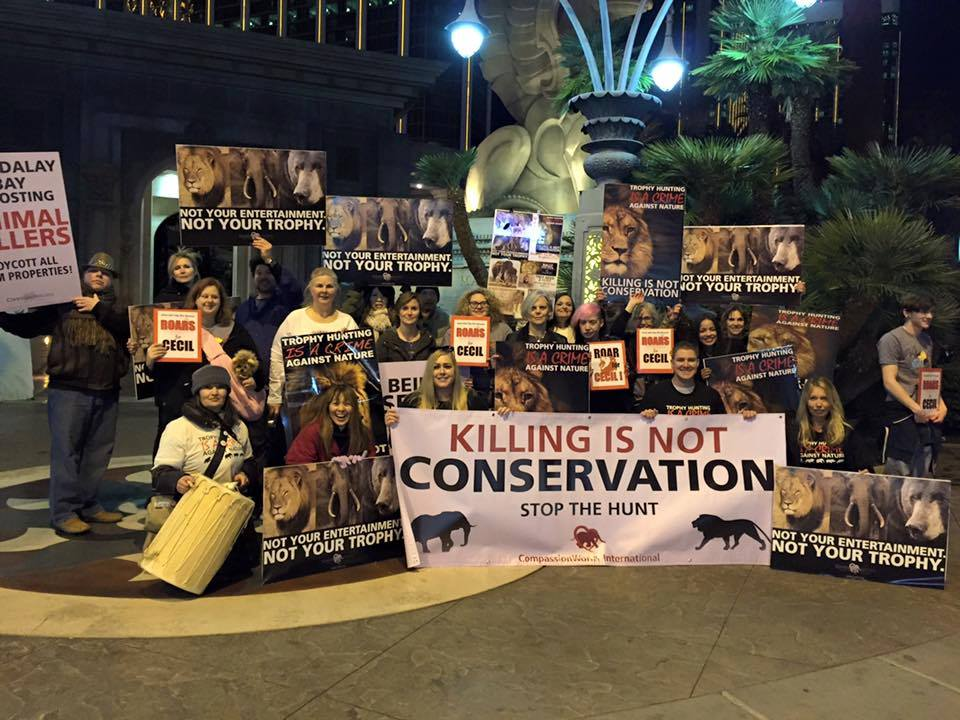
Brooklyn Park safari hunting convention draws protesters

LA rally

http://www.startribune.com/brooklyn-park-safari-hunting-convention-draws-protesters/370377931/
“The protesters, from Minnesota-based Animal Rights Coalition and
Minnesota Animal Liberation, held signs displaying slogans such as
“Killing Isn’t Conservation” and alluding to the event’s connection to
Walter Palmer, the Minneapolis dentist whose killing of Cecil the Lion
in Zimbabwe stirred international controversy last summer. The
Minnesota SCI is not connected to Palmer, according to President Ryan
Burt, who said he “respects the First Amendment right to protest.””

Justice Scalia spent his last hours with members of this secretive society of elite hunters

FILE - In this Oct. 20, 2015 file photo, Supreme Court Justice Antonin Scalia speaks at the University of Minnesota in Minneapolis.© AP Photo/Jim Mone, File FILE – In this Oct. 20, 2015 file photo, Supreme Court Justice Antonin Scalia speaks at the University of Minnesota in Minneapolis. 

http://www.msn.com/en-us/news/us/justice-scalia-spent-his-last-hours-with-members-of-this-secretive-society-of-elite-hunters/ar-BBpXBgx?ocid=spartandhp

When Supreme Court Justice Antonin Scalia died 11 days ago at a West Texas ranch, he was among high-ranking members of an exclusive fraternity for hunters called the International Order of St. Hubertus, an Austrian society that dates back to the 1600s.

After Scalia’s death Feb. 13, the names of the 35 other guests at the remote resort, along with details about Scalia’s connection to the hunters, have remained largely unknown. A review of public records shows that some of the men who were with Scalia at the ranch are connected through the International Order of St. Hubertus, whose members gathered at least once before at the same ranch for a celebratory weekend.

Members of the worldwide, male-only society wear dark-green robes emblazoned with a large cross and the motto “Deum Diligite Animalia Diligentes,” which means “Honoring God by honoring His creatures,” according to the group’s website. Some hold titles, such as Grand Master, Prior and Knight Grand Officer. The Order’s name is in honor of Hubert, the patron saint of hunters and fishermen.

Cibolo Creek Ranch owner John Poindexter and C. Allen Foster, a prominent Washington lawyer who traveled to the ranch with Scalia by private plane, hold leadership positions within the Order. It is unclear what, if any, official association Scalia had with the group.

“There is nothing I can add to your observation that among my many guests at Cibolo Creek Ranch over the years some members of the International Order of St. Hubertus have been numbered,” Poindexter said in an email. “I am aware of no connection between that organization and Justice Scalia.”

An attorney for the Scalia family did not respond to requests for comment for this article.

Two other private planes that landed at the ranch for the weekend are linked to two men who have held leadership positions with the Texas chapter of the Order, according to a review of state business filings and flight records from the airport.

After Scalia’s death, Poindexter told reporters that he met Scalia at a “sports group” gathering in Washington. The U.S. chapter of the International Order of St. Hubertus lists a suite on M Street NW in the District as its headquarters, although the address is only a mailbox in a United Parcel Service store.

The International Order of St. Hubertus, according to its website, is a “true knightly order in the historical tradition.” In 1695, Count Franz Anton von Sporck founded the society in Bohemia, which is in modern-day Czech Republic.

The group’s Grand Master is “His Imperial Highness Istvan von Habsburg-Lothringen, Archduke of Austria,” according to the Order’s website. The next gathering for “Ordensbrothers” and guests is an “investiture” March 10 in Charleston, S.C.

The society’s U.S. chapter launched in 1966 at the famous Bohemian Club in San Francisco, which is associated with the all-male Bohemian Grove — one of the most well-known secret societies in the country.

In 2010, Poindexter hosted a group of 53 members of the Houston chapter of the International Order of St. Hubertus at the Cibolo Creek Ranch, according to a Houston society publication. A number of members from Mexico were also part of the ranch festivities that included “three days of organized shoots and ‘gala’ lunches and dinners.”

Poindexter told CultureMap Houston that some of the guests dressed in “traditional European shooting attire for the boxed bird shoot competition” and for the shooting of pheasants and chukar, a type of partridge.

For the hunting weekend earlier this month, Poindexter told The Washington Post that Scalia traveled to Houston with his friend and U.S. marshals, who provide security for Supreme Court justices. The Post obtained a Presidio County Sheriff’s Office report that named Foster as Scalia’s close friend on the trip.

Sheriff Danny Dominguez confirmed that a photograph of Washington lawyer C. Allen Foster is the same man he interviewed at the ranch the day of Scalia’s death.

From Houston, Scalia and Foster chartered a plane without the marshals to the Cibolo Creek Ranch airstrip. In a statement after Scalia died, the U.S. Marshals Service said that Scalia had declined a security detail while at the ranch.

The friend, Louisiana-born Foster, is a lawyer with the Washington firm Whiteford, Taylor & Preston. He is also known for his passion for hunting and is a former spokesman for the hunting group Safari Club.

In 2006, Foster was featured in The Post when he celebrated his 65th birthday with a six-day celebration in the Czech Republic. He flew his family and 40 Washington friends there to stay in Moravia’s Zidlochovice, a baroque castle and hunting park. The birthday bash included “tours of the Czech countryside, wine tasting, wild boar and mouflon (wild sheep) hunts, classic dance instruction and a masked costume ball.”

A secretary at Foster’s law firm said he is traveling in Argentina. The firm’s director of marketing, Mindee L. Mosher, said Foster was traveling and she would try to contact him. A woman answering a phone associated with Foster hung up when asked for comment.

Planes owned by Wallace “Happy” Rogers III and the company of A.J. Lewis III left from San Antonio and arrived at the ranch just after noon Feb. 12. The planes departed the ranch about 30 minutes apart Feb. 14, according to flight records provided to The Post by FlightAware.

Rogers owns the Buckhorn Saloon and Museum in San Antonio. He has donated $65,000 to Republican candidates since 2008. Lewis is the owner of a restaurant supplier company, also based in San Antonio. He has given $3,500 to GOP candidates since 2007.

Rogers and Lewis have both served as prior officers in the Texas chapter of the International Order of St. Hubertus, according to Texas business records. Rogers spoke to a Post reporter briefly on the phone and confirmed that he was at the ranch the weekend of Scalia’s death, He declined to comment further.

Lewis did not respond to several attempts for comment.

The Presidio County Sheriff’s Office released an incident report to The Post on Tuesday that revealed Foster’s name as Scalia’s traveling companion and provided details about the discovery of his body.

Poindexter and Foster told the sheriff that Scalia had traveled to Texas the day before to go hunting. Poindexter told the sheriff that they “had supper and talked for a while” that evening.

Scalia “said that he was tired and was going to his room for the night,” the sheriff wrote in his report.

When Scalia didn’t show up for breakfast that morning, Poindexter knocked on his door and eventually went in and found the Justice dead in his bed, Poindexter said.

Law enforcement officials told The Post that they had no knowledge of the International Order of St. Hubertus or its connection to Poindexter and ranch guests. The officials said the FBI had declined to investigate Scalia’s death when they were told by the marshals that he died from natural causes.

Alice Crites in Washington and Eva Ruth Moravec in San Antonio contributed to this report.