by Rosemary Lowe
Category Archives: Trophy Hunting
Jimmy John Liautaud: Listen to Your Customers and Stop Your Trophy Hunting
![]() |
||||||||||||||||||||
|
B.C. man persuaded to give up coveted licence to hunt grizzly bears
Brent Sheppe grew up in a family of hunters, and for almost as long as he can remember he wanted to kill what some people regard as the biggest trophy of all.
“It’s been a dream of mine to get a grizzly bear. You know, to be able to hunt something that could hunt you back is pretty intimidating, is pretty awesome,” Mr. Sheppe said in a recent interview as he sat at home watching a hunting show on television.
This fall, after 10 years of trying, Mr. Sheppe got lucky, and for the first time his name was drawn for a grizzly bear licence in a limited entry hunt (LEH) in the Knight/Kingcome Inlet area on British Columbia’s central coast.
Getting your name drawn for an LEH is like winning the lottery, because it allows you access to an area from which the vast majority of hunters are excluded. LEHs are a way for the government to restrict the number of animals killed by limiting the number of hunters allowed in a prescribed zone. This year, 9,614 hunters applied for LEH licences for grizzly bears in British Columbia, and 3,469 tags were issued. In the Knight/Kingcome zone, 324 applied and 59 were selected.
(A government spokesman said many more tags are issued than bears are harvested. In 2014, for example, 3,067 LEH hunters province-wide killed 267 grizzlies.)
When Mr. Sheppe got his licence after so many years of trying, he was ecstatic.
But in a remarkable story of conversion that shows the dramatic way attitudes are shifting against grizzly hunting in B.C., Mr. Sheppe is going to forfeit his LEH.
Instead of shooting a trophy bear, he is going to look at one through binoculars.
“The way I was raised, we’d go out and shoot some animals and we’d bring the animals home and clean them, process them, smoke them and put them in the freezer. That was what we’d eat growing up. So hunting has been a big part of my life,” he said.
But his views on hunting grizzly bears changed recently when he talked with Mike Willie, an old friend and a hereditary chief of the Musgamakw Dzawada’enuxw First Nation.
Mr. Willie runs Sea Wolf Adventures, which offers cultural and wildlife tours on the coast, and Mr. Sheppe was hoping to get a boat ride into the remote Knight/Kingcome area, at the southern edge of the Great Bear Rainforest.
“I gave him a call, and was like, ‘You know, you’re the guy to take me out and help find some animals.’ And he said, ‘Well, there’s a bit of a problem because I’m completely against hunting these animals; they are majestic and spiritual,’” Mr. Sheppe said.
They talked about the importance of bears to First Nations.
“Bears are like family. If you have a bear lost, it’s a family member down,” Mr. Willie said.
“It really hit me,” Mr. Sheppe said. “I never had the opportunity to go hunt one before, so I was pretty excited about this [hunt], but my views have changed. Something in my spirit has switched and I’m ready to start a new chapter and try and help promote saving these bears.”
Mr. Willie said as an incentive to help Mr. Sheppe abandon his hunt, Sea Wolf Adventures and Nimmo Bay Resort, a luxury wilderness lodge, have offered to host him and his family for a bear-viewing trip.
It is an offer he hopes to make to other hunters prepared to give up their LEH licences.
Fraser Murray of Nimmo Bay Resort said when Mr. Sheppe sees a trophy grizzly, they will identify it as the bear that would have been shot had the hunt proceeded. A snare will be used to get DNA from a hair sample, and the bear will become part of a science project tracking the movement of coastal grizzlies.
“We’ll learn more about that bear and get a sense of the value of that bear to tourism as opposed to hunting,” he said.
A study last year found that tourists spent $15-million on bear viewing in the Great Bear Rainforest in 2012, while hunters spent $1.2-million.
Judging by that, the bear being spared by Mr. Sheppe is worth a lot more alive than dead.
Increasingly, British Columbians seem to be realizing that. A survey released on Friday found that more than 90 per cent now oppose the grizzly hunt. Included in that number are probably a lot of hunters like Mr. Sheppe, who have turned away from killing bears.
Bear Hunt Trial Triggers Protest In B.C.
VANCOUVER — The case of an NHL player charged in the death of a grizzly bear has become a rallying cry for a British Columbia group against trophy hunting.
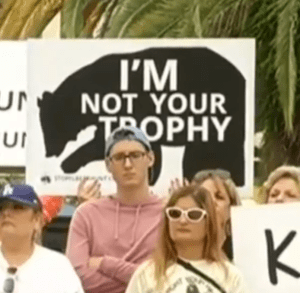
About a dozen members of Bears Matter gathered outside provincial court in Vancouver on Friday before a court date for Anaheim Ducks defenceman Clayton Stoner.
Stoner is charged with five counts under the provincial Wildlife Act, including two counts of knowingly making a false statement to obtain a hunting licence, hunting out of season, hunting without a licence and unlawfully possessing dead wildlife.
The bear, which local residents had named Cheeky, was killed in the Great Bear Rainforest on B.C.’s central coast in 2013.
Bear Matters member Barb Murray said a growing number of people are against trophy hunting and that Stoner’s case should draw attention to the practice.
“We really need to make this case stand out above the others so that Premier (Christy) Clark cannot ignore our petitions, cannot ignore our letters and cannot ignore our voices,” she said.
Records from the Environment Ministry show dozens of charges in 2014 related to hunting without a licence and unlawfully possessing dead wildlife.
However, few other cases have been in the spotlight.
“Clayton Stoner, he’s recognized internationally, he’s an NHL hockey player, he makes millions of dollars,” Murray said. “He’s supposed to be an example of what a sportsman (embodies). And he’s not.”
Stoner has never denied the hunt, which sparked debate two years ago when pictures published in a Vancouver newspaper showed him holding a grizzly’s severed head.
Stoner, who is from Port McNeill on Vancouver Island, defended his hunting trip with his father, an uncle and a friend after the photos were publicized.
“I grew up hunting and fishing in British Columbia and continue to enjoy spending time with my family outdoors,” he said in a September 2013 written statement, adding he would continue those activities in the province.
Stoner should apologize for hunting bears, said Murray, her voice choked with emotion.
“I’m hoping they slap a very big fine, and he could also contribute to conservation in this province, big time.”
Stoner was not in court Friday. Ricky Bal, a lawyer who appeared on his behalf, said he does not know how the hockey player intends to plead.
The case was put over until Nov. 13.
Former Billings woman has 2 hunts of a lifetime in 1 week
“Oh my goodness, yeah,” Eric Percy said. “She pulled it off.”
This year, Cathy drew coveted bighorn sheep and mountain goat tags after 12 years of applications and denials. The Billings West graduate, who at age 54 has retired to Bozeman, said the successful drawings weighed heavily on her mind all summer.
“I felt like I needed to try my best to fill both tags,” she said.
She succeeded in not only filling both tags, but doing so only a week apart.
Eastern bighorn
The first to fall to Cathy’s hunting prowess was a Missouri Breaks bighorn ram that green scored 175, just shy of the Boone & Crockett Club record books because he had worn off the tips of his heavy horns. The minimum score to make the Montana record book is 175, but Boone & Crockett has a minimum score of 180 for bighorn sheep.
“I wanted to get my sheep first because I was worried about the weather becoming a factor,” she said. “I got my sheep in three days.”
Those weren’t three easy days, though. Cathy noted that the landscape they were hunting near Fourchette Bay along the north shore of Fort Peck Reservoir in Eastern Montana is steep country.
“That land is wicked,” she said, “down and up.”
On one of the four days spent scouting, they spotted 17 rams on private land, indicating the wealth of the sheep herd in the area. But the Percys were on a public land hunt in Hunting District 622, so they had to ignore the temptation of those private land sheep.
After hiking about 2.5 miles on the third day, they spotted two rams. While working in closer for a shot, the sheep took off running. Cathy shouldered her brother Michael Sampson’s .270 Winchester Short Magnum rifle and drew a bead on the second of the two rams. With one shot from only 60 yards away, the bighorn dropped.
“I saw the first one when he took off,” Cathy said. “He had longer horns but they were skinnier. The one behind definitely had way more mass. Another few inches, and he would have made the Boone and Crockett record book.”
It was a hot day when Cathy made her kill, and it took two days of hiking to pack out all of the sheep meat, hide and antlers. She “worried the whole night long” after the first trip, concerned that a predator might find and ruin the horns they’d left behind in a tree. But her luck held out, and the trophy was fine.
Western billy goat
After returning home to Bozeman, the Percys heard reports that the weather was about to get nasty in the mountains. So they telephoned Hell’s A-Roarin’ Outfitters in Jardine and asked if they could move up their scheduled hunt by three days. Owners Warren and Susan Johnson were happy to accommodate their guests, so the Percys went from the lowlands of Eastern Montana to the highlands of the Beartooth Mountains in a span of a few days.
“I can’t decide which hunt was harder,” Cathy said. “Getting to the goat was exhausting.”
A 15-mile horseback ride took the Percys in to a base camp from which they arose at 4:30 in the morning to ride again through the Absaroka-Beartooth Wilderness, just north of Yellowstone National Park. It was in the vicinity of 10,000-foot high Roundhead Butte that Cathy’s guide spotted a billy goat perched below on the edge of a cliff.
Even after two shots behind the goat’s shoulder it was still standing, so Cathy aimed for the backbone and dropped the reticent billy at a distance of about 125 yards. The guide told Cathy she didn’t have to scramble down the slope for a photograph of the goat that would measure 57 5/8 inches, he would be happy to bring it back uphill since she has a bad knee. But Cathy was adamant that she wanted a shot of the billy where he fell and before he was skinned.
“I’m going down,” she recounted telling the guide. “I slid all the way down on my butt.”
She joked that her husband “was trying to figure out a way to tell my daughter where my body was,” as she scrambled downhill.
“That goat was incredible
Guide: Walter Palmer knew Wis. black bear ‘was illegally shot and killed’
KMSP) – Before Cecil the lion, there was this unnamed Wisconsin black bear. Minnesota dentist Walter Palmer let his guides know he wasn’t interested in any bear, but the largest they could find. He paid his guides more than $2,500, but was allegedly willing to pay so much more if they would lie about where the kill went down.
http://www.fox9.com/news/19925713-story

Zimbabwe man who helped U.S. dentist kill Cecil the Lion arrested on new wildlife smuggling charges
Professional hunter Theodore Bronkhorst, who helped in the killing of Cecil the lion, has been arrested by Zimbabwean authorities for allegedly smuggling antelopes.
A professional hunter in Zimbabwe who helped an American dentist kill a well-known lion named Cecil has now been arrested for allegedly trying to smuggle sable antelopes into South Africa, Zimbabwean police said Tuesday.
Theo Bronkhorst, a Zimbabwean, is in police custody in the southern city of Bulawayo following his arrest a day earlier and will appear Wednesday in a court in Beitbridge, a town on the border with South Africa, police spokeswoman Charity Charamba said.
Police and Zimbabwe National Parks officials also caught three South African men after the vehicles carrying the sables got stuck along the Limpopo River which marks Zimbabwe’s border with South Africa, the Zimbabwe National Parks and Wildlife Management Authority said in a statement.
“Bronkhorst will be charged for trying to move wild animals without a permit. He faces an additional charge of being an accomplice in a smuggling racket involving the sables,” Charamba told The Associated Press in a telephone interview.
The scheme involved trying to smuggle 29 sables worth $384,000 into South Africa, according to the parks authority.
Paula French/AP
Cecil the Lion was killed in July.
The South Africans had no capture and translocation permits authorizing them to move the sables — seven males, 16 females and six calves — from a private sanctuary in Zimbabwe to a private conservancy in South Africa, the parks authority said.
Bronkhorst had been out on bail after being charged for the allegedly illegal hunt of Cecil by dentist James Walter in July.
He is due to go on trial in that case on Sept. 28. Authorities say Cecil was lured out of a national park with an animal carcass before he was shot.
The lion’s death sparked an international outcry, prompting some airlines to ban the transport of parts of lions and other animals killed by hunters.
Cecil The Lion’s Killer Says Animal Activists Have Made His Life A Misery
Walter Palmer caused outrage after he killed the famous beast during a poaching expedition in Zimbabwe in July.
Speaking for the first time since the incident, the US dentist showed little remorse for his actions and hit out at critics who forced him into hiding.
Palmer, 55, was adamant he followed “the proper procedures” and claimed the hunting party had no idea the lion was so special. He said: “If I had known this lion had a name and was important to the country or a study, obviously I wouldn’t have taken it.
“Nobody in our hunting party knew before or after the name of this lion.
“This has been especially hard on my wife and my daughter.
“They’ve been threatened in the social media. I don’t understand that level of humanity to come from people not involved at all.”
But Palmer, from Minnesota, did not rule out returning to Africa to add to his trophy collection. There was worldwide fury after pictures emerged of him with the skinned lion he shot with a crossbow arrow. Animal rights groups called for his extradition to Zimbabwe to face charges. Others sent death threats and protesters spent days gathered outside his dental practice.
But on Tuesday he said he would be returning to work the following day.
“I’m a health professional,” he said.
“I need to get back to my staff and my patients. I’m a little heartbroken at the disruption in their lives.
Hundreds of wild animals to be slaughtered in Limpopo, South Africa
http://www.telegraph.co.uk/news/worldnews/africaandindianocean/southafrica/11848103/Hundreds-of-wild-animals-to-be-slaughtered-in-Limpopo-South-Africa.html
New hunting controversy – two months after Cecil the lion was shot – which will see animals shot from specially erected platforms rekindles debate on big game hunting
Animal welfare groups in South Africa on Monday failed to prevent the opening of a week-long “driven hunt”, in which foreign hunters pay to shoot wildlife that is herded past them for easy dispatch.
More than 20 Belgian and Dutch hunters took part in the hunt on a farm near the town of Alldays, in the northern province of Limpopo.
Taking aim from purpose-built platforms overlooking a bush strip, hunters are able to shoot at hundreds of wild animals including baboons, warthogs and antelope as they pass.
Just two months after the global furore surrounding the slaughter of Cecil the lion in Zimbabwe, the hunt has rekindled controversy over the killing of wildlife for sport.
Cecil greets one of the lionesses in the Linkwasha Camp, within the Hwange National Park Photo: Brent Staplecamp
Such was the anger over the death of Cecil, who was being tracked by Oxford University as part of a research project, that the hunter – Walter Palmer, a dentist from Bloomington, Minnesota – was forced into hiding, emerging only this week to make a public statement.
The National Council of SPCAs, the South African animal welfare group, appealed for the driven hunt to be stopped.
Ainsley Hay, the group’s manager of wildlife protection, said that it was trying to obtain a warrant to prevent the hunt from the magistrates court in the town of Louis Trichardt.
“Our team is trying to get the warrant, but the hunters are there already and the shooting is about to start,” she said.
Later reports said 18 animals were killed on Monday.
She said an indigenous community in the area had claimed the land and was renting it out to “individuals” who were hosting the hunt as a way of earning income.
“They have built platforms that line the bush for the hunters to stand on and have employed locals to walk in a straight line beating metal drums to chase the animals into the slaughter strip.
“The hunters then take pot shots at the animals. The animals have no chance of evading the onslaught and the hunters have no way of ensuring a clean shot or a humane death.
“From past hunts like these we have seen that much of the kill can’t be eaten or used as trophies because the dead animals are so full of bullets.”
The hunt, at Braam Farm outside Alldays, is due to last for one week. Hundreds of animals could be killed each day.
Hermann Meyeridricks, president of the Professional Hunters’ Association of South Africa, said he did not have enough information about the hunt to comment.
“There is a media frenzy around hunting at present and we don’t know enough about this this kind of hunting, which has been going on for centuries in Europe.
“I have no mandate to investigate activities of citizens of this country.”
Dentist Walter Palmer Returns to Work With Police Escort Amid Cecil the Lion Protests
http://abcnews.go.com/US/dentist-walter-palmer-returns-work-police-escort-amid/story?id=33602439
Palmer returned to his dental clinic in Bloomington, Minnesota, with a police escort at around 7 a.m. today.
A few protesters gathered outside his office and yelled “Extradite Palmer,” saying he should face punishment in Zimbabwe.
The dentist was named in late July as the hunter who killed Cecil, a lion that had been fitted with a GPS collar as part of research for Oxford University. Palmer has said he did not know he was killing a beloved animal when he followed his hunting party guide, and he believed he acted legally. The 13-year-old Cecil was the biggest dominant male black-maned lion in Hwange National Park in Hwange, Zimbabwe.
Today, Bloomington Police Deputy Chief Mike Hartley said police will keep a presence at Palmer’s office for as long as they are needed, mostly to manage blocking off the street for media. There were about 10 officers on the premises this morning. Hartley said he is not concerned for Palmer’s safety at this point, and Palmer has employed his own security.
Zimbabwean authorities have reportedly paused an effort to extradite Palmer due to possible fears that doing so would hurt Zimbabwe’s hunting business, the Associated Press reported. The Zimbabwean professional hunter who helped Palmer was charged with “failure to prevent an illegal hunt,” while the man whose property on which the killing took place faces a charge of allowing the hunt to occur on his farm without proper authority. They allegedly lured the lion out of the national park with an animal carcass.


