Although one never saw the light of day again (former bakery-shop owner Hansen died in an Alaskan prison in 2014) and one may never see the inside of a courtroom, there are numerous similarities between serial killer/trophy hunter Robert Hansen and dentist/trophy hunter Walter Palmer:
Both were family men, well-liked and successful in small business
Both were avid sport hunters (though thus far Dr. Palmer‘s chosen “trophies” were taken only from the legal, non-human side of the imaginary great divide that separates worthy life forms from fair “game.”)
Both “sportsmen” Walter Palmer and Robert Hansen enjoyed the challenge of bow hunting (presumably to prolong the agony for their prey)
Both needed to constantly to refresh their “trophies” in an obsessive effort to boost their flagging self-esteems (after all, how much macho pride can be derived from being a baker…or a dentist?)
Both serial killers objectified and thought nothing of the lives or the suffering of their many innocent victims, whom they failed to recognize as vastly superior in intrinsic value
Conversely, perhaps they did recognize their value and envied them for it
When accused, neither apologized to those whom their crimes affected, but instead cared only of how the accusations affected them
Both were narcissistic psychopaths
Both deserve whatever punishment they got or eventually get
Whether or not he broke enough hunting laws to warrant extradition back to Zimbabwe for a trial is all that seems to matter to Dr. Palmer. The fact that Cecil had a name and a radio tracking collar didn’t help the doctor’s legal case. But as with any psychopathic serial killer, his overwhelming sense of entitlement keeps him from seeing the fundamental wrong in his murderous ways.
Dentist who killed Cecil the lion set to return to work
By BRIAN BAKST, Associated PressPublished: Sep 7, 2015
MINNEAPOLIS (AP) – The Minnesota dentist whose killing of Cecil the lion sparked a global backlash emerged for an interview in which he disputed some accounts of the hunt, expressed agitation at the animosity directed at those close to him and said he would be back at work within days.
Walter Palmer, who has spent more than a month out of sight after becoming the target of protests and threats, intends to return to his suburban Minneapolis dental practice Tuesday.
In an interview Sunday evening conducted jointly by The Associated Press and the Minneapolis Star Tribune that advisers said would be the only one granted, Palmer said again that he believes he acted legally and that he was stunned to find out his hunting party had killed one of Zimbabwe’s treasured animals.
“If I had known this lion had a name and was important to the country or a study obviously I wouldn’t have taken it,” Palmer said. “Nobody in our hunting party knew before or after the name of this lion.”
Cecil was a fixture in the vast Hwange National Park and had been fitted with a GPS collar as part of Oxford University lion research. Palmer said he shot the big cat with the black mane using an arrow from his compound bow outside the park’s borders but it didn’t die immediately. He disputed conservationist accounts that the wounded lion wandered for 40 hours and was finished off with a gun, saying it was tracked down the next day and killed with an arrow.
An avid sportsman, Palmer shut off several lines of inquiry about the hunt, including how much he paid for it or others he has undertaken. No videotaping or photographing of the interview was allowed. During the 25-minute interview, Palmer gazed intensely at his questioners, often fiddling with his hands and turning occasionally to an adviser, Joe Friedberg, to field questions about the fallout and his legal situation.
Some high-level Zimbabwean officials have called for Palmer’s extradition, but no formal steps toward getting the dentist to return to Zimbabwe have been publicly disclosed. Friedberg, a Minneapolis attorney who said he is acting as an unpaid consultant to Palmer, said he has heard nothing from authorities about domestic or international investigations since early August.
Friedberg said he offered to have Palmer take questions from U.S. Fish and Wildlife Service authorities on the condition the session be recorded. He said he never heard back.
“I’m not Walter’s lawyer in this situation because Walter doesn’t need a lawyer in this situation,” said Friedberg, who said he knew Palmer through previous matters. “If some governmental agency or investigative unit would make a claim that he violated some law then we’d talk about it.”
Ben Petok, a spokesman for U.S. Attorney Andy Luger, declined comment about conversations with Friedberg and referred questions to Fish and Wildlife. An agency spokeswoman didn’t immediately return a call or an email Sunday evening.
After Palmer was named in late July as the hunter who killed Cecil, his Bloomington clinic and Eden Prairie home became protest sites, and a vacation property he owns in Florida was vandalized. Palmer has been vilified across social media, with some posts suggesting violence against him. He described himself as “heartbroken” for causing disruptions for staff at his clinic, which was shuttered for weeks until reopening in late August without him on the premises. And he said the ordeal has been especially hard on his wife and adult daughter, who both felt threatened.
“I don’t understand that level of humanity to come after people not involved at all,” Palmer said.
As for himself, he said he feels safe enough to return to work – “My staff and my patients support me and they want me back” – but declined to say where he’s spent the last six weeks or describe security steps he has taken.
“I’ve been out of the public eye. That doesn’t mean I’m in hiding,” Palmer said. “I’ve been among people, family and friends. Location is really not that important.”
Palmer, who has several big-game kills to his name, reportedly paid thousands of dollars for the guided hunt but wouldn’t talk money on Sunday.
Theo Bronkhorst, a professional hunter who helped Palmer, has been charged with “failure to prevent an illegal hunt.” Honest Ndlovu, whose property is near the park in western Zimbabwe, faces a charge of allowing the lion hunt to occur on his farm without proper authority.
Asked whether he would return to Zimbabwe for future hunts, Palmer said, “I don’t know about the future.” He estimated he had been there four times and said, “Zimbabwe has been a wonderful country for me to hunt in, and I have always followed the laws.”
In addition to the Cecil furor, Palmer pleaded guilty in 2008 to making false statements to the U.S. Fish and Wildlife Service about a black bear he fatally shot in western Wisconsin outside of the authorized hunting zone. He was given one year probation and fined nearly $3,000 as part of a plea agreement.
Cecil’s killing set off a fierce debate over trophy hunting in Africa. Zimbabwe tightened regulations for lion, elephant and leopard hunting after the incident, and three major U.S. airlines changed policies to ban shipment of the trophies.
When I heard an American killed Cecil the lion, I felt sick to my stomach. I also felt embarrassed for our country. I know I am not alone in feeling concern, because people around the world reacted with horror to the needless killing of such an iconic African lion. A movement is building to protect rare wild animals, and I’m asking for your support to prevent future tragedies like what happened to Cecil. Please sign my petition telling Congress to pass the CECIL Act into law, which would place restrictions on trophy hunting of animals considered for endangered or threatened wildlife protections.
The Conserving Ecosystems by Ceasing the Importation of Large (CECIL) Animal Trophies Act may be our best chance to protect rare wild animals from getting killed for trophies and shipped here to the United States. Without this law, we leave animals around the world vulnerable to trophy hunting.
Right now, the Endangered Species Act prevents the import and export of wildlife already listed as endangered. The CECIL ACT would extend those protections to animals proposed for addition to the list. The CECIL ACT would prohibit the import of such hunting trophies into our country.
I’m at Harvard Law School right now to learn the most effective ways to protect animals from abuse and neglect. I know it’s important to show Congress that the public demands better laws. We must work together to make this change right now. Otherwise, big money from wealthy trophy hunters will drown out the compassionate voices of regular Americans like us.
By signing my petition, we can send a loud message to Congress that Americans want to protect rare wildlife. Tell Congress to pass the CECIL Act into law to protect animals like Cecil from trophy hunting.
Facebook has deleted trophy photos showing rhinos, elephants, lions and leopards killed or tranquilized by a Texas Tech cheerleader.
Kendall Jones, 19, has sparked outrage across the social media site for sharing images of herself with the big game she has hunted through Africa.
On Thursday, Facebook removed some of the images that violated their standards.
In a statement, it said it removes ‘reported content that promotes poaching of endangered species, the sale of animals for organized fight or content that includes extreme acts of animal abuse’.
Removed: Facebook had taken down this photo of Kendall Jones, 19, with a lion that she hunted in Africa. The social networking site said that the image – and others – violate their standards
Following the removal of the images, she shared a Fox News Channel montage of the deleted photos but by Friday, there was no sign of the montage.
It came after more than a quarter of a million animal lovers signed a petition urging Facebook CEO Mark Zuckerberg to take down the photos in which Jones smiles proudly over the corpses of her prey she claims to be saving from extinction.
‘For the sake of all animals,’ the petition against Jones reads as it implores animal lovers to sign, ‘especially the animals in the African region… where hunters are going for fun just to kill an animal!’
Image caption For those who are so inclined, it is possible to legally hunt virtually any African animal
Trophy hunting has been the subject of much media attention amid the backdrop of declining populations of big game animals in Africa. But is a blanket ban really the answer?
At the end of June 2015, a Zimbabwe lion known as Cecil was wounded by a crossbow bolt shot by American dentist Walter Palmer.
Sometime later [40 HOURS!!] Cecil was shot and finally killed.
The media attention that followed made it clear that many people were unaware of the realities of modern-day African hunting.
In fact, if you have enough money and are so inclined, you can legally hunt pretty much any African animal, including lion, leopard, elephant, buffalo and hippo.
You’ll need the right permits and it’s subject to quotas and regulations but if you do it by the book, then it’s perfectly legal. And once you’ve killed it you can export the “trophy” home.
‘Moral objection’
Following Cecil’s death, many have called for a blanket ban on trophy hunting. Calls for a ban come from a number of different directions.
For some, there is a moral objection to the killing of animals for pleasure, for others an understandable emotional response to images of hunters posing with their kills or concerns over conservation.
But calls for a blanket ban on trophy hunting fail to take into account the complex relationship between hunting and conservation.
Some trophy kills are hard to justify no matter which side of the fence you sit on. Leopard for example are a CITES (Convention on International Trade in Endangered Species of Wild Fauna and Flora) Appendix I species.
Image caption As the human population in Africa expands, conflict between humans and wildlife increases
Such species are threatened with extinction and the commercial trade in wild-caught specimens is illegal. Despite this, it is still possible to hunt one “on trophy” (subject to quotas) for personal, non -commercial purposes.
Another hunting practice that has come under the spotlight is “canned hunting” of lions. There is considerable confusion between, and conflation of, trophy hunting and canned hunting. Canned hunting, where captive bred lions are released into small enclosures to be hunted in a “no kill no fee” arrangement, “hits the bottom of the barrel” according to Will Travers, President of wildlife charity the Born Free Foundation.
Poor welfare
Largely based in South Africa, the welfare issues involved in canned hunting, which include severe over-crowding and inadequate access to food and water, have recently been exposed by environmental film maker Ian Michler in his film Blood Lions.
However, as lion conservation expert and author of Lions in the Balance: Man-eaters, Manes and Men with Guns, Professor Craig Packer, says: “These animals are not part of the wild population and so, there’s no real immediate impact on conservation… I view canned hunting mostly as an animal welfare issue.”
Many sought-after trophy animals, such as kudu and impala, are maintained in large numbers across Southern Africa, especially South Africa, within large, fenced, privately-owned reserves.
Image caption Many prized trophy animals such as kudu are maintained in large, fenced reserves
Animal numbers need to be controlled to prevent over-stocking and over-grazing. Surplus animals are harvested for meat but larger males can generate far more revenue if they’re taken by a trophy hunter.
The taking of trophy animals in such reserves is of limited conservation concern and the money generated helps to pay for the management that is required to keep reserves in good condition.
In fact, the impact of trophy hunting depends on the species and the region being considered. So the past few decades in South Africa have seen a landscape-level replacement of cattle farming with wildlife farming.
As a consequence: “Southern Africa’s seen large scale recoveries of wildlife in the 20th century, built around hunting,” says Rosie Cooney, who heads the IUCN Sustainable Use and Livelihoods Specialist Group.
Trophy hunting of many species was, and continues to be, vital in funding this reversal and a blanket ban there is neither needed nor desirable.
It pays, it stays?
This “consumptive utilisation of wildlife” model (“it pays it stays”) also works well in some other regions. The Bubye Valley Conservancy in Zimbabwe for example has more than 400 lions and one of the most important populations of rhino still in existence.
The Conservancy is funded entirely by hunting and, according to the reserve manager Blondie Leathem, a ban would be “devastating”.
However, trophy hunting is not always beneficial for wildlife. Over-harvesting can clearly have a detrimental effect on numbers.
Also, trophy hunters select large males and this can have more profound effects on the breeding dynamics of animals in that region. These problems are greatest when land is not stably owned and a “tragedy of the commons” (when everyone harvests as much as they can for short-term gain) can result.
It is tempting to suggest that hunting could be replaced by tourism and in some places this is indeed the case. However, as Rosie Cooney points out, tourism is only possible in regions that “are accessible…a few hours generally from a major hub…with good roads”.
They also need to be safe, “lacking in dangerous diseases….and politically stable”. There needs to be the infrastructure to look after tourists and you need capital to invest in it. Many hunting concessions operate successfully in areas where none of these conditions are in place, at least for now.
The pro-hunting argument is simple. Hunting provides revenue that directly funds conservation. Anti-hunters often claim that this hunting-conservation link doesn’t stand up to scrutiny. The problem in deciding whether hunting is beneficial or not is that both sides are right.
How can both sides be right? The answer to that lies in the fact that Africa is not a single entity.
Different countries and even regions within those countries have different histories, geography, politics, governance, infrastructure, economics, population demographics and tribal politics. In some regions hunting is vital for conservation. In such regions “it pays it stays” works and a ban would be detrimental to wildlife.
In other regions, hunting could be replaced or at least supplemented by tourism. In still other regions, and certainly for some species, a ban on hunting could be a sensible move for conservation. A “one size fits all” solution is not what is required.
Last wilderness
In fact, Prof Craig Packer says that across Africa overall “neither trophy hunting nor phototourism is sufficient to cover the costs [of conservation]”.
Whilst these activities can and do work in some places, he thinks that “we need to move away from the standard model of wildlife conservation in Africa, which has always been ‘wildlife must pay its own way'”. Overall, the approach doesn’t generate enough money and consequently, “we’re seeing dramatic losses of wildlife numbers throughout a lot of Africa.”
It is interesting that the killing of a single lion by a wealthy, white, American attracted so much attention.
As Will Travers explains: “I don’t think we should fool ourselves that it’s all about trophy hunting. Lions are threatened by habitat loss, habitat fragmentation…human activities that disperse and displace lions [and] the loss of prey species.”
There are few true wildernesses left, and as the human population in Africa expands, conflict between humans and wildlife gets ever greater. Far more lions are killed by cattle herders defending their livestock and their families than by trophy hunters. Don’t forget, in the UK, we long ago killed our apex predators so that we could sleep soundly.
To conserve wildlife we need to find ways to protect animals from people and people from animals. We also need to find ways to ensure animal populations are more valuable alive in the long-term (even if that means sustainable harvesting) than dead in the short-term.
Conservation is an extraordinarily complex problem but it is also one of the most significant problems we now face. The solution will not be found in knee-jerk responses driven by emotion and fuelled by social media.
Prof Adam Hart is professor of science communication at the University of Gloucestershire. He presents Big Game Theory on BBC Radio 4 at 20:00 on Tuesday 1 September.
Air Canada and WestJet have banned the transport of big game out of Africa, but continue to allow the transport of Canadian animal ‘trophies’, such as black bears, grizzly bears, polar bears and wolves.
Sign and share this petition to tell Air Canada and WestJet they should be taking a stand against trophy hunting in their own backyard.
On August 4, Air Canada and WestJet banned the shipment of big game trophies after the brutal killing of Cecil the lion in Zimbabwe in early July drew international attention and sparked a media outcry.
What about in our own backyard?
British Columbia is one of the last refuges of the grizzly bear, which once roamed widely across North America. Though listed as a species of special concern by the Committee on the Status of Endangered Wildlife in Canada, the province still allows a Limited Entry Hunt for grizzly bear trophy hunters twice a year.
Despite a recognized need for protection, independent biologists indicate B.C.’s grizzly population has fallen from 35,000 bears in 1915 to as low as 6,000 today. Still, trophy hunters shoot between 300 and 400 grizzlies each year, and Air Canada and West Jet kindly ship the trophies home.
In 2004, the European Union banned imports of all B.C. grizzly parts into member countries after its analysis found the BC grizzly bear hunt to be unsustainable.
A recent study by the Centre for Responsible Travel finds bear viewing in B.C.’s Great Bear Rainforest generates far more economic value than bear hunting. According to this study, visitors spent 12 times more on bear viewing than on bear hunting in British Columbia.
Ironically, the very businesses that benefit from tourist travel are undermining it!
Beyond the evidence, 90% of British Columbians simply do not support the trophy hunt including all Coastal First Nations.
In the absence of provincial leadership, we are all doing what we can to stop the trophy hunt. It’s time for Air Canada and West Jet to do their part at home.
Join us in:
a) acknowledging Air Canada CEO, Calin Rovinescu and WestJet CEO, Gregg Saretsky for taking these important first steps to oppose the trophy hunt; and
b) calling on them to take a stand against this brutal and inhumane ‘sport’ in their own backyard by refusing to transport grizzly, black bears, and wolves from their natural habitat.
Until the provincial government of British Columbia bans trophy hunting, it’s up to us to make it as difficult as possible.
Please sign and share this message to help #banthetrophy hunt, one step at a time.
The outcry over the killing of Cecil the lion last month in Zimbabwe has some hunters worried that the incident hurt the sport’s image in the U.S. at a critical time when participation is dwindling and more Americans express support for animal rights.
“In my opinion, he’s doing more harm to public opinion on hunting than any anti-hunter could ever do,” said Mark Duda, executive director of the public opinion research firm Responsive Management, referring to the Minnesota dentist who shot Cecil with a crossbow after guides allegedly lured lion out of a national park. “And it’s too bad because it hurts … ethical, legal hunters who contribute to conservation and care deeply about wildlife.”
Duda, a hunter whose firm has tracked Americans’ attitudes about hunting for two decades, said the actions of Dr. Walter J. Palmer of Eden Prairie, Minn., suggested he had “read my newsletter on how to talk to the public about hunting, and did everything the exact opposite.”
Zimbabwe Alleges Another American Involved in Illegal Lion Hunt1:58
Not all hunters who spoke to NBC News about Cecil’s death agreed that the ensuing controversy had damaged support for the domestic sport. But none defended the way the lion, a popular attraction with visitors to Zimbabwe’s Hwange National Park, was reportedly killed.
Dale Hall, CEO of Ducks Unlimited and director of the U.S. Fish and Wildlife Service under President George W. Bush, was one of many hunters saying that Palmer should be prosecuted if an investigation reveals illegal activities.
“First of all, let me say that if unethical activities took place – if that’s what the evidence ends up showing – then I would be 100 percent for full prosecution,” Hall said. “Because we ethical hunters believe ethics is defined by what we do when no one is watching.”
Other hunting proponents say animal rights groups are using Cecil’s story as propaganda to press their anti-hunting agenda.
David Allen, CEO of the Rocky Mountain Elk Foundation, said animal rights groups “lay in wait for any opportunity to take issue with hunting in America.” But he doubts the Cecil controversy will stick to U.S. hunters.
“I think it’s going to be a huge stretch to try and turn Cecil, whatever happened, into that’s what’s wrong with North American hunting and fishing. It’s a huge leap,” Allen said.
But Ingrid Newkirk, president of People for the Ethical Treatment of Animals (PETA), said hunters and pro-hunting groups should be concerned because the outcry reflects changing attitudes toward killing wildlife.
“I don’t think they had realized that once was this was exposed … that people would be as upset as they are,” Newkirk said. “And they fear that the same rage and disgust is going to erupt if people stop buying the myth that hunting in America is to put food on the table.” PETA calls hunting unnecessary and cruel, and advocates for more humane methods of wildlife control.
Yellowstone grizzly bears face the two greatest threats to their survival in our lifetime: global warming and the U.S. government. Between them they could wipe the bears out.
One cold October day in 1968, I climbed out of a warm creek on the Yellowstone Plateau and came face to face with a huge grizzly. I froze, not knowing what to do. Since I was naked, my options were limited. I slowly turned my head and looked off to the side. The giant bear flicked his ears and, with unmistakable restraint, swung away and disappeared into the trees. Standing in the chill breeze of autumn, I knew something had passed between us.
That peaceful standoff with the grizzly was the first of hundreds of such bear encounters whose force would shape my journey for decades to come, significantly changing the declination of my life’s compass. I was lost, fresh back from Vietnam, searching, maybe, for a peril the equivalent of war but aimed in the direction of life. That bear and his clan literally saved me. The notion of “payback” (as coined by grunts in Vietnam) means that when you receive a gift from the bear, you find a way to pay it back. It took me a while to figure that out.
***
Today, the Yellowstone grizzly bear faces the two greatest threats to its survival in our lifetime. The first deadly threat is global warming, which has already decimated the grizzly’s most important food source. The second potentially fatal threat comes from agents of the U.S. Fish and Wildlife Service (FWS) who want to remove the federal protections of the Endangered Species Act from Yellowstone’s grizzlies (called delisting) and turn bear management over to the states of Wyoming, Montana, and Idaho.
“Management” for these three states means hunting licenses. So a combination of trophy grizzly bear permits and a lack of deterrents for just shooting any old bear on sight could lead to the killing of 100-200 additional grizzlies per year. There are as many as 600 or 700 grizzlies in the greater Yellowstone area. This bear population is an island ecosystem, isolated physically and genetically from other grizzlies living in northern Montana or Idaho. The grizzly has one of the lowest reproductive rates of any land mammal in North America; once you start killing off more bears than are born into this marooned population, you’re headed down the road to extinction for the Yellowstone grizzly.
The government claims the Yellowstone grizzly bear population is large, healthy, has steadily grown in number and is ready to be delisted. Independent scientists say these claims are bogus, that a clear pattern of political bias runs throughout the feds’ arguments, and that this bias exhibited by government servants is nothing less than a betrayal of public trust. Why the government is so vehemently eager to delist the grizzly remains a troublesome question.
FWS’s effort to strip these bears of federal protections will be challenged in court by pro-grizzly advocates. This fight looks like it will emerge as the major American wildlife campaign of the decade. Conservationists and Native tribes are already picking sides.
***
Yellowstone National Park serves as a microcosm, a model for modern people living with wild nature, a guide for humans coexisting with wild animals and with the wilderness that was once their home. Like most other national parks and monuments, Yellowstone is isolated—an island ecosystem afloat in a sea of human dominated landscapes. Unlike other parks in the lower states, Yellowstone is still home to all the larger mammals that were here when the first European explorers arrived—the wolf, bison, wolverine, lynx and, especially, the grizzly bear. This great bear is Yellowstone’s most iconic animal, both famous and exceedingly notorious, as legendary creatures have always been.
***
Trophy Hunting
If the federal government succeeds in removing the Yellowstone grizzly from Endangered Species-listing, bear management will be transferred to the states of Wyoming, Montana, and Idaho. “Management” in this situation means issuing permits for trophy grizzly hunts. As Gilbert says: “Delisting … will resurrect a so-called ‘trophy’ grizzly bear hunt, a historical tradition out of touch with current principles of wildlife management.”
How many permits will the three states put out there? If Wyoming indeed wants to issue 60 permits, Montana and Idaho won’t be far behind. Back in the ’60s, when hunting grizzlies was legal, biologists found that 47 percent of all bear mortality was caused by big game hunters.
One can quibble about how many legal hunting permits will be issued by Wyoming, Montana, and Idaho and how successful that grizzly hunt will be, but what is certain is that a climate will be created where it will be very easy for anyone to kill a Yellowstone grizzly, for any reason. If you doubt that, look at the history of these Northern Rocky Mountain states with the recently delisted wolf.
On Sept. 30, 2012, FWS delisted the gray wolf and transferred wildlife management to the states. In Wyoming, protected wolves became legal vermin overnight—subject to being shot on sight in approximately 90 percent of the state as of October 1. In the other 10 percent of Wyoming, wolf-hunting season opened that same day. The state of Idaho paid a bounty hunter to kill wolves in the Salmon River country. My own state of Montana’s wolf record is no better. These hostile attitudes towards top predators will create a virtual “open season” on grizzlies once the Yellowstone bear is delisted.
In 2008, the first year after the collapse of whitebark pine nuts as food, the government estimated that 79 grizzlies died in the Yellowstone ecosystem. Fifty-six grizzlies were known to die in 2012—rough numbers that probably represent about half of actual mortality. With delisting, relaxed regulations, and hunting quotas, you might add in another one or two hundred dead grizzlies. During bad drought years, which global warming models predict for Yellowstone, you could end up with 300 dead grizzlies in this island ecosystem during a single year. At that point, it wouldn’t matter how many hundreds of bears are in Yellowstone: In a species with a very low reproductive rate, this is a blueprint for turning the grizzly bear of Yellowstone into nothing more than a legend, fading with memory into the hot sagebrush.
Resistance
Yellowstone’s grizzlies have many friends and an international constituency that reaches far beyond the region. As citizens, we could mobilize and petition President Obama to order the Secretary of the Interior to withdraw the proposed order to delist the bear.
But why do the feds continue to cling so fiercely to their need to delist Yellowstone’s grizzlies? I put this bedrock question to Louisa Willcox, who has unfalteringly defended the grizzly for three decades, variously representing the Greater Yellowstone Coalition, National Resources Defense Council, and the Center for Biological Diversity. The answer, she says, is “about power and ego.” Willcox blames Chris Servheen, “the longest running recovery coordinator (of the Interagency Grizzly Bear Committee) in the history of the Endangered Species Act,” for whom “delisting Yellowstone grizzly bears would be the capstone in his career. In accomplishing delisting, Servheen is taking personal revenge against those who have worked assiduously for years to stop delisting and secure more protections for grizzly bears: for him, this agenda is personal.” For the feds, she says, “delisting is, at bottom, about appeasing the states; FWS believes, despite lack of evidence, that such moves will save the Endangered Species Act. The shrill demands of states like Wyoming only amplifies the imperative for the Fish and Wildlife Service to delist bears.”
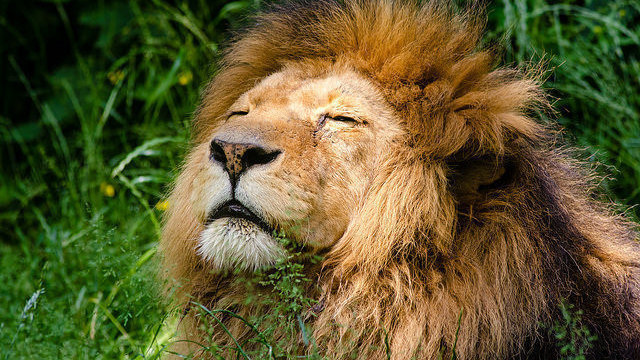
Since the killing of Cecil (pictured above), 38 airlines have committed to halting the shipping of the Africa Big Five. Photo by 500px Prime
The reverberations from the early July slaying of Cecil the lion continue to be felt worldwide, with the news that authorities in Zimbabwe have charged the second of two men who guided Safari Club International member Walter Palmer’s illicit trophy kill just outside the borders of Hwange National Park. “Cecil was delivered to him like a pizza,” said the Hwange Lion Research Project’s Brent Stapelkamp, who took the last photo of Cecil alive, just a month before Palmer killed, skinned, and beheaded the lion with the assistance of hunting guide Theo Bronkhurst and game park owner Honest Ndlovu. We are still awaiting word on Zimbabwe’s request to extradite Walter Palmer, who was at the center of this scheme to kill Hwange National Park’s most famous lion, and if that happens, there will be some measure of justice for all three horsemen of the Hwange apocalypse.
Either way, the killers will have a hard time getting those trophies back home. Since the Cecil slaying, 38 airlines have committed to halting the shipping of the Africa Big Five. Delta, United, and American Airlines — the big U.S.-based carriers with service to Africa — are among the airlines to ban shipping lion, leopard, elephant, rhinoceros, and Cape buffalo trophies. UPS this week announced a good, sound policy of not shipping shark fins, but we are still awaiting a declaration from that company on its policy concerning the hunting trophies, since four species of the Africa Big Five are listed, or about to be listed, as threatened with extinction under the provisions of the Endangered Species Act.
U.S. Senator Robert Menendez, D-N.J., has introduced a bill to ban all imports of trophies and parts from African lions and other at-risk species into the United States. Reps. Sheila Jackson Lee, D-TX, and Eddie Bernice Johnson, D-TX, have announced their intention to sponsor a bill to amend the Endangered Species Act to ban “all acts of senseless and perilous trophy killings.” Lawmakers in New York and New Jersey have introduced bills to restrict imports into their states.
Right now, there are 41 trophy hunters who, just like Walter Palmer, paid a fortune to kill an animal about to get listed under the Endangered Species Act, and want a waiver from Congress to display the heads and hides of the slain animals in their homes. In the case of the 41, they killed polar bears in northern Canada. We’re fighting their import-waiver effort not just as a symbolic act to deny these trophy hunters their ill-gotten gains, but to prevent the bum rush of trophy hunters into a foreign land whenever our federal government announces that it’s going to upgrade federal protections for a declining species and restrict imports.
Finally, there is the battle we’re waging in the marketplace of ideas. We’ve answered the self-serving reasoning of the trophy-hunting clan about the value of their activity to conservation, and more than ever, people see through their pay-to-slay reasoning. People realize that trophy killing undermines wildlife conservation, is no boon to national or regional economies anywhere, and should not be countenanced or encouraged by anyone. How can anyone possibly think it’s helpful to animals to kill a dominant lion in a pride with an arrow, or to slay a large-tusked elephant, or a mature rhino with a beautiful horn? For them, I guess, it diminishes the utter selfishness of the activity by concocting some far-fetched scenario where killing a creature somehow helps the grieving, surviving family members or pride or herd mates. It’s really a travesty to think anyone could buy this drivel.
When it comes to The HSUS and Humane Society International, we’re going to devote more resources, in the near and the long term, to fight this enterprise of globe-trotting trophy hunting of the rarest, most remarkable animals in the world. If you’re willing to stand with us, and to support our worldwide campaigns against trophy killing, I’m willing to make you this promise: Cecil won’t have died in vain.




 August 20, 2015
 Exposing the Big Game
