Wyoming man’s trophy display shows passion for hunting

http://trib.com/lifestyles/recreation/wyoming-man-s-trophy-display-shows-passion-for-hunting/article_b79ae5fd-e079-5ada-ba80-d00c53e971c6.html

By EVE NEWMAN Laramie Boomerang Casper Star-Tribune Online
12 hours ago  •  By EVE NEWMAN Laramie Boomerang

By EVE NEWMAN Laramie Boomerang

LARAMIE — It’s called the trophy room, and it sits on the west side of the longtime west Laramie business, The Boardwalk.

Inside, more than 50 trophies of all shapes and sizes are mounted on the wall and displayed in cases, along with saddles, antique guns, American Indian artifacts and family heirlooms. The room is open to visitors who pass through the store.

Owner William “Rob” Vogel, an Albany County native, has run the family business for more than 45 years. The trophy room is his museum of memories, and it shows off his passions for hunting and history.

“Some of my most fond memories of my younger life were getting out. No telephone, no cars, no nothing,” he said. “I have a lot of good memories.”

Vogel, 63, was born in Rock River, where his father, Bud, served as mayor and ran a lumberyard and motel. His grandfather homesteaded near Arlington, where his grandmother was the postmistress.

The Vogels moved to Laramie in the 1960s and opened The Boardwalk in 1967, remodeling the original building and constructing additions as they expanded. Inside, custom woodwork adorns the rafters and doors. A back room with one wall made of logs reflects the teenage Vogel’s desire to live in a log cabin, his wife, Crystal, said.

Today, the Vogels sell and repair saddles and tack, repair shoes and boots and run a Western-themed gift shop.

In the trophy room, a collection of rifles dating back to the 1800s hangs on one wall. One belonged to Vogel as a child living on a Rock River ranch. His mother gave him five bullets at a time, and he had to make them count.

“I couldn’t just shoot them all up. There were a lot of jackrabbits around the ranch, and they’d just eat you out of house and home. I had to shoot a couple of jackrabbits,” he said.

His first antelope is mounted high on the wall near the entrance. He got that one when he was 16, hunting with his grandfather.

Vogel said he enjoys hunting antelope. Another half dozen antelope trophies are prized for their size or unique horns.

“It’s something there’s a lot of, and they’re a lot of fun to hunt,” he said. “You see them within 20 feet of your vehicle when it’s not hunting season, and then when it comes to hunting season, then they’re a long ways out there.”

One display case shows a couple beavers and a muskrat.

“I got the beaver and the muskrat right here on the Laramie river north of town,” Vogel said.

Another display shows a coyote fighting a badger. Vogel and his father created them to show authentic Western scenes.

“That’s one thing you see in Wyoming. That was one of our first scenes that we put together,” he said.

On the wall one can also see black bear, mule deer, elk, caribou, buffalo and wolverine. A Dall sheep and a bighorn sheep both came from hunting trips to British Columbia.

A moose from Canada represents one his most memorable hunts. He shot the bull about 15 miles from a hunting camp in northern British Columbia after tracking it for two days.

“We were out in the middle of the boonies,” Vogel said.

He returned the following day with four pack horses to bring the moose back to camp. It yielded more than 500 pounds of meat in addition to the trophy. Vogel spent the whole day loading the animals and headed for camp that night in calf-deep snow that had started at noon and was still coming down.

On the way back, the pack horses were acting up, so he retraced his steps to see what was bothering them.

“We went through a little park, and I went to my back mule and was looking around, and I saw what looked like little flickers of things,” he said.

It was a pack of wolves.

Wolf permits were easy to come by in Canada, and Vogel shot the lead male first, hoping it would disperse the rest.

“He was a big boy. I saw him and thought that would run them off, and it didn’t run them off,” he said.

Then he shot the alpha female and the rest left. Those two wolves, one black and one white, are now on display at the back of the trophy room.

One of the newest trophies in the room is a European skull mount of an antelope, taken just a few years ago. A photo above the mount shows Vogel with a group of friends. In this photo, Vogel is sitting in a wheelchair.

When he was 36, a motorcycle accident left him paralyzed. It didn’t take his ability to hunt, though, thanks to a device that mounts to his wheelchair and steadies the rifle.

“I still hunt antelope. I like target shooting a lot,” Vogel said.

Vogel said his trophies aren’t the biggest you’ll ever see, but that’s because he’s never done a hunt just for the size of the antlers.

“They were all meat hunts. My moose is a good moose, but he’s not gigantic,” he said.

The trophies also honor his father, who grew up hunting to feed his family.

“My father, he always wanted that kind of stuff and he was never able,” Vogel said, referring to the trophies. “He hunted to survive.”
Wrong, New York Times. The Trophy Hunt Is Terrible For Rhinos

https://www.thedodo.com/community/MarcBekoff/is-killing-a-rhino-for-350k-re-396733510.html

Marc Bekoff
20 January 2014

Share on Facebook Share on Twitter

Who lives, who dies, and why?

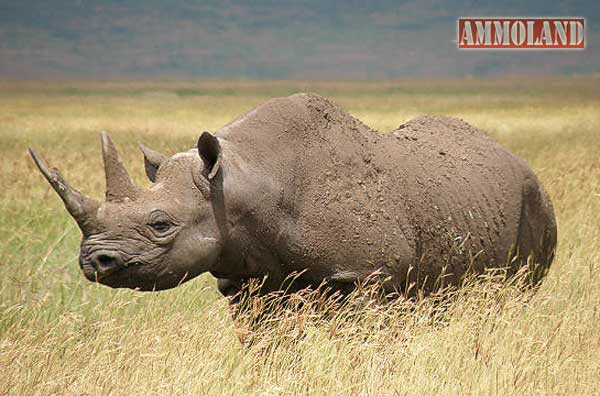
We live in a troubled and wounded world in which humans continue to dominate and relentlessly kill numerous nonhuman animals. A Texas hunting club recently auctioned off an endangered black rhino purportedly to save other black rhinos and their homes in Namibia. A representative of the Dallas Safari Club noted, “Namibian wildlife officials will accompany the auction winner through Mangetti National Park where the hunt will occur, ‘to ensure the correct type of animal is taken.'” This is not a very comforting thought. Nor is the idea that it’s OK to kill one rhino to save other rhinos.

Because of who we are we are always making decisions about who lives and who dies. The criterion used in these sorts of difficult decisions in the realm of conservation efforts centers on the debatable notion that we know what’s best for the good of a particular species. As a result of this often misplaced thinking, individual animals are devalued and treated as if they’re disposable objects and traded off for the good of their own (or other) species.

In today’s New York Times Richard Conniff published an essay called, “A Trophy Hunt That’s Good for Rhinos.” He writes, “auctioning the right to kill a black rhino in Namibia is an entirely sound idea, good for conservation and good for rhinos in particular.” This conclusion is too fast for me, and he does not present data that support this claim.

Conniff claims that Namibia, a small and sparsely populated country, is a conservation success story. Over the past 20 years its rhino population has increased as have the number of mountain zebras, elephants and lions. This is because around 44 percent of the country benefits from conservation protection due to the establishment of communal conservancies that own the wildlife. Nowhere does Mr. Conniff argue that these success stories rest on killing some of these animals for the good of other members of their species. That’s good, because we really don’t know this.

In Namibia and elsewhere black rhinos do indeed find themselves trying to avoid humans out to kill them, but in Namibia only 10 rhinos have been killed since 2006. Of course, this is 10 too many, but far fewer than have been killed in neighboring South Africa, where around 1,000 were killed in 2012 alone. For more on rhino slaughter in South Africa please read this.

Mr. Conniff also claims that the old post-reproductive and belligerent male who will be killed won’t be much of a loss because individuals such as these “have a tendency to kill females and calves.” Does having a tendency to do something warrant an individual’s unnecessary death? No it doesn’t. And, if these individuals were so harmful in any regular and significant way, one would think they would have been weeded out of the population over time due to natural selection or that they would be avoided and ostracized by other group members who fear them. This old male is merely a sacrificial rhino who’s killed for a lot of money that will supposedly go into conservation efforts.

We must revise some of the ways in which we attempt to coexist with other animals. Some of these methods center on heinous ways of killing them “in the name of conservation” or “to foster coexistence.” Compassionate conservation stresses that the life of every individual matters and trading off an individual for the good of their own or another species is not an acceptable way to save species. And, there doesn’t seem to be much evidence that it works in any significant way.

(For more on compassionate conservation please see “Ignoring Nature No More: Compassionate Conservation at Work”, Ignoring nature no more: The case for compassionate conservation, and a Forbes interview.)

The life of every individual matters. I agree with Conniff that “Protecting wildlife is a complicated, expensive and morally imperfect enterprise, often facing insuperable odds.” Where I and others disagree is his swift claim that killing a rhino male is a sound conservation strategy. When people say they kill animals because they love them this makes me feel very uneasy. I’m glad they don’t love me.

Cruelty can’t stand the spotlight and it is important that news about the sorts of activities discussed above be widely disseminated and openly discussed. That major media is covering them is a step in the right direction. Now it is essential that people who care about conserving without killing make their voices heard.

Marc Bekoff’s latest books are Jasper’s Story: Saving Moon Bears (with Jill Robinson; see also), Ignoring Nature No More: The Case for Compassionate Conservation (see also), and Why Dogs Hump and Bees Get Depressed

black-rhino

It’s Terrible About Those Death Threats

I don’t know who is sending would-be rhino Corey Knowlton all those death threats we keep hearing about, but I think it’s just terrible.

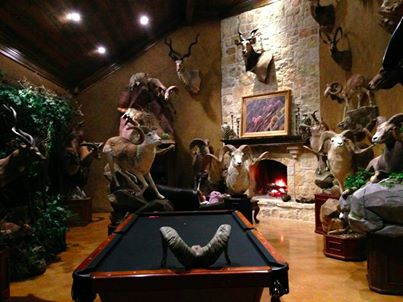
It’s terrible they waited until after he’d killed all those other 120 species—from every continent—that line the walls of his trophy1613918_577895065613412_412557772_n room. Too bad they held off until he had a chance to murder one of every species of wild sheep in existence, for instance. It’s a shame the 35 year old lived long enough to become the co-host of a hunting show on The Outdoor Channel which extols the virtues of snuffing out wildlife and encourages animal assassination in the name of sport.

It’s an absolute tragedy they waited until he won last week’s Dallas Safari Club auction to hunt a black rhino in Namibia. Now, unless the threats are in fact serious and carried out in the coming weeks, he will get the chance to destroy yet another undeserving sentient being in the name of ego, selfishness, arrogance and hedonism.
____________________________

For those not keen on lethal action, here are 3 things you can do to help:

1) PETITION: http://e-activist.com/ea-action/action?ea.client.id=104&ea.campaign.id=24844
2) PETITION: http://www.ifaw.org/united-states/get-involved/protect-black-rhinos-trophy-hunters
3) FB page with USFWS contact info and sample letter for writing to ask them to deny permit: https://www.facebook.com/events/242483775925213/

1017393_10202261526713538_1876940690_n

Corey Knowlton? Yup, I Hate Him Too

Corey Knowlton is the hunter who won the right to kill an endangered rhino in the Safari Club auction. This is part of trophy room (Big Horn Sheep section – Knowlton claims that he has hunted “over 120 species on every continent” – obviously many animals per species)…

1613918_577895065613412_412557772_n

…and this is what Grumpy Cat has to say about him:

1017393_10202261526713538_1876940690_n

“Endangered” Hunter Auctioned off to Save Species

Believing the spin that “hunters are an endangered species,” trophy-hunter hunting group, the Sahara Club, a conservation group dedicated to preserving the hunter herd for future generations of trophy-hunter hunters to harvest, auctioned off asuccessful anti-hunt chance to hunt an aging, expendable hunter to raise funds for their cause. Taxidermy services will also be awarded to the winning bidder. Proceeds will be used to enhance hunter habitat for the species known taxonomically as Homo huntsman horribilis and will go towards funding more logging roads to allow access for their trucks and four-wheelers, as well as building more conveniently located gas station/mini-marts, taverns and mobile home parks.

Biologists blame a long history of inbreeding for the decline in hunter fertility and viability. When asked about the ethics of hunting down and killing this unfortunate individual, a Sahara Club spokesman stated, “Overall I think it will be a good thing. While it may bad for this individual hunter, it is in the interest of conservation of the hunter species.” If the auction idea proves to be a success, the group plans to hold similar events for loggers, ranchers, commercial fishermen and other resource extractors also said to be endangered species by industry spin doctors.

Individuals chosen to be hunted down and harvested can thank the Safari Club for recently coming up with the idea of auctioning a rhino trophy hunt on an endangered black rhinoceros.

______________________

(This has been another installment in EtBG’s “Headlines We’d Like to See.”)


Black Rhino Auctioned for $350K in the Name of Conservation

black-rhino

http://www.psychologytoday.com/blog/animal-emotions/201401/black-rhino-auctioned-350k-in-the-name-conservation

by Marc Bekoff

Should we kill in the name of conservation? Individual animals are not disposable commodities

We live in a troubled and wounded world in which humans continue to dominate and to relentlessly kill numerous nonhuman animals (animals).

A Texas hunting club recently auctioned off an endangered black rhino purportedly to save other black rhinos and their homes in Namibia. The Dallas Safari Club says, “Namibian wildlife officials will accompany the auction winner through Mangetti National Park where the hunt will occur, ‘to ensure the correct type of animal is taken.'” This is not a very comforting thought.

This sale, in which an animal is objectified and treated like a disposable commodity, raises many questions about how we try to save other species. One major question is, “Should we kill in the name of conservation?” People disagree on what is permissible and what is not. My take and that of compassionate conservation is this is not an acceptable trade-off. (Please see “Ignoring Nature No More: Compassionate Conservation at Work”, Ignoring nature no more: The case for compassionate conservation, and a Forbes interview for more on compassionate conservation.) The life of every individual matters.

The world is in dire need of healing and we must revise some of the ways in which we attempt to coexist with other animals. Some of these methods center on heinous ways of killing them “in the name of conservation” or “to foster coexistence”. Compassionate conservation stresses that the life of every individual matters and trading off an individual for the good of their own or another species is not an acceptable way to save species. And, there doesn’t seem to be much evidence that it works in any significant way.

Black rhinos do indeed find themselves trying to avoid humans out to kill them, but in Namibia only 10 rhinos have been killed since 2006. Of course, this is 10 too many, but far fewer than have been killed in neighboring South Africa where around 1000 were killed in 2012 alone.

“To destroy nature is not to conserve nature. To mount the head of a wild animal in your trophy room is not conservation, it is repugnant.”

The above quotation comes from an essay in examiner.com called “Must conservation of wildlife including killing wildlife”. It was based on a 60 Minutes report titled “Hunting animals to save them?” While it dealt with wildlife ranches in Texas where people can pay a small fortune to kill various animals in canned hunts, it does raise important questions about killing in the name of conservation. Some other valuable snippets worth deep consideration include:

“If we want to conserve a population of, for instance, people native to a particular section of our country, would we kill a few to conserve the others? Isn’t that saying the group is more important than the individual? Isn’t it saying the individual gives up his or her rights to life because he or she belongs to a particular group, a particular species?”

“Each life—human animal and nonhuman animal—is an individual with an individual personality. Take a group of purebred puppies, for example—they may all look the same but they aren’t. They are their own individual beings with individual traits and personalities. Wildlife are individuals with their own individual traits and personalities. To say one is more deserving to live than another, in the name of conservation, bastardizes the word.”

Killing animals to save others sets a bad example and a regrettable precedent and is not the way to foster peaceful coexistence. When people say they kill animals because they love them this makes me feel very uneasy. I’m glad they don’t love me.

Cruelty can’t stand the spotlight and it is important that news about the sorts of activities discussed above be widely disseminated and openly discussed. That major media is covering them is a step in the right direction.

“Wish Someone Dead Foundation” Grants Child’s Homicidal Request

The Wish Someone Dead Foundation, a new nonprofit organization dedicated to countering the animal-unfriendly efforts of the group, Hunt of a Lifetime (which was founded in 1998, after the Make a Wish Foundation ceased granting wishes involving the use of firearms or other weapons designed to cause injury), has awarded 7 year old leukemia victim, Gerald Watkins, a chance to fulfill his lifelong dream of offing a trophy hunting scumbag. The charitable group plans to fly the boy to Zimbabwe, outfit him with a sniper rifle and plenty of ammunition and line him up with a professional assassin who will instruct him in the fine art of dispatching a camo-clad nimrod with one clean shot.

Although society generally frowns on children (outside the military) being trained to kill other people, the raw deal this young terminal patient has been dealt in life seems to justify an exception to the rule. And besides, the target Gerald has chosen to eliminate—Philippe de Sade—couldn’t be more deserving. In one African safari, De Sade shot and killed species including elephants, hippos, buffaloes, lions, cheetahs, leopards, giraffes, zebras, hartebeest, impalas, pigs, the not-so-formidable 30-pound steenbok and even a mother ostrich on her nest. No wait, that was Teddy Roosevelt, musing in his autobiographical, African Game Trails. But this De Sade guy is a pretty murderous a-hole too…
______________________
(This has been another installment in EtBG’s “Headlines We’d Like to See.”)

HuntingTrophiesJamieKripke600

Cancel the upcoming show “Amazing America with Sarah Palin”!

Cancel the upcoming show "Amazing America with Sarah Palin"

  • Petitioning Jeff Paro

This petition will be delivered to:

CEO, InterMedia Outdoors
Jeff Paro
President, InterMedia Outdoors
Willy Burkhardt


Regarding your upcoming show “Amazing America with Sarah Palin”—America has already been “amazed” by Sarah Palin and her lack of compassion, and her complete relish of the animals she kills with unabashed fevor!  

Palin has taken advantage of her half-governesship, by glamorizing the killing of iconic wolves from aircraft.  As half-governor she offed a bounty for every left, front wolf paw surrendered—the wolf is a necessary predator for a healthy ecosystem; she lobbied for years to get the endangered polar bear kicked off of the Endangered Species List — despite the impossible challenges facing the polar bear to even survive — loss of habitat, starvation, and drownings.  She failed at her attempts to doom the polar bear in the USA, so she continues to trophy hunt in Canada.  

Her last attempt at exploiting animals with a show on TLC, “Sarah Palin’s Alaska”, evoked criticism from many including distinquished writer Aaron Sorkin, who labeled her actions, “jaw-dropping mean”.   The show was not renewed after just one season — so why are you at InterMedia Outdoors, going to repeat history and subject the public to more of the offensive, cavalier disregard for animals and viewers, by allowing this callous woman air time?  

We the signed, will boycott all of the sponsors of “Amazing America with Sarah Palin”, and we will give them all written notification of our intent.

Please sign petition here: http://www.change.org/petitions/cancel-the-upcoming-show-amazing-america-with-sarah-palin?share_id=wQTGUAUBMD&utm_campaign=friend_inviter_chat&utm_medium=facebook&utm_source=share_petition&utm_term=permissions_dialog_false