This week, British Columbia’s newly formed government, responding to the will of an overwhelming majority of the province’s citizens and following through on its own campaign promise, announced a ban on all trophy hunting of grizzly bears there, starting in November.
Under the prior Liberal government, B.C. had become the world’s grizzly-bear-hunting hub, with trophy hunters killing 250 of the great bears a year, even within renowned provincial parks and protected areas and, most brazenly, in the Great Bear Rainforest, where Coastal First Nations have vehemently opposed trophy hunting of bears.
This is a signature win for animal protection groups (including Humane Society International/Canada, which worked for this outcome), and for the more than 90 percent of B.C. residents who opposed trophy hunting. Polling revealed that opponents of the practice include an overwhelming majority of residents of rural communities with strong hunting traditions. All of this is an emphatic reminder to the U.S. government and to our northern Rockies states not to proceed with a trophy hunt for grizzly bears in the Greater Yellowstone ecosystem, which may be enabled with the recent delisting of bears there from the ranks of threatened and endangered species.
There is no justification for the cruelty of trophy hunting, and the utterly gratuitous nature of the killing. In 2015, the world watched in horror as a video showed a wounded grizzly bear thrashing in agony as she tumbles down a hill, her blood smearing the snow, while the men who shot her cheer the outcome. Other, similarly jarring videos, showing wounded bears suffering in agony while trophy hunters rejoice, live on YouTube for anyone to see.
It’s not just a moral issue, it’s also an economic one. Each year, thousands flock to B.C.’s lush forests to participate in grizzly-bear-viewing expeditions. The bear-viewing industry brings in 12 times more direct revenue to the province than trophy hunting. There are millions of people throughout North America and the world who’d pay handsomely for an opportunity to see a grizzly in the wild, while only a few thousand people wish to slay these bears as a head-hunting exercise. The economic potential of an industry built around bear watching is vast, while the killing industry is small and receding and also a threat to the larger wildlife-watching enterprise.
HSI/Canada has worked for more than a decade to bring down the trophy hunting industry in British Columbia and other provinces. More than 10,000 supporters of HSI/Canadasigned a letter to B.C. premier Christy Clark, asking her to ban the hunt, and HSI, with other partners, participated in the delivery of over 70,000 signatures to the B.C. legislature in April, calling for a ban on grizzly bear trophy hunting. While much remains to be clarified about the recent announcement, HSI is determined to work with the B.C. government to ensure that grizzlies are truly protected from all forms of trophy hunting.
This victory for grizzlies comes close on the heels of other notable wins wildlife in the past couple of weeks. Earlier this month, the U.S. Court of Appeals for the District of Columbia ruled that federal protections for wolves under the Endangered Species Act should be maintained for 4,000 or so wolves inhabiting the northern reaches of the boreal forests of Minnesota, Wisconsin, and Michigan. Also on Monday, the U.S. Court of Appeals for the Fourth Circuit ruled that Endangered Species Act protections clearly extend to grizzly bears kept in captivity, even though those facilities also must meet the minimum standards of humane treatment set by the U.S. Department of Agriculture under the Animal Welfare Act, as advocated by HSUS attorneys in an amicus curiae brief. On Friday, Illinois became the first state in the United States to ban the use of elephants in circuses and other traveling acts, when Gov. Bruce Rauner signed a landmark bill prohibiting this practice. And on August 1, the Czech Republic became the latest country to ban fur farming, a policy that, when it takes effect, will spare 20,000 foxes and mink from being raised and killed for the fur trade.
These are all indicators that the world is waking up to the plight of animals. Our task is far from complete, but these wins should stir the hopes of all of us who imagine a day when we recognize the rightful place of other creatures on our planet and treat them with respect and dignity.
[New York Times does it again! With friends like them, what animal needs enemies?]
The United States Fish and Wildlife Service last month moved to allow hunters to bring home trophies from elephants killed in Zimbabwe and Zambia. Safe to say, few conservationists saw it coming.
In a 39-page report, the agency cited Zimbabwe’s progress in creating a sound management plan for its 82,000 elephants and evidence that hunting revenue is in fact reinvested into conservation. Well-managed trophy hunting “would not have an adverse effect on the species, but can further efforts to conserve the species in the wild,” the agency concluded.
The announcement, which would have turned back an elephant-trophy prohibition instituted during the Obama administration, was met with praise from pro-hunting groups, like the National Rifle Association and Safari Club International, and criticism from animal-rights advocates on all sides of the political spectrum.
Unexpectedly, President Trump intervened on Twitter, saying that the trophy decision would be delayed “until such time as I review all conservation facts.” Two days later, the president referred to trophy hunting as a “horror show” and cast doubts on its effectiveness for helping conservation of elephants and other species. An updated decision, the president added, was still pending.
Big-game trophy decision will be announced next week but will be very hard pressed to change my mind that this horror show in any way helps conservation of Elephants or any other animal.
Whether the proceeds from big-game hunting should be used to protect threatened and endangered species is a difficult question to answer. In some areas, including in Namibia and Zimbabwe, the strategy has helped revive wildlife populations. In others, including Tanzania, hunting has fed corruption and decimated species.
Among conservation biologists and advocacy groups, trophy hunting is the third rail: Their supporters largely are repulsed by the sanctioned shooting and butchering of elephants, lions and other big game. The killing of Cecil, a Zimbabwean lion, by an American hunter triggered a global social media storm.
Photo
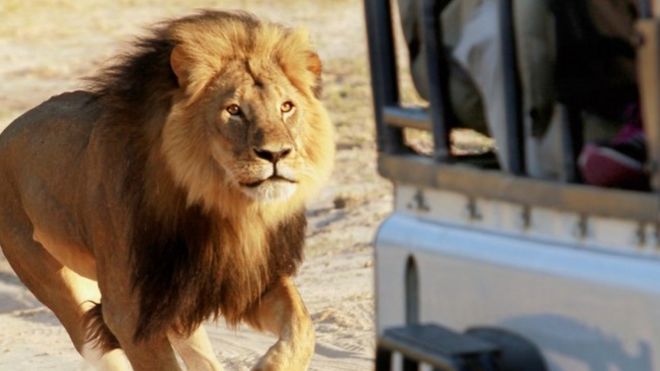
The killing of Cecil, a Zimbabwean lion, in 2015 by an American hunter triggered a global social media storm.CreditAndy Loveridge/Wildlife Conservation Research Unit, via Associated Press
Many conservationists “have been bullied into silence” on the subject of hunting, said Michael ’t Sas-Rolfes, a research fellow at Oxford University who studies wildlife trade.
Yet many experts also believe that the proceeds from hunting are all that prevents many poor communities from turning against local wildlife.
“While the noise in the press is all about morals and entitled white men killing innocent animals to hang obnoxiously on their wall — all of which I agree with — this actually has very little to do with pragmatic conservation,” said Brian Child, an ecologist at the University of Florida.
“Like everything else in life, it’s all about the money — money to combat illegal wildlife trade, and money to prevent the much more serious problem of wildlife’s replacement by the cow or the plow.”
Critics of big-game hunting seldom offer viable alternatives for the communities that rely on these funds to protect wildlife, Dr. Child said. Nor do the countries that issue trophy bans typically provide financial assistance sufficient to make up for the shortfall when hunting income goes away.
Hunters pay $65,000 to $140,000 to hunt lions in Zimbabwe, for example; an elephant hunt can run $36,000 to $70,000. (The price would be higher were it not for the American trophy ban.)
“Zimbabwe is on its knees because of economic downturn, yet the international community expects our poor country to look after elephants and lions when we can’t even feed our nation,” said Victor Muposhi, a zoologist at Chinhoyi University of Technology in Chinhoyi, Zimbabwe.
“No one is coming to the table to say, ‘Yes, we want you to stop this hunting, but here is a budget and an alternative plan you can follow instead.’”
Calls for blanket bans, Dr. Muposhi continued, overlook the benefits that well-managed hunting programs can bring and gloss over the complexities of the industry and of conservation itself.
“I think one of the real problems in this whole debate is that people are looking for generalizations about trophy hunting, and there just are none,” said Rosie Cooney, chair of the sustainable use and livelihoods specialist group at the International Union for Conservation of Nature.
“There’s great examples and terrible examples and ones we don’t have a clue about — and everything in between.”
Those looking for the terrible examples will find no shortage of them.
A study by Craig Packer, director of the Lion Research Center at the University of Minnesota, found that sport hunting directly contributed to the decline of lions in most of Tanzania’s hunting areas. Over the past dozen years, he also reported, 40 percent of these areas were abandoned because of declines in trophy species.
Benefits from those hunts usually did not reach those on the ground. The Maasai people in Tanzania’s Serengeti region have repeatedly reported eviction from their lands by a luxury hunting and safari company operating with a special “Presidential permit,” Dr. Packer noted.
The precise impacts of sport hunting in Tanzania have been almost impossible to measure, he pointed out, because independent scientists are frequently prevented from conducting research.
In 2015, after 37 years of work, Dr. Packer himself was banned from Tanzania after he warned authorities in the United States about pervasive corruption in the hunting industry.
“The African safari hunting industry is a business, and businesses don’t want people interfering with their bottom line,” Dr. Packer said. “The lack of transparency is a key problem.”
Photo
Park wardens drive through the Mikumi National Park, which borders the Selous Game Reserve in Tanzania. The precise impacts of trophy hunting in Tanzania are difficult to measure; independent scientists often have been prevented from conducting research in hunting preserves.CreditDaniel Hayduk/Agence France-Press — Getty Images
In other countries, including Zimbabwe, authorities have simply seized hunting preserves and reaped the profits without reinvesting in conservation, according to Vanda Felbab-Brown, a senior fellow at the Brookings Institution and author of “The Extinction Market.”
The trophy hunting business “becomes very commercialized, and the profits are captured by elites,” she said. “You can also end up with trophy hunting serving as a cover for trafficking.”
Success at a High Price
But in places where hunting is strictly regulated and corruption is minimal, it can be an integral tool for conservation, Dr. Felbab-Brown added. Ideally, science-based quotas and age and gender limits ensure that wildlife populations are not decimated, while funds are channeled back to communities acting as custodians.
Namibia’s communal conservancies, for example, cover some 63,000 square miles and are often hailed for success in rebuilding and sustaining the country’s wildlife. Hunting is integral to the conservancies’ survival; without it, the majority of conservancies would not be able to cover operational costs, researchers at the World Wildlife Fund reported last year in the journal Conservation Biology.
The Save Valley and Bubye Valley conservancies in Zimbabwe, which are primarily supported by hunting, are managed well enough that lion populations are growing. And in South Africa and Zimbabwe, Dr. Cooney said, hunting has pushed landowners into converting agricultural land into private wildlife reserves.
Even where this conservation strategy seems to work, however, some critics question the contradiction inherent in hunting threatened and endangered species.
“Any trophy hunting of an endangered species is by definition unsustainable, as it cannot sufficiently contribute to the survival of the species to justify removing individuals from the population,” said Elly Pepper, a deputy director at the Natural Resources Defense Council.
Indeed, savanna elephant populations across Africa declined by 30 percentfrom 2007 to 2014, primarily as a result of poaching. But the numbers were not evenly distributed.
Most legal trophy hunting for elephants occurs in southern Africa, in countries like Namibia and South Africa. The region accounts for nearly 40 percent of the continent’s 415,000 elephants, according to data presented last week at a meeting of the Convention on International Trade in Endangered Species of Wild Fauna and Flora in Geneva.
Photo
Armed guides watch as an elephant passes in front of a tourist safari vehicle at the Sabi Sands private game reserve in the province of Mpumalanga, South Africa.CreditDavid Silverman/Getty Images
Relatively speaking, legal elephant hunting casualties in those five countries is minuscule, ranging from 0.01 to 0.23 percent of their respective populations in 2015.
Casualties from hunting “are really low, but they provide crucial benefits for rural communities and conservation,” said Marco Pani, a wildlife management consultant who has studied Zimbabwe’s elephant population.
In a recent survey of elephants in Zimbabwe’s hunting-dependent areas, Mr. Pani found that the country could lose a quarter of its elephant population should hunting be completely halted.
Science Times
If managed well, Dr. Cooney said, hunting finances landholders and communities, providing a crucial incentive for people not only to tolerate potentially dangerous wildlife but to protect it.
In Zimbabwe’s Campfire communities — which are equivalent in size to the country’s strictly protected national parks, but reliant on trophy hunting — elephants destroyed over 17,000 acres of crops from 2010 to 2015. Along with other animals, elephants have killed 139 community members since 2010.
Lions, likewise, killed four people in Mozambique in 2016, not to mention 220 cows. Tolerance for wildlife quickly wanes if animals cease to bring benefits — a growing threat in Zimbabwe, Dr. Muposhi said.
Elephant hunts are still legal there, but leaving behind the animal’s tusks is a deal-breaker for most big-game enthusiasts. After the 2014 trophy ban, 108 of 189 American hunters canceled their trips.
The Campfire program’s annual income dropped to $1.7 million from $2.2 million; private landowners reported similar losses. Zimbabwe’s Parks and Wildlife Management Authority derives about 20 percent of its funding from hunting fees, over half of which traditionally comes from American hunters.
“All of Zimbabwe’s hunting areas are surrounded by communities who are hungry for agricultural land,” Dr. Muposhi said. “If people see that elephants and lions no longer have value, they’ll kill all the animals and let their cattle use the land currently set aside for wildlife.”
Some argue that photographic tourism can make up for these losses, but Dr. Muposhi disagrees.
Before the trophy suspension, hunters were undeterred by Zimbabwe’s political turmoil. But tourism over all suffered a decade-long decline.
Hunters also tend to relish the chance to spend three weeks or more in rugged wilderness lacking in roads, cellphone service and treated water. Tourists on photographic safaris, on the other hand, “are soft people,” Dr. Muposhi said.
“They expect to sleep in a nice bed in a nice lodge where there’s no mosquitoes and there’s electricity and pure water.”
That’s why transforming hunting areas into destinations that appeal to conventional tourists often requires prohibitively expensive investment in infrastructure and marketing.
Photo
Jao Luxury Safari Camp in the Okavango Delta, Botswana. Transforming hunting preserves into destinations that appeal to wildlife watchers often requires expensive investment in infrastructure and marketing.CreditChris Jackson/Getty Images
Communities in Botswana are now struggling with such a transition. In 2013, President Ian Khama issued a national hunting moratorium, accompanied by an order to convert hunting operations — many located in featureless, remote areas — into photographic safaris.
But the government did not provide assistance to help with those efforts or to make up for lost income. As a result, affected communities are increasingly negative about wildlife and poaching has increased, according to researchpublished this year.
Hunting operators also stopped maintaining artificial water holes for wildlife, so elephants, lions, leopards and other species moved into riverbank areas where crops are grown, leading to an uptick in killings.
“We don’t know the number of predators now being indiscriminately killed by farmers and villagers, but we do know it’s much higher than the hunting quota ever allocated,” said Debbie Peake, a longtime advocate of hunting and conservation in Botswana.
Although no credible figures exist for how much trophy hunting brings to the continent overall, critics often write off hunting’s contribution in comparison to traditional tourism.
“There is an enormous wildlife watching industry in Africa, while trophy hunters are in the low thousands,” said Wayne Pacelle, president and chief executive of the Humane Society of the United States.
“Trophy hunting generates money, yes, but the number of dollars is so small compared with wildlife watching that it just doesn’t compare.”
Photo
The Okavango Delta, as seen from the Jao Luxury Safari Camp in Botswana. The delta is home to an abundance of wildlife.CreditChris Jackson/Getty Images
But in parts of Botswana and elsewhere, big-game hunting can make or break conservation efforts.
“The macro argument about however many millions hunting brings into the country misses the point,” Mr. ’t Sas-Rolfes said. “What is relevant is what would happen at the micro level if you removed hunting.”
“My sense is the damage would be quite significant,” he added.
For Mr. ’t Sas-Rolfes and other experts, the trophy hunting debate remains a tiring distraction from the pivotal question of how to sustainably financeconservation in Africa, and how to deal with poaching and growing human populations.
In a 2015 survey of 133 experts in 11 African countries, trophy hunting came in next to last in a ranking of 11 threats to wildlife. Poaching was at the top.
6COMMENTS
“We’re talking about the wrong thing right now,” said Dan Ashe, president of the Association of Zoos and Aquariums and former director of the Fish and Wildlife Service.
“Trophy hunting is not the issue. We should be focused on wildlife trafficking and the broader plight of elephants.
“PROUD” MONTANA HUNTERS SHOW THEIR TROPHIES
….Warning!..graphic pictures of dead animals
I’m at a loss for words here…smiling faces showing off a dead animal?…what is wrong with these people? Were they abused as children..WTF?
This is on the front page of the Missoulian newspaper
Hunting season 2017 was a big success for many Montana hunters. Readers submitted their photos of this year’s trophies.
Image copyrightGETTY IMAGESImage captionCecil the lion, killed in 2015, was a major attraction at a national park in Zimbabwe. His black-fringed mane was an identifying characteristic
Hunting animals that stand out from the crowd because of their impressive horns or lustrous manes could lead to extinction, according to a study.
Research predicts that removing even 5% of high-quality males risks wiping out the entire population, for species under stress in a changing world.
Animals prized by trophy hunters for their horns, antlers or tusks usually have the best genes, say UK scientists.
Removing these could push a species over the edge, they warn.
There is intense global debate over trophy hunting. Some argue that it should be banned or restricted, while others say it can provide valuable revenue for conservation.
Dr Rob Knell of Queen Mary, University of London, who led the research, said the assumption that so-called selective harvesting is not especially threatening to a population of animals does not take into account recent work.
”Because these high-quality males with large secondary sexual traits tend to father a high proportion of the offspring, their ‘good genes’ can spread rapidly, so populations of strongly sexually selected animals can adapt quickly to new environments,” he said.
”Removing these males reverses this effect and could have serious and unintended consequences.”
Human hunting is different from natural predation in that big-game trophy hunters target large animals, usually males.
They may be awarded prizes for killing animals with exceptionally large antlers, horns or manes.
And illegal poaching of animals such as elephants for the ivory trade also targets animals with the biggest tusks.
Using a computer simulation model, the scientists were able to predict the impact of selectively targeting males on the basis of their secondary sexual traits.
”If the population is having to adapt to a new environment and you remove even a small proportion of these high quality males, you could drive it to extinction,” said Dr Knell.
”You’re removing the genes from the population that would otherwise allow the population to adapt.”
In the past, human hunting has led to the extinction of many animals, from the zebra-like Quagga, which was once common in Southern Africa, to the Tasmanian tiger of mainland Australia and Tasmania.
Hunting is still legal in many countries; trophy hunting takes place over a larger area in Sub-Saharan Africa than is conserved in national parks.
In the US and Canada, there is also a lucrative trophy hunting industry, for the likes of deer and big-horn sheep.
Some argue that revenue from trophy hunting can support conservation efforts and local livelihoods.
The scientists said age restrictions that allow males to breed before being removed could reduce the impact of trophy hunting.
This is already recommended with some species, such as lions.
“When properly regulated trophy hunting can be a powerful force for conservation which is why we’re suggesting a different management approach as opposed to calling for a ban,” said Dr Knell.
The study is published in Proceedings of the Royal Society B: Biological Sciences.
According to a new study, hunting the most impressive animals weakens a species’ ability to survive in the face of environmental changes.
VIEW IMAGES
Big tusks on an elephants indicate well-being, which in turn signifies that they have high-quality genes that help them adjust to a changing environment. Elephants with big tusks are also the target of trophy hunters, but removing those genes from their populations could lead more quickly to extinction.
PHOTOGRAPH BY DAVID CHANCELLOR, NATIONAL GEOGRAPHIC CREATIVE
By Stephen Leahy
PUBLISHED
Trophy hunters, as well as poachers who “harvest” the big males—antelopes and deer with the largest horns and antlers, elephants with the longest tusks, or lions with the most impressive manes—are putting those species at greater risk of extinction with climate change.
That’s the finding of a new study published today by researchers at Queen Mary University of London, England, in Proceedings of the Royal Society B: Biological Sciences. “Trophy” animals tend to be the most evolutionarily fit and possess the high-quality genes a population of animals need to adapt quickly to a changing environment, says evolutionary ecologist and lead author Robert Knell. “They also father a high proportion of the offspring. But if they’re killed before they can spread their ‘good genes’ around, this reduces the overall fitness and resilience of that population.”
When environmental conditions change—a shift in seasonal rainfall or warmer temperatures—the risk of extinction increases dramatically, even with a healthy population of animals apparently unaffected by trophy hunting, Knell says.
This can happen even with an annual harvest rate as low as 5 percent of the high-quality males. With environmental change now a reality across the globe, the study shows that some animal populations facing even relatively light hunting pressure are more vulnerable to extinction than is generally believed, Knell says.
This also means poachers are even more of a threat since they target big males but also indiscriminately kill any individual they believe will profit them, he says.
The study also shows that restricting the take to older trophy males means that they will have had time to spread their good genes around, which should help populations adapt to environmental changes.
“When properly regulated, trophy hunting can be a powerful force for conservation, which is why we’re suggesting a different management approach as opposed to calling for a ban,” Knell says.
In an email Rosie Cooney, of the International Union for Conservation of Nature, which sets the conservation status of species, called the study interesting, “with obvious relevance to trophy hunting management, highlighting that there may be a need under climate change scenarios to shift to age restrictions as a basis for management.”
“This study matches up with the empirical work we’ve done on bighorn sheep in the Rocky Mountains,” says David Coltman, professor of biological sciences at the University of Alberta. Coltman’s studies have shown that decades of trophy hunting have resulted in a 20 percent decline in the size of ram’s horns in today’s sheep.
We also know that sheep with the biggest horns produce the largest offspring, and losses of them all contribute to a decline in the fitness of the overall population, Coltman says.
Horns aren’t ornaments. They’re a signal of fitness. The biggest horns that trophy hunters crave are likely found only on the highest-quality individuals, he says. This is an example of human selection leading to artificial evolution.
Hunters argue that the funds from their hunts—estimated to be anywhere from $132 million to $436 million in Africa annually—gives local communities an incentive to protect wildlife as well as fund conservation efforts and community development. Many conservation groups, on the other hand, argue that oftentimes the fees trophy hunters pay are actually siphoned away by corruption and mismanagement.
The latest trophy hunting controversy came on November 14, when the U.S. Fish and Wildlife Service announced it would be lifting the ban on trophy imports of elephants killed in Zimbabwe and Zambia. There was an intense backlash, and within three days President Donald Trump tweeted that the Department of the Interior, which oversees the Fish and Wildlife Service, would reevaluate the decision. In a follow-up tweet he wrote, “[The department] will be “hard pressed to change my mind that this horror show in any way helps conservation of elephants or any other species.”
Sustainable sport hunting is important for raising conservation revenue in many areas, but this study tells us we must be mindful of our evolutionary impact, said Adam Hart, professor of science communication at the University of Gloucestershire, England, in an email. “As always, conservation is more complex than it can appear.”
A herd of elephants stands near a water hole in Zimbabwe’s Hwange National Park, east of Harare, in September 2013. Zimbabwean ivory poachers killed more than 80 elephants by poisoning water holes with cyanide that year, endangering one of the world’s biggest herds. (Philimon Bulawayo/Reuters)
President Trump’s announcement that he is delaying a decision on allowing elephant hunting trophies from Zimbabwe drew angry reactions from hunting groups and reignited a heated debate over whether killing iconic animals is the best way to manage their shrinking populations.
Last week, the Trump administration announced it would reverse a ban on trophy imports from Zimbabwe that had been imposed by the Obama administration. Two days later, however, Trump tweeted that elephant hunting is a “horror show” and suggested he would maintain the ban.
Hunters have criticized the decision to delay ending the ban. In voicing their indignation, hunters were careful not to blame the president. Instead, one of the largest and more recognized groups, Safari Club International, issued a call to arms against “hysterical anti-hunters and news media outlets” that “went into overdrive, attacking everyone in sight, including the Trump administration, SCI and even the National Rifle Association of America” after the decision was announced by the U.S. Fish and Wildlife Service last Wednesday.
The Safari Club said the hold is the result of “shrill, negative reactions.” It asked supporters to use its “action center” to call in and tell Trump how much they appreciate the finding that Zimbabwe had enhanced its program to protect elephants, paving the way for allowing trophies of legally hunted elephants to be imported. SCI did not respond to requests for comment.
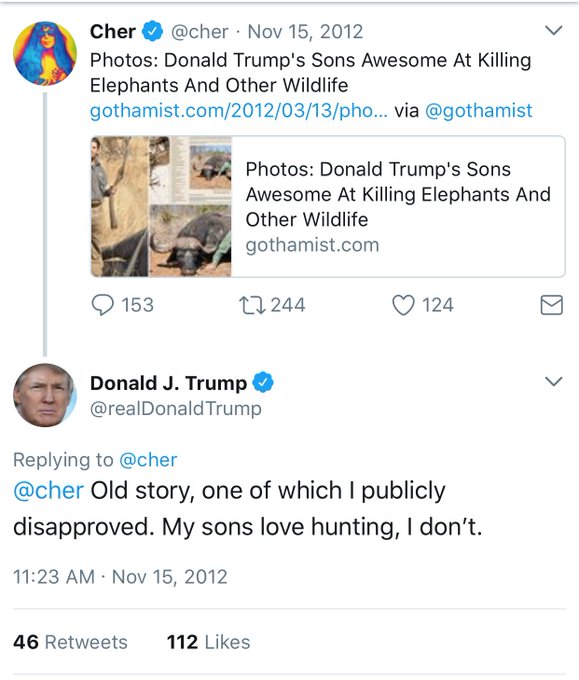
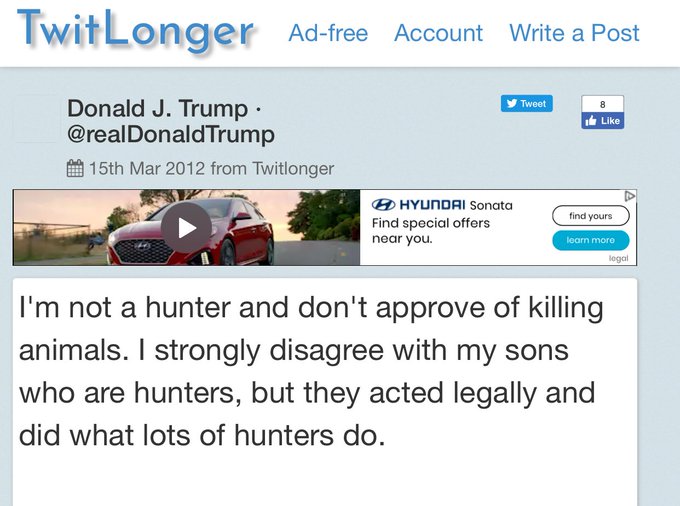
Little known fact about Trump — he actually opposes hunting! Here are his tweets criticizing his kids for big-game hunting in 2012. pic.twitter.com/vdM2X8YrIX
Seventy percent of hunters who pay up to $20,000 for permits to legally harvest elephants are American, according to Campfire, a group in Zimbabwe that manages its elephant hunting program. The program’s revenue dropped from an average of $2 million per year before the ban in 2014 to $1.73 million last year, Charles Jonga, Campfire’s director, said in an email.
Jonga joined hunters in blaming Trump’s decision on others. “This is certainly not about President Trump’s reaction,” he said, “but about animal welfare lobbyists who have nothing to show for their misplaced belief that they can dictate to African rural communities how they should share their living space with wildlife.”
Trump tweeted Friday that he would put off a decision until he could meet with Interior Department Secretary Ryan Zinke. Zinke, an avid hunter and trophy collector, later issued a statement on Interior’s website and tweeted that he agreed with the president.
Put big game trophy decision on hold until such time as I review all conservation facts. Under study for years. Will update soon with Secretary Zinke. Thank you!
During the Obama administration, Fish and Wildlife had questioned Campfire’s management and how much revenue was devoted to the conservation of elephants. Animal rights groups such as the Humane Society International said much of the funding was lost to corruption. The arrest of Zimbabwe’s president, Robert Mugabe, within days of the Trump administration’s favorable finding raised concerns.
Elephant hunting trophies are allowed to be imported to the United States from two other African countries, South Africa and Namibia. Another country, Zambia, was given the green light by the Fish and Wildlife Service last week. The current controversy focuses on the import of trophies from Zimbabwe.
On Monday, two environmental groups sued the Trump administration over the move to end the ban, which they called contrary to the slow and deliberate process called for under the Endangered Species Act, which lists African elephants as threatened.
“Trump’s abrupt backpedaling after public outcry, while appreciated, shows how arbitrary this deplorable decision was,” Tanya Sanerib, a senior attorney with the Center for Biological Diversity, said in a statement. “These incredibly imperiled creatures need a lot more than vague promises.”
The Center for Biological Diversity and Natural Resources Defense Council drew on Zimbabwe’s troubles in the announcement of their lawsuit, filed at the U.S. District Court for the District of Columbia. To arrive at an enhanced finding that elephant herds are well managed, Fish and Wildlife must rely on “Zimbabwe having the plans, resources, funds, and staff to conserve elephant and lion populations.”
“But . . . corruption is already a huge concern” due to the ouster of Mugabe. Also, the groups noted, “Zimbabwe scored an abysmal 22 out of 100 on Transparency International’s 2016 Corruption Perception Index.
“Poaching elephants for their ivory remains a significant threat in Zimbabwe. According to aerial surveys — known as the Great Elephant Census — Zimbabwe’s elephant population decreased 6 percent between 2001 and 2013, when the aerial surveys were performed.” They went on to point out that controversies over animal killing often arise in Zimbabwe, where Cecil the Lion was illegally tracked, shot with an arrow and killed by an American hunter.
Elly Pepper, deputy director of a wildlife trade initiative and program at NRDC, called Trump’s announcement a pleasant surprise but said he needs to do more. “These tweets are still really ambiguous,” she said. “And tweets don’t have any legal authority. We want to make sure that the administration doesn’t have its cake and eat too. We want to ensure they aren’t going to quietly start issuing trophy permits and enjoy public support because their tweets indicated they oppose trophy hunting.”
Wayne Pacelle, president and chief executive of the Humane Society of the United States, said his organization plans to work with Trump without taking legal action. But Pacelle questioned the idea of killing elephants to conserve them.
“Botswana disallowed all trophy hunting, and Botswana has more elephants by a long shot than every other country,” Pacelle said. “It’s recognized that this would damage the brand of the nation. Trophy hunting subtracts animals from nature. It diminishes the value of animal populations.”
During the controversy in 2015 over allowing a rhinoceros hunter to import the trophy head of a rhinoceros he planned to kill in Namibia, the International Union for the Conservation of Nature said concern over the act confused illegal poaching with well-managed hunting tourism.
“Well-managed trophy hunting has little to do with poaching, and indeed can be a key tool to help combat it,” the union said in a statement. Without it, African conservationists “would not be able to employ the upwards of 3,000 field rangers employed to protect wildlife and enforce regulations.” Namibia’s conservation is viewed by Fish and Wildlife as one of most responsible such programs in Africa.
Pacelle dismissed this type of argument. Hunters never say “we want to trophy hunt because we want to mount the head,” Pacelle said. “They always apply something to it. They could just give the money for conservation. But they want something out of it.”
In a year that saw the Ringling Bros. Circus fold after a century and a half following an outcry over its treatment of animals, the nation is experiencing a major shift in tolerance, according to Pacelle.
“That was a marker of how our attitudes have evolved toward elephants. We don’t want to see anyone chain them and have them perform silly stunts,” he said. “It’s worse to shoot them in the head.”
The African Pachyderm Organisation stunned conservationists by ending a long-standing moratorium on the crushing of rich tossers who think slaughtering rare wildlife somehow makes up for the loveless pantomime that is their life.
Tembo, a Tanzanian bull elephant and PR director for the APO, denied the move was linked to the steady increase of privileged bellends called Troy or Donald Jr going to Africa and pretending that shooting a large animal from the safety of a Land Rover is a life-affirming experience.
He explained, “We are doing it to enhance the ecological health of the Rich Prick subspecies, particularly in America.
“They have been too long removed from having to fend for themselves and the degeneracy is showing. We are seeing highly aggressive behaviour combined with physical cowardice and horrendous mating habits based on intimidation and humiliation. A cull is long overdue.”
Tembo also denied the unrestricted squishing of narcissist wankers emulating Hemingway would hurt the tourist trade in already impoverished countries.
He went on, “Quite the opposite. The end of restrictions will mean great windfalls for local communities.
“The APO is fully committed to the principles of Sustainable Squishing. Our crushers work with rural humans to track and bait the trigger-happy fuckwits with promises of macabre selfies next to dead apex predators.
“Tribal elders are always consulted to help select the most egregious gun-nuts for a good trampling.
“The locals take all the spoils and a share of the squishing fee. Did you know that the personal effects of a Florida orthodontist can buy a whole new schoolhouse for a Zambian village?”
What a thoutful early Christmas gift from daddy dearest to do for a pair of savage sons, one of whom was quoted recently enjoying the sport of hunting [and therefore, presumably, killing] even better than golfing.
But what if one of them were to follow in daddy’s footsteps and get themselves elected president, as Geoge W. Bush did?
In other words, What If Junior Takes Over?
A scary thought indeed–especially for the wildlife!
A grizzly bear roams through the Hayden Valley in Yellowstone National Park in Wyoming, on May 18, 2014. Conservation groups have slammed the decision to remove the Yellowstone grizzly bear from the Endangered Species Act.JIM URQUHART/REUTERS
The decision by President Donald Trump’s administration to remove the Yellowstone grizzly bear from the list of endangered species has been called “a gift to trophy hunting” by conservation groups.
The bear has enjoyed protected status for 42 years, during which time its numbers grew to more than 700 from just 136. On Thursday, Secretary of the Interior Ryan Zinke said it is now time to call the operation a success and to remove the bear from the Endangered Species Act, instead allowing states to take control over its future.
“This achievement stands as one of America’s great conservation successes; the culmination of decades of hard work and dedication on the part of state, tribal, federal and private partners,” Zinke said in a statement. “As a Montanan, I am proud of what we’ve achieved together.”
The move, which was first proposed by the previous administration of President Barack Obama last year, will go into effect 30 days after it is published in the federal register. At least immediately, it will not lead to open season on grizzly bear hunting. As well as being restricted to the bears that travel outside of the park’s boundaries, hunts will only be allowed if the number of bears remains above 600.
However, many conservationists argue that Thursday’s decision adds yet another threat to the future survival of the bears, whose habitat they say is already endangered by climate change.
“The Trump Administration’s delisting maneuver is a gift to trophy hunting and oil and gas interests,” Wayne Pacelle, president and chief executive officer of the Humane Society of the United States, tells Newsweek in an email. “The bears continue to face an array of threats, and the last thing they need are wealthy elites chasing them down and shooting them for trophies.”
The action will not affect the nearly 1,000 grizzlies inhabiting Glacier National Park in Montana. But experts have said protections for those bears could soon similarly be removed, according to The New York Times.
Prior to the 1850s and the onset of widespread hunting and trapping, grizzly bears across North America numbered around 50,000. And some conservationists have argued that placing their conservation back in the hands of states, which can use hunting as a form of population control, is an unnecessary risk. Indeed, Tim Preso, an attorney for environmental law firm Earthjustice, has said that legal action to prevent the change is already being considered.
“We’re certainly prepared to take a stand to protect the grizzly, if necessary,” he told the Associated Press. “There’s only one Yellowstone. There’s only one place like this. We ought not to take an unjustified gamble with an iconic species of this region.”
In addition to conservation groups, the move has also been opposed by Native American tribes, for whom the grizzly bear is a sacred animal. A treaty opposing hunting of the bear has been signed by 125 tribes.
Zinke, a former senator from Montana, has a lifetime score of just 4 percent from the League of Conservation Voters, with the group indicating that of 73 votes on bills with environmental impact, only three were pro-environment.
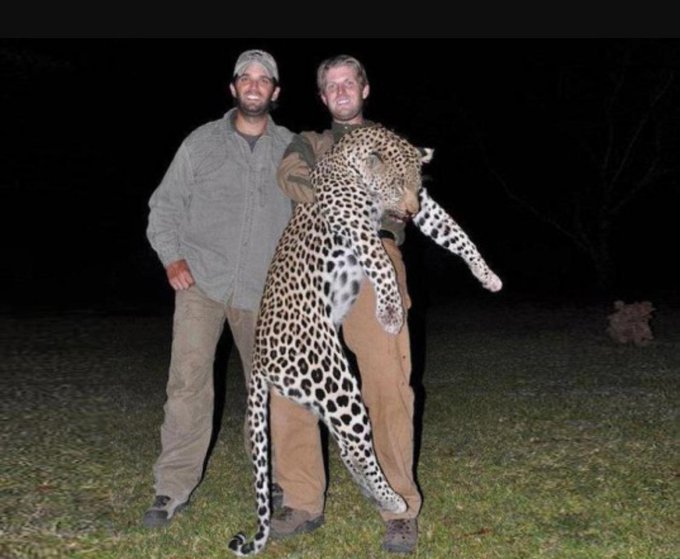
Trump’s two sons, Donald Jr. and Eric, are known to be fond of big-game hunting and have previously attracted criticism for posing for photos alongside dead animals, including a leopard and an elephant.
Elephant and lion trophies can be imported from Africa again, in a reversal of an Obama-era policy that prohibited the importation of endangered animals.
The U.S. Fish and Wildlife Service announced Wednesday that it will allow trophy hunters to bring back legally hunted wildlife, removing restrictions on permits that were put in place to discourage the hunting and poaching of animals that are on the threatened species list.
The International Wildlife Conservation Council, a newly created arm of the Department of the Interior, wants to bring a focus to the “economic benefits that result from U.S. citizens traveling to foreign nations to engage in hunting.” Plus, it believes “human populations” could benefit from having Americans visit and hunt.
Philip Dixie (L), a professional hunter from Blaauwkrantz hunting reserve shows a trophy during a hunting Safari in the Blaauwkrantz game reserve some 70km from Port Elizabeth, South Africa.GIANLUIGI GUERCIA/AFP/GETTY IMAGES
The council has determined that hunting in Zimbabwe and Zambia will help with conservation efforts, though its announcement does not include research that supports that view.
“By lifting the import ban on elephant trophies in Zimbabwe and Zambia, the Trump Administration underscored, once again, the importance of sound scientific wildlife management and regulated hunting to the survival and enhancement of game species in this country and worldwide” said Chris Cox, executive director of the National Rifle Association’s Institute for Legislative Action in a statement on the NRA-ILA website.
“This is a significant step forward in having hunting receive the recognition it deserves as a tool of sound wildlife management, which had been all but buried in the previous administration.”
In 2015, the Fish and Wildlife Service suspended the import of sport-hunted elephant trophies, citing a lack of evidence that the practice helped conservation efforts.
The expanded import policy will likely be welcome news to Eric Trump and Donald Trump Jr., who have posted photos of themselves after a trophy hunting expedition. The photos showed them with a leopard and an elephant, and drew criticism from animal rights groups. They have continued to take big-game hunting trips across the U.S. and in Canada, though they haven’t posted photos.
What went so wrong with Trump sons that they could kill this beautiful creature
Trophy hunting may be popular with the Trumps, but not everyone is on board. When Minnesota dentist Walter Palmer shot Cecil the Lion in Zimbabwe in 2015, he sparked international outrage for targeting one of the most well-known and beloved African lions. Palmer had a permit to hunt in Zimbabwe, and paid around $50,000 to a professional hunter-guide to kill the lion.
Zimbabwe’s elephant population has declined since 2001, and Zambia’s populations have declined in some regions. Hunters often choose the healthiest or strongest members of animal populations, to have a more impressive trophy, but this can have negative effects on the species overall.
A 2015 poll showed that 86 percent of Americans oppose big-game hunting, and six out of 10 respondents said it should be illegal.








 Exposing the Big Game