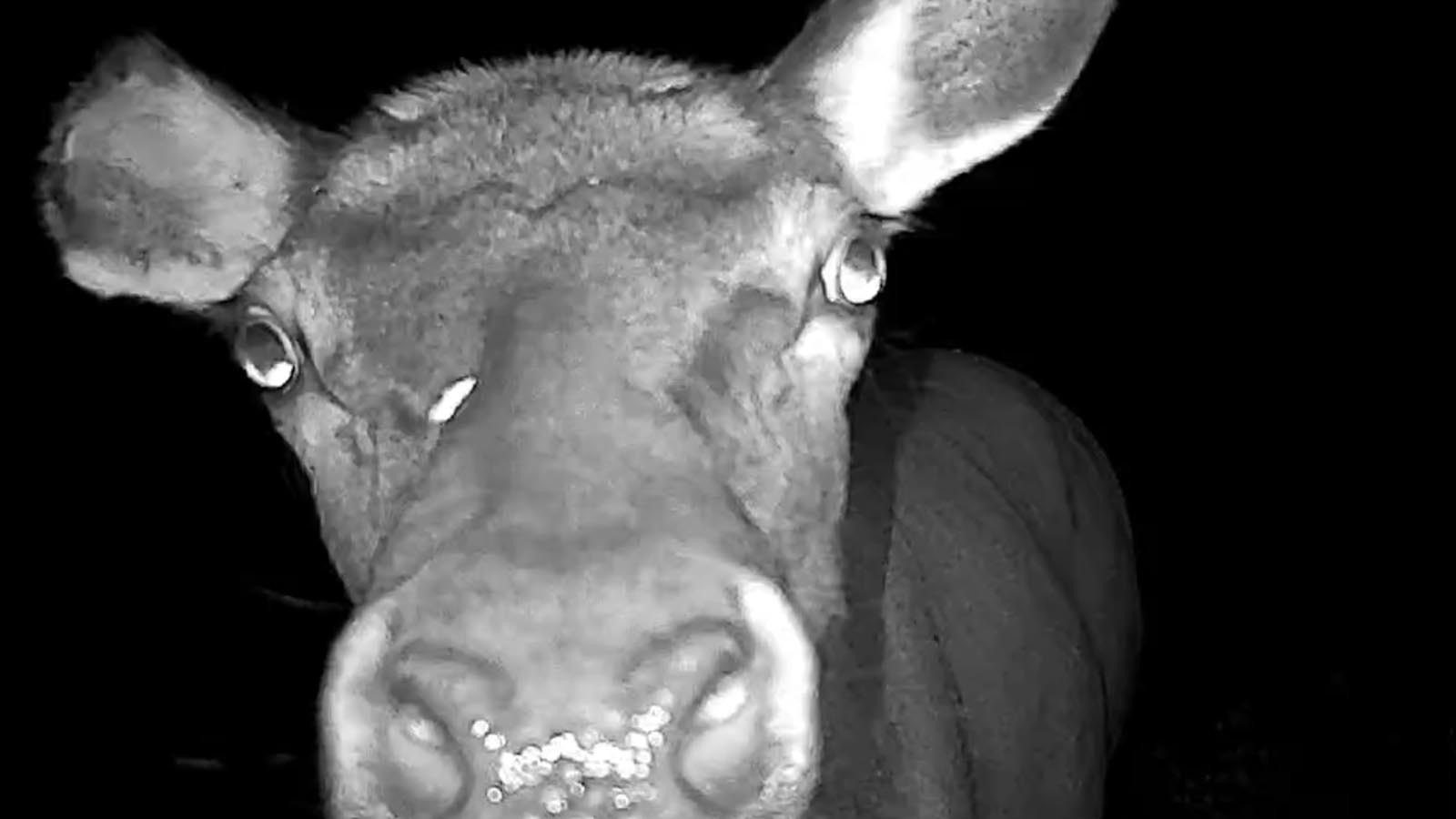
A one-eared elk, nicknamed ‘van Gogh’ is one of many elk visiting an area with a webcam on a daily basis. The number of elk is encouraging to hunters as this area was wiped-out by the hard winter of 2022-2023.
This curious cow elk in the Greys River area in Teton County was undeterred by old human and horse scent at a game trail camera site. (Courtesy Lacelynn Seibel)
Hunters must be mindful of elks’ keen sense of smell, but at least one curious cow elk in the Greys River area of Teton County is undeterred by residual human and horse scent at a game camera site.
Video taken by the camera shows the cow elk — missing about half of one of her ears — walking right up to the camera, sticking her face into the lens and snuffing away.
“I am nicknaming her ‘van Gogh’ for her missing ear,” Teton County resident Lacelynn Seibel, who set the camera up, told Cowboy State Daily.
It’s a reference to famed 19th century artist Vincent van Gogh, who sliced off part of his own ear.
Making Scents Of It All
An avid archery hunter, Seibel has been observing the Greys River herd since she moved to Teton County about three years ago.
She was somewhat concerned about how good her trail camera footage would be this season, because she left a lot of scent at the site when she installed the trail camera.
She rode her horse into the site and “it’s a little way back in there and we were both really sweaty when we arrived,” she said.
Like any archery hunter, she knows that even a small trace of human scent can be enough to ruin a good hunt.
However, older residual scent apparently doesn’t bother elk that much, Seibel said, because she’s captured great footage of van Gogh and other elk from the herd.
Alex Maher, an archery hunter from Jackson, said that matches his experience.
“I think you can walk by and minutes or hours later, they’re not going to pick your scent up off the ground,” he said. “The main part of elk smelling you is when you’re there.
“If you are upwind of elk, and they catch your scent, they’re out of there.”
Some hunters use “scent killer” formulas that can be sprayed on clothing or even used as laundry detergent.
Maher said he relies more on paying attention to wind direction. He carries a “wind-checker” with him while hunting.
That’s a small, squeezable tube of fine powder. When the tube is squeezed, it shoots a puff of the powder into the air, which will indicate which way the wind is blowing.
What’s With The Ear?
Like much of the wildlife in central and Western Wyoming, the Greys River elk suffered horribly during the hard winter of 2022-2023, when thousands of animals froze or starved to death.
Even so, elk are hardy and resilient, and Seibel said that from what she’s seen, the Greys River elk she tracks are making a strong comeback.
“The past two years, the elk have had so many babies, and they’re all so fat,” she said.
As to how the particularly curious cow elk lost half an ear, Seibel said she doesn’t know.
Van Gogh the artist sliced off part of his left ear on Christmas Eve in 1888, supposedly after a quarrel with his roommate in the south of France.
He reportedly wrapped the severed ear and delivered it to a woman in a neighborhood brothel, instructing her to “guard this object carefully.”
It’s thought that the bizarre episode stemmed from van Gogh’s exhaustion and possible mental illness.
Van Gogh the elk perhaps could have lost part of her ear to frostbite during that brutal 2022-2023 winter.
Seibel doubts that’s the case because the ear stub has a clean edge.
“It’s not typical what it looks like when they lose ears to frostbite, or get it caught in something,” she said. “It’s usually torn and tattered at the edges.”
‘It’s Just A Gorgeous Area’
Seibel said that as hunting season gets underway, van Gogh and the other cows in the herd are safe from her.
She prefers to shoot bulls.
“Last year I got a pretty good bull, so I’m holding out for an even better one this year,” she said.
Most archery elk hunting seasons kicked off Monday. Seibel said she prefers to wait until the middle of the month before venturing out. That way, she misses the initial rush and is more likely to have the fields and woods to herself.
And even if she doesn’t end up filling her elk tag, the experience is always worth it, she said.
The territory that the elk occupy have become one of her favorite places in the world.
She relocated to Teton County from the Midwest, where she loved archery hunting for elusive white-tailed deer. Archery elk hunting has proven to be a new challenge.
“It’s cool getting to know the terrain and how the animals use it,” she said. “It’s just a gorgeous area.”
Marking the first H5N1 avian flu detection at a US commercial poultry farm since early July, the US Department of Agriculture (USDA) Animal and Plant Health Inspection Service (APHIS) on August 28 confirmed an outbreak at a South Dakota turkey farm.
Morgan Lieberman/Mizzou CAFNR/Flickr cc
The facility in Faulk County has 55,400 birds. The last detection at a commercial farm occurred in early July at a game bird facility in Lancaster County, Pennsylvania. Since then, there was a detection at a live-bird market in Los Angeles County and in backyard birds in St. Lawrence County, New York.
Detections often drop off in warmer months, but sporadic detections in wild birds, dairy cows, domestic cats, and wildlife have continued over the summer.
UK confirms 2 more H5N1 detections
Meanwhile, the United Kingdom has been experiencing an early rise in H5N1 outbreaks in poultry, with a spate of detections that began in late July.
The Department for Environment, Food, and Rural Affairs over the past few days reported two more, one at a facility in Devon and the other involving captive birds at a location near Somerset.
YUMA, Ariz. (KYMA, KECY) – Dove hunting season officially started on September 1, and many passionate hunters wake up bright and early to head to the hunting sites.
Over the weekend, the Yuma County Sheriff’s Office (YCSO) issued a reminder to the public saying hunting is strictly prohibited in parks and preserves.
YCSO also says it’s unlawful to discharge a firearm within a quarter mile of occupied structures without the permission of the owner.
Shooting across roads or railways is illegal and trespassing is not tolerated.
Lastly, remember to leave no trace as shotgun cases or wildlife remains left behind are prohibited and subject to penalties.
One family in particular gets up at two in the morning to head out before anyone else.
For the Kammann family, it is a longtime tradition that is passed through their families generations. Jeff Kammann has been following in his dad’s footsteps for about 50 years.
“I made my kids go through hunter safety. I’ve been through hunter safety, you know, know where your shooting and opening day of dove [hunting season], usually if there’s a lot of dove around, that means there’s a lot of hunters around,” Kammann shared.
The season ends at sunset on September 15. For more information on hunting laws and safety guidelines, click here.
Please take a short multiple-choice quiz to test your knowledge of our fellow animals.
Instructions: Choose the animals that best fit the descriptions in the questions below. Although some species may share several of the characteristics, they must meet all the criteria in order to qualify as a correct answer.
1.) Which two animal species fit the following description?
Highly social
Live in established communities
Master planners and builders of complex, interconnected dwellings
Have a language
Can readily learn and invent new words
Greet one another by kissing
A. Humans B. Prairie Dogs C. Dolphins D. PenguinsAnswer: A. and B.
2.) Which two species fit the following description?
Practice communal care for the offspring of their group
Beneficial to all other species who share their turf
Essential to the health of their environment and without whom an entire ecosystem unravels
Vegetarian
Have been forcibly reduced to less than 3% of their original population
A. Humans B. Prairie Dogs C. Bison D. HyenasAnswer: B. and C.
3.) Which two species fit the following description?
Out of control pestNonessential in nature’s schemeMultiplying at a phenomenal pace and overrunning the planetRapidly destroying habitats for all other life forms and physically crowding them off the face of the EarthCharacterized by a swellheaded sense of superiority, convinced they are of far greater significance than any other animalMake sport of killing gifted, gregarious beings whom they regard as “lower,” “varmints” or “vermin”
A. Humans B. Prairie Dogs C. Cockroaches D. Sewer RatsAnswer: Trick question. The only species fitting all the criteria is A
If this seems a harsh assessment of the human race, don’t forget we’re talking about the species who, single-handedly and with malice aforethought, blasted, burned and poisoned the passenger pigeon—once the most numerous birds on the entire planet—to extinction and who nearly wiped out the blue whale—the largest animal the world has ever known. Under the gravely mistaken impression that prairie dogs damage grasslands usurped by cattle ranchers, the U.S. government began a poisoning campaign in the 1920s that led to the demise of prairie dog colonies throughout most of their ecosystem.
The few remaining scattered colonies now occupy only 1% of their original range, yet prairie dogs are still senselessly shot by hunters on public lands to this day.
When the dust settles on their reign of terror, the human species will be best remembered as squandering ingrates who turned their noses up at nature’s gifts and goose-stepped on toward mass extinction, despite warnings from historians and scientists and pleas from the caring few. Professor Paul R. Ehrlich, author of The Population Bomb, written in 1968 (when humans numbered “only” 3.5 billion) and, more recently, The Population Explosion, written in 1991 (when 5.3 billion humans walked the Earth) has spent decades trying to get the word out. In 1970, he told National Wildlife Magazine, “It isn’t a question of people or animals—it’s got to be both of us or we’re finished. We can’t get along without them. They could get along without us.” Today, the human population has erupted to over 8.2 billion (as of this writing), and yet most people still aren’t listening.
All across the globe, humans have enslaved those animals they deemed worthwhile and set out to eliminate the rest. As John Muir noted, “The world, we are told, is made especially for man—a presumption not supported by the facts. A numerous class of men are painfully astonished whenever they find anything…which they cannot eat or render in some way useful to themselves.” To the vast majority of people living in their realm, prairie dogs fall into the category of “not useful” and so have suffered the wrath of the gods.
Yet, as Dr. Jane Goodall observes, “Nine different wildlife species depend on the prairie dog and their habitat for their survival. The prairie dog is a critical component to healthy North American grasslands.” And Terry Tempest Williams adds, “If the prairie dog goes, so goes an entire ecosystem. Prairie dogs create diversity. Destroy them and you destroy a varied world.”
The black-footed ferret is one species who cannot survive without a stable population of prairie dogs. Once thought extinct, ferrets are among the most endangered animals on the continent, numbering only in the low 100s. Ferrets, coyotes, badgers, swift foxes and others use abandoned prairie dog holes for denning. In a region so arid trees can’t grow, burrowing owls and mountain plovers have adapted to nesting in old prairie dog tunnels. (Despite their name, burrowing owls aren’t heavy excavators; they depend on prairie dogs to do the grunt work for them.)
Like renters scrambling for a recently vacated Manhattan apartment, anyone lucky enough to secure a former prairie dog home finds themselves living in the lap of relative luxury. Accommodations include multiple rooms on different levels, branching off from a passageway dug sometimes 15 feet deep and traveling horizontally for up to 100 feet or more.
By moving massive amounts of dirt in the construction of their elaborate abodes (which include a level just inside where they listen for danger, year-round sleeping quarters, birthing chambers and a designated restroom) prairie dogs spread nutrient-rich soil and compost onto the surface, acting as nature’s organic gardeners. Deep layers of aerated, fertile soil are tilled up and the resulting nitrogen-rich grasses and forbs associated with prairie dog towns are preferred by grazers, such as bison, pronghorn…and even cattle.
Prairie dog colonies were once a central feature throughout their range– the short-grass region of the Great Plains—which ran from the east slopes of the Rockies through Southern Alberta, the Dakotas, Nebraska, Kansas and south to Texas and Northern Mexico. Their burrows not only housed extended families, or coteries, but in larger colonies, included an elaborate and lengthy tunnel system connecting one home to the next. One such aggregation in Texas stretched for 100 miles, covered over 25,000 square miles and housed 400 million prairie dogs. Words like ‘subdivision’ have been used to describe prairie dog colonies, but while urban sprawl—notorious for miles of blacktop and coal-fired power plants—X’s out wildlife habitat, prairie dog dwellings are a positive boon to the environment.
So cooperative are prairie dog settlements that mothers even practice communal nursing, but not because they can’t keep track of their own offspring. Unlike many rodents, prairie dogs have a low birth rate—a would-be mother only comes into estrous one day per year. And litter size is relatively small, usually three to four young who remain in the household until maturity, at which time the males disperse.
As you might imagine, any animal evolved to be this social will have developed their own form of communication, and prairie dogs have become quite the little conversationalists. Who would have thought the prairie dog “barking” to others from the edge of his burrow was actually a skilled orator reciting an animal version of the Gettysburg Address? Northern Arizona biology professor and prairie dog linguist, Con Slobodchikoff, has identified a boundless array of words with specific meanings, as well as signs of sentence structure and the ability to invent new words describing things they had previously never seen before, within the varied sounds of prairie dogs.
According to Slobodchikoff, “We’re chipping away…at the idea that animals don’t have language,” adding, “So far, I think we are showing the most sophisticated communication system that anyone has shown in animals.” A few years back, wildlife researchers in Africa caused a stir in the scientific community with their earth-shattering discovery that vervet monkeys had their own language. They were found to have three categories of warning calls: one each for leopard, eagle and snake. Well, our home team has that beat. Slobodchikoff, with the aid of a computer that creates a sonogram, has analyzed recordings of prairie dogs and identified words for potential predators such as coyote and red-tailed hawk, as well as for fellow grass-eaters like pronghorn, deer and elk. They also have words differentiating between curious human onlooker and aggressive human with bad intent.
Unfortunately, the latter is the rule. People in “cattle country” entertain themselves by using the few remaining prairie dogs as living targets. Taking sick pleasure in shooting a watchful, cooperative grass-eater as she pops up from her burrow to see if it’s safe for her youngsters to come out, the noble hunters are completely unconcerned about leaving dependent infants to starve. They’ve even devised a clever name, “double tap,” for a shot that kills both a mother and her adoring baby. “Tap” is a particularly twisted label, considering the hollow point bullets they use cause the victims to literally explode on impact, a sight that must really get the shooter’s blood up.
Ladies beware—there’s a well-established link between cruelty to animals and domestic abuse and other crimes along the violence continuum. One such thrill-killer describes his sport this way: “Prairie dog hunting is a blast…on both private and public lands. I like to start by clearing everything within 50 yards with an AR-15, then switch to my .223 Remington for anything out to about 150 and finally trade up to the bull barrel .22-250 for the longer shots.” The only thing stopping people with this much bloodlust is the melting point of their gun barrels and perhaps the cost of ammunition. Going through 500 rounds a day can get expensive. Yet, these vacuous, pathetic excuses for human beings will pay upwards of $1,200 for a couple of days at one of the private ranches that advertise prairie dog hunts. One enticing ad describes their typical day as follows: “We approach the edge of a prairie dog town and set up and shoot for an hour or two or until the prairie dogs start getting scarce, then we pull up and drive over the hill and continue prairie dog hunting…after you get tired of the carnage, it’s also fun to try shots over 1,000 yards.”
Longtime candidates for protection under the Endangered Species Act, black-tailed prairie dogs were removed from the waiting list in 2004, their fate left up to the states which manage them for “recreational shooting opportunities.” This glib game department jargon, loosely translated, means states like Wyoming have an open season on prairie dogs, allowing for unregulated, year-round shooting, without limit or regard for their future.
Wherever I’ve lived in the West, I have been fortunate enough to locate or stumble upon the rare or secretive species indigenous to the area—be they wolves, grizzly bears, cougars, lynx, fishers, mink or pine martens, even coming across the shadowy wolverine on three separate occasions. So it was with confidence that I set out across eastern Montana and Wyoming in search of the amicable, diurnal rodents that call the prairie their home. Surely, they must be thick everywhere in the open plains. How hard could they be to discover? It’s not like I was searching for Bigfoot this time.
I combed hundreds of miles of what should be prime prairie dog habitat, scouring the gravel back roads—through over-grazed cattle allotments and between active and defunct oil rigs—yet found almost no sign of them. All I discovered were a few prairie dog ghost towns and a lot of lonely, parched and denuded ground desperately in need of the cornerstone species who was once synonymous with the treeless grasslands.
Finally I stopped at the headquarters of the Bighorn Canyon National Recreation Area and asked the National Park Service spokesperson why there were no prairie dogs anywhere in the vicinity. She replied with a shrug, “Uh…Target practice?” Apparently, unregulated shooting has taken its toll. No one at that government compound could point me to a single place where prairie dogs still thrived, yet these vanishing symbols of the plains remain unprotected by the federal ESA. Needless to say, no state or local law safeguards them either. What will good ol’ boys shoot at when they run out of prairie dogs and ground squirrels—each other? Okay, fair enough, but let’s hope they don’t target anyone who doesn’t deserve it.
On the way back home to southwest Montana on Interstate 90, I spotted a sign for Greycliff Prairie Dog Town State Park. Just as the name implies, there is an active prairie dog town there—one of the last of its kind. The tiny park, located right along the interstate with a railroad just beyond, is however, a surprisingly good place to see prairie dogs living otherwise undisturbed. But with the constant whirr of a busy freeway, punctuated by locomotives dragging eternal black streams of overflowing coal cars, it’s also a great place to get a glimpse into what has happened to the world of prairie dogs and why there are so few left of their besieged and embattled species.
If we ever completely decode prairie dog language, we’re likely to find that the word for human is unflattering at best. Edward Abbey (author of such inspirational works as The Monkey Wrench Gang and Heyduke Lives) wrote, “We are obliged…to spread the news, painful and bitter though it may be for some to hear, that all living things on earth are kindred.” No doubt many prairie dogs, embittered by the cruel treatment their families have endured, would find it painful indeed to claim any kinship to the human race.
Jim Robertson is the president of C.A.S.H. Text and photos for this article were excerpted from his book, Exposing the Big Game: Living Targets of a Dying Sport. You can find Jim Robertson’s book on Amazon.




.jpg)


 Exposing the Big Game