Concentrations of carbon dioxide in the atmosphere in May were 50 percent higher than during the pre-industrial era, reaching levels not seen on Earth for about four million years, the main US climate agency said on Friday.
The amount of carbon dioxide in the atmosphere passed the threshold of 420 parts per million (ppm), the National Oceanic and Atmospheric Administration (NOAA) said. PPM is a unit of measurement used to quantify pollution in the atmosphere.
Last May, the rate was 419ppm, and in 2020, 417ppm.
Global warming caused by humans, particularly through the production of electricity using fossil fuels, transport, the production of cement, or even deforestation, is responsible for the new high, the NOAA said.
CO2 is a greenhouse gas that traps heat, gradually causing global warming. It remains in the atmosphere and oceans for thousands of years.
Many huge automotive companies are transitioning to cleaner car manufacturing. Electric vehicles have been the focal point of that conversation, allegedly expelling less energy and leaving behind virtually no carbon footprint. But manufacturing the vehicle from its wheels to its battery could have significant damage to the earth. Consumer skepticism remains around if electric cars are as environmentally friendly as they’re marketed.
What vehicle is worse for the environment, electric cars or gasoline-powered cars? On the surface, electric vehicles create no carbon emissions because they’re not expelling harmful fumes into the atmosphere. Standard vehicles, of course, emit all kinds of pollutants into the earth and the air, which is not suitable for the upkeep of the planet. But…
Exclusive: Focus on human needs must not result in impact on animals being overlooked, say researchers
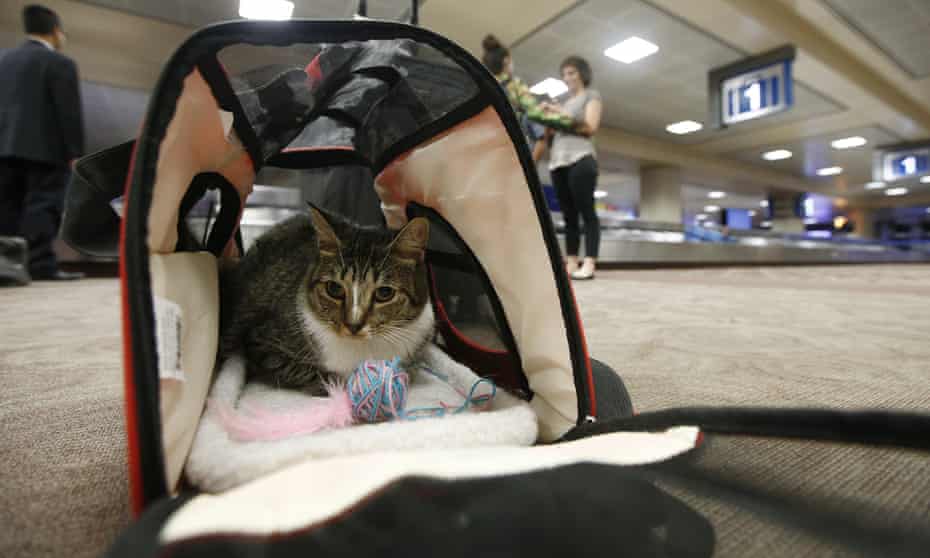
Emotional support animals are not trained to aid their owners, as is the case for assistance animals such as guide dogs. Photograph: Ross D Franklin/AP
Taking a pet everywhere for emotional support, from aeroplanes to the daily shop, may be all the rage, but experts have warned animal welfare is at risk of being overlooked.
But experts say the focus on human needs must not mean the potential impact on the animals themselves is overlooked.
“We need to be careful with our enthusiasm, and not lose sight of what the animal might need,” said Dr Elena Ratschen, associate professor in health services research at the University of York, whose work has explored animal-assisted interventions.
Advertisement
“We have a duty here to make sure the benefit of the human-animal relationshipis reciprocal in the greatest possible way.”
Emotional support animals are not trained to aid their owners, as is the case for assistance animals such as guide dogs, and in many countries – including the UK – they are not covered by the same laws that protect assistance animals.
Instead, said Prof Janet Hoy-Gerlach of the University of Toledo, they are often pets who helps to mitigate the impact of their owner’s physical or mental health condition through everyday benefits of human-animal interaction.
However, Ratschen said it was challenging to conduct sufficiently large, randomised controlled studies around emotional support animals themselves. “It is incredibly difficult to conduct rigorous studies in this field,” she said.
Among research into the use of emotional support animals, is a pilot study by a team including Hoy-Gerlach that paired 11 participants with serious mental illness with a rescue dog or cat. The results suggest the participants experienced an improvement in their mental health wellbeing, with reductions seen in anxiety, depression, and loneliness – however, the pilot was small and lacked a control group.
A key concern raised by Hoy-Gerlach is animal welfare, noting that being out and about could put animals in situations that cause them stress, a particular concern where undomesticated animals are concerned.
“An emotional support animal isn’t trained to be out in public,” she said, adding by contrast service animals such as guide dogs are given plenty of preparation to help them cope.
Ratschen agreed. “If we then say [emotional support] animals are allowed to travel on aeroplanes, or enter, for example, crowded places where animals [are] not normally accepted, yes, of course, you could think that this will most likely incur substantial stress on them,” said Ratschen. “If you imagine the peacock on the plane, do you think the peacock enjoyed it? Probably not.”
The Conservation Officer Service says the investigation included help from the U.S. Fish and Wildlife Service after a moose carcass in northern B.C. was spotted by a pilot.B.C. Conservation Officer Service
An Alberta man has lost hishuntingand guiding privileges in B.C. following an investigation that included cross-border help from the U.S. Fish and Wildlife Service.
TheB.C. Conservation Officer Service(COS) says Richard Todd Bunnage pled guilty in May to being involved in an illegal guiding operation by Tenaka River Guide Service in northern British Columbia.
Default Mono Sans Mono Serif Sans Serif Comic Fancy Small CapsDefault X-Small Small Medium Large X-Large XX-LargeDefault Outline Dark Outline Light Outline Dark Bold Outline Light Bold Shadow Dark Shadow Light Shadow Dark Bold Shadow Light BoldDefault Black Silver Gray White Maroon Red Purple Fuchsia Green Lime Olive Yellow Navy Blue Teal Aqua OrangeDefault 100% 75% 50% 25% 0%Default Black Silver Gray White Maroon Red Purple Fuchsia Green Lime Olive Yellow Navy Blue Teal Aqua OrangeDefault 100% 75% 50% 25% 0%
The search for an injured black bear in Juneau County is intensifying.
Published: Jun. 2, 2022 at 8:46 AM PDT|Updated: 21 hours ago
NEW LISBON, Wis. (WMTV) – The search for an injured black bear in Juneau County is intensifying. Volunteers from the organization Help Asheville Bears or HAB arrived in New Lisbon this week to find the bear and help remove a small game trap from its right front paw. NBC15 first reported on the bear last week when a viewer sent us a video of the bear hobbling around in their backyard.
“We had seen the same thing happen in North Carolina last year — almost a year ago to date — and the bear ended up losing its paw after a few weeks,” said Alex Williams, a volunteer with HAB. “So, we knew how important it was to find the bear quickly before it lost its paw.”
Williams and his brother Jody arrived at the home in New Lisbon Wednesday morning where the bear spotted searching for food and going after bird feeders. In the video, you can see the bear has a trap on its paw.
A still frame from the video of the bear. You can see the trap stuck on it’s front right paw.(Tim Elliott)
ADVERTISEMENT
“Our concern has always been from the beginning to get help for the bear,” said Ian Judd, the man who filmed the bear. “Seeing the bear with the trap on is heartbreaking.”
The type of trap the bear stepped on is called a conibear trap. Despite its name, the trap is not designed to catch bears. Instead, it’s designed to catch small animals like a raccoon. Trapping bears is illegal in Wisconsin. However, the type of trap seen in the video is legal.
“Currently in Wisconsin, we don’t have any trapping season open this time of year. However, state law does allow landowners to trap and remove nuisance animals that are on their land, year-round,” said Kris Johansen with the Wisconsin Department of Natural Resources.
Alex Williams pours a bottle of maple syrup on a pile of doughnuts, pies, and other sweet treats in an attempt to get the bear into the live trap set up by wildlife officials(Tim Elliott)
ADVERTISEMENT
Johansen believes the bear inadvertently stepped on the trap, but says “no one wants to see an animal that is in distress like that.”
The bear was filmed on Saturday, May 21. The next day, the USDA Wildlife Service put a live bear trap on Judd’s property is an attempt to catch the bear and safely tranquilize it. They would then remove the trap and then set the bear free.
As of Thursday, the bear still has not entered the live trap.
The Williams brothers spent Wednesday morning setting up 10 trail cameras around Judd’s seven-acre property to hopefully document the bear’s movement. They also dumped gallons of maple syrup, molasses, and other sugary sweets on the property in an attempt to entice the bear to come back to the property and enter the live bear trap.
ADVERTISEMENT
This is one of several trail cameras set up on the Judd’s property to try to document the bear’s movement(Tim Elliott)
“The goal right now is to use baits and scents and attractants like these to get the bear closest to the barrel trap as we can,” said Williams.
Williams says HAB started two-and-a-half years ago in North Carolina to stop poachers in the area from trapping black bears. He believes trapping animals with these conibear traps – or really any spring-loaded trap– is barbaric.
“So how does the trap know whether a bear or a raccoon steps in it? Maybe it’s your dog that accidently gets out of your yard or gets off the leash and wanders out of the yard,” he said. “We should all look at the traps and say, ‘does this really make sense in our modern times? Do we want animals being maimed and limping around at all times or is it time to put this old way of doing this down?”
ADVERTISEMENT
In addition to helping bears, Williams says HAB’s goal is to “document their injuries and missing limbs to try to get this cruelty stopped,” Williams says if the trap is not removed in a reasonable amount of time, the bear will chew his own paw off to get free.
Judd says since his video has gotten out, the community has really banded together to find the bear.
“The outpouring of sympathy for the bear has been quite enormous. It just shows there are people out there that care, people are still concerned for animals.”
The Williams brothers are determined to help – and if nothing else – shine a spotlight on what happens when an animal gets trapped.
ADVERTISEMENT
“Even if we can’t save the limb and it’s chewing it off right now and it’s too late, we can’t stop until we document what happened to this bear from beginning to end. The story is too important,” said Williams.
The Williams brothers say there has been a sighting of a black bear in the area with a missing right front paw. It’s unclear if this is the same bear that was filmed in the Judd’s backyard. NBC15 is working to confirm with the Wisconsin DNR if this recent sighting is in fact the same bear.
Officials with Public Health – Seattle and King County announced that several wild ducks and geese found on public parks in Seattle and Bellevue have tested for bird flu.
The birds were found on May 22 at Green Lake and Volunteer parks in Seattle and Bellevue Downtown Park.
Cases of avian influenza have been detected in two additional Washington counties: Pierce and Whatcom. However, the Washington State Department of Agriculture said that there is no immediate public health concern.
Last month, the Washington State Department of Agriculture announced the state’s first case of bird flu. There were confirmed cases in 11 domestic, backyard flocks in eight counties.
The health department is advising people to not transport wild birds or keep them in their homes or yards.
People should not approach or touch the birds.
Anyone who may have touched or come within six feet to any sick birds at the locations, is asked to call King County Public Health at 206-4774.
Bird flu is killing an alarming number of bald eagles and other wild birds, with many sick birds arriving at rehabilitation centers unsteady on their talons and unable to fly. Cases were also just confirmed in a Washington state backyard flock.
To report sick or dead birds to the Washington state Department of Fish and Wildlife, click here: bit.ly/sickwildbirds.
The WSDA said if your flock experiences a sudden death or illness of multiple birds should call the sick bird hotline at 1-800-606-3056.
A monkeypox outbreak continues to grow in countries where the virus isn’t normally found, putting global health officials on high alert.
Now with more than 643 cases of monkeypox in dozens of countries where the virus is not endemic, “the sudden appearance ofmonkeypoxin many countries at the same time suggests there may have been undetected transmission for some time,” World Health Organization Director-General Tedros Adhanom Ghebreyesus said Wednesday.
The virus has been circulating for decades in some places, including parts of West and Central Africa. In earlyresearch posted this week, scientists at the Institute of Evolutionary Biology at the University of Edinburgh described how the genetic pattern they’re seeing suggests that “there has been sustained human to human transmission since at least 2017.”
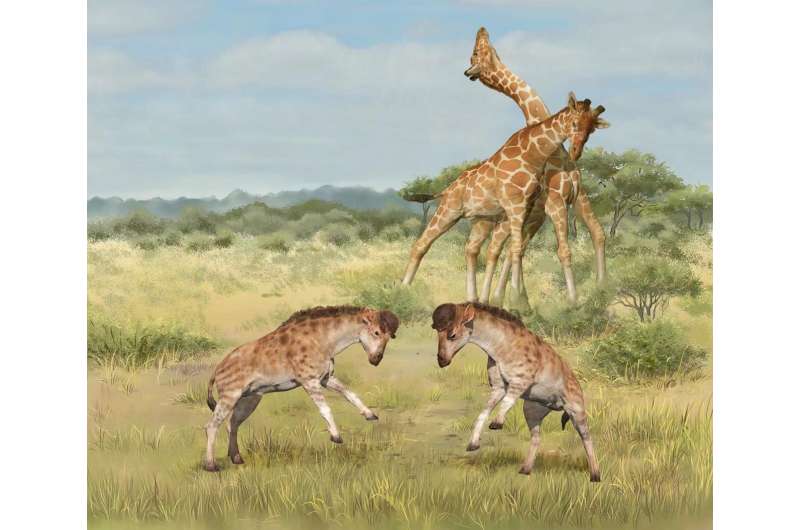
Intermale-competitions of giraffoid, foreground: Discokeryx xiezhi, background: Giraffa camelopardalis. Credit: WANG Yu and GUO Xiaocong
Fossils of a strange early giraffoid have revealed the key driving forces in giraffe evolution, according to a study led by researchers from the Institute of Vertebrate Paleontology and Paleoanthropology (IVPP) of the Chinese Academy of Sciences.
How the giraffe’s long neck evolved has long been an evolutionary mystery. Although there have been different opinions about the process of giraffe neck elongation, scientists never doubted that the impetus for neck elongation was high foliage.
However, as observation of giraffe behavior increased, scientists began to realize that the elegant, long neck of giraffes actually serves as a weapon in male courtship competition and this may be the key to the giraffe evolutionary mystery.
Specifically, giraffes use their two-to-three-meter-long swinging necks…
House Minority Leader Kevin McCarthy awaits the arrival of Greek Prime Minister Kyriakos Mitsotakis in the House Chamber of the U.S. Capitol on May 17, 2022, in Washington, D.C.