ANCHORAGE, Alaska (AP) — A man who stars on a TV show called “The Bear Whisperer” has been accused of illegally killing a black bear in Alaska’s Kenai Fjords National Park and lying about where it was killed.
The U.S. Attorney’s Office filed misdemeanor charges last Friday against Harvey Neil Anthony of Maine and Nature Productions Inc. Anthony goes by the name of Blaine Anthony in the television series he also produces, the Anchorage Daily News reported.
An online court records system did not show an attorney listed for Anthony. There was no immediate response to an email seeking comment sent to Nature Productions Inc. on Thursday by The Associated Press. The charging documents said Anthony is the company’s sole shareholder.
Get an Entire 6 Months of Digital Access for Only 99¢
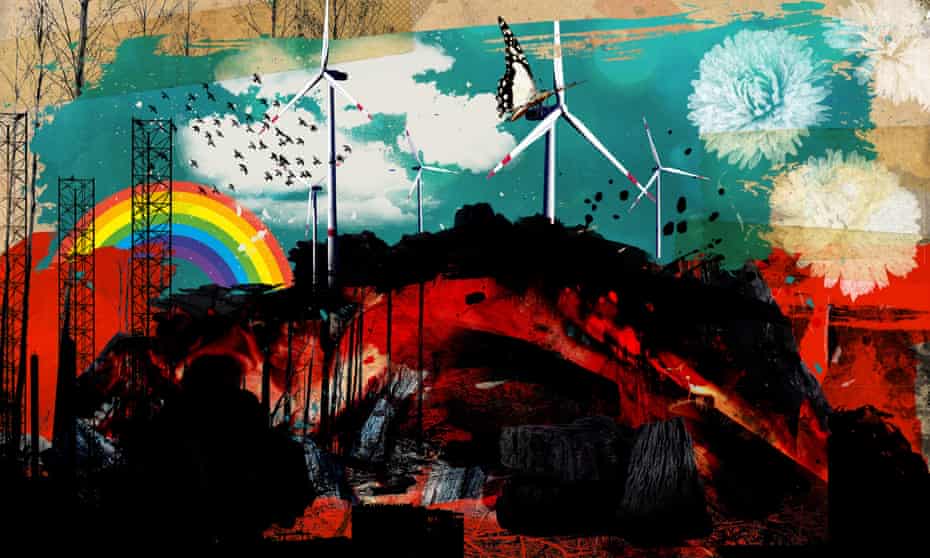
In seeking to prevent environmental breakdown, what counts above all is not the new things we do, but the old things we stop doing. Renewable power, for instance, is useful in preventing climate chaos only to the extent that it displaces fossil fuels. Unfortunately, new technologies do not always lead automatically to the destruction of old ones.
In the UK, for example, building new offshore wind power has been cheaper than building new gas plants since 2017. But the wholesale disinvestment from fossil fuels you might have expected is yet to happen. Since the UN climate summit last November, the government has commissioned one new oil and gas field, and reportedly plans to license six more. It has overridden the Welsh government to insist on the extension of the Aberpergwm coalmine. Similar permissions have been granted in most rich nations, even before Russia’s invasion of Ukraine.
Why? Politics. Fossil fuel companies need spend just a fraction of their income on lobbying – funding politicians and their parties, buying the services of thinktanks and public relations agencies, using advertising to greenwash their credentials – to impede the energy transition and defend their investments. Fossil fuels will become stranded assets only when governments insist that they be left in the ground. Yet, somehow, a major strand of thinking in rich nations continues to ignore this obvious truth.
The latest example is the economist Oded Galor’s much-praised new book, The Journey of Humanity. Galor argues that the driving forces of human development override setbacks such as wars, pandemics and depressions to deliver ever-increasing prosperity and welfare. They will, he believes, continue to propel a “relentless march of humanity” towards an “even more bountiful future”.
While the book makes some interesting points, you might have imagined that climate and ecological breakdown, as they present the greatest threat to the optimism that he professes, would be covered in depth. But while he acknowledges their importance, his treatment is remarkably brief, even glib. The only source he cites in support of his main contention on the issue is Bill Gates, whose techno-utopianism and political naivety are notorious among environmentalists.
Instead of detailed analysis, I found handwaving and magical thinking. Galor claims, without providing the necessary evidence, that “the power of innovation accompanied by fertility decline” may allow us to avoid a difficult choice between economic growth and environmental protection. He asserts that a decline in fertility will buy us the time we need to develop unspecified “revolutionary technologies” that will one day rescue us from the climate crisis. So, rather than encouraging countries to adopt “clean energy technologies and environmental regulations”, we should instead help them further to reduce fertility.
Just a few problems. While the decline in population growth rates is real enough, it comes far too late to deliver the salvation that Galor anticipates. The most optimistic of current projections, which assumes the deployment of all the measures Galor recommends, sees global population peaking in 2064, then declining to a little higher than today’s level by 2100. But already, as the current devastating heatwave in India and Pakistan suggests, the conditions required to sustain human life in some parts of the world are at grave risk, while some Earth systems could be approaching their tipping points. If they pass these critical thresholds, and this triggers a cascade of change, the living planet could flip into a state that is largely uninhabitable. There’s likely to be no return from this on any human timescale. The long arc of human history for which Galor claims to have developed a “unified theory” is a mere instant of Earth systems’ time.
He also fails to establish a connection between fertility rates and fossil fuel use. There are plenty of countries whose low fertility rates are accompanied by very high fossil fuel consumption: Canada, for instance, has a fertility rate of just 1.5 children for every woman of childbearing age, Russia 1.6, and the US, Australia, China and the UK 1.7. We already possess the technologies required to avoid catastrophe. What’s missing is the political will to deploy them at sufficient speed, and to shutter the legacy industries with which they compete.
A few days before his book was published in the UK, the UN Office for Disaster Risk Reduction warned that irrational optimism and a misperception of risk greatly exacerbate our exposure to disaster. The timing was coincidental, but it stands as a direct riposte to his claims. Groundless optimism could be seen as one of the “cultural traits” that, Galor says, help determine the journey of humanity. It leads us not to his “even more bountiful future”, but to a different place altogether.
His is the latest in a line of books by professional optimists – Gates, Steven Pinker, Matt Ridley – who have failed to grasp the nature of either Earth systems or the political economy that bears upon them. These men are not climate deniers; they are politics deniers. They appear to believe that the transformations necessary to prevent systemic collapse can happen without political pressure or political change. Understandably, the media loves them. Nothing fundamental needs to change, we can sit and wait for technological and demographic shifts and everything will work out in the end. A simple story with a happy ending, telling power what it wants to hear, this is the Disney version of environmental science.
If we leave these issues to “the market” and other supposedly automatic processes, we can see what will happen. This week, the Guardian is publishing the results of its carbon bomb research. New oil and gas projects, if not stopped, will push global temperatures beyond the limits to which governments claim to have committed us, and are likely to drive Earth systems past their tipping points.
In other words, only a radical break from business as usual will prevent planetary disaster. This requires the mass mobilisation of citizens to demand that their governments stop these projects and keep fossil fuels in the ground. How do we know such protests work? Because if they didn’t, our government would not be planning to ban them. Politics, which means seeking to change the decisions made in our name, is all that stand between us and catastrophe. This is why I see the politics deniers as more dangerous now than the climate deniers.
We need optimism, and there could be some grounds for it, but it must be rooted in political and environmental reality. Fairytales are a threat to life on Earth.
How many seconds does it take for a ballistic missile to reach London, Paris or Berlin?
That’s the question pundits on Russian state TV were pondering as the war in Ukraine entered its third month.
The eerie estimates were accompanied by a graphic showing the trajectories that Moscow’s intercontinental ballistic missiles would take to reach the capitals of European nations that supply Kyiv with the most military aid.
All the while, pro-Kremlin host Olga Skabeyeva and the experts on her “60 Minutes” show on the Russia-1 TV channel were nonchalantly joking about how the West should tune in.
Just months ago, the graphic, the rhetoric and the seeming casualness of such conversations would have been shocking, even by the standards of Russian propaganda.
But with Russia’s military struggling, its rivals emboldened and the neighbor it invaded responding with defiance, NBC News watched dozens of hours of state media coverage to find the Kremlin and its mouthpieces increasingly reaching for new and more outlandish claims to justify the Ukraine invasion.
“The Kremlin has relatively few instruments to try and influence the West, and therefore it’s resorting to all this spine-chilling rhetoric as a means of attempted intimidation,” said Mark Galeotti, a senior associate fellow at the Royal United Services Institute, a think tank based in London. That leaves “the dark power of looking crazy and dangerous” as one of the very few tools at Russian President Vladimir Putin’s disposal, he said.
Russian Foreign Minister Sergey Lavrov’s false suggestion that Nazi leader Adolf Hitler had “Jewish blood” like Ukrainian President Volodymyr Zelenskyy and that some of the “biggest antisemites were, as a rule, Jewish” drew widepsread condemnation and ridicule. Russian state media has also peddled narratives about “black magic” supposedly practiced by Ukrainian troops and hinted at baseless allegations of drug use by Zelenskyy.
The country’s tightly-controlled media space means that Russian audiences have been seeing a strikingly different version of events in Ukraine on their TV screens than people in the West — one that bears little resemblance to evidence of what’s happening on the ground.
Newscasts and daily political shows have spent countless hours of airtime telling their viewers that the war in Ukraine is not, in fact, a war, but instead a “special military operation” designed to spare civilians. The Russian forces are portrayed as liberators, fighting against what the propaganda calls the “neo-Nazis” who are said to overrun Ukraine under the influence of the United States and it allies and are allegedly committing “genocide” against Russian-speaking Ukrainians.
Loaded: 25.78%PlayLQCaptionsFullscreen
Far-right groups boosting Russia propaganda against UkraineUnmute
The atrocities documented in Bucha and other Ukrainian towns are staged by Kyiv, Russia claims. Moscow says it went into Ukraine as a pre-emptive strike against NATO, as Ukraine was seeking nuclear weapons. The public is told that tough sanctions are simply further proof of the West’s pathological hate for Russia that drove the conflict in the first place.
Above all, the state media would have Russians believe that the military operation in Ukraine is going to plan and that Russian forces are winning.
A recent poll by Russia’s Levada Center, which is not a state-run group, found that public support for “the actions of the Russian armed forces in Ukraine” remains high at 74 percent, although experts have raised doubts about whether such polls can be accurate.
But a lot of that support is for the war as it’s being portrayed on state television, rather than support for what’s actually going on in Ukraine, Galeotti said.
“It’s support for a limited operation, conducted surgically to avoid civilian casualties in order to prevent a neo-Nazi regime from getting nukes and committing genocide,” he said. “If that’s what you’re presented with, well, I’m not surprised that a lot of people will say — yes, that sounds like a perfectly appropriate war. It’s more about what happens once reality starts to confront them as more people start coming back from the battlefield.”
Moscow’s war has been beset by uneven offensives and heavy personnel losses as Kyiv’s allies ramp up military aid. That has seen the rhetoric on Russian state TV ramp up further to a point where talking about missile strikes on European capitals and the possibility of nuclear war are simply par for the course, said Stephen Hutchings, professor of Russian studies at the University of Manchester in the United Kingdom.
“There is an unprecedented and seemingly almost concerted effort to bandy around and play fast and loose with this rhetoric of World War III and nuclear strikes,” he said. It’s a reflection of a war that’s not going according to plan, and in which people are becoming frustrated and angry, he added.
One of the most egregious examples, he said, came from pro-Kremlin journalist Dmitry Kiselyov, who used an episode of a weekly current affairs show in early May to illustrate how Moscow could swiftly turn Britain into a “nuclear wasteland” if it was moved to do so.
The U.K. could be attacked with Russia’s unstoppable Poseidon underwater drone, he said, generating a giant tsunami that would annihilate the nation.
“A lot of this rhetoric is essentially to ram home this notion that this is not actually just a war in Ukraine, but rather a proxy war with the West,” Galeotti said. “They’re trying to amp up the sense of the scale of this confrontation just in case the decision is made about converting it from a special military operation into a full-scale war. If you want to avoid making that sound like a defeat, then you have to say it’s because this is no longer just about Ukraine, but rather about Russia against the whole West.”
The Ukrainian government has blamed Russian state media for fueling the war, with Zelenskyy threatening retaliation against Moscow’s most prolific propagandists.
Russia’s jailed opposition leader Alexei Navalny has also called out his country’s state media for being “warmongers.”
It all comes against the backdrop of a country with nearly no remaining independent media. Russia passed a law criminalizing any criticism of its armed forces early in the invasion, and the few remaining independent journalists have either left the country or have stopped working altogether.
The internet, of course, is still there for those seeking out international war coverage — although several foreign news sites have been blocked — but for an average Russian consumer, state TV remains the main source of news about Ukraine.
Feeding audiences an intensifying stream of propaganda, including the potential for nuclear war, may only achieve so much for the Kremlin, however, experts said.
“It’s all very well threatening these kinds of things,” Galeotti said. “At what point do people start thinking — this is getting really scary?”
BY DON SWEENEY MAY 12, 2022 2:13 PM A man accidentally shot his 14-year-old son while hunting turkeys in the woods near Hartford, Vermont officials reported. Getty Images | iStock photo A 52-year-old father accidentally shot his teenage son while the two were hunting turkeys, Vermont officials reported. The boy suffered non-life-threatening injuries in the accident on the morning of Sunday, May 8, in the woods near Hartford, Vermont State Police said in a news release. The 14-year-old shot a turkey, injuring it, and the two split up to look for it, Vermont Fish & Wildlife officers said in a news release.
The father later shot at the wounded turkey but hit his son, the release said. The boy was treated at Dartmouth Hitchcock Medical Center for serious injuries. State police are continuing their investigation.
BY MARIAH RUSH MAY 13, 2022 4:21 PM The teen died two days after the shooting, officials said. Getty Images | iStock photo A 16-year-old boy died after getting shot as wild hogs charged him and other family members on a hunting trip, a Texas sheriff’s office said. Dylan Seymour was hunting with his mother and 19-year-old brother on the night of May 7 near Trent, west of Abilene, according to a report from the Fisher County Sheriff’s Office. The family was hunting on the mother’s boyfriend’s property when hogs “charged at them.” They began running as gunfire erupted, the report said.
As the hogs scattered, Dylan said, “Stop, stop, I got shot.” Seymour’s mother told investigators that the 16-year-old was still shooting until he realized he’d been shot in the back, the report said. $2 for 2 months Subscribe for unlimited access to our website, app, eEdition and more…
FILE – In this Oct. 21, 2015, file photo, cage-free chickens walk in a fenced pasture at an organic farm near Waukon, Iowa. Some farmers are wondering if it’s OK that eggs sold as free-range come from chickens being kept inside. It’s a question that arises lately as farmers try to be open about their product while also protecting chickens from a highly infectious bird flu that has killed roughly 28 million poultry across the country. (AP Photo/Charlie Neibergall, File)
OLYMPIA, Wash. – Two more flocks have come down with the bird flu, according to Washington state officials.
The two new flocks were found in Clallam County and makes it six identified outbreaks since a week ago.
Washington State Department of Agriculture officials and state veterinarians are urging anyone with a flock to be hyper-vigilant.
The National Oceanic and Atmospheric Administration Fisheries Southeast division reported a 47-foot male sperm whale stranded off the Gulf of Mexico in the Florida Keys.
Biologists found a mass of fishing line, pieces of net and plastic bags in its stomach. A tweet by NOAA Fish Southeast revealed the whale was emaciated and the debris probably didn’t allow the whale to eat properly.
Biologists say marine debris likely led to whale’s stranding off the FL Keys. The 47ft male sperm whale had a mass of intertwined line, pieces of net & plastic bags in its stomach. This debris likely did not allow the whale to eat properly, leading to its stranding. Pic:@MyFWCpic.twitter.com/ICxWQPxmCH— NOAA Fish Southeast (@NOAAFish_SERO)May 12, 2022
According to theMiami Heraldthe whale weighed 40 tons and beached itself off Mud…
After baking the state of Texas, an early-season heat wave is poised to shatter temperature records across the central and Northeastern sections of the United States in the next few days.
Unusually hot weather, with temperatures expected to top 100 degrees Fahrenheit throughout a broad stretch of the country, will affect millions of Americans from Texas to Maine and serve as yet another wake-up call as to the mounting evidence of climate change.
“The heat wave will produce temperatures that are 15-25 degrees above average. In most cases, temperatures this high have not been experienced since September or August last year,”AccuWeather said on its website.
On Saturday, heat records were toppled in the Texas cities Del Rio, San Angelo and Abilene, with the thermometer registering 112 degrees in some locations. At the weekend, San Antonio…